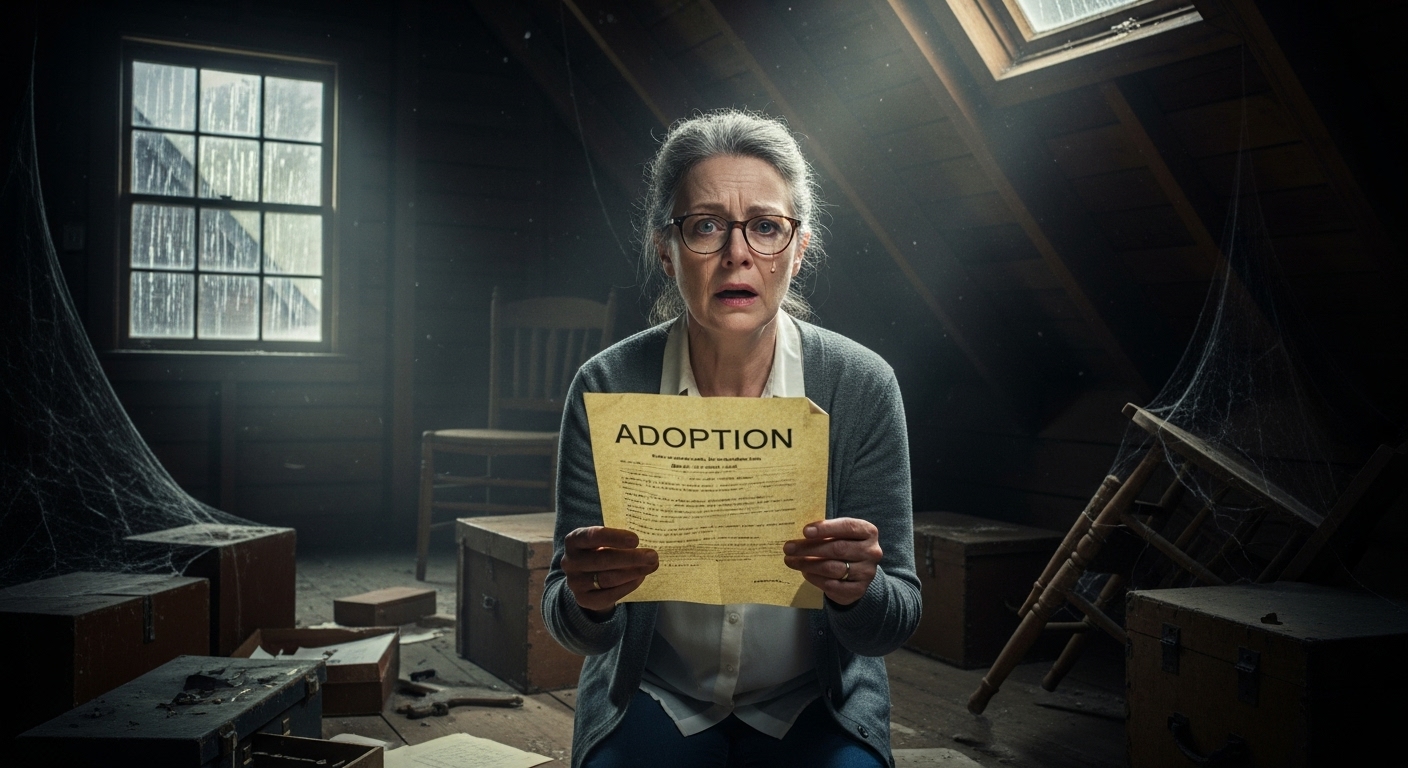
The Aunt Who Stole My Name: I Discovered I Was Adopted at 55, and Then My Biological Mother Returned for the Inheritance
Chapter 1: The Hollow Echo of Rain
The rain in Oregon doesn’t wash things clean; it just presses them down into the mud. That was exactly how Sarah felt standing in the center of the attic—pressed down, heavy, and sodden with a grief that refused to evaporate.
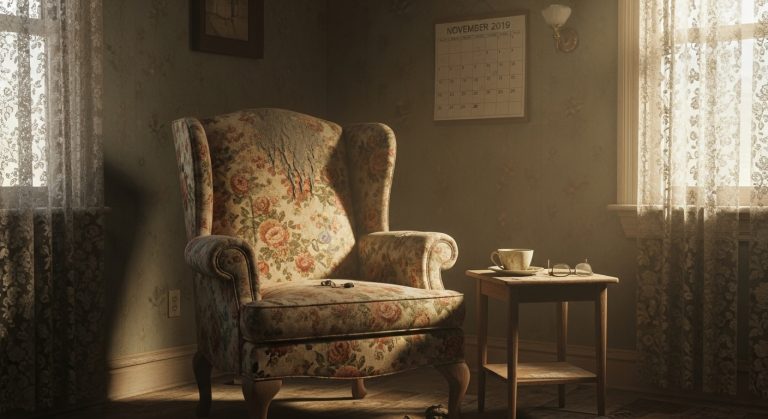
At fifty-five, Sarah’s knees weren’t what they used to be. They popped and protested as she knelt on the rough-hewn floorboards of the Victorian home on Elm Street. This house, with its gingerbread trim and wrap-around porch, had been the envy of the neighborhood for decades. Now, inside, it felt like a tomb.
Eleanor was gone.
It had been three weeks since the funeral, but the smell of Eleanor—a mixture of stale peppermint tea, old paper, and prescription lidocaine patches—still lingered in the air. For the last ten years, Sarah had been the sentinel of this house. She had traded her forties, a potential career in graphic design, and perhaps even a marriage, to care for Eleanor as Alzheimer’s slowly dismantled the woman who had once been a pillar of strength.
“Just boxes, Sarah. Just get through the boxes,” she whispered to herself.
The attic was a museum of a life lived frugally but with love. There were jars of buttons, stacks of National Geographic magazines from the 1980s, and Christmas ornaments wrapped in newspaper that crumbled at the touch.
Sarah pushed aside a heavy wool coat, moth-eaten and smelling of cedar, and saw it.
It was a metal lockbox, painted a dull army green, tucked deep into the eaves where the roof met the floor. It wasn’t the usual tin box where Eleanor kept receipts or savings bonds. This one looked deliberate. Hidden.
Sarah tugged it out, the metal scraping screeching against the wood. It was heavy. She didn’t have the key, but the lock was rusted. With a sigh that puffed into the cold attic air, she grabbed a screwdriver from her back pocket and wedged it under the lid.
Pop.
The lid groaned open.
Inside, there were no bonds. No cash. There was a baby rattle made of silver, tarnished black. A dried yellow rose. And a manila envelope, thick and sealed with wax that had long since cracked.
Sarah’s hands trembled. She wasn’t snooping anymore; she was the executor of the estate. It was her duty to know. She tore the envelope open.
The documents were yellowed, typed on a typewriter that punched the letters deep into the grain of the paper.
Decree of Adoption.State of Oregon, County of Multnomah.Date: October 14, 1969.
Sarah blinked. She wiped her glasses on her flannel shirt and looked again.
Adoptive Parent: Eleanor Grace Miller.Child: Baby Girl Miller.Biological Mother: [Redacted].
The world tilted on its axis. The sound of the rain on the roof roared in her ears, drowning out her own sharp intake of breath. Adopted?
She had been fifty-five years old for exactly two months. For fifty-five years, she had looked in the mirror and thought she saw Eleanor’s chin, Eleanor’s eyes. She had nursed Eleanor through the indignities of incontinence and memory loss, thinking, This is my blood. I am caring for the body that made me.
But she wasn’t.
She flipped the page. Clipped to the back was a letter, handwritten in ink that had faded to a sepia tone.
October 1969.To my sister, Eleanor.Take the brat. I’m done. The check better clear, El. If you tell her, I’ll burn your life down. I’m going to Europe. Don’t write.— Brenda.
Sarah dropped the paper as if it were burning hot.
Aunt Brenda.
The glamorous, flighty Aunt Brenda. The woman who would swoop in once every three years in a cloud of expensive perfume and cigarette smoke, bringing tacky souvenirs from Italy or France, pinching Sarah’s cheek and saying, “My, aren’t you getting stocky like your mother.”
Brenda wasn’t her aunt. Brenda was her mother.
And Eleanor… Eleanor, the woman who worked double shifts at the cannery to put Sarah through college, the woman who sat up with her when she had the flu, the woman who died holding Sarah’s hand… Eleanor had bought her.
Sarah sat back on her heels, surrounded by dust motes dancing in the singular beam of light coming from the window. She felt like a house that had been gutted, leaving only the facade standing.
Her phone buzzed in her pocket, shattering the silence. It was Mr. Henderson, the family lawyer and an old friend of Eleanor’s.
“Sarah?” His voice sounded tight. Strained. “I need you to come to the office. Now. Don’t wait for the rain to stop.”
“I… I just found something, Mr. Henderson,” Sarah stammered, her voice sounding foreign to her own ears.
“I know,” Henderson said, and the gravity in his tone made Sarah’s stomach drop. “She’s here, Sarah. Brenda is here. And she’s contesting the will.”
Chapter 2: The Vulture Descends
The drive to Mr. Henderson’s office was a blur of gray sky and wet asphalt. Sarah gripped the steering wheel of her 2012 Honda Civic until her knuckles turned white. The windshield wipers slapped back and forth, counting down the seconds to a confrontation she wasn’t ready for.
Mr. Henderson’s office was in the old part of town, smelling of mahogany and lemon polish. When Sarah walked in, shook the rain from her umbrella, and looked up, the air left her lungs.
Brenda was sitting in the leather client chair.
At seventy-four, Brenda looked remarkably preserved, a testament to surgical intervention and a life devoid of manual labor. She wore a leopard-print coat that probably cost more than Sarah’s car, and her hair was dyed a fierce, unnatural jet black. She was smoking a slim cigarette, tapping the ash into a potted fern despite the “No Smoking” sign on the wall.
“Hello, darling,” Brenda said. Her voice was scratchy, like velvet dragged over gravel. She didn’t stand up.
Mr. Henderson, a man of seventy with kindly eyes and a nervous tic in his left hand, stood behind his desk. He looked miserable.
“Sarah, please sit,” Henderson said gently.
“What is she doing here?” Sarah asked, remaining standing. She clutched the manila envelope from the attic against her chest like a shield.
Brenda took a long drag of her cigarette. “Is that how you greet your mother?”
The room went silent. The clock on the wall ticked loudly.
“You’re not my mother,” Sarah said, her voice shaking but gaining strength. “Eleanor was my mother.”
“Eleanor was a babysitter with a checkbook,” Brenda scoffed, blowing smoke toward the ceiling. “Look, let’s cut the melodrama. I know you found the papers. Eleanor always was a sentimental fool, keeping that trash.”
“Why are you here, Brenda?” Sarah demanded. “You haven’t visited in six years. You didn’t come to the funeral.”
“I was in Bali. Spiritual retreat. Very healing,” Brenda waved a hand dismissively. “I’m here because of the house.”
The house. The Victorian on Elm Street. Gentrification had swept through the town in the last five years. The neighborhood, once quiet and working-class, was now trendy. The house, fully paid off by Eleanor’s blood and sweat, was appraised at $1.5 million.
“The house belongs to Sarah,” Mr. Henderson interjected firmly. “Eleanor’s will is clear. ‘Everything to my daughter, Sarah Miller.'”
Brenda smiled, a predator showing its teeth. “Ah, but that’s the rub, isn’t it, build? ‘To my daughter.’ Legally, Sarah is my daughter. And I have a very expensive lawyer from Seattle who found a fascinating clerical error in the 1969 adoption filing. It seems the final seal wasn’t… fully processed due to a courthouse fire that year. Technically, the adoption was never finalized by the state.”
Sarah felt the room spin. “That can’t be true.”
“It’s a loophole,” Henderson admitted, looking sick. “A very small, very cruel loophole. If the adoption isn’t recognized, and since Eleanor has no biological children…”
“Then the estate reverts to the next of kin,” Brenda finished, her eyes gleaming. “Her sister. Me.”
“You want to take the house?” Sarah whispered. “You want to take the home where she died? Where I took care of her?”
“I don’t want the house, sweetie. Who wants to live in this dreary rain bucket?” Brenda laughed. “I want to sell it. I’m thinking of a condo in Scottsdale. My knees hate the damp.”
“You gave me away,” Sarah said, tears finally spilling over. “You sold me to her. I saw the note. You traded me for a check.”
Brenda’s expression didn’t soften. It hardened. She stood up, smoothing her coat. “I was twenty-two! I had a life to live! Eleanor manipulated me. She preyed on a vulnerable young girl. I am the victim here, Sarah. I have carried the trauma of losing a child for fifty years.”
“Trauma?” Sarah laughed, a broken, hysterical sound. “You were ‘backpacking in Europe’!”
“Everyone grieves differently,” Brenda said coldly. “I want what is owed to me. Reparations for my suffering. The house is mine, Sarah. You have week to vacate, or my lawyer files the eviction.”
Chapter 3: The Price of Blood
The next few days were a nightmare of legal jargon and public humiliation.
In a small town, secrets don’t stay secret; they fester. Brenda didn’t just sue for the house; she launched a PR campaign. She was seen crying in the local coffee shop, telling anyone who would listen how her “controlling” older sister had “stolen” her baby when she was young and confused.
People Sarah had known her whole life began to look at her differently at the grocery store. “Is it true?” Mrs. Gable from the bakery asked, leaning over the counter. “Did Eleanor really take you without permission?”
“She adopted me,” Sarah said, her voice tight. “She loved me.”
“Well, blood is blood,” Mrs. Gable muttered, handing over the sourdough.
Sarah felt like a ghost in her own life. She walked through the Victorian house, touching the walls. Every scratch in the floorboards had a story. The height chart penciled on the kitchen doorframe. The stain on the rug where she’d spilled grape juice at age seven and Eleanor had just laughed and said, “It adds character, bug.”
Brenda wanted to turn all of this into a condo in Scottsdale.
Mr. Henderson was working around the clock, but the news was grim. “The judge is a stickler for paperwork, Sarah. The missing seal from 1969… it’s bad. If Brenda can prove the adoption was invalid, the law of intestacy takes over. Since Eleanor’s will says ‘my daughter,’ and legally you might not be… Brenda could argue the will is void based on a false premise.”
“So I lose everything?” Sarah asked, sitting in her kitchen, the darkness of the evening pressing against the windows. “Fifty-five years of being her daughter, and it means nothing?”
“We need proof,” Henderson said. “Proof that Brenda abandoned you. Proof that she knew exactly what she was doing and that the adoption was intended to be permanent, regardless of the clerical error. We need intent.”
Sarah hung up the phone. She looked at the metal box on the table. She had been too afraid to look deeper. The note from Brenda had been enough to break her heart. But now, she needed ammunition.
She reached into the box again. Underneath the adoption decree, there was a leather-bound book. Eleanor’s diary.
Chapter 4: Whispers from the Grave
Sarah opened the diary. The pages were brittle, the handwriting neat and looped.
November 2, 1969Brenda left today. She didn’t even say goodbye to the baby. She just honked the horn of that red convertible and sped off. I looked down at this tiny bundle in my arms—Sarah. I named her Sarah. It means ‘Princess.’ Because she is royalty to me. Brenda calls her ‘the burden.’ I call her ‘the gift.’ Lord, give me the strength to be enough for her.
Sarah wept. She turned the pages, devouring the years.
July 14, 1974Sarah has the measles. Her fever is 103. I haven’t slept in two days. Brenda called from New York. She wanted to know if I could send her $500 for a modeling portfolio. I told her Sarah was sick. She said, ‘Kids get sick, El. Don’t be a bore.’ I hung up on her. I will sell my wedding ring if I have to, to pay for Sarah’s medicine, but I will not send Brenda another dime.
August 20, 1980Sarah fell off her bike. Five stitches. She cried and called for ‘Mommy.’ She called for ME. My heart soared and broke at the same time. Does she know? Will she ever know that I didn’t birth her? I hope not. Biology makes a human, but love makes a mother. I am her mother. I am.
Then, Sarah found the entry that stopped her breath. It was dated from when Sarah was ten years old, the year she had severe pneumonia and was hospitalized for two weeks.
December 12, 1979The doctors say it’s touch and go. The pneumonia is deep in her lungs. I sat by her bed all night. I held her hand. It’s so small. I made a bargain with God tonight. I told Him: Take my years. Take my mind. Take my memories when I am old. I don’t care. Just let her live. Let her grow up. Give her my life force.
Sarah sobbed, her forehead resting on the cool kitchen table. Eleanor had bargained her mind away. The Alzheimer’s… the cruel disease that had stolen Eleanor bit by bit… Eleanor had offered that sacrifice thirty years prior, just to keep Sarah alive.
And Brenda? Where was Brenda in 1979?
Sarah flipped through the dates.
December 15, 1979Brenda is in town. She’s staying at the Holiday Inn. I asked her to visit the hospital. Sarah might… she might not make it. Brenda said, ‘I can’t do hospitals, El. They smell like death. Besides, I have a date with a pilot tonight.’ I hate her. God forgive me, I hate my own sister.
Sarah closed the book. The sadness was gone. It was replaced by a cold, hard fury. This wasn’t just about a house anymore. This was about honor. Brenda had abandoned her to die, and Eleanor had traded her soul to save her.
She dug to the very bottom of the box. There was one last item. A small, rectangular object wrapped in foil.
A VHS cassette tape. On the label, written in Eleanor’s shaky hand: For Sarah. In case she comes back.
Chapter 5: The Smoking Gun
Sarah didn’t own a VCR. Nobody did. She drove to the local library the next morning. They had an old AV room in the basement with legacy equipment.
She inserted the tape. The machine whirred and clicked. Static filled the screen, followed by a burst of blue. Then, a grainy, flickering image appeared.
The timestamp said: October 12, 1990. Sarah did the math. She would have been twenty-one. Brenda had visited that year. Sarah remembered it because Brenda had made a scene at her college graduation party.
The camera was set up on a tripod, likely hidden on a bookshelf. The angle was slightly high. It showed the living room of the Victorian house.
Brenda was there, pacing. She looked younger, but the cruelty was the same. She was holding a glass of wine. Eleanor was sitting on the sofa, looking tired.
Audio crackled.
Brenda: “I need ten thousand, El. That investment in the vineyard is a sure thing.”
Eleanor: “I don’t have it, Brenda. That money is for Sarah’s tuition.”
Brenda: “Sarah, Sarah, Sarah! God, you act like she’s the Messiah. She’s just a mistake I made in the backseat of a Chevy!”
Sarah, watching in the library, clamped a hand over her mouth.
Eleanor: “Stop it. She is my daughter.”
Brenda: “She’s my daughter! I leased her to you! And you know what? The paperwork is sloppy, El. I checked. If I wanted to, I could blow this whole charade up. I could tell her. I could take her back just to spite you.”
Eleanor (standing up, voice shaking): “You signed the papers. You took the money.”
Brenda: “I signed a piece of paper. But I know the judge didn’t stamp it right. I remember. I could sue you for kidnapping.”
Eleanor: “What do you want, Brenda? To leave us alone forever? What do you want?”
Brenda (smiling into her wine glass): “I want you to fix it. If you ever die, I don’t want that brat getting my family inheritance. This house… it’s Miller property. It should be mine.”
Eleanor: “I will never cut her out.”
Brenda: “Then I’ll wait. I’ll wait until you’re dead, and then I’ll take it all. Because I can. Because I’m the ‘grieving mother’ and the law loves a mother.”
Eleanor: “Get out. And don’t come back until I call for you.”
Brenda: “Fine. Good luck with the tuition. I hope she flunks out.”
The tape cut to static.
Sarah sat in the darkness of the AV room. Her hands were no longer shaking. She ejected the tape. “I’ll wait until you’re dead,” Brenda had said. It was premeditated. It was malice. And it was admissible.
Chapter 6: A Mother’s Legacy
The mediation room at the courthouse was sterile and gray. Brenda sat on one side of the long table, looking bored. She was checking her nails. Her high-priced lawyer from Seattle, a man in a shark-skin suit, looked at his watch.
“Ms. Miller,” the lawyer said to Sarah. “My client is prepared to offer you a settlement. She will allow you to keep the furniture and personal items. She only wants the real estate assets. This is generous, considering the invalidity of your adoption.”
Mr. Henderson looked at Sarah. He looked defeated. “Sarah…”
“No,” Sarah said. Her voice was quiet, calm.
Brenda laughed. “Don’t be stupid, darling. You have no standing. You’re a genetic stray.”
Sarah reached into her bag. She pulled out a laptop she had borrowed from the library, with the digitized video file queued up.
“Eleanor anticipated this,” Sarah said. “She knew you were a vulture, Brenda. She knew you were waiting for her to die.”
“I don’t know what you’re talking about,” Brenda snapped, though her eyes flickered with unease.
“We have a video,” Mr. Henderson said, catching on. “Evidence of malicious intent and acknowledgment of the adoption contract, regardless of clerical errors.”
Sarah pressed play.
The sound of Brenda’s voice filled the room.“She’s just a mistake I made…”“I’ll wait until you’re dead, and then I’ll take it all…”
Brenda’s face went pale. The rouge on her cheeks stood out like clown paint. The Seattle lawyer stiffened. He watched the video, then closed his file folder.
“This changes things,” the lawyer muttered. “This proves you knowingly waived your rights and are now acting in bad faith to defraud the estate.”
“Turn it off!” Brenda hissed. “That was private! That was illegal recording!”
“Oregon is a one-party consent state for recording if you are a party to the conversation,” Mr. Henderson said, a smile finally breaking across his face. “But this… this establishes that you acknowledged the ‘lease’ of the child. You accepted payment. And you threatened extortion. If we go to court with this, Brenda, not only will you lose, but I will petition for you to pay Sarah’s legal fees and potentially face fraud charges.”
Brenda stood up, trembling with rage. She looked at Sarah—really looked at her—for the first time. She didn’t see a victim. She saw Eleanor’s strength.
“You have her eyes,” Brenda spat. “Judgy, self-righteous eyes.”
“I have my mother’s eyes,” Sarah said evenly. “And I have her house. You have nothing.”
Brenda grabbed her purse. “I’m leaving. This town smells like wet dog anyway.”
She stormed out. The door slammed, leaving a ringing silence.
Mr. Henderson exhaled a long breath. “Well. I think that settles that.”
Chapter 7: Roots and Ash
The rain had finally stopped. A weak, watery sun was trying to break through the clouds over the cemetery.
Sarah stood before Eleanor’s headstone. It was simple granite.Eleanor Grace Miller. Beloved Mother.
Sarah knelt down. The grass was wet against her jeans. She placed the metal box on the ground. She took out the adoption papers—the ones that had caused so much terror.
She struck a match.
The flame caught the edge of the paper. It curled, turning black, then gray. Sarah watched the name [Redacted] disappear into ash. She watched the clerical errors burn. She watched Brenda’s signature vanish.
“You were right, Mom,” Sarah whispered to the stone. “You didn’t need the papers. You never did.”
She thought about the diary entry. The bargain Eleanor had made with God. Take my mind, just let her live.
Eleanor had lost her mind in the end. She had forgotten how to use a fork, forgotten Sarah’s name, forgotten the house. But she had kept her promise. She had given Sarah life, twice. Once by taking her in, and once by protecting her future from beyond the grave.
Sarah took a handful of the ashes and scattered them over the soil of the grave.
“I’m safe,” Sarah said, her voice choking up. “The house is safe. I’m not going anywhere.”
She stood up, wiping her hands on her jeans. She felt lighter. The heavy, crushing weight of being an “orphan” was gone. She wasn’t an orphan. She was the daughter of Eleanor Miller.
As she walked back to her car, her phone buzzed. It was a text from the real estate agent who had been pestering her.Are you still thinking of selling? The market is hot.
Sarah typed back: Not for sale. Not now. Not ever.
She drove home to the Victorian house. She walked up the steps, sat on the porch swing, and looked out at the neighborhood. The gentrification was creeping in, modern condos rising in the distance, but this house stood firm.
Sarah closed her eyes and listened. She could almost hear Eleanor’s voice in the wind chimes.“You are my heart walking outside my body.”
“Happy Birthday, Mom,” Sarah whispered.
And for the first time since the funeral, she smiled.