THE SYMPHONY OF SCARS: THE DAY THE MUSIC STOPPED
Chapter 1: The Girl in the Velvet Turtleneck
The heat in Oakhaven, Virginia, in mid-July was not merely a weather condition; it was a physical weight. It sat on your chest, heavy and wet, smelling of asphalt and dying honeysuckle. It was the kind of heat that made the air shimmer above the hood of Hattie Higgins’s 1998 Buick Century as she pulled into the faculty parking lot of Oakhaven High School.
Hattie was sixty-four years old, three months away from a retirement she wasn’t sure she wanted. She had spent forty years in this school, first as a history teacher, then as a guidance counselor. She knew every squeaky floorboard, every hidden corner where students snuck cigarettes, and every look a child gave when they were hiding something. She was a woman of sturdy shoes and sensible haircuts, with eyes that missed nothing and a heart that—despite four decades of teenage angst—remained stubbornly soft.
Summer school was in session, a quiet, lethargic affair mostly populated by kids making up algebra credits. But the auditorium was occupied.
Clara Thorne.
Hattie paused in the hallway, clutching a box of files she was meant to be archiving. Through the double doors, the sound of a violin wept. It wasn’t just playing; it was crying. The notes were perfect—technically flawless—but they carried a sorrow so profound it made Hattie’s skin prickle despite the humidity.
Clara was fifteen, a prodigy, the town’s “Golden Girl.” She was also a ghost.
Hattie pushed the door open just a crack. The auditorium was stifling. The air conditioning had been on the fritz since May, and the room felt like a sauna. Yet, there on the center stage, stood Clara.
Most teenagers in this weather were wearing as little as the dress code allowed—shorts, tank tops, flip-flops. Clara Thorne was wearing a thick, black velvet turtleneck, a long wool cardigan that reached her knees, and opaque tights.
She looked like a Victorian mourner lost in a heatwave.
“Again,” a voice boomed from the front row.
Hattie narrowed her eyes. Dr. Andrew Thorne sat there. The town’s hero. The pediatric surgeon who had just made national news for separating conjoined twins. He was handsome in a Kennedy-esque way, always impeccably dressed in a linen suit, even in this swelter. He was a widower, a saint who raised a genius daughter alone. Or so the ladies at the hair salon said.
Clara didn’t argue. She lifted the bow. Her face was alabaster white, shining with a sheen of sweat that looked cold. She swayed slightly.
“Posture, Clara. You’re slouching,” Andrew barked, his voice smooth but edged with steel. “Greatness does not slouch.”
Hattie watched, a knot forming in her stomach. She had seen “stage parents” before. But this was different. There was no love in Andrew’s eyes, only possession. And in Clara’s eyes, there was no spark. Just a terrified, hollow void.
As Clara drew the bow for a crescendo, her knees buckled. It happened in slow motion. The violin dropped from her chin, but she caught it—instinctively protecting the instrument over her own body—before she collapsed sideways onto the hardwood stage.
“Clara!” Hattie shouted, dropping her box of files.
She ran down the aisle, moving faster than her arthritis usually allowed. Dr. Thorne was standing up, looking annoyed rather than panicked.
“She’s fine,” Andrew said dismissively as Hattie scrambled onto the stage. “She’s just dramatic. Get up, Clara.”
Hattie ignored him. She knelt beside the girl. Clara was unconscious, her breathing shallow and rapid. Her skin was burning hot to the touch.
“She’s burning up, Andrew! Look at her!” Hattie snapped, her maternal instincts overriding social hierarchy. “We need to get these layers off her. She’s having a heatstroke.”
Hattie reached for the buttons of the thick wool cardigan.
“Don’t touch her!” Andrew lunged forward, grabbing Hattie’s wrist. His grip was shockingly strong, painful. “I am a doctor. I will handle my daughter.”
Hattie yanked her arm back, her eyes flashing. “And I am a mandated reporter in a school building, Dr. Thorne. Back off.”
With a defiance that surprised even herself, Hattie unbuttoned the cardigan and pulled it open. Then, she reached for the collar of the velvet turtleneck. It was soaked with sweat. She needed to loosen it to check her pulse and let the girl breathe.
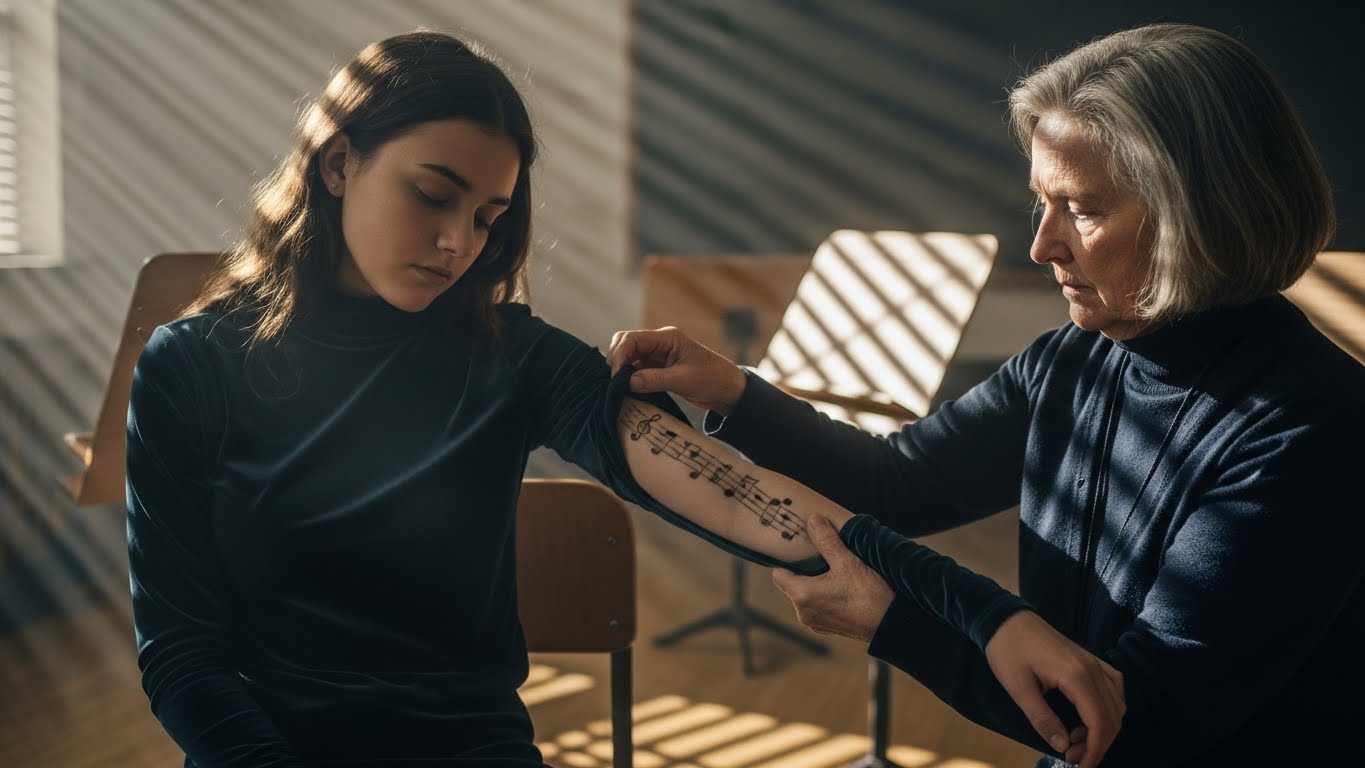
She rolled up the heavy left sleeve of the turtleneck.
The silence that followed was louder than the violin had been.
It wasn’t just bruises. Hattie had seen bruises before. This was… architecture.
Running up the inside of Clara’s pale forearm, arranged with surgical precision, were burns. Circular, weeping, angry red burns. They weren’t random. They were spaced perfectly, stepping up the arm like notes on a sheet of music.
A musical scale of cigarette burns.
Hattie gasped, her hand flying to her mouth. She looked at the burns, then at Dr. Thorne.
For a split second, the mask slipped. The charming, benevolent doctor vanished. In his place was a monster with eyes like a shark—cold, dead, and predatory.
“She’s clumsy,” Andrew said, his voice dropping to a terrifying whisper.
Clara groaned, her eyelids fluttering open. When she saw her exposed arm, sheer panic seized her. She scrambled backward, crab-walking away from Hattie, pulling the sleeve down so hard the fabric tore.
“I fell!” Clara shrieked, her voice cracking. “I fell! I’m sorry, Daddy! I’m sorry! I’ll do it better!”
Hattie looked at the girl—terrified not of the injury, but of the discovery. Then she looked at the father, who was calmly buttoning his suit jacket.
“You did this,” Hattie whispered, the realization settling in her bones like lead. “You… you butcher.”
Chapter 2: The Fortress of Lies
The police station smelled of stale coffee and floor wax. Hattie sat on a hard wooden bench, her back straight, her hands trembling slightly in her lap. She had been waiting for two hours.
When Chief Miller finally called her back, he didn’t look concerned. He looked tired.
“Hattie,” he sighed, sitting heavily behind his desk. “We’ve been through this. Dr. Thorne explained everything.”
“Explained?” Hattie’s voice rose an octave. “Explained a scale of burns on a child’s arm? Did he say she tripped and fell onto a pack of lit cigarettes arranged in B-flat major?”
“Now, calm down,” Miller warned, pointing a pen at her. “The Doctor brought Clara in. We spoke to her. Separately.”
“And?”
“And she confirmed his story. She’s… she’s sick, Hattie.” Miller lowered his voice, looking uncomfortable. “She cuts herself. Burns herself. Dr. Thorne showed us the psychiatric files. She’s been diagnosing with severe delusional disorder since her mother died. She does it for attention.”
“That is a lie,” Hattie said, slamming her hand on the desk. “I saw her eyes, Jim. That girl is terrified of him. She didn’t burn herself! Those marks were on the inside of her forearm. Do you know how hard it is to burn yourself there with that precision? It’s torture!”
“Dr. Thorne is a hero in this town!” Miller snapped, losing his patience. “He just saved the Miller twins. He donates to the orphanage. He is a grieving widower doing his best with a mentally unstable child. And frankly, Hattie, you’re embarrassing yourself. You’re close to retirement. Maybe the heat got to you, too.”
Hattie felt the blood drain from her face. It wasn’t just a rejection; it was an erasure. Because she was an old woman, a spinster school counselor, her testimony meant nothing against the word of a wealthy, handsome surgeon.
“You’re making a mistake,” Hattie said, standing up. “A fatal mistake.”
“The Principal wants to see you,” Miller said, looking back at his paperwork. “And Hattie? Stay away from the Thorne family. He’s threatening a lawsuit for harassment.”
The meeting with the Principal was worse. He didn’t yell. He pleaded. He talked about the school’s funding, about Dr. Thorne’s position on the school board.
“He’s pulling her out, Hattie,” the Principal said, looking at his shoes. “He’s filing for homeschooling. Effective immediately. He says the school environment is ‘too stressful’ for her condition.”
Hattie felt like she had been punched in the gut. Homeschooling. It was the ultimate weapon of the abuser. Isolation. No teachers to see the bruises. No counselors to ask questions. Just Clara and the monster, alone in that big house on the hill.
“You’re handing her a death sentence,” Hattie said quietly.
“I’m accepting his resignation letter for her,” the Principal corrected. “And I need you to sign this apology letter to Dr. Thorne. Or… well, the board might reconsider your pension package.”
Hattie looked at the letter. It was a groveling admission of “misunderstanding” and “overstepping boundaries.”
She thought about her pension. She thought about the small cottage she planned to buy in the Carolinas. She thought about the quiet life she had earned.
Then she thought about the musical scale burned into a fifteen-year-old’s skin.
Hattie took the pen. The Principal sighed in relief.
Hattie drew a thick, black line through the text, wrote “GO TO HELL” in block letters at the bottom, and walked out of the office.
She was retired now. And she had work to do.
Chapter 3: The Invisible Army
Retirement, Hattie discovered, gave one a dangerous amount of free time.
The Thorne house was a fortress. High hedges, iron gates, and a security system that probably cost more than Hattie’s car. But no fortress is impenetrable if you have the right army.
And Hattie Higgins had the most powerful, underestimated army in America: The Old Ladies of Oakhaven.
It started at the hair salon. Hattie sat under the dryer next to Mrs. Gable, the town’s gossip matriarch and the former postmistress.
“I heard about the fuss,” Mrs. Gable shouted over the roar of the dryer. “Thorne says you went senile.”
“He burns her, Martha,” Hattie said flatly. “Cigarette burns. On her arm.”
The dryer noise seemed to fade. Mrs. Gable looked at Hattie. She looked at the conviction in Hattie’s eyes.
“His wife didn’t die of a heart attack,” Mrs. Gable whispered, leaning in. “I knew the EMT who responded. He said she had a broken jaw. Said she fell down the stairs. But he told me, ‘Martha, people don’t break their jaws falling on carpet.'”
“Where is the housekeeper?” Hattie asked. “The one they fired last year?”
“Nursing home. The Shady Oaks. Room 302. Maria.”
Hattie went to Shady Oaks that afternoon. Maria was frail, her memory fading, but when Hattie mentioned Andrew Thorne, the woman began to weep.
“The music,” Maria sobbed in Spanish, clutching her rosary. “He makes her play until her fingers bleed. If she misses a note… the basement. He takes her to the basement. No sound comes out of the basement.”
Hattie recorded it on her phone. It wasn’t enough for the police—hearsay from a dementia patient—but it was fuel for the fire.
For the next three weeks, the “Invisible Army” mobilized.
Mrs. Gable, who lived two houses down from the Thornes, began “birdwatching” from her attic window at 2 AM. She logged the lights. Basement light on: 11 PM to 4 AM. Every night.
Mrs. Higgins (no relation), the librarian, pulled the public records. She found that Dr. Thorne had bought soundproofing foam—industrial grade—six months ago.
And Hattie? Hattie parked her car down the street every night. She rolled down the window and listened.
It was August now. The heat hadn’t broken. The air was heavy and still.
At 3:00 AM on a Tuesday, Hattie heard it. It wasn’t the violin.
It was a scream. But it was cut short. Stifled. Like a hand clamped over a mouth.
Hattie gripped the steering wheel until her knuckles turned white. She called the police. They came, knocked on the door, spoke to Andrew for two minutes, and left. They told Hattie if she called again, she’d be arrested for stalking.
“He’s winning,” Hattie whispered to the dashboard. “He’s going to kill her, and everyone will say it was a tragedy.”
Then she saw the flyer on the telephone pole.
THE OAKHAVEN CHARITY GALA. Honoring Father of the Year: Dr. Andrew Thorne. Special Performance by Miss Clara Thorne.
It was in two days. It was a public event. The whole town would be there.
“If the law won’t watch,” Hattie said, starting her engine, “then the world will have to.”
Chapter 4: The Crescendo
The Oakhaven Community Center was transformed. Crystal chandeliers (rented) hung from the ceiling. The town’s elite sipped champagne, fanning themselves in their evening wear.
Dr. Andrew Thorne was the center of the universe. He moved through the crowd like a shark in a tank of guppies—smiling, shaking hands, accepting praise. He looked golden.
Hattie walked in. She wasn’t on the guest list. She had bought a ticket from a scalper (one of her former students who owed her a favor). She was wearing her Sunday best—a navy blue dress that made her look exactly like what she was: a retired school teacher.
She saw the “Army.” Mrs. Gable gave her a subtle nod from the buffet table. The librarian was near the stage exit. They were ready.
The lights dimmed. The Mayor took the stage.
“And now,” the Mayor boomed, “to play us into the night, please welcome the daughter of our honoree. A true prodigy. Miss Clara Thorne!”
The curtain rose.
Clara stood center stage. She looked like a corpse bride. Her dress was floor-length, high-necked, with long lace sleeves. She looked thinner than Hattie remembered. Her eyes were glazed, staring at nothing.
Andrew Thorne sat in the front row, center seat. He crossed his legs, a look of smug satisfaction on his face. He owned her. He owned this town.
Clara raised the violin. The room went silent.
“Play the scale, Clara!”
The voice wasn’t loud, but it cut through the silence like a whip.
Hattie stood up in the middle of the third row.
Heads turned. Gasps rippled. Andrew Thorne stiffened, not turning around, his neck muscles bunching.
“Sit down, Hattie!” someone hissed.
“Play the scale on your arm, child!” Hattie said, her voice trembling but gaining strength. She walked toward the aisle. “Don’t play Bach. Play the truth.”
“Security!” Andrew stood up, his face flushing red. “Remove this woman! She is mentally unstable!”
Two security guards started toward Hattie.
“No!” Mrs. Gable stepped in front of one guard, “accidentally” spilling a tray of drinks. The librarian blocked the other aisle. The Invisible Army was holding the line.
Hattie looked directly at Clara. The girl was trembling, the bow shaking in her hand.
“Look at me, Clara,” Hattie said, ignoring the chaos around her. “You don’t have to protect him anymore. He can’t hurt you if everyone sees. I am here. We are all here. Show them.”
Clara looked at her father. He was making a slicing motion across his throat—a threat. Stop. Or else.
Then she looked at Hattie. Hattie, who had lost her job for her. Hattie, who had sat outside her house in the dark.
Clara lowered the violin.
“Clara, play the music!” Andrew roared, losing his composure. “Now!”
Clara shook her head. A single tear cut through the makeup on her cheek.
Slowly, deliberately, Clara reached behind her neck. She found the zipper of her dress.
“What is she doing?” someone whispered.
Clara unzipped the dress. She let the top slide down. It pooled around her waist, revealing the white camisole she wore underneath.
And her arms.
The gasp that sucked the air out of the room was horrifying.
Under the harsh stage lights, the truth was illuminated. The musical scale of cigarette burns was there, angry and scabbing. But there was more.
There were lacerations. Surgical cuts. Thin, precise lines made with a scalpel, crisscrossing her shoulders. There were old scars, silver and jagged. Her body was a map of torture.
Dr. Andrew Thorne stood frozen. The smile was gone. The mask was gone.
“He… he did it,” Clara whispered into the microphone, her voice small but amplified to every corner of the room. “He makes me be perfect.”
For a second, there was total silence.
Then, the room erupted. It wasn’t applause. It was a primal roar of outrage.
Andrew Thorne realized the tide had turned. He turned to run.
He didn’t make it three steps.
The Principal—the coward who had fired Hattie—stepped into the aisle and blocked him. Then the Mayor. Then the fathers of the town. They didn’t touch him; they just formed a wall. A wall of judgment.
Police Chief Miller walked down the aisle. He looked at Clara’s arms, then at Hattie. He took off his hat. He looked sick with shame.
He walked up to the “Saint of Oakhaven,” took out his handcuffs, and spun the doctor around.
“Dr. Thorne,” Miller said, his voice shaking. “You are under arrest.”
Hattie didn’t watch the arrest. She climbed onto the stage. Clara dropped the violin—it smashed onto the floor, snapping the neck—and collapsed into Hattie’s arms.
“I got you,” Hattie sobbed into the girl’s hair. “I got you, baby girl. The concert is over.”
Chapter 5: The Lemonade
The trial was swift. The evidence—Clara’s testimony, the housekeeper’s deposition, the medical records found in Thorne’s safe—was overwhelming. The “Saint” was sentenced to twenty-five years without parole.
But the real battle was for Clara.
She had no family. The system wanted to put her in a group home two counties over.
Hattie Higgins stood before the Family Court judge. She was sixty-five now. She had no husband, no large income, and a small house.
“I am not her blood,” Hattie told the judge. “But I saw her when she was invisible. And I promise you, Your Honor, if you give her to me, she will never be invisible again.”
The judge, a woman who had been at the Gala that night, wiped her eyes and banged the gavel. “Petition granted.”
One Year Later
The Virginia heat was back, but on Hattie’s porch, the ceiling fan hummed a lazy, comforting tune.
Hattie sat in her rocking chair, shelling peas. She looked older, tired, but happy.
The screen door creaked open.
Clara stepped out. She looked different. The ghostly pallor was gone, replaced by a dusting of freckles. She had gained weight. Her hair was cut short, a messy, stylish bob.
She was wearing a yellow sundress. Sleeveless.
The scars were there. The cigarette burns were faded pink circles. The scalpel lines were silver threads. She didn’t cover them. They were part of her history, not her shame.
“Lemonade,” Clara said, handing Hattie a glass.
“Thank you, sweetie.”
Clara sat on the railing. She didn’t play the violin anymore. She was learning to paint. She painted messy, chaotic, colorful abstracts.
“Are you happy, Hattie?” Clara asked suddenly.
Hattie looked at the girl who had once been a ghost. She looked at the scars that were healing in the sun.
“I am,” Hattie said. “I truly am.”
Clara smiled. It wasn’t the polite smile of a performer. It was wide. It showed her gums. It was real.
“Me too,” Clara said.
And in the quiet of the afternoon, that simple admission was the most beautiful music Hattie had ever heard.