The Backpack Filled with Nothing but Life: A Principal’s Lesson on the Coldest Day
Chapter 1: The Fortress of Rules
The thermometer outside Arthur Miller’s office window read twelve degrees below zero, but the wind chill factor—that cruel, invisible thief—pushed it down to minus thirty. It was the kind of cold that didn’t just freeze water; it seemed to freeze time, hope, and patience.
Arthur stood by the window of his office at Oak Creek Elementary, sipping coffee that had gone lukewarm ten minutes ago. He was fifty-five years old, and he liked to think he ran his school the way a captain ran a ship: tight, orderly, and by the book. He adjusted his tie, watching the yellow buses idle in the parking lot, their exhaust plumes rising like white ghosts into the gray morning sky.
Arthur was a man who believed in rules. Rules were the bedrock of civilization. Without them, you had chaos. Without them, you had children running wild, grades slipping, and the moral fabric of society unraveling. He had been the principal here for fifteen years, and in that time, he had seen it all. Or at least, he thought he had.
“Mr. Miller?”
The voice came from the doorway. It was Jenna Reynolds, the new second-grade teacher. She was young, idealistic, and, in Arthur’s opinion, a little too soft. She wore her heart on her sleeve, a dangerous fashion choice in the public school system.
Arthur turned, setting his mug down on a coaster. “Yes, Miss Reynolds? Is there a problem?”
Jenna looked flustered, wringing her hands together. “It’s Timmy. The new transfer student. Timothy Larson.”
Arthur sighed internally. Timmy Larson had been at the school for three days. He was a ghost of a child—small, pale, with dark circles under his eyes that looked like bruises. His file was thin, the address listed was a P.O. Box, and his previous records were spotty at best.
“What has he done now?” Arthur asked, moving behind his mahogany desk. “Is he fighting again?”
“No, sir. He’s not fighting. He’s just… he won’t take off his backpack.”
Arthur blinked. “Excuse me?”
“His backpack,” Jenna repeated, her voice rising in frustration. “He wears it constantly. He wears it during the lesson. He wears it at lunch. He wore it to the bathroom. The other kids are complaining because he bumps into them in the circle time rug. It’s a distraction. I asked him to put it in his cubby, and he just… he refused.”
Arthur frowned. “He refused a direct instruction?”
“He didn’t just refuse, Mr. Miller. He panicked. He grabbed the straps like his life depended on it. I tried to gently take it from him to hang it up, and he screamed. Not a tantrum scream. A terror scream.”
Arthur tightened his jaw. This was exactly the kind of insubordination that nipped at the heels of his orderly ship. A backpack in the classroom was a safety hazard. It was a violation of the dress code. But more importantly, it was suspicious.
“Why would a six-year-old be so attached to a bag?” Arthur mused, his mind immediately going to the worst-case scenarios he’d seen on the news. “Is he hiding something? Toys? A video game console? Stolen items from other students?”
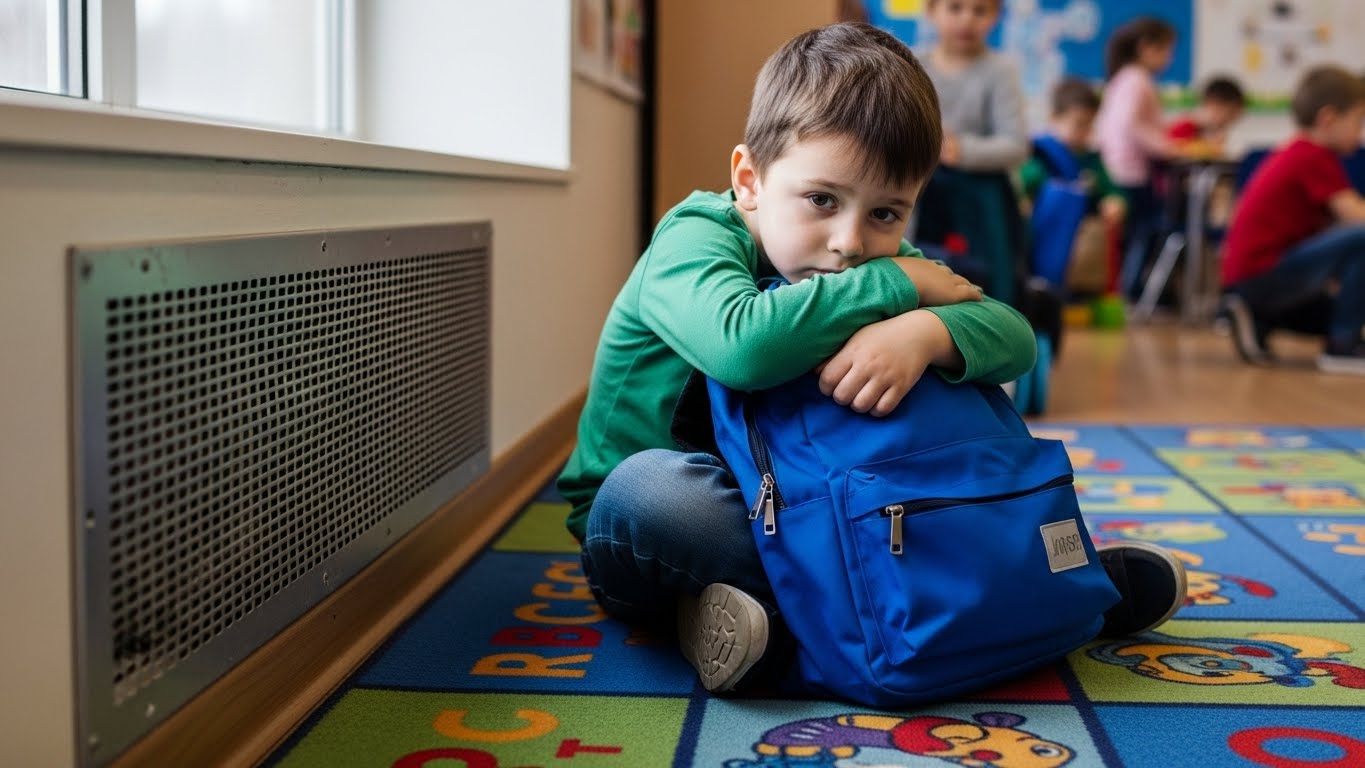
“I don’t know,” Jenna said softly. “But he’s sitting by the heating vent again. He just sits there, huddled up against the grate, clutching that bag.”
“Bring him here,” Arthur commanded, buttoning his suit jacket. “We don’t tolerate defiance, Miss Reynolds. And we certainly don’t tolerate contraband. If he’s hiding something, we need to know.”
Jenna hesitated. “Arthur… be gentle. He looks… fragile.”
“I am always fair, Miss Reynolds,” Arthur said stiffly. “But I am also firm.”
Ten minutes later, the door opened. Jenna ushered Timmy into the room.
The boy looked even smaller in the large office. He was wearing a mishmash of clothing—a faded superhero t-shirt over a flannel button-down, sweatpants that were too short, and sneakers that looked like they had been salvaged from a dumpster. And there, on his back, was the backpack.
It was a cheap, blue nylon thing, frayed at the edges. It looked bulky, swollen, as if it were stuffed to the brim.
Timmy stood in the center of the Persian rug, his eyes wide and darting around the room like a trapped animal. He was shivering, though the office was a toasty seventy-two degrees.
“Hello, Timothy,” Arthur said, using his “Principal Voice”—deep, authoritative, calm.
Timmy didn’t answer. He just gripped the straps of the blue bag tighter, his knuckles white against his chapped skin.
“Miss Reynolds tells me you’re having trouble following the rules today,” Arthur said, walking around the desk to lean against the front of it. He crossed his arms. “In this school, backpacks belong in cubbies. They are not clothing. They are not blankets. They are for transport only.”
Timmy looked down at his sneakers. “I can’t take it off,” he whispered. His voice was raspy, like he hadn’t spoken in days.
“And why is that?” Arthur pressed.
“I just can’t.”
“Is there something in there you shouldn’t have?” Arthur asked, stepping closer. He saw the boy flinch. “Video games? Candy? Did you take something from the teacher’s desk?”
“No!” Timmy’s head snapped up, tears welling in his eyes. “I didn’t steal! I promise!”
“Then take it off,” Arthur said, extending a hand. “Show me. If it’s just books, you have nothing to worry about.”
Timmy took a step back, shaking his head violently. “Please, Mr. Miller. Please don’t make me open it. You’ll ruin it.”
“Ruin what?” Arthur’s patience was thinning. He was a busy man. He had budgets to balance and board members to appease. He didn’t have time for a six-year-old’s stubborn games. “Timothy, take off the bag. Now. That is not a request.”
The air in the room grew heavy. Miss Jenna stepped forward. “Timmy, honey, just let him look. It’ll be okay.”
“No!” Timmy shrieked, backing into the bookshelf. “You don’t understand! It took me all morning!”
Arthur had had enough. In his mind, this was clearly a behavioral issue, a child testing boundaries. If he gave in now, the boy would learn that crying got him what he wanted. Arthur moved quickly, closing the distance.
“That’s enough,” Arthur said sternly. He reached out and grabbed the top handle of the backpack.
Timmy fought back with surprising strength, sobbing openly now. “No! No! Please!”
But Arthur was a grown man. With a firm tug, he pulled the backpack off the boy’s shoulders. Timmy collapsed to the floor, curling into a ball, weeping as if Arthur had just ripped away his arm.
Arthur held the bag. It felt… strange.
It was light. incredibly light.
If it was full of toys, it would rattle. If it was full of clothes, it would be lumpy. But this felt taut, bloated, yet weightless.
“Let’s see what is so important,” Arthur muttered.
He placed the bag on his desk. He reached for the zipper.
“Don’t!” Timmy screamed from the floor, reaching out a desperate hand. “You’ll let it all out!”
Arthur ignored him. He zipped the bag open.
Chapter 2: The Weight of Nothing
Arthur expected a jack-in-the-box surprise. He expected a stolen hamster. He expected something.
He turned the bag upside down and shook it over his desk.
Nothing fell out.
Absolutely nothing.
A single, tiny ball of gray lint drifted slowly down to the mahogany surface.
Arthur stood there, holding the empty, blue nylon shell. He looked inside. The pockets were empty. The main compartment was empty.
It was just… air.
Confusion washed over him, quickly followed by a flash of irritation. Was this a joke? Had the boy disrupted an entire grade level for a prank?
“It’s empty,” Arthur said, his voice flat. He looked down at the boy on the floor. “Timothy, is this some kind of game? You disrupted my school, defied your teacher, and threw a tantrum over an empty bag?”
But Timmy wasn’t listening. He was scrambling to his knees. He rushed to the desk, not to grab the bag, but to grab the air above it.
His small hands made frantic scooping motions, trying to cup the invisible atmosphere and shove it back into the open mouth of the backpack.
“It’s not empty!” Timmy sobbed, his voice cracking with a devastation so profound it made the hair on Arthur’s arms stand up. “You let it out! You let it all out!”
“Let what out?” Arthur asked, bewildered. “There’s nothing in there!”
Timmy stopped scooping. He looked up at Arthur, tears streaming down a face that was streaked with grime. He looked defeated. He looked old. Six-year-olds shouldn’t look old.
“The heat,” Timmy whispered.
Arthur froze. “The what?”
“The warm air,” Timmy said, his voice trembling. He pointed a shaking finger toward the heating vent in the corner of the office. “I sit by the vent all morning. Miss Jenna thinks I’m playing, but I’m not. I hold the bag open. I catch the heat. I catch the warm air from the school. Then I zip it up real fast and tight so it stays hot.”
The silence in the office was deafening. The ticking of the grandfather clock seemed to stop. Miss Jenna covered her mouth with her hand, a small gasp escaping her throat.
Arthur felt a cold stone drop into his stomach. “Why, Timmy? Why are you catching warm air?”
Timmy wiped his nose on his sleeve. He sniffled, looking down at the deflated blue bag on the desk as if it were a dead pet.
“Because of waiting,” he said softly.
“Waiting for what?” Arthur knelt down. For the first time, he wasn’t the Principal. He was just a man, confused and suddenly frightened by the answer he knew was coming.
“For my sister,” Timmy said. “Susie. She’s a baby. She cries all night.”
Arthur felt his throat tighten. “Where does she cry, Timmy?”
“In the car,” Timmy said matter-of-factly. “We live in the Toyota. Mom says it’s just for a little while until she gets a job, but it’s been a long time. The car is broken, so the heater doesn’t work. Mom gives us all the blankets, but Susie… she’s so little.”
Timmy looked Arthur in the eye, and the intensity of the gaze burned.
“Last night, Susie stopped crying. Her lips turned blue. Mom had to put her inside her coat. It was so scary. So I had a plan.”
He reached out and touched the empty bag.
“If I fill the bag with the school air… the hot air… I can put it under the blanket with Susie tonight. I unzip it just a tiny bit. Just enough so she can feel it. It’s the only time she stops shivering. It’s the only way she sleeps.”
Timmy looked at the Principal with an accusatory, heartbroken glare. “And now you opened it. You let the heat out. Now I have nothing to take to her.”
Arthur Miller stopped breathing.
The world tilted on its axis. The heavy mahogany desk, the framed diplomas, the “Order and Discipline” plaque on the wall—it all suddenly looked ridiculous. It looked grotesque.
He had scolded a child for theft. He had assumed malice. He had enforced rules.
And all the while, this six-year-old boy was trying to smuggle the only resource he couldn’t afford—heat—out of the building to save his baby sister’s life.
Arthur stood up. He felt dizzy. He walked to the window.
He looked out at the parking lot. He scanned the rows of cars until his eyes landed on the far edge of the property, just past the school boundary line.
There, half-hidden by a snowbank, was an old, rusted sedan. It was covered in a layer of frost so thick it looked like a tomb. The exhaust pipe was dark. There was no engine running.
Inside that metal box, Arthur realized with a jolt of horror, was a mother and a baby, waiting for the bell to ring. Waiting for a six-year-old boy to bring them a backpack full of air.
Arthur Miller turned back to the room. The “Rule Follower” was gone. Something else had taken his place.
Chapter 3: The Warmth of Redemption
Arthur looked at Miss Jenna. Her face was wet with tears. She didn’t say “I told you so.” She didn’t have to.
“Miss Reynolds,” Arthur said, his voice sounding strange to his own ears—thicker, rougher. “Take Timmy to the cafeteria. Tell Mrs. Higgins I said to give him whatever he wants. Hot chocolate. Soup. A sandwich. Two sandwiches.”
“Yes, sir,” Jenna said, reaching for Timmy’s hand.
“And Timmy?” Arthur said.
The boy looked up, wary.
“Leave the bag,” Arthur said gently. “I need to fix it.”
Timmy hesitated, then nodded. He walked out with Miss Jenna, his small shoulders slumped.
As soon as the door clicked shut, Arthur moved. He didn’t move with the measured grace of an administrator. He moved with the frantic energy of a man trying to outrun his own guilt.
He grabbed the phone. He didn’t call the police. He didn’t call Child Protective Services. He knew exactly what would happen if he did: foster care, separation, the shattering of a family that was already cracked. Protocol demanded he report it.
To hell with protocol, Arthur thought.
He dialed the number for the Lakeside Motel, a modest establishment across the street from the school.
“This is Arthur Miller, Principal at Oak Creek,” he barked into the receiver. “I need a room. A suite. Kitchenette. Ground floor. For a month. Yes, put it on my personal credit card. I’m coming over in ten minutes to get the key.”
He hung up and dialed again. “Frank? It’s Arthur. I need you to unlock the custodian supply closet. The one with the winter gear donations. Bring everything we have in size ‘Toddler’ and ‘Six-Year-Old.’ And blankets. All the blankets from the nurse’s office.”
Arthur grabbed the blue backpack from his desk. He stared at it. It was such a flimsy thing. A piece of cheap nylon that a child had turned into a life raft.
He opened his wallet. He took out every bill he had—about two hundred dollars. He shoved it into the front pocket.
Then, he went to the staff lounge. He raided the pantry. Granola bars, apples, crackers, bottles of water. He stuffed the main compartment until it was actually heavy.
He grabbed his own scarf—a thick, wool cashmere blend his wife had given him. He stuffed it in. He grabbed a pair of thick wool socks from his gym bag in the corner.
He zipped the bag shut. It was bulging now. It was heavy. It had substance.
Arthur put on his heavy winter coat and walked out of the office. He marched to the cafeteria. Timmy was there, nursing a cup of hot cocoa, looking small and lost at a long table.
“Timmy,” Arthur said.
The boy looked up.
Arthur held out the backpack. “It’s full.”
Timmy’s eyes went wide. He reached for it. “You caught the air again?”
“Better,” Arthur said. “I put some super-heated air in there. It’s heavy air. It holds the heat longer.”
He crouched down. “Timmy, school is over for the day. I’m going to walk you to your car.”
“But Mom says—”
“I know,” Arthur said. “I want to meet your mom.”
They walked out of the school doors and into the biting wind. The cold hit them like a physical blow. Arthur held Timmy’s hand. The boy’s hand was rough, chapped, and so small it disappeared inside Arthur’s leather glove.
They crunched through the snow across the parking lot. As they approached the rusted sedan, Arthur saw movement inside. A woman’s face appeared at the foggy window, terrified. She opened the door and scrambled out, pulling a thin coat around herself.
She looked ready to fight, or to run. She saw the suit, the tie, the authority. She saw the judgment coming.
“I’m sorry,” she stammered, her teeth chattering. “We’re moving on. We didn’t mean to park so close. We’re leaving right now.”
Arthur let go of Timmy’s hand. The boy ran to his mother, hugging her legs.
“Mom!” Timmy yelled. “The Principal filled the bag! It’s really heavy!”
Arthur stepped forward. He didn’t look at the rust. He didn’t look at the pile of dirty laundry in the back seat. He looked at the mother. He saw the exhaustion etched into her face, the same dark circles that Timmy had.
“Mrs. Larson?” Arthur asked.
“Yes,” she whispered, bracing herself.
Arthur reached into his pocket and pulled out a plastic key card with a yellow tag.
“This is for Room 104 at the Lakeside Motel across the street,” Arthur said, pressing it into her frozen hand. “It’s paid for. For the next thirty days.”
The woman stared at the key. Then she stared at Arthur. Her mouth opened, but no sound came out.
“It has a kitchenette,” Arthur continued, his voice thick. “And two beds. And a heater. A very good heater.”
“I… I can’t pay you back,” she choked out, tears instantly freezing on her cheeks.
“You don’t have to,” Arthur said. He reached into his jacket pocket and pulled out a folded piece of paper. “However, my head custodian, Frank, tells me he’s short-staffed for the night shift. It pays eighteen dollars an hour, full benefits. It’s warm work. Indoor work. If you’re interested, show up at the front office tomorrow at 8:00 AM.”
The mother fell to her knees in the snow. She didn’t care about the cold. She covered her face with her hands and sobbed—a sound of release so powerful it seemed to crack the frozen air.
Timmy looked at his mom, then at the key, then at Arthur.
“Is the room warm?” Timmy asked.
Arthur smiled. It was the first genuine smile he had felt in years. It warmed him more than the coffee ever had.
“Yes, Timmy,” Arthur said, placing a hand on the boy’s hooded head. “It’s very warm. You don’t need the backpack tonight.”
Timmy looked down at the bulging blue bag. He unzipped it. He saw the food. He saw the wool scarf. He saw the money tucked in the pocket.
He looked up at the Principal.
“Thank you,” Timmy whispered.
Arthur watched them go. He watched them walk across the street, the mother clutching the key like a diamond, the boy struggling under the weight of a backpack filled with food and hope.
He watched them enter the motel room. He saw the light flicker on inside. He imagined the click of the thermostat turning up. He imagined the baby, Susie, feeling the warmth settle into her bones for the first time in weeks.
Arthur Miller stood in the freezing parking lot for a long time. He was cold, but he didn’t feel it. For the first time in a long time, the weight in his chest was gone. He realized that for fifteen years, he had been keeping the school running, but today, he had finally made it a place that mattered.
He turned back toward the brick building. The wind howled, but it didn’t sound like a thief anymore. It sounded like a song. And as he walked, Arthur Miller realized that Timmy was right. The most important things in the world—love, kindness, warmth—are invisible. You have to be willing to open the bag to find them.