He Returned To Evict A “Deadbeat” Tenant, Only To Find The Teacher Who Saved His Life Shivering In The Dark.
The Ink of Yesterday
Chapter 1: The Shark in the Snow
The windshield wipers of the rental Mercedes slashed back and forth, fighting a losing battle against the Pennsylvania sleet. It wasn’t quite snow, and it wasn’t quite rain; it was just a miserable, grey slush that seemed to coat everything in Oakhaven with a layer of depression.
Lucas Miller adjusted the cuff of his five-thousand-dollar Italian suit, grimacing as he checked his watch. It was 2:15 PM. He had a flight back to New York at 7:00 PM. He had exactly enough time to ruin one old man’s life, secure the deed, and get back to civilization before the grime of this dying town settled into his pores.
Lucas was fifty-two, though his dermatologist and personal trainer kept him looking forty. He was a “liquidator,” a specialist in acquisition and demolition. His firm, Miller & Sterling, didn’t build things; they cleared the way for things. And right now, they were clearing the way for a massive, server-farm data center that required the demolition of a block of row houses on 4th Street.
Every tenant had taken the buyout. Everyone except the old man in Number 412.
“Stubborn old coot,” Lucas muttered, steering the pristine car around a pothole deep enough to swallow a tire.
Oakhaven had been dying for thirty years. The steel mill was a rusted skeleton on the horizon. The main street was a smile with missing teeth—boarded-up windows where the bakery, the cinema, and the hardware store used to be. Lucas had grown up here, a fact he had spent three decades trying to scrub from his history. He hadn’t been back since the day he left for college, and he felt a phantom itch on his skin just being here.
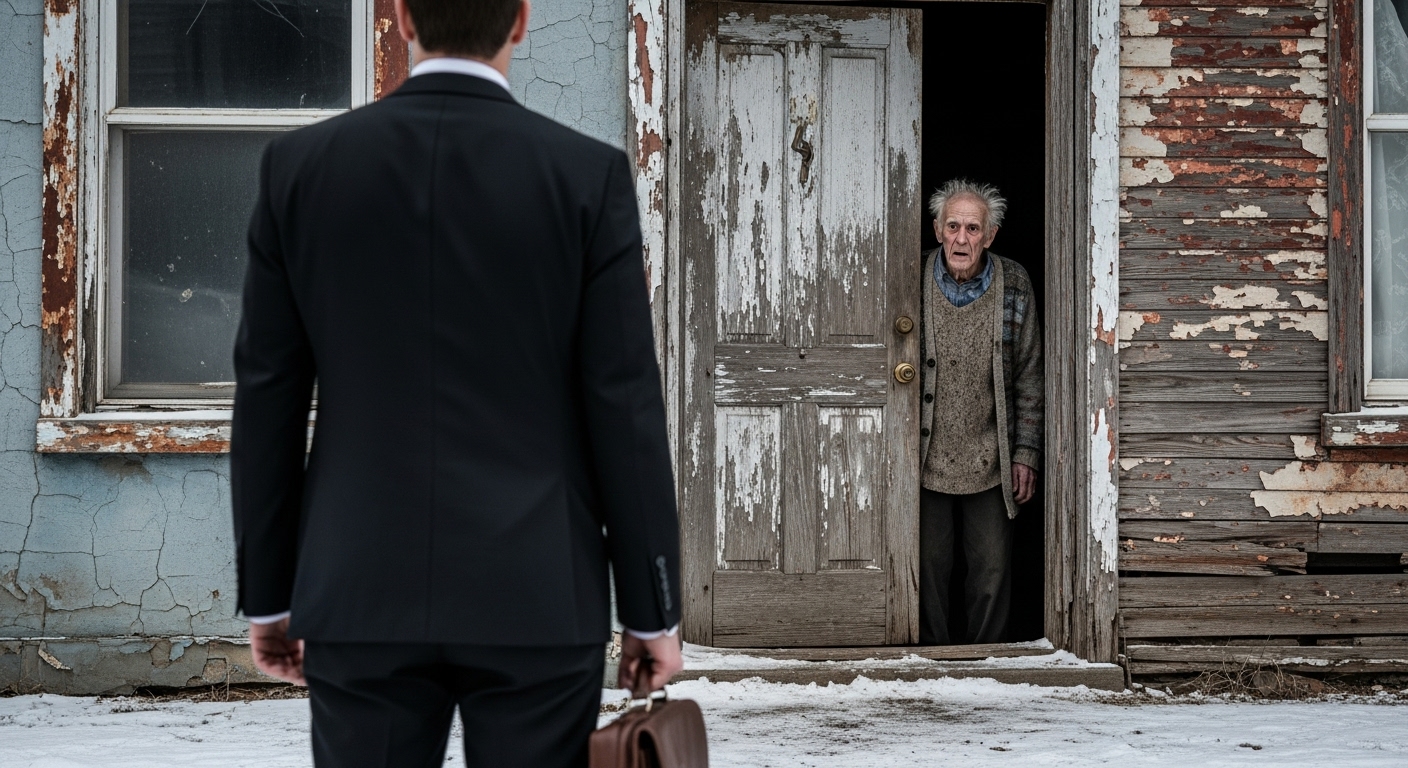
He pulled up to Number 412. It was a brick row house, identical to its neighbors, but in significantly worse disrepair. The gutters hung loose like broken limbs. The windows were dark, draped with heavy, uneven curtains.
Lucas grabbed his leather briefcase—containing the eviction notice and a final, low-ball check—and stepped out into the cold. The wind bit through his cashmere coat. He navigated the cracked sidewalk, stepping over a frozen puddle that looked like oil, and banged his fist on the peeling paint of the front door.
“Mr. Harrison!” Lucas barked. “Open up. We need to finalize this today.”
Silence.
Lucas checked the file in his hand. Arthur Harrison. 84 years old. Lived there since 1965. No next of kin listed. The perfect victim.
He banged again, harder this time. “Mr. Harrison, I have the sheriff on speed dial. Do not make me drag you out of here.”
A shuffling sound came from inside. The scraping of a deadbolt. Then another. Finally, the door creaked open, revealing a slice of darkness that smelled of mildew, old paper, and the sharp, metallic scent of unwashed clothes.
The man standing there was skeletal. He wore three layers of sweaters, the top one moth-eaten and stained with soup. A wool cap was pulled low over his ears. His hands, clutching the doorframe for support, were trembling violently. But it was his eyes that caught Lucas off guard. They were milky with age, yet they held a terrified, childlike confusion.
“Is… is it the grocery delivery?” the old man rasped. His voice was thin, like dry leaves skittering on pavement. “I… I don’t think I have the money this week, sir.”
Lucas stiffened, his corporate armor locking into place. “I’m not the grocer, Mr. Harrison. I’m Lucas Miller from M&S Holdings. We’ve sent you five letters. You are illegally squatting on property we acquired three months ago.”
Arthur Harrison blinked, tilting his head. “Lucas? Miller?” He tasted the name, rolling it around his mouth, but no spark of recognition lit up his face. “Come in, come in out of the cold. You’ll catch your death.”
He stepped back, leaving the door open.
Lucas hesitated. This wasn’t how it usually went. Usually, there was screaming, or begging, or a shotgun. This pathetic hospitality was disarming. He sighed, checked his watch again, and stepped into the gloom.
The interior was freezing—colder than outside, somehow. The dampness sat heavy in the air. Lucas could see his breath. The living room was a maze of stacks. stacks of newspapers, stacks of books, stacks of magazines. It wasn’t quite hoarding, but it was the clutter of a mind that had lost the ability to organize.
There was no furniture, save for a single, tattered armchair positioned in front of a kerosene heater that wasn’t lit.
“Sit, sit,” Arthur gestured to the armchair. “I was just making tea. I have… I have a tea bag somewhere. I can use it again.”
“I don’t want tea,” Lucas said sharply, remaining standing. He didn’t want to touch anything. “I want you to sign these papers. We are offering you five thousand dollars to vacate the premises by sundown. If you don’t, the eviction team will be here at 8:00 AM tomorrow, and you will get nothing.”
Arthur looked at the papers Lucas thrust toward him as if they were written in alien hieroglyphs. He began to wring his hands. “Move? But… my things. The children need their grades. I haven’t finished grading the papers.”
Lucas frowned. “What are you talking about? You’re not a teacher anymore, Arthur. You’re eighty-four.”
“The semester ends on Friday,” Arthur whispered, panic rising in his voice. “I have to find the red pen. I had it just here.” He began shuffling through a stack of newspapers on the floor, his movements erratic.
Lucas felt a surge of irritation mixed with something else—pity? No, he crushed that. Pity didn’t close deals. “Mr. Harrison, listen to me!”
Suddenly, the front door burst open behind them.
“Arthur! I told you to keep the bolt locked!”
A woman stormed in. She was in her late forties, wearing scrubs that read Oakhaven General Hospital. She had a fierce, tired face and carried a plastic bag of groceries. She stopped dead when she saw Lucas in his suit, standing amidst the squalor like a vulture.
Her eyes narrowed. “Who the hell are you?”
“Lucas Miller. I own this building,” Lucas stated, drawing himself up to his full height.
The woman dropped the groceries on a stack of books. “You’re the developer? The shark from New York?” She stepped into his personal space, smelling of antiseptic and cheap coffee. “Get out.”
“I have every legal right—”
“I don’t care about your rights!” she shouted, her voice cracking with exhaustion. “Look at him! He has dementia. He doesn’t know what year it is, let alone what a deed is. The temperature in here is thirty-eight degrees because he can’t afford oil!”
“That’s hardly my problem,” Lucas said, though he took a half-step back. “If he can’t maintain the property…”
“Maintain it?” The nurse laughed, a bitter, jagged sound. “He served this town for fifty years. He taught every single person on the City Council how to read. And you know what they did? A ‘clerical error’ wiped his pension ten years ago. He’s been living on three hundred dollars a month. I come here on my breaks to make sure he doesn’t freeze to death, and you… you come here to throw him on the street?”
Lucas looked at Arthur. The old man was oblivious to the argument, still hunting through the papers on the floor, muttering about a red pen.
“He has to go,” Lucas said, his voice quieter now, stripped of its earlier bluster. ” The bulldozers are coming Monday. It’s done. If he signs, he gets money for a nursing home.”
“Five thousand dollars won’t buy a month in a nursing home!” the nurse spat. “You’re sentencing him to death.”
“I am doing my job,” Lucas snapped, his temper flaring to cover his discomfort. “I’ll give you an hour to help him pack a bag. Just the essentials. I’m not a monster, but business is business.”
He turned to Arthur. “Mr. Harrison. One hour. Find what you need.”
Arthur looked up, his eyes watery. He looked right at Lucas, and for a split second, the fog seemed to clear. He smiled—a gentle, patient smile that hit Lucas in the chest like a sledgehammer.
“You have a strong voice, young man,” Arthur said softly. “Projecting from the diaphragm. Very good. We worked hard on that, didn’t we?”
Lucas froze. The hair on the back of his neck stood up. “What did you say?”
But the moment was gone. Arthur turned back to the pile of trash. “I need my box. I can’t leave without the box.”
Lucas stared at the old man’s bent back. The air in the room felt suddenly too thin. He needed to get out, to breathe, but his feet were rooted to the rotting floorboards.
Chapter 2: The Shoebox of Souls
The hour passed in excruciating tension. The nurse, whose name Lucas learned was Sarah, moved around the apartment with efficient fury, shoving Arthur’s meager clothes into two black garbage bags. Lucas stood by the window, watching the sleet turn to snow, trying to ignore the gnawing sensation in his gut.
Arthur was useless in the process. He flitted from corner to corner, picking up trinkets—a ceramic cat, a broken stapler—and trying to hide them in his pockets.
“Arthur, no,” Sarah said gently, prying a moldy book from his hands. “We can’t take everything. Just the clothes.”
“But the box,” Arthur whimpered. “I can’t find the box.”
“We’ll find it,” Sarah soothed him, shooting a dagger-glare at Lucas. “If Mr. Big Shot here gives us a minute.”
Lucas checked his phone. Three missed calls from his boss, Sterling. He ignored them. The atmosphere in the house was suffocating him. He turned to help, purely to speed things up.
“What does this box look like?” Lucas asked, stepping toward a towering bookshelf that leaned precariously against the damp wall.
“It’s… it’s a shoe box,” Arthur stammered, wringing his hands. “Blue. Hush Puppies. Size 10.”
Lucas scanned the shelves. They were crammed with old textbooks: Fun with Dick and Jane, History of the American People, Basic Arithmetic. Dust coated everything in a thick grey fur.
“Is this it?” Lucas reached for a blue box wedged tight on the top shelf.
“Careful!” Arthur shrieked, lunging forward with surprising speed.
Startled, Lucas jerked his hand. The shelf, already unstable, groaned. The wood splintered. In slow motion, the entire unit tipped forward.
“Look out!” Lucas yelled, grabbing Arthur and hauling him back just as the bookshelf crashed to the floor.
The sound was deafening. Books exploded outward. Dust billowed up like a mushroom cloud. And the blue shoe box, which had been the catalyst, hit the floor and burst open.
It didn’t contain money. It didn’t contain jewelry.
It contained paper.
Hundreds, maybe thousands of scraps of paper fluttered into the air, settling over the wreckage like confetti.
Silence returned to the room, save for Arthur’s ragged breathing.
“My treasures,” Arthur whispered, falling to his knees. He didn’t care about the heavy shelf that had nearly crushed him; he began frantically gathering the papers.
Lucas dusted off his suit, his heart hammering. He looked down at the mess. He bent to pick up a piece of paper near his polished shoe, intending to toss it into a trash bag.
His hand stopped.
It was a note, written on lined notebook paper, yellowed with age. The handwriting was loopy and feminine. “Dear Mr. Harrison, thank you for buying me the winter coat. My mom said she couldn’t afford it, and I was scared to walk to school. You told the class I won a prize, but I know you bought it. I won’t tell. Love, Jenny, Class of ‘82.”
Lucas frowned. He picked up another. A drawing of a turkey made from a traced hand. On the back: “For Mr. H. Happy Thanksgiving. I hope you aren’t lonely.”
He picked up another. And another.
They were letters. Thank you notes. Christmas cards. Drawings. Apologies. Decades of them.
“Mr. Harrison, thank you for staying late to help me with math. I got into college.” “Mr. Harrison, sorry I stole the chalk. I promise to be good.”
Lucas felt a strange pressure in his throat. This wasn’t trash. This was a life. This was the currency of a man who had no family, no children of his own. His students were his children.
“Help me,” Arthur wept, trying to scoop them up with shaking hands. “They’ll get cold on the floor.”
Lucas knelt. He wasn’t thinking about the suit anymore. He reached for a piece of construction paper that had slid under the overturned shelf. It was faded, the edges tattered as if it had been held and folded a thousand times.
The drawing was crude. A stick figure in blue crying, and a stick figure in brown holding a giant umbrella over him.
The writing was jagged, the letters reversed and uneven, pressed hard with a red crayon.
“To Mr. H.”
Lucas read the words, and the world stopped. The wind outside, the smell of mold, the nurse’s heavy breathing—it all vanished.
“Th-thank y-you for n-not let-ting them hit me. My d-dad says I am st-stupid bec-cause I talk bad. You s-said I have a vo-voice like a K-King. I will be b-brave. – Luke.”
Lucas stared at the red crayon.
A trapdoor opened in his mind, releasing a memory he had buried under thirty years of ambition and whiskey.
1978. The playground. He was seven years old. Skinny. Pathetic. He tried to answer a question in class and the words got stuck in his throat. “I… I… I…” The class laughed. The teacher—not Mr. Harrison, the other one—had rolled her eyes.
Recess. The bullies cornered him behind the gym. Tommy Miller (no relation) pushed him into the mud. “Spit it out, retard! Talk!”
He was crying, curling into a ball, waiting for the kicks. But they never came.
Instead, a shadow fell over him. Mr. Harrison. He wasn’t old then. He was tall, broad-shouldered, wearing a brown corduroy jacket. He didn’t yell. He just stood between Lucas and the bullies, radiating a quiet, terrifying calm. “Gentlemen,” he had said. “Walk away.”
Mr. Harrison had picked Lucas up. He didn’t ask if he was okay. He took him to the classroom, opened his own lunchbox, and gave Lucas half a turkey sandwich. Then, he sat on the desk and looked Lucas in the eye.
“Lucas,” he had said. “Do you know who King George was? He had a stutter too. And he led an empire. Your words are just fighting to get out because they are important. Don’t rush them. A King never rushes.”
Lucas Miller, the shark of Manhattan, the man who fired people for fun, dropped the piece of paper. His hand was shaking harder than Arthur’s.
He looked up. Arthur was holding the shoe box, clutching it to his chest. He looked at Lucas, really looked at him, with that same eerie flash of clarity.
“Luke,” Arthur whispered. “Little Luke Miller.”
Lucas couldn’t breathe. “You… you remember?”
Arthur smiled, a tear tracking through the grime on his cheek. “I remember all my children. Luke. He was so scared. He stuttered so bad, his little chest would heave. But he was smart. So smart.” Arthur looked around the room, confused again. “I wonder where he went? He was going to be a King. I hope… I hope he grew up to be kind.”
The word hung in the air. Kind.
Lucas looked at his Italian shoes. He looked at the eviction notice peeking out of his briefcase. He looked at the old man shivering in the coat he couldn’t afford to replace.
The shame was a physical blow. It hit him in the solar plexus, doubling him over. He hadn’t just forgotten. He had become the bully. He had become the very thing Mr. Harrison had saved him from. He was Tommy Miller now, pushing the weak into the mud.
“Oh god,” Lucas choked out. A sob, unbidden and violent, ripped from his throat.
Sarah, the nurse, watched him, her expression shifting from anger to shock.
Lucas fell to his knees amidst the scattered papers. He reached out and touched Arthur’s trembling hand.
“I’m sorry,” Lucas wept, the tears hot and fast. “I’m so, so sorry.”
Chapter 3: The Debt Repaid
The phone in Lucas’s pocket buzzed again. Sterling.
Lucas stood up. He wiped his face with a silk handkerchief, but he didn’t put the mask back on. His eyes were red, raw, and furious.
He answered the phone.
“Miller! Where the hell are you?” Sterling’s voice was a tinny scream. “Did you get the signature? The bulldozers are scheduled!”
“Shut up,” Lucas said. His voice was low, steady, and dangerous.
“Excuse me?”
“I said shut up, Sterling. There will be no demolition. Not today. Not ever.”
“Have you lost your mind? We have millions invested—”
“I don’t care,” Lucas interrupted. “If you send one machine to 4th Street, I will leak the EPA report on the Hudson project. I know where you buried the asbestos, Sterling. I know everything.”
There was a stunned silence on the other end.
“I quit,” Lucas said. “And I’m keeping the signing bonus as a consultancy fee.” He hung up and threw the phone into the pile of trash.
He turned to Sarah and Arthur. “Pack the car,” he commanded. But the tone was different. It wasn’t the bark of a boss; it was the urgency of a protector.
“Where are we going?” Sarah asked, wary but sensing the shift.
“To the Town Hall,” Lucas said, picking up the blue shoe box. “We have a lesson to teach.”
The Oakhaven Town Council meeting was a dull affair, usually attended by three people. Tonight, the doors swung open with a bang that echoed off the high ceilings.
Lucas Miller strode in, still covered in dust from the apartment, holding a battered blue shoe box like it was the Ark of the Covenant. Sarah pushed Arthur in a wheelchair they had retrieved from her trunk.
“Mr. Miller?” The Council President, a portly man named Bob Henderson, squinted over his glasses. “We weren’t expecting a report until tomorrow.”
Lucas walked to the podium. He didn’t use the microphone. He didn’t need to. He projected from the diaphragm.
“There is no report,” Lucas said. He placed the box on the podium. “There is only a bill. A bill that is forty years overdue.”
He reached into the box and pulled out a handful of letters.
“Bob Henderson,” Lucas read aloud, looking at the Council President. “1968. ‘Dear Mr. Harrison, thank you for buying me glasses. My dad said four eyes is better than no eyes.’ You sit there in that chair, reading your agenda, because Arthur Harrison paid for your first pair of glasses when your father drank away his paycheck.”
The room went deadly silent. Bob Henderson’s mouth dropped open.
Lucas grabbed another letter. “Susan Gable, City Treasurer. 1974. ‘Mr. H, thank you for the lunch money. I was hungry.’ You manage the city’s millions, Susan, but you let this man starve?”
He threw the letters onto the council table. They slid across the polished wood, accusations written in crayon and pencil.
“This man,” Lucas gestured to Arthur, who was shrinking in his wheelchair, overwhelmed by the lights. “This man raised this town. He fixed your shoes. He fed you. He protected you. And when he got old? When he got sick? You cut his pension. You let him rot in the dark.”
Lucas leaned forward, his eyes burning. “I came here to evict him. Because I forgot. I forgot that I was the boy he taught to speak. But I remember now. And you are going to remember too.”
He slammed his hand on the table. “I am buying the building on 4th Street. Personally. I am renovating it. And every single one of you is going to chip in. Not with city funds. With your own money. Or so help me God, I will take every story in this box and I will put it on the front page of the New York Times.”
Susan Gable was crying. Bob Henderson had his head in his hands.
The silence stretched, heavy and thick, until a slow clapping started from the back of the room. It was the janitor. Then the clerk joined in. Then Sarah.
The renovation of Number 412 wasn’t a construction project; it was a revival.
Word spread. The story of the “Shark” and the Teacher went viral, but in Oakhaven, it was personal. People showed up. Plumbers who had learned subtraction from Mr. Harrison fixed the pipes for free. Carpenters who had learned to read in his class rebuilt the shelves.
Lucas didn’t return to New York. He stayed in the Holiday Inn, supervising the work, trading his suit for jeans and a work shirt.
For three weeks, Arthur Harrison lived like a king. He was moved into a heated suite at the hotel, paid for by Lucas. He ate warm meals. He had visitors every day—former students bringing their own children to meet the legend.
His mind was still fading, the dementia taking its toll, but his heart was full.
One afternoon, Lucas sat with him in the hotel room. Arthur was frail, his breathing shallow.
“Luke,” Arthur whispered.
“I’m here, Mr. Harrison,” Lucas said, holding the old man’s hand.
“Did you… did you find your voice?”
Lucas swallowed the lump in his throat. “Yes, sir. I did. You found it for me.”
Arthur closed his eyes. “Good. Use it… use it for the little ones. The quiet ones.”
Arthur Harrison died peacefully in his sleep that night. He died warm. He died full. He died knowing he was loved.
Epilogue
The funeral was the largest event in Oakhaven’s history. The line of cars stretched for three miles.
After the service, Lucas stood in front of the renovated row house on 4th Street. It was beautiful now. Fresh brick, bright windows, a ramp for accessibility.
Above the door hung a new sign: The Arthur Harrison Center for Speech and Literacy.
Lucas cut the ribbon. He looked at the crowd—at Sarah, at the shamed but reforming Council members, at the children running around.
He reached into his pocket and pulled out a piece of faded construction paper. The stick figure drawing.
He knelt down and taped it to the front door, right at eye level for a seven-year-old.
“Class is in session,” Lucas whispered.
And for the first time in thirty years, the Shark smiled. And it was a real smile