I Missed the Job Interview That Would Save My Homeless Daughter to Save a Dying Hells Angel. I Thought I Lost Everything, But Then 15 Bikers Showed Up and Changed My Life.
Chapter 1: The Last Chance
The alarm on my phone didn’t go off because I didn’t have enough battery to set it. I woke up because the woman on the cot next to ours at St. Mary’s Shelter was coughing—a wet, rattling hack that sounded like pneumonia. It was 6:00 a.m.
I lay there for a moment, staring at the water-stained ceiling tiles, feeling the warmth of my five-year-old daughter, Emma, pressed against my side. She was sleeping in her coat because the heating in the shelter had been broken since October. November 28th. Today was the day.
“Time to wake up, baby,” I whispered, brushing a tangle of hair out of her eyes.
Emma groaned, burrowing deeper into the thin, scratchy blanket. “Mommy, it’s cold.”
“I know. But today is the big day. Remember? Harper’s Department Store.”
I said the name like it was the Emerald City. Harper’s. It was just a mid-range retail store downtown, but to us, it was everything. A cashier position. $14.50 an hour. Full-time. I had done the math on the back of a napkin so many times the paper had disintegrated.
$14.50 meant a studio apartment on 4th Street. It meant I could buy Emma new shoes instead of the pinching hand-me-downs that were blistering her heels. It meant food that didn’t come from a can. It meant safety.
I had been unemployed for eight months. We had been homeless for four. This interview at 10:00 a.m. was the first callback I’d had in weeks. It was my only lifeline.
I dragged myself up, my joints stiff from the metal cot. I went to the communal bathroom, splashing icy water on my face. I looked at myself in the cracked mirror. Dark circles under my eyes, cheeks hollow from skipping meals so Emma could eat. I looked like what I was: a woman hanging on by a thread.
But I had one outfit. One “armor.” A white blouse I had kept sealed in a Ziploc bag to keep it clean, and a pair of black slacks I ironed with a hair straightener I borrowed from another resident. I put them on with the reverence of a priest putting on vestments.
“You look pretty, Mommy,” Emma said, sitting up and rubbing her eyes.
“Thank you, sweetie. You look brave.”
We left the shelter at 8:45 a.m. We had to walk. I didn’t have bus fare. The shelter was on the outskirts, and Harper’s was downtown. According to Google Maps, it was a 55-minute walk. We had a buffer, but not much of one.
The wind cut through my jacket—a thin denim thing that was my only layer against the Chicago chill. I held Emma’s hand tight. Her little legs had to take two steps for every one of mine.
“My feet hurt,” she whimpered around the 30-minute mark.
My heart broke, but I couldn’t stop. “I know, Em. We’re going to play a game. Let’s count the red cars. If we get to fifty red cars, we win.”
“What do we win?”
“A surprise,” I lied. The surprise would be me getting this job and buying her insoles.
We kept moving. My stomach growled, a hollow, cramping pain. I hadn’t eaten since yesterday morning. I needed to be sharp for the interview. I started rehearsing my lies.
Gap in employment? I was caring for a sick relative. Why did you leave your last job? Downsizing. Current address? I’d give them my old P.O. Box.
The truth—that my ex-husband vanished with our savings, that my family disowned me for having a baby, that I lost my last job because I was too distracted by impending homelessness—that truth scared employers away.
9:47 a.m.
We were close. I could see the skyline of downtown getting sharper. Three blocks to go. 13 minutes. We were going to make it. I could feel the adrenaline surging, masking the hunger and the fatigue.
“Almost there, Emma. Look, that’s the building,” I pointed toward the Harper’s sign in the distance.
Then, I heard it.
It wasn’t a normal traffic sound. It was a roar. A deep, guttural mechanical scream that vibrated in my chest.
I looked up. A black motorcycle was weaving through traffic, moving fast. Too fast. The rider was hunched low, his leather vest flapping in the wind. He looked like a missile.
At the intersection ahead of us, a massive white SUV tried to beat the yellow light. It didn’t make it.
The sound of the impact was something I will never forget. It wasn’t a crash; it was a detonation. Metal crunching, glass shattering, and then the sickening thud of a body hitting the pavement.
Chapter 2: The Sacrifice
The motorcycle flipped into the air, spinning like a toy, before smashing into a parked sedan. Sparks showered the asphalt.
But my eyes were locked on the rider. He had been thrown twenty feet. He hit the ground and didn’t move.
Time seemed to freeze. The world went silent, except for the hissing of the wrecked bike.
“Mommy?” Emma squeezed my hand, her voice trembling.
I looked at the time on my phone. 9:48 a.m.
I looked at the department store. It was right there. Two blocks away. If I kept walking—if I just picked up the pace and dragged Emma along—I would make it to the lobby by 9:55 a.m. I would be early. I would get the job. I would save us.
I looked back at the man. He was lying in a heap in the middle of the intersection. Dark, viscous blood was already pooling beneath his leather jacket, spreading fast across the grey asphalt.
Cars were slowing down. People were rolling down their windows to look. One guy in a Honda honked his horn, swerving around the body like it was a piece of roadkill.
No one was stopping.
I felt a physical pull toward the department store, a desperate need to run toward safety. But then I heard my mother’s voice in my head. She had been an ER nurse for thirty years before she passed. Sarah, if you have the ability to help, you have the obligation to act.
The blood was moving too fast. It was bright red—arterial.
“Emma, stay on the sidewalk,” I commanded, my voice sounding strange to my own ears. “Do not move.”
“Mommy, the interview!” Emma cried. She knew. Even at five, she knew what this meant.
“I have to, baby.”
I dropped her hand and ran.
I sprinted into the middle of the street, waving my arms to stop an oncoming taxi. I slid to my knees beside the rider. Up close, the damage was horrifying. His jeans were shredded. His arm was bent at a wrong angle. But the real problem was his side. A jagged piece of chrome from the bike had pierced his side, and the blood was pumping out in rhythm with his failing heart.
I didn’t think. I just reacted. I ripped off my denim jacket. It was dirty, but it was thick. I balled it up.
Then, I looked at my white blouse. The interview blouse. The only clean thing I owned.
“Forgive me,” I whispered.
I pressed the denim hard against the wound, leaning my entire body weight onto his ribs. The blood soaked through the denim instantly, hot and sticky. It seeped onto my hands, up my wrists, and stained the cuffs of my white sleeves crimson.
The man groaned. A guttural, wet sound.
“Stay with me,” I yelled, pressing harder. “You hear me? Stay with me!”
He gasped, his eyes fluttering open behind his shattered visor. They were glazed, unfocused.
“My… my brothers,” he choked out. Blood bubbled past his lips.
“Don’t talk. Just breathe.”
I looked up, scanning for help. A crowd had gathered on the sidewalk, phones out, recording. No one was helping. They were just watching the show.
“Call 911!” I screamed at a man in a suit filming us. “Put the phone down and call 911!”
He flinched and dialed.
9:52 a.m.
My arms were shaking. The man was big—heavy muscle and bone. Keeping the pressure was exhausting. I glanced at Emma. She was standing exactly where I left her, tears streaming down her face, clutching her stuffed rabbit.
I had missed it. Even if I left right now, I was covered in blood. I looked like a murderer. There was no job. There was no apartment. There was just the shelter, the cold, and the failure.
The despair hit me harder than the cold wind. I started to cry, silent tears mixing with the grime on my face.
Then, the ground started to shake.
At first, I thought it was the adrenaline. But then the sound grew—a low, thunderous rumble that echoed off the skyscrapers. It drowned out the city traffic.
I looked down the avenue.
They were coming.
A wall of black motorcycles. Chrome flashing in the morning sun. Fifteen of them. They took up all three lanes, moving in a tight, predatory formation.
My blood ran cold. I saw the patches on their vests as they got closer. The winged death’s head. The red lettering.
Hells Angels.
I had heard the stories. Everyone in Chicago had. These weren’t weekend hobbyists. These were outlaws.
They saw the wreck. The formation broke. They swarmed the intersection, engines revving, tires screeching as they boxed in the scene.
I was kneeling over one of their own, my hands covered in his blood.
The bikes stopped. The silence that followed was terrifying.
Fifteen men dismounted. They were giants. Beards, tattoos, chains. They didn’t run; they stalked toward me. The lead biker was a mountain of a man with a grey beard and eyes like flint.
I wanted to pull away. I wanted to grab Emma and run. But if I let go of the wound, this man would die.
“Step away from him,” the grey-bearded man growled, his hand drifting to his belt.
“I can’t!” I shouted back, my voice cracking. “He’s bleeding out! If I let go, he dies!”
The biker stopped. He looked at the blood soaking my jacket. He looked at my ruined white blouse. He looked at my terrified face.
Sirens wailed in the distance. Finally.
“Don’t you move,” he said, but his voice was different now. Less angry. More… confused.
The ambulance screeched to a halt. Paramedics shoved through the circle of bikers.
“We got him, ma’am,” a medic said, putting a gloved hand on my shoulder. “Let go on three. One, two, three.”
I pulled my hands back. My jacket stayed, stuck to the wound.
I stumbled backward, my legs giving out. I fell onto the curb, gasping for air. I looked at my hands. They were red.
I checked my phone. 10:03 a.m.
It was over.
I looked up to find Emma, but a shadow fell over me. I flinched, looking up.
A woman was standing over me. She was wearing a leather vest like the men, but she had silver rings on every finger and hair like a raven’s wing. She wasn’t looking at me with aggression. She was looking at me with intensity.
“You got a name?” she asked. Her voice was smoke and gravel.
“Sarah,” I whispered.
“Well, Sarah,” she said, nodding toward the ambulance where they were loading the man I had just saved. “You just saved Marcus. He’s the VP of this chapter.”
She looked at my clothes. The blood. The cheap shoes. Then she looked at Emma, standing alone on the corner.
“And it looks like you just paid a hell of a price to do it.”
Chapter 3: The Ghost in the Machine
The ambulance doors slammed shut with a finality that echoed in my bones. I watched as the vehicle peeled away, lights flashing, disappearing into the concrete labyrinth of downtown Chicago. Marcus, the man whose blood was drying on my skin, was gone.
I was left standing on the corner of 5th and Grand, shivering in just a stained white blouse.
“Mommy?” Emma tugged at my slacks. “Are we going to the interview now?”
I looked down at her. Her face was streaked with tears and grime. She was looking at the department store, still waiting for the surprise I had promised.
“No, baby,” I choked out, my voice raspy. “We missed it.”
“But… the red cars. We counted forty-two.”
“I know. I’m sorry.”
Raven, the dark-haired woman in the leather vest, was still watching me from near the crash site. She was talking to a massive biker with a shaved head, gesturing toward me. I felt a spike of fear. In my world—the world of shelters and street corners—attention was never a good thing. Attention meant danger. Attention meant Child Protective Services wondering if you were fit to be a mother.
“Come on,” I grabbed Emma’s hand, pulling her away. “We have to go.”
“Where?”
“Back.”
The walk back to St. Mary’s Shelter was a twelve-block death march. The adrenaline had worn off, leaving behind a crushing exhaustion. The wind whipped through my thin blouse, biting into my skin. But the cold was nothing compared to the shame.
People stared. Of course they stared. I looked like a crime scene. A woman walking a child in the middle of the day, covered in dried, rusty-brown blood. Mothers pulled their children closer as we passed. A businessman on his phone actually stepped into the street to avoid walking near me.
We were ghosts. We were visible only when we were inconvenient.
By the time we reached the shelter, my feet were blistered in my cheap flats. I pushed open the heavy metal doors, bracing myself for the smell of bleach and desperation that always greeted us.
Helen, the shelter coordinator, looked up from the plexiglass intake window. She was a hard woman, worn down by twenty years of seeing the worst of the city, but she had a soft spot for Emma.
Her eyes widened when she saw me.
“Sarah? Good Lord, honey, what happened? Did someone hurt you?” She was already reaching for the panic button under the desk.
“No,” I said, leaning against the counter for support. “It’s not my blood. There was an accident. I helped.”
“You look like you walked through a slaughterhouse. And the interview? Harper’s?”
I laughed, a dry, brittle sound. “I missed it. I was holding a man’s artery closed while they gave the job to someone else.”
Helen’s face fell. She knew. She knew what that job meant. It was the exit strategy. It was the difference between Emma sleeping in a bed or sleeping in a cot surrounded by strangers.
“Go get cleaned up,” Helen said softly, sliding the bathroom key across the counter. “I’ll watch Emma. Go.”
I went to the communal showers. I stood under the lukewarm water for forty minutes, scrubbing my skin until it was raw. I watched the water swirl pink around the drain. I scrubbed my hands, my arms, my chest. But I couldn’t scrub away the feeling of failure.
I had saved a man’s life. I knew that. My mother would have been proud. But my mother wasn’t here. My daughter was. And tonight, my daughter was going to eat instant oatmeal again because her mother decided to play hero instead of provider.
While I was washing away the evidence of my sacrifice, miles away at Mercy General Hospital, a different kind of storm was brewing.
Marcus Reaper Stone woke up to the rhythmic beeping of machinery. His chest felt like it had been crushed by a hydraulic press. He tried to take a breath, but his ribs screamed in protest.
“Easy, VP,” a voice said.
Marcus blinked, his vision clearing. A nurse was adjusting his IV drip.
“My bike,” Marcus rasped.
“Totaled,” the nurse said efficiently. “But you’re alive. Punctured lung, three broken ribs, shattered collarbone, and significant blood loss. You’re very lucky.”
Marcus’s memory came back in jagged flashes. The SUV running the red. The sky spinning. The asphalt. And then… pressure. Hands. A voice screaming Stay with me.
“There was a woman,” Marcus said, trying to sit up. The pain forced him back down. “On the street. She stopped the bleeding.”
“The paramedics mentioned her,” the nurse nodded. “Said she had her hands inside your jacket before they even got the kit out. She saved you, Mr. Stone. You would have bled out in two minutes without that pressure.”
“Where is she?”
“She left. Police took a statement from witnesses, but she was gone before anyone got her info.”
Marcus hit the call button on the side of his bed, not for the nurse, but for the phone. He dialed a number he knew by heart.
“Yeah,” a deep voice answered. It was Big Jake, the Sergeant-at-Arms.
“It’s me,” Marcus grunted.
“Boss? Thank God. We heard it was bad.”
“I’m still here. Listen to me. The woman who stopped. The one at the scene.”
“Raven saw her,” Jake said. “Said she looked rough. Homeless, maybe.”
Marcus closed his eyes. Homeless. A woman with nothing had stopped to save a man who had the backing of an entire organization.
“Find her,” Marcus commanded. His voice was weak, but the authority was absolute. “I don’t care what you have to do. Turn this city upside down. Find out who she is, and bring her to me. I owe her a debt.”
Chapter 4: The Lion’s Den
It took the Hells Angels exactly six hours to find me.
When you are homeless, you think you are invisible, but you leave tracks. We are in the system. St. Mary’s was one of five major shelters in the district. Raven simply went to each one, describing a thin woman with a five-year-old girl and a blood-stained blouse.
I was sitting on my cot, reading a worn-out copy of Goodnight Moon to Emma, trying to distract her from the hunger pains, when Helen appeared in the doorway of the dormitory. She looked nervous.
“Sarah,” she whispered. “There are people here to see you.”
“Who?” My heart hammered against my ribs. “Is it the police?”
“No. It’s… bikers. A lot of them. They’re parked out front.”
I froze. They found me. Why? Did Marcus die? Did they think it was my fault? In my experience, powerful men didn’t come looking for people like me to say thank you. They came to settle scores.
“Tell them I’m not here,” I pleaded, clutching Emma.
“I can’t, honey. They know you’re here. The woman, Raven, she said they aren’t leaving until they speak to you. She said… she said the VP wants to see you.”
I looked at Emma. She was looking at me with wide, fearful eyes. I couldn’t bring trouble to the shelter. If the bikers caused a scene, we’d all get kicked out.
“Okay,” I said, standing up. “Watch Emma?”
“Of course.”
I walked out to the lobby. Through the glass doors, I saw them. Twelve motorcycles lined up at the curb like jagged steel teeth. Raven was leaning against the front desk, looking out of place in the sterile, fluorescent-lit room.
She straightened when she saw me. I was wearing oversized grey sweatpants and a hoodie from the donation bin—clothes that swallowed my frame.
“Sarah,” she said. Her voice wasn’t aggressive, but it wasn’t friendly either. It was business.
“Is he dead?” I asked, my voice trembling.
Raven blinked, surprised. “What? No. He’s awake. He’s asking for you.”
“Why?”
“Because he wants to look the person who saved his life in the eye. He wants you to come to the hospital.”
I shook my head, backing away. “I can’t. I have my daughter. I don’t… I don’t want any money. I just did what I had to do. Please, just leave us alone.”
Raven stepped closer, lowering her voice. “Look, I get it. You’re scared. You think we’re bad news. But Marcus isn’t just a biker. He’s a man of his word. He sent us to find you because he intends to balance the scales. You missed something important this morning, didn’t you?”
I looked down at my feet. “It doesn’t matter.”
“It matters to him. The car is outside. We’ll bring you back in an hour. Or do you want to stay here and wonder ‘what if’ for the rest of your life?”
I hesitated. The logical part of my brain screamed Stranger Danger. But the desperate part—the part that had just watched my daughter eat watery oatmeal—wondered if maybe, just maybe, this was a lifeline.
“I need to bring Emma,” I said. “I’m not leaving her.”
“Bring her,” Raven nodded. “We got a car seat in the SUV.”
The ride to Mercy General was silent. Emma sat in the back, eyes wide, looking out the window. I sat next to her, my hands clenched in my lap.
When we walked into Room 304, the air changed. It smelled of antiseptic and power.
Marcus was propped up in bed, his torso wrapped in thick bandages. He looked paler than he had on the street, but his eyes were sharp. Blue, intense, and currently fixed on me.
“Leave us,” he said to the three other men in the room. They filed out without a word, leaving only Raven by the door.
Marcus looked at me for a long time. He took in the donation-bin clothes, the exhausted posture, the way I stood protectively in front of Emma.
“You’re Sarah,” he said.
“Yes.”
“The doctors said I had a severed intercostal artery. They said if you hadn’t put your weight on it, I would have been dead before the ambulance turned the corner.”
I didn’t know what to say. “I used to watch my mom. She was a nurse.”
“You saved my life, Sarah.”
“I just stopped. That’s all.”
“No,” Marcus shook his head, wincing slightly. “Raven told me what happened. You were walking somewhere. Fast. You were dressed up. Where were you going?”
I felt the tears prickling again. I tried to fight them, but I was so tired. “Harper’s. The department store.”
“For what?”
“A job interview. 10:00 a.m.”
Marcus looked at the clock on the wall. It was 4:00 p.m.
“You missed it.”
“Yes.”
“Did you call them?”
“I don’t have enough minutes on my phone.”
Silence filled the room. Marcus looked at Raven, then back to me. His expression shifted from gratitude to something deeper. Respect.
“You traded your future for mine,” he said softly. “You gave up a job that would have gotten you off the street to save a stranger.”
“I couldn’t just let you die.”
“Most people did,” he replied. “I saw them driving by before I blacked out. You were the only one.”
He shifted in the bed, grimacing. “I want to help you. The club… we take care of people who help us. I can get you set up. Money, a place to stay. Let us fix this.”
My spine stiffened. It was a reflex. Years of bad luck had taught me one thing: Nothing comes for free. There is always a catch. My ex-husband had “helped” me with the bills until he controlled every penny I had. My landlord had “helped” me with late rent until he started asking for other forms of payment.
“I’m not looking for a handout,” I said, my voice sharper than I intended. “I appreciate the offer, really. But I can find my own job. I don’t need charity.”
Marcus frowned. “It’s not charity. It’s a debt.”
“I didn’t do it for a reward. If I take money from you, then it wasn’t a good deed. It was a transaction. I need to know I did it for the right reasons.”
It was a stupid, prideful thing to say. I knew that. I had $4 to my name. But my dignity was the only thing I had left that hadn’t been repossessed or stolen.
“Sarah,” Marcus warned. “Don’t be a martyr. You have a kid.”
“And I’ll take care of her,” I snapped. “We’re leaving. I’m glad you’re okay, Marcus. Truly. But we’ll be fine.”
I turned and walked out of the room, dragging a confused Emma with me. I didn’t look back. If I had, I would have seen the look of frustration—and admiration—on Marcus’s face.
Chapter 5: The Breaking Point
I was wrong. We were not fine.
The next three days were a descent into hell.
The morning after the hospital visit, I went to Harper’s. I begged the manager to reschedule. I told him there was a medical emergency. He looked at my wrinkled donation-bin clothes and my unwashed hair and told me the position had been filled. He didn’t even make eye contact.
I spent the rest of that day walking. I went to five restaurants, three retail stores, and a warehouse.
“Do you have a permanent address?” No. “Do you have a reliable vehicle?” No. “Do you have someone to watch the kid during shifts?” No.
The doors slammed shut, one by one. The American Dream didn’t work if you didn’t have the starter kit: a phone, an address, a car. Without those, you were trapped in a loop of poverty that tightened around your neck every time you moved.
By Day 3, the money ran out. I spent the last of my change on a banana and a small carton of milk for Emma. I didn’t eat.
That night, Emma woke up crying. Her skin was burning hot.
I checked her temperature with the back of my hand. She was radiating heat. She was coughing that deep, barking cough I had heard from the woman in the next cot.
“My ear hurts, Mommy,” she screamed, clutching the side of her head. “Make it stop!”
I carried her to the front desk. “Helen, she has a fever. I need Tylenol.”
Helen gave me two pills from her purse, but she looked worried. “There’s a bug going around the shelter, Sarah. It’s nasty. If that fever doesn’t break, she needs a doctor.”
It didn’t break. By morning, Emma was lethargic. She wouldn’t drink water. She just lay there, whimpering, her small body shaking with chills.
I took her to the free clinic down the street. The line wrapped around the block. We waited for four hours in the freezing wind. When we finally saw the nurse, she was exhausted and rushed.
“Double ear infection and likely strep,” she said, scribbling on a pad. “She needs antibiotics. Amoxicillin. And she needs to not be sleeping in a drafty shelter.”
“How much is the medicine?”
“$35 at the pharmacy.”
I stared at the prescription paper. It might as well have been a million dollars. I had zero. Nothing. I couldn’t even sell anything because I had nothing left to sell.
I walked out of the clinic, Emma heavy and burning in my arms. I sat on a bench near a bus stop and just stared at the traffic.
This was it. This was the wall.
I looked at my daughter. Her lips were cracked. Her eyes were sunken. I was failing her. My pride, my stubbornness, my refusal to accept help—it was killing her.
I pulled out my phone. 4% battery. I went to my contacts. I scrolled past the empty job leads to the number I had saved for the ultimate worst-case scenario.
Child Protective Services.
If I called them, they would take her. They would put her in a foster home. She would have a bed. She would have medicine. She would have food.
She wouldn’t have me.
But I was the one letting her suffer. A good mother protects her child, even if it breaks her own heart.
I dialled the number. My thumb hovered over the green call button. Tears blurred my vision, hot and fast.
“I’m sorry, baby,” I whispered into Emma’s feverish hair. “I’m so sorry. I can’t do this anymore.”
I took a breath to steady my voice. I pressed the button.
A hand reached over my shoulder and tapped the ‘End Call’ icon on my screen.
I jumped, clutching the phone to my chest.
Raven was standing there. She looked different today. No leather vest. Just a heavy black coat and a scarf. She looked like a normal person, except for the intensity in her eyes.
“Don’t do it,” she said.
“You’ve been following me?” I asked, too tired to be angry.
“Marcus said you wouldn’t make it three days. He said you were too proud to ask for help, but you loved your kid too much to let her starve. He said we needed to be there when you broke.”
I looked at the phone, then at Emma. “She needs medicine. It’s $35. I don’t have it. If I give her up, the state will pay for it.”
Raven sat down on the bench next to me. “Or,” she said, pulling a prescription bottle out of her pocket. “You can give her this.”
I stared at the bottle. Amoxicillin.
“How?”
“We have a doctor in the club. Marcus had him write it up as soon as we heard the kid was sick at the shelter. We picked it up an hour ago.”
Raven shoved the bottle into my hand. “And this,” she added, dropping a warm paper bag on my lap. The smell of a cheeseburger wafted out. “You haven’t eaten in two days, Sarah. You look like a skeleton.”
I held the medicine bottle like it was a holy relic. The relief was so sudden, so violent, that I felt dizzy.
“Why?” I wept. “I told you to leave me alone.”
“Yeah, you did,” Raven said, looking at the traffic. “But Marcus gave us an order. He said, ‘She saved me when it cost her everything. We don’t let her fall.’ So you can hate us, you can yell at us, but you’re coming with me.”
“Where?”
“To the clubhouse. We have a room set up. It’s warm. There’s food. And there’s a job offer on the table that you’re going to listen to, because if you dial that number again, you lose your little girl forever. And I don’t think you want that.”
I looked at the CPS number on my screen. I looked at the antibiotics in my hand. I looked at Raven, who was offering me the one thing I hadn’t had in years.
A choice.
“Okay,” I whispered. “Take us.”
Chapter 6: The Sanctuary
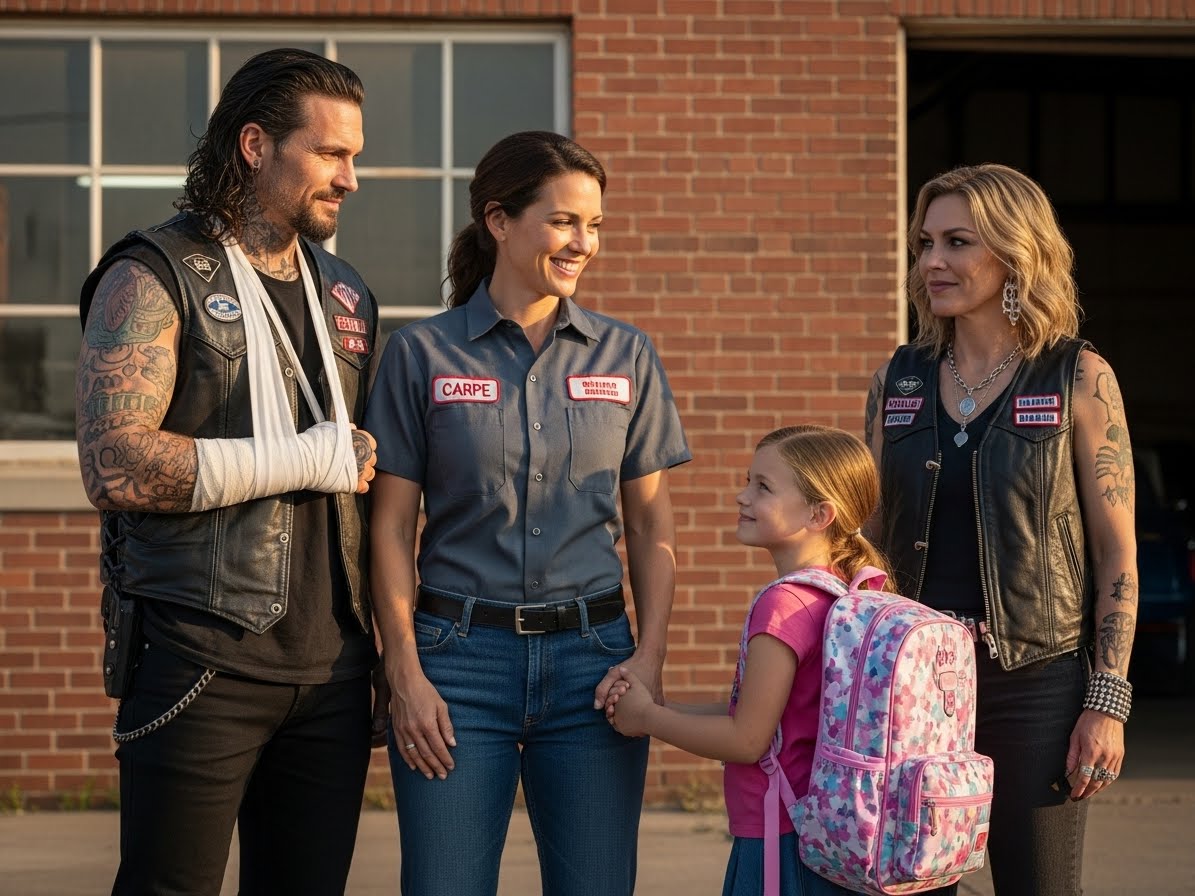
The Hells Angels clubhouse was not what I expected. I had imagined a dark, smoky den filled with illicit deals and danger. Instead, Raven drove us to a massive, reinforced brick building on the industrial side of town. It was called “Iron Horse Garage.”
The bay doors were open, revealing gleaming chrome and men working with focused precision. It smelled of motor oil, old leather, and… barbecue?
Raven led me through the side door. I carried Emma, who was drowsy from the medicine Raven had given her in the car.
Inside, the clubhouse was clean. Startlingly clean. There were photos on the walls—not of crimes, but of toy drives, charity runs, and smiling families.
“In here,” Raven said, opening a door to an office.
Marcus was sitting behind a desk. He was out of the hospital bed, but his arm was in a sling and he moved with a stiffness that betrayed his injuries. When we walked in, he stood up.
“Sarah,” he said. His voice was deep, filling the small room. “I’m glad you came.”
I stood by the door, clutching my daughter like a shield. “You didn’t give me much choice.”
“Sometimes people need a push to save themselves,” Marcus said, sitting back down. “Sit. Please.”
I sat. The chair was comfortable leather. It felt alien after months of sitting on metal benches and hard cots.
“Let’s cut to the chase,” Marcus said. He slid a piece of paper across the desk. “I did a background check on you. Don’t look at me like that; I needed to know who saved my life. You have a degree in business administration. You managed a retail floor for five years before your husband took off. You’re not incompetent, Sarah. You’re just unlucky.”
I looked at the paper. It was an employment contract.
Iron Horse Garage. Position: Office Manager. Pay: $22.00/hour. Benefits: Full medical and dental, effective immediately.
I stared at the number. Twenty-two dollars. That was nearly double minimum wage. That was… a life.
“I don’t know anything about motorcycles,” I stammered, my hands shaking.
“I don’t need you to fix bikes. I have twenty guys who can do that,” Marcus gestured to the shop floor. “I need someone to handle the invoices, the scheduling, the vendors, and the IRS. My current guy, Carlos, wants to retire. He says the paperwork is drowning him. You can swim.”
“This is too much,” I whispered. “I can’t accept this. It’s a pity hire.”
“Look at me,” Marcus commanded. I looked up. His eyes were hard as flint. “We don’t do pity here. We do loyalty. You stepped up when everyone else stepped back. That shows character. I can teach anyone to file an invoice. I can’t teach them to have guts. I’m hiring you because I trust you.”
He slid a set of keys across the desk. They landed with a heavy clink next to the contract.
“What are these?”
“There’s an apartment above the garage. Two bedrooms, full kitchen, heat works. It’s been empty since Carlos moved out. It’s included in the compensation package. First six months rent-free to let you build up savings.”
I looked at the keys. Then I looked at Emma, who was asleep on my shoulder, her fever finally breaking thanks to the medicine these “criminals” had provided.
The walls I had built—the pride, the fear, the stubborn independence—finally crumbled. It wasn’t a slow collapse; it was a landslide.
I buried my face in Emma’s neck and sobbed. I cried for the interviews I missed. I cried for the cold nights. I cried for the sheer relief of someone finally catching me.
Marcus didn’t say a word. He just pushed a box of tissues across the desk and waited.
Chapter 7: Iron Horse
Moving in took exactly ten minutes because we owned nothing.
Raven unlocked the door to the apartment above the shop. I walked in, expecting a dusty crash pad. I stopped dead in the doorway.
It was furnished. A soft beige couch. A dining table. A TV. Sunlight poured through clean windows, illuminating a space that smelled of lemon polish and safety.
“The club wives,” Raven said, leaning against the doorframe with a rare smile. “Once they heard about Emma, they went a little overboard.”
I walked into the kitchen. The refrigerator was stocked. Milk, eggs, cheese, fresh fruit, chicken, vegetables. Real food. Not expired canned goods. Not half-eaten leftovers.
I opened the second bedroom door.
“Mommy!” Emma squealed, sliding out of my arms.
The room was pink. Not overwhelmingly so, but soft and warm. There was a bed with a fluffy comforter. And toys. A dollhouse in the corner. A bookshelf filled with Dr. Seuss and Disney. A giant stuffed bear on the bed.
Emma ran to the bear, burying her face in its fur. “It’s so soft!”
I turned to Raven, tears streaming down my face again. “I can never repay this.”
“You already did,” Raven said seriously. “Now get some sleep. You start at 8:00 a.m. Monday.”
The first week at Iron Horse Garage was a blur of activity. I was terrified I would fail, that they would realize I was a mistake. But the work was grounding. Organizing files, answering phones, chasing down parts orders—it was logic and order in a world that had been chaotic for so long.
The bikers—men with names like “Big Jake,” “Tiny,” and “Dutch”—treated me with a terrifying amount of respect. To them, I wasn’t the homeless lady. I was the woman who saved the VP.
If a vendor was rude to me on the phone, Dutch would loom over the desk and ask if he needed to “pay them a visit.” (I had to politely tell him no). If Emma was sitting in the corner coloring after school, Big Jake would bring her chocolate milk and let her wear his helmet.
I wasn’t just an employee. I was a mascot. I was family.
On Friday of my second week, I came home to find a package on my kitchen table.
I opened it. Inside was a leather jacket. It was heavy, high-quality leather, smelling of newness. I unfolded it.
On the back, embroidered in silver thread, was a patch. It wasn’t the club’s “Death Head”—I wasn’t a member—but it was beautiful. It read:
Honorary Sister. Iron Horse Chapter. “Courage Has No Address.”
I put it on. It fit perfectly. I looked in the mirror. The woman looking back wasn’t the scared, hollow-eyed ghost from the shelter bathroom. She was strong. She was protected. She belonged.
That Saturday, there was a cookout behind the shop. Fifty people—bikers, their wives, their kids—filled the lot. The smell of burgers and charcoal filled the air.
I stood by the grill, wearing my jacket, watching Emma play tag with Big Jake’s daughters. She was laughing. A real, belly-deep laugh I hadn’t heard in two years.
Marcus walked up to me, handing me a soda. His arm was out of the sling now.
“She looks happy,” he said.
“She is,” I replied. “We both are. Marcus… thank you. For everything.”
“You know,” he said, looking at the fire. “When you stopped that day, you missed your interview. You thought you lost your future.”
“I did.”
“No,” Marcus smiled, clinking his can against mine. “You just took a detour to find the right one. Welcome home, Sarah.”
Chapter 8: The Circle Complete
Six months later.
I stood in front of the bathroom mirror in my apartment, buttoning my shirt. It had my name embroidered on the pocket: Sarah – Manager.
I had money in the bank. Not a fortune, but enough. Enough for emergencies. Enough for pizza on Fridays. Enough to never worry about the cold again.
“Emma! Bus is here!” I called out.
Emma ran out of her room, backpack bouncing. She was thriving in kindergarten. She had friends. She had new shoes.
After I dropped her off, I didn’t go straight to work. I drove our car—a used Honda the guys at the shop had fixed up for me—to downtown Chicago.
I parked at the corner of 5th and Grand.
It looked different in the spring sunshine. The asphalt where Marcus had almost died was clean. The traffic moved relentlessly, indifferent to history.
I walked to the corner and stood there. I closed my eyes, remembering the sound of the crash, the feel of the hot blood, the terror of losing that job.
“I come here sometimes too.”
I turned. Marcus was parking his new bike at the curb. He took off his helmet and walked over to stand beside me.
“I didn’t know you knew,” I said.
“I know a lot of things,” he smirked. Then his face grew serious. “There’s something I never told you, Sarah. About that day.”
“What?”
“I was coming from the hospital that morning. Not for me. For my son.”
I blinked. “You have a son?”
“Leo. He’s 19. He had leukemia. For six months, it was touch and go. That morning… I had just left his bedside because I hadn’t slept in two days. I was exhausted. That’s why I didn’t see the SUV.”
Marcus looked at the intersection, his jaw tightening.
“If I had died right here,” he pointed to the ground. “Leo would have woken up alone. And when he went into remission two months later… I wouldn’t have been there to see it.”
He turned to me, his eyes shining with unspilled emotion.
“You didn’t just save me, Sarah. You saved his father. You made sure he didn’t have to bury his dad while he was fighting for his own life. That’s what you did.”
I felt the tears hot on my cheeks. “I didn’t know.”
“We never know,” Marcus said softly. “We never know what hangs in the balance. We just make a choice.”
We stood there for a long moment, two survivors in the city that tried to eat us alive.
“Come on,” Marcus said, putting his helmet back on. “We got work to do. Big Jake is trying to use the new invoicing software and I think he’s about to punch the computer.”
I laughed, wiping my eyes. “I’ll handle him.”
I walked back to my car. As I reached for the handle, I saw him.
A young man, maybe twenty, sitting on a bench a few feet away. He had a trash bag of clothes at his feet. He was shivering in a thin windbreaker. He looked at people passing by with that hollow, invisible stare I knew so well.
I froze. I looked at the time. I was going to be late for work.
Then I looked at the young man again. I saw myself.
I opened my car door, but not to leave. I reached into the glove box where I kept an emergency envelope. It had $50 in it.
I walked over to the bench. The young man flinched as I approached, expecting to be told to move along.
“Hey,” I said gently.
He looked up. “I’m not begging, lady. I’m just resting.”
“I know,” I said. I sat down next to him. “I sat on this bench six months ago. I didn’t have anywhere to go either.”
His eyes widened. He looked at my clean clothes, my car keys. “You?”
“Me. And my little girl.”
I handed him the envelope. “There’s a diner two blocks down. Get something warm. And here.”
I pulled a business card from my pocket. Iron Horse Garage.
“If you’re willing to work, and you can show up on time, call this number. Ask for Sarah. We might have some sweeping up to do in the shop.”
The young man took the card, his hands shaking. He looked at the money, then at me. “Why?”
I smiled, and I felt the ghost of my mother standing beside me, and the strength of fifteen bikers standing behind me.
“Because,” I said, repeating the words that had saved my life. “Family takes care of family. And today, you’re family.“
I walked back to my car, got in, and drove toward the garage. I was late for work.
But for the first time in my life, I knew I was exactly where I was supposed to be.