A Runaway Teen Saved a Lost Elderly Woman in the Woods. She Didn’t Know the Woman’s Son Was the Leader of the Hells Angels.
Chapter 1: The Ghost in the Woods
The heat in the Redding wilderness was a physical weight, pressing down on the pines and the dry, cracking earth. It was the kind of heat that made the air shimmer and the silence ring in your ears.
Emily Navaro wiped a streak of grime from her forehead, her eyes scanning the ground. She wasn’t supposed to be here. She wasn’t supposed to be anywhere.
At seventeen, Emily had mastered the art of disappearing. She knew which gas stations didn’t have cameras in the back. She knew how to sleep with one eye open in the majestic, terrifying silence of public parks. She knew that a discarded scarf near a roadside barrier wasn’t just trash—it was a sign.
For two days, she had been following signs that weren’t meant for her. A footprint dried into the mud near the creek. A broken branch that looked too fresh. Rumors she’d overheard at a diner while counting out nickels for a coffee—talk of an “old lady wandering off” and “the bikers tearing the town apart looking for her.”
Emily didn’t want to get involved. Getting involved meant being seen. Being seen meant the risk of being sent back to the house with the peeling paint and the shouting and the smell of stale beer.
But the footprint had been small. Frail.
Just keep moving, she told herself, adjusting the straps of her battered backpack. You need to make it to Oregon. You need to wait until you’re eighteen. Then you come back for Liam.
Liam. Her brother’s name was the only thing that kept her putting one foot in front of the other. He was fifteen, trapped in the hell she had escaped. Every mile she put between herself and their aunt and uncle felt like a betrayal, but she knew she couldn’t save him if she was drowning right next to him. She needed legal ground. She needed to be an adult.
She stepped over a rotting log and froze.
Twenty yards ahead, standing near the edge of a drop-off that led down to the rocky riverbed, was a figure.
It was her.
Elellanena Keller stood trembling, her silver hair a tangled mess of twigs and dirt. She was soaked in sweat, her clothes torn from the brush. She was swaying, her eyes fixed on the horizon, distant and empty. It had been five days. Five days in this heat for a woman in her seventies.
Emily’s breath hitched. The woman looked like a statue made of dust, ready to crumble at the slightest touch.
Walk away, the instinct screamed. Someone else will find her. The search parties are out.
But they weren’t here. They were miles south, near the highway. Emily was the only one who had noticed the faint trail veering north.
If Emily walked away now, Elellanena would die. It was that simple.
Emily stepped forward, a twig snapping under her boot. “Ma’am?”
The woman didn’t turn. She didn’t seem to hear.
Emily moved closer, her heart hammering against her ribs like a trapped bird. She reached out, her hand hovering before gently touching the woman’s sun-baked arm. “Mrs. Keller?”
Elellanena turned slowly. Her eyes were milky, unfocused. The fog of dehydration and dementia had pulled a veil over the world. She blinked, looking through Emily, not at her.
“I… I have to go,” Elellanena rasped, her voice sounding like dry leaves skittering on pavement. “Jonathan is waiting.”
“I know,” Emily whispered, her throat tight. She saw her own grandmother in those eyes—a woman who had been kind, who had smelled like lavender and safety before she passed away and left Emily and Liam alone in the world. “We’ll get you to Jonathan.”
Emily guided her away from the edge, sitting her down on a flat rock. She pulled her water bottle—her last half-liter—from her bag and held it to Elellanena’s cracked lips. The woman drank greedily, coughing as the water hit her parched throat.
“Slowly,” Emily soothed. “Slowly.”
Now came the choice. The terrible, impossible choice.
Emily pulled the burner phone from her pocket. It was a cheap plastic brick she’d bought with cash three towns over. She never turned it on unless she had to. Turning it on meant connecting to a tower. Connecting meant a digital footprint.
If she called 911, she saved the woman. But she also lit a flare in the dark for her Uncle Greg to see.
He won’t be looking here, she reasoned, her hands shaking. He thinks I went south to Mexico.
She looked at Elellanena, who was now resting her head on her knees, muttering a name over and over. “Jonathan… Jonathan…”
Emily closed her eyes. For Liam, she thought. Because if it was Liam out here, I’d pray someone would stop.
She pressed the buttons. 9-1-1.
“911, what is your emergency?”
“I found her,” Emily said, her voice trembling. “I found the missing woman. Elellanena Keller. We’re two miles north of the old logging trail.”
“Stay on the line,” the operator commanded. “What is your name?”
Emily hesitated. The silence stretched, heavy and dangerous.
“Ma’am?”
“Just send help,” Emily said. “She’s in bad shape.”
She didn’t hang up, but she lowered the phone. She sat in the dirt, holding the hand of a stranger, and waited for her world to collide with the one she was running from.
Chapter 2: The Rumble of Thunder
Minutes dragged like hours. The sun dipped below the trees, turning the sky a bruised purple. The temperature began to drop, the heat of the day replaced by the biting chill of the wilderness evening.
Emily kept rubbing Elellanena’s hands, trying to keep the circulation moving. The older woman had drifted into a semi-conscious state, murmuring fragments of memories that didn’t make sense.
“The garden… tell Caleb the garden needs water…”
“I will,” Emily whispered. “I’ll tell him.”
Then, she heard it.
At first, she thought it was the wind picking up in the canyon. But it was too rhythmic. Too mechanical. It was a low-frequency thrum that vibrated in her chest cavity.
Sirens? No. Sirens were high-pitched, hysterical wails. This was a growl. A deep, guttural roar that grew louder with every second, tearing through the quiet of the forest.
Emily stood up, her pulse spiking. She looked down the trail.
Dust was rising in a cloud, backlit by the fading light. Through the haze, headlights cut sharp beams into the twilight.
Motorcycles. Not dirt bikes—these were heavy cruisers. Harleys.
Panic, cold and sharp, seized Emily. She wasn’t afraid of the wilderness. She was afraid of men. Men who traveled in packs. Men who looked for things in the woods.
She took a step back, her eyes darting to the dense brush behind her. She could disappear. She could leave Elellanena here—the woman was safe now, they would find her—and she could vanish before they saw her face.
She tried to pull her hand away, but Elellanena’s grip tightened. The frail woman looked up, her eyes suddenly lucid for a terrifying second.
“Stay,” she begged. “Please.”
The roar became deafening. The lead bike, a massive black machine with high handlebars, skidded to a halt ten yards away, kicking up a spray of gravel. Behind it, five more bikes fanned out, creating a wall of chrome, leather, and exhaust.
The engines cut. The silence that followed was heavy, ringing in Emily’s ears.
Seven men. They wore leather vests—’cuts’—with patches Emily didn’t recognize, but she knew what they meant. Territory. Brotherhood. Violence if necessary.
The man at the front swung his leg over his bike. He was terrifying. Broad-shouldered, mid-forties, with a beard that hid half his face and eyes that looked like they had seen the end of the world and survived it.
Jonathan Keller.
He didn’t look at Emily. He didn’t look at the other bikers. He ran.
The heavy boots slammed into the dirt as he sprinted the gap between them, dropping to his knees beside the rock. The terrifying aura vanished, replaced by the desperate vulnerability of a terrified son.
“Mom,” he breathed, his voice cracking. He reached out, his large, tattooed hands hovering over her face as if afraid she might disappear if he touched her. “Mom, I’m here.”
Elellanena smiled weakly, her hand reaching up to touch his beard. “Jonathan… I got lost.”
“I know,” he choked out, tears cutting tracks through the dust on his face. “I know, Ma. I’ve got you. I’ve got you now.”
The other bikers had dismounted. They stood in a semi-circle, respectful, silent. They were watching their leader, but their eyes were also flicking to Emily.
Emily stood frozen, her arms wrapped around herself, trying to make her body take up as little space as possible. She was an intruder in this moment. A witness to something private.
Jonathan exhaled, a long, shuddering breath. He kissed his mother’s forehead, then slowly stood up.
He turned to Emily.
Up close, he was enormous. He smelled of gasoline, leather, and old sweat. His eyes were dark, intense, and currently locked onto her face.
He studied her. He took in the worn-out sneakers, the dirty jeans, the oversized hoodie that she wore despite the heat. He saw the way she was trembling, not from cold, but from adrenaline.
“You found her?” he asked. His voice was rough, like gravel tumbling in a dryer.
Emily nodded. She couldn’t find her voice.
“I called the ambulance,” she managed to whisper. “They’re coming.”
Jonathan looked at the burner phone in her hand, then back at her face. He narrowed his eyes slightly. He saw the fear there. Not just fear of him—fear of everything.
“You stayed with her,” he said. It was a statement, heavy with meaning.
“I couldn’t leave her alone,” Emily said.
“Most people would have,” Jonathan said quietly. “Most people would have called it in and kept driving. Or not called at all.”
One of the other bikers, a man with a gray beard and a calm demeanor, stepped forward. This was Caleb. He handed Jonathan a bottle of water.
“Ambulance is two minutes out, Jon,” Caleb said, his eyes resting gently on Emily. “We can hear them coming up the access road.”
Jonathan nodded, but he didn’t look away from Emily.
“What’s your name?” he asked.
Emily hesitated. Every instinct she had honed over the last six months screamed DON’T.
“Emily,” she said.
“Just Emily?”
“Just Emily.”
Jonathan held her gaze for a second longer, as if he was reading the story written in the dark circles under her eyes.
“Thank you, Emily,” he said.
The sirens grew loud now, flashing red and blue lights cutting through the trees. The paramedics burst into the clearing, taking over, moving with professional urgency. Jonathan stepped back to let them work, but he kept himself positioned between the paramedics and his mother, a silent guardian.
Emily took a step backward toward the tree line. The chaos of the medics, the police car pulling up behind the ambulance—it was too much. Uniforms meant questions. Questions meant ID checks.
She turned to slip away into the shadows.
“Hey!”
She froze. Jonathan was walking toward her. He stopped a few feet away. He reached into his vest pocket and pulled out a folded piece of paper. It was a flyer for a local garage, with a handwritten number scrawled on the back.
“You look like you’re running on empty,” Jonathan said low enough that the cops couldn’t hear. “If you need a place to land. Or a meal. Or just… help.”
He held it out.
Emily stared at the paper. Taking it felt like a contract.
“I’m fine,” she said, her voice defensive.
“I didn’t ask if you were fine,” Jonathan said. He crouched down slightly so he was eye-level with her. “I’m telling you that you did something today that I can never repay. But I’m gonna try.”
He placed the paper on a flat stone between them.
“My name is Jonathan. If you call that number, someone answers. Day or night.”
He stood up and walked back to the ambulance where they were loading his mother.
Emily stood in the shadows as the convoy prepared to leave. She looked at the paper on the rock. The wind fluttered the edge of it.
Don’t take it, she thought. Just go.
She reached down, snatched the paper, shoved it into her pocket, and vanished into the trees before the police officer closing his door could turn his head.
Chapter 3: The Cage of Visibility
Fame is a death sentence when you are trying to disappear.
Emily Navaro learned this the hard way the morning after she made the call. She was sitting on a curb outside a 24-hour laundromat on the south side of Redding, her hood pulled up over her head, chewing on a stale bagel she’d bought with her last two dollars.
She looked up at the newspaper box chained to the light pole. The headline screamed in bold, black ink: MISSING WOMAN FOUND ALIVE: MYSTERY TEEN HERO VANISHES.
Emily’s stomach twisted into a cold, hard knot. They didn’t have her name yet—the police report had likely redacted it because she was a minor, or the EMTs hadn’t passed it on—but they had a description. Runaway. Seventeen. Dark hair. Distressed clothing.
To the average person, it was a feel-good story. To Emily, it was a flare shot into the night sky, signaling her location to the hunters she had spent six months evading.
She stood up, her legs cramping from sleeping in a crouch behind a dumpster the night before. She had to move. Redding wasn’t safe anymore. The town was too small, the talk too loud.
She walked past a diner. Through the glass, she saw a television mounted in the corner. The local news was playing a loop of the ambulance pulling away from the trail. The ticker at the bottom read: Family of Elellanena Keller thanks anonymous savior.
“Anonymous,” Emily whispered to herself, hugging her backpack tighter to her chest. “Stay anonymous.”
But the universe had other plans.
At noon, her burner phone buzzed.
The sound was so loud in the quiet alleyway that Emily jumped, nearly dropping the device. She stared at it. It was a burner. No one had the number. She had only used it once.
911.
Her heart hammered against her ribs. If she answered, she was confirming the phone was active. If she didn’t, she was blind.
She pressed the green button and held it to her ear, not saying a word.
“Emily.”
The voice was deep, calm, and terrifyingly familiar. It wasn’t the police. It wasn’t her uncle.
“Who is this?” she whispered, her voice barely audible.
“It’s Jonathan. Jonathan Keller.”
Emily stopped walking. She pressed her back against the brick wall of a warehouse, sliding down until she was crouching. “How… how did you get this number?”
“You called 911 from it,” Jonathan said. His tone wasn’t threatening, but it carried the weight of a man who could get things done. “I have friends who work in dispatch. They traced the call log.”
Panic flared. “If you can find it, they can find it.”
“Who is they, Emily?”
She didn’t answer. She was already calculating how far she could get if she ditched the phone right now. Maybe hitchhike to the coast?
“Look,” Jonathan continued, sensing her fear. “I’m not the cops. I’m not whoever you’re running from. I’m just a son who wants to pass on a message.”
Emily held her breath. “What message?”
“My mom woke up this morning. The doctors say she’s stable. The dehydration was bad, but her heart held out.” There was a pause, a crack in the armor of the hard man. “The first thing she asked for was you. She wants to say thank you properly.”
“I can’t,” Emily said quickly. “Hospitals have cameras. They ask for ID.”
“I handled the staff,” Jonathan said. “No questions. No logs. Just a visit.”
“I can’t take the risk.”
“Emily,” Jonathan’s voice dropped an octave. “You sound like a soldier behind enemy lines. You’re seventeen. You shouldn’t have to live like this.”
“You don’t know anything about my life,” she snapped, the exhaustion finally breaking through her control.
“I know you’re scared,” he said. “And I know you’re hungry. That offer I made yesterday? It stands. I’m not trying to trap you. But if you need a safe harbor, the hospital is Room 304. I’ll be there until midnight.”
He hung up.
Emily stared at the phone. She should throw it in the nearest storm drain. She should run.
But then she remembered Elellanena’s hand holding hers in the dirt. She remembered the way the old woman had looked at her—not as a runaway, not as a problem, but as a person. It had been so long since Emily had felt like a person.
She spent the next six hours walking in circles, warring with herself.
Around 4:00 PM, she saw him.
She was passing the public library, using the reflection in the windows to check behind her, when she saw a silver sedan parked illegally in the loading zone. A man was standing next to it, talking to a uniformed police officer. He was wearing a cheap, ill-fitting suit that Emily knew too well. He held a manila folder in one hand and a photograph in the other.
Uncle Greg.
The air left Emily’s lungs. He was here. He wasn’t in Mexico. He wasn’t in Oregon. He was here, in Redding, less than fifty yards away.
He must have tracked the credit card she stole when she first ran—she had only used it once, months ago, but maybe the ping had finally registered. Or maybe he had seen the news report about a “mystery teen” and recognized the description.
Greg laughed at something the cop said, a sharp, barking sound that made Emily’s skin crawl. He looked angry, impatient. He wasn’t a worried guardian looking for a lost child. He was a man looking for his lost property. He was looking for the monthly state check that came with her custody.
Emily pulled her hood down further and turned the corner, walking fast. Her legs felt like lead. If Greg was here, Linda would be close behind. They were closing the net.
She needed to hide. But the streets weren’t safe anymore. The parks weren’t safe. The library wasn’t safe.
She needed a place where the police wouldn’t look. A place where Greg wouldn’t dare to go.
She thought of the leather vests. The motorcycles. The wall of men who had looked at her with respect.
Emily changed direction. She wasn’t going to the highway. She was going to Mercy General Hospital.
Chapter 4: The Lion’s Den
The hospital smelled of antiseptic and floor wax, a scent that triggered a deep, buried memory of the night her parents died. Emily pushed it down. She entered through the loading dock, slipping in behind a catering delivery, moving through the service corridors like a shadow.
She took the stairs to the third floor, counting the steps to calm her racing heart. One, two, three… just breathe.
When she reached the third floor, she peeked through the wire-mesh window of the stairwell door. The hallway was quiet. A nurse was typing at a station midway down.
Emily moved. She kept her head down, walking with purpose, looking at the room numbers. 302… 303… 304.
The door to Room 304 was ajar.
She paused outside, listening. She heard low voices.
“…she might not come, Ma. She’s scared.” That was Jonathan.
“She’ll come,” a softer, older voice replied. “She has nowhere else to go. I saw it in her eyes, Jon. That girl is drowning.”
Emily’s eyes burned. She pushed the door open.
The room was dim, lit only by the monitors and a small bedside lamp. Jonathan was sitting in a plastic chair, his massive frame looking out of place in the sterile environment. Elellanena was propped up in bed, hooked to an IV, looking frail but conscious.
When the door opened, Jonathan stood up instantly, his body shifting into a defensive posture before he recognized her. His expression softened.
“You came,” he said, sounding genuinely surprised.
Elellanena turned her head. When she saw Emily, a smile broke across her face—a real smile, one that reached her eyes and cleared away the fog of dementia that had clouded her gaze in the woods.
“Come in, sweetheart,” Elellanena whispered. “Close the door.”
Emily stepped inside and clicked the door shut. She stood with her back against it, ready to flee.
“I can’t stay long,” Emily said, her voice shaking. “I just… I wanted to make sure you were okay.”
“I’m okay because of you,” Elellanena said. She patted the edge of the bed. “Come. Sit.”
Emily hesitated, then walked over. She didn’t sit, but she stood close enough for Elellanena to reach out and take her hand. The old woman’s skin was warm now, not the terrifying cold of yesterday.
“You have a name now,” Elellanena said. “Jonathan told me. Emily.”
“Yes, ma’am.”
“Don’t call me ma’am. Call me Ellie. Everyone does.” She squeezed Emily’s hand. “Why are you running, Emily?”
The question was direct, stripping away the pleasantries.
Emily looked at Jonathan. He was watching her, not with judgment, but with an intensity that made her feel like he was weighing her soul.
“My uncle is in town,” Emily said, the words tumbling out before she could stop them. “I saw him today. By the library. He’s talking to the cops.”
Jonathan’s brow furrowed. “Your uncle? Is he your legal guardian?”
“Yes.”
“Then why run from him?”
“Because if he takes me back,” Emily said, her voice cracking, “I can’t save Liam.”
“Liam?” Jonathan asked.
“My brother. He’s fifteen. He’s still in the house.” Emily pulled her hand away from Ellie, wrapping her arms around herself. “They… they don’t hit us. Not really. It’s not like that. It’s the neglect. The lock on the refrigerator. The nights where they scream until four in the morning. The way Greg looks at me…” She trailed off, shivering. “They only keep us for the foster checks. I ran so I could turn eighteen, get a job, get a lawyer, and get custody of Liam. If they catch me now, they’ll lock me down. I’ll never get out. And Liam… Liam won’t survive another two years alone.”
The room went silent. The only sound was the rhythmic beeping of the heart monitor.
Jonathan looked at his mother. A silent communication passed between them—a look of understanding that spanned decades of their own history.
“The system,” Jonathan muttered, a dark edge to his voice. “The system doesn’t give a damn about kids. It cares about paperwork.”
“I have to go,” Emily said, panic rising again. “If Greg is at the library, he’ll check the hospitals next. He knows I have asthma. He knows I might need meds.”
The door opened behind her.
Emily spun around, crouching instinctively.
It was Caleb. The older biker with the gray beard. He stepped inside, closing the door quickly. He looked tense.
“We got a problem, Jon,” Caleb said. His eyes flicked to Emily. “Word is out. A guy matching the description of the ‘Uncle’ just walked into the ER lobby downstairs. He’s showing a picture of her to the intake nurse.”
Emily’s blood ran cold. The walls of the room seemed to close in. “He’s here.”
“How did he know?” Jonathan asked sharply.
“He didn’t,” Caleb said. “He’s fishing. He’s checking every spot in town. And he’s got a CPS agent with him.”
Emily backed away, hitting the window sill. “I have to run. Is there a back exit?”
“Sit down,” Jonathan ordered. His voice was a command, leaving no room for argument.
“I can’t—”
“I said sit down.” Jonathan stood up to his full height. He looked at Caleb. “How many guys do we have downstairs?”
“Marcus and Rachel are in the lot. The prospects are guarding the bikes.”
Jonathan nodded. He turned to Emily. “You go out there now, you get caught. The police are looking for a runaway minor. The uncle has legal papers. If they find you, they handcuff you, and they hand you over. That’s how the law works.”
“I know!” Emily cried, tears spilling over. “That’s why I have to leave!”
“No,” Jonathan said. He stepped closer, blocking her path to the door. “That’s why you have to vanish.”
“What?”
“You saved my mother,” Jonathan said. “You think I’m going to let them drag you back to a cage? Not on my watch.”
“Jon,” Caleb warned, “This is kidnapping. Or custodial interference. This brings heat on the club.”
“I don’t care about the heat,” Jonathan growled. He looked at his mother.
Ellie nodded, her eyes fierce. “Do it, Jonathan. Get her out.”
Jonathan looked back at Emily. “We’re going to walk you out of here. Not as a patient. Not as a runaway.”
He pulled off his leather vest. It was heavy, covered in patches—the death’s head, the ‘President’ rocker, the ‘1%’ diamond. It smelled of tobacco and the road.
He draped it over Emily’s shoulders. It swallowed her small frame, hanging down to her knees.
“Put the hood up,” he said. “Keep your head down. You walk in the middle of us. You don’t stop. You don’t look at anyone. You just look at the boots in front of you.”
“Where are we going?” Emily asked, her voice trembling as she clutched the heavy leather.
Jonathan’s eyes were hard as flint. “We’re going to the one place they can’t get in without a warrant.”
Chapter 5: The Sanctuary of Chrome
The exit from the hospital was a blur of adrenaline and terror. Emily was sandwiched between Jonathan and Caleb, hidden beneath the oversized leather vest. They moved like a phalanx through the side exit. She saw the flash of a police cruiser’s lights near the ER entrance, saw a man in a suit arguing with a security guard, but she kept her eyes on Jonathan’s boots.
Left. Right. Left. Right.
They reached the parking lot. The roar of engines starting up was the sweetest sound Emily had ever heard.
“Get on,” Jonathan said, pointing to the back of his black Harley.
Emily climbed on. There was no helmet for her—no time. She wrapped her arms around Jonathan’s waist, burying her face in his back.
“Hold tight,” he yelled over the engine. “And don’t let go.”
They tore out of the lot, jumping the curb to avoid the main exit where the police car sat. The sudden acceleration snapped Emily’s head back. The wind roared in her ears, tearing away the sounds of the city, the sirens, the fear. For the first time in months, she wasn’t just running; she was flying.
They rode for twenty minutes, leaving the city limits of Redding behind, heading into the industrial outskirts where the streetlights were broken and the roads were cracked.
They turned down a gravel driveway obscured by a line of dense oak trees. At the end of the drive sat a large, corrugated metal structure. It wasn’t just a garage; it was a compound. A high chain-link fence topped with razor wire surrounded it. Several security cameras blinked red in the darkness.
The gate rolled open as they approached.
Jonathan killed the engine inside the main bay. The sudden silence was jarring. The air smelled of motor oil, stale beer, and sawdust.
Emily slid off the bike, her legs wobbling like jelly. She pulled the vest tighter around herself.
The space was massive. Dozens of motorcycles lined the walls. In the center was a bar area, a pool table, and worn-out leather couches. Flags hung from the rafters—American flags, POW/MIA flags, and club banners.
“Welcome to the clubhouse,” Caleb said, parking his bike next to Jonathan’s.
Other people were there. A woman with sharp eyes and tattoos up her neck was wiping down the bar. A younger man—Marcus—was tuning a guitar in the corner. They all stopped and looked at Emily.
“Is this the stray?” the woman asked, walking over. She didn’t look mean, just tough. Tough in a way that said she had stopped taking nonsense from the world a long time ago.
“This is Emily,” Jonathan said, his voice echoing in the large space. “And she’s under protection.”
“Rachel,” the woman said, nodding to Emily. “You look like you’ve been through a grinder, kid.”
“I’m okay,” Emily said, though she wasn’t. She was shaking.
“She’s hungry,” Jonathan said. “And she needs clean clothes. Burn the ones she’s wearing.”
“Burn them?” Emily asked, alarmed. “It’s all I have.”
“If they have dogs,” Caleb said, walking over with a beer in his hand, “they can track the scent on those clothes. Plus, you’ve been living in them for a week. You need a fresh start.”
Rachel beckoned her. “Come on. I’ve got some spare clothes in the bunk room. They’ll be big on you, but they’ll be clean.”
An hour later, Emily sat on one of the leather couches. She was wearing a pair of sweatpants that she had to roll up three times at the waist and a black t-shirt that said Support Your Local Outlaws. She had eaten two sandwiches and drank a bottle of Gatorade.
Jonathan sat across from her on the coffee table, cleaning a wrench with a rag. The rest of the club members were giving them space, but Emily could feel their eyes. She was an outsider in their sanctuary.
“So,” Jonathan said, not looking up from the wrench. “We need to talk about the endgame.”
“Endgame?”
“You can’t stay here forever,” he said. “And you can’t run forever. Greg—your uncle—he isn’t going to stop. Men like that, men who lose an income stream? They get desperate.”
“I just need four months,” Emily said. “I turn eighteen in October.”
“Four months is a long time to hide from a custody order,” Jonathan said. He looked up, locking eyes with her. “If they find you here, they can arrest me. They can shut this club down. They can seize our assets.”
Emily’s stomach dropped. She stood up. “Then I should leave. I didn’t know… I don’t want to bring you down.”
“Sit,” Jonathan said.
“But you said—”
“I said those are the risks,” Jonathan interrupted. “I didn’t say we weren’t taking them.”
Emily froze. “Why? You don’t know me. I’m just a stray.”
Jonathan set the wrench down. The metal clinked against the glass table.
“You’re not a stray. You’re the girl who stopped. You’re the girl who held my mother’s hand when she was dying in the dirt. In my world, loyalty is the only currency that matters. You showed loyalty to my family without asking for a dime. That makes you family.”
He leaned forward.
“But if we do this, Emily, we do it my way. No more running. No more hiding in alleys. We stand our ground. We let them come to us. And when they do, we make sure they regret it.”
“How?” Emily whispered. “They have the law.”
“The law is a piece of paper,” Jonathan said, a dangerous grin tugging at the corner of his mouth. “Out here? We are the law.”
The side door of the garage banged open. Marcus ran in, looking breathless.
“Pres,” he shouted. “We got a problem at the gate. Local PD just rolled up. And they’ve got a civilian car with them.”
Jonathan stood up, his face hardening into stone. “Greg.”
Emily shrank back against the couch. “He found me. How did he find me?”
“Doesn’t matter,” Jonathan said. He looked at Caleb and Rachel. “Lock the back. Get the prospects out front. Nobody comes in without a warrant.”
He looked down at Emily.
“Stay here. Don’t move. Let me do the talking.”
Jonathan turned and walked toward the heavy steel doors of the garage. As they began to roll up, revealing the flashing lights of the police cruisers in the driveway, Emily realized two things:
She was no longer running.
And the war had just begun.
Chapter 6: The Line in the Dirt
The metal gate rattled as the police cruiser’s spotlight swept across the compound, illuminating the oil-stained concrete and the grim faces of the club members.
Jonathan stood in the driveway, his arms crossed, a solitary figure against the flashing blue and red lights. Beside him stood Caleb and Rachel. They looked like statues carved from granite—immovable, unbothered.
Inside the garage, peering through a crack in the blinds of the office window, I felt my heart hammering against my ribs like a trapped bird. My hands were shaking so hard I had to grip the windowsill to steady them.
“They can’t come in,” Marcus said from behind me. He was young, barely twenty, but he held a pool cue like a weapon. “Not without a warrant.”
“My uncle doesn’t need a warrant,” I whispered. “He has custody papers. He has the law.”
Outside, the heavy door of the cruiser opened. A uniformed officer stepped out, followed by Uncle Greg.
Seeing him there, under the harsh glare of the security lights, made my stomach turn. He looked exactly as I remembered—impatience etched into the lines around his mouth, his cheap suit jacket straining at the buttons. But there was something else there too: fear. He was standing ten feet away from the President of a motorcycle club, and he knew he was out of his depth.
Behind them, a woman in a beige blazer stepped out of a sedan. She held a clipboard tight against her chest. Child Protective Services.
Jonathan walked forward to meet them at the gate. He didn’t yell. He didn’t posture. He just stood there.
“Gentlemen,” Jonathan’s voice carried through the cool night air. “You’re trespassing on private property.”
“We’re here for the girl, Mr. Keller,” the officer said. He sounded tired. “We know she’s in there. We have a report stating you transported a runaway minor from Mercy General.”
“I transported a hero,” Jonathan corrected, his voice flat. “A young woman who saved my mother’s life when nobody else bothered to look.”
“That’s touching,” Uncle Greg snapped, stepping past the officer. “But she’s seventeen. She’s a minor. She belongs to me.”
Jonathan looked at Greg. The look lasted only a second, but Greg visibly flinched.
“She’s not a car keys, buddy. She doesn’t belong to anyone.”
“She is my legal ward!” Greg shouted, his face flushing red. “And you are harboring a fugitive. That’s kidnapping. Officer, arrest him!”
The officer sighed. “Mr. Keller, if the girl is here, you need to bring her out. We can do this the easy way, or we can get a judge to sign a warrant. If we do that, we tear this place apart.”
I saw Caleb lean in and whisper something to Jonathan. Jonathan’s jaw tightened. He knew the score. If they raided the clubhouse, they’d find things—maybe unregistered weapons, maybe just reasons to shut them down. I was putting everything they had built at risk.
I couldn’t let them do that. I couldn’t let the people who saved me get destroyed because I was too coward to face my own nightmare.
I turned away from the window.
“Don’t,” Marcus said, blocking my path. “Jon said stay put.”
“Jon is going to go to jail if I don’t go out there,” I said, my voice surprisingly steady. “Move, Marcus.”
He hesitated, looking at the door, then back at me. Slowly, he stepped aside.
I pushed the heavy steel door open and stepped out into the night.
The conversation at the gate stopped. All heads turned toward me. The sudden silence was louder than the sirens.
I walked down the driveway, the oversized leather vest Jonathan had given me dragging slightly on the ground. I felt small, but I also felt the weight of the patch on my back. Support Your Local Outlaws.
I stopped next to Jonathan. I didn’t look at Greg. I looked at the woman with the clipboard.
“I’m Emily,” I said.
“Emily!” Greg barked, his voice filled with fake relief. “Get in the car. Now.”
I didn’t move. “No.”
Greg blinked. “Excuse me?”
“I said no. I’m not going back to that house.”
“You don’t have a choice!” Greg lunged forward, grabbing my arm.
Before I could even flinch, a hand clamped onto Greg’s wrist. It was Jonathan. He didn’t squeeze hard, just enough to stop him cold.
“Let go of her,” Jonathan said. His voice was a low growl, vibrating with restrained violence.
“You can’t touch me!” Greg shrieked, looking at the cop. “Officer! Assault!”
“He’s stopping you from assaulting a minor,” the woman in the blazer spoke up. Her voice was sharp, cutting through the testosterone. She stepped forward, adjusting her glasses. “I’m Karen Moss, CPS. Mr. Keller, release him. Mr. Navaro, step back.”
Jonathan let go. Greg stumbled back, rubbing his wrist, his eyes darting between the bikers and the police.
Karen looked at me. She studied the bruise on my cheek from where a branch had hit me in the woods, the exhaustion in my eyes, and the protective wall of bikers standing behind me.
“Emily,” Karen said softly. “You are seventeen. Until you are eighteen, the law says you must be with your guardians. Do you understand?”
“I understand the law,” I said, my voice trembling but clear. “But the law didn’t stop them from locking the refrigerator so my brother and I couldn’t eat. The law didn’t stop them from screaming until the windows shook. The law didn’t stop them from spending the foster checks on a new car while I wore shoes with holes in the soles.”
Greg’s face went pale. “She’s lying. She’s a dramatic teenager. She ran away because she didn’t like the rules.”
“What rules?” Caleb asked from behind me. “The rule that says she doesn’t exist?”
“We just want her home,” Linda, my aunt, spoke from the passenger seat of the car. She hadn’t stepped out. She looked terrified.
“I’m not going home,” I said, tears stinging my eyes. “I’m staying here.”
“You can’t stay with a biker gang!” Greg yelled. “Karen, tell her! This is an unsafe environment!”
Karen looked at Jonathan, then at the row of bikers. Then she looked at Greg.
“I’m curious, Mr. Navaro,” Karen said slowly. “Why are you so desperate to get her back today? Is it because the state audit for your foster payments is due next week?”
The silence that followed was absolute. Greg’s mouth opened and closed like a fish.
“I… that has nothing to do with—”
“Because if Emily isn’t in the home,” Karen continued, her eyes like steel, “you don’t get the check. And if I open an investigation into financial fraud and child neglect, you don’t get the check. In fact, you might get a prison sentence.”
Greg froze. The fight drained out of him instantly. It was never about love. It was never about family. It was always about the math.
“I want to speak to Liam,” Karen said. “Tonight. If I find one thing out of place, Mr. Navaro, I am removing that boy from your care immediately.”
Greg looked at the cop, then at the bikers, then finally at me. He sneered.
“Fine,” he spat. “Keep her. She’s more trouble than she’s worth anyway.”
He turned, got into his car, and slammed the door. The engine roared to life, and he peeled out of the driveway, leaving the police officer and the CPS agent standing there.
The officer looked at Jonathan. “Keep your nose clean, Keller. I don’t want to come back here.”
“Understood,” Jonathan said.
Karen Moss walked up to me. She handed me a business card.
“You have four months until you’re eighteen,” she said quietly. “Technically, you’re a runaway. But… my paperwork is going to get lost on my desk for a while. You stay safe, Emily. And call me if you need help getting your brother.”
She got in her car and drove away.
My knees gave out. I would have hit the concrete if Jonathan hadn’t caught me.
“You did good, kid,” he whispered into my hair. “You stood your ground.”
I buried my face in his chest and finally, after six months of holding it in, I let myself cry.
Chapter 7: The Long Wait
The next four months were the longest and shortest of my life.
The clubhouse became my world. I slept in a small bunk room that Rachel helped me fix up. It wasn’t much—a mattress, a lamp, and a stack of books Caleb brought me—but it was safe.
I learned that the “scary bikers” were just people. Loud, messy, complicated people.
Rachel taught me how to cook in the galley kitchen, showing me how to make a stew that could feed twenty hungry men for ten dollars. Caleb taught me how to change the oil on a Softail, his patient hands guiding mine until my knuckles were as greasy as his.
And Jonathan… Jonathan gave me a purpose.
Every Sunday, we went to visit Ellie at the care facility where she was recovering. She became the grandmother I had lost. We would sit in the garden, and I would read to her while Jonathan watched from the bench, a silent sentinel.
“You have his eyes,” Ellie told me once, watching Jonathan.
“I’m not his daughter, Ellie,” I reminded her gently.
“Blood is just biology,” she scoffed, tapping her chest. “Heart is what makes family. You have his heart. You’re a fighter.”
But beneath the safety, the clock was ticking.
Every night, I thought about Liam. I wondered if he was eating. I wondered if Greg was taking his anger out on him now that I was gone. I texted him on a secret burner phone Caleb had set up, but his replies were short. I’m fine. Don’t worry. Just come back when you can.
October crept closer. The leaves on the oaks around the compound turned gold, then brown. The air grew crisp.
On the morning of my eighteenth birthday, I woke up to the smell of pancakes.
I walked out into the main garage area. A banner made of butcher paper was hung over the bar: HAPPY BIRTHDAY STRAY.
The whole club was there. They cheered when I walked in. Marcus handed me a plate of pancakes stacked so high they defied gravity.
“Make a wish,” Rachel said, sticking a lighter into the top pancake because they didn’t have candles.
I closed my eyes. I didn’t need to wish. I had a plan.
I’m coming for you, Liam.
I blew out the lighter flame.
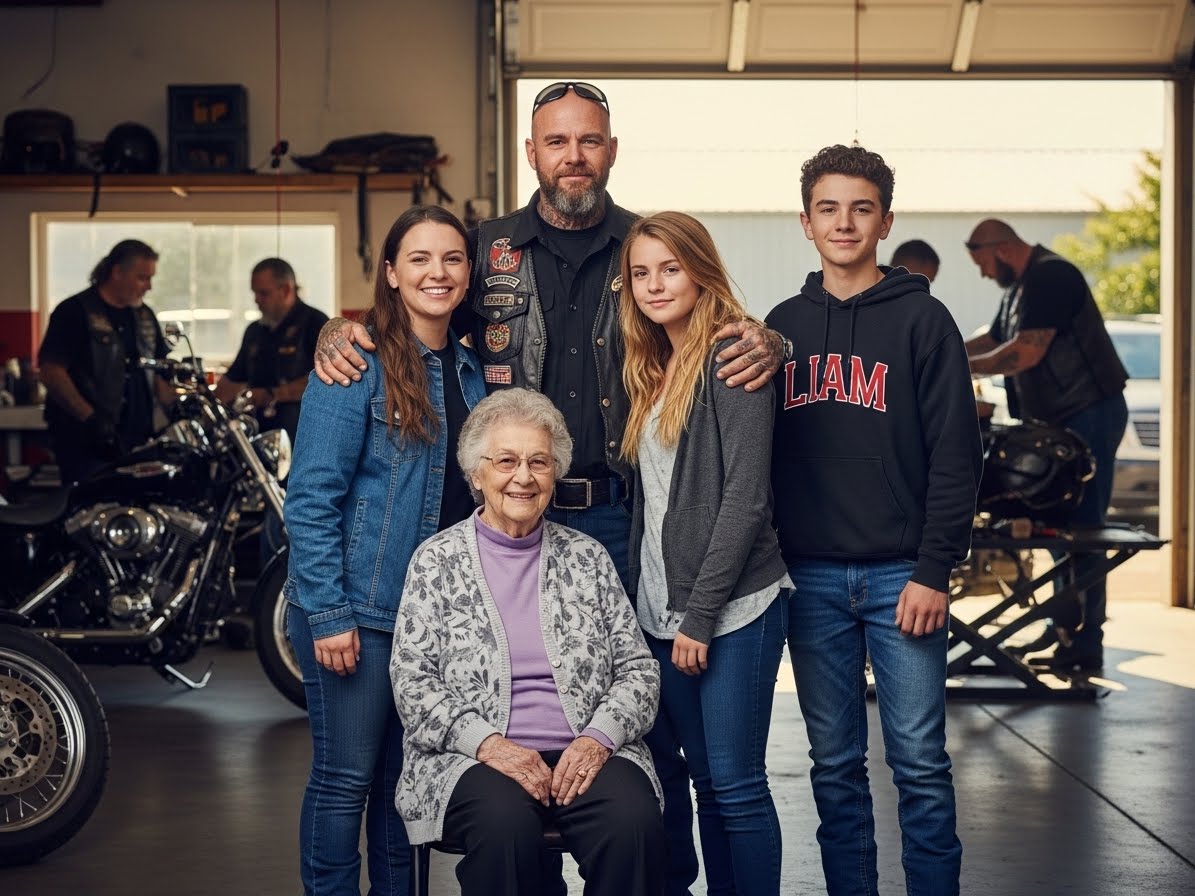
Jonathan walked over. The room went quiet. He was holding a leather vest. It wasn’t an oversized loaner this time. It was tailored. It fit me.
It didn’t have the club patch—I wasn’t a member, not really—but on the back, stitched in white thread, it said: PROPERTY OF NO ONE.
“You’re legal now,” Jonathan said, a grin cracking his beard. “You’re an adult. You can go anywhere you want.”
I took the vest. It felt heavy, like armor. I slipped it on. It fit perfectly.
“I don’t want to go just anywhere,” I said, looking at him. “I want to go to 402 Maple Street.”
Jonathan nodded. He looked at the guys.
“Mount up,” he shouted. “We’ve got a retrieval mission.”
Chapter 8: The Homecoming
The ride to my uncle’s house was a parade of thunder. Twenty bikes. The sound was deafening, a physical force that announced our arrival long before we turned onto the quiet suburban street.
Neighbors peeked out from behind curtains. A dog barked frantically. But nobody came outside.
We pulled up to the house with the peeling paint. The lawn was overgrown. The car in the driveway was new—Greg had spent the checks well—but the house looked like it was rotting from the inside.
Jonathan killed his engine. The silence that followed was heavy.
“Stay back,” Jonathan told the others. “This is Emily’s play.”
He walked with me to the front door. Just the two of us.
I reached for the doorbell, my hand trembling slightly. Then I stopped. I wasn’t a guest. I didn’t need to ring the bell.
I pounded on the door. Three hard knocks.
“Greg! Open up!”
A minute passed. Then the lock clicked.
The door swung open. Uncle Greg stood there. He looked smaller than I remembered. His eyes were bloodshot. He looked at me, then at Jonathan standing behind me, arms crossed.
“What do you want?” Greg muttered. “You got what you wanted. You’re free.”
“I’m here for Liam,” I said.
“He’s not going anywhere,” Greg sneered. “I have custody until he’s eighteen.”
“Actually,” a voice called from the driveway.
Greg looked up. Karen Moss was walking up the path, holding a thick file.
“Mr. Navaro,” Karen said pleasantly. “I’m afraid your custody has been revoked pending the investigation into the discrepancies in your financial reports. And since Emily is now eighteen, legal, and gainfully employed…” She gestured to Jonathan, who nodded. “She has filed for emergency guardianship. The judge signed it this morning.”
Greg’s face turned a spectacular shade of purple. “You can’t do this! That’s my money! That’s my—”
“Boy,” Jonathan finished for him. “He’s a boy. Not a paycheck.”
“Liam!” I yelled past Greg into the dark hallway. “Liam, get your bag!”
There was a thumping sound from upstairs. Footsteps thundered down the hall.
Liam burst into view. He had grown three inches. His hair was messy, and he looked thin, but when he saw me, his face broke open.
“Em?”
“Let’s go,” I said, holding out my hand. “We’re leaving.”
He didn’t hesitate. He grabbed a duffel bag that was sitting by the stairs—he had been packed for days, waiting—and pushed past Greg.
Greg tried to block him. “You ungrateful little—”
Jonathan took one step forward. He didn’t touch Greg. He didn’t have to. The sheer menace radiating off him was enough to make Greg shrink back against the wall.
“Step aside,” Jonathan whispered.
Greg stepped aside.
Liam ran out the door. I grabbed his hand, pulling him into the sunlight. We walked down the path, past Karen Moss who gave us a subtle wink, past the row of gleaming motorcycles, past the neighbors watching from their windows.
We stopped by Jonathan’s bike.
“Is this real?” Liam whispered, looking at the bikers. “Are they… are they with us?”
I looked at Jonathan. I looked at Caleb, who gave me a thumbs up. I looked at Rachel, who was smiling.
“Yeah,” I said, putting my arm around my brother’s shoulders. “They’re with us.”
We didn’t go back to the house right away. We rode out to the trail where it all started. The sun was setting, casting long shadows over the wilderness.
The bikers hung back, giving us space.
Jonathan handed me a small box.
“From Mom,” he said. “She couldn’t make the ride.”
I opened it. Inside was a silver pendant. It was simple, just a silver circle, but engraved on the back was a single word: Family.
“She said you found her when she was lost,” Jonathan said. “She wanted to make sure you never felt lost again.”
I clasped the necklace around my neck. It felt cool against my skin.
I looked at Liam, who was sitting on a rock, watching the sunset with a look of peace I hadn’t seen on his face in years.
I had spent so long running from the monsters in my life that I forgot there were guardians too. I thought I had to do it all alone. I thought strength meant being a fortress that no one could enter.
But standing there, with the smell of pine and gasoline in the air, I realized the truth.
We aren’t meant to survive alone. We are meant to find the people who will stand in the rain with us. The people who will roar down a suburban street to save a kid they don’t even know.
“You ready to go home?” Jonathan asked.
I looked at the clubhouse in the distance, then at my brother, then at the man who had become my father in every way that mattered.
“Yeah,” I smiled. “Let’s go home.”