They Forced Me to Wear a ‘LOSER’ Sign. Then My Military Father Walked Onto the Field.
Chapter 1: The Cardboard Collar
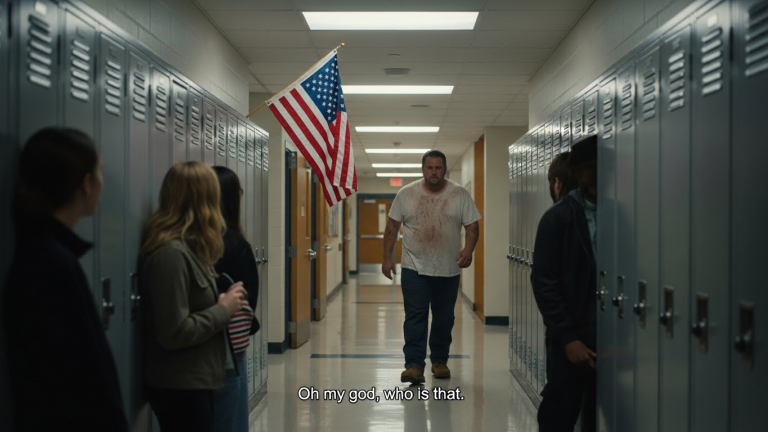
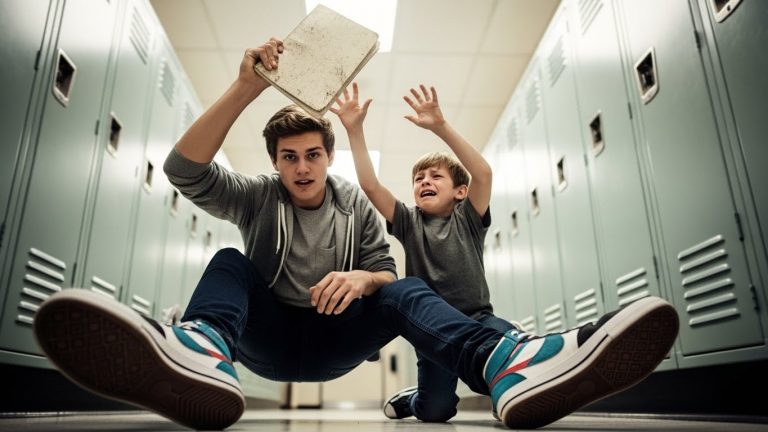
The zip tie bit into the back of my neck, the cold plastic pinching the fine hairs there like a dull serrated knife.
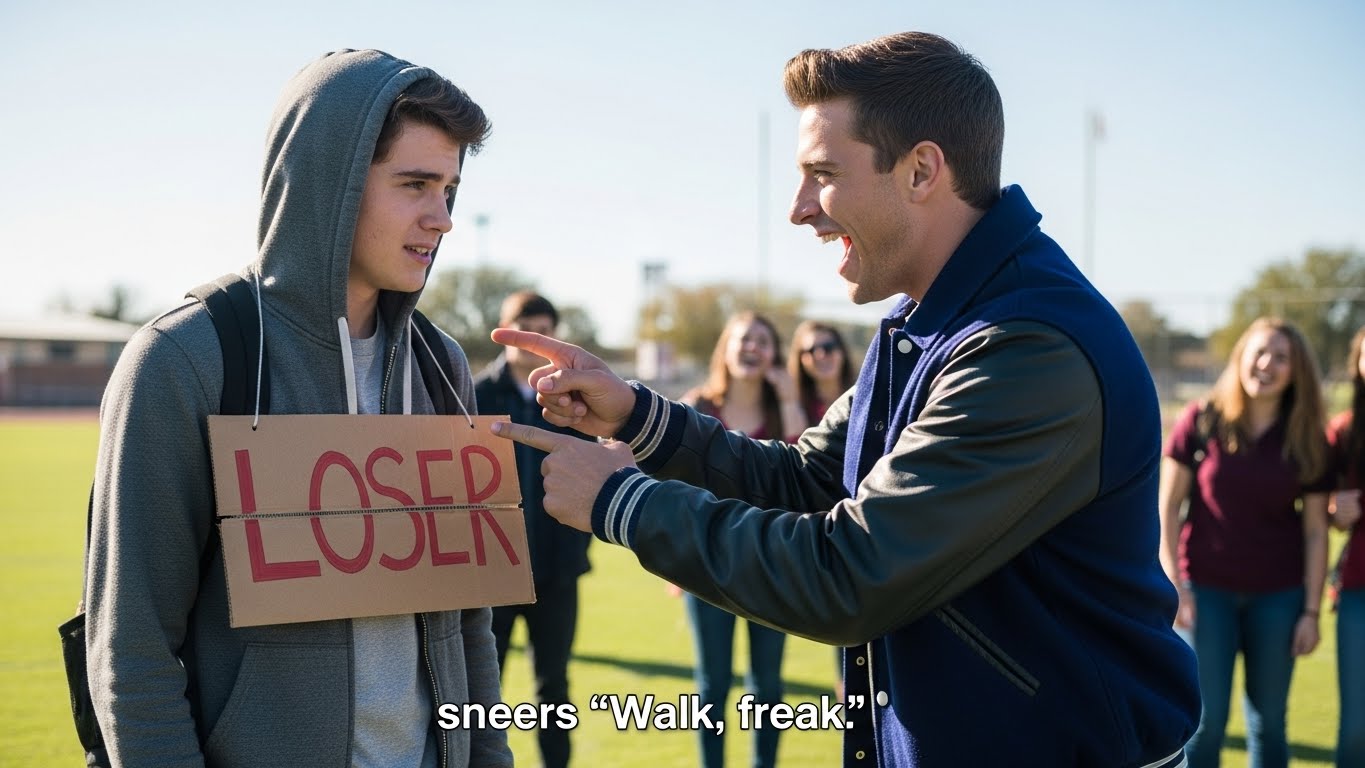
“Tight enough?” Braden asked, his voice thick with that fake, sugary concern that made my stomach turn over. He yanked the cardboard sign down against my chest to test the fit.
I looked down. LOSER.
Written in thick, bleeding red Sharpie. The cardboard was torn from a beer case—probably from the party last weekend I wasn’t invited to.
“Liam, buddy, look at me,” Braden said, tapping my cheek with a manicured hand. He was the golden boy of Creekview High. Quarterback, prom king in training, and currently, the architect of my own personal hell. “It’s just one lap. One lap around the track. You do this, and we forget you exist for the rest of the semester. Deal?”
I swallowed hard. My throat felt like it was stuffed with sawdust. Around us, the rest of the varsity team was leaning against the chain-link fence, snickering. They looked like a pack of hyenas waiting for the carcass to drop. A few girls from the cheer squad were pretending not to look, checking their phones with aggressive disinterest, but I saw the camera lenses peeking over the tops of their cases.
“Do I have a choice?” I whispered.
“No,” Braden grinned, showing teeth that were too white, too perfect. “Not really.”
He spun me around and shoved me toward the red clay of the track. It was 3:00 PM on a Tuesday in Texas. The heat was oppressive, a physical weight radiating off the aluminum bleachers, blurring the air into a shimmering haze.
I took the first step. The sign banged against my ribs. Thump. Thump. Like a second, shameful heartbeat.
I was sixteen, skinny, and into graphic novels. In this town, where Friday Night Lights was a religion, that was a crime punishable by public execution. My dad was… away. Again. He’d been deployed to a base in Germany, then moved somewhere else—somewhere he couldn’t tell me about—for eleven months this rotation.
I hadn’t told him about the bullying in our Skype calls. How could I? He was a Colonel. A man who led battalions. A man whose medals clinked when he walked. I couldn’t even walk to my locker without shaking. I didn’t want him to know his son was a coward.
“Pick up the pace, Loser!” someone shouted from the stands. It sounded like Kyle, the linebacker.
Laughter rippled through the sticky air.
I kept my head down, staring at my worn-out Converse sneakers. Just keep walking, I told myself. One foot. Then the other. Survive until 3:15. Mom is picking me up at 3:30. Just survive.
But inside, something was cracking. It wasn’t just the humiliation. It was the loneliness. The crushing realization that no one was coming to help. The teachers were inside enjoying the AC. The other students were relieved it wasn’t them. I was completely, utterly alone.
Chapter 2: The Arrival
By the time I reached the halfway mark, the sweat was stinging my eyes, mixing with the sunscreen I’d hastily applied before gym class. The cardboard was chafing my neck raw, the rough edge sawing back and forth with every step.
Every movement felt heavier than the last. I could hear Braden and his crew jogging parallel to me on the grass, mocking my gait.
“Look at him,” Braden jeered, tossing a football up and catching it. “He walks like he’s broken. Maybe we should call the vet and have him put down.”
I was broken. I felt it in my marrow. I wanted to disappear. I wanted the red clay to open up and swallow me whole so I’d never have to see another human face again.
I rounded the curve near the parking lot entrance. That’s when the atmosphere shifted.
It was subtle at first. The jeering from the fence line quieted down. The laughter from the stands sputtered out like a dying engine.
I stopped. The silence was louder than the noise had been. It was heavy. Expectant.
I looked up, squinting against the harsh Texas sun.
A black government-issue Chevy Tahoe had pulled up right onto the grass, bypassing the designated parking spots entirely. It had hopped the curb, tearing up a strip of the pristine sod the principal loved so much. The engine was still ticking as the driver’s side door opened.
A pair of polished black combat boots hit the turf.
Then, the rest of him emerged.
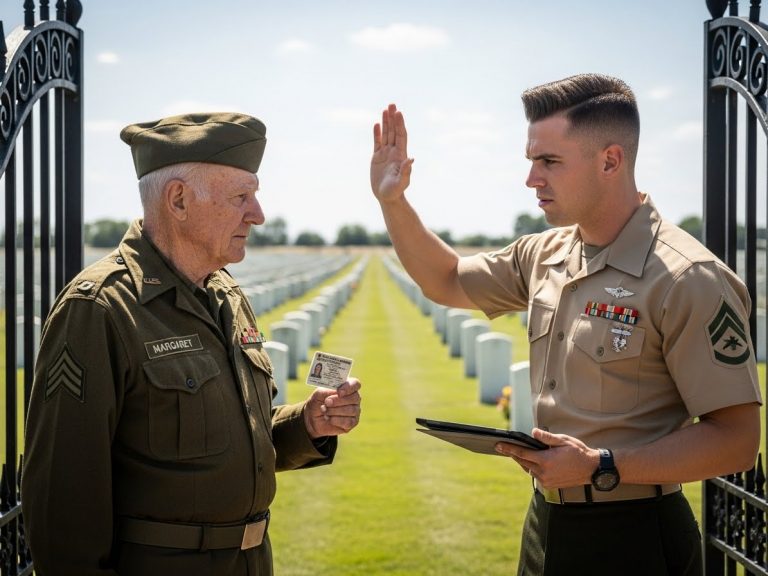
Full dress uniform. Digital camouflage turned in for crisp Army greens. The jacket was tailored perfectly to a frame that was all muscle and rigid discipline. Medals and ribbons caught the sun like fire—a Silver Star, a Purple Heart, rows of commendations that told a story of violence and survival.
He was tall, broad-shouldered, and terrifyingly still. He adjusted his black beret with a sharp, practiced movement.
It was Colonel Jack Miller.
My dad.
He wasn’t supposed to be home for another two weeks.
He took off his sunglasses, revealing steel-grey eyes that were currently scanning the field like he was assessing a hostile combat zone. His gaze swept over the football players, the laughing girls, the terrified coaches… and finally, it landed on me.
Or rather, it landed on the sign around my neck.
I saw the moment the realization hit him. His jaw set. A muscle feathered in his cheek.
The color drained from Braden’s face. He stopped jogging. The swagger evaporated instantly, replaced by the primal fear of a predator realizing it just walked into a lion’s den.
My dad didn’t run. He didn’t shout. He just started walking toward me. His stride was long, rhythmic, and deadly calm. He walked right past the stunned football coach, Coach Miller (no relation, thank God), who opened his mouth to say something about “no vehicles on the field” and then wisely shut it.
He walked right through the group of varsity players. They parted like the Red Sea. Big guys, guys who benched 250 pounds, scrambled backward to get out of his path.
He stopped two feet in front of me. He smelled like starch, leather, and airplane fuel.
He looked at the zip tie. He looked at the red ink. Then he looked at Braden, who was now trembling near the fence, holding his football like a shield.
“Liam,” my dad said, his voice low, a rumble that vibrated in my chest. “Stand at attention.”
I straightened my spine instinctively. Shoulders back. Chin up. It was muscle memory from childhood.
“Who authorized this uniform modification?” he asked, pointing a gloved finger at the sign.
“I… they…” I stammered, my voice cracking. Tears threatened to spill over, but I held them back. Not in front of him.
Dad turned slowly to face the group. The silence on the field was absolute. You could hear a pin drop in the grass.
“Which one of you,” Dad said, his voice carrying all the way to the top of the bleachers without him even raising it, “decided my son needed a label?”
No one moved.
“I’m not asking twice,” he said. The tone was ice cold.
Chapter 3: The Ranking Officer
Braden took a half-step back, his eyes darting toward the school building, looking for an exit. He was used to intimidating freshmen and geometry teachers, not men who dismantled insurgents for a living.
“You,” Dad barked. It wasn’t a question. It was a command that hit you in the chest. “Front and center.”
Braden froze. For a second, I thought he was going to run. But the sheer authority radiating off my father pinned him in place. Braden shuffled forward, dragging his feet. He looked small now. Just a kid in a polyester jersey.
“It… it was just a joke, sir,” Braden squeaked. “We were just… messing around. Initiating him into the… spirit of the school.”
“Initiating,” my dad repeated the word like it tasted rotten.
Suddenly, the side doors of the gym burst open. Mr. Henderson, the Principal, came jogging out, his tie flapping over his shoulder. He was a nervous man who hated confrontation and loved donations from the football booster club.
“Now, now! What is going on here?” Henderson panted, arriving at the scene. He looked at the SUV on his grass, then at my dad. “Sir, you cannot drive onto school property like this! This is a liability! I’ll have to ask you to—”
My dad didn’t even look at him. He held up one hand, palm out. A universal stop signal.
“Mr. Henderson,” Dad said, still staring directly at Braden. “Unless you want me to call the base commander and have a discussion about how this school protects the children of active-duty service members, you will remain silent.”
Henderson’s mouth snapped shut with an audible click. He knew the military base provided 40% of the district’s funding. He went pale.
Dad turned back to Braden. He reached into his belt and pulled out a tactical folding knife.
The cheerleaders gasped. Braden flinched so hard he almost fell over.
“Easy,” Dad said softly.
He stepped toward me. With surgical precision, he slid the blade behind the zip tie at my neck. He didn’t even graze my skin. Snap.
The cardboard sign fell to the red dirt. LOSER lay face down in the dust.
Dad folded the knife and clipped it back away. Then he placed both hands on my shoulders. His grip was firm, grounding. For the first time in months, I felt safe.
“Liam,” he said, loud enough for everyone to hear. “Pick it up.”
I blinked. “What?”
“The sign,” he said. “Pick it up.”
I bent down and retrieved the cardboard. My hands were shaking.
Dad took it from me. He walked over to Braden, invading his personal space. Braden was taller than me, but my dad towered over him by three inches and about fifty pounds of hardened muscle.
“You like labels, son?” Dad asked Braden.
Braden shook his head frantically. “No, sir. No.”
“I think you do,” Dad said. “You spent a lot of time making this. It would be a waste to throw it away.”
Dad looked at the varsity team, then at the coach, and finally back at Braden.
“I have a new mission objective for you,” Dad said, his voice dropping to a terrifying whisper. “You have two choices. Choice A: I call the police and file charges for assault, harassment, and unlawful restraint. My lawyers are very good, and a criminal record destroys your chances at a D1 scholarship.”
Braden looked like he was going to vomit. Football was his entire life.
“Choice B?” Braden whispered.
Dad smiled. It wasn’t a nice smile.
“Choice B is you finish the lap,” Dad said. “But you wear the uniform you designed.”
Braden stared at the sign in Dad’s hand.
“I… I can’t,” Braden stammered. “Everyone is watching.”
“That,” Dad said, shoving the sign into Braden’s chest, “is the point.”
My dad pulled a fresh zip tie from his cargo pocket—why he had one, I didn’t know, but I wasn’t asking—and held it out.
“Turn around,” Dad commanded.
Braden looked at Coach Miller for help. The Coach looked at the sky, suddenly very interested in a passing cloud. He looked at Principal Henderson. Henderson was busy inspecting his shoes.
Defeated, Braden turned around.
Dad secured the sign around Braden’s neck. It looked ridiculous on him. The red LOSER seemed to glow against his varsity jacket.
“One lap,” Dad said. “Walking. If you jog, you start over. If you take it off, I call the police. Am I clear?”
“Yes, sir,” Braden choked out.
“Move.”
Braden took the first step. A few students in the stands giggled. Then a few more. The tables hadn’t just turned; they had been flipped over and smashed.
Dad didn’t watch him. He turned back to me, his face softening instantly. The terrifying soldier vanished, replaced by my father.
“You okay, kid?” he asked, brushing some dust off my shoulder.
“Yeah,” I breathed. “I am now.”
“Good,” he said. “Get in the truck. We’re not done yet.”
“We’re not?”
“No,” Dad said, opening the passenger door for me. “That was just the warm-up. We have a meeting to get to.”
“With who?”
Dad started the engine, the rumble drowning out the sound of Braden’s shame-filled walk.
“With your principal,” Dad said, shifting into gear. “And the school board. I have some questions about why my son has been fighting a war all by himself.”Chapter 4: The Rules of Engagement
Principal Henderson’s office smelled like stale coffee and lemon floor wax. It was a smell I associated with trouble—the few times I’d been called in here were to be told to “ignore” the boys who tripped me in the hallway.
Now, Henderson sat behind his mahogany desk, sweating through his dress shirt. My dad sat opposite him, posture rigid, hands folded on the table. I sat in the corner, trying to make myself small.
“Colonel Miller,” Henderson began, his voice wavering. “I want to assure you, Creekview High has a zero-tolerance policy for bullying. We take these matters very seriously.”
“Zero tolerance,” Dad repeated. He didn’t shout. He spoke with the quiet, terrifying calm of a man who held the codes to airstrikes. “Is that why my son has been shoved into lockers three times this month? Is that why his gym clothes were stolen last week?”
Henderson blinked. “I… I wasn’t aware of those specific incidents.”
“That’s the problem,” Dad said. He reached into his jacket pocket and pulled out a folded stack of papers. He tossed them onto the desk.
“What is this?” Henderson asked.
“Emails,” Dad said. “Emails my son sent to his guidance counselor. Emails sent to your Vice Principal. Dates. Times. Witnesses. All ignored.”
I looked up, stunned. I didn’t know Dad had access to my sent folder. I didn’t know he’d been reading them from a barracks in the Middle East.
“Liam didn’t tell me,” Dad continued, his voice softening just a fraction as he glanced at me. “I had to find out because I saw a video on TikTok. A video of my son being tripped in the cafeteria while fifty kids laughed. It had four thousand likes.”
My face burned. I stared at the carpet. He had seen it. He had seen me weak.
“Mr. Henderson,” Dad leaned forward. “I command a battalion. I am responsible for the lives of eight hundred men and women. If one of them is hurt on my watch, I answer for it. You are responsible for two thousand students. And you let a pack of wolves hunt my son in broad daylight.”
“We will handle Braden,” Henderson promised quickly. “Suspension. Counseling. I promise.”
“You will,” Dad said, standing up. The chair scraped loudly against the floor. “And you will also implement a mandatory anti-bullying seminar for the varsity staff. And you will ensure Liam is not retaliated against. Because if I have to come back here, I won’t be alone. I’ll bring the JAG officers from the base, and we will audit every cent of federal funding this school receives.”
Henderson looked like he was about to faint. “Understood, Colonel. Completely understood.”
Dad turned to me. “Let’s go, Liam.”
We walked out. The secretaries stopped typing to watch us pass. For the first time in my life, I didn’t walk with my head down. I walked in my father’s wake, drafting behind his strength.
Chapter 5: Checkpoint Charlie
The ride home was quiet. The adrenaline of the confrontation was fading, leaving behind a thick, awkward silence.
My dad drove the Tahoe with one hand on the wheel, his eyes scanning the road. The radio was off.
“Hungry?” he asked suddenly.
“A little,” I lied. I was starving, but my stomach was still in knots.
He pulled into a Whataburger. It was our tradition, or at least it used to be before he deployed. We got our food and sat in a booth near the window. The normalcy of it—fries, ketchup, condensation on the soda cups—felt jarring after the scene at the track.
Dad took a bite of his burger, then looked at me. The intensity was gone from his eyes, replaced by a weary sadness. He looked older than I remembered. There were new grey hairs in his temples.
“I’m sorry, Liam,” he said.
I paused, a fry halfway to my mouth. “For what? You saved me.”
“I shouldn’t have had to,” he said. He stared at his hands. “I’ve been gone too long. I missed it. I missed all of it. A father is supposed to protect his kid, and I was five thousand miles away playing soldier while you were fighting a war in your own school.”
“It’s not your fault, Dad. You were serving.”
“That’s an excuse,” he said sharply. Then he sighed. “I saw that video, Liam. The one in the cafeteria. It broke me. I wanted to fly home that night. I felt… helpless.”
I looked at this man—this giant who scared full-grown adults—and saw the crack in the armor. He wasn’t Superman. He was just a dad who felt guilty.
“You came back,” I said quietly. “That’s what matters.”
He reached across the table and squeezed my shoulder. His hand was rough, calloused. “I’m back now. And I’m not going anywhere for a while. But Liam… you have to promise me something.”
“What?”
“Don’t hide things from me,” he said. “I can handle insurgents. I can handle enemy fire. I can’t handle not knowing if my son is safe. We’re a team. You and me. Squad of two. Copy?”
I smiled, a real smile this time. “Copy.”
“Good,” he said, stealing one of my fries. “Now eat. You look like a twig. We’re hitting the gym tomorrow. If you’re going to survive high school, we need to put some armor on you.”
Chapter 6: Collateral Damage
The next day, walking into school felt like walking onto a movie set after a major scandal.
The hallway, usually a cacophony of shouting and slamming lockers, went quiet as I passed. People stared. They whispered.
“That’s him.” “Did you see his dad?” “I heard Braden cried.”
I kept my head up, just like Dad taught me. I went to my locker. No one bumped me. No one kicked my books. It was peaceful, but it was a strange, isolating peace. I wasn’t “Liam” anymore. I was “The Colonel’s Kid.” I was untouchable, but I was also radioactive.
I walked into first-period History. Braden wasn’t there. His desk was empty.
I sat down, and for the first time all year, the guy sitting next to me—a basketball player named Marcus—nodded at me. It wasn’t a friendly nod, exactly. It was a nod of respect. Or fear. I couldn’t tell the difference yet.
But the peace didn’t last.
At lunch, I was sitting alone (as usual) when a shadow fell over my table. I tensed up, expecting Braden’s goons.
It was Sarah. She was in my English class. She had blue streaks in her hair and always wore headphones. We had never spoken a word to each other.
She slammed a tray down across from me.
“That was badass,” she said, opening a milk carton.
I blinked. “What?”
“Yesterday,” she said. “Braden walking the track with the sign. I took a picture. It’s already a meme.”
“Oh,” I said. “I didn’t want… I didn’t want it to be a big deal.”
“It needed to be,” she said. She bit into an apple. “Braden has been terrorizing this school for three years. Nobody stood up to him. Not the teachers. Not us. Your dad is a legend.”
“He’s just… my dad.”
“Well, your dad kicked the hornet’s nest,” Sarah said, her voice dropping. She nodded toward the cafeteria entrance.
I turned around.
The double doors swung open. But it wasn’t Braden.
It was a man in a tailored Italian suit. He was holding a briefcase, flanked by Principal Henderson and a uniformed police officer. He looked like he owned the building. He looked like an older, richer, meaner version of Braden.
“Who is that?” I asked.
“That,” Sarah whispered, “is Mr. Sterling. Braden’s dad. And he owns half the town.”
Mr. Sterling scanned the cafeteria. His eyes locked on me. He didn’t look scared like the kids. He looked furious. He pointed a finger at me and whispered something to the police officer.
The officer started walking toward my table.
My stomach dropped. Dad had won the battle of physical intimidation. But Mr. Sterling didn’t fight with fists. He fought with money and lawyers.
“Liam Miller?” the officer said, stopping at my table.
“Yes?” I squeaked.
“You need to come with us,” the officer said. “We have a complaint filed against you.”
“Against me?” I stood up. “For what?”
Mr. Sterling stepped forward, a shark-like grin on his face.
“Cyberbullying,” Sterling said smoothly. “Recording a minor without consent. Defamation of character. And… emotional distress caused to my son.”
“That’s a lie!” I shouted.
“Save it for the judge, kid,” Sterling said. “Call your father. Tell him the war isn’t over.”