I Was Invisible In My Own Home Until My Father Threw Me Through Drywall—Now They Can’t Look Away From The Truth
Chapter 1: The Physics of Collateral Damage
The house on Elm Street, in the suburbs of Ohio, always smelled of lemon pledge and stale bourbon by 8:00 PM on a Friday. To the neighbors, Mark and Sarah changing the oil in their driveway or mowing the lawn on Sundays looked like the picture of the American Dream. But inside, the air pressure was different. It was heavier, thicker, charged with a static electricity that made the hair on twelve-year-old Leo’s arms stand up long before the first shout was fired.
Leo was a wallflower. It wasn’t just a personality trait; it was a survival mechanism. Over the years, he had perfected the art of stillness. If he sat perfectly still in the winged armchair in the corner of the living room, if he slowed his breathing until it was barely a whisper, he could become part of the upholstery. He could merge with the beige paint of the walls. Invisibility was safety. He knew exactly which floorboards squeaked and which doors needed to be lifted slightly to close silently. He was a ghost in his own life, haunting the periphery of his parents’ volatility.
Tonight, however, the camouflage wasn’t working.
It started with a receipt. It always started with something small—a piece of paper, a forgotten chore, a glance that lingered too long. Mark, a large man whose hands were permanently stained with grease from the auto shop, slammed his fist onto the kitchen island. The granite countertop didn’t flinch, but the entire house seemed to shudder. The vibration traveled through the floor, up through Leo’s sneakers, and settled in his gut.
“Three hundred dollars, Sarah? Three hundred?” Mark’s voice wasn’t slurred yet, but it had that jagged edge, like broken glass wrapped in velvet. “We are behind on the mortgage, and you’re buying… what is this? Boutique clothes?”
Sarah was leaning against the sink, a glass of Chardonnay in her hand. It was her fourth. Her eyes were glassy, her makeup slightly smeared. She didn’t look frightened anymore; she just looked tired and mean. “It’s for the presentation next week. I have to look professional, Mark. Unlike you, I don’t work in a pit.”
“Don’t you talk down to me,” Mark growled, taking a step forward. The floorboards groaned.
Leo, sitting in the living room adjacent to the open-concept kitchen, stopped breathing. He gripped his comic book so hard the pages crinkled. Don’t look up, he told himself. Be the chair. Be the wall. If he looked up, he would become a participant. If he stayed down, he remained an observer.
“I’ll talk how I want,” Sarah snapped, her voice rising an octave. She took a swig of wine, the liquid sloshing over the rim. “Maybe if you didn’t drink away your paycheck at the bar before coming home, we wouldn’t be worried about three hundred dollars.”
That was the trigger. It was always the trigger. Mentioning the drinking was like pulling the pin on a grenade that Mark had been juggling all evening.
Mark lunged. He didn’t hit her, not initially. He swiped the wine glass from her hand. It shattered against the subway-tile backsplash, raining shards of glass and wine like jagged confetti. Sarah screamed—a high, piercing sound that cut through Leo’s chest.
“You ungrateful witch!” Mark roared.
Leo knew the routine. Usually, this was when he would retreat to his room, lock the door, and put on his noise-canceling headphones. But something about tonight felt different. The air was too hot. The rage was too focused. Mark wasn’t just venting; he was hunting. The violence wasn’t dissipating with the smashed glass; it was escalating.
Sarah pushed Mark back, her hands slipping on his flannel shirt. “Get out! Just get out!”
Mark grabbed her by the shoulders and shook her. Her head whipped back and forth, her blonde hair flying. “I pay for this house! You get out!”
Leo stood up. He didn’t mean to. His legs moved on their own, driven by a primal instinct that overrode his training as a ghost. He dropped the comic book. It hit the floor with a soft thud, but in the silence between screams, it sounded like a gunshot.
Mark and Sarah both froze, turning their heads toward the living room.
“Leo,” Sarah breathed, her face pale.
“Stop it,” Leo said. His voice was small, cracking in the middle. He hated how weak he sounded. “Just stop fighting.”
Mark’s eyes were bloodshot, two burning coals in a flushed face. He released Sarah and turned his bulk toward his son. “Go to your room, Leo.”
“No,” Leo said, his knees shaking. “Don’t hurt her.”
“I said, go to your room!” Mark bellowed, stepping over the broken glass. He didn’t even check to see if he was cutting his feet.
“Mark, leave him alone,” Sarah cried out, reaching for her husband’s arm, but he swatted her away like a fly. She stumbled back into the counter, clutching her side.
Leo didn’t move. He stood his ground between the hallway and the kitchen, a skinny twelve-year-old blocking the path of a two-hundred-pound drunk man. “You’re scaring us,” Leo whispered.
Mark laughed, a dry, humorless sound. “I’m scaring you? I’m trying to teach you respect! Both of you!”
He closed the distance in two strides. Leo flinched, raising his arms to protect his face. He expected a slap. He expected the stinging heat of a hand across his cheek. He prepared for the pain he knew.
But he didn’t get the pain he knew. He got physics.
Mark didn’t strike him. He grabbed the front of Leo’s hoodie with both hands. The fabric pulled tight against Leo’s throat, choking him instantly. Leo’s feet left the ground.
For a split second, there was weightlessness. It was a bizarre, almost peaceful sensation. Leo felt like an astronaut, untethered from gravity. He saw the ceiling fan spinning slowly above him—wobbling slightly on its axis. He saw the dust motes dancing in the light of the chandelier. Time dilated, stretching that single second into an eternity.
I’m flying, he thought, his mind unable to process the violence.
Then, the acceleration took over. Mark pivoted, using his entire body weight to hurl his son across the room like a sack of garbage.
Leo flew backward. He couldn’t brace himself. He couldn’t tuck and roll.
The impact wasn’t a thud. It was a crunch.
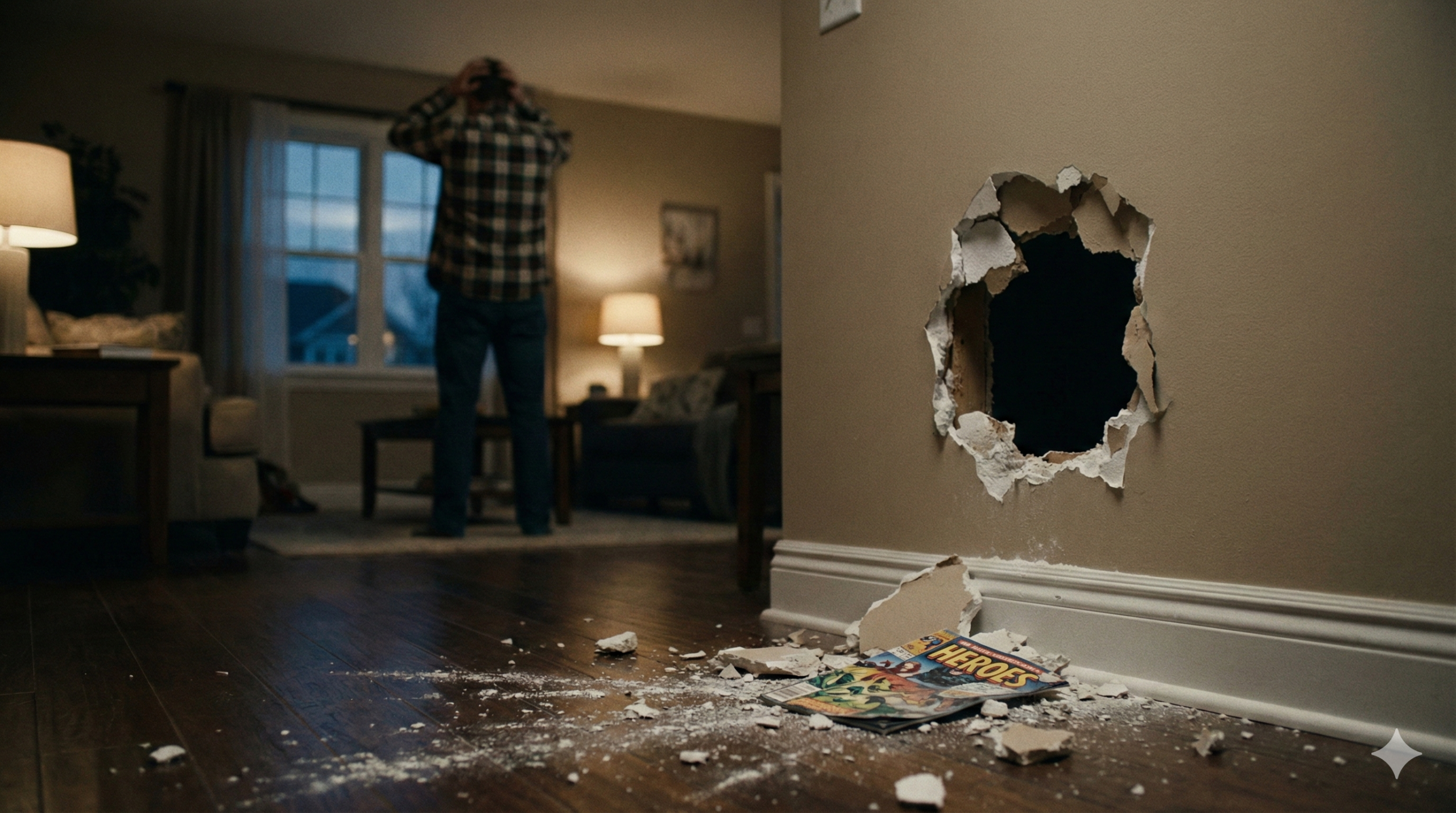
Leo hit the drywall between the hallway and the living room. His back struck a stud, but his head and shoulder punched through the sheetrock. The sound was deafening—the tearing of paper, the snapping of gypsum, and the wet crack of bone.
He didn’t slide down the wall. He crumpled.
The world went white. A blinding, searing white that erased the kitchen, his parents, and the smell of bourbon. Then came the sound. It wasn’t a scream. It was a high-pitched ringing, like a tea kettle screaming inside his skull. Eeeeeeeeeeeee.
He was on the floor. He tried to take a breath, but his lungs refused to expand. The wind had been knocked out of him so violently that his diaphragm was paralyzed. He opened his mouth to gasp, but all he tasted was copper.
He bit his tongue. Hard. Warm blood filled his mouth, mixing with the drywall dust that coated his lips.
“Leo?”
The voice sounded like it was coming from underwater.
Leo blinked. The white faded to a fuzzy gray. He was staring at the baseboard. There was a hole in the wall above him, shaped vaguely like a human torso. Dust was still drifting down, settling on his eyelashes.
“Oh my god, Mark! What did you do?” Sarah’s scream was raw, hysterical.
“I… I didn’t mean to…” Mark’s voice was trembling now. The rage had evaporated, replaced by the sudden, terrifying clarity of consequences.
Leo tried to push himself up, but his left arm didn’t work. It just hung there, a dead weight attached to a shoulder that felt like it was on fire. A low moan escaped his lips, bubbling through the blood.
“Don’t move him! Don’t move him!” Sarah was beside him now, hovering, afraid to touch him.
“He’s fine, he’s fine,” Mark stammered, pacing in a tight circle. “Leo, get up. Shake it off, buddy. You’re okay. Tell your mom you’re okay.”
Leo looked at his father. Mark looked huge from this angle, a distorted giant looming over him. But Leo noticed something else. Mark was shaking.
“I can’t,” Leo wheezed, finally catching a shallow breath. “My arm…”
“We have to take him to the ER,” Sarah sobbed.
“No!” Mark snapped. “Think, Sarah! They’ll ask questions. We can’t… we can’t go there yet. We need to get our story straight. He fell. He was running and he tripped.”
Lying on the floor, amidst the drywall dust and the shattered glass of his childhood innocence, Leo realized the truth. He wasn’t a son to them. He was a liability. Even now, with his bones broken and his head swimming in a concussion fog, their first instinct wasn’t to save him. It was to save themselves.
The ringing in his ears grew louder, drowning out their bickering. But through the haze, he heard a sound that cut through the noise.
Knocking.
Heavy, authoritative pounding on the front door.
“Police! Open up!”
Mrs. Gable. The old lady next door who spent her days gardening and watching the street from behind her lace curtains. She must have heard the scream. She must have heard the crash.
Mark’s face went white. He looked at the door, then down at Leo. For a second, Leo saw a flash of something dangerous in his father’s eyes—a desire to finish the job, to hide the evidence. But the pounding came again, louder this time.
“Open the door, or we will kick it in!”
Leo closed his eyes and let the darkness take him. He didn’t have to be a wallflower anymore. The wall had spit him out.
Chapter 2: The Art of Gaslighting
The ride to the emergency room was a masterpiece of tension, more suffocating than the chokehold had been. They hadn’t opened the door for the police. Mark had panicked, grabbed Leo, and shoved him into the backseat of the sedan before the officers could force entry, speeding out of the driveway while the patrol car was still rounding the corner. It was a desperate, stupid move, but in his drunken logic, Mark thought getting Leo away from the “scene of the crime” would save him.
Leo sat in the back, cradling his left arm. Every bump in the road sent a jolt of nausea-inducing pain radiating from his collarbone to his fingertips. He felt sick, not just from the injury, but from the smell of the car interior—old leather and the lingering scent of fast food.
Sarah was in the passenger seat, twisting her hands in her lap. She kept glancing back at Leo, her eyes wide and wet.
“We have to have a story,” Mark said, his eyes glued to the rearview mirror. “Leo, listen to me. This is important.”
Leo stared out the window at the passing streetlights. They blurred into streaks of yellow, like comets.
“You were running in the house,” Mark continued, his voice taking on a rehearsed, pleading tone. “You were chasing… a cat. A stray cat that got in. You slipped on the rug and hit the wall. You understand?”
“We don’t have a cat,” Leo murmured, his voice thick.
“It was a stray!” Mark snapped, hitting the steering wheel. “Dammit, Leo, work with me here. If you tell them what happened, they’ll take you away. They’ll put you in a foster home with strangers. Do you want that? Do you want to live with strangers who don’t care about you?”
Leo looked at the back of his father’s head. Strangers might be better, he thought. Strangers might not throw me.
“Mark, stop scaring him,” Sarah whispered.
“I’m protecting us!” Mark yelled. “Sarah, you tell him. Tell him what happens if he talks.”
Sarah turned around in her seat. Her face was a mask of tragic desperation. “Leo, honey… please. Just say you fell. For me? If Daddy goes to jail, we lose the house. We lose everything. Please.”
That was the knife. The physical pain was one thing, but this was a different kind of injury. His mother, the woman who had bandaged his scraped knees and made him soup when he had the flu, was asking him to cover up his own assault. She was choosing her lifestyle, her house, and her abusive husband over her son’s safety.
Leo didn’t answer. He just closed his eyes and let the tears leak out.
When they arrived at the ER, the lights were aggressive. They buzzed with a fluorescent hum that synced painfully with the throbbing in Leo’s left temple. He was placed on a gurney, a neck brace itching his skin, his left arm immobilized in a temporary sling.
A nurse with kind eyes and tired shoulders was checking his vitals. Her nametag read ‘Betty.’ She moved with efficiency, but her touch was gentle. “Can you tell me your name, sweetheart?”
“Leo,” he whispered. His tongue felt swollen, the cut from where he bit it stinging with every word.
“Okay, Leo. You took quite a tumble. Do you remember what happened?”
Before Leo could answer, the curtain swept open. Mark and Sarah stood there. They looked eerily presentable. Sarah had wiped off her makeup in the car and tied her hair back. Mark had tucked in his shirt and popped a handful of breath mints—strong peppermint trying to mask the bourbon.
“He’s a clumsy kid,” Mark said, stepping into the room with a forced, tight smile. He moved to the side of the bed, placing a heavy hand on Leo’s uninjured shoulder. It was a warning grip. “Always running around in socks on the hardwood. We’ve told him a million times, right, Leo?”
Leo looked at the nurse, then at his father. The fear was a cold stone in his stomach. He saw the slight pressure of Mark’s thumb digging into his skin.
“He tripped?” the nurse asked, writing something on her clipboard without looking up. “And hit the wall hard enough to cause a Grade 2 concussion and a fractured clavicle? That’s some velocity for a trip.”
“He was running,” Sarah added quickly, her voice high and brittle. “He was chasing the… the cat. And he slid.”
The cat. The imaginary cat.
Leo looked at his mother. She wouldn’t meet his eyes. She was staring at the heart monitor, watching the green line peak and valley, mesmerizing herself to avoid the reality of her son’s broken body.
“Leo,” the nurse said, stopping her writing. She put the pen down and looked directly at him. Her eyes were sharp, intelligent. She had seen this script before. “Is that what happened? Did you trip chasing a cat?”
The room went silent. The beep of the monitor seemed to slow down. Mark’s fingers dug slightly deeper into Leo’s shoulder. Just a millimeter of pressure. A reminder of who held the power.
Say yes, the voice in Leo’s head screamed. Say yes and we go home. Say yes and the yelling stops.
But then he remembered the feeling of flight. The weightlessness. The look on his father’s face—not of concern, but of annoyance that Leo had interrupted the fight. He remembered the police at the door and the way Mark had whispered, Don’t say a word, while the officers were pounding.
Leo looked at the nurse. “We don’t have a cat.”
Mark’s hand spasmed. “Leo, don’t be confused. The concussion—”
“We don’t have a cat,” Leo repeated, louder this time. The fog in his brain was clearing. “And I didn’t trip.”
The nurse’s expression shifted. It went from professional to protective in a heartbeat. She stepped between Mark and the bed, breaking the physical contact. “Sir, I’m going to ask you and your wife to step out to the waiting room while we finish the examination.”
“I’m not leaving my son,” Mark bristled, puffing out his chest, trying to use his size to intimidate.
“Sir, that wasn’t a request. Step out, or I call security.” The nurse didn’t flinch. She was five-foot-four, but she held the space like a linebacker. “This is a sterile environment and you are crowding the patient.”
Sarah grabbed Mark’s arm. “Come on, Mark. Let the doctors work.” She dragged him out, but not before Mark shot Leo a look of pure venom. You’re dead, the eyes said.
As soon as the curtain closed, the nurse keyed her radio. “I need a social worker in Bay 4. Stat. Possible 416.” She turned back to Leo and took his good hand. “You’re safe now, Leo. You did the brave thing. You just did the hardest thing you’ll ever have to do.”
Ten minutes later, a woman named Ms. Halloway walked in. She was older, wearing a cardigan that looked like it had been knitted by someone who loved her. She sat down on the stool next to Leo’s bed.
“Leo, my name is Janice. I work for Child Protective Services. The police officers who came to your house… they saw the wall, Leo. They broke the door down after you left. They saw the hole.”
Leo stared at the ceiling tiles. “It looks like a person,” he murmured. “The hole.”
“Yes,” Janice said softly. “It does. Officer Miller said it looked like someone was thrown. The physics… they don’t lie, Leo. People lie. Physics doesn’t.”
Leo closed his eyes. Tears leaked out, hot and salty, running into his ears. “I tried to stop them fighting. Mom was going to get hurt.”
“So you stepped in?”
“I tried to be invisible. But it didn’t work.”
Janice reached out and touched his hand. “No child should have to be invisible in their own home. I need you to tell me exactly what happened, Leo. Can you do that? If you tell me the truth, I can make sure you never have to go back there.”
Never go back. The words hung in the air. No more Friday night fights. No more hiding in the chair. No more walking on eggshells. But also… no more bedroom? No more of his comic books? No more of the only life he had ever known?
It was terrifying. But the alternative was going back to that house with the man who threw him and the woman who watched it happen.
“He picked me up,” Leo whispered. “By my hoodie. And he threw me. Like I was trash.”
Janice wrote it down. Her pen scratched against the paper, a sound of judgment and record. “Did your mother try to stop him?”
“She screamed. Afterward.” Leo swallowed the lump in his throat. “But in the car… she told me to say it was the cat. She chose him, Ms. Janice. She chose him.”
That was the hardest part. The bones would heal. The drywall could be patched. But the betrayal of his mother conspiring to protect his abuser? That was a fracture that would never set right.
Janice closed her notebook. “Thank you, Leo. That was very brave. Officer Miller is outside. He’s going to take a statement from you too, just to make it official. And then, we’re going to find you a safe place to sleep tonight.”
“Not with them?”
“No. Not with them.”
As Janice stood up to leave, the curtain parted slightly. Through the gap, Leo saw down the hallway to the waiting room. Two police officers were approaching Mark and Sarah. Mark was standing up, waving his arms, his face red. Sarah was crying into her hands.
Leo watched as the officers turned Mark around. He saw the flash of metal. Handcuffs. Mark lunged, resisting, but the officers were ready. They pinned him against the reception desk.
Leo felt a strange sensation in his chest. It wasn’t happiness. It was relief. Deep, exhausting relief. He wasn’t the wallflower anymore. He was the witness. And for the first time in his life, he was the one watching them be powerless.
Chapter 3: The Sound of Strangers
The system doesn’t move like a movie. It moves like a glacier—slow, grinding, and crushing everything in its path.
After the hospital, I didn’t go home. I didn’t even get to go back to grab my comic books or the stash of candy bars I hid under my mattress. I was discharged into the custody of the state, a phrase that sounded sterile but felt like being kidnapped by a bureaucracy.
My first placement was an emergency shelter in downtown Columbus. It was a converted large house that smelled of industrial disinfectant and boiled vegetables. There were six other boys there. They were loud, rough around the edges, and wore their trauma like armor.
I was the new kid with the sling and the “drywall story.”
“Your dad threw you?” a kid named Marcus asked me on the second night. We were in the rec room, a sad space with a beanbag chair leaking styrofoam pellets and a TV that only got four channels.
“Yeah,” I said, staring at the floor.
“Cool,” Marcus said, not unkindly. “My mom tried to stab me with a fork. You win.”
It was a dark competition nobody wanted to enter.
The nights were the hardest. In my house on Elm Street, I knew the rhythm of the terror. I knew that 8:00 PM was the danger zone, and by 2:00 AM, Mark would be passed out and the house would be safe until sunrise. But here, the noises were unfamiliar. Footsteps in the hall could be a staff member checking beds, or it could be a fight breaking out. I didn’t have my map of safety anymore.
I lay in a bunk bed that wasn’t mine, staring at the plywood slats of the bed above me. I traced the grain of the wood with my eyes, trying to find patterns.
Where is Mom?
The question gnawed at me. Janice, my caseworker, had told me Sarah was released on bail but was staying with a friend. She wasn’t allowed to contact me. Mark was still in county jail, unable to make the bond set by a judge who, thankfully, didn’t take kindly to men who used their children as projectiles.
Two weeks in, Janice came to visit. She looked tired. Her cardigan was blue this time.
“Leo, we need to talk about the long term,” she said, sitting across from me in the visitation room.
“Am I going back?” I asked. The words tasted like ash. Part of me—the stupid, child part—wanted to go back. I wanted my bed. I wanted the Saturday mornings before the drinking started.
“No,” Janice said firmly. “Mark is facing serious charges. And your mother… Leo, the prosecutor is charging her too. For creating an unsafe environment and for the obstruction. Lying to the police.”
“She was scared,” I said automatically. It was a reflex. Protect Mom.
“Being scared is okay. Failing to protect your child because you’re protecting your lifestyle isn’t,” Janice said. It was a harsh truth, one I wasn’t ready to swallow. “Do you have any relatives, Leo? Anyone you trust?”
I thought about it. My dad’s side of the family was nonexistent—he had burned those bridges years ago with borrowed money and drunken rages. My mom’s side…
“Aunt Clara,” I whispered.
Janice raised an eyebrow. “Clara? Your mother’s sister?”
“They don’t talk. Mom says Clara thinks she’s better than us because she lives in Oregon and drinks tea.”
Janice jotted something down. “Do you know her last name?”
“Vance, I think. She sent me a card for my birthday three years ago. It had a picture of a mountain on it. Mom threw it away, but I saw it.”
Janice smiled, a genuine, warm expression that cracked her professional demeanor. “Oregon is a long way from Ohio, Leo. But mountains sound nice, don’t they?”
“Yeah,” I said, touching the healing bump on my collarbone. “They sound solid.”
While Janice hunted down a ghost relative across the country, I had to survive the shelter. I learned quickly that invisibility was still my best superpower. I ate quickly, kept my head down, and avoided eye contact.
But the anger was growing. It started in my chest, a hot ember. Why me? Why was I the one eating lukewarm oatmeal in a shelter while Sarah was probably out there crying to her friends about how she was the victim? Why was I the one with the broken bone when Mark was the one who broke it?
One afternoon, during ‘group time,’ another boy bumped into my bad shoulder. It was an accident, but the pain flashed white-hot.
“Watch it, cripple,” the boy sneered.
I didn’t think. I didn’t retreat to the wall. I shoved him. Hard.
He stumbled back, surprised. “Woah. The ghost has hands.”
Staff intervened immediately, separating us. “Leo! calm down!”
I stood there, chest heaving, fists clenched. I realized with a jolt of horror that I felt good. The release of energy, the physical act of pushing back—it felt powerful.
Then I looked at my hands. They looked like Mark’s hands.
I ran to the bathroom and threw up. I wasn’t him. I couldn’t be him. I promised myself, right there on the cold tile floor of a shelter bathroom, that I would never use my hands to hurt anyone ever again. I would rather be broken than be the breaker.
Chapter 4: The Screen and the Verdict
The legal system is a theater where everyone knows their lines except the victim.
Three months later, I was sitting in a small conference room in the courthouse. I wasn’t allowed in the main courtroom—Janice said it would be too traumatic to be in the same room as Mark. Instead, I had to testify via closed-circuit television.
A camera stared at me like a cyclops eye. On a monitor to my right, I could see the courtroom. It looked small and pixelated.
There they were.
Mark was sitting at the defense table. He looked different. He had lost weight. His hair was cut short, and he was wearing a suit that looked two sizes too small, straining at the shoulders. He wasn’t the giant who threw me anymore. He looked like a tired, angry accountant.
Sarah was sitting behind him, in the gallery, but separated. She looked pristine. She was wearing a beige cardigan—trying to look like a soccer mom, trying to look innocent. She wasn’t looking at the camera. She was looking at her hands.
“Leo,” the prosecutor’s voice came through the speaker. She was a sharp woman named Ms. Darden. “Can you hear me?”
“Yes,” I said. My voice sounded tinny in the room.
“Leo, I want you to think back to the night of November 12th. Can you tell the court what happened in the kitchen?”
I took a deep breath. I had rehearsed this with Janice. Just the facts. Don’t speculate. Just say what you saw.
“Mom and Dad were fighting about money,” I said. “Dad was drinking. He broke a wine glass.”
“And then what happened?”
“I asked them to stop. Dad told me to go to my room. I said no because I thought he was going to hurt Mom.”
On the screen, I saw Mark’s lawyer whisper something to him. Mark shook his head aggressively.
“And then, Leo?”
“Then he grabbed me.” I unconsciously touched my throat. “He grabbed my hoodie. He lifted me up.”
“Did you trip, Leo?” Ms. Darden asked. “Did you trip over a cat?”
“No,” I said firmly. “We don’t have a cat. He threw me. He used his body to throw me across the room.”
“Objection!” Mark’s lawyer stood up. “Speculation on the intent.”
“Overruled,” the judge said, looking bored. ” The witness is describing the physical action.”
“I hit the wall,” I continued, my voice gaining strength. “I heard a crunch. I fell down. I couldn’t breathe.”
“Did your father call 911?”
“No.”
“Did your mother call 911?”
“No.”
The silence in the courtroom was heavy, even through the monitor.
“What did they do, Leo?”
“They argued about the mortgage,” I said. “And then, when the police knocked, they ran. They put me in the car and told me to lie.”
“Who told you to lie?”
I looked at the pixelated image of my mother. She finally looked up at the camera. Her eyes were pleading. Don’t do it, Leo. Don’t ruin me.
I remembered the ER. I remembered her choosing the house over me.
“Both of them,” I said. “My mom told me to say it was a cat so they wouldn’t lose the house.”
Sarah put her head in her hands and began to sob. It was a performance. I knew that cry. It was the “I’m the victim” cry she used to get out of speeding tickets.
Then it was the defense attorney’s turn. He was a slick man with a greased-back haircut.
“Leo,” he said, his voice dripping with fake sympathy. ” isn’t it true that you have a history of… acting out? That you have an active imagination? Maybe you read too many comic books?”
“I don’t imagine broken bones,” I said.
The lawyer paused. He hadn’t expected that. “Your father works very hard to provide for you, doesn’t he? He was under a lot of stress.”
“Stress doesn’t make you throw a kid through a wall,” I said. “Physics does.”
Janice, sitting next to me, squeezed my hand under the table.
The trial lasted three days. The most damning evidence wasn’t my testimony, though. It was the photos. Ms. Darden projected the crime scene photos onto the big screen in the courtroom.
The hole.
It wasn’t just a dent. It was a violent puncture. You could see the outline of my shoulder, the depression where my head had hit. It looked like a bomb had gone off in the sheetrock.
A forensic expert testified. “To generate this kind of force on 5/8-inch gypsum board, a body of Leo’s weight would need to be traveling at approximately 15 miles per hour upon impact. That is not a trip. That is a launch.”
Mark’s defense crumbled. The “cat” defense was laughable in the face of the math.
The verdict came down on a Tuesday.
Mark: Guilty of Felony Child Abuse and Aggravated Battery. Sarah: Guilty of Child Endangerment and Obstruction of Justice.
When the judge read the sentence, I watched Mark. I expected him to scream. I expected him to turn into the monster one last time.
But he didn’t. He just slumped. The air went out of him. He looked small.
Mark got eight years. The judge added extra time because of the severity of the injury and the attempt to flee. Sarah got two years of probation, mandatory parenting classes, and 500 hours of community service. She lost custody rights immediately.
I walked out of that conference room and felt… light. The weight of their secrets, the weight of keeping the peace, was gone.
Janice met me in the hallway. She was holding a manila envelope.
“It’s over, Leo,” she said.
“Where do I go now?” I asked. “Back to the shelter?”
Janice smiled. She opened the envelope and pulled out a piece of paper. It was a printout of an email.
“I found her,” Janice said. “Aunt Clara. She’s been calling my office every hour for the last three days since she found out. She’s flying in tonight.”
I took the paper. It was a short email.
Get him out of there. I don’t care about the paperwork. Bring him to me. I have a room ready. It faces the mountains.
I looked at Janice. “Does she have thick walls?”
Janice laughed, a sound that released the tension of the last three months. “I think she has something better, Leo. She has space.”
Chapter 5: The House in the Trees
The flight to Oregon was the first time I had ever been on a plane. I sat by the window, watching the patchwork quilt of America scroll by beneath me. As we flew west, the green squares of Ohio farmland gave way to the brown plains, and finally, to the jagged, snow-capped teeth of the Rockies and the Cascades.
Janice traveled with me. She bought me pretzels and didn’t make me talk.
We landed in Portland in the rain. It wasn’t the angry, driving rain of the Midwest thunderstorms. It was a persistent, misty drizzle that made everything look green and alive.
A woman was waiting at the bottom of the escalator. She didn’t look like Sarah. Sarah was all blonde highlights, makeup, and nervous energy. This woman had messy brown hair streaked with gray, no makeup, and was wearing a raincoat that looked like it had seen actual battles. She wore hiking boots.
She saw me and froze. Her eyes scanned my face, my healing arm, my posture. She didn’t rush me. She didn’t scream my name. She just waited until I got close.
“Leo,” she said. Her voice was lower than my mother’s, scratchy, like she didn’t use it often.
“Hi,” I said.
Clara knelt down—not to talk down to me, but to be on my level. “I am so sorry I wasn’t there. I didn’t know.”
“It’s okay,” I said. It was the automatic response.
“No,” Clara said fiercely. “It is not okay. It was a failure. But you are here now.” She stood up and extended a hand. She didn’t hug me. She seemed to sense that I wasn’t ready to be squeezed. “Let’s go home. I made chili.”
The drive was two hours south, deep into the Willamette Valley and up into the foothills. The trees here were dinosaurs—massive Douglas firs that blotted out the sky.
Clara’s house was an A-frame cabin made of cedar and glass. It sat on a ridge overlooking a valley of mist.
“It’s… open,” I said, stepping inside.
The house was one giant room with a loft. The walls were mostly windows. There were no corners to hide in. There was nowhere to blend into the beige, because there was no beige. Everything was wood, stone, and glass.
“I like the light,” Clara said, dropping her keys in a bowl. “But there’s a downside. You can’t hide from the morning sun. It wakes you up at 6 AM whether you like it or not.”
She showed me up to the loft. It was my space. A bed with a quilt that looked handmade. A bookshelf that was already half-full of books—fantasy, sci-fi, nature guides.
“I didn’t know what you liked,” Clara said, leaning against the ladder. “So I got the classics. Lord of the Rings, Dune, Hatchet.”
“I like Spider-Man,” I said.
Clara nodded seriously. “Noted. We go to town on Saturdays. We will rectify the comic book situation.”
The first week was strange. I was waiting for the explosion. I was waiting for Clara to drink.
But the only thing Clara drank was tea. Gallons of it. Earl Grey, Peppermint, Chamomile. She smelled like herbs and rain, not bourbon.
There was no TV. Instead, there was music. Clara played vinyl records—old jazz, folk music, things that sounded like wood smoke.
One evening, I was sitting on the rug, reading Dune. Clara was in the kitchen chopping carrots.
Chop. Chop. Chop.
The rhythm was fast. Aggressive.
Suddenly, she slammed the knife down to crush a clove of garlic. WHAM.
I flinched. My body went rigid. I dropped the book and curled into myself, my hands flying up to cover my head. The flashback hit me—the fist on the counter, the receipt, the shout.
Silence.
I waited for the yell. I waited for the hands.
“Leo.”
Clara’s voice was a whisper.
I opened my eyes. Clara hadn’t moved toward me. She had backed away. She was standing on the other side of the kitchen island, her hands raised in the air, open palms facing me. Surrender.
“I’m sorry,” she said softly. “I was crushing garlic. It was a loud noise. I didn’t mean to startle you.”
My heart was hammering against my ribs like a trapped bird. “I thought…”
“I know,” Clara said. “I know what you thought. Look at my hands, Leo.”
I looked. Her hands were rough, calloused from gardening, stained with soil and carrot juice. They were steady.
“These hands plant things,” Clara said. “They fix things. They cook. They do not hit. Ever.”
She stayed there, hands up, until my breathing slowed down.
“You’re safe here,” she repeated. “The walls are glass, Leo. Nothing is hidden here. We can see everything coming.”
That night, I didn’t sleep in the loft. I slept on the couch downstairs, watching the moon rise through the massive windows. For the first time, the openness didn’t feel exposed. It felt like I could breathe. The house wasn’t trying to squeeze me. It was letting me expand.
Chapter 6: The Art of Impact
Healing isn’t just about stopping the pain. It’s about learning how to move again without flinching.
I had been with Clara for six months. My arm was fully healed, though the bone had knit together slightly thicker than before. The doctor called it a “callus.” He said the bone was actually stronger at the break point than it was before. I liked that idea.
I had started school in the local town. It was small. The kids knew I was the “nephew from Ohio,” but nobody knew about the wall. I kept it that way. I was still quiet, still observing, but I wasn’t invisible.
Clara noticed my restlessness. I had energy I didn’t know what to do with. The anger I had felt at the shelter was still there, simmering under the surface.
One Saturday, Clara drove us to an old warehouse on the edge of town. A faded sign read: Cascadia Dojo: Aikido & Judo.
“What is this?” I asked, eyeing the building suspiciously.
“Physics,” Clara said, turning off the engine. “You were hurt by physics, Leo. Mass, velocity, leverage. Your father used his size against you.”
I stiffened. We didn’t talk about Mark often.
“I want you to learn how to control it,” she continued. “I don’t want you to learn how to fight. I want you to learn how to fall. And how to make sure nobody can ever throw you again without your permission.”
We walked inside. The room was covered in blue mats. It smelled of sweat and discipline. An older man, Japanese-American, was throwing a much younger, larger man across the room.
But it wasn’t violent. It was fluid. The old man barely moved. He just stepped aside, took the young man’s wrist, and used the attacker’s own momentum to send him flying.
The young man hit the mat with a loud SLAP, but he rolled instantly and stood up, smiling.
“Sensei Tanaka,” Clara called out.
The old man bowed. “Clara. Is this the boy?”
“This is Leo.”
Tanaka looked at me. He didn’t look at my scar. He looked at my feet. “You stand like a victim,” he said bluntly. “Weight on heels. Shoulders hunched. Easy to push over.”
I bristled. “I’m not a victim.”
“Then stand like a tree,” Tanaka said. “Roots deep.”
I started training that day.
Aikido is the art of peace. It’s based on the principle that you don’t meet force with force. If someone pushes you, you pull. If someone pulls, you enter. You blend with the energy and redirect it.
For the first month, all I did was learn how to fall. Ukemi. The art of receiving the ground.
“The ground is not your enemy,” Tanaka would say as I slammed into the mat for the hundredth time. “The ground is there to catch you. Do not fight the fall. Tuck. Roll. Disperse the energy.”
I realized that when Mark threw me, I had stiffened. I had tried to fight gravity. That’s why I broke. If I had known how to flow…
One evening, three months into training, Tanaka paired me with a boy named Sam. Sam was bigger than me, loud, aggressive. He reminded me of a miniature Mark.
“Attack me,” Sam grinned.
We were practicing a technique called Iriminage—the entering throw.
Sam lunged at me, trying to grab my collar—just like Mark had.
The flashback triggered. The hand coming for my neck.
My brain screamed FREEZE.
But my body… my body had a new map.
I didn’t freeze. I stepped to the side, forty-five degrees. I let Sam’s hand pass harmlessly by my neck. I caught his momentum, my arm guiding his head, and I turned.
I didn’t use strength. I used the spiral.
Sam’s feet left the ground. He flew.
He hit the mat with a resounding thud.
I stood over him, breathing hard. I hadn’t hurt him. I had just redirected his aggression into the floor.
“Good,” Tanaka said from the corner. “But you are still angry. You threw him with hate. Next time, throw him with nothing.”
I looked at my hands. They weren’t Mark’s hands anymore. They were mine. They were tools of physics, not rage.
That night, I sat on the deck with Clara. The stars were out, millions of them, unobscured by city lights.
“I threw Sam today,” I said.
“I know,” Clara said. “Tanaka called me. He said you have natural timing.”
“It felt… easy,” I admitted. “Scary easy.”
“Power is easy,” Clara said, blowing steam off her tea. “Control is hard. Your father had power, Leo. But he had zero control. That’s why he was weak. You… you are learning the difference.”
I looked out at the valley. “I’m not afraid of the wall anymore,” I whispered.
“What wall?”
“The one inside. The one that tells me to be quiet.”
Clara reached out and squeezed my shoulder. Her grip was firm, grounding. “Good. Because you have a lot to say.”
Chapter 7: The Ghost at the Gate
Peace is a funny thing. You work so hard to build it, brick by brick, breathing exercise by breathing exercise. You think you’ve built a fortress that can’t be breached. But then, the past pulls up in a rusted Honda Civic, and you realize your fortress has a doorbell.
It had been two years. I was fourteen now. I was taller, my shoulders broader from chopping wood and daily training at the dojo. I didn’t look like the spindly kid who could be tossed like a ragdoll anymore.
I was in the garden with Aunt Clara, weeding the tomato bed, when we heard the gravel crunching in the driveway.
We didn’t get many visitors up in the hills. The mailman, the propane guy, and Sam coming over to practice throws. That was it.
Clara stood up slowly, wiping her hands on her jeans. She squinted at the car. It was dusty, with Ohio plates.
My stomach dropped. Not from fear—that old, paralyzed feeling was gone—but from a heavy, sinking dread. Like swallowing a stone.
The car door opened.
Sarah stepped out.
She looked… faded. That was the only word for it. The vibrant, anxious energy she used to vibrate with was gone, replaced by a dull exhaustion. Her hair was pulled back in a messy bun, and she was wearing jeans that were too loose.
Clara walked to the edge of the porch steps. She didn’t invite her up. She stood like a sentinel.
“You’re not supposed to be here, Sarah,” Clara said. Her voice was level, dangerous.
“I have rights,” Sarah said. Her voice wavered. She looked past Clara, her eyes locking onto me. “Leo. Oh god, Leo. Look at you.”
She took a step toward me.
In the old days, I would have frozen. I would have looked for a corner. But I remembered Sensei Tanaka’s voice. Roots deep. Stand like a tree.
I didn’t move backward. I didn’t move forward. I just stood there, holding a trowel, breathing into my belly.
“Hi, Mom,” I said. It felt like talking to a stranger.
“Leo, please,” she said, tears already starting. “I drove three days. I just want to talk to you. The courts… they’re so unfair. They don’t understand what it was like living with him. You know, don’t you? You know I was a victim too?”
There it was. The hook.
She wasn’t here to apologize. She was here to recruit me. She wanted me to validate her narrative. She wanted the son who lied about the cat, not the son who told the truth about the wall.
Clara stepped forward. “Sarah, get back in the car.”
“No,” I said.
Clara turned to look at me, surprised.
“It’s okay, Aunt Clara,” I said. I set the trowel down on the garden wall. “I want to hear this.”
I walked down the steps. I stopped ten feet from her. The Aikido distance. Close enough to engage, far enough to react.
“You were a victim,” I said calmly. “He hit you too. I saw it.”
Sarah let out a sob of relief. “Yes! Exactly! Thank you, Leo. I knew you’d understand. I want to petition for visitation. If you tell the judge that I was protecting you the best I could—”
“I won’t do that,” I said.
Sarah froze. “What?”
“I won’t lie for you anymore,” I said. “He hit you. That’s true. But you told me to lie while my bone was broken. You saw me bleeding in the car, and you cared more about the mortgage than my life.”
“I was scared!” she screamed. The flash of the old anger was there. “You don’t understand adult problems, Leo! You don’t understand money!”
“I understand physics,” I said. “I understand that when you throw something, it breaks. And I understand that when someone is broken, you help them. You don’t tell them to pretend it didn’t happen.”
“I am your mother!” she shouted, stepping closer, her hands balling into fists.
I didn’t flinch. I watched her center of gravity shift. I saw the desperation.
“You gave birth to me,” I said. “But you didn’t keep me safe. Aunt Clara did. The nurse at the hospital did. The social worker did. You… you just watched.”
She stopped. She looked at me, really looked at me, and realized that her invisibility cloak didn’t work on me anymore. I saw her. I saw the weakness she clung to like a shield.
“Go home, Mom,” I said. “Work on yourself. Stop drinking. Stop blaming him for everything you did. Then, maybe, we can write letters. But not today.”
She stood there for a long time, the wind from the valley blowing wisps of hair across her face. Then, without another word, she turned around, got in her rusted car, and drove away.
I watched the dust settle.
Clara came up beside me and put a hand on my shoulder. “You okay?”
I took a deep breath. The air smelled of pine and damp earth. “Yeah. I didn’t break.”
“No,” Clara said, smiling. “You didn’t.”
Chapter 8: The Architect of Truth
Four years later.
I was eighteen. It was a Tuesday. I was sitting in a small room in the county library, wearing a button-down shirt that Clara had ironed for me. A laptop was open in front of me, connected to a secure video link.
It was Mark’s parole hearing.
He had served six years of his eight-year sentence. He was eligible for early release due to “good behavior” and overcrowding.
The screen flickered to life.
There he was.
He looked old. Prison ages you in dog years. His hair was gone, replaced by gray stubble. He looked thinner, harder, like leather left out in the sun too long.
He looked at the camera. He didn’t know I was on the other end yet. He was just looking at the parole board members.
“Mr. Vance,” the board chair said. “Do you feel you have been rehabilitated?”
“Yes, sir,” Mark said. His voice was raspy. “I’ve found God. I’ve taken anger management classes. I haven’t had a drink in six years. I just want to go home and… reconnect with my family.”
The lie was so smooth. It was polished.
“We have a victim impact statement,” the chair said. “From your son, Leo.”
Mark’s eyes flickered. He shifted in his seat.
“Leo is present via video feed and wishes to read the statement.”
The screen split. Now Mark could see me.
I looked into the eyes of the man who had been my nightmare. And I realized something profound. He was just a man. A small, angry man who used violence because he lacked the vocabulary for anything else.
I looked down at my paper.
“My name is Leo,” I began. “For twelve years, I tried to be invisible. I thought if I took up less space, there would be less for my father to hit.”
Mark looked down at the table.
“On November 12th, my father threw me through a wall. I broke my clavicle and suffered a concussion. But the damage wasn’t just to my bones. He broke the idea of ‘home’ for me. Home is supposed to be the place where you are safest. He turned it into a war zone.”
I paused. I looked directly at the camera.
“He says he is rehabilitated. He says he found God. But rehabilitation requires truth. And my father has never admitted what he did. He told the police I tripped. He told the doctors I fell. Even in his letters to the court, he calls it ‘the accident.'”
“It wasn’t an accident,” I said, my voice steady, filling the quiet library room. “It was a choice. He chose to pick me up. He chose to throw me. Until he can say the words, ‘I hurt my son on purpose,’ he is not rehabilitated. He is just resting.”
I took a breath.
“I am eighteen now. I am studying to be an architect. I spend my days learning how to build walls that stand up to pressure. I learn about load-bearing structures. I learn how to make things that last.”
“My father is a demolitionist. He breaks things. And if you let him out today, he will find something else to break. Please do not let him break anything else.”
I closed the laptop.
I walked outside. The Oregon rain was falling, a soft, cleansing mist.
I got a text from Janice, my old social worker, two hours later.
Denied. Two more years.
I put the phone in my pocket.
I walked down to the dojo. The lights were on. Sam was there, teaching a class of little kids—six and seven-year-olds in oversized gi, tumbling around on the mats.
“Hey, Leo!” Sam called out. “You want to jump in?”
I took off my shoes and stepped onto the mat.
One little girl, tiny, with pigtails, looked up at me. She looked terrified. She was new. She was standing in the corner, trying to be invisible.
I recognized that look. I knew it in my bones.
I walked over to her. I knelt down so I was smaller than her.
“Hi,” I said softly. “The mat looks scary, doesn’t it?”
She nodded, clutching her belt.
“I used to be scared of it too,” I said. “But you know what? The floor is actually your friend. It catches you.”
I held out my hand.
“Do you want to learn how to fall so it doesn’t hurt?”
She hesitated, then slowly reached out and took my hand.
“Okay,” she whispered.
We stepped onto the mat together.
I wasn’t invisible anymore. I was solid. I was a wall, but not the kind you get thrown through. I was the kind that held the roof up. I was the kind that kept the storm outside.
And for the first time in my life, the silence inside my head wasn’t fear. It was peace.