THEY THOUGHT HE WAS JUST A LONELY OLD MAN. THEY WERE WRONG.
CHAPTER 2: THE CRACKS IN THE PAVEMENT
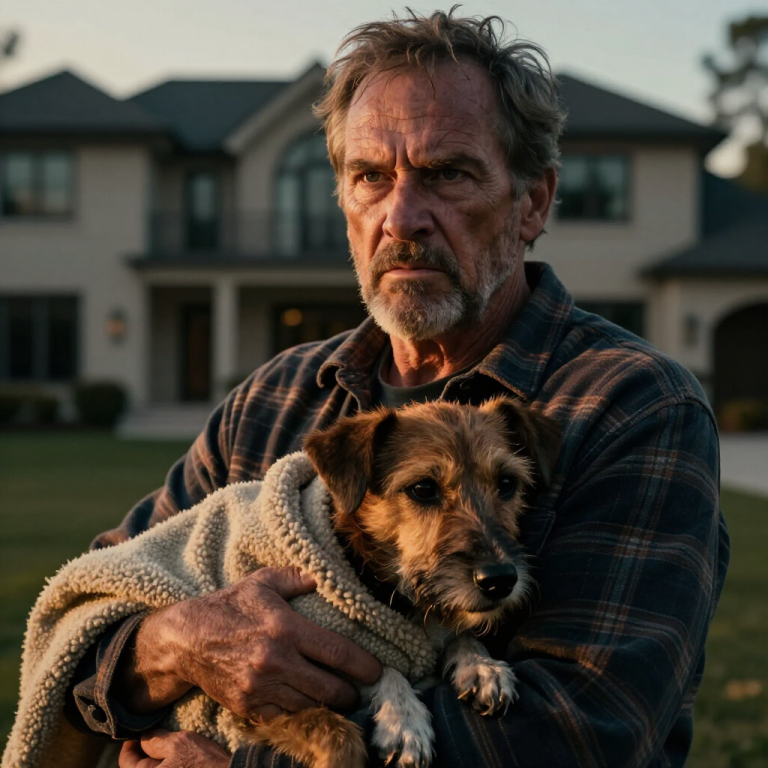
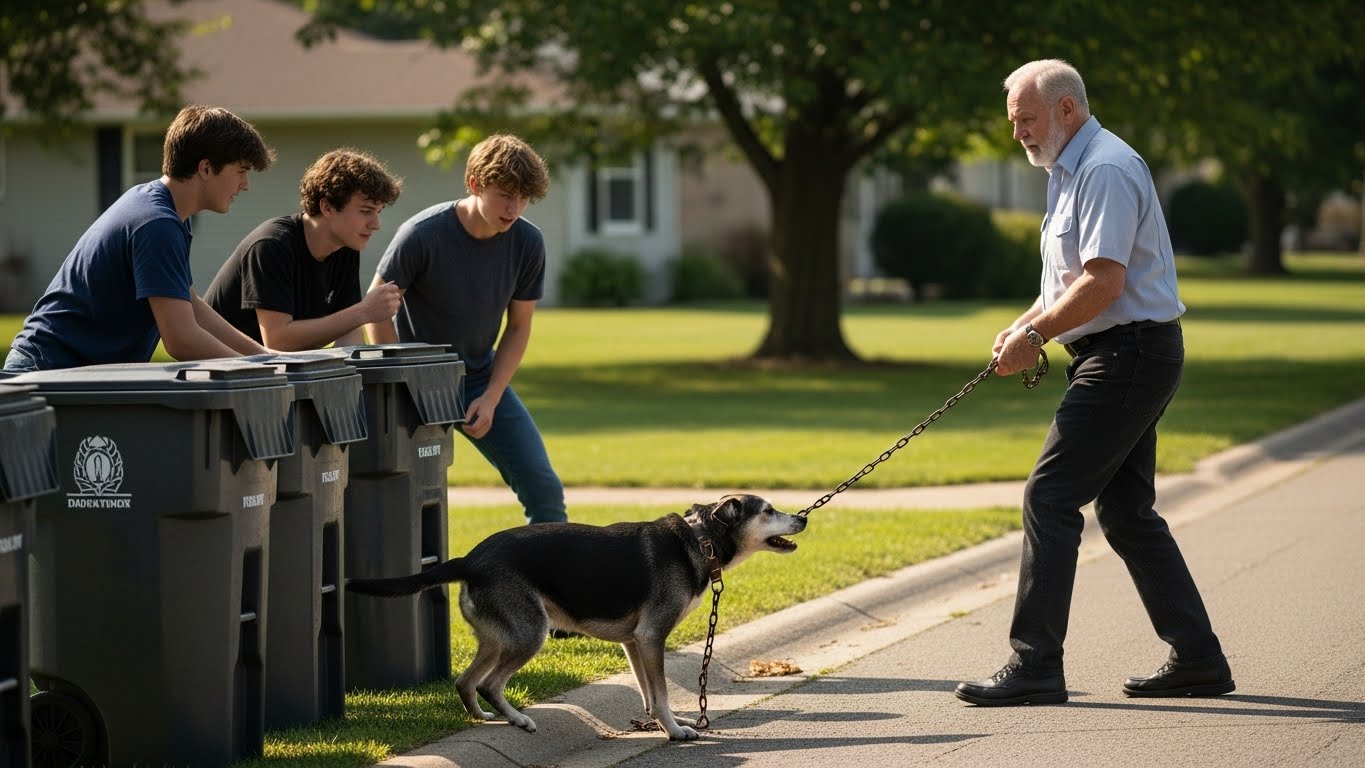
The walk back to my house felt like hauling a heavy load of gravel uphill. Bear’s paws clicked rhythmically against the asphalt, a sound that should have been peaceful but felt like a countdown. Every few steps, the old dog would stop, his head low, looking back at the corner where the chain had hit the ground. He wasn’t just afraid of the boys; he was afraid of the world they represented.
I led him into my garage, the same space where I’d been sanding wood only twenty minutes ago. It felt like a lifetime had passed. The smell of sawdust was still there, but the serenity was gone, replaced by the sharp, metallic tang of the confrontation.
I didn’t have a dog bed. I didn’t have dog food. I was a man who lived a sparse, utilitarian life—a habit born from three decades of living in spaces defined by concrete and steel. My house was a series of right angles and organized surfaces. Martha had been the one to bring the softness—the throw pillows, the rugs, the life. Since she’d passed three years ago, the house had slowly reverted to a cell. Clean, functional, and lonely.
I found an old moving blanket in a plastic bin and folded it into a thick square in the corner of the kitchen.
“Here, Bear,” I said softly.
The dog hesitated at the threshold of the kitchen. His cataracts made his eyes look like marble, catching the light in a way that made him look ghostly. He sniffed the air, his tail tucked between his legs. Then, with a sigh that sounded heartbreakingly human, he collapsed onto the blanket.
I sat at the kitchen table, my hands resting on the cool granite. They weren’t shaking. My hands never shook. It was a point of pride, or perhaps a symptom of a soul that had gone numb. I looked at the clock. 2:45 PM.
In the prison, 2:45 PM was shift change. The air would be thick with the sound of heavy boots, the jangle of keys, and the low-frequency hum of a thousand men being moved from the yard back to their blocks. It was a time of high tension—the perfect moment for a “shivving” in the blind spot of a corridor.
I realized I was still breathing in that rhythm. Controlled. Shallow. Ready.
The doorbell rang. It wasn’t a gentle ring; it was the persistent, aggressive chime of someone who believed their time was more valuable than mine.
I didn’t rush. I stood up, checked the deadbolt, and opened the door.
It wasn’t the police. Not yet.
Standing on my porch was Marcus Vance. He was wearing a navy blue suit that probably cost more than my first car. His hair was perfectly silvered at the temples, and he carried a leather briefcase like a shield. Behind him, parked at the curb, was a black Tahoe with tinted windows.
Marcus Vance, the District Attorney. The man who decided who went to my prison and who got a plea deal. We had met a dozen times at charity functions and city council meetings, but we weren’t friends. He saw me as a tool of the state; I saw him as a man who played a game with people’s lives from the safety of an air-conditioned office.
“Arthur,” he said. No greeting. Just a statement of my name, like he was filing a document.
“Marcus,” I replied, staying behind the screen door. I didn’t invite him in. In the yard, you never invite a predator into your cell unless you’re prepared to kill them.
“My son just came home in a state of shock,” Marcus said, his voice smooth, practiced, and cold. “He says you assaulted him. That you threatened his life with a weapon.”
I felt a ghost of a smile touch my lips. It wasn’t a happy smile. “He told you that, did he? Did he mention the chain? Or the dog he was trying to turn into a bloody pulp?”
Marcus stepped closer, his shadow falling over the porch. “I don’t care about a stray dog, Arthur. I care about my son. Tyler is a sensitive boy. He’s headed for Yale in the fall. If this… incident… ends up on a police report, it could jeopardize his future.”
“His future was jeopardized the moment he decided that hurting something weaker than him was a hobby,” I said. I pushed the screen door open and stepped out onto the porch. I didn’t care about the height difference or the expensive suit. “He didn’t come home in shock, Marcus. He came home embarrassed. There’s a difference.”
Marcus’s eyes narrowed. The “polite politician” mask was slipping, revealing the arrogant man underneath. “I’m going to make this very simple for you. You’re a retired civil servant living on a state pension. I am the District Attorney. I have friends on the bench, friends in the precinct, and friends at the paper. If you don’t hand over that dog and sign a statement admitting you had a ‘misunderstanding’ with Tyler due to your… let’s call it ‘post-service stress’… I will make your retirement very uncomfortable.”
I looked past him at the Tahoe. I could see the silhouette of Tyler in the passenger seat, probably filming this on his phone, waiting for the old man to break.
“You’re threatening me?” I asked quietly.
“I’m offering you a way out,” Marcus countered.
I took a step forward, forcing him to take a half-step back. It was a small victory, but a telling one. “Marcus, I’ve spent thirty years surrounded by men who would kill a guard for a pack of cigarettes. I’ve survived riots, hunger strikes, and three assassination attempts. Do you honestly think a threat from a man who spends his days arguing about zoning laws and plea bargains moves the needle for me?”
I leaned in, my voice dropping to that “Warden” whisper that used to make the toughest inmates look at the floor.
“You want the dog? You’ll have to take him. But before you do, you should know that Sarah from across the street saw everything. And I’m willing to bet she isn’t the only one. Your son didn’t just pick a fight with an old man; he did it in a neighborhood full of Ring cameras and bored retirees with nothing to do but watch their front lawns.”
Marcus stiffened. The mention of cameras was the one thing that could pierce his armor. In his world, the truth didn’t matter, but optics were everything.
“This isn’t over, Arthur,” he hissed.
“I know it isn’t,” I said. “Because tomorrow, I’m taking Bear to the vet. And if the vet finds so much as a bruise on him that correlates with that chain your son was swinging, I won’t go to the police. I’ll go to the Bar Association. I’ll go to the press. I’ll make sure every voter in this county knows that the DA’s son likes to torture animals for fun, and that the DA himself tried to bully a retired Warden into covering it up.”
Marcus’s face went a shade of red that looked like an impending stroke. He turned without another word, his heels clicking sharply on my driveway. He got into the Tahoe, and the vehicle peeled away, leaving a faint scent of burnt rubber in the air.
I stood on the porch for a long time after they were gone. The sun was beginning to set, casting long, orange shadows across the cul-de-sac.
I felt a coldness in my chest that had nothing to do with the evening breeze. I had won the round, but Marcus Vance was a man who didn’t know how to lose gracefully. He was the kind of man who would burn down the whole forest just to catch one rabbit.
I went back inside. Bear was still on the blanket, but he had lifted his head. He looked at me with those cloudy eyes, and for the first time, he gave a tiny, almost imperceptible thump of his tail against the floor.
“Don’t get too comfortable,” I muttered, though I was already reaching into the cupboard to see if I had anything a dog could eat. “This is just the beginning of the lockdown.”
I found some leftover roast chicken in the fridge. I shredded it into a bowl and placed it in front of him. He ate it with a desperate hunger that told me he hadn’t had a real meal in days.
As I watched him, I realized my phone was buzzing on the counter. It was a text from an unknown number.
I saw what happened. I have the video from my porch cam. Tyler’s friends are already posting a cropped version online making you look like the aggressor. You need to see this.
It was Sarah.
I clicked the link she sent. It was a TikTok video. It had been edited to start right when I grabbed the chain from Tyler. It didn’t show the dog. It didn’t show the chain being swung. It just showed a “crazy old man” aggressively grabbing a teenager and shouting at him.
The caption read: Ex-Prison Warden goes psycho on local teens. Is he dangerous? #Karen #Assault #OakCreek
It already had 50,000 views.
I looked at Bear. He was licking the bottom of the bowl, oblivious to the fact that the digital world was currently being fed a lie designed to destroy me.
In the prison, we called this “The Setup.” It was when the inmates would provoke a guard just enough to get a reaction, then point to the reaction as proof of brutality. It was a classic move.
I sat down on the floor next to the dog. My joints ached, and I felt every bit of my sixty-eight years. I put my hand on Bear’s head. His fur was coarse and matted.
“They’re coming for us, Bear,” I whispered.
The silence of the house felt heavy now. The suburb wasn’t a sanctuary anymore. It was a yard. And the rules of the yard were simple: You don’t back down. You don’t show weakness. And you never, ever let the predators see you bleed.
I stood up and went to my closet. Way in the back, inside a locked steel box, sat my old uniform. Not the suit I wore as Warden, but the tactical vest and the heavy belt from my days as a sergeant on the lines.
I didn’t take them out. Not yet. But I looked at them.
The Vances thought they were playing a game of politics. They didn’t realize they were playing a game of survival with a man who had forgotten how to do anything else.
I walked to the window and pulled the blinds shut.
Tonight, the neighborhood was quiet. But I knew the sirens were coming.
CHAPTER 3: THE COURT OF PUBLIC OPINION
The morning sun didn’t bring warmth; it brought a spotlight.
By 7:00 AM, the quiet cul-de-sac of Oak Creek had become a theater. I watched from behind my slatted blinds as a white news van with a satellite dish parked two houses down. It wasn’t the big leagues—just a local affiliate—nhưng ở cái thị trấn này, tin tức địa phương còn tàn độc hơn cả báo chí quốc gia.
Bear was still asleep on his blanket, his breathing heavy and rattling. Each wheeze felt like a needle in my heart. He was an old man, just like me, and he deserved a porch and a nap, not to be the centerpiece of a suburban war.
My phone hadn’t stopped buzzing. It wasn’t just Sarah anymore. It was “No Caller ID” numbers leaving voicemails that ranged from “You should be ashamed of yourself” to “We know where you live, you psycho.”
The TikTok video had done its job. It had 1.2 million views now. In the digital age, a lie can travel halfway around the world before the truth even gets its boots on.
At 8:30 AM, a cruiser pulled into my driveway. Not the DA’s Tahoe, but a standard black-and-white.
I opened the door before they could knock. I knew the man stepping out. Officer Miller. I’d seen him grow up. I’d seen him at the precinct back when I was still coordinating prisoner transfers. He was a good kid, but he looked like he’d just been told he had to arrest his own father.
“Arthur,” Miller said, tipping his cap. He wouldn’t look me in the eye. He was focused on his notepad.
“Benny,” I replied. “Come to check my permits? Or did the DA give you a direct order?”
Miller sighed, his shoulders dropping. He stepped onto the porch, lowering his voice. “Art, you know how this works. A formal complaint was filed. Assault, menacing, and… well, Marcus is pushing for ‘unlawful restraint’ because you held the kid’s chain.”
“The kid was swinging a weapon at a dog, Benny. Where’s the report on that?”
“There is no dog, Art,” Miller whispered, his eyes finally meeting mine. They were full of apology. “That’s the story. Tyler and his friends say they were just ‘hanging out’ and you came out of your garage like a man possessed. They say you had a breakdown. That you thought you were back in the prison.”
The “PTSD” card. It was the most effective way to disarm a veteran or a lawman. Turn their service into a sickness.
“The dog is in my kitchen,” I said, stepping back and gesturing inside.
Miller hesitated. He knew that if he walked in and saw the dog, he’d have to document it. And if he documented it, he’d be going against the man who signed his paychecks.
“I can’t go in there, Art,” he said, his voice cracking. “I’m here to serve you a ‘No Trespass’ order for the Vance property and to tell you that the Chief wants you to come down for an informal statement. Off the record. For now.”
“Tell the Chief if he wants to talk to me, he knows where I live,” I said, my voice turning to iron. “And tell him to bring a warrant if he wants to talk about ‘unlawful restraint.’ Until then, I have a sick dog to take to the vet.”
I closed the door. My heart was thumping—not with fear, but with a cold, righteous fury I hadn’t felt in years.
I didn’t wait for Miller to leave. I grabbed my car keys, a leash I’d fashioned from a piece of soft climbing rope, and coaxed Bear toward the garage. The old dog moved slowly, his joints clicking, but he trusted me. That trust was the only thing that felt real in a world made of smoke and mirrors.
I loaded him into the back of my old Ford F-150 and backed out of the driveway. I ignored the cameraman who tried to shove a lens in my face as I turned onto the main road.
The vet clinic was ten miles away, a small practice run by a woman named Dr. Aris. She was the kind of person who preferred animals to people—a sentiment I was starting to share.
“He’s dehydrated, Arthur,” Dr. Aris said an hour later, looking over her spectacles at me. Bear was on the steel table, looking small and fragile under the fluorescent lights. “He’s got a Grade 3 heart murmur, untreated cataracts, and…”
She paused, running her gloved hand over Bear’s hindquarters. She moved a patch of fur, and my stomach turned.
There were scars. Long, jagged lines of hairless skin that could only have been made by one thing.
“Chain burns,” she whispered. “Old ones. This didn’t start yesterday.”
“He was a stray,” I said, my voice shaking. “He lived in the woods behind the cul-de-sac.”
“He wasn’t always a stray,” Aris said, her voice hard. “Someone kept him on a short leash. Someone let him pull until the metal bit into his skin. Arthur, if you hadn’t stopped those kids yesterday, he wouldn’t have survived the night. His heart wouldn’t have taken the stress.”
She looked at me, her gaze softening. “I saw the video, Arthur. My daughter showed it to me this morning. They’re making you out to be a monster.”
“I’ve been called worse by better men,” I muttered.
“They’re calling for a neighborhood association meeting tonight,” she said, checking her phone. “A ‘Safety Forum’ at the community center. It’s on the local Facebook group. Marcus Vance is the keynote speaker.”
A public lynching. That’s what it was. Marcus was going to use his influence to turn the entire neighborhood against me, to paint me as a “danger to the community” so he could have me removed. It wasn’t about the dog anymore. It was about erasing the man who saw his son for what he truly was.
“Keep him here for the day,” I said, placing a hand on Bear’s head. The dog licked my palm, his tongue dry and sandpaper-rough. “Run whatever tests you need. I’ll be back for him.”
“Where are you going?”
“To prepare for the hearing,” I said.
I didn’t go home. I went to the one place Marcus Vance couldn’t touch.
I drove forty miles out of town, past the rolling hills and the white-picket fences, to a place where the fences were topped with concertina wire.
Blackwood Maximum Security.
The guards at the gate recognized me instantly. They didn’t see a “crazy old man.” They saw The Warden. They snapped to attention, their eyes widening as I rolled down the window.
“Warden,” the lead guard said, his voice full of genuine respect. “Good to see you, sir. What brings you back to the graveyard?”
“I need to see a resident,” I said. “Frankie ‘The Ghost’ Moretti.”
“Moretti? Sir, he’s in solitary. He’s been a handful since you left.”
“He’ll talk to me,” I said.
Frankie Moretti was a man I’d spent twenty years trying to reform, and twenty years failing. He was a fixer. He knew everything about everyone in this county. He was the reason Marcus Vance had a 98% conviction rate—because Frankie fed him the names he needed to keep the system moving. It was a dirty little secret they both shared.
Half an hour later, I was sitting across from Frankie in a glass-walled booth. He looked older, his skin the color of a basement floor, but his eyes were as sharp as ever.
“Warden,” Frankie grinned, revealing a missing tooth. “You look like hell. Retirement doesn’t suit you. You miss the smell of bleach and despair?”
“I need a favor, Frankie. And in exchange, I’ll make sure your sister’s medical bills keep getting paid through the ‘discretionary fund’ I set up before I retired.”
Frankie leaned in, his smile vanishing. “A favor? From me? You must be desperate, Artie.”
“I need the truth about Tyler Vance. Not the Yale-bound son. The real Tyler. The one who spends his weekends in the parts of town his father pretends don’t exist.”
Frankie chuckled, a dry, hacking sound. “Oh, the golden boy. He’s a regular. He’s got a thing for ‘underground’ entertainment. You know, the kind of stuff that involves bets, blood, and things that bark.”
My blood went cold. “Dog fighting?”
“Not the big leagues,” Frankie said, waving a hand. “Just ‘scrapping.’ Him and his little prep-school crew. They buy strays or ‘lost’ pets and see how long they last against a real fighter. It’s sick, even for a guy like me.”
“Do you have proof?”
Frankie smirked. “I don’t. But I know who does. Tyler’s best friend, Jax? He’s got a hidden folder on his phone. He’s the one who records it all. He thinks it’s art. He’s been trying to sell the footage to a site I know.”
I stood up. My hands were balled into fists so tight my scars were turning white.
“Thanks, Frankie.”
“Hey, Warden?” Frankie called out as I walked toward the door. “Be careful. Men like Marcus Vance don’t just lose. They explode.”
“I’ve spent my life around explosives, Frankie,” I said. “I know exactly how to handle the blast.”
I drove back to Oak Creek as the sun began to dip below the horizon. The community center was packed. I could see the rows of SUVs and the crowd of neighbors I’d known for years—people I’d shared barbecues with, people whose kids I’d watched grow up.
They were all there to watch me fall.
I pulled my truck into the lot. I didn’t have a lawyer. I didn’t have a PR team. I only had the truth, and a set of skills the suburbs had made me forget I possessed.
I reached into the glove box and pulled out a small, digital recorder. I checked the battery.
Then, I straightened my posture. I felt the weight of the “Warden” settle back over my shoulders like a suit of armor. I wasn’t an old man anymore. I was the law.
I walked toward the bright lights of the community center, the sound of my boots on the pavement echoing like a drumbeat.
It was time to turn the yard upside down.
CHAPTER 4: THE FINAL COUNT
The Oak Creek Community Center was a building made of glass, polished wood, and hypocrisy. Usually, it hosted yoga classes and planning committees for the annual Fourth of July parade. Tonight, it was a courthouse.
As I stepped through the double doors, the low roar of a hundred voices cut out instantly. It was the kind of silence you only find in a graveyard or a cell block right before a riot. Every head turned. I saw neighbors I’d waved to for five years—people who had borrowed my lawnmower or shared my wife’s apple pie—looking at me with a mixture of fear and disgust.
They didn’t see Arthur, the quiet widower from the end of the street. They saw the man from the TikTok video: the aggressor, the “psycho,” the relic of a violent past who had finally snapped.
At the front of the room, behind a mahogany lectern, stood Marcus Vance. He looked presidential. He had a microphone clipped to his lapel and a look of practiced grief on his face. Tyler and Jax were seated in the front row, looking like choirboys in their ironed polo shirts. Tyler even had a fake bandage on his wrist, a touch of theater that made my jaw tighten.
“Mr. Reardon,” Marcus said, his voice amplified and echoing. “This is a private meeting for the residents of Oak Creek. Given the recent… volatility… of your behavior, we’ve asked you to stay away.”
I didn’t stop walking. I moved down the center aisle, my boots hitting the floor with a rhythmic, heavy thud. People leaned away from me as I passed, as if my “madness” were contagious.
“I’m a resident, Marcus,” I said, my voice unamplified but carrying to the back of the room. “I pay my dues. And I’m here to hear the charges.”
I stopped ten feet from the front row. I didn’t look at Marcus. I looked at Tyler. The boy tried to hold my gaze for a second, then looked down at his shoes. He knew. He knew I had been to Blackwood. He knew that in the yard, secrets were the only currency that mattered.
“The charges are simple, Arthur,” Marcus said, turning to the crowd. “We are here because our community’s safety is being compromised by a man who cannot leave his past at the prison gates. We’ve all seen the footage. We’ve seen him attack a group of teenagers. We’ve heard the threats. My son is traumatized. This neighborhood was built on peace, and today, that peace was shattered.”
A murmur of agreement rippled through the room. A woman I knew, Mrs. Higgins, stood up, her voice trembling. “Arthur, we liked you. But if you’re… having trouble… if the stress of your old job is making you violent, you need help. Not a dog and certainly not a place in this neighborhood.”
I felt the weight of it then—the sheer power of a well-crafted lie. It was a landslide, and I was standing at the bottom of the mountain.
“Is that what you told them, Tyler?” I asked, turning my focus to the boy. “That I just ‘snapped’? That there was no reason?”
Tyler looked at his father, then back at me, emboldened by the crowd. “You went crazy, man! You grabbed me! You were talking about ‘insurgents’ and ‘paperwork.’ You’re a freak!”
I nodded slowly. I reached into my pocket. Half the room gasped, someone shouted “He’s got a gun!”, and Marcus reflexively stepped back.
I pulled out the digital recorder I’d brought from the truck.
“No gun,” I said, holding it up. “Just a memory. Something your friend Frankie Moretti thought you’d like to hear, Marcus.”
Marcus’s face went from pale to a sickly, mottled grey. The name ‘Moretti’ hit him like a physical blow. He tried to speak, but his throat seemed to have seized up.
“I spent today doing what a Warden does,” I said, addressing the room. “I looked into the history of the inmates. And I found out that Bear—the dog these ‘boys’ were ‘joking’ with—wasn’t just a stray. He’s been in this neighborhood for months. And for months, he’s been used as a punching bag.”
I turned to Jax, who was sweating under the fluorescent lights.
“Jax, you’re the cameraman, right? You like to film things. You have a folder on your phone. A hidden one. The one you use to show off your ‘scraps’ to the guys downtown.”
“I don’t know what you’re talking about,” Jax stammered, his hand instinctively going to his pocket.
“You do,” I said, taking a step toward him. “And you know that once the police forensic unit gets a hold of that phone, ‘unlawful restraint’ is going to be the least of your problems. Animal cruelty is a felony in this state, Jax. And conspiracy to run an illegal fighting ring? That’s years. Not in a juvenile hall. In a place like Blackwood.”
The room was deathly silent now. The “Safety Forum” had suddenly turned into an interrogation.
“He’s lying!” Tyler screamed, his voice cracking. “Dad, tell him he’s lying!”
But Marcus Vance couldn’t say a word. He was looking at me, and for the first time, he saw the man who had managed the most dangerous men in New York. He saw that I wasn’t playing a game. I was conducting a shakedown.
“Marcus,” I said, my voice low and lethal. “You have two minutes to tell this room the truth. Or I play this recording. I think the voters would love to hear how the District Attorney’s office handles ‘evidence’ provided by the Moretti family.”
It was a bluff. The recorder was empty—I hadn’t had time to record Frankie. But in the yard, a good bluff is better than a bad weapon. Marcus didn’t know what I had. He only knew what he had to hide.
The silence stretched. It was the longest two minutes of Marcus Vance’s life. He looked at his son—the boy he’d protected and spoiled until there was nothing left but a hollow shell of cruelty. He looked at the neighbors, his constituents, his power base.
Then, he looked at me. He saw the iron in my eyes, the lack of hesitation. He knew I would burn my own life down just to make sure the truth came out.
“This meeting is adjourned,” Marcus whispered into the microphone.
“What?” Mrs. Higgins cried. “But what about the safety—”
“I said the meeting is adjourned!” Marcus shouted, his voice breaking. He grabbed Tyler by the arm—not gently, but with a sudden, violent realization of the ruin his son had brought upon him—and practically dragged him toward the side exit.
Jax followed, looking like he was about to vomit.
The room erupted into chaos. People were shouting, standing on chairs, demanding answers. But I didn’t stay to watch the fallout. I’d done my job. The “lockdown” was over.
I walked out the back door, the cool night air hitting my face like a blessing. My truck was the only thing left in the parking lot once the sirens started—not for me, but for the DA’s office. I heard later that Jax had folded within ten minutes of being taken to the precinct, handing over the videos in exchange for a plea deal that never came.
I drove back to the vet clinic. It was late, but Dr. Aris was still there. She was sitting in the waiting room, holding a leash.
Next to her, standing on four shaky but steady legs, was Bear. He’d been cleaned. His fur was still thin in places, and he moved with the stiffness of a thousand years, but when he saw me, his entire body vibrated.
He didn’t bark. He just walked over and leaned his weight against my shins.
“He’s ready to go home, Arthur,” Dr. Aris said softly.
“I don’t have a dog bed,” I said, looking down at him.
“I think he’ll be fine with the moving blanket,” she smiled.
We drove home in silence. The neighborhood was dark, but lights were flickering in windows. The “Warden” was no longer the villain, but I knew I’d never truly be one of them. I was the man who saw the shadows. I was the man who knew that even in the most beautiful suburbs, the wolves are always at the fence.
I led Bear into the house. I locked the door—out of habit, not fear.
I sat down on the kitchen floor, my back against the cabinets. Bear came over and circled three times before collapsing next to me, his head resting on my thigh. I placed my hand on his side, feeling the slow, steady beat of his heart.
For thirty years, I had been the man who kept people in cages. I had lived a life defined by locks, bars, and the absence of light. I thought retirement was just a slower version of that same cage.
I looked at the old dog, his eyes closed, finally safe, finally home.
I realized then that I wasn’t a Warden anymore. For the first time in my life, I was just a man with a friend.
I reached up and turned off the kitchen light. The house was dark, but for once, the silence didn’t feel like a cell. It felt like peace.
I closed my eyes and breathed in the scent of cedar and old dog, and for the first time since Martha died, I didn’t dream of the prison.
I just slept.