They Stomped On A Poor Girl’s Essay And Called Her Trash. They Didn’t Know Her Father Was The Supreme Court Justice Standing Right Behind Them.
Chapter 1: The Weight of Expectations
The air in the library of Oak Creek Academy always smelled the same: old paper, floor wax, and the faint, expensive perfume of teenagers who had never worked a day in their lives. For sixteen-year-old Sarah Miller, it was the smell of sanctuary.
Sarah sat at a secluded table in the back, hidden behind a stack of encyclopedias. She wasn’t hiding from her studies—she was currently carrying a 4.0 GPA—she was hiding from the “Court.” That was what the student body called them: Brittany Van Der Hoven and her entourage of five perfectly coiffed, terrifyingly cruel followers.
Sarah adjusted her glasses, pushing them up the bridge of her nose. She wore a simple grey cardigan that had seen better days, the cuffs slightly frayed, and jeans that she had bought from a thrift store three years ago. To the students of Oak Creek, where the parking lot looked like a luxury car dealership, Sarah was an anomaly. She was the “charity case,” the scholarship kid, the nobody.
She looked down at the essay in front of her. “The Architect of Liberty: How the Judiciary Protects the Voiceless.” She had poured her soul into these ten pages. It wasn’t just an assignment for the State History competition; it was a conversation she wished she could have openly.
Her phone buzzed silently on the table. A text message. Dad: Good luck today, Counselor. Remember, truth is its own defense.
Sarah smiled, a small, sad thing. No one at school knew who “Dad” was. To them, Sarah Miller was the daughter of a deceased woman named Catherine Miller. And that was true. Her mother had passed away four years ago, leaving a void that Sarah tried to fill with books and silence. But her father… her father was very much alive.
He was Justice William Sterling. The Chief Justice of the State Supreme Court. A man known in the legal world as “The Hangman” for his unyielding strictness and his absolute intolerance for corruption.
They had made a deal when she started high school. She wanted to make it on her own merits. She didn’t want the Sterling name paving her way or painting a target on her back. So, she used her mother’s maiden name. She lived in the small guest cottage on their estate rather than the main house when friends dropped by. She worked in the library to pay for her own books.
“Hey, Charity Case.”
The sanctuary was breached.
Sarah didn’t flinch, but her stomach tightened. She looked up to see Brittany standing there. Brittany was beautiful in the way a polished knife is beautiful—cold, sharp, and dangerous. She was wearing a cashmere sweater that cost more than Sarah’s entire wardrobe.
“Hello, Brittany,” Sarah said quietly.
“I heard the results for the History Essay are being posted at noon,” Brittany said, leaning against the table. She picked up Sarah’s pencil case, inspecting it with disdain before dropping it. “My father, Councilman Van Der Hoven, says the judges are looking for ‘legacy’ perspectives this year. You know, people who actually understand how the world works.”
“I’m sure your essay was very… perspective-rich,” Sarah replied diplomatically.
Brittany narrowed her eyes. She hated Sarah. She hated her quiet confidence. She hated that no matter how much she flaunted her wealth, Sarah never looked impressed. But mostly, she hated that Sarah Miller, the girl with the frayed cardigan, consistently scored higher than her on every single test.
“Don’t get your hopes up, Miller,” Brittany sneered. “Scholarship kids are here to fill a diversity quota, not to win awards. You should stick to shelving books. It’s what you’re bred for.”
Brittany’s “Court”—three girls and two boys, all varsity athletes or debutantes—snickered behind her.
“Is there something you needed, Brittany?” Sarah asked, turning back to her book. “I’m studying.”
“I just wanted to remind you of your place,” Brittany hissed. “The view from the bottom is where you belong. Don’t try to climb the stairs today.”
They turned and left, a cloud of expensive scent trailing behind them. Sarah took a deep breath, her hands trembling slightly. She grabbed her pen, gripping it until her knuckles turned white.
Integrity, her father always told her. Integrity is doing the right thing when no one is watching. Dignity is holding your head up when everyone is trying to force it down.
She checked her watch. 11:55 AM. The results were going up in the main foyer.
Sarah gathered her books. She wouldn’t let them win. She would go to the board, see her score, and walk away with her head held high. She didn’t know that she was walking into an ambush that would change the history of Oak Creek Academy forever.
Chapter 2: The Staircase of Judgment
The main foyer of Oak Creek Academy was a testament to old money. Marble floors, mahogany banisters, and a grand, sweeping staircase that led up to the administrative offices. At the center of the foyer stood the massive bulletin board where academic standings were posted.
A crowd had gathered. As Sarah approached, the sea of students parted. It wasn’t out of respect; it was the kind of separation that happens when a contagious disease enters a room. Whispers followed her.
“There she is.” “Does she really think she beat Brittany?” “Look at those shoes. Goodwill special.”
Sarah kept her eyes forward. She reached the board. The list was typed on heavy cream paper.
State History Essay Competition – Final Rankings
- Miller, Sarah – Score: 100/100 (State Finalist)
- Van Der Hoven, Brittany – Score: 62/100 (Fail)
Sarah let out a breath she didn’t know she was holding. A perfect score. She had done it.
“Well, well, well.”
The voice came from the top of the grand staircase. Brittany stood there, looking down like a queen addressing a peasant. Her face was composed, but her eyes were burning with humiliation and rage. She held a stack of papers in her hand—the returned essays.
“It seems there’s been a mistake,” Brittany announced, her voice echoing in the cavernous hall. “The teachers obviously mixed up the papers. There is no way a Miller understands the complexities of state law better than a Van Der Hoven.”
Sarah stepped toward the stairs. “I earned that grade, Brittany. Please, just give me my paper.”
“You want it?” Brittany waved the essay in the air. “Come and get it.”
Sarah hesitated. The staircase was Brittany’s stage. But she needed that essay for her portfolio. She took a step up. Then another.
When Sarah was halfway up the stairs, Brittany smiled—a cruel, twisted expression.
“You know what I think?” Brittany said, loud enough for the Superintendent’s office to hear if the doors weren’t closed. “I think trash belongs with trash.”
Brittany dropped the essay.
It fluttered down, landing on the dirty marble step between them.
“Oops,” Brittany mocked. She signaled to her friends. “Help her out, guys. Make sure it stays where it belongs.”
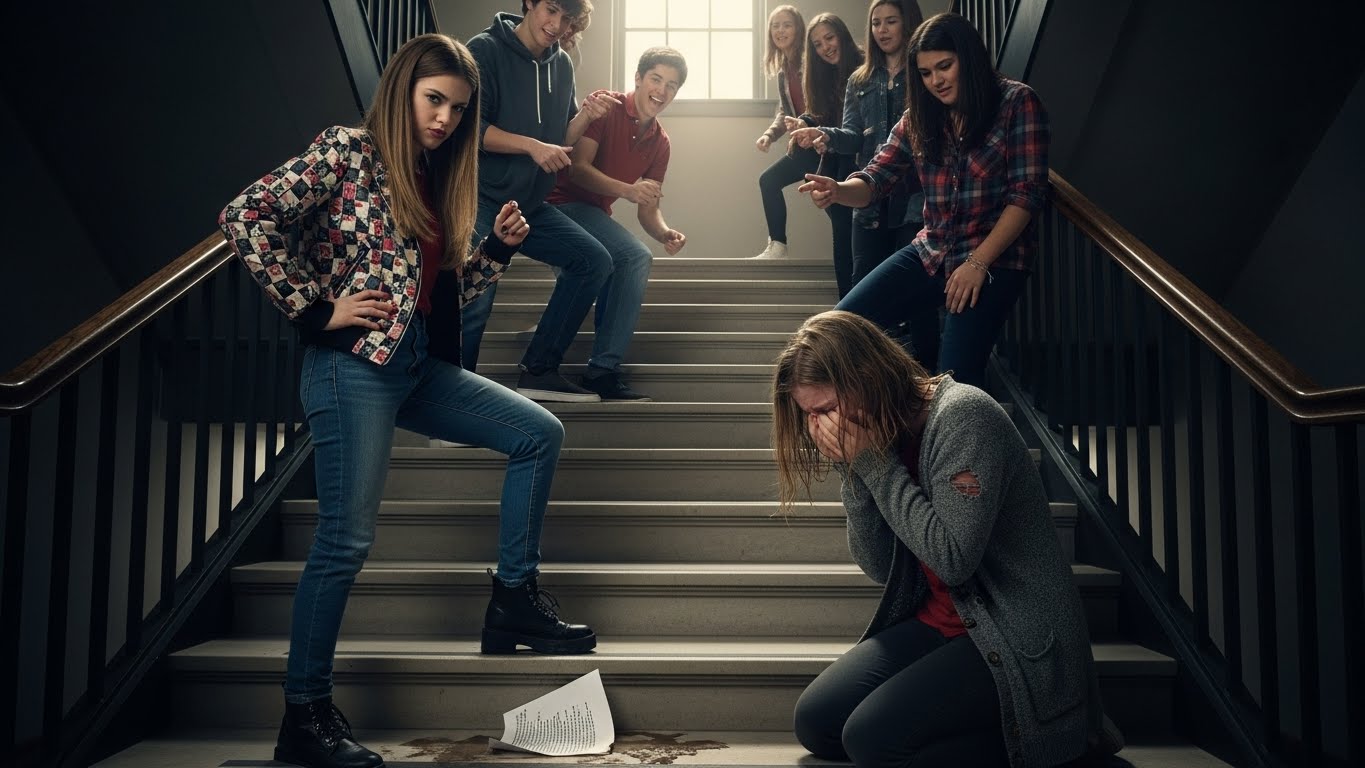
What happened next was a choreographed act of cruelty. Brittany stepped forward and stomped her designer leather boot directly onto the handwritten title page of Sarah’s essay. She ground her heel into the paper, tearing the corner and smearing mud from the courtyard across the ink.
“Oops,” she said again, laughing.
Then the next friend stepped up. Stomp. “Know your place, Miller.”
Then the next. Stomp. “Go back to the library.”
Sarah stood frozen three steps down. She watched as weeks of research, sleepless nights, and passion were desecrated by the soles of shoes that cost more than her father’s first car. The essay was torn, muddy, and ruined.
The hallway erupted in laughter. It was a mob mentality. They were laughing at the girl who tried to be better than her station.
Sarah felt tears pricking her eyes. Her throat burned. Every instinct in her body wanted to scream, to push Brittany, to fight back. But she heard her father’s voice in her head. Tears are for the courtroom, Sarah. Not the hallway. Never let them see you bleed.
She bit her lip so hard she tasted copper. She slowly knelt on the cold stairs, reaching out to pick up the tattered remains of her hard work. Her hand trembled as she touched the muddy paper.
“Look at her,” Brittany crowed, looking down at the top of Sarah’s head. “On her knees. Finally showing the proper respect to her betters.”
The laughter reached a crescendo. It was deafening. It was absolute.
And then, it stopped.
Chapter 3: The Gavel Drops
The silence didn’t happen gradually. It happened instantly, as if someone had sucked all the air out of the building.
The sound that cut through the laughter was distinct. It was the heavy, rhythmic thud of a cane hitting the floor, followed by the slow, deliberate tread of heavy dress shoes.
Thud. Step. Thud. Step.
It came from the top of the landing, behind Brittany and her crew.
“Is this…” a voice boomed, deep, baritone, and vibrating with an authority that made the windows rattle, “…the behavior this institution fosters?”
Brittany spun around. The blood drained from her face so fast she looked like she might faint.
Standing at the top of the stairs was a giant. He stood six-foot-four, his broad shoulders encased in a long, black wool trench coat that swirled around his legs like judicial robes. He had steel-gray hair swept back from a face that looked carved from granite. His eyes were dark, intelligent, and currently burning with a cold, terrifying fire.
It was Justice William Sterling. The Chief Justice.
Beside him, looking like he was about to vomit, was Superintendent Reynolds.
“Justice Sterling!” Brittany’s voice squeaked. Her demeanor flipped like a light switch. The sneer vanished, replaced by a sugary, terrifyingly fake smile. She quickly kicked the muddy paper away from her boot. “Good morning, Your Honor! We… we were just helping her. She dropped her things. We were helping her pick them up.”
She looked at her friends, eyes wide, silently commanding them to play along. “Right, guys?”
“Yes, sir,” one of the boys stammered. “Just helping.”
Justice Sterling didn’t blink. He didn’t look at the Superintendent. He began to descend the stairs.
Thud. Step.
He moved slowly, favoring his left leg—an injury from his days as a prosecutor when a disgruntled defendant tried to run him over. The injury only added to his menacing aura. It made him seem inevitable, like the slow march of time.
He stopped two steps above Brittany. He towered over her. The physical difference in power was staggering, but the difference in moral authority was a chasm.
He ignored her outstretched hand. He walked past her, the hem of his coat brushing against her legs.
He continued down until he reached Sarah.
Sarah was still kneeling, clutching the muddy paper. She looked up at him, her eyes wide behind her glasses. She didn’t say a word. She knew better than to interrupt him when he was in this mode.
The “Hangman” groaned slightly as he bent his large frame down. It was a painful movement for him, but he did it with a grace that silenced the room. He reached out a large, gloved hand and gently took the paper from Sarah’s trembling fingers.
He stood up, holding the ruined essay. He pulled a pristine white handkerchief from his pocket and wiped a smear of mud from the title.
He read aloud, his voice carrying to the back of the foyer: “Equal Justice Under Law. By Sarah Miller.”
He turned slowly to face Brittany. She was trembling now.
“You told me you were helping her,” Sterling said softly. The softness was worse than shouting. It was the calm before a hurricane. “You just destroyed a document about equality. And then, you looked a weary old man in the eye and lied to him.”
“I… I didn’t mean…” Brittany stammered. “It’s just a joke, Your Honor. And anyway, who cares? It’s just her. She’s a nobody. She’s just a Miller. She’s on financial aid, for God’s sake.”
The entire student body held its breath. Brittany had just dug her own grave.
Sterling took a step up toward her. “A nobody?”
He looked at the paper again, then at Sarah. His expression softened into something infinite and tender. “She uses the name Miller to honor her mother, my late wife, Catherine Miller, who died of cancer four years ago. She accepts financial aid because she insisted—insisted—on earning her place here on merit, refusing to use my money or my influence to get ahead. Unlike you.”
A collective gasp ripped through the hallway. It was a physical sound, a shockwave.
Brittany’s mouth fell open. She looked from the imposing Justice to the girl in the fraying cardigan. The resemblance was suddenly undeniable—the same determined jaw, the same intelligent eyes.
“You see a ‘nobody,'” Sterling continued, his voice rising, gaining the thunderous resonance he used when delivering a death sentence. “I see a young woman of superior intellect and character. I see the daughter of the Chief Justice of the Supreme Court. And I have just witnessed an assault on her dignity.”
He leaned in close to Brittany. “And in my court, Miss Van Der Hoven, assault on dignity is a crime I punish with extreme prejudice.”
Chapter 4: The Verdict and The Virtue
Brittany looked for an escape route, but there was none. “My… my father is Councilman Van Der Hoven,” she tried, playing her last, desperate card. “He creates the budget for the courts. He knows you.”
“Oh, he certainly does,” Sterling said, a dark smile playing on his lips. “And I know him. In fact, I am scheduled to have lunch with the Ethics Committee tomorrow. I think your father and I will have a very long, very interesting conversation about how he raises his children. And perhaps, we will discuss his influence on this school’s ‘legacy’ policies.”
Brittany burst into tears. Real, ugly tears of panic.
Sterling turned his back on her. He looked at the Superintendent.
“Superintendent Reynolds,” Sterling barked.
“Yes, Mr. Chief Justice?” The man squeaked.
“I came here for a civics inspection,” Sterling said, gesturing to the scene with his cane. “I have seen enough. This environment is toxic. It breeds entitlement and crushes merit. These students,” he pointed his cane at Brittany and her five followers, “have engaged in harassment, destruction of property, and public intimidation.”
“I… I will handle it immediately, sir,” Reynolds stammered. “Expulsion. Immediate expulsion. Zero tolerance policy.”
“See that you do,” Sterling said. “Or I will launch an independent investigation into this district that will make your head spin.”
The bullies stood frozen, their futures evaporating before their eyes. The Ivy League acceptances, the social standing—gone in seconds, crushed under the weight of their own cruelty.
Sterling turned back to Sarah. The terrifying “Hangman” vanished. In his place was just a dad who loved his kid.
He held out his hand. “Head up, Counselor.”
Sarah stood up, wiping her eyes. She took his hand. It was warm and strong.
“I’m sorry about your essay, Dad,” she whispered. “It’s ruined.”
“The paper is ruined,” Sterling corrected her, tapping her temple with his finger. ” The mind that wrote it is just fine. And that,” he pointed to her heart, “is untouched. That is where your integrity lives. They can stomp on paper, Sarah. They can never stomp on who you are.”
He tucked her hand into the crook of his arm. “Now, I believe we have a tradition. When we win a case, we get ice cream.”
“But… school isn’t over,” Sarah said, a smile breaking through her tears.
“I’m the Chief Justice,” Sterling winked. “I think I can issue a pardon for a half-day absence. Let’s go.”
As they walked down the rest of the stairs and toward the front doors, the students of Oak Creek Academy did something they had never done for Sarah Miller.
They clapped.
It started with a few freshmen, then spread to the sophomores, until the whole foyer was applauding. They weren’t clapping for the Justice. They were clapping for Sarah—the girl who took the abuse and never broke, the girl who was silently royalty all along.
Chapter 5: The Aftermath
Three months later.
The community park on the south side of town was hot and humid. Brittany Van Der Hoven, wearing an orange vest over her designer clothes, jabbed a stick at a discarded soda can.
“Keep moving, Van Der Hoven,” the parole officer shouted. “That trash isn’t going to pick itself up.”
Brittany wiped sweat from her forehead, smearing dirt on her face. Her friends had abandoned her. Her father had lost his seat on the Council after the Ethics investigation. She had been expelled from Oak Creek and was now finishing her semester at public school. It was a hard lesson, but for the first time in her life, she was learning the value of work. She looked at the trash on the ground, remembering the paper she had stomped on, and felt a pang of genuine shame.
Miles away, in the grand auditorium of Oak Creek Academy, the air was cool and filled with anticipation.
“And now,” the Principal announced, “your Valedictorian, Sarah Sterling-Miller.”
Sarah walked to the podium. She wore the graduation gown, but underneath, she still wore her simple clothes. She didn’t need to dress up to prove her worth anymore.
She looked out at the audience. In the front row, sitting in the VIP section, was Justice William Sterling. He dabbed his eye with the same handkerchief he had used to clean her essay.
Sarah adjusted the microphone.
“Thank you,” she began. “When I wrote my history essay this year, I titled it ‘Equal Justice Under Law.’ I thought I knew what that meant. I thought it meant laws and courts.”
She paused, looking directly at the students.
“But I learned that justice isn’t just what happens in a courtroom. Justice is how we treat each other in the hallways. Justice is refusing to look away when someone is being mistreated. Justice is recognizing that the person cleaning the floor has just as much dignity as the person owning the building.”
She smiled at her father.
“My father taught me that power doesn’t come from a title, or money, or a name. True power is the ability to lift others up. And true integrity is knowing that even if you are covered in mud… you are never trash.”
The applause was thunderous. Justice Sterling stood up, favoring his bad leg, and clapped the loudest of them all. He watched his daughter, not as a judge, but as a witness to a greatness that far exceeded his own. The verdict was in: Sarah Miller had won.