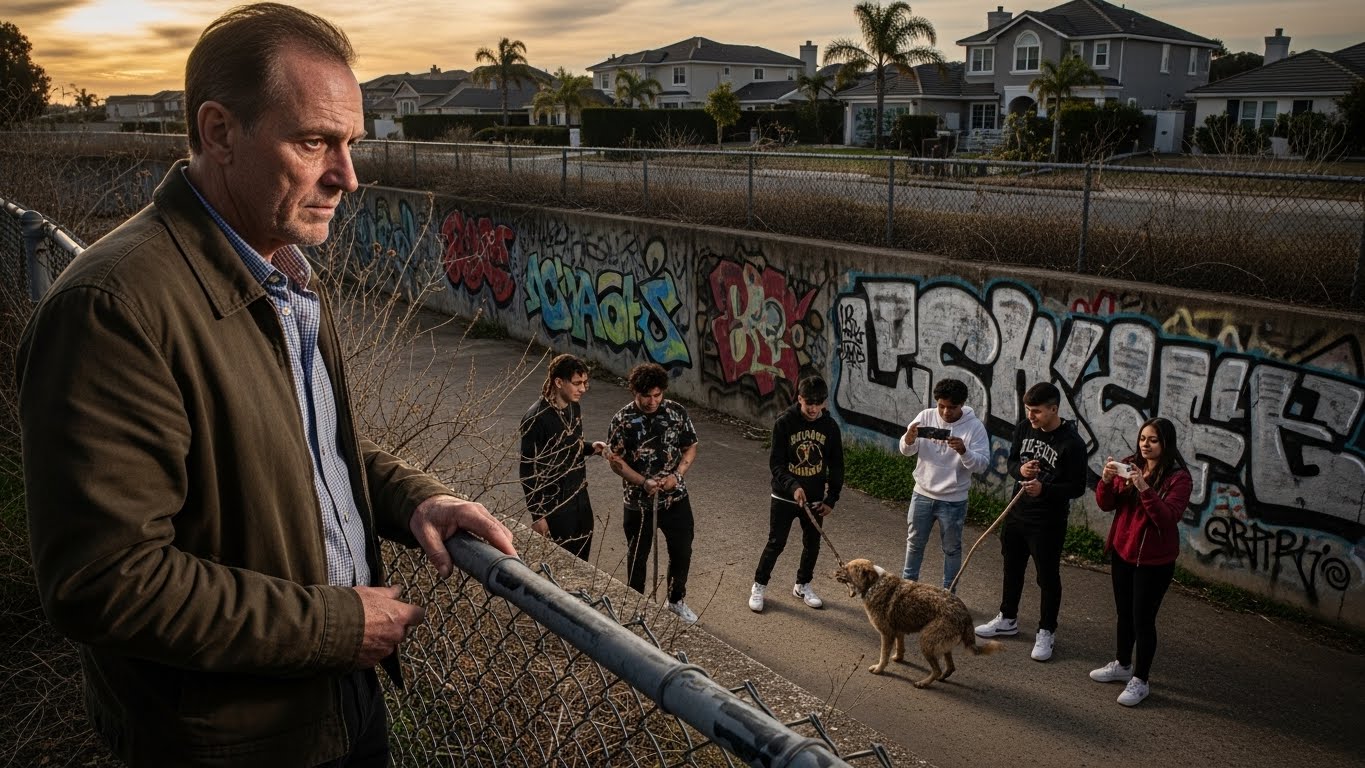
THEY CALLED HIM A “WASHED-UP OLD MAN” UNTIL HE UNLEASHED THE COMMANDER INSIDE.
Chapter 2: The Weight of the Badge
The kitchen of my small, two-bedroom bungalow smelled like wet fur and iodine.
I sat on the linoleum floor, my back against the refrigerator, watching the dog. He was huddled in the corner by the pantry, his head resting on his paws. I’d spent the last hour cleaning the mud and dried blood off him with a warm washcloth. He hadn’t snapped at me once. He hadn’t even growled. He just let out these small, rhythmic whimpers that vibrated in the floorboards beneath us.
I called him “Sarge.” It was unoriginal, sure, but he had the eyes of a soldier who had stayed too long at the front lines. Hollow. Watchful. Tired.
My own hands were finally starting to stop shaking. People think adrenaline is a gift; they don’t tell you about the tax it takes from your body afterward. My joints felt like they were filled with crushed glass. Every breath was a reminder that I wasn’t thirty anymore. I was sixty-four, with a heart that had seen too much and a soul that was mostly scar tissue.
I poured two fingers of the bourbon that hadn’t broken—a cheap brand that tasted like smoke and regret—and took a sip. It burned the right way.
“You’re safe now, Sarge,” I muttered.
The dog’s ears flickered at the sound of my voice. He didn’t move, but he watched me with one amber eye. He was looking for the catch. In his world—and mine—kindness usually came with a hidden price tag.
The silence of the house was interrupted by a sharp, rhythmic rapping at the front door. Not a neighborly knock. This was a “Police Arrival” knock. Three sets of two. Firm. Authoritative.
I sighed, the bourbon settling in my gut. “Stay,” I told Sarge, though he had no intention of moving.
I walked to the door, checking the peephole. It was Marcus Reed. Marcus was a sergeant with the Oak Ridge PD. Ten years ago, when I first moved here after the Chicago PD gave me my “voluntary” retirement, I’d helped train him on tactical entries. He was a good kid—honest, maybe a little too soft for the job, but he had a moral compass that actually pointed North.
I opened the door. Marcus was standing there in his blues, his cruiser’s lights off but the engine still idling at the curb. He looked pained.
“Elias,” he said, nodding.
“Marcus. A bit late for a social call.”
Marcus sighed and looked past me into the house. “I got a call from Grant Miller. Well, technically, I got a call from the Chief, who got a call from Grant Miller. Something about you assaulting his son in the park?”
“I didn’t assault him, Marcus. I corrected his behavior. There’s a difference.”
“Jax is at the ER. Nothing broken, but he’s got a bruised sternum and he’s claiming he can’t breathe right. Grant is screaming about ‘aggravated assault’ and ‘elderly menace.’ He wants your head on a platter, Elias. You know how he is. He owns half the commercial real estate in this county. He thinks the law is a subscription service he pays for.”
I stepped out onto the porch, closing the door behind me. I didn’t want Marcus seeing the dog yet. Not until I knew which way the wind was blowing.
“The boy was torturing a stray, Marcus. Using a magnesium light as a club. I told him to stop. He swung at me. I neutralized the threat. Standard Use of Force. You remember the manual, don’t you?”
Marcus rubbed his face. “The manual doesn’t apply to civilians, Elias. You’re a retiree. To the law, you’re just an old man who beat up a teenager in a ditch. There were no witnesses.”
“There were three other kids,” I said.
“Who are all sticking to Jax’s story. They’re saying you came out of the bushes like a lunatic and started swinging.”
I leaned against the porch railing, looking out at the dark street. This was the trap. The world had changed. In the old days, a man like Grant Miller would have been ashamed of a son like Jax. Now, the shame was hidden behind lawyers and PR.
“What are you here to do, Marcus? Arrest me?”
Marcus looked at his boots. “I’m here because I told the Chief I’d handle it quietly. If I don’t bring you in for a statement tonight, the Chief will send the SWAT team tomorrow morning just to make a show of it for Grant. He’s looking for a reason to flex, Elias. He doesn’t like that people still call you ‘Commander’ at the diner. It makes him look small.”
I felt a flash of the old heat—the fire that used to roar when I was leading a line of riot shields against a mob. “Let him come. I’ve seen bigger men than him try to break my door down.”
“Don’t be like that,” Marcus whispered, his voice pleading. “Think about the dog. If you go to jail, who takes care of it? If the city gets involved, that dog is ‘evidence.’ And evidence of an animal attack usually gets put down within forty-eight hours.”
That hit me harder than Jax’s shove ever could. I looked back at the door. I could almost feel Sarge’s presence on the other side—a broken creature that had finally found a corner where it didn’t get kicked.
“I need twenty minutes,” I said.
“Elias—”
“Twenty minutes, Marcus. I need to make sure the dog is fed and locked in the back room. Then I’ll come with you. But if you let them touch that animal, I’ll burn this department to the ground with the paperwork I still have on your Chief. You understand?”
Marcus swallowed hard. He knew I wasn’t joking. I had files from my time in Internal Affairs back in the city—names, dates, and ‘favors’ that Oak Ridge’s finest would rather keep buried.
“Twenty minutes,” Marcus agreed. “I’ll wait in the car.”
I went back inside. Sarge was standing now. He’d crawled out of his corner and was sniffing the grocery bag I’d managed to save. I opened the freezer and pulled out a ribeye I’d been saving for my birthday. I didn’t even cook it. I sliced it into thick, raw chunks and put it in a bowl.
“Eat up, Sarge,” I whispered. “I have to go away for a bit. You stay quiet. Don’t bark. Don’t make a sound. If anyone but me comes through that door, you hide in the basement. Under the old tarps. You hear me?”
The dog began to eat, his tail giving one, singular, hesitant wag.
I went to my bedroom and opened the small safe under the bed. I didn’t reach for my service weapon—that stayed locked away. Instead, I pulled out a small digital recorder and a legal pad. I wrote down one name and one phone number.
Sarah Jenkins. 402 Maple St.
She was the neighbor I’d seen in the park. The one who had been holding her phone. She hadn’t stepped in, but she had watched. In a town like this, people see everything, but they only speak when they’re forced to.
I tucked the pad into my pocket, grabbed my coat, and walked back out to Marcus’s cruiser.
As we drove toward the station, the neon lights of the strip malls blurred into long streaks of red and blue. I watched my reflection in the window—a tired man with deep lines around his mouth. I thought about the 1998 riots. I thought about the night I had to order my men to hold the line against a crowd of protesters that included some of their own neighbors.
I had lost my soul that night. I had traded my humanity for “order.”
But as I sat in the back of that patrol car, I realized something. I wasn’t protecting order tonight. I was protecting a life. And for the first time in twenty years, I felt like the badge I used to wear actually meant something again, even if it was no longer pinned to my chest.
The station was waiting. And so was Grant Miller.
I saw his black Mercedes Maybach parked in the “No Parking” zone right in front of the precinct. He was standing on the steps, smoking a cigar that cost more than my weekly groceries, talking to Chief Halloway.
When the cruiser pulled up, Grant turned. He didn’t look like a grieving father. He looked like a hunter who had finally caught a trophy. He smiled, a slow, predatory baring of teeth.
“Commander Thorne,” Grant called out, his voice booming across the parking lot. “I hear you’ve been having some trouble adjusting to civilian life. Don’t worry. We’ve got a very small, very quiet cell where you can work on that.”
I stepped out of the car, my back straight, my chin up. I didn’t look at Grant. I looked at the Chief.
“Halloway,” I said. “I hope you’ve got the coffee on. We’re going to be here a long time.”
“This isn’t a joke, Elias,” Halloway said, his voice tight. “You’re being charged with felony assault on a minor.”
“He’s eighteen, Chief. In this state, that’s an adult. And in my world, that’s a combatant.”
Grant Miller stepped forward, his face inches from mine. I could smell the expensive scotch on his breath. “You touched my son. You embarrassed him. I’m going to make sure you die in a state facility, you old relic.”
I leaned in, my voice a whisper that only he could hear. “Your son is a coward, Grant. And the only thing worse than a coward is the man who raised him. You want to dance? Let’s dance. But remember—I’m the one who knows how to lead.”
I walked past them into the station, the sliding glass doors closing behind me with a hiss.
The battle for Sarge—and for whatever was left of my honor—had officially begun.
Chapter 3: The Ghost of the Thin Blue Line
The interrogation room was exactly how I remembered it—cold, smelling of industrial bleach and old cigarettes, lit by a fluorescent hum that could drive a sane man to confession just to make it stop.
I sat with my hands folded on the metal table. They hadn’t cuffed me yet. That was Halloway’s way of showing “professional courtesy,” but we both knew it was a leash.
“You’re making this very difficult, Elias,” Chief Halloway said, pacing the small square of linoleum. He’d taken his cap off, revealing a thinning scalp and a bead of sweat that wouldn’t stop rolling down his temple. “Grant Miller isn’t just a donor. He’s the Chairman of the Board of Supervisors. He signs my budget. He decides if my guys get new cruisers or if they keep driving tin cans with 200,000 miles on them.”
“Then you’ve already sold your badge, Bill,” I said, my voice flat. “I’m just curious what the price was. Was it a new fleet of SUVs? Or did he promise you a seat on the council when you retire?”
Halloway slammed his palm on the table. The noise echoed like a gunshot. “It’s about the boy! He’s a kid, Elias! You’re a trained killer. You have ‘Deadly Weapon’ hands, for God’s sake. You can’t just go around tossing teenagers into fences because they were being ‘mean’ to a stray dog.”
“He wasn’t being ‘mean,’ Bill. He was being a sociopath. There’s a psychological line between mischief and cruelty. That kid crossed it a long time ago. I just provided the wall he ran into.”
The door opened, and a woman stepped in. She didn’t look like she belonged in a police station. She was wearing a tailored charcoal suit, her hair pulled back into a sharp, efficient bun. She carried a leather briefcase like it was a shield.
Elena Vance. I hadn’t seen her in five years. She was the daughter of my old partner back in Chicago—a man who had taken a bullet meant for me during a botched drug raid. I’d helped put her through law school. Now, she was one of the most feared defense attorneys in the state.
“That’s enough, Chief,” Elena said, her voice like a blade. “My client is done speaking. Unless you’re prepared to book him on a specific charge with a signed affidavit from a victim who isn’t currently under the influence of high-dosage painkillers, you’re going to let him go.”
Halloway turned red. “Elena? What the hell are you doing here?”
“Doing my job, Bill. Something you seem to have forgotten how to do. I’ve already filed a motion for the release of the body-cam footage from Sergeant Reed’s arrival. I’ve also sent a private investigator to the park to look for the ‘broken flashlight’ my client mentioned.”
She sat down next to me, not looking at me yet. Her presence changed the air in the room. The “Commander” was no longer alone.
“Grant Miller is going to sue,” Halloway warned.
“Let him,” Elena replied. “We’ll counter-sue for malicious prosecution, defamation, and—once I get a look at Jax Miller’s juvenile record, which I know you’ve been suppressing—we’ll talk about the pattern of violence the Miller family has been enabling.”
Halloway blinked. He looked at me, then at Elena, and finally, he just exhaled. “Get him out of here. But tell him to stay in his house. If he so much as sneezes near a member of the Miller family, I won’t be able to stop what happens next.”
The night air felt like a blessing as we walked out to Elena’s car.
“You look like hell, Elias,” she said, finally looking at me. There was a softness in her eyes that she never let the cops see. “Since when do you care about stray dogs and suburban punks?”
“Since I realized I’m one of them,” I said, leaning against the door of her BMW. “A stray, I mean. No one wants an old dog that’s been trained to bite. We’re just… inconvenient.”
“You’re not inconvenient to me,” she said firmly. “But you’re in trouble. Grant Miller isn’t just a rich guy. He’s dirty, Elias. My office has been tracking his ‘development’ projects for months. He’s been using shell companies to buy up land near the old refinery. He’s planning something big, and he can’t afford any scandals. Especially not his son being outed as a neighborhood bully.”
“It’s worse than bullying, Elena. I saw Jax’s eyes. There was no fear. No remorse. Only a sense of… ownership. He thought he owned that dog’s life. He thinks he owns the town.”
“He does,” she said grimly. “And now he thinks he owns you. Listen to me—stay at home. I have a friend at Animal Control. I’ll make sure they don’t come for the dog tonight. But tomorrow? The city attorney is going to try to declare that animal a public nuisance.”
“They won’t get him,” I said. My hand went to my pocket, feeling the weight of the digital recorder I’d hidden there earlier. “I have something they don’t expect.”
“What?”
“A witness who’s tired of being afraid.”
Elena dropped me off at the end of my block. I didn’t want her car seen in front of my house. I walked the rest of the way, my limp more pronounced now that the adrenaline was gone.
The street was quiet, but it was a “watching” quiet. Every window felt like an eye.
When I reached my porch, I saw a shadow.
My hand went to the small of my back—a ghost of a movement for a weapon I wasn’t carrying.
“It’s just me,” a voice whispered.
It was Sarah Jenkins, the woman from the park. She was clutching a thick cardigan around her shoulders, her face pale under the streetlamp. She looked terrified.
“Mrs. Jenkins?”
“I… I saw what happened,” she said, her voice trembling. “Jax and his friends… they’ve been doing things like that for months. They killed my cat, Elias. I know they did. I found him in the same ditch three weeks ago. But I was too scared to say anything. Grant Miller owns the bank that holds my mortgage. He told me if I ever complained about his son, I’d be ‘looking for a new view’ within thirty days.”
I stepped closer, my heart heavy. This was the suburb I had retired to. A place of “peace” built on a foundation of silent fear.
“Did you record it?” I asked softly.
She nodded, pulling a phone from her pocket. “I didn’t stop them. I’m a coward. I just… I just watched through the bushes.”
“You’re not a coward, Sarah. You’re a witness. And right now, you’re the most important person in this town.”
She handed me the phone. “The video is clear. You can see Jax laughing. You can see him swinging the light. And you can see that he hit you first.”
I looked at the screen. The footage was shaky, but the truth was there. It wasn’t just a fight. It was a revelation of character.
“I need you to go home, Sarah. Lock your doors. I’m going to send an attorney to your house in the morning. Her name is Elena. You tell her everything. Can you do that?”
She nodded, tears welling in her eyes. “Is the dog okay?”
“He’s inside. He’s eating a ribeye.”
She gave a small, watery smile. “Good. He deserves it.”
She hurried away, disappearing into the shadows of the maple trees.
I went inside my house. The lights were off, just as I’d left them. Sarge was waiting by the door. He didn’t bark; he just leaned his head against my thigh. I could feel his heartbeat—steady, rhythmic, trusting.
I sat down on the floor with him, the phone in my hand.
I had the evidence. I had the attorney. I had the truth.
But I also knew how men like Grant Miller reacted when they were cornered. They didn’t surrender. They burned the forest down to kill the fox.
I looked at Sarge. “It’s going to be a long night, buddy.”
I went to the closet in the hallway. I reached past the coats and the old boxes of tax returns. At the very back, under a false floorboard, was a heavy, black nylon bag.
I pulled it out.
Inside was my old tactical vest. My radio. My zip-ties. And a heavy, matte-black canister of Grade-A riot suppressant.
I wasn’t the Commander of the Chicago Riot Police anymore. But in this town, on this night, I was the only law that mattered.
The “Commander” wasn’t just a title. It was a promise. And I intended to keep it.
Suddenly, a bright light washed through my living room windows.
A car had pulled into my driveway. Not a police cruiser. A black Mercedes Maybach.
The engine didn’t turn off. The headlights stayed on, blinding, cutting through the glass like a searchlight.
Then, the horn began to honk. A long, steady, arrogant blast that shattered the silence of the neighborhood.
Grant Miller was here. And he didn’t bring his lawyers.
Chapter 4: The Commander’s Last Stand
The glare of the Maybach’s LED headlights turned the dust motes in my living room into a swirling storm of white fire. The horn was a rhythmic, soul-crushing blare—the sound of a man who had never been told “no” in his entire life.
I looked at Sarge. He was tucked under the kitchen table, his hackles raised, a low, guttural vibration coming from his chest. He wasn’t afraid anymore. He was ready.
“Stay,” I whispered, the word more for myself than for him.
I didn’t reach for the riot suppressant. I didn’t put on the vest. I realized, in that moment of blinding light, that Grant Miller wasn’t a riot. He wasn’t a mob. He was a cancer. And you don’t fight cancer with a shield; you fight it with a scalpel.
I grabbed my phone—the one containing Sarah’s video—and walked out onto the porch.
The neighborhood was awake. Lights were flickering on in the houses across the street. People were peering through blinds, watching the king of Oak Ridge lose his mind on the lawn of the “crazy old man.”
Grant Miller stepped out of the driver’s seat. He looked disheveled, his silk tie loosened, his face a mottled purple in the moonlight. Behind him, in the passenger seat, I could see Jax. The boy looked small, his face partially obscured by a surgical mask—likely to hide the bruising I’d left on his ego and his chest.
“Thorne!” Grant screamed over the sound of the horn. He finally reached inside and cut the noise, leaving a silence so heavy it felt like a physical weight. “I gave you a chance to go quietly. I gave you a chance to take a plea. But you sent that bitch lawyer of yours to threaten the Chief?”
I stood on the top step, my hands in my pockets, leaning slightly against the post. I looked like a man waiting for the morning paper, not a man facing down the town’s most powerful resident.
“You’re trespassing, Grant,” I said, my voice carrying easily in the still air. “And you’re disturbing the peace. I count at least six neighbors recording this right now. You’re making a very expensive mistake.”
“I own this street!” Grant roared, stalking up the driveway. “I own the dirt you’re standing on! You think a video of a ‘scuffle’ in a park is going to stop me? I’ll have that neighbor evicted by Monday. I’ll have your house condemned by Friday. I have friends in the state capitol who will make sure you spend your ‘golden years’ in a cage with the animals you love so much.”
He stopped at the bottom of the porch steps. Up close, he smelled of expensive tobacco and the sharp, metallic scent of desperation. He wasn’t here to negotiate. He was here to break me because he was terrified that for the first time, he couldn’t control the narrative.
“Where’s the dog, Elias?” Jax called out from the car, his voice cracking. He stepped out, emboldened by his father’s presence. “I want that mutt. It’s a dangerous animal. It attacked me. My dad says we can have it put down tonight if we bring it in.”
I looked at Jax. I didn’t see a villain. I saw a hollow shell of a human being, filled with the poison his father had poured into him since birth.
“The dog is staying where he is,” I said. “And so are you.”
I pulled the phone from my pocket and hit ‘Play.’ I turned the volume to the maximum and held it out.
The sound of Jax’s laughter echoed across the lawn. The sound of the magnesium light hitting Sarge’s ribs. And then, the voice—Jax’s voice, clear as a bell: “My dad says we can do whatever we want to these rats, Leo. The city owes us. We’re the ones who keep the lights on.”
Grant froze. He looked at the phone, then back at his son.
“That’s not just a ‘scuffle,’ Grant,” I said quietly. “That’s a confession. That’s your son admitting that you taught him he’s above the law. And I’ve already uploaded it to a secure cloud server. Elena has the link. If I don’t check in with her every two hours, it goes to the Cleveland Plain Dealer and the State Attorney General.”
“You wouldn’t,” Grant hissed. “You’d destroy your own life. I’ll sue you for everything you have.”
“I have a pension, an old house, and a dog who finally trusts me,” I replied, stepping down the first stair. “You have a multi-million dollar development deal that depends on a ‘family-friendly’ image. You have a seat on the board that requires a clean reputation. I have nothing to lose, Grant. That’s what makes me the most dangerous man you’ve ever met.”
I walked down the remaining steps until I was inches from his face. I was the Commander again. I could feel the invisible line behind me—the one I had spent thirty years defending.
“You’re going to do three things,” I said, my voice dropping to a low, lethal hum. “First, you’re going to get in that car and leave this neighborhood. Second, you’re going to drop all charges and ensure that Sarah Jenkins’s mortgage remains exactly where it is. Third, you’re going to pay for Sarge’s vet bills—anonymously—for the rest of his life.”
Grant’s eyes were darting back and forth, looking for a way out. He looked at Jax, who was staring at the ground, realizing that his father’s “magic” was failing.
“And if I don’t?” Grant whispered.
“Then I stop being a retiree,” I said. “I become the man who spent twenty years taking down people much smarter and much meaner than you. I will dismantle your life, piece by piece, until you’re just a memory of a man who used to be someone. And I’ll do it with a smile on my face.”
For a long minute, the only sound was the ticking of the Maybach’s engine. The power dynamic of Oak Ridge shifted in that silence. The bully met the wall. The wall didn’t move.
Grant Miller turned around without a word. He didn’t look at his son. He didn’t look at the neighbors. He got into his car, slammed the door, and reversed out of the driveway so fast the tires screamed on the asphalt.
I watched the red taillights disappear around the corner.
Slowly, the neighborhood lights began to go out. One by one, the “witnesses” went back to their lives, safe in the knowledge that the old man on the corner had held the line.
My legs felt like lead as I walked back into the house. I closed the door and locked it. Not because I was afraid, but because the job was done.
Sarge was waiting in the hallway. He wagged his tail—a full, rhythmic thump-thump-thump against the wall.
I sat down on the floor, ignoring the ache in my back, and pulled the dog into my lap. He licked my hand, his tongue warm and rough.
“We’re okay, Sarge,” I whispered. “We’re home.”
Epilogue
Six months later, the park behind the drainage ditch was different.
There was a new fence, paid for by an “anonymous donor,” and a small sign that read: Oak Ridge Community Dog Park.
I sat on a bench, a thermos of coffee beside me. My limp was still there, but I didn’t mind it as much. It was a badge of a different kind.
Sarge was fifty yards away, playing with a golden retriever. He looked healthy now. His coat was shiny, his ribs were covered, and the hollow look in his eyes had been replaced by a bright, curious spark. He was the most popular dog in the park.
A woman walked up and sat on the other end of the bench. It was Sarah Jenkins. She looked younger, the tension gone from her shoulders.
“He looks good, Elias,” she said, nodding toward Sarge.
“He is good,” I replied. “Better than I deserve.”
“We heard about the Millers,” she said softly. “Grant moving the firm to Florida? Jax going to that… ‘leadership academy’ out west?”
“Change of scenery is good for some people,” I said, taking a sip of my coffee. I didn’t tell her about the monthly checks that arrived at the local shelter, signed by a shell company Grant owned. It was a small price for his silence, and I made sure every penny went to the animals.
Sarah looked at me for a long moment. “You know, people used to be afraid of you. They thought you were just this… angry old man who wanted to be left alone.”
“I was,” I said.
“And now?”
I looked at Sarge, who had stopped playing and was looking back at me, waiting for my signal. I whistled once—a short, sharp note. Sarge immediately broke away from the other dog and came sprinting toward me, his tongue lolling out in a wide, goofy grin.
He skidded to a halt at my feet and sat, his chest heaving, looking up at me for approval.
I reached down and scratched him behind the ears.
“Now,” I said, “I’m just a man who knows that sometimes, the only way to find peace is to be ready for war.”
I stood up, Sarge following at my heel without a leash. We walked out of the park, past the spot where the ditch used to be, and into the warm afternoon sun.
The Commander was gone. But the man—the one who protected the weak and stood his ground—was exactly where he was supposed to be.
The world had tried to break the dog, and the city had tried to break the man. But in the end, they both found the only thing that truly mattered: a reason to stay.