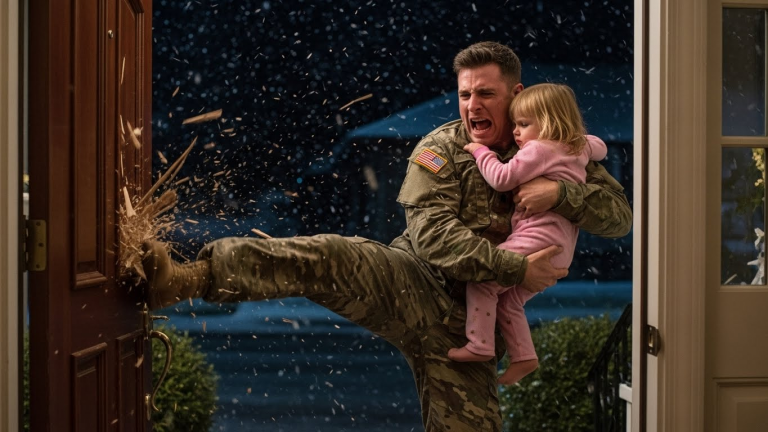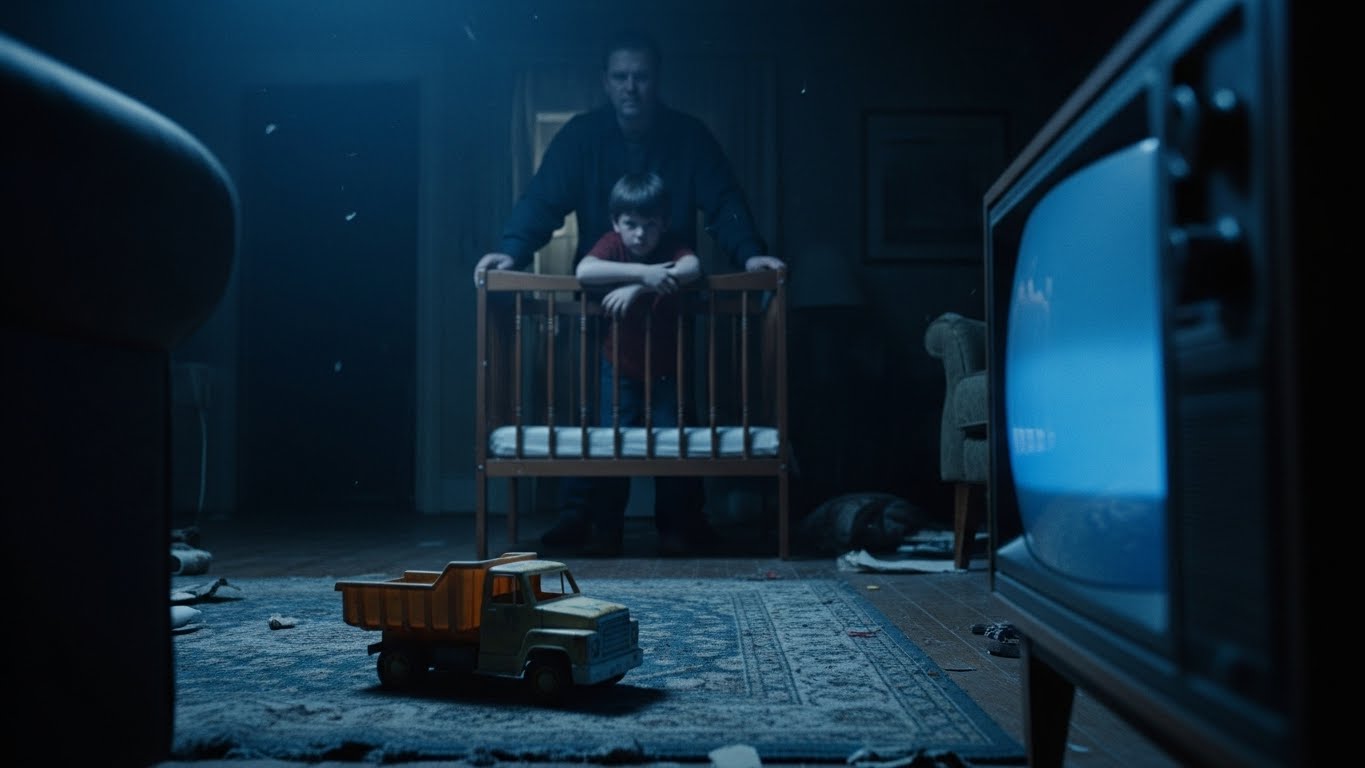
He Was Only 10 Years Old. When His Father Raised A Fist At The Baby, He Stepped In And Made A Choice That Silenced The Room Forever.
Part 1
Chapter 1: The Storm Inside
The rain in Ohio didn’t just fall that night; it hammered. It beat against the aluminum siding of our dilapidated ranch-style house on Elm Street like a thousand angry fingers demanding to be let in.
But for me, sitting on the frayed rug in the center of the living room, the storm outside was nothing compared to the atmospheric pressure building inside.
I was ten years old. My name is Leo. At an age where most kids were worrying about multiplication tables or trading cards, I was worrying about survival. I was worrying about the man sitting in the recliner six feet away from me.
The house smelled the way it always did on nights like this. Stale cigarette smoke, damp carpet that never quite dried, and the sharp, metallic tang of cheap whiskey. It was a smell that I associated with fear. It was the scent of walking on eggshells.
I sat with my legs crossed, my eyes fixed on a small, battered toy truck in my hands. I wasn’t playing. I was waiting. My hearing was tuned to a frequency that only children of trauma possess—a hyper-awareness of every creak of the floorboards, every shift in weight, every intake of breath.
In the corner, in a crib that had seen better days, lay Sarah. She was six months old, a tiny bundle of pink fleece and innocence. She was asleep, her chest rising and falling in a rhythm that I found hypnotic. It was the only peaceful thing in the room.
On the recliner, illuminated by the flickering blue light of the television, sat Frank. My father.
Frank wasn’t just a father; he was a weather system. When he was sober, he was a drought—dry, distant, cracking at the edges. But when he was drinking, like tonight, he was a tornado. Unpredictable. Destructive. And there was no shelter to be found.
I watched his hand. It was a large hand, calloused from years of working at the steel mill before the layoffs hit our town. That hand gripped a glass of amber liquid.
I counted the sips. One. Two. A heavy swallow. The clink of the glass hitting the wooden side table. That was the third glass in an hour.
“Damn rain,” Frank muttered, his voice gravelly and slurred. He shifted in the chair, the leather groaning under his weight. “Can’t even get a decent signal.”
He picked up the remote and jabbed at the buttons with unnecessary force. The TV static hissed, a harsh white noise that cut through the room like a physical blow.
I held my breath. My fingernails dug into the plastic of the toy truck.
Please don’t wake her. Please, Sarah, stay asleep.
It was a prayer I said a hundred times a day. Since Mom had passed away a year ago—a car accident on an icy road that Frank blamed on the tires, on the city, on God, on everyone but the fact that the brakes were shot—I had become the ghost of the house. I learned to be invisible. I learned that silence was safety.
But a six-month-old baby didn’t know the rules. Sarah didn’t know that noise was dangerous.
The static from the TV spiked in volume. In the crib, Sarah stirred. A small whimper escaped her lips.
I froze. My heart hammered against my ribs like a trapped bird. I looked at Frank.
His head snapped toward the crib. His eyes, rimmed with red and heavy with exhaustion and booze, narrowed.
“Quiet,” he hissed, more to the room than the baby.
Sarah whimpered again, louder this time. The sudden noise of the TV had startled her. She began to cry—a thin, high-pitched wail that grated on the nerves. To a loving parent, it was a sound of need. To Frank, in his current state, it was an insult. A challenge to his authority.
“I said quiet!” Frank roared, slamming his hand onto the armrest.
The sound was like a gunshot in the small room.
I moved. I didn’t think; I just moved. I stood up and drifted silently toward the crib, my socks sliding on the worn carpet. I reached through the bars and gently placed a hand on Sarah’s stomach, patting her rhythmically.
“Shh, Sarah. It’s okay,” I whispered, my voice barely audible. “I’m here. It’s okay.”
I needed to soothe her before Frank reached his breaking point. I knew the signs. The vein throbbing in his temple. The way he clenched his jaw. The way the whiskey glass was set down with deliberate, dangerous precision.
“Why is she crying?” Frank asked. The question wasn’t a question; it was an accusation. He didn’t turn his head; he stared straight at the static-filled screen.
“She’s just hungry, Dad,” I lied. She wasn’t hungry; she was scared. “I’ll make her a bottle. I’ll take her to the kitchen.”
“She’s always crying,” Frank grumbled, standing up. He swayed slightly, catching his balance on the side table. The lamp wobbled, casting wild shadows against the wall. “Just like your mother. Always whining. Always needing something.”
I felt a surge of hot anger in my chest, burning like acid. But I swallowed it down. Anger was dangerous. Anger got you noticed.
“I’ve got it, Dad,” I said, trying to keep my voice steady, trying to sound like a calm adult in a small boy’s body. “Just go back to your show. I’ll take her out.”
I scooped Sarah up. She was warm and smelled of baby powder and milk. She was light, but the responsibility I felt for her weighed a thousand pounds. I held her tight against my chest, shielding her face from the man looming across the room.
Frank turned. He was a big man, six foot two, with shoulders that blocked out the light. He took a step toward us. The floorboards whined under his boots.
“You coddle her,” Frank sneered. “Making her soft. She needs to learn to shut up.”
“She’s a baby,” I said.
I couldn’t help it. The words slipped out before I could stop them.
The room went deadly silent. The rain outside seemed to stop, though I knew it was just my ears ringing with the rush of adrenaline.
Frank stopped. He tilted his head, looking at me as if seeing me for the first time that evening.
“What did you say to me?”
I stepped back, clutching Sarah tighter. “I… I just said she’s little. She doesn’t know.”
Frank took another step. The smell of whiskey hit my face—a wave of sour heat. “You think you’re the man of the house now? Because your mom’s gone? You think you can tell me what’s what?”
“No, sir,” I whispered. I looked at the door to the hallway. It was ten feet away. If I could just get to the hallway, I could get to my room, lock the door, and wedge the chair under the handle. I had practiced it.
“I’m taking her to bed,” I said, inching sideways.
Frank lunged.
Chapter 2: The Human Shield
It wasn’t a clumsy, drunken stumble. It was a sudden, violent motion. He grabbed my upper arm, his fingers digging in like steel claws. I gasped, nearly dropping Sarah, but I clamped my other arm around her, securing her to my hip.
“You don’t walk away when I’m talking to you!” Frank shouted, spittle flying from his lips.
Sarah screamed. The sudden movement and the shouting sent her into a panic. Her cries filled the small room, echoing off the thin walls like a siren.
“Make her stop!” Frank yelled, shaking me. My teeth rattled. “Make her stop or I will!”
I looked into my father’s eyes. There was nothing there. No recognition. No love. Just a black hole of rage and alcohol. I realized with a chilling clarity that tonight was different. Tonight, Frank wasn’t going to pass out in the chair. Tonight, the violence was looking for a place to land.
If I did nothing, Frank would hurt Sarah. He would shake her, or strike her, just to silence the noise. She was too small. She wouldn’t survive it.
I made a calculation. It was the kind of math no ten-year-old should ever have to do.
Mass times velocity equals impact.
If the impact hits Sarah, she breaks. If the impact hits me, I bruise.
I needed to become the target. I needed to draw the fire.
I looked up at my father, my eyes hardening. I stopped cowering. I stood up straight, ignoring the pain in my arm where Frank was gripping me.
“She’s crying because you’re scary,” I said. My voice was loud. Clear. “You’re a drunk and you’re scary and Mom hated you for it.”
The words hung in the air like a lit match thrown into a pool of gasoline.
Frank’s face went slack with shock, then contorted into a mask of pure fury. He released my arm, stepping back as if he had been slapped.
“What did you say?” Frank whispered. The tone was far more terrifying than the shouting.
I didn’t retreat. I used the split second of release to turn and sprint toward the hallway.
Run! I screamed internally.
I made it to the bedroom—the room I shared with Sarah. I slammed the door, but I didn’t lock it. There wasn’t time. I heard Frank’s heavy boots thundering down the hall.
I dropped Sarah into her crib. “Stay down,” I whispered desperately. I threw a heavy quilt over her, not to keep her warm, but to hide her. To make her invisible.
I spun around just as the door flew open. It hit the wall with a crack that sounded like a gunshot.
Frank stood in the doorway, filling the frame. His chest was heaving. His fists were clenched at his sides.
“You ungrateful little brat,” Frank growled. He stepped into the room.
I didn’t back into the corner. I didn’t hide under the bed. Instead, I stepped forward. I planted my feet firmly on the floorboards, directly between my father and the crib.
I was four feet, eight inches tall. I weighed seventy pounds soaking wet. But in that moment, I was a wall. I was the Guardian.
“Don’t touch her,” I said. I kept my voice steady, though my knees were shaking so hard I thought they might buckle. “You want to hit someone? Hit me.”
Frank laughed, a cold, harsh sound. “You think you’re a hero, Leo? You think you can stop me?”
“I think you’re a coward,” I said, looking Frank dead in the eye. I knew exactly which buttons to push. I had heard my mother argue with him enough times. “Only cowards hit babies.”
Frank roared. He closed the distance in two strides. He raised his hand, a heavy, open palm that looked like a meat cleaver.
I didn’t flinch. I didn’t close my eyes. I turned my body slightly, presenting my shoulder, protecting my head, just like I’d seen boxers do on TV. I braced myself.
One.
The first blow struck me on the left shoulder. It felt like being hit with a baseball bat. The force of it spun me around, sending me crashing into the dresser. Pain exploded down my arm, turning my fingers numb instantly.
But I didn’t fall. I caught myself on the dresser and scrambled back to my position. Center of the room. Protecting the crib.
“Is that all you got?” I gasped. I tasted blood. I must have bitten my tongue.
Frank looked stunned that I was still standing. The defiance fueled his rage. He swung again.
Two.
This one caught me in the ribs. The air left my lungs in a painful whoosh. I doubled over, clutching my side. I felt something crack—a rib, maybe two. The pain was white-hot, blinding. I fell to my knees.
Sarah was screaming in the crib now, a muffled, terrified sound from under the blanket.
Frank loomed over me. “Stay down,” Frank spat.
I looked at the floor. I saw the dust bunnies under the bed. I saw the scuff marks from my sneakers. I wanted to stay down. It would be so easy to just curl into a ball and let the darkness take me.
But then I heard the whimper from the crib.
She can’t take this. I can.
Gritting my teeth, I forced myself up. My legs felt like lead. My side screamed in protest. I stood up, swaying, and put myself back in the line of fire.
“No,” I wheezed.
Frank’s eyes went wide. He looked at his hands, then at his son. For a second, there was hesitation. But the alcohol was driving the bus, and the bus had no brakes.
“You just don’t learn,” Frank muttered. He raised a fist this time.
Three.
The fist connected with my cheekbone.
The world went sideways. There was a burst of light behind my eyes, like fireworks. I hit the floor hard. My head bounced off the carpet. A high-pitched ringing filled my ears, drowning out the rain, drowning out Sarah’s cries, drowning out Frank’s heavy breathing.
I lay there, staring at the ceiling fan. It wasn’t moving.
Get up, a voice inside me said. It sounded like my mother. Get up, Leo. You have to get up.
I tried to move my arms. They felt heavy, disconnected. I rolled onto my stomach. I crawled. I dragged myself, inch by inch, until I was wedged against the leg of the crib. I wrapped my arms around the wooden leg, anchoring myself.
If Frank wanted to get to Sarah, he would have to go through me. He would have to kill me.
Frank stood over me, breathing hard. The rage was starting to ebb, replaced by a dawning realization of what he had done. He looked at his knuckles, bruised and red. He looked at me, battered and bleeding on the floor, guarding the crib like a soldier at the gates.
“Leo?” Frank’s voice trembled. The monster was receding, leaving the broken man behind.
I didn’t answer. I just counted.
One blow to the shoulder. One to the ribs. One to the face.
Three blows.
That’s three blows Sarah didn’t take.
I closed my eyes. The darkness was warm. The pain was starting to fade into a dull throb. I heard a siren in the distance. Or maybe it was just the ringing in my ears.
He hoped it was a siren. I had dialed 911 on the landline in the kitchen right before I walked into the living room to confront my father. I had left the phone off the hook. I hoped the dispatcher had heard the screaming.
“Leo, get up,” Frank said, panic rising in his voice. “Stop playing. Get up.”
The front door burst open downstairs. Heavy boots on the stairs. Voices. Radios.
“Police! Anybody home?”
Frank backed away, his face draining of color. He looked at the window, thinking about running.
I smiled. A small, broken smile.
Safe.
Part 2
Chapter 3: White Noise and Beeping Machines
The first thing I noticed was the light. It wasn’t the flickering blue of a television or the gray gloom of a rainy Ohio evening. It was a harsh, fluorescent white that stabbed at my eyes even through my closed lids.
The second thing was the smell. It smelled like rubbing alcohol and lemon floor cleaner. The smell of “clean.” The smell of a place where people came to get fixed or to die.
I tried to sit up, but a sharp, hot wire of pain tightened around my chest. I gasped, the air catching in my throat.
“Whoa, easy there, tiger.”
A hand gently pushed my shoulder back down against the mattress. The sheets were stiff and scratchy.
I forced my eyes open. A woman in blue scrubs was looking down at me. She had kind eyes and tired lines around her mouth. A nurse.
“Where…” My voice sounded like gravel grinding together. My throat was dry as a desert. “Where is she?”
The nurse poured a cup of water from a pink plastic pitcher and held a straw to my lips. “Drink first. Talk later.”
I drank. The water was cold and tasted like metal, but it was the best thing I had ever tasted. I pushed the cup away.
“Sarah,” I rasped. “My sister. The baby.”
Panic started to rise in my chest, beating against my broken ribs. The last memory I had was the floor. The boot. The siren. Had they taken her? Was she with him?
“She’s okay,” the nurse said quickly, sensing my rising heart rate on the monitor that beeped rhythmically beside the bed. “She’s right down the hall in the pediatric ward. She’s getting checked out, but she’s fine, Leo. Not a scratch on her.”
Not a scratch.
I let my head fall back against the pillow. The tension that had been holding my body together since Mom died suddenly snapped. I felt heavy. Useless.
“And Dad?” I asked, staring at the acoustic tiles on the ceiling. I counted the little black dots.
“Police have him,” a deep voice said from the doorway.
I turned my head. It hurt to move my neck. Standing there was a police officer. He was a mountain of a man, with a gray mustache and a uniform that looked like it had seen too many double shifts. Officer Miller. I recognized him from the blurry moments before I passed out.
He walked into the room and took off his cap, twisting it in his hands. He looked uncomfortable, like he wasn’t sure how to talk to a ten-year-old who looked like he’d been hit by a truck.
“Your dad is in a holding cell downtown,” Miller said. “He’s being charged with aggravated assault, child endangerment, and resisting arrest. He’s not going anywhere for a long time.”
“Good,” I whispered.
Miller pulled a metal chair closer to the bed. The legs scraped against the linoleum. “You did a brave thing, son. Stupid, but brave. You know you have two broken ribs? A hairline fracture in your cheekbone? A concussion?”
I touched my face. It felt swollen, like a balloon filled with water. “He was going to hurt her.”
“I know,” Miller said softly. “We heard the call. The dispatcher heard everything before the line went dead. We got there as fast as we could.”
He leaned forward, his elbows on his knees. “I need to ask you something, Leo. And I need you to be honest with me. Has he done this before?”
I looked at the officer. I thought about the bruises I had hidden with long sleeves in the summer. I thought about the “clumsy falls” down the stairs. I thought about the way Mom used to wear sunglasses inside the house.
“Not to Sarah,” I said. “Never to Sarah. Just me. And Mom.”
Miller’s jaw tightened. He nodded slowly, taking a small notebook out of his pocket and writing something down.
“Okay. That’s what I needed to know.” He closed the notebook. “Now, here’s the hard part, Leo. Since your dad is locked up and your mom is… gone… we have to figure out where you and Sarah go from here.”
The cold dread returned. I knew what this meant. I watched cop shows. I knew about “The System.”
Foster care. Strangers. Separation.
“You can’t split us up,” I said, my voice rising in panic. The monitor started beeping faster. Beep-beep-beep. “She doesn’t sleep unless I hold her hand. She doesn’t take the bottle for anyone else. You can’t take her.”
“Leo, calm down,” Miller said, raising his hands. “Social services is on their way. They’re going to look for next of kin first. Do you have anyone? Aunts? Uncles? Grandparents?”
I racked my brain. My brain felt foggy, full of cotton. Mom had a sister. Martha. But they hadn’t spoken in years. Frank had driven everyone away. He said Martha was “uppity” and “judgmental.” I hadn’t seen her since I was five. I barely remembered her face.
“There’s… Aunt Martha,” I said hesitantly. “But she lives in Montana. That’s far.”
“Do you know her last name?”
“Evans. I think.”
Miller nodded. “We’ll find her. In the meantime, you just rest. You’re safe here, Leo. There’s a cop outside that door. Nobody gets in unless I say so. Especially not Frank.”
He stood up and put his hand on my uninjured shoulder. It was a heavy, warm hand. A gentle hand. It felt so different from the hand that had put me in this bed.
“Get some sleep, kid. You earned it.”
Miller left the room, leaving me alone with the beeping machine. I stared at the door. I wanted to believe him. I wanted to believe I was safe.
But I knew the world wasn’t that simple. Frank was gone, but now we were orphans in everything but name. And orphans didn’t get to choose their endings.
I closed my eyes, but I didn’t sleep. I just kept counting the beeps. Waiting for the next shoe to drop.
Chapter 4: The Cavalry Arrives
The next morning, the room was filled with suits.
There was a doctor, checking my charts and tutting at my x-rays. There was a social worker, a woman named Mrs. Halloway who smelled like stale coffee and paperwork. She had a kind face, but her eyes were tired, like she had seen too many sad stories and had run out of tears.
“Leo,” Mrs. Halloway said, sitting in the chair Miller had occupied the night before. “We’ve been trying to reach your aunt. We left messages, but we haven’t heard back yet.”
My heart sank. Montana was a different world. Maybe she didn’t care. Maybe she didn’t want the baggage of a broken boy and a baby she’d never met.
“If we can’t find her by the end of the day,” Mrs. Halloway continued gently, “we’re going to have to place you in temporary care. There’s a nice family in Dayton who takes emergency placements.”
“Do they take babies?” I asked quickly.
“Well… usually they take older boys. We have a different home for infants. Babies need… specialized care.”
“No,” I said. It wasn’t a request. “No. We stay together.”
“Leo, it’s only for a little while,” she tried to reason. “Just until we sort this out. It’s hard to keep siblings together in emergency situations.”
“Then I’m not going,” I said, crossing my arms over my chest, wincing as my ribs protested. “I’ll stay here. I’ll live in the hospital.”
Mrs. Halloway sighed. She opened her mouth to speak, probably to tell me that’s not how the world works, when there was a commotion in the hallway.
I heard heavy footsteps. Fast footsteps. The sound of heels clicking on linoleum with purpose. And then, a voice.
“I don’t care about visiting hours! That is my nephew and my niece, and if you don’t get out of my way, I will move you myself!”
The voice was loud. It was fierce. It sounded like Mom, but stronger. Like Mom without the fear.
The door to my room flew open.
Standing there was a woman who looked like she had just walked off a ranch. She was wearing jeans, a denim jacket, and boots. Her hair was graying and pulled back in a messy ponytail. She looked wild and windblown, like she had run all the way from Montana.
It was Aunt Martha.
She looked at Mrs. Halloway. She looked at the doctor. Then her eyes landed on me.
Her expression crumbled. The fierce warrior dropped her shield, and she rushed to the side of the bed.
“Oh, Leo,” she breathed. She reached out to touch my face but stopped, afraid to hurt me. Tears welled up in her eyes. “Oh, honey. Look at you.”
“Aunt Martha?” I whispered. I felt a lump form in my throat.
“I’m here, baby. I’m here.” She turned to Mrs. Halloway, her eyes flashing fire again. “I’m Martha Evans. I’m their aunt. And I’m taking them.”
Mrs. Halloway stood up, looking flustered. “Ms. Evans, we left messages, but—”
“I was out on the range. No cell service,” Martha snapped. “I got the message four hours ago. I drove to the airport and got on the first plane. I’ve already called my lawyer. I am filing for immediate emergency custody.”
She looked back at me. “Where is Sarah?”
“Down the hall,” I said. “They said she’s okay.”
“Is she?” Martha asked the doctor.
“Physically, yes,” the doctor said. “She’s being monitored.”
“Good. Pack her up,” Martha commanded. “We’re leaving.”
“Ms. Evans,” Mrs. Halloway interjected. “There are procedures. Background checks. Home studies. You can’t just…”
Martha reached into her jacket pocket and pulled out a stack of photos. She slammed them onto the bedside table.
“That is my ranch. Five hundred acres. That is the nursery I set up in the spare room before I even got on the plane. That is my clean criminal record. And that,” she pointed to a photo of her and my mother, laughing together years ago, “is my sister. I promised her I would look out for them if anything happened. I let Frank keep them away because I thought… I thought he was just a jerk, not a monster. I made a mistake. I’m not making another one.”
She leaned in close to the social worker. “Now, you can help me fill out the paperwork, or you can explain to the press why you’re keeping these children in the system when they have family willing to take them today.”
Mrs. Halloway looked at Martha. Then she looked at me. For the first time, a genuine smile touched her lips.
“I think we can expedite the paperwork, Ms. Evans.”
Martha let out a breath and turned back to me. She sat on the edge of the bed and carefully took my hand. Her hand was rough, calloused like a worker’s, but warm.
“Leo,” she said softy. “I heard what happened. The police officer told me.”
I looked down at our hands. “I had to.”
“I know,” she said. “You were the man of the house. You did a job you never should have had to do.” She squeezed my hand. “But I’m here to tell you something, Leo. You’re fired.”
I looked up, confused. “What?”
“You’re fired,” she repeated, a sad smile on her face. “You don’t have to be the protector anymore. That’s my job now. You just have to be a ten-year-old boy. Can you do that?”
I felt the tears then. They came hot and fast, spilling over my swollen cheeks. The dam finally broke.
“It hurt,” I sobbed. “It hurt so much.”
“I know, baby. I know.” She pulled me into a hug, careful of my ribs. She smelled like rain and horses and safety.
“Can I see Sarah?” I asked into her shoulder.
“Yes,” Martha said, pulling back and wiping my tears with her thumb. “Let’s go get your sister.”
A nurse brought a wheelchair. I didn’t argue. I let them wheel me down the hall to the pediatric ward.
When we entered the room, Sarah was in a crib with metal bars, playing with her toes. She looked up when we entered. Her eyes were big and blue, just like Mom’s.
She saw me and squealed, reaching her arms out.
“Lee-o,” she babbled. It wasn’t a real word, but it was close enough.
Martha lifted her out of the crib and placed her in my lap. I wrapped my good arm around her. She felt solid. Real. Alive.
She grabbed my finger with her tiny hand and held on tight.
I looked at Aunt Martha. “We’re going to Montana?”
“Yeah,” Martha said, stroking Sarah’s hair. “Big sky. Horses. No neighbors for miles.” She paused, her expression hardening just a fraction. “And if Frank ever tries to come near you again, he’ll have to get through five hundred acres and a very angry aunt with a shotgun.”
I laughed. It hurt my ribs, but it felt good.
“I think I’d like that,” I said.
For the first time in a year, the static in my head cleared. The fear that had been a constant hum in my veins faded.
I looked out the hospital window. The rain had stopped. The sun was trying to break through the clouds.
We were going to be okay.
Part 3
Chapter 5: The Big Sky
Montana wasn’t just a place; it was a shock to the system.
After the cramped, gray confines of Ohio, the ranch felt like stepping onto another planet. The sky was so big it felt like it might swallow you whole. The air didn’t smell like exhaust and wet pavement; it smelled of sagebrush, pine, and drying mud.
The ranch house was made of logs thick enough to stop a tank. It had a wraparound porch and windows that looked out over a valley that turned gold in the sunset.
But for the first two weeks, I didn’t care about the view. I cared about the locks.
“Why isn’t there a deadbolt on the back door?” I asked Martha on the third night.
Martha was in the kitchen, kneading dough. She dusted her hands with flour and looked at me. “Because the nearest neighbor is five miles that way, and the bears don’t know how to use doorknobs, Leo.”
“He could find us,” I whispered. I was checking the window latches for the third time that hour.
Martha stopped. She walked over and knelt in front of me. She did that a lot—getting on my level so she wasn’t looming over me like Frank used to.
“Leo, look at the driveway.”
I looked out the window. The dirt road wound for miles until it disappeared into the tree line.
“You can see a car coming for twenty minutes before it gets here,” she said. “And the dogs—Buster and Blue—they’d hear a squirrel sneeze a mile away. You are safe.”
It took time for my brain to believe her. Trauma is a muscle memory; your body remembers to be afraid even when your mind knows you’re safe.
I jumped when the toaster popped. I froze when Martha dropped a pan. I slept with a flashlight under my pillow, clicking it on every time the house settled and groaned in the wind.
But slowly, the rhythm of the ranch started to rewrite the rhythm of my fear.
Martha put me to work. Not hard labor, but purpose.
“Horses are like people, Leo,” she told me one morning in the barn. She introduced me to a mare named Whisper. The horse had a scar on her flank and skittish eyes. “Whisper had a bad owner before me. She doesn’t trust easy.”
I reached out a hand. Whisper flinched and stepped back.
“She thinks you’re going to hit her,” I said softly.
“Exactly,” Martha said. “So how do you tell her you won’t?”
“You don’t tell her,” I said, remembering the nights I tried to reason with Frank. “Words don’t matter. You just… wait.”
I stood there for an hour, hand out, not moving. Finally, Whisper took a step. Then another. She nudged my palm with her velvet nose, letting out a warm huff of breath.
I smiled. It was the first real smile I’d felt in weeks.
“See?” Martha said, leaning against a stall door. “Broken things heal, Leo. They just need time and a gentle hand.”
I knew she wasn’t talking about the horse.
Chapter 6: The Summons
The healing was interrupted three months later by a letter in the mailbox.
It was thick, creamy paper with an official seal. Martha opened it on the porch while I played with Sarah on a blanket in the grass. Sarah was crawling now, a determined little tank in a pink onesie.
I saw Martha’s shoulders stiffen. She read the paper, her lips pressing into a thin line. Then she looked at me.
I knew. My stomach dropped to my shoes.
“Is it him?” I asked.
Martha came down the steps and sat on the blanket. “It’s the District Attorney in Ohio. The trial is set for next week.”
“Do I have to go?”
“You don’t have to,” Martha said carefully. “We can ask for you to testify by video. You don’t have to be in the room with him.”
I looked at Sarah. She was chewing on a rubber giraffe, blissfully unaware that her father was a monster who was currently sitting in a cell, possibly plotting a way to get out.
If I didn’t go, maybe the jury wouldn’t understand. Maybe Frank’s lawyer would say I was a liar. Maybe he would get out. And if he got out, he would come for us. He would come for her.
I touched the faint scar on my cheekbone. It was barely visible now, just a thin white line.
“I want to go,” I said.
“Leo, you don’t—”
“I want him to see me,” I interrupted. My voice surprised me. It wasn’t the whisper of the ghost boy from Ohio. It was the voice of a kid who had tamed a scared horse. “I want him to see that he didn’t win.”
Martha looked at me for a long moment. She saw the set of my jaw, the same stubbornness that ran in our family.
“Okay,” she said, pulling me into a side hug. “Then we go. We buy you a suit. We fly back there. And we finish this.”
The flight back to Ohio felt like traveling backward in time. The closer we got, the grayer the world seemed. When we landed, the humidity hit me like a wet blanket.
We stayed in a hotel, not the house. I never wanted to see that house on Elm Street again.
The night before the trial, I couldn’t sleep. I paced the hotel room.
“What if I freeze?” I asked Martha. “What if I see him and I can’t speak?”
“Then I’ll be right there in the front row,” she said. “And you just look at me. Ignore him. He’s just a small man in a chair, Leo. He’s not a giant anymore.”
Chapter 7: The Verdict
The courtroom smelled like old wood and nervous sweat.
When the bailiff opened the doors, my heart started hammering that old, familiar rhythm. Thump-thump-thump.
I walked in holding Martha’s hand. I scanned the room. And then I saw him.
Frank sat at the defense table. He looked different. He had lost weight. His hair was cut short, and he was wearing a cheap suit that didn’t fit his broad shoulders. He wasn’t the tornado. He looked… pathetic.
He looked up as I walked down the aisle. Our eyes met.
I waited for the fear. I waited for the urge to hide, to cower, to apologize.
But it didn’t come.
Instead, I felt a strange sense of detachment. He was just a stranger. A stranger who had hurt me, yes, but a stranger who had no power here. There were guards. There was a judge. There were laws.
When they called my name, I walked to the stand. I sat in the big leather chair that swiveled slightly. The microphone was too high; the bailiff had to lower it.
The District Attorney, a sharp woman named Ms. Vance, smiled at me. “Leo, can you tell the jury what happened on the night of November 12th?”
I took a breath. I looked at the jury—twelve strangers staring at a ten-year-old boy.
“It was raining,” I began.
I told them everything. I told them about the whiskey. The static. The crying.
Frank’s lawyer tried to interrupt, tried to object, but the judge waved him down. The room was silent.
Then came the hard part.
“And when your father came into the bedroom,” Ms. Vance asked softly, “what did you do?”
“I stood in front of the crib,” I said.
“Why?”
“Because he was going to hit Sarah. And she’s a baby. She breaks easy.”
A woman in the jury box wiped a tear from her eye.
“And what did he do?”
I looked at Frank. He was staring at the table, refusing to look at me.
“He hit me,” I said. “Three times.”
“Can you show us where?”
I touched my shoulder. “One here.” I touched my ribs. “One here. That’s the one that broke the bones.” I touched my cheek. “And one here. That’s the one that knocked me out.”
The silence in the room was heavy, suffocating.
“Did he say anything to you?” Ms. Vance asked.
“He told me to stay down,” I said. I leaned into the microphone. “But I didn’t.”
Frank’s lawyer decided not to cross-examine me. He knew it was suicide. There was no spinning this. There was no “accident.”
When I stepped down from the stand, I walked past Frank’s table. He looked up, just for a second. I saw shame in his eyes.
I didn’t look away. I held his gaze until he was the one who flinched and looked down.
Coward, I thought.
The jury deliberated for less than an hour.
Guilty on all counts.
The judge sentenced him to fifteen years. With his record and the severity of the assault, he wouldn’t be eligible for parole for at least ten.
As the bailiffs cuffed him, Frank turned to look at the gallery. He looked for me. But I wasn’t looking at him. I was looking at Aunt Martha, who was crying happy tears.
I was done with him. He was the past. I was the future.
Chapter 8: The Guardian Rests
One Year Later
The sun over Montana was setting, painting the sky in streaks of violet and fire orange.
I sat on the top rail of the fence, watching the horses graze in the lower pasture. Whisper was there, flicking her tail at flies, calm and steady.
“Leo!”
I turned. Sarah was toddling across the porch, her legs wobbly but determined. She was eighteen months old now. She had a head full of curly blonde hair and a laugh that sounded like bells.
Aunt Martha was right behind her, drying her hands on a dish towel. “Dinner’s ready! Pot roast!”
I hopped down from the fence. My boots hit the dust with a solid thud.
My ribs didn’t hurt anymore. I could breathe deep, filling my lungs with the clean mountain air. The scar on my cheek had faded to almost nothing—just a tiny dimple when I smiled.
I walked up to the porch and scooped Sarah up. She giggled and patted my face with her sticky hands.
“You got dirt on you,” I teased her.
“Durt!” she squealed.
I held her on my hip, looking out at the horizon one last time before going inside.
For a long time, I thought my job was to be the shield. To be the thing that took the hits so others didn’t have to. I thought that’s what love was—absorbing pain.
But Martha had taught me something different. Love wasn’t just about protecting; it was about living. It was about trusting that the walls were strong enough to hold, and that the monsters didn’t always get in.
Frank was in a cell in Ohio. He was a memory that was getting smaller and smaller in the rearview mirror.
Here, under the big sky, there was no static. There was no yelling.
There was just the wind in the grass, the smell of dinner cooking, and the sound of my sister laughing.
“Coming?” Martha asked from the doorway.
“Yeah,” I said, turning my back on the dark. “I’m coming home.”
I carried Sarah inside and kicked the door shut behind me. The lock clicked into place, not to keep out the fear, but to keep in the warmth.
I was eleven years old. And for the first time in my life, I was just a boy.