THE BULLY TORE HIS “TRASH” COAT. HE DIDN’T EXPECT A MARINE SERGEANT MAJOR TO BE WATCHING.
Chapter 1: The Weight of the Fabric
The morning sun over the small town of Oakhaven, Ohio, didn’t sparkle; it just sort of hung there, pale and indifferent, filtering through the haze of the old steel mill that had closed a decade ago. For ten-year-old Leo Miller, the morning light was just a signal that the sanctuary of his small, drafty bedroom was no longer safe. It was time to face the world.
Leo sat on the edge of his mattress, staring at the chair in the corner. There, draped carefully over the backrest like a sacred relic, was the jacket.
It was an old M-65 field jacket, the woodland camouflage pattern faded to a soft, pastel wash of greens and browns. The elbows were thinning, threatening to turn into holes with one wrong move. It was a Men’s Medium, which meant that on Leo’s scrawny, underfed ten-year-old frame, it looked less like a piece of clothing and more like a tent. The sleeves hung past his fingertips, forcing him to roll them up three times just to use his hands. The hem knocked against his knees.
To the rest of the world, it was an oversized rag. To Leo, it was armor. It was a hug from a ghost.
“Leo? Honey, you’re going to be late,” his grandmother’s voice drifted in from the kitchen, accompanied by the smell of burnt toast and weak coffee.
“Coming, Grandma,” Leo whispered.
He stood up and slid his arms into the jacket. The familiar weight settled on his shoulders. It smelled faintly of mothballs and something else—something earthy and metallic that never washed out, no matter how many times Grandma Martha ran it through the wobbly machine in the basement. Leo zipped it up. The zipper caught halfway, a temperamental metal jaggedness that required patience, but Leo didn’t mind. He liked the ritual.
He walked into the kitchen. Martha looked up from the table where she was counting out quarters for the electric bill. She looked older than her sixty years, her face mapped with the kind of wrinkles that come from worrying about money, not from smiling. Her eyes softened when she saw him.
“It’s going to be eighty degrees today, Leo,” she said gently. “You sure you want to wear that heavy thing?”
“I’m sure,” Leo said, grabbing a slice of dry toast.
Martha sighed, a sound that rattled in her chest. “Okay. But drink plenty of water. I don’t want the school nurse calling me about heatstroke again.”
“I’ll be fine.”
She reached out and smoothed his hair, her rough fingers catching on a cowlick. “You look handsome. Just like him.”
Leo offered a small, tight smile. He didn’t feel handsome. He felt small. He felt like a target. But when he wore the jacket, he felt like he had backup, even if that backup was just a memory of a man named Captain Christopher Miller, who had left for Iraq five years ago and came home in a flag-draped box.
The walk to Oakhaven Elementary was a mile-long gauntlet. Leo kept his head down, watching his sneakers kick up dust on the sidewalk. His shoes were generic brand, bought at the thrift store, slightly too big so he could grow into them. He walked quickly, trying to make himself invisible.
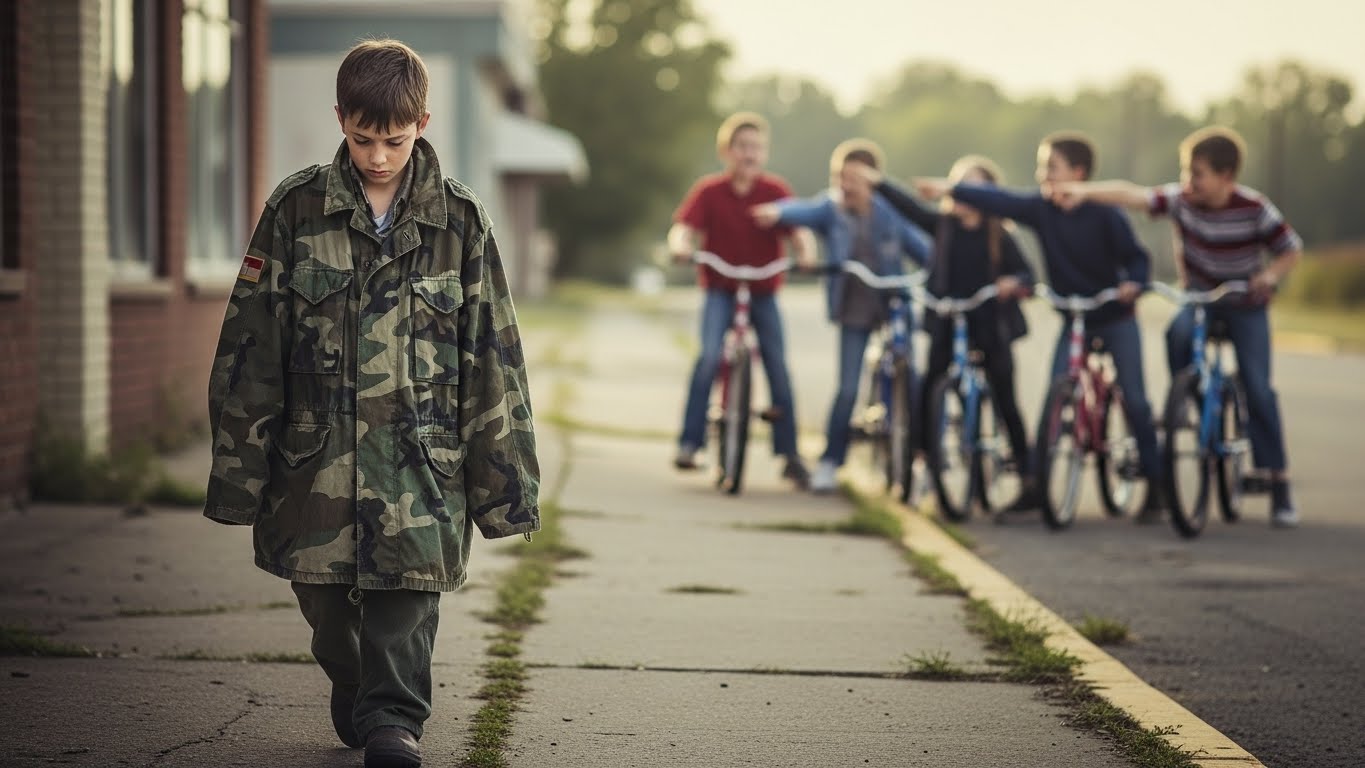
But invisibility was impossible when you were the kid in the giant camo coat.
“Hey! Look! It’s G.I. Joke!”
The voice hit Leo like a physical blow. He didn’t need to look up to know it was Braden Van Doren. Braden was twelve, held back a year, and built like a linebacker. He was the son of the town’s biggest car dealership owner, a man who plastered his face on billboards with the slogan “Van Doren Drives You Home.” Braden had inherited his father’s loud voice and his absolute certainty that he owned everything he looked at.
Leo quickened his pace, clutching his backpack straps.
Braden and his two shadows, Kyle and Mick, fell into step behind him. They were riding expensive mountain bikes, circling Leo like sharks in shallow water.
“Is it Halloween?” Braden jeered, popping a wheelie next to Leo. “Or are you going hunting? Hunting for food in the dumpster?”
Kyle and Mick laughed, a cruel, sycophantic sound. “He’s hunting for a dad!” Kyle shouted.
Leo bit the inside of his cheek so hard he tasted copper. Don’t cry, he told himself. Dad never cried. Soldiers don’t cry.
“My dad says your dad was a loser,” Braden continued, circling closer, his front tire dangerously close to Leo’s ankles. “Says he probably got lost in the desert because he was too stupid to read a map. That’s why he didn’t come back. He ran away.”
“Shut up,” Leo whispered.
“What?” Braden swerved his bike, cutting Leo off and forcing him to stop. “I couldn’t hear you over that ugly trash you’re wearing. Why don’t you take it off? It smells like a wet dog.”
“I said shut up!” Leo shouted, his voice cracking.
Braden stopped laughing. He straddled his bike, his face twisting into a sneer. “You think you’re tough because you wear camo? You’re nothing, Leo. You’re just a poor little orphan living off the government. My dad pays taxes so your grandma can buy her cigarettes.”
“She doesn’t smoke!” Leo yelled, his hands balling into fists inside the long sleeves.
“Whatever,” Braden spat on the ground, missing Leo’s shoe by an inch. “Just stay out of my way today, trash. Or I’ll rip that coat right off your back and use it to wipe my bike chain.”
Braden pushed off the pedals and sped away, his cronies following. Leo stood alone on the sidewalk, his heart hammering against his ribs like a trapped bird. The sun beat down on his shoulders, and sweat began to trickle down his back under the heavy lining of the field jacket. He was hot, he was miserable, and he was terrified.
But he didn’t take the jacket off.
He arrived at school just as the bell rang. The hallways of Oakhaven Elementary were a blur of noise and color. Kids were talking about video games, about vacations to Florida, about things that cost money. Leo moved through them like a ghost, navigating the currents to get to his locker.
He had a system. Get to class early, sit in the back row, don’t raise your hand, don’t make eye contact. If the teacher called on him, he answered in a monosyllable.
Mr. Henderson, his homeroom teacher, was a kind man but oblivious. He saw a quiet kid, not a drowning one. “Leo, jacket off inside, please,” Mr. Henderson said as he took attendance. “It’s the rules.”
Leo looked up, panic flaring in his chest. “I… I’m cold, sir.”
“It’s seventy-two degrees in here, Leo.”
“I have a fever,” Leo lied, the words tasting like ash.
Mr. Henderson sighed and adjusted his glasses. He looked at Leo—really looked at him—and saw the desperation in the boy’s eyes. He decided it wasn’t a battle worth fighting today. “Fine. But if you get overheated, take it off.”
Leo nodded, sinking lower into his seat. He could feel Braden’s eyes boring into the back of his head from three rows up. Braden whispered something to Mick, and they both snickered. A piece of crumpled paper hit the back of Leo’s neck. He didn’t brush it off. He just stared at the blackboard, focusing on the date written in white chalk.
May 24th.
Tomorrow was Memorial Day.
The realization made his stomach turn. That’s why Braden was being worse than usual. Braden knew. everyone in town knew. The Millers were the town’s “tragedy.” The car dealership family were the town’s “success.”
The morning dragged on. Math, English, History. Leo tried to focus on the multiplication tables, but his mind kept drifting to the picture on his grandmother’s mantle. A tall man with a square jaw and kind eyes, wearing this very jacket, holding a baby Leo in one arm and saluting with the other.
“This jacket kept me safe, Leo,” his dad had told him in a dream Leo had constructed from fragments of memory. “Now it’s going to keep you safe.”
But it didn’t feel safe today. It felt like a target.
Lunch was the hardest part of the day. The cafeteria was a caste system defined by lunchboxes. Licensed characters and thermos containers sat on the cool kid’s tables. The free lunch line was for the others. Leo grabbed his tray—lukewarm pizza and a bruised apple—and headed for the door. He wasn’t allowed to eat outside, technically, but the lunch aides usually looked the other way.
He found his spot behind the dumpsters near the loading dock. It smelled of rotting vegetables, but it was secluded. He sat on an overturned milk crate, balancing his tray on his knees. He took a bite of the pizza, the cheese rubbery and tasteless.
He pulled the collar of the jacket up, burying his nose in the fabric. He inhaled deeply. The scent was fading. Every day, the smell of his father became a little fainter, replaced by the smell of the world. That scared Leo more than Braden did. What if one day, he sniffed the collar and smelled nothing but cotton? Would his dad be gone for good then?
“I told you he eats trash.”
Leo froze. He didn’t turn around. He knew the voice.
Braden stepped around the corner of the dumpster, followed by Kyle, Mick, and two other boys Leo didn’t know. They were grinning, that predatory grin of pack animals sensing weakness.
“Leave me alone, Braden,” Leo said, his voice trembling. He stood up, the tray clattering to the ground. The pizza landed face down in the dirt.
“Look at that,” Braden laughed, kicking the pizza. “Wasting government handouts. My dad says people like you are leeches.”
“I’m not a leech,” Leo said, backing up until his back hit the brick wall of the school.
“You are,” Braden said, stepping closer. “And you’re a coward. Just like your dad.”
“Don’t talk about him!”
“Why? He’s dead. He doesn’t care.” Braden was within arm’s reach now. He reached out and flicked the zipper of Leo’s jacket. “This thing is disgusting, Leo. It’s offensive. You’re disrespecting the military by wearing it like a hobo.”
“It was his!” Leo screamed. “It was his jacket!”
“Well, he doesn’t need it anymore,” Braden sneered. “And neither do you. It’s eighty degrees, Leo. I think you need to cool off. Boys, help him out.”
Kyle and Mick moved forward. They weren’t smiling anymore. They looked focused, cruel.
Leo wrapped his arms around himself, clutching the fabric so tight his knuckles turned white. “No! No, please!”
This wasn’t just bullying anymore. This was an assault on the only thing that mattered to him. They weren’t just attacking a boy; they were trying to erase a memory. Leo squeezed his eyes shut and prepared for the end of his world.
Chapter 2: The Battle of the Loading Dock
The first hand grabbed his left shoulder. It was Mick. He yanked hard, the fabric straining against Leo’s desperate grip.
“Get off me!” Leo shrieked, kicking out blindly. His sneaker connected with Mick’s shin, eliciting a yelp of pain and anger.
“You little rat!” Mick shouted, shoving Leo hard against the brick wall. The impact knocked the wind out of him, his head bouncing off the rough masonry. Stars exploded behind his eyelids.
“Hold him still!” Braden commanded. He stepped in, grabbing the front of the jacket near the collar. “We’re doing you a favor, Miller. We’re taking out the trash.”
Leo fought with the ferocity of a trapped animal. He wasn’t fighting for his body; he didn’t care about the bruises forming on his arms or the scrape on his cheek. He was fighting for the integrity of the seams, for the patch on the shoulder that said AIRBORNE, for the name tape that read MILLER.
“No! Stop! You’re going to rip it!” Leo sobbed, the tears finally spilling over, hot and humiliating.
“That’s the point!” Braden grunted, pulling the zipper down. The metal teeth hissed as they separated.
Leo tried to curl into a ball, dropping to the ground to use his body weight to anchor the coat. He tucked his knees to his chest, his arms crossed over the front, burying his face in the dirt.
“Flip him over!” Braden yelled.
They descended on him. Four older, stronger boys against one undernourished ten-year-old. Hands grabbed at his ankles, his wrists, his hair. They dragged him across the gravel. The rough stones tore at his jeans and scraped his palms, but he didn’t let go of the lapels.
“Let go, you freak!” Kyle shouted, stomping on Leo’s hand.
Leo screamed, a high-pitched sound of pure agony, but his fingers only tightened. He couldn’t let go. If he let go, he lost his dad.
“Cut it off,” Braden said breathlessly. He reached into his pocket and pulled out a small folding pocket knife. It wasn’t big, but the blade gleamed in the sunlight.
The other boys hesitated. “Braden, man, maybe that’s too much…” Mick muttered, looking around nervously.
“Shut up. I’m just gonna cut the fabric so it falls off. He needs to learn a lesson.” Braden knelt down, pinning Leo’s head to the dirt with his knee. He brought the knife toward the sleeve of the jacket.
Leo watched the blade coming through his tear-blurred vision. He stopped struggling. He was overpowered. He was going to lose. A deep, hollow despair opened up inside him. I’m sorry, Dad. I’m not strong enough. I’m not a soldier.
“Say goodbye to your security blanket,” Braden hissed.
The knife tip touched the fabric.
CRUNCH.
The sound of heavy boots on gravel was loud, distinct, and rhythmic. It wasn’t the scuffling of sneakers. It was the heavy, authoritative thud of military-issue footwear.
Braden froze. The knife hovered inches from Leo’s arm.
A shadow fell over them. A shadow so large it seemed to block out the sun entirely. The temperature in the alleyway seemed to drop ten degrees.
“I suggest,” a voice rumbled, deep and resonant like the low roll of thunder, “that you drop that knife. Now.”
Braden looked up. His eyes went wide. His mouth fell open.
Standing ten feet away was a giant. He stood at least six-foot-four, his shoulders broad enough to span a doorway. He was dressed in the Immaculate Dress Blue uniform of the United States Marine Corps. The high collar was stiff, the gold buttons blinded in the sun, and the blood stripes ran down his trousers like lasers. His chest was a wall of colorful ribbons and medals.
But it was his face that was terrifying. It was carved from granite, weathered by sun and sand. His eyes were hidden behind dark aviator sunglasses, but the set of his jaw promised violence if his orders were not obeyed.
Braden scrambled back, dropping the knife. It clattered harmlessly onto the concrete. The other boys released Leo as if he had suddenly caught fire, backing away with their hands up.
“We… we were just playing,” Braden stammered, his voice rising an octave. “It’s just a game.”
The Marine didn’t move. He didn’t even look at Braden yet. He took two slow, deliberate steps toward Leo.
Leo was still curled in a ball, shivering, clutching his jacket. He looked up, terrified that this was just another authority figure coming to yell at him for fighting.
The Marine removed his sunglasses. His eyes were steel blue, piercing but strangely calm. He looked down at the knife in the dirt, then at the bullies, and finally at Leo.
“Stand up, son,” the Marine said. His voice wasn’t angry when he spoke to Leo. It was gentle.
Leo struggled to his feet, wiping the dirt and tears from his face. He pulled the jacket tight around him, trying to hide the zipper Braden had forced down. He looked at the Marine, then at the rank insignia on the sleeve. Chevrons and rockers. A lot of them.
The Marine turned to Braden. The gentleness vanished. The man who faced the bully now was a weapon of war.
“You think this is a game?” The Marine’s voice was quiet, which made it infinitely scarier than shouting. “You think tormenting a smaller boy, attacking him three-on-one, is a game?”
“He… he started it,” Braden lied, though his lip was trembling. “He’s weird. He wears that trashy coat every day. We were just telling him to dress normal.”
The Marine’s eyes narrowed. He took a step toward Braden. Braden flinched.
“Trashy coat,” the Marine repeated, tasting the words like they were poison.
“It’s dirty,” Braden squeaked. “It’s too big.”
“Do you know what this uniform represents?” the Marine asked, gesturing to his own pristine blues.
“The… the Marines?”
“It represents discipline. Honor. Sacrifice,” the Marine said. Then he pointed a gloved finger at Leo’s ragged, oversized field jacket. “And do you know what that jacket represents?”
Braden shook his head, too terrified to speak.
“Then you listen to me, and you listen closely,” the Marine said. He looked up, noticing that a small crowd had gathered. Teachers, drawn by the commotion, were running over. Other students were watching from the windows.
“Sergeant Major!” A teacher yelled, breathless. “Is everything alright?”
The Sergeant Major raised a hand to stop the teacher. “I am handling this.”
He turned back to the bullies. “You called him ‘fatherless.’ You called him ‘trash.’ You have no idea the weight of the ground you are standing on.”
The Sergeant Major walked over to Leo. He knelt down on one knee in the dirt—ruining his pristine trousers without a second thought—so he could be eye-level with the boy.
“What is your name, son?”
“Leo,” he whispered. “Leo Miller.”
The Sergeant Major froze. His eyes searched Leo’s face, looking for something. He saw the chin. The eyes. He took a deep, shuddering breath.
“Miller,” the Sergeant Major whispered. “Christopher Miller’s boy?”
Leo nodded, fresh tears spilling over. “Yes, sir.”
The Sergeant Major closed his eyes for a second, composing himself. When he opened them, they were wet. He reached out and gently touched the dirty, torn fabric of the field jacket on Leo’s shoulder. He touched it not like it was a rag, but like it was the Shroud of Turin.
“I know this jacket,” the Sergeant Major said, his voice thick with emotion. He stood up and turned to the crowd, his voice booming now, addressing Braden, the teachers, and the world.
“You boy,” he pointed at Braden. “You wanted to know why he wears this jacket?”
Braden nodded dumbly.
“This is a standard issue M-65 Field Jacket,” the Sergeant Major announced. “Ten years ago, in a place called Fallujah, a patrol was ambushed. They were pinned down in an alleyway much like this one. Taking heavy fire. RPGs. Machine guns. There was no way out.”
The schoolyard was dead silent. Even the wind seemed to stop listening.
“The platoon leader realized that the only way to save his men was to draw the enemy’s fire. To create a diversion.” The Sergeant Major looked down at Leo. “That platoon leader was Captain Christopher Miller.”
Leo looked up, his eyes wide. Grandma had told him Dad was a hero, but she never told him the details. She said it was too sad.
“Captain Miller stood up,” the Sergeant Major continued, his voice cracking slightly. “He ran into the open. He drew the fire away from his men. He took three bullets to the chest and kept running until his men were safe.”
The Sergeant Major walked over to Leo and gently turned the oversized collar of the jacket down. There, hidden under the fold, was a dark, stained hole in the fabric. A hole that had been mended with clumsy, loving stitches long ago.
“This isn’t dirt,” the Sergeant Major said, pointing to the stain. “This is the blood of a man who loved his country and his son more than his own life.”
He turned his blazing eyes back to Braden. “I was in that alleyway. I was the radio operator. I am alive today, breathing this air, standing in this sun, because the man who wore this coat died for me.”
Braden’s face was ashen. He looked at the jacket, and for the first time, he didn’t see rags. He saw a ghost. He saw a sacrifice he couldn’t comprehend. He looked down at his expensive sneakers, shame burning his face like acid.
“He doesn’t wear it because he’s poor,” the Sergeant Major said, his voice dropping to a whisper that carried across the yard. “He wears it because he is wrapping himself in his father’s arms. It is a mantle of honor that you could never afford, no matter how much money your daddy has.”
Chapter 3: The Salute
The silence that followed was heavy, but it wasn’t the oppressive silence of fear anymore. It was the silence of reverence.
Leo stood there, trembling. He felt lighter. The shame that had weighed him down all these years—the feeling that he was just a poor kid with a dead dad—evaporated. He looked at the jacket. It wasn’t just old clothes. It was a shield. The Sergeant Major said so.
The Sergeant Major—Sergeant Major Vance, as his nameplate read—turned back to Leo. He ignored the teachers, the stunned students, and the retreating bullies who were trying to melt into the brickwork.
Vance reached into his pocket and pulled out a coin. It was heavy, gold and black, with the Marine Corps emblem on one side and the words “First to Fight” on the other.
“Leo,” Vance said softly. “I have been looking for your father’s family for a long time. I wanted to tell you… I wanted to say thank you.”
He took Leo’s small, dirty hand and pressed the coin into his palm. “This is a Challenge Coin. It means you are part of the brotherhood. You are never alone. Do you understand?”
Leo nodded, clutching the coin. “Yes, sir.”
“And if anyone,” Vance looked over his shoulder at Braden, who was now crying silently, “If anyone ever gives you trouble about this uniform again, you tell them to come see Sergeant Major Vance. Can you do that?”
“Yes, sir!” Leo said, his voice stronger now.
“Good.”
Vance stepped back. He straightened his uniform. He brought his heels together with a sharp clack. He stood tall, a tower of strength and respect.
Slowly, sharply, with perfect precision, Sergeant Major Vance raised his right hand to the brim of his cover.
He saluted Leo.
He didn’t salute a general. He didn’t salute a flag. He saluted a ten-year-old boy in a ragged, oversized coat.
Leo gasped. He knew what a salute meant. It meant respect. It meant you were important.
Leo sniffled, wiped his nose on his sleeve, and stood as tall as he could. He straightened his spine. He looked the Sergeant Major in the eye. And clumsily, with his hand slightly cupped and his elbow sticking out, Leo returned the salute.
It wasn’t a perfect military salute, but to Sergeant Major Vance, it was the most beautiful thing he had ever seen.
“At ease, soldier,” Vance smiled, dropping his hand.
He put a massive hand on Leo’s shoulder. “Come on. Let’s go get that lunch you dropped. But not from the cafeteria. I think a pizza place downtown owes us a table.”
“But… school?” Leo asked.
Vance looked at the principal, who had arrived on the scene. The principal, a stern woman named Mrs. Higgins, was wiping her eyes with a tissue.
“I think Leo is excused for the rest of the day,” Mrs. Higgins said, her voice wavering. “Go on, Leo.”
Vance guided Leo toward the parking lot. As they walked past Braden, the bully didn’t look up. He was staring at the ground, defeated not by violence, but by the crushing weight of truth.
They walked to Vance’s truck, a black pickup with a Marine sticker on the back. Vance opened the door for Leo.
“Sergeant Major?” Leo asked as he climbed in, the jacket bunching up around him.
“Call me Uncle Vance, kid.”
“Uncle Vance… did he really save you?”
Vance started the engine. He looked at the empty passenger seat for a moment, seeing a ghost there, before looking back at Leo.
“Yeah, kid. He did. And now, I’m going to make sure his boy is okay. That’s a promise.”
As they drove away, Leo looked out the window. He saw his reflection in the glass. He saw the camo jacket. It didn’t look too big anymore. It looked just right.
He wasn’t just Leo Miller, the poor kid. He was the son of Captain Christopher Miller. And he had a Marine to watch his back.
For the first time in forever, Leo smiled.