He Sold Our Home For A “Mid-Life Crisis” Trip. I Was Furious Until I Found What He Was Hiding In The Glove Box.
Chapter 1: The Great Betrayal
The “For Sale” sign on the front lawn of 42 Maplewood Drive didn’t just look like a piece of wood; to Sarah, it looked like a tombstone marking the death of her sanity.
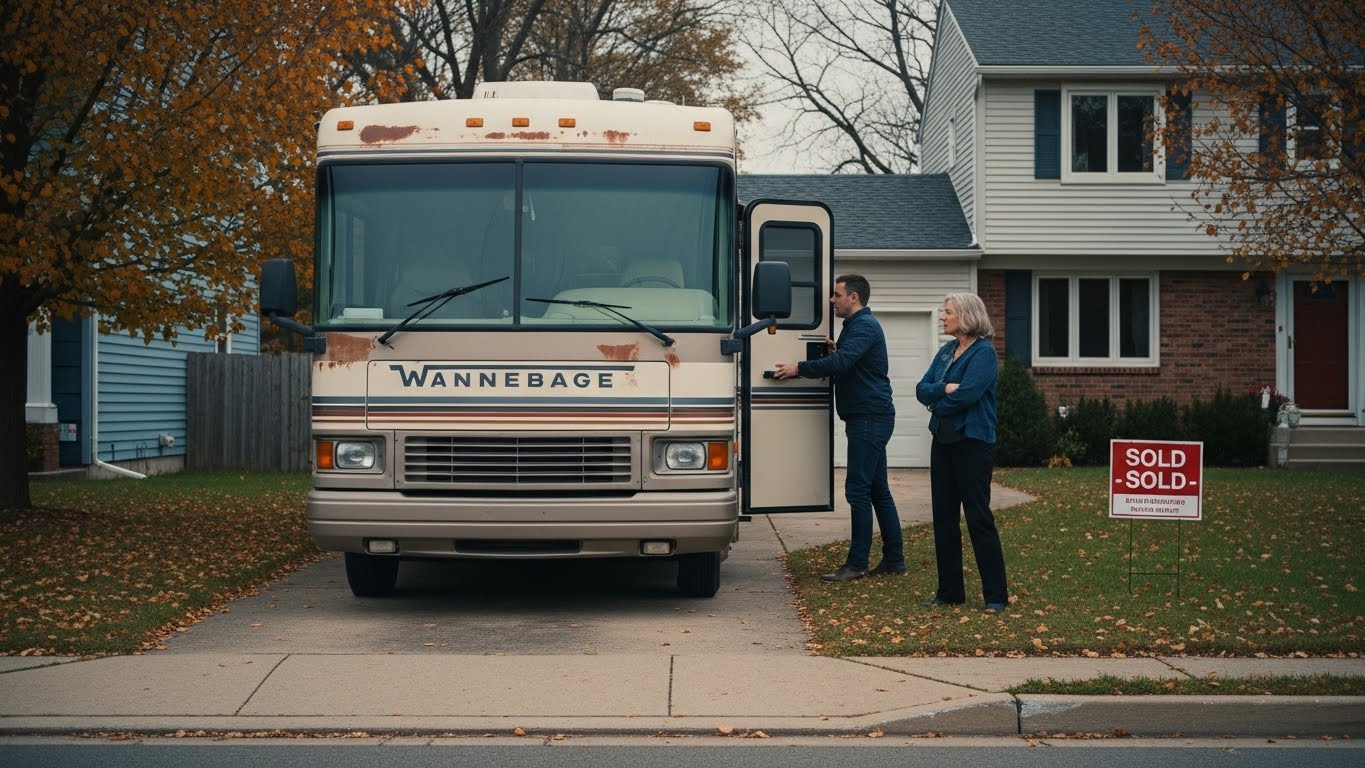
It was a Tuesday in mid-October, the kind of autumn day in Ohio that usually smelled of burning leaves and pumpkin spice. Today, however, the air smelled of diesel fumes and regret. Parked in the driveway, blocking the view of the house they had lived in for twenty-two years, was a monstrosity. A 1998 Winnebago, painted a shade of beige that could only be described as “depression tan.”
“David, you cannot be serious,” Sarah said, her voice trembling not with sadness, but with a white-hot rage that started in her stomach and radiated out to her fingertips. She stood on the sidewalk, her arms crossed so tightly over her chest that her ribs ached.
David was on his knees by the front tire of the RV, checking the pressure with a gauge that looked as old as the vehicle itself. He stood up, wiping grease onto his jeans—jeans that used to be pressed, worn by a man who was the regional manager for a logistics firm, not a… vagabond.
“It’s solid, Sarah,” David said. He offered her that lopsided smile she used to love, the one that had charmed her at a fraternity party thirty years ago. Now, it just looked tired. His skin was greyer than usual, pulled tight over his cheekbones. “The engine hums. She’s got character.”
“Character?” Sarah choked out a laugh. “David, we have a mortgage we just paid off. We have a garden I spent ten years cultivating. We have stability. And you… you sold it. You literally sold our lives out from under us for a mid-life crisis on wheels?”
“It’s not a crisis,” David said softly, his eyes drifting away from hers to look at the second-story window where their youngest, Lily, was probably packing her stuffed animals in tears. “It’s an adventure. We’ve talked about seeing the country for years.”
“We talked about doing it when we retired! When the kids were grown!” Sarah shouted, not caring that Mrs. Gable next door was peering through her blinds. “Michael is a senior, David! He’s going to miss homecoming! Emily has her dance recital! You are ruining their lives because you’re bored with yours!”
David flinched. It was a small movement, barely perceptible, like he’d been stung by a bee. He walked over and placed his hands on her shoulders. His hands felt cold, even in the afternoon sun.
“Sarah,” he said, his voice surprisingly steady. “Please. I need this. I just… I need us to be together. Not in separate rooms staring at screens. Just us. Please, trust me one last time.”
“One last time?” Sarah scoffed, pulling away. “You act like you’re going to prison.”
The next three days were a blur of boxes, angry teenagers, and the heartbreaking sound of packing tape. Michael, seventeen and furious, refused to speak to his father. He slammed his bedroom door so hard on the last day that a picture frame in the hallway fell and shattered. Emily, fifteen, cried silently, mourning the loss of her social life. Jacob, thirteen, and Lily, ten, were just confused, caught in the crossfire of their parents’ tension.
When the new owners signed the papers, Sarah felt a physical piece of her heart rip away. That house was where she brought her babies home. It was where they marked heights on the doorframe. It was where they weathered the recession, the chickenpox, and the death of her mother.
And David was trading it for a roadmap and a beige box.
The departure was grim. As they pulled out of the driveway, the RV’s engine roared—a loud, rattling sound that didn’t inspire confidence. Michael sat in the back with his headphones on, staring daggers at the back of David’s head.
“I hate him,” Michael whispered loud enough for everyone to hear.
“Michael!” Sarah scolded, though her heart wasn’t in it. She looked at David. He didn’t react. He was gripping the steering wheel so hard his knuckles were white, his eyes fixed on the horizon, a strange, desperate determination set in his jaw.
“West,” David said, mostly to himself. “We’re going West. All the way to the Pacific.”
“We’ll run out of money in Nebraska,” Sarah muttered, opening the glove box to shove in the insurance papers. As she did, a small, orange prescription bottle rolled to the front. She frowned. She didn’t recognize the doctor’s name. She reached for it, but David’s hand shot out, snatching it away with lightning speed.
“Vitamins,” he said quickly, shoving the bottle into his pocket. “Just… supplements. For energy. It’s a long drive.”
Sarah narrowed her eyes. David had never taken a vitamin in his life. He ate steak and potatoes and scoffed at kale. But she was too exhausted to fight. She leaned her head against the cool window glass as her neighborhood, her life, and her security disappeared in the side mirror.
They were three hours into the drive when the reality of the RV set in. It was cramped. It smelled of old carpet and stale air freshener. The bathroom was the size of a closet, and the water pressure was non-existent.
“I’m hungry,” Jacob whined from the back.
“We’re stopping in an hour,” David said, his voice strained. He coughed—a wet, rattling sound that seemed to shake his whole thin frame.
“You okay?” Sarah asked, glancing at him.
“Fine,” David wheezed, taking a sip of lukewarm water. “Just road dust. Allergies.”
“You don’t have allergies, David.”
“I do now,” he forced a smile. “New adventures, new allergies.”
That night, they parked at a KOA campground in Indiana. It was raining. The kids were miserable, huddled on the transformative benches that served as beds. The Wi-Fi was terrible, leading to a fresh round of complaints from Michael and Emily.
Sarah lay in the narrow bed above the cab, listening to the rain hammer the metal roof. She could hear David in the tiny bathroom below. He was running the water, but over the sound of the faucet, she could hear him retching. It was a violent, painful sound.
She climbed down the ladder, worry finally piercing through her anger. “David?” she knocked on the flimsy door. “David, open up.”
The water stopped. A moment later, David opened the door. He looked pale, sweating despite the chill. He had a toothbrush in his hand, a glob of toothpaste hiding whatever smell was on his breath.
“Bad road food,” he said, wiping his mouth with the back of his hand. “That gas station burrito. Never again.”
“David, you look terrible,” Sarah whispered, reaching out to touch his forehead. He was burning up.
“I’m fine, Sarah. Really,” he pulled away, walking past her to the small kitchenette. He poured a glass of water, his hand shaking slightly. “Look, I know you’re mad. I know the kids are mad. But tomorrow… tomorrow we’ll see the Mississippi River. We’ll cross the threshold. It’s going to be great.”
“Why are you doing this?” Sarah asked, her voice cracking. “Why the rush? Why the secrecy? You’re not just ‘burnt out.’ You’re running from something.”
David turned to her. The campground light outside cast long shadows across his face, making his eyes look sunken, like deep pools of sorrow she couldn’t reach.
“I’m not running from anything, Sarah,” he said softly. “I’m running to something. I just want… I just want us to have memories. Real ones. Not just memories of me at the office and you in the garden. I want us to remember the wind.”
He sounded so poetic, so unlike the pragmatic man she had married, that Sarah felt a shiver of fear. She went back to bed, but she didn’t sleep. She listened to his breathing. It was shallow, rapid, and occasionally broken by a suppressed whimper of pain.
She didn’t know it then, but the “mid-life crisis” was a lie. The man lying beneath her wasn’t trying to find himself. He was trying to lose himself, slowly, so that when he was finally gone, they wouldn’t be looking for him in the kitchen of a house they could no longer afford.
Chapter 2: The Silent Clock
The Great Plains stretched out like an endless ocean of gold and brown. Nebraska was flat, monotonous, and beautiful in a lonely sort of way. By day four, the initial shock had worn off, replaced by a grudging routine.
David was relentless. He was like a camp counselor on speed. He woke them up at dawn to see sunrises. He stopped at every historical marker. He forced them to put down their phones and look at herds of bison.
“Look at that,” David pointed out the window as they crossed into South Dakota. “That’s freedom, kids.”
“It’s a cow, Dad,” Michael grunted, though he had lowered his phone.
The tension in the RV was still thick, but cracks of light were breaking through. The catalyst came in the form of a breakdown outside of Rapid City. The RV’s radiator hose burst with a dramatic hiss of steam, stranding them on the shoulder of the highway.
“Great,” Michael threw his hands up. “Just great. Now we die of exposure.”
“Nobody is dying,” David said, grabbing his toolbox. He looked exhausted. The dark circles under his eyes were bruising purple now. But he waved Michael over. “Mike, come here. I want to show you something.”
“Why? Call AAA.”
“No cell service,” David lied. Sarah checked her phone; she had full bars. She opened her mouth to speak, but David shot her a look—a pleading, desperate look. She closed her mouth.
“Come on,” David said. “You’re a man now. You need to know how to fix an engine.”
For the next hour, Sarah watched from the window as David taught Michael how to bypass the hose with duct tape and water. He was patient, explaining the mechanics of the cooling system. He wasn’t just teaching him to fix a hose; he was teaching him patience, problem-solving, and self-reliance.
When Michael successfully tightened the clamp and the engine roared back to life, Sarah saw something she hadn’t seen in two years: Michael smiled at his father. A genuine, proud smile. David clapped him on the shoulder, and for a second, David slumped against the vehicle, his face twisting in agony, his hand clutching his abdomen.
Michael didn’t see it. He was wiping grease on a rag, looking proud. But Sarah saw.
That night, they camped in the Badlands. The landscape was alien—jagged peaks and striped rock formations. David built a fire. He insisted on music. He played old Motown records on a battery-powered speaker.
“Emily,” David said, standing up. “Dance with your old man.”
“Dad, no. That’s cringe,” Emily shrank back into her hoodie.
“Come on. I won’t ask again,” David said. There was a finality in his tone that made Emily pause. She stood up, rolling her eyes, but she took his hand.
They slow-danced on the dirt under a sky so full of stars it looked like spilled sugar. David whispered things to her as they swayed. Sarah couldn’t hear what he was saying, but she saw Emily’s stiffness melt away. She saw her daughter lay her head on her father’s chest.
Sarah sat by the fire, tears pricking her eyes. It was a perfect moment. It was the kind of moment David had promised. But the dread in Sarah’s gut was growing.
Later that night, the pattern repeated. Everyone slept. Sarah feigned sleep. She heard the soft beep of a video camera.
She peeked through her eyelashes. David was sitting in the driver’s seat, the interior light dim. He had the old camcorder set up on the dashboard, facing him. He was talking into it, his voice a hoarse whisper.
“Hey Jacob,” David whispered to the lens. “So, this is for your 18th birthday. I know it’s a few years off. You’re probably tall as a tree by now. I hope you stuck with soccer, but if you didn’t, that’s okay too. I just want you to know…”
He stopped, coughing into a handkerchief. When he pulled it away, he quickly folded it, hiding whatever was inside.
“I just want you to know how to shave properly. I realized I never taught you. So, here’s the trick…”
Sarah squeezed her eyes shut, hot tears leaking out onto her pillow. He wasn’t recording a travel vlog. He was recording a manual for life. He was leaving breadcrumbs for a future he wouldn’t see.
She wanted to confront him. She wanted to scream. But she was paralyzed by the terrifying thought that if she said it out loud, it would become real. As long as it was a secret, maybe it wasn’t true. Maybe he really just had allergies. Maybe he really just wanted an adventure.
But deep down, she knew. The clock was ticking, and it was louder than the engine of the old RV.
Chapter 3: The Collapse
Yellowstone National Park was meant to be the highlight. The supervolcano, the geysers, the raw power of nature. But for the family in the beige Winnebago, it became the site of the implosion.
The altitude was hard on David. His breathing had become a constant, laboring wheeze. He had lost so much weight in two weeks that his clothes hung off him like a scarecrow’s rags. He wore layers to hide it, but Sarah could see his wrists—thin, fragile bones.
They were walking toward Old Faithful. The boardwalk was crowded. The kids were actually excited, pointing out the bubbling mud pots. David was lagging behind, leaning heavily on a walking stick he’d found.
“Come on, Dad! It’s going to blow!” Lily shouted, jumping up and down.
“Coming, sweetie,” David called out, but his voice was weak.
Sarah slowed her pace, falling back to walk beside him. “David, we need to stop. We need a doctor. Now.”
“No,” David gritted his teeth, sweat beading on his forehead despite the cool mountain air. “I promised them Old Faithful. I promised.”
“You’re killing yourself!” Sarah hissed.
“I’m already…” David started, then stopped. He stumbled.
It happened in slow motion. One moment he was upright, the next his legs just gave out. He didn’t catch himself. He hit the wooden boardwalk with a sickening thud.
“David!” Sarah screamed.
The kids turned around. The look of horror on Michael’s face would haunt Sarah forever.
Tourists swarmed. Someone called for a ranger. Sarah was on her knees, cradling David’s head. He was conscious, but barely. His eyes were unfocused, rolling back.
“The… the bag…” he murmured, clutching at his jacket pocket. “The blue… bag…”
Sarah reached into his pocket. She pulled out a small, zippered pouch. She unzipped it, expecting an inhaler.
Inside were three bottles. Morphine Sulfate. Oxycodone. Pancreatic Enzyme Replacement.
And a folded piece of paper. A Do Not Resuscitate order.
The world stopped. The sound of the crowd faded into a buzzing white noise. Sarah stared at the labels. Pancreatic.
“Ma’am?” A ranger was beside her. “Ma’am, is he on medication?”
Sarah couldn’t speak. She just held up the bottle of Morphine. The ranger’s face fell. He understood.
They got him back to the RV. He refused the hospital. He was lucid again after Sarah administered the morphine, the pain momentarily dulled. The kids were huddled in the back bunk, terrified, crying.
Sarah sat opposite David at the tiny dinette table. The curtains were drawn.
“Stage Four,” David said. His voice was calm now, stripped of all the fake cheerfulness he’d been wearing for weeks. “Pancreatic cancer. Diagnosed three months ago. They gave me six months. But… I think the timeline accelerated.”
“Why?” Sarah sobbed, her hands shaking so hard she couldn’t hold her water glass. “Why didn’t you tell me? Why did you sell the house? Why did you drag us out here?”
“Because of the house,” David said, reaching across the table to take her hands. This time, she didn’t pull away. “Sarah, if I died in that bedroom, you would never be able to walk in there again without seeing me. You’d hate that house. It would become a mausoleum. And the bills… the treatment would have drained our savings. I would have left you with nothing but debt and a house you couldn’t afford.”
“So you sold it?”
“I sold it. The money is in a trust. It’s enough to buy a smaller place, outright. No mortgage. College funds for the kids. I wanted to leave you free. Financial freedom.”
“But this…” Sarah gestured to the RV. “This torture?”
“I didn’t want my last weeks to be hooked up to machines, Sarah. I didn’t want the kids to remember me with tubes in my throat. I wanted them to remember me driving. I wanted to see the Pacific one last time. I wanted to die living.”
The door to the back bunk creaked open. Michael stood there. He had heard everything. His face was streaked with tears, but his eyes… his eyes were different. The anger was gone.
He walked over and sat next to his father. He didn’t say a word. He just put his arm around David’s frail shoulders and buried his face in his father’s neck. Then Emily came. Then Jacob. Then Lily.
They piled onto him, a heap of sobbing children. David held them all, his eyes closed, tears streaming down his gaunt cheeks.
“I’m sorry,” he whispered. “I’m so sorry.”
“Shut up, Dad,” Michael choked out. “Just… shut up. We’re going to the ocean. You hear me? We’re going to get you to the ocean.”
Chapter 4: The Final Sunset
The dynamic of the trip shifted instantly. It was no longer a vacation; it was a mission.
They didn’t stop for museums anymore. They didn’t stop for scenic overlooks unless David was awake enough to see them. Michael took over the driving. He drove with a focus and maturity that aged him ten years in ten days.
The RV became a mobile hospice. Sarah managed the medication schedule. Emily, who had been so obsessed with her friends, became the chief comforter. She read to David for hours—Harry Potter, his favorite. Jacob and Lily would sit at his feet, massaging his swollen ankles, telling him stories about school, trying to cram a lifetime of conversation into days.
They raced through Idaho. They crossed into Oregon.
David was fading fast. He slept twenty hours a day. When he was awake, he was often confused. He called Michael by his brother’s name. He asked Sarah if they were late for their wedding.
But every time he woke up, he asked one question: “How close?”
“Close, Dad,” Michael would say from the driver’s seat. “We can smell the salt.”
They reached Cannon Beach on a Tuesday evening. The sky was overcast, grey and heavy, mirroring the mood in the bus.
Michael parked the RV right on the sand, risking a ticket, risking getting stuck. He didn’t care.
“We’re here, Dad,” Sarah whispered, brushing the hair off David’s clammy forehead.
David opened his eyes. They were milky, distant. “I can’t… I can’t walk.”
“We know,” Michael said.
Michael and Sarah grabbed the mattress from the back bunk. They dragged it out the side door. The wind was cold, biting. They laid the mattress on the sand, facing the roaring Pacific Ocean. Haystack Rock loomed in the distance, majestic and eternal.
Together, Michael and Sarah carried David out. He was light, so incredibly light. Like a bird made of hollow bones. They laid him on the mattress and covered him with every blanket they owned.
The four kids and Sarah sat around him, creating a human shield against the wind.
David stared at the waves. The sound of the ocean seemed to settle him. His breathing, which had been ragged and terrifying for days, smoothed out.
“It’s beautiful,” he whispered. The words were barely audible over the surf.
“It is, baby. It is,” Sarah held his hand against her cheek.
“I did good?” David asked, his eyes drifting to Michael, then Emily, then the little ones. “Did I do good?”
“You did good, Dad,” Michael said, his voice breaking. “You did perfect.”
“Take care of… the engine,” David breathed.
“I will.”
“Sarah…”
“I’m here.”
“Not… sad,” David struggled to focus his eyes on her. “Don’t be… sad. We had… a hell of a ride.”
The sun began to dip below the horizon, breaking through the grey clouds for just a moment to paint the water in streaks of violet and fire. David watched the light.
He took a breath. Then another. And then… the silence was louder than the ocean.
Sarah felt his hand go slack in hers. She didn’t scream. She didn’t wail. She just leaned forward and kissed his forehead.
“You can rest now, David. We’re home. We’re all here.”
They sat there for a long time as the light faded. The tide came in, the water creeping closer, but they didn’t move. Michael pulled out his phone and played the song David had tried to teach them to dance to. Stand By Me.
They sang it, their voices cracking, tears mixing with the salt spray.
When the ambulance finally came to take him away, they didn’t look like a broken family. They stood in a line, arms linked, watching the flashing lights recede.
They had no house to go back to. They had no father to guide them. But as Sarah looked at her children—Michael stepping up to talk to the police, Emily holding Lily’s hand, Jacob standing tall—she realized David had given them exactly what he promised.
He hadn’t left them a house. He had left them each other. He had stripped away the distractions, the walls, and the Wi-Fi, and forced them to forge a bond that grief could not break.
The next morning, Michael climbed into the driver’s seat of the RV. Sarah sat in the passenger seat, the empty space between them filled with a heavy, sacred silence.
“Where to, Mom?” Michael asked.
Sarah looked at the roadmap David had marked up with highlighters. There was a circle around a small town in Montana, a place he’d noted as “Good fishing, cheap land.”
“Forward,” Sarah said, wiping her eyes. “Let’s go forward.”
The engine roared to life—that loud, rattling, ugly sound. But to Sarah, it sounded like a heartbeat