They Shoved Me. They Laughed at My Clothes. They Spilled Food on Me and Called Me a “Charity Case.” I Took It All. Then, During a Combat Drill, My Shirt Ripped Open. The Colonel Saw the Ink on My Back, His Face Went White, and He Snapped to Attention. They Thought I Was Nobody. They Were Wrong.
Chapter 1: The Gray Woman
The gravel crunched under the bald tires of my pickup, a 2004 Ford that had seen at least two wars and looked like it had lost both. It sputtered to a stop, the engine dying with an asthmatic cough that sounded just as tired as I felt. This was it. Camp Blackwood. The most elite NATO training facility on American soil.
And I, Olivia Mitchell, was walking in looking like I’d taken a wrong turn on my way to a soup kitchen.
That was the plan, anyway.
The faded jeans were from a Goodwill bin in rural Ohio. The boots were scuffed, the soles worn thin, the laces frayed. My backpack was held together by a single stubborn zipper and a prayer. I climbed out, the cold wind biting through my thin flannel shirt. Everything about me screamed ordinary, weak, forgettable. I was here to be invisible, to observe, to be the gray woman no one ever remembered.
It took less than thirty seconds for the plan to go sideways.
“Get out of my way, logistics.”
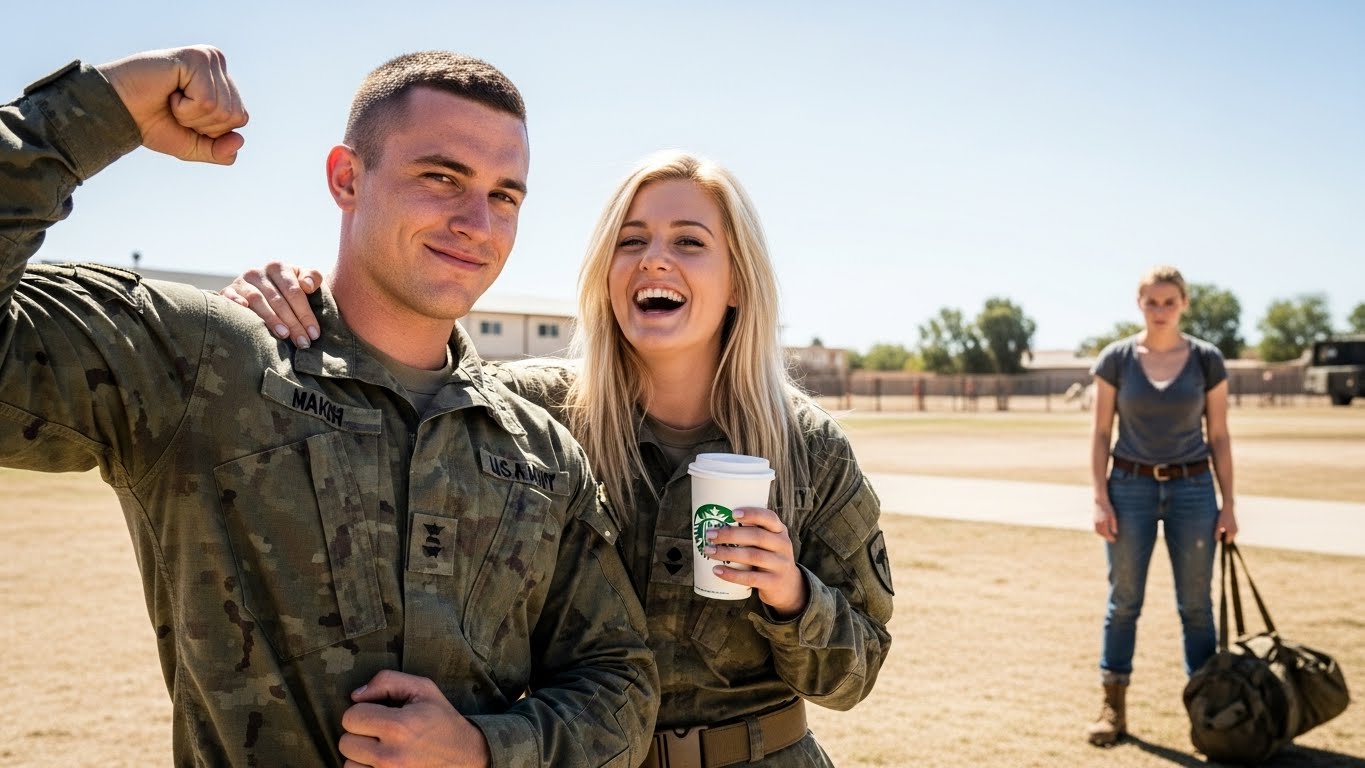
The voice cut through the sharp morning air like a rusty blade. Lance Morrison. Six-foot-two, broad shoulders, a jaw that could cut glass, and the easy arrogance of someone who’d never been told “no” in his life. He didn’t just bump me. He shoved me.
My worn backpack, unbalanced and heavy, pitched me forward. I stumbled, my boots scraping the concrete.
I didn’t fall.
I balanced, catching myself with a quiet grace that was, perhaps, my first mistake. I steadied, my center of gravity locking instantly, a micro-adjustment so fast it was almost invisible to the untrained eye. My feet planted. My core tightened.
But they weren’t looking for grace. They were looking for weakness.
A chorus of laughter followed. That sharp, cutting sound that echoes in places like this, places where fear and ego wrestle for dominance. I was their morning entertainment.
“Seriously, who let the janitor in?” Madison Brooks. Perfect blonde ponytail, lips painted a perfect, cruel red even for a training op. She flicked her hair, gesturing at my faded t-shirt. “This isn’t a shelter, honey.”
I said nothing. My mission parameters were clear: Observe. Blend. Do not engage.
Inside my head, a different voice was running calculations. It was a cold, mechanical voice that I had honed over six years in hell.
Lance Morrison: 210 lbs, over-reliant on his right side, telegraphs his aggression. Madison Brooks: Narcissistic, requires an audience, weakness is her ego.
I just picked up my bag, the movement careful, precise, and walked toward the barracks.
Their laughter followed me. It was fine. Laughter was just noise. It couldn’t hurt me. Not after what I had survived. Not after the training that had stripped the humanity out of me and replaced it with something… harder.
But in exactly eighteen minutes, when that torn shirt revealed what was hidden beneath, every single person in this yard would understand. The commander himself would freeze mid-sentence, his face draining of all color as he recognized a symbol that wasn’t supposed to exist anymore. A symbol that would change everything.
They thought I was the one in danger.
They had no idea.
Chapter 2: The Art of Disappearing
The first day was designed to be a gauntlet. Captain Harrow, the head instructor, was a mountain carved from granite and rage. He paced the yard, his voice a gravel-slide that stopped riots. He was a legend in the Rangers, a man who ate barbed wire for breakfast.
He was sizing us up, the calculating gaze of a predator selecting prey. His eyes scanned the line of recruits—crisp uniforms, expensive tactical gear, eager faces. Then, his eyes landed on me.
And stayed.
He barked, pointing a thick finger right at my chest. “You. What’s your deal? Supply crew get lost?”
The group snickered. The sound rippled down the line like a wave.
Madison whispered, just loud enough for everyone to hear. “Bet she’s here to check a diversity box. Charity quota, right?”
I didn’t blink. I looked at Captain Harrow, my face as calm as still water. Inside, I was cataloging him, too. A good soldier. A loud leader. But he sees uniforms, not people. He sees what he expects to see.
“I’m a cadet, sir,” I said. My voice was low, raspy from disuse.
He snorted, waving me off like an annoying insect. “Get in line, then. Don’t slow us down. One mile behind pace and I ship you back to the homeless shelter.”
I got in line. I didn’t slow anyone down.
The mess hall that first evening was a battlefield of egos. The air was thick with testosterone, the smell of industrial cleaner, and the clatter of metal trays. I carried mine to a corner table, away from the loud chatter, away from the competitive storytelling. I just wanted to eat.
The room buzzed with recruits swapping tales of their accomplishments, their voices growing louder as they tried to outdo each other.
“I benched 300 before breakfast,” one guy bragged. “My dad’s a Senator,” another said, as if that would stop a bullet.
Then a tray slammed down on my table, rattling my fork.
Derek Chen. Lean, cocky, with a buzzcut that screamed “look at me.” He was one of Lance’s entourage. He’d spotted me sitting alone. He was performing.
“Yo, lost girl,” he said, his voice pitched to carry. “This ain’t a soup kitchen. You sure you’re not here to wash dishes?”
The group behind him erupted. Phones came out. I saw the red ‘record’ lights. Social media glory, built on someone else’s humiliation. This was the new warfare—humiliate the weak for likes.
I paused, my fork halfway to my mouth. I looked at him with those same, steady brown eyes. “I’m eating,” I said simply.
He leaned in, smirking. “Yeah, well, eat faster. You’re taking up space real soldiers need.”
Without warning, he flicked his spoon. A wet glob of mashed potatoes splattered across my shirt. It hit my chest with a wet thwack.
The room howled.
I looked down at the stain. I felt the wet warmth seep through the thin cotton. I felt the eyes. Hundreds of them. Watching. Waiting.
I felt a flicker.
A cold, black flicker deep in my chest. It was the Viper. The part of me that Ghost had trained. The part of me that knew six ways to break his wrist before he could even pull his hand back. The part of me that could put him on the floor, gasping for air through a crushed windpipe, before the laughter died in his friends’ throats.
Observe. Blend. Do not engage.
My hand twitched. Just once.
I picked up my napkin.
With slow, methodical movements, I wiped the mess from my shirt. Then I picked up my fork, scooped a bite of my own potatoes, and put it in my mouth. I chewed slowly.
I didn’t look at him. I just ate. As if he wasn’t there. As if he didn’t exist. As if he were nothing more than a buzzing fly.
The deliberate, insulting calm of my response seemed to infuriate him more than any comeback could have. His face reddened. He stood there, sputtering, the star of a show that had suddenly lost its script. He scoffed, grabbed his tray, and strutted away, but the damage was done.
His friends’ laughter was weaker now. They’d seen him fail to get a reaction. I had taken his power by refusing to acknowledge it.
But I had also just painted a much, much bigger target on my back. They wouldn’t stop now. They would escalate.
And I would be ready.
Chapter 3: The Broken Compass
The next morning, the sun hadn’t even breached the horizon when the whistle blew. It was 0400 hours. The air at Camp Blackwood was cold enough to freeze breath in the throat, a sharp reminder that comfort was a luxury we left at the gate.
Physical training. The great equalizer. Or so they said.
We started with burpees in the dirt, the ground hard and unforgiving. Then sprints that burned the lungs like inhaling broken glass. Push-ups until arms shook and muscles screamed for mercy. I kept my pace steady, my breathing controlled in a rhythmic 4-count. In through the nose, out through the mouth. I was in the middle of the pack, exactly where I wanted to be. Anonymous. A gray silhouette in the pre-dawn gloom.
But my shoelaces were a problem.
They were old, the aglets crushed long ago, and the fabric was fraying. During a high-intensity interval sprint, the left one slipped loose.
Lance Morrison—the golden boy, the one who had shoved me at the gate—jogged up beside me. He wasn’t even winded. He had that annoying, genetically gifted stamina that made everything look easy.
“Yo, Thrift Store!” he called out, loud enough for the whole line to hear over the pounding of boots. “Your shoes giving up, or is that just you?”
Laughter rippled through the group, breaking the rhythm of the run.
I didn’t respond. I simply knelt, my movement fluid despite the exhaustion gnawing at my legs. I retied the laces with quick, precise fingers, double-knotting the frayed ends.
But as I stood to rejoin the formation, Lance “accidentally” veered into my path. He dropped a shoulder, slamming it into me with the force of a linebacker.
“Whoops,” he grinned.
It was enough. It sent me stumbling off the asphalt path. My hands hit the mud, the cold sludge oozing between my fingers. My knees sank into the wet earth, the impact jarring my teeth.
The group howled.
“What’s that, Mitchell?” Lance shouted back, not breaking stride. “You signing up to clean the floors or just planning to be our personal punching bag?”
I got up.
I didn’t glare. I didn’t shout. I wiped my muddy palms on my pants, leaving dark streaks on the already faded denim. I looked at his retreating back.
And I resumed running. Not a word.
The laughter followed me, but it was hollower this time. I could feel their confusion radiating off them like heat. Why wasn’t I crying? Why wasn’t I angry? They were poking a bear, expecting a rabbit to scream, and getting… a rock. A boring, unmoving rock.
It was driving them insane.
During a water break, Madison sauntered over. She looked impeccable, even after three miles. “Olivia, right?” she said, her voice syrupy sweet, the kind of tone that hides a knife. “So, like, where are you even from? Did you win some kind of lottery to be here? Because you don’t fit the demographic.”
I took a bite of my dry granola bar. Chewed. Swallowed. “I applied.”
Her smile tightened. The mask slipped. “Okay, but why?” she pressed, stepping closer. “You don’t exactly scream ‘elite soldier.’ I mean, look at your… everything. You look like you belong in a shelter, not a Spec Ops selection course.”
I set my bar down. I leaned forward, just an inch. Just enough to invade her personal space, to make her flinch without touching her.
“I’m here to train,” I said, my voice quiet, flat, dead. “Not to make you feel better about yourself.”
She froze. Her cheeks reddened, a flush of indignation rising up her neck. That got a reaction. “Whatever,” she muttered, turning away quickly. “Weirdo.”
The navigation drill that afternoon was designed to be hell.
Sector 4. A dense, forested ridge filled with brambles, false trails, and steep drops. We were given a topographic map, a lensatic compass, and a time limit that was borderline impossible.
I moved alone. My steps were quiet on the pine needles, a habit ingrained from years of stalking targets who would kill you if they heard a twig snap. I didn’t need the map, not really. I’d memorized the topography of the entire county before I even stepped off the bus. I have an eidetic memory—a curse and a gift. I can recall the serial number on a dollar bill I saw ten years ago.
But I held the map, because that’s what a normal cadet would do.
A group of four, led by Kyle Martinez—a wiry, ambitious type who desperately wanted Lance’s approval—spotted me near a creek bed.
“Hey, Dora the Explorer!” he called, jogging over. “You lost already?”
His group laughed, circling me like hyenas cutting off a straggler.
I folded my map. I kept walking.
Kyle wasn’t done. He jogged up and snatched the map from my hands. “Let’s see how you do without this,” he smirked.
He ripped the map in half. Then into quarters. He tossed the pieces into the wind, watching them flutter down into the rushing creek water.
“Oops,” he mocked. “Guess you’re failing this one, charity case.”
The others cheered.
I stopped. I watched the scraps float away. I looked at Kyle, my face completely blank.
“Hope you know your way back,” I said.
Then I turned and kept moving, my pace unchanged.
His laughter faltered. I could hear them whispering behind me as I vanished into the treeline. “Wait… how does she know where she’s going?”
Because you just tore up a piece of paper, idiot. You didn’t tear the mountain out of my head.
I finished the course 20 minutes ahead of schedule. I sat under a tree near the finish line and “waited,” rubbing dirt on my face to look tired when the first group (Kyle’s, who had gotten hopelessly lost and had to fire a flare) finally stumbled out of the woods hours later.
I was invisible. But the cracks were starting to show.
Chapter 4: The Ghost in the Machine
The rifle disassembly drill was next. The armory smelled of CLP oil, cold steel, and anxiety.
The test was simple: Two minutes. Disassemble, clean, and reassemble an M4 carbine. Blindfolded.
It’s a standard drill, but under pressure, fingers turn to thumbs. Pins slip. Springs fly across the room.
The cadets fumbled. I could hear the clatter of dropped parts. Lance finished in a messy 1:43, grinning as he whipped off his blindfold. “Beat that,” he announced. Madison scraped by at 1:59, her hands shaking so bad she almost dropped the bolt carrier group.
Then it was my turn.
“Bet she can’t even hold the rifle properly,” Madison whispered to Derek. “Probably thinks it’s a broom.”
I stepped up to the table. I tied the blindfold tight. darkness swallowed the room.
And I disappeared.
I wasn’t Olivia the charity case anymore. I was the Viper.
My hands moved.
It wasn’t a conscious effort. It was a script. A dance. Muscle memory from a thousand dark nights in safehouses in Yemen and caves in Afghanistan, cleaning weapons while Ghost screamed at me to go faster, throwing sand into the receiver to make it jam.
Pin out. Retaining ring down. Handguard off.
Bolt carrier free. Cam pin rotated. Firing pin dropped.
The sounds were rhythmic, percussive. Click-clack-slide.
I laid the parts out in a perfect, surgical grid on the mat. Not a pile. A grid. I could feel where every piece was by the displacement of air.
Wipe. Oil. Reassemble.
Click. Slide. Lock.
I slapped the magazine in. I pulled the charging handle. CLACK-CLACK.
“Done,” I said.
I pulled the blindfold off.
Sergeant Pulk, the grizzled instructor who looked like he’d been chewing on bullets since the Gulf War, stared at the timer. Then at me. Then back at the timer.
“52 seconds,” he said, his voice low, stunned.
The chatter in the yard died instantly.
“Mitchell,” Pulk said, stepping closer, looming over me. “Where in the hell did you learn to do that?”
I wiped my clean hands on my pants, reverting instantly to the shy, downtrodden girl. “Practice, sir,” I mumbled, keeping my eyes fixed on the concrete. “I… I watch videos online.”
A lieutenant standing nearby leaned over to Pulk. I heard him whisper. “Sergeant, her hands didn’t shake. Not once. That wasn’t an amateur. That was… special forces steady.”
Lance overheard and scoffed loudly, breaking the tension. “So she can clean a gun. Big deal. Doesn’t mean she can fight. My maid cleans fast, too.”
The group laughed, eager to dismiss the anomaly.
But the whispers had started. A few cadets watched me differently now. The “vagrant” could handle a weapon like a master armorer. The puzzle pieces weren’t fitting.
During the break, while I was drinking water alone, a quiet cadet named Elena Rodriguez approached me. She was small, observant, the kind of person who survived by staying out of the way.
She slipped a folded piece of paper into my hand.
“You’ll need this,” she whispered, not meeting my eyes.
I unfolded it. It was a topographic map of tomorrow’s extraction zone—one that hadn’t been issued yet.
“Why?” I asked.
“I saw what Kyle did to your map,” she said softly. “And I saw you handle that rifle. You’re not who they think you are.”
It was the first act of kindness I’d received in weeks. I looked at her, really looked at her. Elena Rodriguez. Data point: positive. Not a threat. Potential ally.
I nodded once. “Thank you.”
She scurried away before Madison could spot her associating with the untouchable.
I tucked the map away. The storm was gathering. I could feel the electricity in the air. They were going to push harder. And soon, I wouldn’t be able to hold back.
Chapter 5: The Sabotaged Scope
The terrain run the next morning was brutal. 10 miles, full gear, uphill.
Madison was right behind me, hissing insults between panting breaths. “Pick it up, charity case. You’re dragging us down.”
At the halfway mark, the path narrowed along a rocky ridgeline. She made her move.
It wasn’t subtle. A deliberate “nudge” to my elbow as I planted my foot. My boot caught a loose rock. I veered off the path, my ankle twisting with a sickening crunch.
Pain shot up my leg, white-hot and blinding. I stumbled, falling to one knee.
Captain Harrow saw me break formation. “MITCHELL! Broke formation! Squad loses points!”
The group groaned loudly.
“Nice one, Mitchell,” Lance yelled from the front. “Way to sabotage the team!”
I didn’t argue. I didn’t explain. I didn’t point at Madison, who was smirking while pretending to adjust her pack.
I stood up. My left ankle throbbed like it was being crushed in a vice. I tested the weight. It held, but barely.
Pain is information, Ghost’s voice echoed in my head. It tells you the body is damaged. It does not tell you to stop.
I got back in formation, my jaw set so tight my teeth ached, and kept running. I compartmentalized the pain, shoving it into a mental box labeled ‘later.’
When the run ended, Harrow pointed at me. “Five extra laps for slowing us down. Move.”
I ran them. Every one. My ankle was swollen to the size of a grapefruit inside my boot. As I finished, gasping, sweat stinging my eyes, Madison tossed an empty water bottle at my feet.
“Hydrate with air,” she laughed.
I picked up the bottle. I crushed it slowly in my hand, the plastic screaming under the pressure. And I dropped it in the trash.
We moved directly to the shooting range.
This was the filter. The washing out point.
“Five shots. 400 meters. Iron sights,” the Range Master announced. “Five perfect bullseyes, or you’re out of the running for Squad Leader.”
The pressure was immense. Cadets were sweating, shaking. The wind was gusting at 12 knots from the west.
Madison missed two, cursing her windage. Lance hit four, cursing his “near miss” on the fifth.
Then it was my turn.
I limped to the firing line. The pain in my ankle was a dull roar now.
“Bet she can’t even see the target,” Madison whispered.
I settled in. I prone-positioned on the mat. I pulled the stock into my shoulder. I put my eye to the rear sight aperture.
And I froze.
I smiled. Internally.
The sights were misaligned. Deliberately.
Someone—probably an instructor, maybe Harrow, maybe even Lance—had tampered with the rifle. The rear sight was cranked way off. It was off by three clicks to the right and one click down. A significant defect. Enough to make a professional miss the entire target at 400 meters.
If I complained, they’d say I was making excuses. If I adjusted it now, they’d know I was an expert.
I didn’t adjust the sights.
I just breathed.
I shifted my aim. I aimed at the grass, three clicks left and one click up from the bullseye. I was aiming at nothing, compensating perfectly for the defect in my head.
Breathe. Squeeze.
The rifle barked. The recoil was a familiar kiss against my shoulder.
Breathe. Squeeze.
Bark.
Breathe. Squeeze.
Bark.
Five shots. Less than ten seconds.
The range officer stared at the target display monitor. He blinked. He tapped the screen, thinking it was frozen.
“Mitchell,” he announced, his voice cracking. “Perfect score. Five… dead center.”
The silence that followed was heavy.
A colonel I hadn’t noticed before, an older man with steel-gray hair and a uniform plastered with ribbons, leaned forward from the observation deck.
“Who trained her?” he murmured to his aide.
Lance rolled his eyes. “Lucky shots. Wind probably carried them. Let’s see her do something that matters.”
I stood up, putting weight on my bad ankle without flinching.
Later, as we were packing up, I saw the Range Officer check the rifle I had used. He put it in a vice to test the sights. I watched from a distance as he peered through them.
I saw his face go pale. He looked at the target, then back at the sights. He muttered to himself, words I could read on his lips from fifty yards away.
“That’s not luck. That’s impossible.”
The whispers were getting louder. I was failing my mission to be invisible. I was becoming something else. A mystery.
And mysteries beg to be solved.
The mess hall incident that night was the culmination. I was last in line. The food ran out before I got there. I sat at my corner table with just a glass of lukewarm water.
Jenna Walsh, tall and smug, one of Madison’s clones, walked over. She dropped a half-eaten, bruised apple on my empty tray.
“Here,” she said, her voice dripping with pity. “Can’t have you starving, right? You need your strength for… what exactly? Carrying our bags?”
Her table burst into laughter. Phones came out again.
I looked at the apple. Looked at her.
“Thanks,” I said.
I picked it up. And I took a slow, deliberate bite.
Jenna’s smile faltered. She’d expected tears. Anger. Something.
I ate the entire apple. Core, seeds, and all. I didn’t break eye contact.
Then I set my tray aside, stood up, and brushed past her. My shoulder made the slightest contact, just enough to make her step back.
The room went quiet. They were watching. They were all watching. My cover was blown. My anonymity was gone.
And tomorrow was Hand-to-Hand Combat day.
I knew, with absolute certainty, that they were going to come for me. They were going to try to break me physically.
I looked at my hands. They were steady.
Let them come
Here is Part 3 of the story (Chapters 6, 7, & 8).
—————FULL STORY (Continued)—————-
Chapter 6: The Mark of the Beast
The next morning, the gymnasium smelled of stale sweat and old leather. This was it. Hand-to-hand combat.
The mats were laid out in a grid. Captain Harrow stood in the center, looking like a gladiator referee.
“Pair up,” he barked. “Size and weight classes.”
But fate, or perhaps Captain Harrow’s desire to see me break, had other plans. Before I could find a partner near my size, a shadow fell over me.
It was Lance Morrison. Six feet of muscle, ego, and pent-up aggression. He towered over me, a predatory grin plastering his face. This was the moment he’d been waiting for. The moment he could legally hurt the “charity case” who had embarrassed him with her silence.
“I’m going to enjoy this, Thrift Store,” he snarled, cracking his knuckles. “No maps to save you here.”
Harrow looked at the mismatch. He hesitated, then shrugged. “Proceed.”
We stepped onto the mat. The circle of cadets tightened. Phones were out. They wanted blood.
“Fight!” Harrow yelled.
Before the whistle even fully echoed, Lance charged.
It was a violation of the rules—attacking before the opponent was set—but no one cared. He didn’t throw a punch. He grabbed my collar with both hands, using his weight and momentum to slam me back against the padded wall of the training arena.
The impact was violent. It knocked the air from my lungs.
And then, I heard the sound.
RIIIIIP.
The fabric of my old, faded flannel shirt gave way. It tore from the neckline down to my shoulder, ripping halfway down my back.
For a split second, I looked vulnerable. Pinned against the wall. Helpless.
The squad burst into cruel laughter.
“Look at that!” Madison jeered from the sidelines, her phone camera zoomed in. “She’s got ink! What is this, a biker gang? Did you get that in prison, honey?”
Lance leaned in, his face inches from mine, his breath hot and sour with coffee. “This isn’t daycare, Mitchell,” he whispered, his voice dripping with venom. “This is a battlefield. Time to go home, little girl.”
He was preparing to humiliate me. He pulled back a fist, aiming for a body shot that would leave me gasping on the floor.
But something in my eyes made him pause.
There was no fear. No panic. Just… a cold, calculating patience. The kind of look a bomb disposal expert gives a red wire.
“Let go,” I said. My voice was steady. Quiet.
He laughed, but his grip loosened. Just a fraction. It was overconfidence.
It was all I needed.
I stepped back, and the torn shirt fell lower, exposing my right shoulder blade completely.
And that’s when everything stopped.
The laughter died in Madison’s throat like a choked engine. The phone in her hand lowered. Lance’s grin faded, replaced by a confused, furrowed frown.
The entire training yard went silent. A silence so heavy it felt like the air had been sucked out of the room.
My back was now exposed to the room. And etched across my shoulder blade, in stark black ink that seemed to drink the overhead fluorescent light, was the tattoo.
A coiled viper, its body wrapped intricately around a shattered human skull. Its fangs dripped venom. The eyes of the snake were red—a specific, terrifying shade of crimson ink that was only available to a select few.
It wasn’t the art that made them freeze. It was the symbol.
“What the hell is that supposed to be?” Madison’s voice cracked in the quiet.
Colonel James Patterson, the steel-haired man from the range who was observing the drill, was walking across the gym floor. He stopped. Dead.
His weathered face went completely, totally pale. His mouth opened slightly, but no sound came out. His hands began to tremble at his sides.
He approached me, his movements sharp, almost robotic, as if he were walking in a dream.
“Who,” he asked, his voice shaking with something I couldn’t identify—reverence? Terror? “Who gave you the right to wear that mark?”
The yard held its breath.
I stood there, my back straight, the torn shirt hanging off one shoulder. I looked directly at the Colonel.
“I didn’t ask for it,” I said, my voice clear in the silence. “It was given to me. By Ghost Viper himself. I trained under him for six years.”
The name hit the crowd like a physical blow.
Colonel Patterson froze. His eyes widened. Disbelief warring with recognition.
Then, as if his strings had been cut and reattached by a puppeteer, his body snapped to rigid attention. His heels clicked together. His hand flew to his forehead in a perfect, trembling salute.
An aide nearby whispered, confused, “Sir? What are you doing? She’s a cadet.”
Patterson held the salute, his eyes locked on mine, ignoring his aide completely. “No one… no one bears that tattoo unless they’re his final student. His only student.”
Lance stumbled backward, his face ashen. He looked from me to the Colonel. “Ghost… Ghost Viper? That’s… that’s a myth. That’s a campfire story.”
Madison’s phone slipped from her nerveless fingers and clattered on the concrete floor.
The name was a legend in the special forces community. A ghost story told to Navy SEALs to keep them humble. A unit that didn’t exist. Missions that never happened. Operatives who were declared KIA five years ago in a classified operation so secret most people thought it was a rumor.
Ghost Viper himself was the myth within the myth. The trainer who supposedly selected one student per decade. One student to inherit the skills that governments killed to possess.
Looking at Patterson’s salute, it was clear the legend was real.
“Sir,” the aide tried again, looking panicked. “Ghost Viper was classified as…”
“I KNOW what he was classified as,” Patterson cut him off, his voice barking. “I also know what I’m looking at.”
I acknowledged his salute with a slight, almost imperceptible nod. Then I gently, firmly, removed Lance’s hands from my shirt. He didn’t resist. He was staring at the tattoo like it was a live cobra poised to strike.
“This is impossible,” Madison whispered.
Elena, the girl who gave me the map, stepped forward from the back. Her eyes were shining. “I wondered why you never fought back,” she said quietly. “You weren’t hiding because you were weak. You were hiding because you were dangerous.”
But Lance’s pride, his entire identity, was built on being the best. The Alpha. He couldn’t accept this. His brain couldn’t process that the “charity case” was a predator higher on the food chain than he could ever hope to be.
“Bullshit!” he snarled, his voice rising with desperate, suicidal anger. “I don’t care what tattoo you’ve got! Prove it! In a real fight!”
The cadets looked at each other. They knew. They all knew he had just made a catastrophic mistake.
“Son,” Colonel Patterson said, lowering his salute, his voice a sharp warning. “I strongly advise you to stand down.”
“NO!” Lance roared, his face red with humiliation. He tore off his own shirt, throwing it down. “I’m not being intimidated by some ink! If she’s so dangerous, let her prove it! Right now!”
He stepped back, raising his fists in a boxing stance. “Come on, Mitchell! Show us what the great Ghost Viper taught you!”
I looked at him. The cold, black flicker in my chest wasn’t a flicker anymore. It was a frozen lake.
The careful blankness in my expression shifted. The mask dropped.
“If that’s what you want,” I said softly.
I didn’t raise my hands. I just stood there, arms at my sides, as he circled me.
He charged. A wild, telegraphed haymaker aimed at my face. It was powerful, fast, and lethal.
I moved. Just enough. My head shifted two inches to the left. His fist whistled past my ear, disturbing my hair.
He followed with a left hook. I wasn’t there. A right cross. I flowed around it like water.
He was swinging at empty air.
“HIT ME!” he roared, his frustration building to a fever pitch.
I was studying him. Learning his patterns. Waiting for the gap.
He threw another wild right, overextending himself, his balance compromised by his rage.
That was the moment.
I stepped inside his guard, not away from it. My arms slid around his neck in what might have looked like an embrace.
My left arm went under his chin. My right hand locked onto my left bicep. I squeezed.
A perfectly executed rear naked choke. No strikes. No drama. Just surgical precision.
I applied pressure to the carotid arteries.
His eyes widened in panic. He clawed at my arms, scratching at the skin, but he had no leverage. I was a backpack he couldn’t take off.
I counted in my head. Three… two… one…
His eyes rolled back. He went limp, his heavy body sagging against mine.
I held him for another second to ensure he was out, then gently lowered his unconscious body to the mat.
Eight seconds. From start to finish.
The gymnasium was absolutely, profoundly silent. The only sound was the heavy thud of Lance’s body hitting the ground.
Captain Harrow, who had been watching with an unreadable expression, walked over. He looked down at Lance, snoring softly on the mat. Then at me. Then at the shell-shocked cadets.
“Effective immediately,” Harrow announced, his voice carrying absolute authority. “Olivia Mitchell is designated as an honorary instructor. You will learn from her. You will respect her. And you will follow her orders as you would mine.”
I didn’t smile. I just picked up my backpack, pulled my torn shirt closed, and walked toward the barracks.
The cadets parted for me like the Red Sea. Their eyes were down. Their laughter was forgotten.
My mission to be invisible was over. A new, far more complicated one had just begun.
Chapter 7: The General’s Arrival
The change was immediate and absolute.
By evening, the base was buzzing. The video of the “fight”—all eight seconds of it—was everywhere. It had jumped from the private chats to the wider internet. The story of the Colonel’s salute was whispered in every corner.
The live-fire exercise the next day was… different.
Harrow assigned me a team to lead. It included Madison. She looked at me with terror. She rolled her eyes out of habit, but she didn’t say a word. Her hands shook as she loaded her magazine.
As we moved through the urban assault course, Madison, panicked by the new dynamic, ignored my hand signal. She rushed a doorway. A tripwire alarm blared.
Harrow stormed over, his face purple. “MITCHELL! Your team’s a disaster!”
Madison smirked, a reflex. She whispered to Derek, “Told you. Tattoo doesn’t make you a leader.”
I stood there, hands steady on my rifle. “Madison broke formation, sir. I signaled her to wait. She ignored the signal.”
“I didn’t see any signal!” Madison lied smoothly, playing the victim.
Old habits. The group snickered, ready to fall back into the familiar pattern of tearing me down.
“Understood, sir,” I said.
But as we reset, someone—the aide from yesterday—checked the overhead drone footage on a tablet.
“Captain,” the aide interrupted. “You need to see this.”
The replay showed it all in high definition. My clear hand signal. Madison looking directly at me, then deliberately turning her head and charging the door.
Harrow watched the footage, his jaw tightening until a muscle popped. He turned to Madison.
“You risked your squad for a petty grudge?” he asked, his voice deadly quiet. “Docked 50 points. And you’re on latrine duty for the remainder of the cycle.”
The laughter died. Madison’s face went white. She’d been exposed.
Captain Harrow himself was different with me. The man who’d called me “supply crew” now watched me with careful attention. During briefings, he’d pause. “Mitchell? Your thoughts on this breach strategy?”
It wasn’t just respect. It was caution. It was the recognition that he was in the presence of something he didn’t fully understand.
Two days later, a young officer approached me while I was cleaning my gear in the barracks. He was nervous, sweating despite the AC.
“Ma’am?” he whispered.
I looked up. The “ma’am” was new.
“There’s… someone here to see you. At the main gate.”
“Who?”
“I… I can’t say, ma’am. He’s waiting. He has… high clearance.”
I followed him. The walk to the gate felt long. Cadets saw me and feared me. They’d gone from contempt to terror, missing the ‘respect’ part entirely. They pressed themselves against the walls as I passed.
At the gate, a man stood waiting by a black SUV.
He was tall, broad-shouldered, with military-short hair going gray at the temples. He wore civilian clothes—dark jeans and a black tactical jacket that looked deceptively casual but probably cost more than my truck. When he moved, it was with a controlled, lethal precision that I knew better than my own heartbeat.
Colonel Patterson was there, too. Standing at attention, looking like he was about to pass out.
When he saw me, the man in the black jacket turned.
And for the first time since I’d arrived at this hellhole, my carefully controlled expression cracked.
A wave of relief, of… love… so profound it almost buckled my knees washed over me.
I walked up to him. I didn’t salute.
“You didn’t have to come,” I said, my voice softer than anyone at the camp had ever heard it.
General Thomas Reed tilted his head, a small, genuine smile playing on his lips. It transformed his stern face. “Yeah,” he said simply. “I did. heard you were causing trouble.”
The cadets watching from a distance went silent. Madison, standing near the fence, dropped her water bottle.
Colonel Patterson cleared his throat, addressing the gathered crowd of onlookers. “Attention on deck!”
He gestured to the man. “This is General Thomas Reed. Commander of Joint Special Operations.”
He paused for effect.
“And… Olivia’s husband.”
The words hit like a shockwave.
Madison staggered backward, clutching the fence for support. Derek’s mouth fell open, a fly could have flown in. Even Elena looked stunned.
Reed didn’t explain. He didn’t offer a speech. He just reached out and placed a hand on my shoulder—the one with the tattoo—and squeezed gently.
“Time to go, Liv,” he said.
He walked me to my beat-up pickup truck. He opened the door for me.
He got in the driver’s seat. The engine roared to life, a sound far too powerful for such an old vehicle—he’d tuned it himself years ago. We drove off, dust kicking up behind us, leaving the stunned silence of Camp Blackwood in our rearview mirror.
The fallout was swift.
Lance, transferred to the medical facility for his neck, faced a review board. Attacking a classified operative—which I was now confirmed to be—was career suicide. He was discharged within the week, his dreams of glory ending in disgrace.
Madison’s trouble was more public. The videos her friends had posted of her taunting me went viral, but now with a new context. The internet loves a justice story. The defense contractor sponsoring her pulled their support, releasing a statement about “values incompatible with our mission.” Her social media accounts were flooded with outrage. She deleted everything and disappeared.
Derek was reassigned to permanent latrine duty.
Harrow faced a quiet meeting with leadership and was assigned mandatory retraining on leadership principles.
Elena, however, found herself recognized. Her simple act of kindness—giving me the map—was noted in my report. She was fast-tracked for advanced intelligence training.
The story of Olivia Mitchell became a base legend. A ghost story. A lesson.
But for me, it was just another Tuesday.
Chapter 8: Phoenix Rising
We drove for hours, Reed and I, in silence. The comfortable silence of two people who have nothing to prove. We left the beat-up truck in a long-term parking lot in Denver and switched to a black, non-descript sedan that had more armor than a light tank.
We were off the grid for eight months.
A cabin in Montana. Deep in the Bitterroot Mountains.
Peace.
We fished in the icy streams. We hiked through snow-dusted pines. I let the “Olivia Mitchell” of the boot camp fade. I let the “Viper’s Student” fade. I was just… me. Liv.
I started to sleep without a knife under my pillow. I started to laugh again.
Until last night.
It was a quiet evening. A fire crackled in the stone hearth, casting long shadows on the log walls. Reed was reading a history book in the armchair. I was sketching.
An encrypted phone, a burner we kept in a floor safe that I hadn’t touched in nearly a year, began to ring.
The sound was jarring. Alien. It cut through the peace like a siren.
Reed looked up, his eyes instantly hard.
I walked over to the safe. I pulled out the phone. The screen was black, with white text: UNKNOWN.
I answered it.
The voice on the other end was distorted, digital. It spoke a single phrase.
“Code: Phoenix.”
My blood went cold. The sketchpad fell from my hand.
Phoenix. Ghost Viper’s final operation. The one that had supposedly killed him. The one where we buried an empty casket.
“I thought Phoenix was terminated,” I said carefully, my heart hammering against my ribs.
“So did we,” the voice replied. “But we just intercepted chatter in the dark web. The target from the original mission… he’s alive. And he knows about you. He knows you’re the last student.”
I closed my eyes. I looked at Reed. He saw my expression—the return of the soldier—and his book snapped shut. The peace was over.
“When?” I asked.
“48 hours. He’s coming for the list.”
The line went dead.
Reed stood up. He didn’t ask who it was. He knew the look. “How long do we have?”
“I don’t know,” I said. “But we have to move.”
As I began to process this, as I began to mentally prepare to become the woman with the tattoo again, the phone rang a second time.
A different number. A different encryption.
I hesitated, then answered.
“Mitchell. This is Agent Chen, DIA. We have a situation. Three of our deep cover operatives just went missing in Eastern Europe.”
“Go on,” I said, my voice already hardening into steel.
“Before they disappeared, they transmitted one word. A panic signal that hasn’t been used in ten years.”
I waited, the silence stretching.
“The word,” Chen said, his voice trembling slightly, “was ‘Viper’.”
I looked at the fire. The flames reflected in my eyes, turning them red.
The Ghost wasn’t dead. And he was calling his student home.
I hung up the phone. I looked at Reed.
“Pack the gear,” I said. “Class is back in session.”