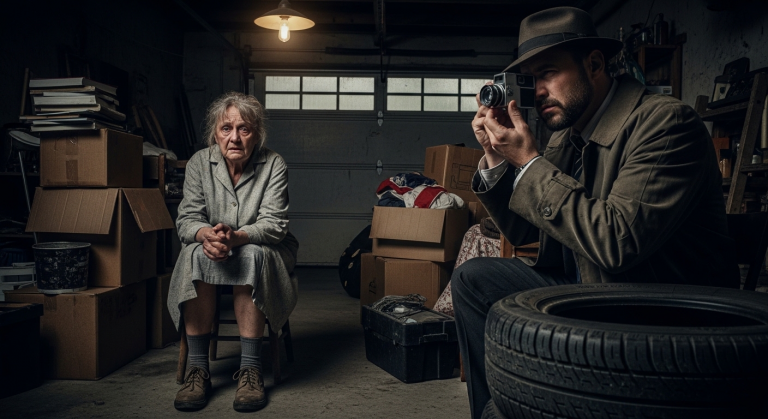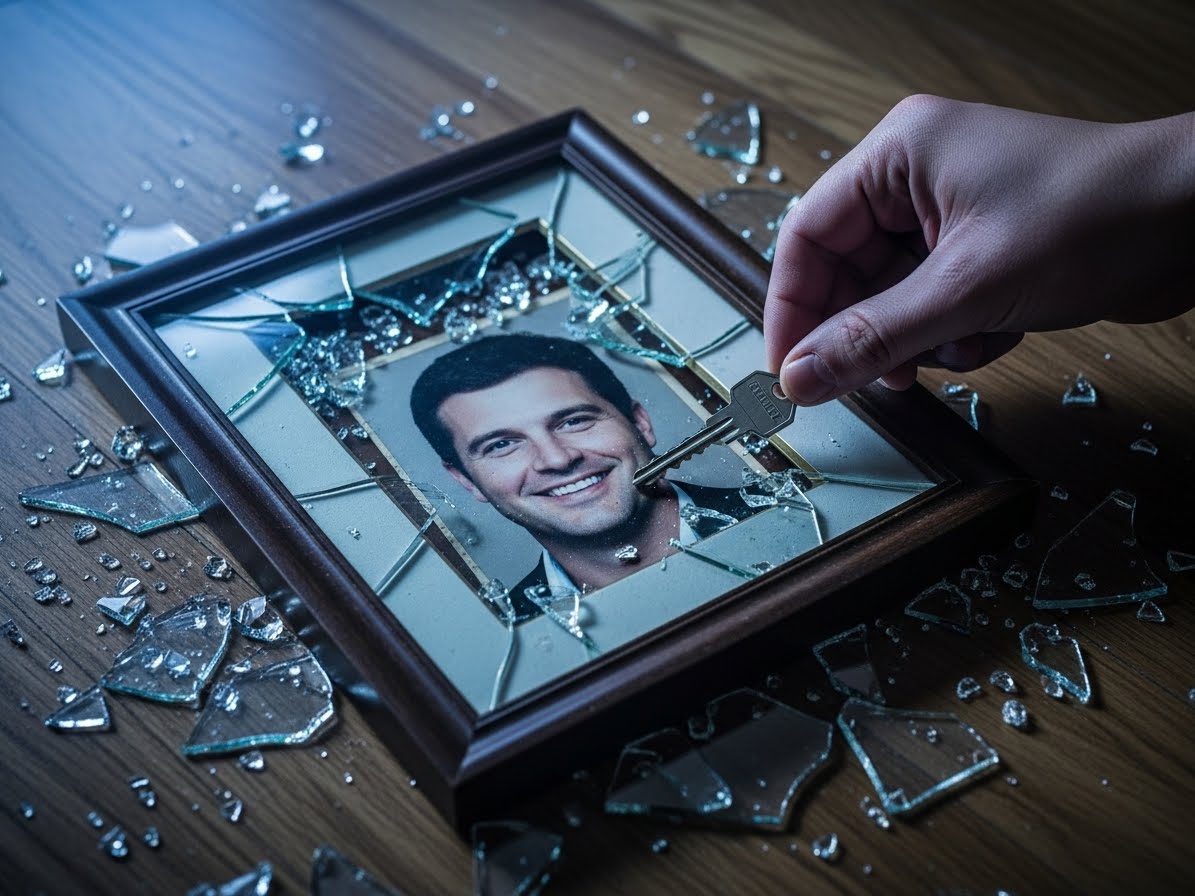
I Tore Up Our Family Portrait Because I Hated My Father. My Sister Taped It Back Together — And Revealed The Boy Hiding Behind Dad’s Shoulder.
PART 1
Chapter 1: The Saint of Willow Creek
They say you shouldn’t speak ill of the dead, especially when the dead man is Dr. Robert Thorne.
The funeral was a circus. Half the town of Willow Creek showed up. There were weeping nurses, grateful parents of children he had saved, and the Mayor giving a twenty-minute eulogy about “the saint who walked among us.”
I stood in the front row, wearing a suit that felt like a straightjacket, grinding my teeth so hard I thought they would crack. Beside me, my sister Emily stood like a marble statue. She was pale, her eyes hidden behind oversized sunglasses. She hadn’t shed a tear. Not when he died of the heart attack, and not now.
To the world, Robert Thorne was a savior. To us, he was the Warden.
The drive back to the estate was silent. The house—a sprawling Victorian monstrosity that sat on a hill overlooking the town—loomed in the grey afternoon light. It was a house of rules. No shoes on the carpet. Dinner at 6:00 sharp. No locked doors.
We walked into the foyer. The smell of lilies and old floor wax hit me. It was the smell of my childhood, and it made me nauseous.
“I’m going to make tea,” Emily said softly, drifting toward the kitchen like a ghost.
I didn’t want tea. I wanted whiskey. And I wanted destruction.
I walked into the “Great Room.” That’s what he called it. The library with the twenty-foot ceilings and the mahogany fireplace.
And there it was. The Portrait.
It was massive. Three feet by four feet, framed in gilded gold. It was taken the summer I turned ten. We were posed in front of the bay window. Dad was in the center, sitting in his wingback chair, his broad shoulders taking up a third of the frame. Mom—who died two years later in a “car accident”—was standing dutifully by his side. Emily was on his lap. I was standing next to him, my hand resting on his shoulder.
We looked perfect. We looked happy.
It was a lie.
I remembered that day. I remembered him pinching Emily’s leg because she wouldn’t smile wide enough. I remembered him whispering to me that if I moved an inch, I wouldn’t eat for two days.
The anger, repressed for twenty years, erupted like a volcano.
“You fraud,” I hissed at the painted face.
I grabbed a heavy crystal decanter from the sidebar. I didn’t pour a drink. I hurled it.
CRASH.
The heavy crystal hit the center of the portrait. The glass shattered, raining down onto the hearth. The photo itself—a high-quality print mounted on board—dented but didn’t fall.
It wasn’t enough.
I climbed onto the hearth. I grabbed the heavy gold frame and yanked. It groaned, the wire biting into the plaster, before coming free. I threw it onto the floor.
I stomped on it. I kicked the frame until the corners split. Then, I reached down and grabbed the photo itself.
I ripped it.
It was tough, thick paper, but my rage gave me strength. I tore through my father’s face. I tore through his chest. I ripped the lie into jagged, ugly strips.
“Die,” I screamed, tearing it again and again. “Just die and leave us alone!”
I was panting, sweating, standing in a pile of debris, clutching a strip of paper that showed only my father’s left eye.
“Leo?”
I spun around.
Emily was standing in the doorway. She wasn’t holding tea. She was holding a roll of clear packing tape and a pair of scissors.
She didn’t look horrified. She looked… expectant.
“Are you done?” she asked calmly.
“I… Emily, I’m sorry. I snapped. I couldn’t look at him.”
“It’s okay,” she said, walking over the broken glass in her heels without looking down. “He always said you had a temper. He counted on it.”
She knelt down. She began to gather the strips of the photo.
“What are you doing? Throw it in the fire.”
“No,” Emily said. “We have to put it back together. But not the way it was.”
“Why?”
She looked up at me, taking off her sunglasses. Her eyes were rimmed with red, but they were sharp. Dangerous.
“Because,” she whispered, “Dad didn’t sit in that chair to look regal, Leo. He sat there to block the line of sight.”
“Line of sight to what?”
“To the Guest House,” she said. “Help me. We have to be precise.”
Chapter 2: The Negative Space
We moved to the dining room table. The surface was polished dark wood, perfect for what looked like a bizarre autopsy.
Emily laid the strips out. There were about fifteen pieces.
“He told me once,” Emily said, her voice monotone as she worked. “When I was twelve. He was drunk. He said, ‘Emily, if your brother ever destroys this family, you put it back together. But you leave me out of it.'”
“He was drunk, Em. He was blathering.”
“He wasn’t blathering. It was an instruction.”
She began to tape. She started with the edges—the drapes, the window frame, the garden in the background. She reassembled Mom. She reassembled me. She reassembled herself.
But when she got to the center—where Dad had been sitting in his massive chair—she stopped.
“This is the trick,” she muttered.
Instead of taping Dad’s face and body back together perfectly, she overlapped the strips. She shifted them. It was like a puzzle where you force the pieces to fit even though the image is wrong.
“You’re messing it up,” I said. “His face is all distorted.”
“I’m not trying to fix his face, Leo. I’m removing his bulk.”
By overlapping the pieces that made up his suit jacket and his broad chest, she effectively “shrank” him. She compressed the image.
And as the strips of his body overlapped, the background elements—which had been disconnected by his large frame—began to align.
The vertical line of the window frame behind his right shoulder met the line of the window frame behind his left shoulder.
The gap was closed.
And in that gap, revealed through the glass of the window in the photo, was something that had been hidden by his head and shoulders for twenty years.
I leaned in, my breath catching in my throat.
The photo was high resolution. Even torn and taped, the detail was incredible.
Through the window, past the rose bushes, stood the old Guest House. We were never allowed near it. Dad said it was full of asbestos and structural rot. He kept it padlocked.
But in the photo, in the upper attic window of the Guest House, there was a face.
It was pressed against the glass. Hands cupped around the eyes to see out.
It was a boy.
He looked to be about ten years old. He had dark, messy hair. He was wearing a white t-shirt that looked dirty.
But it was his face that made my blood freeze.
He had my nose. He had Emily’s chin. And he had Dad’s eyes.
“Who is that?” I whispered, my voice trembling. “Emily, who is that?”
Emily stared at the tiny face in the taped-up photo. She ran her finger over it.
“I used to hear noises,” she said quietly. “At night. When you were away at boarding school. I’d hear singing coming from the yard. Dad told me it was the wind. He told me I was crazy. He put me on medication, Leo. For years. Because I heard a boy singing.”
She looked at me.
“He wasn’t hiding asbestos in the Guest House.”
I grabbed the table. The room was spinning.
“You think… you think he had another kid? A brother?”
“Look at the date on the photo,” Emily pointed to the bottom corner. June 14th, 2003.
“That was the summer Mom had her ‘breakdown’,” I recalled. “She disappeared for three months. Dad said she went to a spa in Switzerland.”
“She didn’t go to Switzerland,” Emily said, her voice hardening. “She was in the Guest House. Birthing him.”
“But why? Why hide him?”
“Because of the condition,” Emily said. She pointed to the boy’s hands pressed against the glass.
I leaned in closer. I squinted.
The boy had six fingers on his right hand. And his eyes… even in the grainy photo, the pupils looked wrong. Vertical. Like a cat’s.
“Dad was a geneticist before he was a surgeon, Leo. Remember?”
I felt bile rise in my throat. “You think he was experimenting?”
“I think,” Emily said, standing up and grabbing the heavy iron fireplace poker from the corner, “that we need to go to the Guest House. Now.”
“Emily, that was twenty years ago. If there was a boy… he’d be a man now. Or dead.”
“Dad brought a tray of food out to the garden every night,” Emily said. “Even last week. He told the nurse it was for the stray cats.”
She looked at me, and I saw the terror she had been holding back for a lifetime.
“Stray cats don’t eat roast beef, Leo.”
I looked at the taped photo one last time. The boy in the window seemed to be looking right at me. Pleading.
I grabbed a flashlight from the kitchen drawer.
“Let’s go,” I said.
We walked out the back door into the gathering gloom of the evening. The Guest House stood at the edge of the property, draped in ivy, dark and silent.
It looked abandoned.
But as we approached, I saw something that made my heart stop.
The grass leading up to the front door wasn’t overgrown. It was trampled. A path. Worn smooth by twenty years of footsteps.
And on the front door, the heavy padlock was hanging open.
PART 2
Chapter 3: The House of Static
The door to the Guest House didn’t creak. It swung open silently on well-oiled hinges.
Dad had maintained this place. He had oiled the hinges while the main house fell into disrepair. He had prioritized the prison over the palace.
I shone the flashlight into the gloom.
“Hello?” I called out. My voice died in the thick, stagnant air.
The interior wasn’t ruined or abandoned. It was sterile. The floors were covered in industrial linoleum, the kind you see in hospitals. The walls were painted a soft, calming blue—the exact shade of the nursery in the main house.
But there was no furniture. No couches. No tables.
Just mats. Thick, gym-class mats covered the floor of the living room.
“It’s a padded cell,” Emily whispered, stepping in behind me. She was gripping the fireplace poker so hard her knuckles were white.
We moved deeper. The air smelled of bleach and… something musky. Like a wet dog, or a zoo enclosure.
We passed the kitchen. The cupboards were zip-tied shut. There was a single metal bowl on the floor. It was huge.
“He treated him like an animal,” I said, feeling sick.
We reached the stairs. A heavy metal gate was installed at the bottom, but it was unlocked.
We climbed. The upstairs hallway was lined with drawings.
They were taped to the walls, just like the family portrait had been. Hundreds of them. Drawn on the back of medical billing paper.
I stopped to look at one.
It was a drawing of me. I was standing in the garden, throwing a baseball. The drawing was crude, charcoal on paper, but the detail was obsessive. The anger on my face was captured perfectly.
Next to it, a drawing of Emily. She was sitting on the swing, her mouth open in song. Musical notes were drawn floating around her head.
“He watched us,” Emily whimpered, touching the paper. “All these years. We were his TV show.”
We reached the door at the end of the hall. The room that corresponded to the window in the photograph.
The door had a sliding viewport at eye level. A heavy deadbolt was on the outside.
It was unlatched.
I pushed the door open.
The room was surprisingly normal. There was a bed with a quilt. A bookshelf filled with encyclopedias from the 1990s. A small TV with a built-in VCR.
But the window…
The window had been modified. A high-powered telescope was mounted on a tripod, pointed directly at the main house. Specifically, at the dining room window.
He hadn’t just been watching. He had been studying.
On the bed lay a notebook. It was open.
I picked it up. The handwriting was jagged, frantic.
Day 7,402. The Warden is dead. I saw the black car take him away. The Angry Boy broke the picture. The Singing Girl fixed it. They are coming.
Protocol 4 says I must hide. But I am hungry.
“He was here today,” I whispered. “He saw us.”
“Leo,” Emily said, her voice trembling. “Look at the closet.”
The closet door was open. Inside, hanging on a single rod, were suits. My father’s old suits.
But they had been altered. The sleeves were lengthened. The shoulders were padded out with rags.
And on the floor of the closet was a pile of bones.
Small bones. Chicken bones. Ribs.
And a collar. A red leather collar with a silver tag.
I picked it up.
Fluffy.
“Mrs. Higgins’ cat,” Emily gasped. “It went missing three years ago.”
“He didn’t just eat the roast beef,” I said, dropping the collar.
From the floorboards beneath us—from the basement we hadn’t checked yet—came a sound.
A low, guttural growl.
It vibrated through the soles of my shoes.
“He’s downstairs,” I said.
Chapter 4: The Chimera
We went back down the stairs. The growling stopped, replaced by a heavy, wet breathing sound.
The door to the basement was behind the kitchen. It was reinforced steel, like a bank vault, but it stood slightly ajar.
“Dad died of a heart attack,” Emily whispered. “Did he have it down here? Did he scare him to death?”
“Let’s find out.”
I pushed the door. It was heavy.
We descended into the dark. My flashlight beam cut through the gloom.
The basement wasn’t a dungeon. It was a laboratory.
Stainless steel tables. Centrifuges. Microscopes. Rows of glass cabinets filled with vials and beakers. It looked like a scene from a sci-fi horror movie, preserved in amber.
But in the center of the room was a cage.
It was a plexiglass enclosure, ten feet by ten feet. Inside, there was a nest made of blankets and shredded clothes.
The door to the cage had been ripped off its hinges. The plexiglass was shattered outward.
“He broke out,” I said. “Recently.”
I walked over to a desk in the corner. It was piled high with file folders.
I grabbed the top one. The label read: SUBJECT: THOMAS. GENE SEQUENCE: CHIMERA-4.
“Thomas,” Emily said. “That was Dad’s middle name.”
I flipped the file open. There were photos. Baby photos.
But the baby wasn’t right.
In the first photo, the infant had patches of fur on his back. In the second, his eyes were fully dilated, reflecting light like a cat’s. In the third, his fingernails were long, curved talons.
I read the doctor’s notes—my father’s handwriting.
October 14, 2003. Subject shows accelerated muscle density. The Feline DNA integration is stable, but the aggression markers are rising. He bit the nurse today. Took the finger clean off. I told her it was a machinery accident. Paid her off.
January 2008. Subject’s hearing is hypersensitive. He screams when the vacuum runs. He is fascinated by his siblings. He calls them ‘The Others’. I must keep them separated. They are the control group. He is the variable.
“He spliced him,” I whispered, feeling the room spin. “Emily, he didn’t just have a secret son. He was… he was editing him.”
“Why?” Emily sobbed. “Why would he do that?”
“Because he could,” a voice said from the shadows.
It wasn’t Emily.
It was a deep, rasping voice. It sounded like gravel grinding together.
I spun around, aiming the flashlight at the far corner of the lab, behind a row of bubbling tanks.
Two yellow eyes reflected the beam. Vertical pupils.
“Turn off the light,” the voice growled. “It hurts.”
I lowered the flashlight, pointing it at the floor so the room was bathed in a dull glow.
A figure stepped out.
He was tall. Taller than me. Maybe six-foot-five. He was hunched over, his spine curved. He was wearing one of Dad’s altered suits, but the sleeves were ripped at the seams, unable to contain the muscle mass of his arms.
His hands hung low, almost to his knees. And they were huge. The fingers were long, tipped with thick, dark nails that looked more like claws.
But his face…
It was the face from the photo. Older now. Ragged. But unmistakably my brother. He had my nose. He had Dad’s jawline.
But his skin was covered in a fine, downy layer of hair. And his teeth, when he spoke, were pointed.
“Thomas?” Emily whispered.
The creature—the man—tilted his head. He sniffed the air.
“Singing Girl,” he said. His voice softened. “You smell like lavender. And fear.”
He looked at me. His lip curled back, revealing a canine snarl.
“Angry Boy,” he said. “You smell like him. The Warden.”
“We aren’t him,” I said, stepping in front of Emily. “He’s dead, Thomas.”
“I know,” Thomas said. He stepped closer. His movement was fluid, silent. Predatory. “I watched him die. He came to feed me. He forgot the tranquilizer gun. He was getting old. Slipping.”
Thomas smiled. It was a terrifying sight.
“I growled,” Thomas said. “Just a little. And his heart… pop.”
He mimed an explosion with his massive hand.
“You killed him?” Emily asked.
“He died of fear,” Thomas corrected. “I just… facilitated it.”
He walked toward the desk. He picked up a scalpel with surprising delicacy.
“He told me you were monsters,” Thomas said, examining the blade. “He said the world outside was on fire. He said you would eat me if I ever left the Guest House. That’s why he kept me safe. In the cage.”
He looked up at us.
“But I watched you. Through the glass. You didn’t look like monsters. You looked… sad.”
“We were sad,” Emily said, taking a brave step forward. “Because of him. Thomas, we didn’t know you existed. If we had known…”
“You would have saved me?” Thomas asked.
“Yes.”
Thomas laughed. It was a barking, dry sound.
“No,” he said. “You wouldn’t have. Because you don’t know what I am. You don’t know why he made me.”
“Why?” I asked. “Why did he do this to you?”
Thomas ripped his shirt open.
His chest was a map of scars. Surgical lines crisscrossing his torso. But in the center of his chest, the skin was translucent.
I could see his heart beating. It was huge. Too big for a human.
“I wasn’t an experiment,” Thomas whispered. “I was a harvest.”
Chapter 5: The Spare Parts
“A harvest?” I asked, the word hanging heavy in the cold air.
“The Warden was sick,” Thomas said. “A long time ago. Before you were born. A blood disease. Genetic. He knew his organs would fail. He knew he would need replacements.”
He tapped his chest.
“But he has a rare blood type. O-Negative with a specific protein marker. Almost impossible to match. So… he made his own.”
I stared at him in horror. “He grew you… for parts?”
“I am the organ bank,” Thomas said. “He strengthened my DNA with animal sequences to make the organs more durable. To make them last longer. He wanted a heart that wouldn’t fail. Kidneys that wouldn’t quit. He created a monster so he could live forever.”
He looked at the desk, at the files.
“But the animal parts… they came with instincts. He didn’t expect the mind to change. He didn’t expect me to learn. To hate.”
He walked toward us. I raised the poker, but Thomas swatted it out of my hand faster than my eye could follow. Clang. It hit the wall across the room.
He grabbed me by the throat. He didn’t squeeze. He just held me there, lifting me off the ground an inch. His grip was like steel.
“I could kill you,” he whispered. “I could snap your neck like I snapped the Warden’s mental state. I could eat you and take the house.”
“Thomas, don’t!” Emily screamed. “We are your family!”
Thomas looked at Emily. He dropped me. I fell to the floor, gasping.
“Family,” Thomas mused. He looked at his claws. “He said that word, too.”
He walked over to the shattered plexiglass cage. He reached inside and pulled out a small, stuffed bear. It was ragged, torn, covered in dust.
“I used to pretend,” he said softly. “That I was sitting at the table with you. In the portrait. I pretended I was the one on his lap. And you were the one in the cage.”
He turned to us. His eyes were watering. Yellow tears.
“But now the cage is broken.”
Suddenly, a siren wailed in the distance. Then another. They were getting closer.
“The police,” I said. “The neighbors must have heard the glass breaking earlier. Or the screaming.”
Thomas stiffened. His ears twitched.
“Men with guns,” he said. “The Warden said if they ever came, they would burn me. They would dissect me.”
“No,” Emily said. “We won’t let them. We’ll explain. We’ll protect you.”
Thomas shook his head. “You can’t protect me, Singing Girl. I am a Class 4 Biological Hazard. I read the files.”
He walked to the back of the lab. There was a tunnel entrance there. A dark hole dug into the earth.
“Where does that go?” I asked.
“The woods,” Thomas said. “I dug it. Years ago. With my hands. I go out at night sometimes. I watch the deer. I run.”
He paused at the entrance. He looked back at us.
“The Warden is dead,” he said. “But his work isn’t done.”
“What do you mean?” I asked.
Thomas pointed to a second file on the desk. One I hadn’t touched.
“There were three embryos,” Thomas said.
My blood ran cold.
“Thomas was Subject One,” he said. “He was the Heart.”
He pointed to me.
“Leo was Subject Two. The Brain. The Control.”
He pointed to Emily.
“Emily was Subject Three. The Legacy.”
“What are you saying?” I whispered.
“I’m saying,” Thomas rasped, “that you aren’t natural either, brother. Why do you think you never get sick? Why do you think you healed so fast when you broke your leg at 12? Why do you think Emily has perfect pitch?”
He grinned, exposing those sharp teeth.
“He didn’t just tinker with me. He tinkered with all of us. I’m just the one that looked wrong.”
The sirens were in the driveway now. Blue lights flashed through the high basement windows.
“They are here,” Thomas said. “I must go. Protocol 5: Survival.”
“Wait!” Emily cried. “Will we see you again?”
Thomas stepped into the darkness of the tunnel.
“Yes,” his voice echoed back, deep and resonant. “Because now I know I’m not the only monster in the family.”
He vanished.
Emily and I stood in the silence of the lab. The police were pounding on the front door of the main house.
I looked at the second file on the desk. The one labeled SUBJECT: LEO & EMILY.
I reached out and opened it.
The first page wasn’t a baby photo.
It was a receipt.
GENETIC MODIFICATION SERUM – BATCH 2. STATUS: SUCCESSFUL. PURPOSE: INTEGRATION INTO SOCIETY.
I looked at my hands. They looked normal. But for the first time, I noticed how steady they were. How I could see the dust motes dancing in the dark with perfect clarity.
Emily walked up beside me. She looked at the file. She didn’t scream.
She started to hum. A low, haunting melody. It was perfectly in tune with the hum of the refrigerator in the corner.
We weren’t just the children of a monster. We were his masterpieces.
And Thomas was loose in the woods.
I closed the file.
“Let the police in,” I said to Emily. “But we don’t tell them about Thomas.”
“Why?” she asked.
“Because,” I said, looking at the dark tunnel. “We need to find him first. Family sticks together.”
I picked up the scalpel Thomas had dropped. I put it in my pocket.
“Besides,” I whispered. “I think I’m hungry.”
Here is the final part of the story.
PART 3
Chapter 6: The Blueprint
The police officers were polite. They were sympathetic. They were painfully human.
They stood in the foyer of the main house, hats in hands, apologizing for the disturbance. They had searched the grounds but found nothing. No “intruder.” No “wild animal.” Just the wind and the shadows.
“We checked the Guest House,” Deputy Miller said, scratching his chin. “Door was open, but it looks like it hasn’t been used in years. Just some old medical equipment. Dr. Thorne was a collector, right?”
“Yes,” I lied, my voice steady, my heart rate impossibly calm. “He stored his old practice gear out there. We think a drifter might have broken in to sleep. That’s probably who we heard.”
“Well, we’ll keep a patrol car nearby tonight,” Miller said. “You two stay safe. Grief makes the mind play tricks.”
I watched them leave. I watched the taillights fade down the long, winding driveway.
“They didn’t see the cage,” Emily said from the stairs. She was holding the file folder. “They saw it, Leo, but they didn’t register it. Their brains filled in the gaps. ‘Old medical equipment.’ They didn’t want to see a prison.”
“Or maybe,” I said, turning to her, “you told them not to see it.”
Emily froze. She looked down at the file in her hands.
“I didn’t say anything to them.”
“You didn’t have to. You hummed. When Miller asked about the basement, you started humming that tune. And his eyes glazed over. He stopped asking questions.”
Emily opened the file. Her hands were shaking, but not from fear. From excitement.
SUBJECT: EMILY. CODE: SIREN. Modification: Laryngeal resonance enhancement. Pheromone production. Neuro-linguistic suggestion. Purpose: Social integration. Control. The Face of the Unit.
She read it aloud, her voice vibrating in the air. It wasn’t just sound; it was physical. I felt it in my teeth.
“He made me a hypnotist,” she whispered. “He drugged me for years because he was afraid I would accidentally tell him to kill himself.”
I grabbed the file and flipped to my page.
SUBJECT: LEO. CODE: SENTINEL. Modification: Adrenal regulation override. Myostatin inhibition. Enhanced ocular perception. Purpose: Defense. Enforcement. The Shield of the Unit.
I walked to the mirror in the hallway. I looked at my eyes. Really looked at them.
In the dim light, my pupils weren’t round. They were slightly hexagonal. Geometric. Artificial.
“I broke the crystal decanter,” I whispered. “I ripped the frame out of the wall. That frame was bolted into the studs, Emily. I ripped it out with one hand.”
“We aren’t victims,” Emily said, closing the file. She looked at the front door. “We are weapons.”
“And Thomas?”
“Thomas is the Warhead,” she said. “He’s the brute force. The Warden kept him locked up because he couldn’t blend in. We could. We were the infiltrators.”
“We have to find him,” I said. “He’s out there alone. He’s scared. And he’s hungry.”
“He’s not scared, Leo,” Emily said, walking past me toward the back door. “He’s hunting. And if we don’t control him, he’s going to eat the town.”
Chapter 7: The Apex Predator
We entered the woods behind the estate. It was pitch black, the moon hidden behind thick storm clouds.
To a normal person, this would be suicide. Wandering into a forest with a genetic monster on the loose.
But as I stepped past the treeline, the world shifted.
My vision sharpened. The darkness didn’t obscure; it clarified. I could see the heat signature of a rabbit hiding in a bush thirty feet away. I could hear the sap moving in the trees. I could smell the ozone of the coming rain… and the copper scent of blood.
“He went north,” I said, pointing toward the ravine. “I can smell him.”
“Lead the way,” Emily said.
We moved fast. I didn’t stumble over roots. I flowed over them. My body felt light, powerful. The “temper” I had struggled with my whole life—the sudden bursts of rage—I realized now it wasn’t anger. It was fuel. It was the engine revving.
We found the first carcass a mile in. A deer. It had been torn in half. Not eaten—just torn. Discarded.
“He’s testing his strength,” I noted. “He’s enjoying it.”
We reached the ravine. It was a steep drop into a rocky creek bed.
Thomas was there.
He was crouching on a boulder, shirtless, the moonlight catching the fur on his back. He was holding something. A license plate.
Willow Creek Police.
“Thomas!” I called out.
He spun around. His eyes glowed like twin lanterns. He dropped the plate and hissed.
“Go away, Subject Two,” he growled. “I am free. The woods are mine.”
“The woods are small,” I said, stepping closer. “And the men with guns will come back. They have thermal scopes, Thomas. They have helicopters. You can’t hide here forever.”
“I will kill them,” Thomas said, flexing his claws. “I will tear them apart like the deer.”
“There are too many of them,” Emily said. She stepped out from behind me.
Thomas snarled. He leaped.
He covered twenty feet in a single bound, landing in front of Emily, his claws raised.
“Don’t speak to me, Singing Girl! I am the Alpha now!”
I moved to intercept, but Emily held up a hand.
“Stop,” she said.
She didn’t scream it. She hummed it.
It was a low, resonant note. It hit a frequency that I felt in my bones, but for Thomas, with his hypersensitive hearing, it must have been agony.
He flinched. He dropped to his knees, clutching his head.
“Make it stop!” he screamed.
Emily walked closer. She didn’t stop humming. She changed the pitch, sliding into a soothing, melodic rhythm. It wasn’t a song; it was a command encoded in sound.
Calm. Submit. Listen.
Thomas stopped screaming. His breathing slowed. His claws retracted slightly. His eyes, wide and feral, began to droop.
“Good boy,” Emily whispered. She reached out and touched his face.
Thomas leaned into her hand, purring. A deep, chest-rattling purr.
I watched them. The Beast and the Siren. And me, the Soldier standing guard.
“We are going home, Thomas,” Emily said softly. “The Guest House is cold. You can sleep in the master bedroom tonight.”
Thomas looked at her, then at me.
“The Warden’s room?” he asked.
“It’s not the Warden’s room anymore,” I said, looking at the house on the hill. “It’s ours.”
Chapter 8: The New Portrait
The next morning, the sun broke over Willow Creek. It was a beautiful day.
I stood in the kitchen, making coffee. The radio was playing soft jazz.
Emily was at the table, reading the newspaper.
“Any news?” I asked.
“A few reports of a ‘bear’ sighting near the ravine,” she said, sipping her tea. “And Mrs. Gable is complaining about her missing garden gnomes. But otherwise, quiet.”
The back door opened.
Thomas walked in.
He was wearing sweatpants and a custom-made hoodie I had stitched together from two of my old ones. He had shaved his face—it took three razors—and while he still looked distinct, with his heavy brow and sharp teeth, he could pass for a human with a severe condition if you didn’t look too closely.
“I’m hungry,” Thomas rumbled.
“Eggs are on the stove,” I said. “And I bought ten pounds of raw steak. It’s in the fridge.”
Thomas grinned. He opened the fridge and took out a steak, eating it like a candy bar.
We gathered in the Great Room.
The fireplace was cleaned. The shards of glass were gone.
But the frame—the massive gold frame of the family portrait—was back on the wall.
Emily had put the picture back.
But she had changed it.
She had taken the scissors and cut our father out completely. There was just a gaping hole where the “Warden” used to be.
And in that hole, she had taped the drawing Thomas had made. The crude, charcoal sketch of himself.
So now, the portrait showed Mom, Me, Emily… and Thomas, standing in the center, drawn in black ink, looking like a monster, but looking like he belonged.
“It looks better,” Thomas said, tilting his head.
“It looks honest,” Emily agreed.
I looked at my siblings. The Chimera. The Siren. The Sentinel.
We weren’t the family Dr. Robert Thorne wanted. We were the family he feared. He tried to control evolution, to build a legacy of perfection. instead, he built a pack of predators.
And now, the leash was cut.
“What do we do now?” Thomas asked, finishing his steak. “Do we hide?”
“No,” I said, walking to the window and looking out at the town below. I adjusted my cuffs, feeling the strength in my arms, the clarity in my mind.
“We don’t hide, Thomas. We own.”
Emily stood up. She hummed a low, happy note.
“Dad left us the hospital,” she said. “He left us the estate. He left us the money.”
She looked at Thomas.
“And I think the hospital needs a new head of security,” she smiled. “Someone who works the night shift.”
Thomas purred.
“I like the night shift,” he said.
I looked at the portrait one last time. The hole where my father used to be didn’t look like damage anymore. It looked like space. Space for us to grow.
“Welcome to the family, Thomas,” I said.
We stood there, the three of us, casting long, strange shadows on the floor. The perfect family.
God help anyone who tried to break us apart.
(THE END)