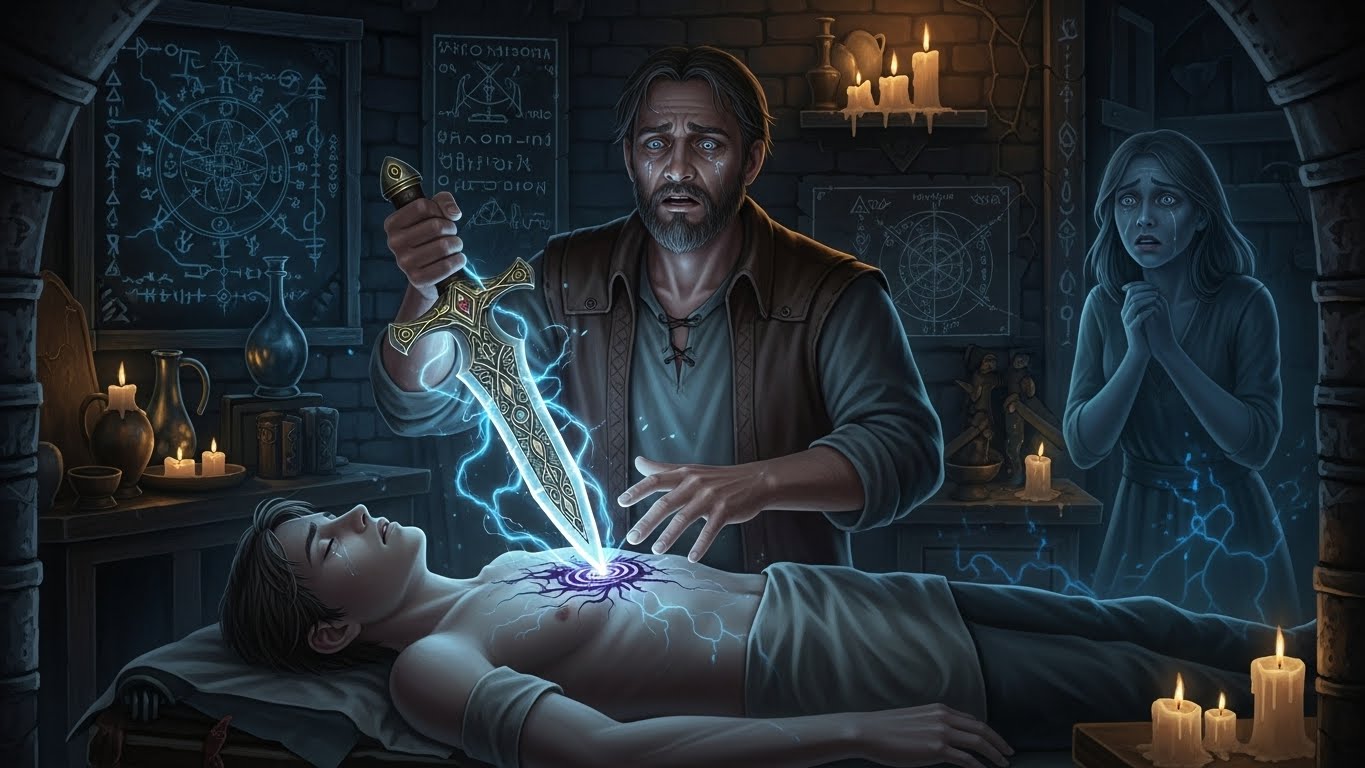
I Abandoned Her To Avoid My Past. Now I Have To Cut Open Our Son To Save Him From The Same Curse.
PART 1
Chapter 1: The God Complex
They call it the “God Complex” for a reason. When you hold a scalpel, and you’re standing over a chest cavity that you’ve cracked open like a walnut, you stop feeling like a human being. You decide who wakes up and who becomes a memory. I liked that feeling. I needed that feeling. It was the only thing that drowned out the noise in my head.
I am Dr. Sam Miller, Chief of Cardiothoracic Surgery at Mercy General in Seattle. To the board of directors, I’m a golden goose. To the residents, I’m a terrifying mentor. To the world, I’m a success story.
But to the woman screaming in the hallway of my own hospital, I am something else entirely.
It was a Thursday. Seattle was doing what it does best—drowning under a relentless, grey downpour. The ER was overflowing. A multi-car pileup on I-5 had turned the trauma bay into a war zone. I had just finished a six-hour aortic valve replacement, a masterpiece of surgical precision. My hands were steady. My mind was clear.
I walked out of the scrub room, peeling off my cap, expecting the usual deferential nods from the nursing staff. Instead, I found a wall of backs.
A crowd had gathered near the triage desk. Not a medical crowd—not the organized chaos of a code. This was a spectacle. People were whispering, phones were out. The air smelled of wet wool and metallic fear.
“What is going on here?” I barked, my voice cutting through the murmur. “If you aren’t dying or treating someone who is, clear the hallway!”
The crowd parted, but they didn’t leave. They just made space for me to see the center of their attention.
And then, my heart—that steady, rhythmic organ I knew so well—skipped a beat. Then another.
Lying on the dirty linoleum, surrounded by muddy footprints, was a woman. She was curled in a fetal position, clutching a battered duffel bag. Her jeans were soaked through with amniotic fluid. Her face was pressed against the cold tile, her knuckles white as she gripped the leg of a plastic chair.
I knew that bag. I had bought it for our weekend trip to the Cascades, back when we were happy. Back before I panicked.
“Vera?”
The name scraped my throat like swallowed glass.
She looked up. Her hair, usually a cascade of chestnut waves, was plastered to her forehead with sweat. Her face was contorted, unrecognizable in its agony. But her eyes… I would know those eyes anywhere. Green, sharp, and intelligent.
Right now, they were filled with a mixture of terror and a hatred so profound it made me take a step back.
“No,” she groaned, the sound guttural and raw. “Not you. Anyone but you.”
“Why is she on the floor?” I yelled, spinning around to face the triage nurse, a young woman named Sarah who looked like she was about to faint. “Why is this patient on the floor?”
“We… we didn’t know, Dr. Miller,” Sarah stammered. “She just walked in… she said back pain… we told her to wait… and then she just collapsed.”
“She’s not having back pain, you idiot! She’s in labor!” I dropped to my knees beside her. The knees of my tailored slacks soaked up the fluid on the floor instantly. I didn’t care.
“Vera,” I said, reaching out to touch her shoulder.
“Don’t touch me!” she screamed, thrashing away from my hand. “You don’t get to touch me! You made your choice, Sam! You walked away!”
The accusation hung in the air, louder than the ER alarms. Every nurse, every patient, every resident within earshot heard it. The Great Dr. Miller, the man who saves lives, destroyed this one.
“Vera, please,” I pleaded, my voice dropping to a desperate whisper. “I can see the head. You are crowning. We can’t move you. We have to do this here. Right now.”
“I hate you,” she sobbed, tears streaming sideways into her ears. “I hate you so much.”
“I know,” I said, positioning myself between her legs, transforming from her ex-lover back into a doctor. It was a defense mechanism. If I was a doctor, I didn’t have to be the father who abandoned them. “Focus on the hate, Vera. Use it. I need you to push.”
Chapter 2: The Blue Silence
The hallway ceased to exist. The murmuring crowd, the squeak of shoes, the smell of rain—it all faded into a grey blur. There was only Vera, the rhythm of her breathing, and the terrifying reality of what was happening.
I had delivered babies before. In medical school, during my rotation. It’s supposed to be a miracle. A messy, loud, beautiful miracle.
This felt like an execution.
“Okay, on the next contraction, I need you to give me everything,” I commanded, my hands ready. “Chin to chest. Hold your breath. Push.”
Vera let out a sound that wasn’t human. It was the sound of an animal caught in a trap, a sound of pure, unadulterated suffering. Her body convulsed.
“That’s it,” I encouraged, watching the crown of the head emerge. “I have the head. The cord is clear. Vera, stop pushing! Pant! Pant for me!”
She gasped, her chest heaving, her eyes rolling back.
“One more,” I said, guiding the shoulders. “One more little push, and he’s here.”
She bore down one last time, a sob breaking from her throat. And then, in a rush of fluid and warmth, he was out.
My son.
I held him in my hands. He was slippery, warm, and terrifyingly light.
Time usually slows down in moments of trauma, but this was different. Time stopped.
I waited for the wail. The angry, indignant cry of a newborn entering the cold world.
Silence.
“Sam?” Vera’s voice was weak, trembling. She was straining to lift her head. “Sam… why isn’t he crying?”
I looked down. My training kicked in before my emotions could catch up.
The baby wasn’t pink. He was blue. deeply, terrifyingly blue. Cyanotic.
I rubbed his back vigorously. “Come on, buddy. Come on.”
Nothing. He was limp. A ragdoll in my hands.
“Suction!” I yelled, not looking up. “I need a bulb syringe and a bag-valve-mask, pediatric size, NOW!”
A nurse dropped a kit next to me. I snatched the bulb, clearing his airway. Fluid came out, but no air went in.
“Is he… is he dead?” Vera whispered. The hatred was gone from her voice, replaced by a hollow, shattering brokenness that hurt more than the anger.
“No,” I lied. I didn’t know. “He’s just stunned. It was a fast delivery.”
I placed him on the floor—the cold, dirty floor—and put two fingers on his tiny chest. I felt for a pulse. It was there, but it was thready. Too fast. Erratic.
And then I saw it.
His nail beds. The specific duskiness of his lips.
The room spun. A memory violently imposed itself over reality. Ten years ago. My first wife, Sarah. The ultrasound room. The doctor’s grave face. Hypoplastic Left Heart Syndrome. The heart didn’t develop. The left side is useless.
Sarah died carrying that baby. The stress, the complications, the pre-eclampsia. I lost them both in one night.
That was why I left Vera. That was why, when she told me she was pregnant, I panicked. I told her I was “cursed.” I told her I brought death to everything I loved. I pushed her away to save her from me.
And now, looking at my blue son, I realized I hadn’t saved anyone. The curse was real.
“Hypoplastic,” I whispered, the word slipping out involuntarily.
“What?” Vera asked, her voice rising in panic. “What did you say?”
“Start oxygen!” I shouted at the respiratory therapist who had finally arrived. “Bag him! Do not stop! Get him to the NICU. Tell Dr. Evans to prep for an emergency echo. Go! GO!”
They snatched my son from my hands. I watched them run down the hall, the tiny blue legs dangling from the bundle.
I was left kneeling in a pool of fluid and blood, my hands empty.
I slowly turned to Vera. She wasn’t looking at the hallway where our son had disappeared. She was looking at me. She saw the recognition in my eyes. She saw the terror.
“Sam,” she said, her voice trembling with a realization that was dawning on her. “You knew. You knew this would happen.”
“I didn’t,” I choked out, tears finally spilling over, hot and stinging. “I swear to God, Vera, I didn’t know.”
“You left me,” she said, her voice turning to ice. “You left me alone to carry a dying baby.”
“I… I was afraid.”
“You’re not afraid,” she spat, struggling to sit up as the nurses tried to help her onto a gurney. “You’re a coward. And if my son dies, Sam… if he dies because of your genes, because of your curse… I will never forgive you. I will spend the rest of my life making sure you never forget it.”
They wheeled her away.
I stayed on the floor. The Chief of Surgery. The God of the O.R.
I covered my face with my blood-stained hands and, for the first time since I was a child, I prayed. Not for me. But for the tiny, broken heart I had just held in my hands.
PART 2
Chapter 3: The Devil You Know
The NICU is a cruel place. It’s designed to save lives, but it feels like a spaceship drifting in a void. It’s too bright, too quiet, and it smells like rubbing alcohol and desperation.
I stood outside the glass isolation room, watching Vera. She was sitting in a rocking chair, staring at the incubator. Inside that plastic box lay Damian. My son. He was wired up to so many machines that you could barely see the baby beneath the leads.
Dr. Evans, the head of Pediatric Cardiology, stood next to me. He was a good man, a competent doctor. But he wasn’t me.
“It’s HLHS, Sam,” Evans said quietly, confirming the nightmare. “Hypoplastic Left Heart Syndrome. The left ventricle is basically non-existent. He’s running on a patent ductus arteriosus right now, but once that closes…”
“He dies,” I finished for him. My voice sounded hollow, like it was coming from someone else. “He needs the Norwood procedure. Immediately.”
Evans sighed, rubbing the back of his neck. “Sam, look… his stats are garbage. He’s 5 pounds. He was born in a hallway. The risk of infection is through the roof. The mortality rate for a Norwood on a preemie in this condition is… it’s high.”
“I know the stats,” I snapped. “I wrote half the papers on them.”
“I can’t do it,” Evans admitted, looking down at his clipboard. “My hands… they aren’t steady enough for a heart the size of a walnut. Not with these complications. I’d lose him on the table.”
I looked through the glass. Vera was stroking the plastic porthole of the incubator. She looked small. Broken.
“I’ll do it,” I said.
Evans looked at me, horrified. “You can’t. He’s your son. Ethics committee will have a field day. You’re emotionally compromised.”
“I am the best cardiothoracic surgeon on the West Coast,” I said, turning to face him. My eyes felt dry, gritty. “If you do it, he has a 30% chance. If I do it, he has 60%. Ethics be damned. I’m not letting him die because of a rulebook.”
I walked into the room. Vera didn’t look up.
“He needs surgery,” I said. No preamble. No softness. We were past that.
“I know,” she whispered. “Dr. Evans told me.”
“Evans isn’t doing it,” I said. “I am.”
Vera’s head snapped up. Her eyes were red-rimmed, dark circles carved under them like bruises. “No.”
“I’m the only one who can, Vera.”
“You abandoned us!” she hissed, standing up. She was trembling, but she stood her ground between me and the incubator, a human shield. “You didn’t want him! How do I know you won’t… that you won’t let him go? How do I know you won’t ‘accidentally’ make a mistake to clear up your ‘curse’?”
The accusation hit me like a physical blow. She thought I was capable of murder. She thought my cowardice ran that deep.
“Because,” I said, stepping closer, until I could smell the stale sweat and fear on her. “Because if he dies, Vera, I have nothing left. I left you because I was afraid of this. I was afraid of watching another person I love die on a table while I stood by helpless. But I’m not helpless now. I have a scalpel. And I am going to save him.”
She searched my face. She was looking for the lie. She was looking for the arrogant boyfriend who told her a baby would ruin his career. She didn’t find him. She found a father who was terrified.
She reached into her pocket and pulled out a crumpled consent form. She slammed it against the incubator.
“Do it,” she said, her voice shaking. “But Sam? If you kill him… if you let his heart stop… you better make sure mine stops too. Because I will end you.”
Chapter 4: The Walnuts and the Wires
The Operating Room is my church. It’s the only place where the world makes sense. The temperature is always 68 degrees. The lighting is always perfect. The variables are controllable.
But today, the church felt like a tomb.
I scrubbed in. The water was scalding hot, but I couldn’t feel it. I scrubbed my hands until the skin was raw. Ten minutes. Scrub for ten minutes. It was a ritual to quiet the demons.
“Dr. Miller, we’re ready,” the anesthesiologist said over the intercom.
I walked in, hands held high. The team was silent. They knew. Everyone knew. This wasn’t just a Norwood procedure. This was the Chief operating on his own flesh and blood.
I approached the table. Damian was lost under the blue drapes. All I could see was a patch of skin on his chest, no bigger than a playing card.
“Scalpel,” I said. My voice was steady. Thank God my voice was steady.
The instrument hit my palm. Cold steel. Familiar weight.
“Incision,” I announced.
I cut. A thin line of crimson bloomed on the pale skin.
The first hour was mechanical. Sternotomy. Opening the chest. Cannulation. Putting him on bypass. The heart-lung machine took over with a rhythmic whoosh-click, whoosh-click.
And then I saw it. The heart.
It was tiny. The size of a walnut. And it was malformed, a twisted knot of muscle that shouldn’t have been able to sustain life for a second, let alone hours.
“Stopping the heart,” I said.
We injected the cardioplegia solution. The tiny fluttering muscle slowed… and stopped.
Silence.
Now, it was just me and the clock. I had to reconstruct the aorta, bypass the non-functioning ventricle, and replumb the entire circulation of a 5-pound human being.
I began to stitch. 7-0 Prolene sutures. The needle was smaller than an eyelash.
Don’t think about his name. Don’t think about his mother waiting in the lobby. He is a patient. He is tissue. He is a puzzle.
“Pressure is dropping,” the perfusionist warned.
“I see it,” I murmured. “Suction.”
My hand slipped. Just a fraction of a millimeter. A tiny tear in the pulmonary artery.
Blood welled up, obscuring the field.
“Damn it!” I froze.
For a second, the room dissolved. I wasn’t in the OR. I was back in that other room, ten years ago. Sarah was flatlining. The monitor was screaming. I was standing there, useless, watching the love of my life bleed out.
You kill everything you touch, Sam. The voice in my head was loud. Screaming.
“Dr. Miller?” The assistant’s voice broke through. “Dr. Miller, the bleed?”
I blinked. I looked down. This wasn’t Sarah. This was Damian.
“Forceps,” I snapped, the paralysis breaking. “Clamp. Give me a pledgeted suture. Now!”
My hands moved faster than my brain. I clamped the tear. I threw the stitch. One knot. Two knots. Three.
The bleeding stopped.
I exhaled, a breath I felt like I had been holding for eight months.
“Resuming reconstruction,” I said.
Two hours later.
“Coming off bypass,” the perfusionist announced. “Warming him up.”
This was the moment. The “moment of truth.” We had replumbed the engine. Now we had to see if it would start.
The heart sat there in the open chest, still and lifeless.
“Give him a jolt,” I ordered. “Five joules.”
Thump.
Nothing.
“Again. Ten joules.”
Thump.
Nothing.
The room got very quiet.
“Come on,” I whispered behind my mask. “Come on, you stubborn little fighter. Don’t be like your father. Don’t quit.”
I reached in and flicked the tiny heart with my finger. A manual stimulation.
It gave a sluggish heave. Then another.
Lub-dub.
A pause.
Lub-dub… lub-dub…
On the monitor, a green line spiked. A sinus rhythm. Fast, chaotic, but there.
“We have a rhythm,” the anesthesiologist breathed out.
I dropped my hands to my sides. My knees felt like water. I looked at the monitor, mesmerized by the bouncing green line. It was the most beautiful thing I had ever seen.
I had broken the curse.
Chapter 5: The Glass House
The relief didn’t last long. It never does.
The surgery was a success, but “success” in the world of congenital heart defects is a relative term. Damian was alive, but he was fragile. His immune system was non-existent. The Norwood is just the first of three surgeries. He was a ticking time bomb that needed 24-hour surveillance.
Two weeks later, the hospital administrator called me into his office.
“Sam, we have a problem,” he said, not meeting my eyes. “The insurance… Vera doesn’t have any. She was working as a waitress off the books when you left her. She’s on state aid, but they won’t cover the extended NICU stay. And we have a RSV outbreak in the pediatric wing. We need to discharge him.”
“Discharge him?” I slammed my hand on the desk. “He’s two weeks post-op! He needs a sterile environment. If he catches a cold, he dies.”
“Then he needs home care,” the admin said. “Expensive home care.”
I walked out of the office and went straight to Vera’s room. She was packing her duffel bag—the same one she brought in. She looked exhausted. She had aged ten years in ten days.
“They’re kicking us out,” she said, not looking at me. “I’m taking him to my apartment.”
“You live in a basement studio in Freemont,” I said. “It has mold, Vera. I saw it when I picked you up for our first date. If you take him there, the spores will kill him before you even unpack.”
“So what do you want me to do, Sam?” she spun around, her eyes blazing. “Live on the street? I have no money. I have no job. I have a sick baby because you have bad genes. What is your brilliant solution?”
I took a deep breath. I knew she was going to hate this.
“My cabin,” I said.
She laughed. A dry, humorless sound. “Your cabin? The ‘man cave’ in the Cascades? The place you went to ‘find yourself’ when you dumped me?”
“It’s not a man cave. It’s a fully equipped sterile recovery suite,” I lied. It wasn’t, but I could make it one in six hours. “It has a generator, HEPA air filtration, and it’s forty miles away from the city smog and the hospital germs. I have Oxygen. I have monitors.”
“No,” she shook her head. “No way. I am not playing house with you.”
“It’s not playing house,” I said, my voice hard. “It’s hospice. It’s a recovery ward. I will stay in the guest house. You take the main bedroom with the baby. I won’t touch you. I won’t even talk to you unless it’s about his meds. But I can’t let you take him to that basement.”
She looked at the car seat where Damian was sleeping. He was so small. He still had tubes taping his nose.
She looked at me. She weighed her hatred for me against her love for him. The love won.
“If you try anything,” she said, her voice low and dangerous, “if you try to act like we’re a family… I will leave. And I will take him with me.”
“Deal,” I said.
The drive up to the mountains was silent. The rain had turned into a wet, slushy snow. The wipers slapped a rhythm against the windshield that matched my racing heart.
Vera sat in the back with the baby. She didn’t look out the window. She just watched Damian’s chest rise and fall.
We arrived at the cabin just as the sun was setting behind the peaks. It was a beautiful place—glass and timber, perched on a ridge overlooking the valley. I had built it to escape the world.
Now, it was a prison.
I carried the oxygen tanks inside. I set up the portable monitor in the master bedroom. I checked the generator fuel levels.
“Here is the schedule,” I said, handing Vera a clipboard. “Meds every four hours. Oxygen saturation needs to stay above 75%. If it drops, you call me on the walkie-talkie. I’ll be in the garage apartment.”
She took the clipboard. Her fingers brushed mine, and she recoiled like I had burned her.
“Sam?” she asked as I turned to leave.
“Yeah?”
“Why are you doing this?” she asked. “Guilt?”
I looked at her, standing in the middle of my living room, holding the son I thought would ruin my life.
“Because I realized something in the OR,” I said softly.
“What?”
“That he’s the only thing I’ve ever done right. And I’m terrified I’m going to mess it up.”
I walked out into the cold night air, leaving them warm inside. The wind was picking up. The trees were swaying violently.
A storm was coming. A real one. And we were forty miles from help, trapped in a glass house with a baby whose heart was held together by fishing line and a prayer.
Chapter 6: The Ghost in the Nursery
The mountains don’t care about your problems. That’s what I learned in the first three days at the cabin. The wind howled through the Douglas Firs like a freight train, and the temperature plummeted. Inside, the cabin was a fortress of warmth and beeping monitors, but the tension was cold enough to freeze water.
We fell into a routine. A grim, silent ballet.
I stayed in the garage apartment, monitoring the weather reports and the generator status. Vera stayed in the main cabin, glued to Damian’s side. I would leave supplies at the door—groceries, formula, fresh oxygen tanks. She would leave empty tanks and dirty laundry. We were ghosts haunting the same property, separated by a wall of wood and a mountain of regret.
But on the fourth night, the silence broke.
It was 3:00 AM. The “witching hour” in the hospital, when patients code and demons come out to play. I couldn’t sleep. The wind was battering the garage door, and I had a bad feeling. A visceral, surgeon’s instinct that something was wrong.
I keyed in the code for the main cabin and slipped inside. It was warm, smelling of woodsmoke and baby powder.
I walked softly to the nursery. The door was cracked open.
I expected to see Vera asleep in the armchair. Instead, the chair was empty.
I stepped closer to the crib. Vera wasn’t there.
I found myself leaning over the rail, looking at Damian. He was asleep, his tiny chest rising and falling in sync with the green light of the pulse ox monitor. He looked so peaceful. So unlike the chaos that created him.
“I’m sorry,” I whispered to the sleeping baby. The words just fell out of me. “I’m so sorry I didn’t want you.”
I reached out, my finger hovering over his hand. I wanted to touch him, but I felt like I would contaminate him. Like my “curse” was a contagion.
“Why did you leave, Sam?”
The voice came from the shadows. I jumped, spinning around.
Vera was standing in the doorway, holding a bottle. She looked exhausted, her hair in a messy bun, wearing one of my old flannels she must have found in the closet.
“I… I was just checking the O2 levels,” I stammered, pulling my hand back.
“No,” she said, stepping into the room. Her voice wasn’t angry anymore. It was just tired. “I’m asking you a question. A real question. Why did you leave me? And don’t give me the ‘I was afraid of commitment’ speech. You’re the most committed man I know. You lived in the hospital. You married your job. Why was I different?”
I looked at her. I looked at the baby. The defense mechanisms I had built for years—the arrogance, the detachment, the God Complex—crumbled.
I slid down the wall until I was sitting on the floor. I put my head in my hands.
“Because of Sarah,” I choked out.
Vera frowned. “Your ex-wife? You said she died in a car accident.”
“I lied,” I whispered. “She didn’t die in a car accident. She died in labor. With our son.”
Vera went still. The room was silent except for the rhythmic beep… beep… of the monitor.
“He had HLHS,” I continued, the tears finally coming, hot and fast. “The same thing Damian has. Exact same defect. We didn’t know until he was born. He died in my arms, Vera. And then Sarah hemorrhaged. I was a second-year resident. I stood there and watched the attending try to save them. I knew exactly what was happening. I knew the moment she was gone.”
I looked up at Vera. My vision was blurry.
“When you told me you were pregnant, I didn’t see a baby. I saw a tombstone. I saw you dying on a table. I saw myself destroying another life. I convinced myself that I was poison. That if I stayed, I would kill you both. So I left. I thought… I thought if I removed myself from the equation, you would be safe.”
I let out a shuddering breath. “I was wrong. I was so wrong.”
Vera didn’t speak for a long time. She walked over to the window and looked out at the storm raging outside.
“You’re an idiot, Sam,” she said softly.
“I know.”
“You decided my fate for me. You took away my choice because you were scared of your own shadow.” She turned to face me. She wasn’t smiling, but the hatred in her eyes had softened into something else. Pity? Understanding?
“I can’t forgive you,” she said. “Not yet. Maybe not ever. But…”
She walked over and sat on the floor next to me. She didn’t touch me, but she was close enough that I could feel her warmth.
“But you’re here now,” she said. “Don’t you dare leave again.”
“I won’t,” I promised.
And then, the lights went out.
Chapter 7: The Longest Night
It wasn’t a flicker. It was a hard, definitive clunk of the grid failing. The cabin was plunged into absolute darkness.
The silence was instant. No hum of the refrigerator. No whir of the heater.
And, most terrifying of all, no whoosh from the oxygen concentrator.
“Sam!” Vera screamed in the dark.
“Stay put!” I yelled, scrambling to my feet. “I have a flashlight in my pocket. Don’t move!”
I clicked the light on. The beam cut through the blackness, landing on the crib.
The monitor was running on battery backup, its screen glowing eerily in the dark. Beep… beep…
“The concentrator stopped,” Vera said, panic rising in her voice. “He needs the oxygen flow. His sats are dropping. Look!”
The number on the screen ticked down. 85%. 82%. 80%.
“The generator,” I said. “It should have kicked on automatically. Wait here.”
I ran to the back door, throwing it open. The wind hit me like a physical blow, carrying snow and ice. I sprinted to the generator shed.
A massive branch from an old pine tree had snapped in the gale. It had crushed the transfer switch box. The generator was running, roaring away, but the power wasn’t getting to the house. The line was severed.
“No,” I roared, kicking the snow. “No, no, no!”
I ran back inside, soaked and freezing.
“It’s gone,” I shouted, locking the door against the storm. “The line is cut. We have no power.”
“What do we do?” Vera was holding Damian now. He was starting to fuss, his color looking dusky in the flashlight beam. “The battery on the concentrator only lasts twenty minutes.”
“We don’t use the concentrator,” I said, my mind racing through protocols. “We use the tank.”
“The tank is for transport! It only has two hours of air!”
“Then we have two hours,” I said. “Two hours for the storm to break or for me to fix the line.”
But the storm didn’t break. It got worse.
Two hours later, the gauge on the tank hit zero. The hiss of oxygen stopped.
Damian’s saturation alarm began to wail. 70%. 65%.
He was turning blue again.
“He’s suffocating,” Vera sobbed, clutching him to her chest. “Sam, do something!”
I grabbed the emergency kit. I pulled out the Ambu-bag—a self-inflating manual resuscitator. It’s a plastic football-shaped bag with a mask. You squeeze it, it pushes air into the lungs. You let go, it refills.
“Give him to me,” I ordered.
I laid Damian on the kitchen table. I placed the mask over his tiny nose and mouth. I squeezed the bag.
Whoosh.
His chest rose.
I let go. His chest fell.
Whoosh.
I looked at the monitor. The numbers stabilized. 75%. 78%.
“Okay,” I breathed. “Okay. We have a manual override.”
“How long can you do that?” Vera asked, her eyes wide.
“As long as it takes,” I said.
The first hour was easy. Adrenaline is a hell of a drug. I sat there, rhythmically squeezing the bag. Squeeze. Release. Squeeze. Release. Every three seconds. Twenty breaths a minute.
The second hour, my hand started to cramp.
The temperature in the cabin was dropping. I could see my breath in the flashlight beam. Vera wrapped Damian in every blanket we had. She rubbed his feet to keep the circulation going.
“Switch hands,” Vera said softly.
I switched to my left hand. My right hand was a claw, frozen in a gripping shape.
The third hour was torture.
My back was screaming. My eyes were burning from staring at the rise and fall of his chest. The repetition was hypnotic, maddening. If I stopped for ten seconds, he would die. If I fell asleep, he would die.
“Sam,” Vera whispered. She was sitting across from me, holding the flashlight steady so I could see the mask seal. “You’re shivering.”
“I’m fine,” I lied through chattering teeth.
“You’re not fine. Drink this.” She held a cup of water to my lips. I drank without breaking the rhythm. Squeeze. Release.
“Talk to me,” I said. “Keep me awake, Vera. Tell me about him. Tell me about the pregnancy.”
“It was hard,” she said, her voice trembling in the cold. “I craved pickles and peanut butter. I cried every time I saw a diaper commercial. I hated you every single day.”
“Good,” I grunted. “Keep hating me. Whatever keeps us warm.”
“I hated you,” she continued, “because I wanted to share it with you. I wanted you to see him kick. I wanted you to build the crib.”
“I’m here now,” I rasped. Squeeze. Release. “I’m building the crib now.”
Hour four. Hour five.
The sun should be up, but the windows were black. The storm was burying us.
My left hand gave out. I switched back to the right. It was numb. I was practically hallucinating. I saw Sarah in the corner of the room, watching me. She wasn’t sad. She was nodding.
Save him, Sam.
“I can’t,” I whispered. “I’m too tired.”
“Yes, you can,” Vera’s voice cut through the fog. She reached out and placed her hand over mine on the bag. Her skin was warm. “We do it together. On three. One, two, squeeze.”
We sat there, huddled over our broken son, squeezing the bag in tandem. My hand under hers. Her strength reinforcing mine.
We weren’t doctor and patient. We weren’t ex-lovers. We were a machine. A heart-lung machine made of flesh and bone and sheer, stubborn refusal to let death win.
Chapter 8: The Sunrise
I didn’t notice when the wind stopped howling.
I was in a trance state, floating somewhere between exhaustion and unconsciousness. My world had shrunk to the size of the plastic bag and the rhythm. Squeeze. Release.
“Sam,” Vera whispered.
“Not yet,” I mumbled. “Keep counting.”
“Sam, look.”
I blinked, my eyes gritty and dry. I looked up.
A beam of light was cutting through the kitchen window. It wasn’t the flashlight. It was grey, dusty, weak light.
Daylight.
And then, a sound. A mechanical hum.
The refrigerator rattled to life. The heater clicked and groaned. The monitor beeped louder as it switched from battery to AC power.
The oxygen concentrator let out a hiss of air.
“The power,” Vera cried out, tears streaming down her face. “The power is back!”
I stared at the concentrator. I didn’t believe it. I didn’t dare believe it.
Vera quickly disconnected the Ambu-bag and hooked Damian’s cannula up to the machine. She watched the monitor.
90%. 95%. 98%.
He was pink. He was warm. He was breathing.
I let the bag drop from my hand. It hit the floor with a hollow plastic sound.
I tried to stand up, but my legs didn’t work. I slid off the chair and collapsed onto the floor. My hands were locked in claws. My whole body was shaking uncontrollably.
“Sam!” Vera was there instantly. She wasn’t looking at the baby anymore. She was looking at me.
She pulled my head into her lap. She rubbed my frozen hands, trying to massage the life back into them.
“You did it,” she was sobbing. “You crazy, stupid son of a bitch, you did it. You saved him.”
I looked up at the ceiling. I felt completely empty, drained of everything—fear, guilt, arrogance. All that was left was a quiet, humming peace.
“We did it,” I whispered. And then the dark took me.
I woke up on the couch. I was covered in a quilt. The fire was crackling in the hearth. The smell of coffee was in the air.
I sat up, groaning. Every muscle in my body felt like it had been torn apart and sewn back together.
I looked towards the door.
Vera was sitting on the porch swing, wrapped in a blanket, holding Damian. The storm had passed. The sky was a brilliant, piercing blue, the kind you only get after a heavy snow. The sun was reflecting off the white peaks, blindingly bright.
I walked out onto the porch. The air was crisp and cold.
Vera didn’t turn around. She knew I was there.
I sat down next to her. I didn’t try to take the baby. I just sat there, watching the sunrise over the Cascades.
“He’s sleeping,” she said softly. “He ate four ounces. He’s a fighter.”
“He gets that from his mother,” I said.
Vera looked at me. Her eyes were clear. The shadows were still there—we had too much history to erase it in one night—but the wall was gone.
She reached out and took my hand. My right hand. The one that had kept our son alive. She traced the tremor that was still there.
“You’re not the man I fell in love with, Sam,” she said.
My heart sank. “I know.”
“You’re different,” she continued. “That man was shiny and perfect and hollow. You… you’re cracked. You’re messy.”
She squeezed my hand.
“I think I like this version better.”
I looked at her, and for the first time in ten years, I didn’t see the past. I didn’t see Sarah. I didn’t see the curse. I saw the future. It was terrifying, and uncertain, and it was going to be hard work.
“Can I start over?” I asked. My voice broke. “Can I try to be the father he deserves?”
Vera looked down at Damian, then back at me. She offered a small, tired smile.
“You just did, Sam. You just did.”
We sat there in silence, watching the sun climb higher, melting the snow, one drop at a time.
THE END