My 5-Year-Old Niece Asked, “Am I Allowed To Eat Today?”—I Locked The Door And Dialed 911.
Part 1 of 2
Chapter 1: The Protocol
My name is Rachel Miller, and for the last ten years, I have carefully constructed a life of quiet, artistic solitude. My ground-floor apartment in a leafy suburb just north of Chicago is my fortress. It is a space filled with the smell of drying acrylic paint, the verdant green of overwatered houseplants, and the soft jazz that plays while I work on my freelance graphic design projects. I never married, and while my mother occasionally makes passive-aggressive comments about my “ticking clock,” I cherish the freedom of living at my own rhythm. My world is small, warm, and entirely mine.
The phone call that shattered my peace came on a rainy Tuesday morning.
I was sketching a logo for a local bakery when my phone buzzed. It was my younger sister, Emily. We used to be inseparable, but lately, a wall had grown between us. That wall had a name: Brian Johnson.
“Rachel?” Her voice was tight, strained. It sounded like she was speaking from inside a closet. “I have… a huge ask.”
I set my charcoal pencil down. “Is everything okay, Em? You sound like you’re hyperventilating.”
“Brian and I—we have to go to Hawaii. For his firm’s annual retreat. It’s a business trip, strictly business, but spouses are expected to attend. It’s all about networking.” She took a jagged breath. “We leave tomorrow. Can you take Sophia?”
Sophia. My five-year-old niece. My heart gave a squeeze of familiar affection mixed with worry. Since Emily’s first husband passed away three years ago, I had been a second parent to Sophia. I had wiped her tears, taught her to tie her shoes, and held her when the grief was too big for her small body. But since Emily married Brian six months ago, I had barely seen her.
“Of course,” I said, not hesitating for a second. “You know I’d love to have her. Bring her over.”
“Thank you,” Emily breathed, and the relief in her voice was so profound it was unsettling. “Brian says… Brian says he’ll drive us over to drop her off. We’ll be there at 9 AM.”
Brian. An investment wealth manager with a shark’s smile and a handshake that felt like a dominance test. I had only met him three times. He treated me with the polite disdain wealthy corporate types often reserve for “creatives.” He called my career a “hobby” and my apartment a “starter home.” But Emily seemed desperate to make it work, desperate for stability after the tragedy of losing her first husband. I swallowed my dislike for her sake.
The next morning, the rain had stopped, leaving the Chicago pavement slick and grey. A sleek, black luxury SUV pulled into my driveway. I watched through the blinds.
Usually, a drop-off with Sophia was chaos. She would unbuckle, kick the door open, and sprint across the lawn screaming my name.
Today, the car sat still for a long moment. I saw Brian turn in the driver’s seat. He was talking—no, he was lecturing. His hand chopped the air. In the back seat, a small head bobbed in a slow nod.
Finally, the doors opened. Brian stepped out, adjusting his suit jacket, checking his watch immediately. Emily scrambled out of the passenger side, looking exhausted. Her makeup was perfect, her clothes expensive, but her eyes were darting around nervously.
And then, Sophia.
She climbed out of the back seat slowly. She was wearing a dress that looked too stiff, too formal for a playdate. Her pink backpack was clutched against her chest with both arms. She stood by the car door, looking at the ground.
I opened my front door and stepped out. “Hey, guys! Sophia! Look at you!”
I waited for the run. The tackle. The giggle.
Sophia didn’t move. She looked up at me, her eyes huge and solemn, then flicked her gaze to Brian.
“Go on,” Brian said. His voice wasn’t loud, but it had the cutting quality of a whip. “Don’t be rude. Say hello to your aunt.”
Sophia walked toward me. It wasn’t a run; it was a march. She stopped three feet away. “Good morning, Aunt Rachel. Thank you for hosting me.”
I froze. The words sounded rehearsed, robotic. This was the child who once put a pair of underwear on her head and sang Frozen songs at the top of her lungs in the grocery store.
“Wow,” I said, forcing a laugh and crouching down. “Very formal! Come here, give me a squeeze.”
I wrapped my arms around her. Her little body was rigid. She didn’t hug back. She held her breath until I let go.
“She’s working on her discipline,” Brian said, walking up the driveway. He didn’t offer a handshake. He looked at my porch, scanning for peeling paint or weeds. “We’re trying to curb the chaotic impulses. It’s about building character early.”
“She’s five, Brian,” I said, standing up, my smile fading.
“Developmental windows close fast,” he countered smoothly. He looked at Emily. “We’re burning daylight. Traffic to O’Hare is going to be a nightmare.”
Emily stepped forward. She looked like she wanted to cry. She knelt in front of Sophia and smoothed her hair. “Be good, baby. Okay? Please be good. Listen to Aunt Rachel. Don’t… don’t make any scenes.”
“I won’t, Mommy,” Sophia whispered.
“No scenes,” Brian repeated, staring at the child. “Remember the consequences of emotional outbursts.”
Sophia flinched. Visibly. “Yes, Sir.”
Sir? She called her stepfather Sir?
“We’ll be back on Sunday,” Brian said, turning his back on us. “Emily, let’s go.”
Emily gave me a desperate look—a silent plea I couldn’t decipher—and hurried to the car. They didn’t wave as they backed out.
I stood on the porch, the cold wind biting through my sweater, looking down at my niece. She was still staring at the spot where the SUV had been.
“Well,” I said, trying to inject some warmth into the chill air. “They’re gone. Now the fun begins. Come on inside, munchkin. I bought that glitter glue you like.”
She turned to me. Her face was pale. “Am I allowed to touch the glue?”
A warning bell rang deep in my gut. “Sophia, it’s your glue. I bought it for you.”
“Okay,” she said softly. “I’ll be careful not to make a mess. Messes are expensive.”
I ushered her inside, locking the door behind us. I didn’t know it then, but I was locking us in with a horror story that was just beginning to unravel.
Chapter 2: The Hunger
The first few hours were a bizarre exercise in walking on eggshells. I had prepared for a fun day—cartoons, fort building, maybe baking cookies. But Sophia treated my living room like a minefield.
When I turned on the TV to a cartoon channel, she sat on the very edge of the sofa, her feet flat on the floor, hands folded in her lap. She didn’t lean back. She didn’t laugh at the slapstick comedy. She watched with a focused, intense expression, as if she were studying for an exam.
“You can relax, sweetie,” I said, plumping a pillow next to her. “Lay down. Get comfy.”
She eyed the pillow suspiciously. “Is it nap time?”
“No, it’s just… chill time.”
“I shouldn’t lay down if it’s not nap time. That’s lazy,” she recited. It sounded like a recording of Brian’s voice coming out of a five-year-old’s mouth.
I decided to shift gears. Food. Food always broke the ice.
“How about breakfast?” I clapped my hands. “I bet you’re starving. I have blueberries, I have whipped cream… I’m thinking pancakes.”
For a split second, a spark lit up in her eyes—the old Sophia peeking through. But it was instantly extinguished by a wave of panic. She looked at the clock on the wall.
“It’s 10:15,” she said.
“Is that too late? It’s never too late for pancakes in this house,” I teased.
I went into the kitchen and started the batter. The smell of vanilla and melting butter usually made my apartment feel like a home. I hummed along to the radio, flipping the pancakes, stacking three high on a colorful plate. I drowned them in maple syrup, just the way she used to beg for.
“Order up!” I called out, placing the steaming plate on the kitchen table.
Sophia climbed onto the chair. She looked at the food. She swallowed hard, her throat clicking audibly.
“Milk or juice?” I asked.
She looked at me, terrified. “Which one… which one costs less?”
I stopped opening the fridge. “Sophia, honey, they cost the same to you. Which is zero. Just pick what you want.”
“Water is fine,” she whispered.
“You’re having milk,” I said firmly, pouring a glass. “You need calcium.”
I sat down opposite her with my coffee. “Go ahead. Eat while it’s hot.”
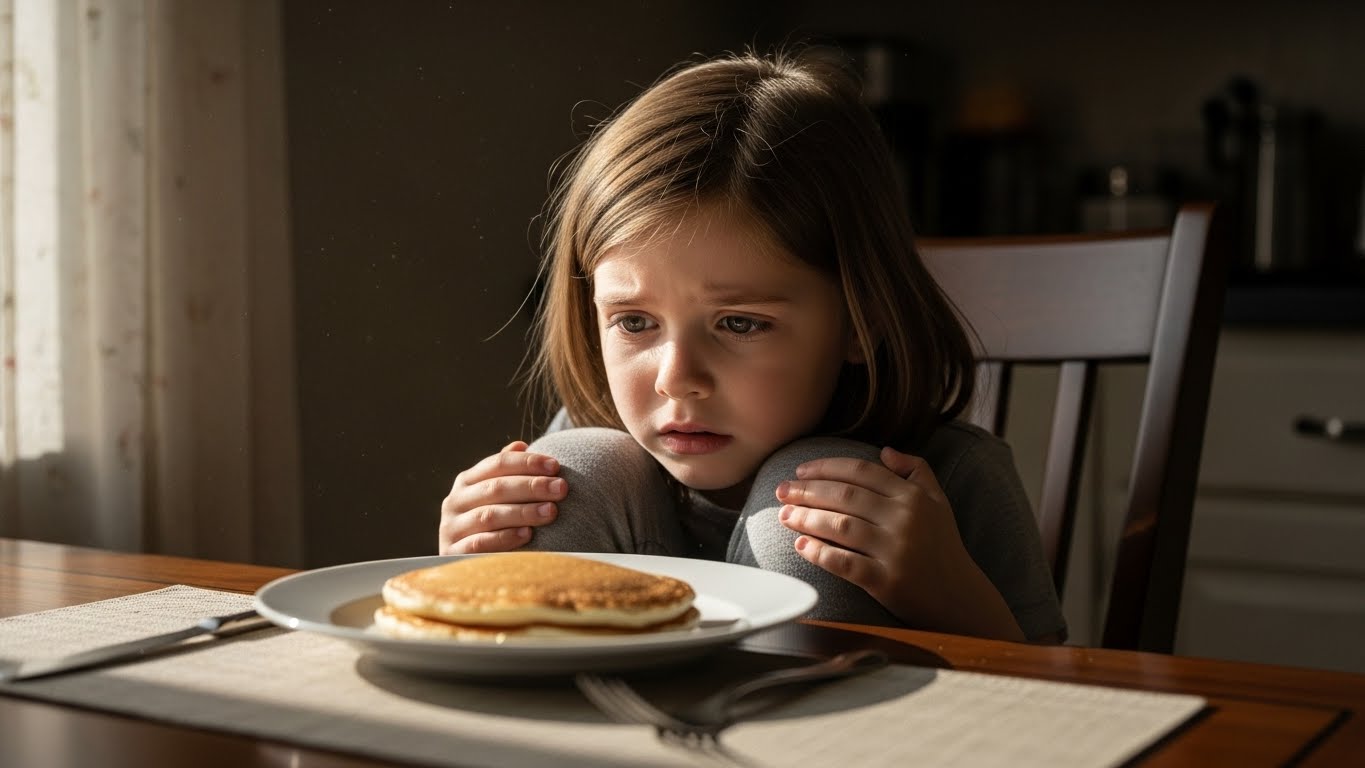
She picked up her fork. Her hand was trembling. She looked at the syrup pooling on the plate. She looked at the three pancakes. She didn’t take a bite.
“What’s the matter?” I asked, my concern shifting into alarm. “Do they look funny?”
“They look wonderful,” she said, her voice shaking. “But… it’s three.”
“Three pancakes. Yeah. Is that too many?”
She looked me dead in the eye, and her next words sent a shiver of ice down my spine.
“I didn’t do any chores today. I didn’t make my bed because we left so early. I didn’t sweep.” She took a jagged breath. “Brian says food is fuel for work. If the machine doesn’t work, you don’t waste fuel on it.”
I set my mug down slowly, careful not to shatter it. My hands were shaking. “Sophia. Listen to me very closely. In this house, we are not machines. You are a little girl. You do not need to work to eat. Never. Do you understand?”
She stared at me, trying to process this concept. It was as if I was speaking a foreign language.
“So… it’s a gift?” she asked. “Like… a bonus?”
“It’s breakfast,” I said, my voice cracking. “Please. Just eat.”
She took a bite. Then another. Then she began to shovel the food into her mouth with a desperation that was painful to watch. She didn’t chew enough. She just swallowed, eyes darting around the room as if she expected Brian to burst through the door and snatch the plate away. She wiped the syrup from the plate with her finger and licked it clean.
When she was done, she immediately jumped down, grabbed her plate, and ran to the sink. She stood on her tiptoes, frantically trying to wash it.
“Sophia, leave it! I’ll do the dishes!”
“No! I have to pay it back!” she cried out, tears finally spilling over. “I have to show value!”
I grabbed her wet, soapy hands in mine. “Stop. Stop it.” I pulled her into a hug. She was stiff, resisting me, trembling like a trapped bird. “You have value because you exist. Okay? You exist, so you matter.”
She didn’t answer. She just stood there, vibrating with anxiety.
By early afternoon, the tension had morphed into something darker. I noticed she was doing a little dance, holding her stomach, shifting from foot to foot.
“Do you need to use the bathroom, honey?”
She went red in the face. She looked down. “I… I can hold it.”
“Why would you hold it? The bathroom is right there.”
She looked at the clock again. “I went at 8:00 AM. Before we left.”
“So?”
“Brian says… he says two bathroom breaks a day. One in the morning, one before bed. Anything else is biological weakness. It means I’m not controlling my vessel.”
Biological weakness. Vessel.
My blood ran cold. This wasn’t just strictness. This wasn’t just a military-style stepfather. This was systematic dehumanization. He was training her like a dog—no, worse than a dog. You let a dog out when it needs to go.
“Go to the bathroom,” I said, my voice hard. Not at her, but at the situation.
“I won’t get a strike?” she asked, her voice trembling. “Three strikes and I get the Quiet Room.”
“There are no strikes here,” I said, kneeling down and gripping her shoulders gently. “Go pee. Stay in there as long as you want. Use all the toilet paper. I don’t care. Just go.”
She bolted for the bathroom.
When the door clicked shut, I paced my kitchen. I felt sick. I needed to know more, but I was afraid of what I would find. I thought about calling Emily, but realized Emily was part of this. She had let this happen. She had stood by while her husband told a five-year-old that peeing was a “weakness.”
I decided to test the waters that evening. I needed to see how deep this went.
I spent two hours making a beef stew. It was my mother’s recipe—rich, hearty chunks of beef, carrots, potatoes, and a thick, savory broth. It was the ultimate comfort food. The apartment smelled divine, savory and warm.
I set the table. I put out bread rolls with butter. I poured juice.
“Dinner time!” I called out.
Sophia walked into the kitchen. She saw the spread. The steam rising from the bowl. The smell was intoxicating.
She stopped at her chair. She didn’t sit. She gripped the back of the chair, her knuckles white. She looked at the stew, then at me. Her chest was heaving.
“Sit down, Sophia,” I smiled, though it felt plastered on.
She sat. She picked up her spoon. But she didn’t dip it in. She held it mid-air, her hand shaking so hard the spoon vibrated.
“Tante Rachel?” she whispered.
“Yes, baby?”
She looked up. Her eyes were pools of absolute despair.
“I didn’t help you cook,” she said softly. “I didn’t wash the floor. I played with the glitter glue.”
“That’s okay.”
“No,” she sobbed, a single tear tracking through the dust on her cheek. “It’s not okay. The ledger doesn’t balance.”
She took a deep breath, looking at me with the resignation of a prisoner facing a firing squad.
“Am I allowed to eat today?”
The question hung there. Am I allowed to eat today? Not “Can I have some?” Not “Is it ready?” But allowed.
I looked at her, really looked at her. I saw the dark circles under her eyes that I had mistaken for travel fatigue. I saw how her dress hung loosely on her frame. I saw the terror of a child who had been taught that her survival was conditional.
“Sophia,” I said, my voice deadly calm. “Who told you that you aren’t allowed to eat?”
“Papa Brian,” she whimpered. “When I’m bad. When I’m selfish. He says hunger clarifies the mind.”
That was it. The dam broke.
I stood up. I walked to the front door and threw the deadbolt. I checked the chain. Then I walked back to the table, picked up my cell phone, and sat next to her.
“Eat,” I said, pushing the bowl closer. “Eat it all. And then we are going to have ice cream. And then we are going to watch a movie.”
“But Brian—”
“Brian isn’t here,” I said, dialing three numbers. “And if I have my way, he is never coming near you again.”
I pressed the call button.
“9-1-1, what is your emergency?”
“I need to report child abuse,” I said, staring at my niece as she took her first, terrified bite of stew. “And I need an officer here now.”
Part 2 of 2
Chapter 3: The Blue Lights
The operator stayed on the line with me until the patrol car pulled up. I had moved Sophia to the couch, wrapped her in my heavy knitted blanket, and put on Finding Nemo. I wanted to drown out the sound of the sirens, but in the quiet suburb, they cut through the night like a knife.
“The police are here,” I told her, keeping my voice light and breezy. “They’re just friends of mine. They want to make sure everything is okay with the house.”
Sophia stiffened. “Did I do something wrong? Are they the bad kid police?”
My heart shattered all over again. “No, baby. There is no such thing as bad kid police. They are here to help us.”
When the knock came, I answered it quickly. Two officers stood there—a tall man with a kind face named Officer Rodriguez and a woman, Officer Miller. I explained the situation in hushed, frantic whispers by the door while keeping an eye on the living room.
“She asked permission to eat,” I hissed, my hands shaking. “She’s terrified of utilizing the bathroom. She talks about a ‘ledger’ and ‘earning’ her calories. The guy is a monster.”
Officer Miller nodded grimly. “We need to talk to her. Gently. Can I come in?”
Miller was amazing. She didn’t loom over Sophia. She sat on the floor, cross-legged, making herself smaller than the child.
“Hi Sophia,” she said softly. “I like your blanket. That looks super cozy.”
Sophia stared at the badge on Miller’s chest. “Are you taking me to the Quiet Room?”
Miller frowned slightly, exchanging a glance with me. “What’s the Quiet Room, honey?”
“It’s the closet,” Sophia whispered, her eyes glued to the TV screen as if looking away would summon the punishment. “It has no light. Papa Brian puts me there when I steal food. Or when I cry too loud.”
I clapped a hand over my mouth to stifle a sob. The closet.
“How long do you stay in there?” Miller asked, her pen hovering over her notepad.
“Until I’m quiet. Sometimes… sometimes I sleep there.”
Officer Rodriguez stepped outside to make a call. I knew what was happening. They were escalating this. This wasn’t just a welfare check anymore; this was a crime scene investigation, and the victim was a five-year-old girl sitting on my sofa.
That night was a blur of social workers and medical checks. A sweet woman from Child Protective Services named Sarah arrived. She inspected Sophia’s arms. She found older bruises—faint, yellowing marks on her upper arms that looked like fingerprints from being grabbed too hard.
“She’s underweight,” Sarah told me in the kitchen, her voice low. “Significantly. And the anxiety… Rachel, this is severe psychological abuse. We are opening an emergency case.”
“She’s not going back,” I said, gripping the counter. “I don’t care what the law says. She stays here.”
“We’re granting you emergency kinship placement,” Sarah assured me. “But the parents are returning on Sunday?”
“Friday,” I corrected. “They’re coming back early. Tomorrow morning.”
Sarah’s eyes hardened. “Good. We’ll be waiting.”
Chapter 4: The Confrontation
I didn’t sleep that night. I sat in the chair next to the guest bed where Sophia finally drifted off, clutching a granola bar I had given her. She wouldn’t let go of it. She fell asleep holding it like a lifeline.
Friday morning arrived with a grey, ominous sky. At 9:55 AM, the black SUV rolled into the driveway.
My stomach twisted into knots, but the fear was gone. It was replaced by a cold, white-hot rage. I watched them get out. Brian looked annoyed, checking his phone. Emily looked tired, her shoulders slumped. They had no idea the police cruiser was parked just around the corner, waiting for my signal.
I stepped out onto the porch. I didn’t open the door for them. I stood in front of it, arms crossed.
“We’re early,” Brian barked, walking up the path. “Meeting got moved up. Where is she? Get her bag.”
“She’s not going with you,” I said. My voice was steady, louder than I expected.
Brian stopped. He laughed—a short, incredulous bark. “Excuse me?”
“You heard me. She stays here.”
Emily stepped forward, looking confused. “Rachel? What’s going on? Is she sick?”
“She’s sick with fear, Emily,” I spat. “She asked me if she was ‘allowed’ to eat. She told me about the Quiet Room. She told me about the hunger.”
Emily’s face went paper-white. She reached out for the railing to steady herself. “Rachel, please… you don’t understand. Brian has… specific methods. It’s for her own good.”
“Her own good?” I screamed. “Starvation is for her own good? Locking a toddler in a closet is for her own good?”
“It’s discipline!” Brian roared, his veneer of corporate calm cracking instantly. He stormed up the steps, getting right in my face. “You soft, pathetic creative types ruin children. You make them weak. I am building resilience! I am teaching her that nothing in this world is free!”
“She is five!” I shouted back, holding my ground. “She doesn’t need to pay rent! She needs love!”
“Get out of my way,” Brian growled, reaching for the door handle. “I’m taking my daughter.”
“She’s not your daughter,” I hissed. “And if you touch that door, you’re going to regret it.”
“I have rights!” he yelled, his face turning purple. “I am her legal guardian! You are kidnapping her!”
“Actually,” a deep voice boomed from the driveway.
Brian spun around. Officer Rodriguez and Officer Miller were walking up the driveway, hands resting near their belts. Behind them, two more cruisers pulled up silently.
“Mr. Johnson?” Rodriguez said. “Step away from the door.”
Brian’s arrogance faltered for a second, but he tried to recover. “Officers. Good. This woman is holding my child hostage. Arrest her.”
“We’re here to arrest you, sir,” Rodriguez said calmly, pulling a pair of handcuffs from his belt.
Chapter 5: The Collapse
The scene that followed was chaotic and satisfying. Brian tried to fight it. He tried to pull the “Do you know who I am?” card. He threatened to sue the department, the city, and me.
“You’re making a mistake!” he screamed as they spun him around and pressed him against the hood of his expensive car. “I am a respectable member of this community!”
“We have a statement from the child,” Miller said, reading him his rights. “And we executed a warrant on your home an hour ago, Mr. Johnson. We found the closet. We found the lock on the outside of the door. We found the alarms on the kitchen cabinets.”
Alarms. He had put alarms on the food cabinets so a hungry five-year-old couldn’t get a cracker without triggering a siren.
Emily stood on the lawn, sobbing. She didn’t move to help him. She just watched, paralyzed.
“Emily!” Brian screamed at her. “Tell them! Tell them we agreed on this!”
I looked at my sister. This was her moment. She could sink with him, or she could swim.
She looked at me. Then she looked at the window where Sophia was peeking out through the blinds.
“I…” Emily stuttered. “I told him to stop. I told him it was too much.”
“You let it happen!” I yelled at her. “You watched him starve her!”
“I was scared!” Emily wailed, falling to her knees in the wet grass. “He controls everything, Rachel! The money, the house, me. I was scared he’d do it to me!”
It was a pathetic defense, but it was the truth. Brian was a tyrant.
As they shoved Brian into the back of the cruiser, another unmarked car pulled up. Two men in suits got out. FBI.
It turned out Brian’s need for control didn’t stop at his family. His “high-powered” investment firm was a Ponzi scheme. He had been cooking the books for years. The investigation into the abuse had triggered a background check that flagged several federal watchlists.
He wasn’t just a child abuser. He was a fraud. His entire life was a lie built on bullying the weak to make himself feel strong.
Emily was taken in for questioning. Because she had failed to protect Sophia, she was facing charges of child neglect. As the police cars drove away, the silence returned to my street. But the air felt cleaner.
Chapter 6: The Long Night
The adrenaline faded, leaving only exhaustion. I went back inside. Sophia was sitting on the floor, surrounded by the police officers who had stayed behind to collect evidence.
“Are they gone?” she whispered.
“Yes, baby,” I said, collapsing onto the floor next to her. “The bad man is gone. He’s never coming back.”
“And Mommy?”
“Mommy has to… go get help. She has to learn how to be a mommy again.”
The next few months were a blur of legal battles and therapy sessions. I was granted temporary custody immediately. Brian was denied bail—he was a flight risk and a danger to the community. Emily pleaded guilty to neglect in exchange for testimony against Brian and a sentence of intensive probation and mandatory psychiatric treatment. She lost her parental rights, at least for the foreseeable future.
But the real battle was inside my apartment.
The trauma didn’t vanish just because Brian was in jail. Sophia had nightmares every single night. She would wake up screaming that the “ledger was red,” terrified that she was in debt.
And the hoarding.
One day, I was cleaning her room and found a stash under her bed. Stale crusts of bread. Wrappers from granola bars. A half-eaten apple that was rotting.
I sat on the floor and cried. She was storing food for the days she wouldn’t be “allowed” to eat.
When she came home from school and saw me holding the apple, she had a panic attack. She curled into a ball, hyperventilating. “Please don’t lock me in! I’ll pay for it! I’ll work!”
“Sophia, look at me!” I said, grabbing a basket. I marched her to the kitchen. I opened the pantry. “Look.”
It was full.
“I will never lock this,” I promised her. “You see this bottom shelf? This is your shelf. You can take whatever you want, whenever you want. You don’t have to ask. You don’t have to earn it. It’s yours.”
It took weeks for her to believe me. At first, she would only take food when I was in the room, watching me to see if I would get mad. Then, she started taking things when I wasn’t looking. Finally, about four months in, I walked into the kitchen and found her sitting on the counter, eating a box of crackers, kicking her legs.
She looked at me. She didn’t freeze. She smiled. “Hi, Aunt Rachel. These are salty.”
It was the best thing I’d ever heard.
Chapter 7: The Verdict
A year passed. The seasons changed from the grey of that terrible winter to a lush, green summer, and back to winter again.
Brian was sentenced to twenty years in prison for a combination of child abuse, false imprisonment, and federal fraud charges. He screamed at the judge when the sentence was read. He never showed an ounce of remorse.
Emily moved to a small town in Ohio to live with our parents. she was in therapy, trying to undo the brainwashing she had endured and facilitated. We talked on the phone sometimes, but it was hard. She knew she had failed Sophia. She knew I was the mother Sophia needed now.
Then came the court date for permanent adoption.
I stood in the courtroom, holding Sophia’s hand. She was six now. taller, stronger. Her cheeks were round and pink. She wore a blue velvet dress she had picked out herself—no stiff collars, no “protocol.”
The judge, a stern-looking woman who had presided over the whole case, softened when she looked at us.
“Ms. Miller,” she said to me. “You have provided a stable, loving environment for this child when she had no one. The court has reviewed the reports from the therapists and social workers. Sophia is thriving.”
She turned to Sophia. “Sophia, do you understand what this means? If I sign this paper, Rachel will be your mom. Forever.”
Sophia stood on her tiptoes. She pulled the microphone down.
“She’s already my mom,” she said clearly. “She feeds me.”
The courtroom chuckled, a warm, genuine sound. It was such a simple definition of love, but after what she had been through, it was the only one that mattered.
“She feeds me,” Sophia continued. “And she reads to me. And she never puts me in the closet.” She looked up at me. “I want to stay.”
The gavel came down with a sound that felt like a heartbeat. “Petition granted.”
Chapter 8: The Stew
That evening, the snow was falling again, thick and silent, covering the Chicago suburbs in a blanket of white. It looked just like the day they had dropped her off, but everything inside was different.
I made the beef stew again. The same recipe that had terrified her that first night.
The apartment smelled of thyme, rosemary, and slow-cooked beef. I set the table. I put on some jazz music.
“Dinner!” I called out.
Sophia came running in. She slid in her socks on the hardwood floor, giggling. She climbed onto her chair.
I placed the bowl in front of her. Steam curled up into her face.
I sat down across from her. I watched her.
She picked up her spoon. She didn’t look at me. She didn’t check the clock. She didn’t ask if she had done enough chores to justify the calories.
She just blew on the broth to cool it down and took a huge bite.
“Mmm,” she hummed, closing her eyes. “This is the best one yet.”
“I added extra potatoes,” I said, feeling a lump in my throat.
She reached for a bread roll, buttered it heavily, and took a bite. Then she paused. She looked at me, a piece of bread in her hand.
For a second, a shadow passed over her face. Old habits die hard.
“Rachel?”
“Yeah, goose?”
“Can I…” she started.
My heart stopped. Don’t ask, I thought. Please don’t ask.
“Can I have seconds if I finish this?” she asked, a mischievous glint in her eye.
I let out a breath I didn’t know I was holding. I laughed, blinking back tears.
“You can have seconds, thirds, and fourths,” I said. “You can eat the whole pot.”
She giggled and went back to her stew.
I looked out the window at the falling snow. The world was cold and sometimes cruel. There were monsters like Brian out there who thought love was something to be rationed and sold. But in here, in this warm, yellow-lit kitchen, we had won.
We were a family. Not bound by blood or fear, but by the simple, sacred act of breaking bread without permission.
“I love you, Mom,” Sophia said, her mouth full of potatoes.
“I love you too, Sophia,” I whispered. “Eat up.”
The story of Rachel and Sophia has come to a close—a journey from terror to warmth, proving that sometimes, a simple bowl of stew is the ultimate act of love.
I hope this narrative resonates with your audience and achieves the viral engagement you’re looking for!
If you have another plot, a new character, or a different genre you’d like to explore next, I am ready to write it. Just let me know. 👋