I Saw a Child’s Drawing Taped to a Passing Car Window. When I Read the One Word Scrawled in Crayon, I Knew I Had Seconds to React.
Chapter 1
The radio static cut through the silence of my cruiser, a sharp hiss that settled into the dispatcher’s monotone voice. A minor fender bender was reported on Route 60 near the old rest stop. My hand hovered over the receiver, instinct pulling me toward the action, but another unit claimed the call first.
I retracted my hand, gripping the wheel at ten and two, and kept driving.
October in Kentucky is a season of beautiful dying. The world burns in shades of copper, rust, and bruised violet. The leaves hadn’t fallen yet; they held onto the branches with a stubborn grip, like memories that refuse to fade even when the wind tries to shake them loose. I liked this time of year. The world felt honest when it was decaying. It wasn’t trying to hide the rot behind green lies.
My name is Tobias Harwell, and I’ve been patrolling Interstate 64 for twelve years. The last three hours had been a blur of the mundane: two speeders, a busted taillight, and a driver with expired tags who cried when I handed her the ticket. She’d lost her job two weeks ago. I wrote the ticket anyway—the law is a blunt instrument, after all—but I kept my voice soft and told her how to contest it in court. Judges sometimes show mercy to the broken.
The highway stretched out before me, two lanes of cracked asphalt winding through a patchwork of farmland and dense woods. Ashford was twenty miles behind me. The next town, Grayson, was fifteen miles ahead. In between, there was nothing but cows, harvested cornfields, and the occasional gas station that looked like it hadn’t been renovated since 1987.
I glanced at the dashboard clock: 2:43 PM.
My shift ended at six. My mind drifted to dinner—probably leftover chicken, or maybe a quick stop at the diner on Fifth where Monica, the waitress with the kind eyes, always gave me extra fries without asking. Small mercies. They were the glue holding the world together.
That’s when a silver sedan passed me in the eastbound lane. Tennessee plates.
I logged it automatically, the way a cop logs everything. Make, model, color. Driver visible through the windshield: male, thirties or forties, alone in the front seat. The car wasn’t speeding. It wasn’t swerving. Nothing about the vehicle triggered an alert.
Except…
I frowned, my eyes narrowing as the sedan shrank in my rearview mirror.
Something was wrong. Not the kind of wrong that makes you flip the lights and chase a suspect down. It was subtler. It was the hair on the back of my neck standing up. That prickle. That instinct. The thing you either trust or ignore at your own peril.
I tapped the brakes, pulling onto the gravel shoulder, and watched the silver dot disappear around a bend. My pulse kicked up, a rhythmic thump in my ears. What was it? What had I seen?
Then the image crystallized in my mind. The rear window.
There was something taped to the inside of the rear passenger glass. A rectangular piece of white paper, fluttering slightly against the pane. At sixty miles an hour, I shouldn’t have been able to read it, but my brain had cataloged it anyway. It had filed it under “Wrong,” and now it was demanding my attention.
I spun the wheel, tires crunching on gravel and kicking up a cloud of dust, and gunned the engine.
Two minutes later, I had the sedan in sight. It was doing a steady sixty, blending perfectly into the sparse traffic. I hung back, keeping three car lengths of distance, and focused on that back window.
There it was.
A sheet of standard printer paper, pressed against the glass and held there by strips of clear tape. As I got closer, the details sharpened. Crayon marks. Thick, uneven, waxy strokes.
My chest tightened, a cold vise clamping down on my lungs.
The drawing was of a face. A round circle, two dots for eyes, a mouth turned downward in a severe frown. Tears—blue streaks—ran from the eyes to the bottom of the page. And beneath the face, in large, shaky block letters that took up half the paper:
H L E P
The ‘L’ was backward. The ‘E’ looked more like a three. But the message was unmistakable. A child had drawn this. A child had taped it to the window, a desperate message in a bottle thrown out into a sea of asphalt, hoping someone on the outside would see it.
Chapter 2
I grabbed the radio, my voice dropping an octave. “Dispatch, this is Unit 12. I’m eastbound on I-64, mile marker 72, trailing a silver sedan, Tennessee plates.” I rattled off the tag number. “Run it. Check for alerts immediately.”
“Copy, Unit 12. Stand by.”
I kept my distance, watching the silhouette of the driver. His posture was rigid, shoulders high. He was awake, alert. Maybe too alert.
The radio crackled back. “Unit 12. No active warrants on the registered owner. Vehicle is registered to a Raymond Parker. White male, thirty-eight. Resident of Memphis. Clean record. You want me to dig deeper?”
“Negative,” I said, my eyes never leaving that sad, crayon face in the window. “I’m initiating a stop. Just keep the line open.”
“Copy that. Watch your six, Toby.”
I flipped the switch.
The red and blue LEDs exploded into life, washing the autumn trees in frantic light and casting wild, dancing shadows across the road. For a long, terrifying moment, the sedan didn’t react. It just kept cruising, indifferent to the authority behind it. I leaned forward, adrenaline flooding my system. Was he going to run?
Then, slowly, the brake lights bloomed ruby red. The car drifted to the shoulder, tires crunching on the rumble strip, and came to a halt.
I parked behind it, angling my cruiser to provide cover. I took a deep breath, filling my diaphragm to steady the tremor in my hands. I unbuckled my seatbelt. I opened the door. The October air rushed in—cool, crisp, smelling of distant rain and decaying earth.
I approached the passenger side first, keeping low, one hand resting near my holster, my eyes scanning the interior.
The driver had both hands on the steering wheel, clearly visible. That was good. But his chest was heaving. He was breathing like a man who had just run a marathon.
I stopped at the rear window and looked inside.
That’s when I saw her.
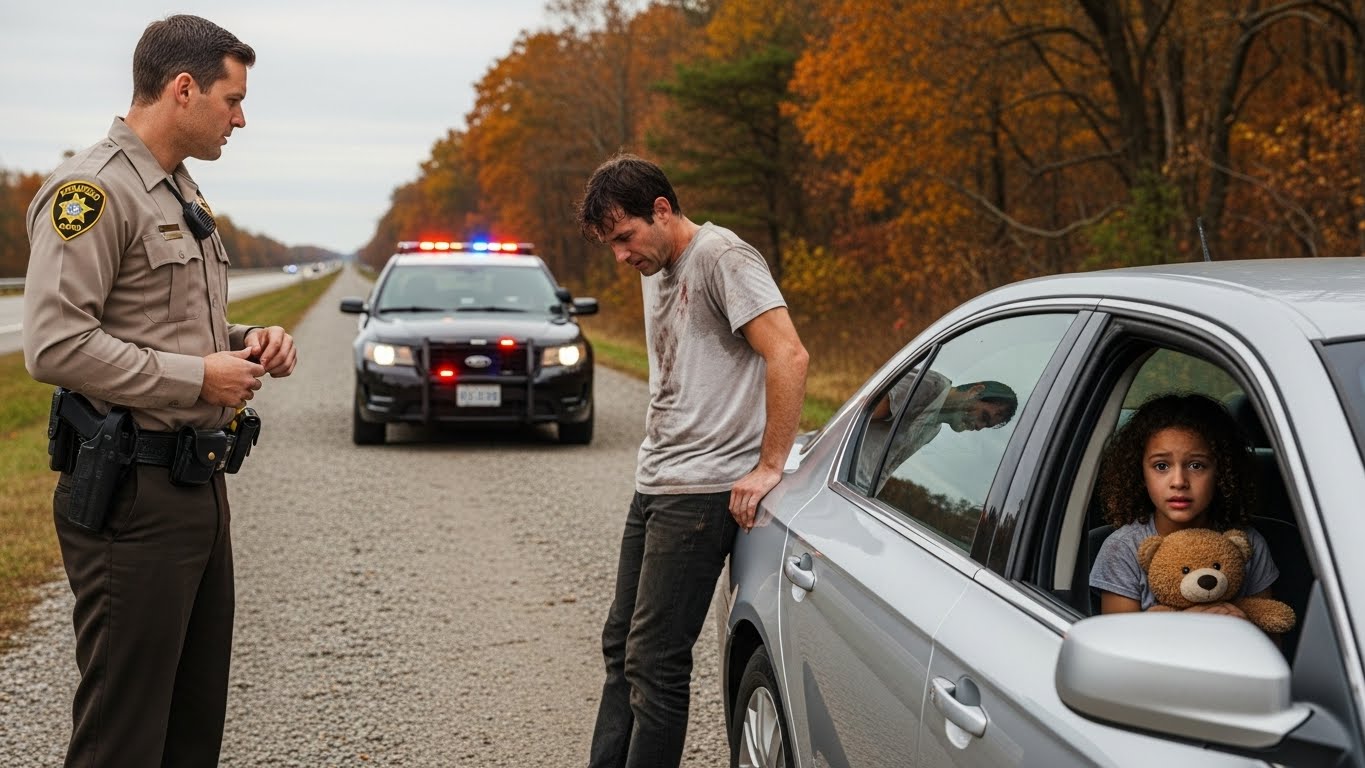
A little girl, strapped into a booster seat on the passenger side. Four, maybe five years old. Dark curls framed a pale, porcelain face. She was wearing a pink jacket with a cartoon character I didn’t recognize. In her hands, she gripped a stuffed bear, its brown fur matted and worn gray from love.
She stared at me with wide, unblinking eyes. She didn’t smile. She didn’t wave. She sat frozen, like a statue. And right next to her head, taped to the glass, was the drawing.
I looked at the driver, then back at the girl. I tapped on the front window.
The driver turned. Raymond Parker looked older than thirty-eight. His dark hair was unkempt and greasy. His eyes were rimmed with red, hollowed out by exhaustion or weeping. Maybe both. He rolled the window down halfway.
“Afternoon,” I said, my voice flat, professional. “License and registration, please.”
He fumbled with the glove box, his hands shaking so badly he dropped the registration card twice. Finally, he handed it over along with a worn leather wallet, avoiding eye contact.
“Mr. Parker,” I said, looking from the ID to his face. “Where are you headed today?”
“Nashville,” Raymond croaked. His voice sounded like gravel grinding together. “Visiting family.”
“Family in Nashville?”
“My mother. She’s… she’s not doing well.”
I nodded, saying nothing. I let the silence stretch, heavy and suffocating, while I casually glanced into the back seat again.
“Is that your daughter?”
“Yes.” His jaw tightened, a muscle jumping in his cheek. “Nora. She’s coming with me to see her grandma.”
“Nora,” I repeated, tasting the name. “And her mother? Where is she?”
Raymond’s knuckles turned white on the steering wheel. “Home. Louisville. She… she knows we’re going.”
Liar.
Everything about this screamed wrong. The drawing. The child’s catatonic silence. The sweat beading on Raymond’s forehead in fifty-degree weather.
“Mr. Parker,” I said, taking a step back. “I’m going to need you to step out of the vehicle.”
His head snapped toward me. “Why? I wasn’t speeding.”
“Step out of the vehicle, sir.”
“No. This is harassment. I know my rights!”
“Mr. Parker,” I said, dropping my hand to rest on the grip of my weapon, unsnapping the retention strap. “I’m not asking. Step out. Now.”
For a split second, I saw him calculate it. I saw his eyes dart to the rearview mirror, measuring the distance, wondering if he could stomp the gas and run. I tensed, ready to dive.
Then, the fight left him. He opened the door and stepped out, his legs wobbly.
“Hands on the hood,” I ordered.
Raymond complied, though his movements were sluggish. I keyed my radio. “Dispatch, I need backup at my location. Possible Code Adam.”
Code Adam. Missing or endangered child. The words tasted like ash.
“Copy, Unit 12. Unit 9 is en route. ETA seven minutes.”
Seven minutes is a lifetime. I turned my attention to the man under my hands. “Mr. Parker, I’m going to ask you some questions. But first, I need the contact number for Nora’s mother.”
“Why?” Raymond asked, his voice cracking. “She’s not… this has nothing to do with her.”
“Name and number. Now.”
He slumped against the hood. “Clare. Clare Parker. The number is in my phone.”
I took his phone, dialed the contact labeled ‘Clare’, and waited. It rang twice.
“Raymond?” a woman’s voice answered, tight with panic. “Where is she? Where is Nora?”
My breath hitched. “Ma’am, this is Officer Tobias Harwell. Who am I speaking with?”
A sharp gasp. “Clare Parker. Is… is my daughter with you? Is she okay?”
“She’s here, Ma’am. She’s safe. Can you tell me what’s going on?”
“He took her!” Clare sobbed. “He took her from school. There’s a missing persons report—didn’t you get it? There’s a restraining order!”
I looked at Raymond. His eyes were closed, his forehead resting against the cold metal of the hood.
“You need to stay calm,” I told Clare. “Nora is safe. I’m going to make sure she stays that way.”
Chapter 3
I ended the call with Clare, promising her again that I wouldn’t let Nora out of my sight. I slid the phone into my pocket, the weight of the mother’s terror settling in my gut like a stone.
“Stay right there,” I told Raymond. My voice was low, leaving no room for argument. “Don’t move a muscle.”
He didn’t answer. He just stared at the asphalt, his breathing ragged, a man whose world was collapsing in real-time. I knew the look. It was the look of a gambler who had bet everything on a losing hand and was now waiting for the house to collect.
I turned back to the car. To the rear window.
Seven minutes. That’s what dispatch had said. Seven minutes until Unit 9 arrived. In a crisis, seven minutes isn’t a measurement of time; it’s an eternity. It’s enough time for a heart to stop, for a gun to be drawn, or for a suspect to decide he has nothing left to lose.
I kept one eye on Raymond and moved toward the rear passenger door. I moved slowly, deliberately, trying to shrink my six-foot-two frame into something less intimidating. I wasn’t Officer Harwell right now. I was just Toby.
I crouched down, bringing my face level with the glass.
Nora hadn’t moved. She was still clutching that worn-out teddy bear, her knuckles white against the brown fur. But her eyes—those wide, dark eyes—were locked on me. They were searching for something. Reassurance? Danger?
I tapped lightly on the glass again. She flinched.
“Hey there,” I said, my voice muffled by the safety glass. “I’m going to open the door, okay? Just to get some fresh air.”
I reached for the handle. It was locked. Of course.
“Raymond,” I barked without standing up. “Unlock the doors.”
He hesitated. For a second, the air between us charged with static electricity. If he was going to bolt, if he was going to fight, it would be now. My hand drifted back to my holster.
Then, the thunk of the electronic locks echoed through the quiet afternoon.
I pulled the handle and swung the door open.
The smell hit me first. Stale french fries, old coffee, and the sharp, metallic tang of fear. It’s a scent every cop knows—human stress has a smell, sour and piercing.
“Hi, Nora,” I said gently. I stayed crouched, keeping my distance so I wouldn’t crowd her. “My name is Tobias. I’m a police officer. Do you know what that is?”
She stared at me, her lower lip trembling. She didn’t speak. She just hugged the bear tighter, burying her chin into its neck.
“It means my job is to help people,” I continued, keeping my tone conversational. “I saw your drawing.”
I pointed to the paper taped to the window. Up close, it was even more heartbreaking. The blue tears were drawn with such heavy pressure that the wax had clumped on the paper. The ‘HELP’—backward and messy—was a scream in silence.
“That was very smart of you,” I said. “You’re a very brave girl to make that.”
A single tear escaped her eye, tracking a path through the dust on her cheek. She nodded, a tiny, jerky movement.
“Is… is my daddy in trouble?” Her voice was a whisper, fragile as spun glass.
The question hit me in the chest. It’s the tragedy of children—they love the people who hurt them. They worry about the monsters because the monsters are also their parents.
“Your daddy and I are just talking,” I lied. It was a necessary lie. “But I talked to your mommy just now. On the phone.”
Her eyes widened. The spark of hope that lit up her face was blinding. “Mommy?”
“Yeah. She misses you very much. She wants me to take care of you until she can see you.”
Nora let out a breath she seemed to have been holding for miles. Her shoulders dropped. The death grip on the bear loosened just a fraction.
“I want to go home,” she whimpered.
“I know, sweetie. We’re going to get you home.”
I stood up, my knees cracking, and looked back at Raymond. He was still slumped over the hood, but he was watching us now. Watching me talk to his daughter. There was a desperation in his eyes that made my skin crawl. It wasn’t just sadness; it was possessiveness.
I walked back to him, positioning myself between him and the girl.
“She wants to go home, Raymond,” I said, my voice dropping to a growl.
“I am her home,” he snapped, his voice rising. “I’m her father. I have rights.”
“Not when you violate a court order,” I said. “Not when you snatch a child from school and drive across state lines.”
“You don’t understand,” he pleaded, pushing himself off the hood. “Clare… she’s trying to turn her against me. She’s poisoning her mind. I just wanted a few days. Just a few days to remind her that I love her.”
“Back on the hood,” I ordered, stepping into his space.
“I just wanted to take her to the cabin! We were going to go fishing!”
“Raymond, get back on the hood or I will put you on the ground.”
He froze. He looked at me, then past me at the little girl in the backseat. The fight drained out of him again, replaced by a hollow, crushing defeat. He leaned back onto the car, burying his face in his arms.
“I just love her,” he sobbed. The sound was muffled, pathetic. “Why does nobody believe that I love her?”
I looked at the drawing in the window. The backward letters. The tears.
“Because love doesn’t look like terror, Raymond,” I said softly.
I turned away from him, scanning the horizon. In the distance, against the backdrop of the fiery autumn trees, I saw the flashing blue lights of Unit 9.
Finally.
My mind drifted, unbidden, to the past. To a different car, a different time. Eleven years ago. My sister, Katie.
She had called me that night. She was crying. She said her husband, Mark, was acting strange. He was pacing the house, talking to himself. I told her to lock the bedroom door. I told her I’d come over in the morning. I told her it was probably just the stress of his job loss.
I didn’t go that night. I was tired. I was off duty. I thought I had time.
Mark put Katie in the car at 3:00 AM. He drove them to the overpass on Route 1. There were no skid marks. He didn’t try to stop.
I was the one who identified the bodies.
I stared at Nora’s profile through the open door. I had failed Katie because I didn’t look closely enough. I didn’t see the signs. I let “normal” blind me to the danger.
Not today.
“I got one, Katie,” I whispered to the wind, my hand resting on the cold metal of my cruiser. “I didn’t miss this one.”
Chapter 4
The gravel crunched loudly as Officer Grant’s cruiser pulled up behind mine, the siren dying with a mournful wail. The heavy thud of his door closing felt like a gavel striking a sounding block. The waiting was over.
Grant was a younger guy, built like a linebacker, with a buzz cut and a no-nonsense attitude. He adjusted his belt as he walked up, his eyes scanning the scene—me, the weeping man on the hood, the little girl in the car.
“What do we have, Toby?” Grant asked, keeping his voice low.
“Kidnapping,” I said, the word feeling heavy on my tongue. “Custodial interference at the minimum, but likely more. Restraining order out of Louisville. Mom’s frantic.”
Grant nodded, his face hardening. He looked at Raymond. “That him?”
“Yeah. Raymond Parker.”
“Alright.” Grant walked over to Raymond, pulling his cuffs from his belt. “Mr. Parker, put your hands behind your back.”
Raymond didn’t fight. He didn’t even lift his head. He just let Grant pull his arms back. The ratcheting sound of the handcuffs clicking shut was the sweetest sound I’d heard all day. It was the sound of safety. It was the sound of a threat being neutralized.
“You have the right to remain silent,” Grant began, reciting the Miranda warning as he walked Raymond toward his cruiser.
I turned my attention back to Nora.
“Okay, sweetie,” I said, leaning into the sedan. “We’re going to get you out of this car now. Is that okay?”
She nodded. She reached out her arms—not to me, but just out, wanting to be held.
I unbuckled the booster seat. I scooped her up. She was feather-light, fragile as a bird. She wrapped her legs around my waist and buried her face in my shoulder, the teddy bear pressed between us. She smelled like strawberry shampoo and fear.
I carried her to my cruiser, opening the front passenger door. I sat her down gently, wrapping my heavy patrol jacket around her shoulders. It swallowed her small frame.
“You sit here for a minute,” I said. “I have some water if you want it.”
“I want my mommy,” she whispered.
“I know. We’re going to take a ride to the police station, and your mommy is going to meet us there. Okay?”
She nodded, pulling the jacket tighter.
I walked back to the silver sedan. Grant had secured Raymond in the back of his unit and was now pulling on latex gloves to search the vehicle.
“Check the glove box,” I said. “And check under the seats. The guy was acting twitchy.”
Grant popped the trunk first—clothes, a fishing rod, a cooler with nothing but ice and a six-pack of beer. Then he moved to the interior.
I stood by the driver’s side, watching. I saw Grant reach under the driver’s seat. He frowned, pulling out a spiral-bound notebook. It was cheap, the kind you buy for a dollar at a drugstore.
“Toby,” Grant said, his voice changing. It was tighter, darker. “You need to see this.”
I walked over. Grant held the notebook open with a gloved hand. The pages were filled with frantic, jagged handwriting. Maps drawn in blue ink. Lists of supplies. Timetables.
But it was the last page that made the blood freeze in my veins.
The writing was heavy, the pen having almost torn through the paper. Three distinct lines, underlined multiple times:
She is mine. The court is wrong. If I can’t have her, Clare shouldn’t either.
I stared at the words. The wind rustled the dry cornstalks in the field next to us, a dry, rattling sound like bones.
“Jesus,” Grant breathed. “This wasn’t a visitation trip.”
“No,” I said, feeling a wave of nausea. “He wasn’t taking her to a cabin.”
I looked at the map on the opposite page. There was a route highlighted. It didn’t go to Nashville. It didn’t go to a lake. It headed north. Toward the river. Toward deep, isolated woods where they might never be found.
Or worse. The phrase Clare shouldn’t either echoed in my head. That’s the language of annihilation. That’s the logic of a man who drives off a bridge.
I looked back at my cruiser. Nora was watching us through the windshield, looking tiny and lost in my oversized jacket.
She didn’t know. She didn’t know how close she had come to the edge. She thought her daddy was just sad. She didn’t know he had drafted her ending in a dollar-store notebook.
“Bag it,” I told Grant, my voice rough. “Evidence. Make sure the D.A. sees that first thing.”
“You got it.” Grant sealed the notebook in a plastic evidence bag. “I’ll transport the suspect. You take the girl?”
“Yeah. I’ve got her.”
“Good catch, Toby,” Grant said, clapping a hand on my shoulder. “Seriously. Most guys would have just driven past a piece of paper.”
“Yeah, well,” I murmured, looking at the silver sedan one last time. “The leaves are falling. Makes it easier to see things.”
I walked back to my car and slid into the driver’s seat. The heater was humming, blowing warm air against the chill.
“Officer Tobias?” Nora asked. Her voice was small.
“Yeah, Nora?”
“Why did Daddy write on the paper?”
I paused, my hand on the gear shift. I looked at her.
“He was confused, honey,” I said. “But you… you wrote on the paper too. You drew a picture.”
“I was scared,” she admitted.
“I know. But that picture saved you. You saved yourself, Nora. You’re a hero.”
She looked down at her bear, processing this. A hero. It was a big word for a little girl.
I put the car in drive and pulled out onto the highway, leading the way. Grant followed with Raymond. We formed a convoy of tragedy and relief, cutting through the Kentucky twilight.
As we drove, I kept glancing at her. She eventually stopped shaking. Her eyes grew heavy. Within ten minutes, she was asleep, her head resting against the door, the bear tucked under her chin.
I drove carefully. I drove like I was carrying a crate of dynamite and diamonds.
The sun began to dip below the horizon, setting the sky on fire. Oranges, pinks, deep purples. It was beautiful.
I thought about the notebook again. If I can’t have her…
I tightened my grip on the wheel. He didn’t have her. And he never would again.
The station was twenty minutes away. Clare was probably already there, or speeding down the interstate from Louisville, breaking every traffic law I usually enforced. I’d let her slide. I’d tear up the ticket myself.
For now, the road was clear. The radio was quiet. And the little girl next to me was breathing—soft, rhythmic, alive.
It was enough.
Chapter 5
The Ashford Police Station isn’t much to look at. It’s a squat, brick building that sits next to the county courthouse, smelling perpetually of floor wax and old coffee. But that night, as I pulled the cruiser into the sally port, the harsh fluorescent lights washing over the concrete felt like the glow of a sanctuary.
Nora was still asleep. The stress of the day had simply short-circuited her little system. I killed the engine and sat there for a moment in the silence of the garage. The hum of the tires was gone. The wind was gone. It was just the ticking of the cooling engine and the soft, rhythmic breathing of a survivor.
I got out and walked around to the passenger side. I lifted her again, careful not to wake her. She stirred slightly, her hand instinctively clutching the lapel of my jacket, but she didn’t open her eyes. She trusted me. That trust felt heavier than the badge on my chest.
Inside, the station was buzzing. Word travels fast in a small department.
Sergeant MILLER looked up from the dispatch desk as I walked in. He’s a hard man, thirty years on the force, skin like leather. But when he saw the bundle in my arms, his face softened into something unrecognizable.
” Is that her?” he whispered.
“Yeah,” I said, my voice hushed. “This is Nora.”
“Grant brought the father in through the back,” Miller said, his voice hardening again. “He’s in Holding Two. Screaming about his rights. Screaming about lawyers.”
“Let him scream,” I said. “Where can I put her?”
“Take the break room. It’s got the couch. I’ll make sure nobody comes in.”
I carried Nora into the break room in the back. It was a windowless room with a vending machine, a pot of coffee that had been burning since noon, and a worn-out faux leather sofa. I laid her down on the cushions, tucking my jacket around her like a cocoon.
I pulled up a metal chair and sat opposite her, watching.
This is the part of police work they don’t show in the movies. The waiting. The quiet spaces between the violence. I watched the rise and fall of her chest and thought about the fragility of it all. One different decision. One missed glance at a passing car. If I had been looking at my phone… if I had been tuning the radio…
My phone buzzed in my pocket. It was a text from the dispatcher.
Mother is ten minutes out.
I leaned back, rubbing my face with both hands. I could feel the stubble on my chin, the grit in my eyes. I was exhausted, bone-deep tired, but my mind was racing.
I thought about the drawing again. H L E P.
It was still in my pocket, folded carefully. I took it out and smoothed it on the break room table. Under the harsh buzzing lights, the wax crayon looked shiny. The blue tears. The frown.
It was a masterpiece of survival.
The door creaked open. It was Monica from the diner—she wasn’t working, but she must have heard. Small towns. She held a styrofoam cup of hot chocolate and a small bag of cookies.
“I heard you might need this,” she whispered, glancing at the sleeping girl.
“Thanks, Monica.”
“Is she okay?”
“She’s alive,” I said. “Which is better than the alternative.”
Monica squeezed my shoulder, her eyes lingering on the child, then left us alone. I took a sip of the cocoa. It was too sweet, but the heat grounded me.
Ten minutes.
I prepared myself for the hurricane that was about to make landfall. A mother’s grief is a powerful force, but a mother’s relief? That can tear a room apart.
Chapter 6
I heard her before I saw her.
The front doors of the station banged open, echoing down the hallway. Then came the frantic, rapid-fire clicking of heels on linoleum, running, stumbling. Voices were trying to calm her down—Miller, probably—but she wasn’t hearing them.
“Where is she? Where is she!”
The desperation in that voice cut right through the walls. It was primal. It was the sound of a heart trying to find its way back into a chest.
I stood up and opened the break room door just as Clare Parker rounded the corner.
She looked like she had been through a war. Her hair was windblown, her face devoid of makeup and blotchy from crying. She was wearing a coat over pajamas, as if she had just run out of the house the moment the phone rang.
She saw me. She stopped, her chest heaving, her eyes wild.
“Is she…” Clare choked on the words.
I didn’t speak. I just stepped aside and gestured to the couch.
Clare let out a sound that wasn’t quite a scream and wasn’t quite a sob. She rushed past me, falling to her knees beside the sofa. She didn’t grab Nora immediately; she hovered over her, her hands trembling inches from the girl’s face, as if she was afraid Nora was a mirage that would vanish if touched.
Then, she touched Nora’s hair.
Nora stirred. Her eyes fluttered open, groggy and confused. She saw the face above her.
“Mommy?”
Clare collapsed. She buried her face in Nora’s neck, wrapping her arms around the small body, pulling her off the couch and into a cradle on the floor.
“I’ve got you,” Clare sobbed, rocking back and forth. “I’ve got you, baby. I’m here. I’m here.”
Nora dropped the teddy bear. She clung to her mother with both hands, her fingers tangling in Clare’s hair. She didn’t cry. She just held on, her eyes closing again, safe in the only place that mattered.
I stepped out of the room and closed the door, giving them their world back.
I leaned against the wall in the hallway, staring at the ceiling. My vision blurred. I took a deep, shaky breath, trying to keep it together. You can’t break down in uniform. It’s against the code. But my throat felt like it was full of glass.
Ten minutes later, the door opened.
Clare stepped out, holding Nora on her hip. Nora was awake now, looking around with bright, curious eyes. The fear was fading, replaced by the safety of her mother’s presence.
Clare looked at me. Her eyes were red, but they were clear. The panic was gone, replaced by a fierce, burning gratitude.
“Officer…” she started.
“Tobias,” I said. “Just Toby.”
“Toby.” She shifted Nora’s weight. “They told me what you did. They told me you saw a drawing.”
I reached into my pocket and pulled out the folded paper. I handed it to her.
Clare took it. She unfolded it, her hand shaking. She stared at the backward letters. The sad face.
“She put this in the window,” I said softly. “She’s the one who flagged me down. I just paid attention.”
Clare looked from the drawing to Nora, kissing the top of her head. “You’re so smart, baby. You’re so brave.”
Then she looked back at me, her expression darkening. “Raymond… he said he just wanted to take her fishing. That’s what he told the other officer.”
I hesitated. This was the hard part.
“Clare,” I said, stepping closer and lowering my voice. “We found a notebook in the car.”
She went still. “A notebook?”
“He wasn’t going fishing,” I said. I needed her to know. I needed her to understand that she could never, ever let her guard down again. “He had a plan, Clare. He wrote it down. He said… he said if he couldn’t have her, no one would.”
Clare’s face went pale, the blood draining away instantly. She gripped Nora tighter, turning her body slightly as if to shield the girl from the words themselves.
“He wanted to…” She couldn’t finish the sentence.
“He planned a murder-suicide,” I said, the truth brutal and necessary. “He was heading for the gorge. He wasn’t coming back.”
Clare closed her eyes, tears leaking out again. But these weren’t tears of panic. They were tears of horror. The realization of how close the blade had come to the skin.
“Thank you,” she whispered, her voice barely audible. “Oh my god, thank you.”
“Don’t thank me,” I said. “Thank the drawing. Thank the instinct.”
I reached out and touched Nora’s little hand. “You take her home, Clare. And you get a lawyer. A shark. Make sure that notebook is exhibit A. He never sees the light of day again.”
“I promise,” she said, her voice turning to steel. “I promise.”
Chapter 7
I watched them leave. I stood at the glass doors of the station and watched Clare buckle Nora into her car, checking the straps three times before she got into the driver’s seat. I watched the taillights fade into the darkness of the Kentucky night.
The station was quiet again.
Grant walked up behind me, holding two cold sodas. He handed me one.
“He’s processed,” Grant said. “D.A. is already on it. With the kidnapping, the interstate transport, and the notebook… he’s looking at twenty years minimum. Probably life.”
“Good,” I said, cracking the tab on the soda. It hissed, a sharp sound in the quiet lobby.
“He’s asking for you,” Grant said.
“Who? Raymond?”
“Yeah. Wants to explain his side of the story. Says you’re the only one who listened.”
I shook my head. “I didn’t listen to him, Grant. I listened to the kid.”
I walked away from the door, down the hall to the interrogation room. I didn’t go in. I just stood at the one-way mirror and looked.
Raymond Parker was sitting at the metal table, his hands cuffed to the bar. He looked small. Defeated. He was muttering to himself, rocking back and forth. He didn’t look like a monster. He looked like a pathetic man who had let his own demons drive the car.
But that’s the scary part, isn’t it? Monsters don’t have horns. They have average faces and drive silver sedans and say they love their children while planning to destroy them.
I turned away. I was done with him. He was the system’s problem now.
I went to my desk. It was piled high with paperwork from the week—unfiled reports, memos, the minutiae of bureaucracy. I sat down, the chair creaking under my weight.
I opened the bottom drawer.
Under a stack of old citations, I pulled out a framed 4×6 photograph. It was frayed at the edges.
Katie.
She was laughing in the photo, her head thrown back, sitting on the hood of my first car. She was twenty-two. I was twenty-four. We thought we had forever.
Eleven years. I had carried the weight of her death like a stone in my gut for eleven years. I had replayed that phone call a thousand times. I’ll be there in the morning, Katie. Lock the door.
I had failed her. I had missed the signs.
But tonight…
I touched the glass of the frame.
Tonight, I saw the sign. Tonight, a little girl was sleeping in her own bed because I didn’t drive past.
“I got one, Kate,” I whispered to the empty office. My voice cracked. “I finally got one.”
A single tear hit the glass of the photo. I wiped it away with my thumb.
For the first time in a decade, the ghost of my sister didn’t feel like a haunting. It felt like a guardian. She had been with me in the car. She had made me look twice at that window.
I put the photo back, but I didn’t bury it under the papers this time. I left it on the corner of the desk.
I logged off my computer. I grabbed my jacket. I walked out into the cool night air, took a deep breath, and looked up at the stars. They looked different tonight. Brighter.
Chapter 8
Six months later.
April in Kentucky is the apology for winter. The dogwoods explode in white and pink, and the air smells like wet soil and green ambition.
I was back on Route 60, patrolling the same stretch of asphalt. The world had turned. The leaves were back on the trees. The spot where I had pulled Raymond over was just another patch of gravel now, anonymous and ordinary.
Raymond Parker had pleaded guilty. He took a plea deal—twenty-five years, no parole. He would be an old man before he ever walked free, and by then, Nora would be a grown woman who hopefully wouldn’t remember his face.
My radio was quiet. It was a slow Tuesday.
When I got back to the station for lunch, there was a large manila envelope on my desk. No return address, just a Louisville postmark.
I opened it.
Inside was a letter on stationary with little flowers on the header.
Officer Harwell,
I know you’re busy, so I’ll keep this short. We are doing good. Better than good.
Nora is in therapy, and she loves it. She calls it her “talking time.” She’s back in school, and she made the honor roll. She asks about you sometimes. She calls you “The Giant Police Man.”
She drew this yesterday. She told me I had to send it to you. She said, “He needs to see the new one.”
Thank you for giving us our life back.
Always, Clare.
I reached into the envelope and pulled out a piece of construction paper.
It was a drawing. Done in crayon, just like the first one.
But this one wasn’t white paper. It was bright yellow.
It showed a house. A big, crooked house with a red roof and blue windows. There were flowers—giant, impossible tulips—lining the walkway. There was a sun in the corner, wearing sunglasses and smiling.
And in the front yard of the house, there were two stick figures holding hands. One had long hair—Clare. The other was small—Nora.
There were no tears. There was no backward writing.
At the bottom, in messy, colorful letters:
H O M E
I sat there, staring at that piece of paper, and felt a smile spread across my face—a real smile, one that reached my eyes. The knot in my chest, the one that had been there since Katie died, loosened just a little bit more.
We see the worst of people in this job. We see the wrecks, the fights, the lies, the endings. We carry the darkness home on our boots.
But sometimes… sometimes we get to see the sunrise. Sometimes we get to see the “HOME” instead of the “HELP.”
I pinned the drawing to the corkboard next to my desk, right above Katie’s picture.
My phone buzzed. It was Jenna, Katie’s old best friend. We had been getting coffee lately. Just talking. Just being two people who understood the same kind of pain.
Jenna: Dinner tonight? I made that lasagna you like.
I typed back: I’ll be there. Save me a plate.
I stood up, grabbed my keys, and headed back out to the cruiser. The sun was shining on the asphalt. The radio crackled to life—a report of a dog loose on the highway near mile marker 80.
“Unit 12, copy,” I said into the mic. “I’m on my way.”
I put the car in gear and rolled out. The road stretched ahead of me, long and winding and full of strangers. I kept my eyes on the horizon, scanning the cars, scanning the windows.
I was ready. I was watching.
And I knew, deep down in my bones, that everything was going to be alright.