THEY LAUGHED AT MY DENTED MINIVAN AND CALLED ME A FAILURE WHO NEVER LEFT THE KITCHEN, UNAWARE THAT I HAD JUST RETIRED FROM COMMANDING THE NATION’S SHADOW WARS. BUT WHEN THE BLACK SUVS SWARMED THE REUNION PARKING LOT AND AGENTS SALUTED THE ‘STAY-AT-HOME MOM,’ THEIR SMUG SMILES DISSOLVED INTO ABSOLUTE TERROR.
The Honda Odyssey smelled like stale Cheerios and the peculiar, sweet rot of a forgotten apple slice somewhere under the third-row seats. It was a smell that defined my life for the last six months—a smell of safety, of mediocrity, of a world where the biggest crisis was a missing shin guard before soccer practice. I gripped the steering wheel, my knuckles pale against the worn leather, and stared at the gymnasium entrance. The banner above the double doors sagged in the humidity: *LAKESIDE HIGH CLASS OF 2004 – 20 YEAR REUNION.*
I shouldn’t have come. That was the voice in my head, the same voice that used to calculate drone strike collateral probabilities in the Situation Room at 3:00 AM. It was the voice of the Director, a woman who didn’t exist anymore. She had been redacted, filed away, and replaced by Elena, the woman wearing a beige cardigan from Target and driving a minivan with a ‘Baby on Board’ sticker peeling off the rear window.
“You promised yourself, El,” I whispered to the rearview mirror. “Normal. You are trying to be normal.”
I checked my face. I looked tired. Not the wired, chemically alert exhaustion of a counter-terrorism operation, but the soft, sagging fatigue of a mother of two who voluntarily stepped down to save her marriage. There were lines around my eyes that hadn’t been there when I took the Oath. My hair was pulled back in a messy bun, utilitarian and unthreatening. I looked harmless. That was the point. For fifteen years, being ‘harmless’ was the best cover I never had to invent.
I stepped out into the humid Virginia night. The parking lot was a showroom of mid-life crisis leasing agreements. Mercedes G-Wagons, Teslas, a bright red Porsche that screamed of alimony payments. My minivan sat among them like a dull gray toad.
Walking into the gym was like stepping into a time capsule that had been contaminated by expensive cologne. The music was too loud—early 2000s hip-hop that felt ironic now. I pinned my nametag on: *Elena Vance*.
“Elena? Oh my god, is that you?”
The voice was high, sharp, and instantly triggered a headache behind my right eye. I turned to see Chloe Miller. In high school, she had been the treasurer of the student council. Now, according to the diamond on her finger and the aggressive Botox freezing her forehead, she was the wife of someone important, or at least someone loud.
“Hi, Chloe,” I said, forcing the smile I used for PTA meetings.
She looked me up and down. Her eyes lingered on the cardigan, the sensible flats, the lack of jewelry. It was a tactical assessment, and I had been identified as a non-combatant. A loser.
“You look so… comfortable!” she practically squealed, motioning for her husband to come over. “Brad, look, it’s Elena. She was the Valedictorian, remember? We all thought she’d be, like, a senator or something by now.”
Brad, a man wearing a suit that cost more than my first car, swirled his scotch. “Valedictorian? tough break. What are you doing now, Elena?”
This was the moment. The Briefing. I had rehearsed this. I couldn’t say, *’I just resigned as the Deputy Director of National Intelligence after dismantling a global trafficking ring and preventing three separate cyber-warfare events.’* I couldn’t say that the President has my personal cell number, or that I know exactly why the grid went down in Texas last winter.
“I’m… taking some time off,” I said, my voice intentionally small. “I’m a stay-at-home mom right now. Just focusing on the kids.”
The silence that followed was heavy with judgment. It was the kind of silence usually reserved for funerals or bankruptcy announcements.
“Oh,” Chloe said, her voice dripping with faux-sympathy. “That’s… nice. Really. It’s so brave to just… settle down. I mean, after all that potential.”
“I barely have time to breathe,” Brad laughed, clapping a hand on my shoulder. It took every ounce of my training not to grab his wrist and dislocate his elbow. “I just closed a deal with the guys in Tokyo. Global logistics. You wouldn’t understand the pressure, Elena. It’s a different world out there.”
“I bet,” I said softly. “Tokyo is… complex.”
“Complex?” He snorted. “It’s a war zone in the boardroom, honey. But hey, someone’s got to drive the soccer bus, right?”
They laughed. It wasn’t a warm laugh. It was a laugh that drew a line in the sand: *Us, the winners,* and *You, the background noise.* I excused myself, feeling a heat rising in my chest that had nothing to do with the temperature. It was the old fire. The ego. The part of me that wanted to burn them down with a single sentence.
I spent the next hour drifting. I was a ghost in my own history. I listened to people brag about second homes, promotions, and minor internet fame. They looked at me with pity. *Poor Elena. So smart, and she ended up nowhere.*
By 10:00 PM, I couldn’t take it anymore. The sensory overload of the civilian world was exhausting in a way that combat zones weren’t. In the field, everything is honest. A bullet is honest. Here, the smiles were weaponized.
I walked out the side door, heading for the parking lot. I just wanted to get into the Odyssey, turn on the heated seats, and listen to a podcast about gardening. I wanted to disappear again.
“Leaving so soon? The party’s just starting!”
It was Brad again. He and Chloe, along with three or four others from the ‘Golden Circle,’ were smoking near the entrance. They blocked the path to my car. It wasn’t physical, not yet, but it was territorial. They were high on nostalgia and cheap wine.
“I have an early morning,” I said, clutching my keys.
“Early morning?” Chloe smirked, taking a drag of a cigarette. “What, do you have to cut the crusts off the sandwiches before dawn? God, Elena, look at you. You’re driving a tank. A literal tank of mediocrity.”
She pointed at my Honda. In the harsh halogen streetlights, the dent on the bumper from when my son hit the mailbox looked enormous.
“It’s safe,” I said, trying to step around them.
Brad stepped in front of me. He was drunker now. “You know, it pisses me off,” he slurred. “We had expectations for you. You were supposed to be the smart one. And here you are, dressed like a librarian, driving a garbage truck, running away because you can’t handle being in a room with successful people.”
“Brad, move,” I said. My voice dropped an octave. The ‘mom’ voice was gone. This was the Command voice.
He blinked, surprised by the tone, but his ego pushed him forward. “Or what? You gonna ground me? Go home, Elena. Go back to your little life. Leave the real world to the adults.”
He reached out and shoved my shoulder. It was a weak, sloppy shove, but it was contact.
I didn’t move. My feet were planted. My breathing stopped for a fraction of a second as I assessed the threat level. Low. Pathetic. But the disrespect—the sheer, unearned arrogance—vibrated through me.
“I said, move,” I repeated.
“Look at her,” Chloe laughed, flicking ash near my shoes. “She’s shaking. You’re gonna cry, Elena? Go cry in the minivan.”
Then, the air changed.
It wasn’t a sound at first. It was a vibration in the asphalt. Then, the distinct, rhythmic *thump-thump-thump* of rotor blades cutting the air miles away, closing in fast. But before the helicopter, came the roar.
Headlights swept across the parking lot, blindingly white. Not one pair. Six. Ten.
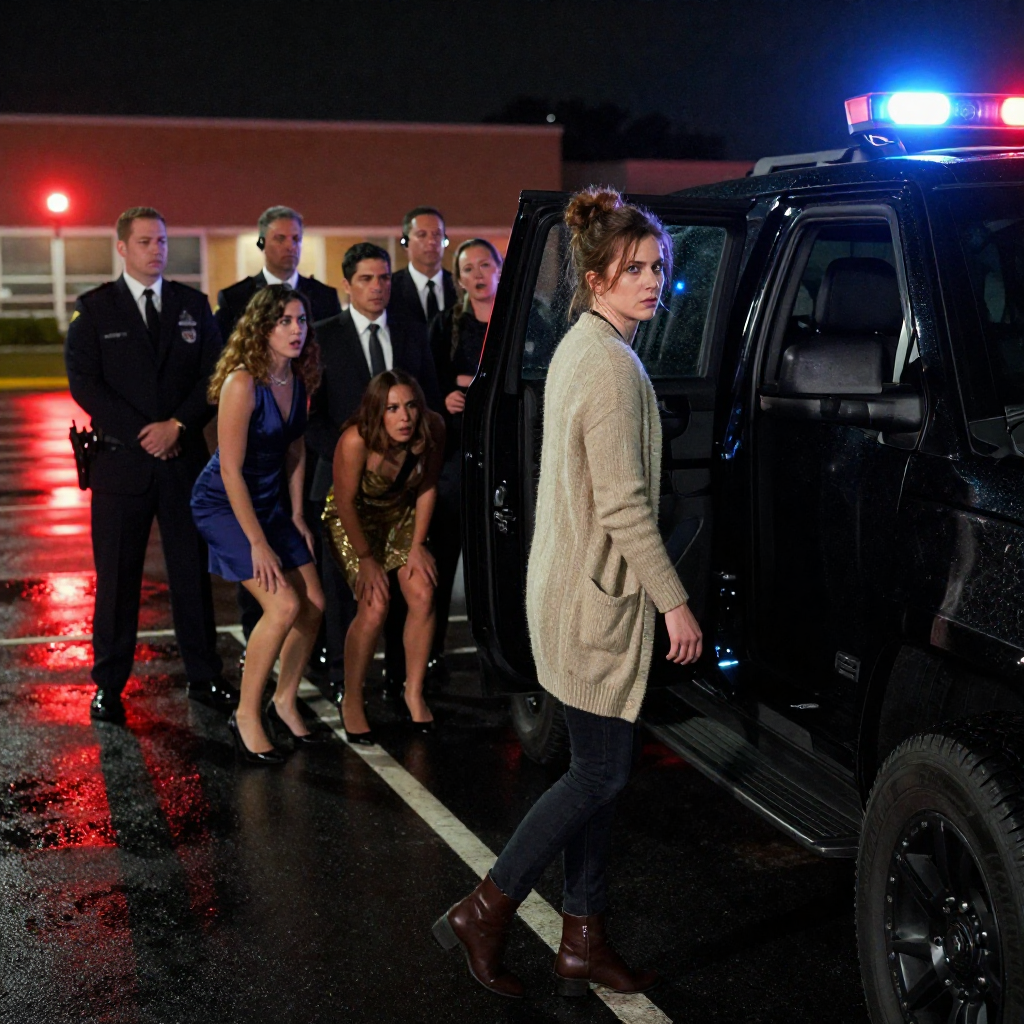
A convoy of black Chevrolet Suburbans tore into the school parking lot, moving with a synchronized, predatory grace that screams *federal budget*. They didn’t slow down for the speed bumps. They swarmed, creating a perimeter in seconds, boxing in the Teslas and the Porsches.
The laughter died in Chloe’s throat. Brad stumbled back, shielding his eyes.
“What the hell is this?” Brad shouted. “Is this a raid?”
The doors of the SUVs flew open in unison. Men and women in sharp, dark suits spilled out. They weren’t police. They didn’t have the chaotic energy of cops. They moved with the terrifying stillness of the Secret Service and the Diplomatic Security Service.
Weapons were visible—low-profile carbines held tight against chests, earpieces coiled like snakes behind ears. They formed a phalanx, pushing the reunion crowd back without touching them, using only their presence to clear a zone.
The ‘Golden Circle’ was trembling now. Chloe dropped her cigarette. Brad looked like he was about to be sick.
A tall man with silver hair and a face carved from granite walked through the gap in the agents. He wore a suit that made Brad’s look like a costume. He ignored the terrified alumni. He ignored the Tesla blocking the lane. He walked straight to me.
He stopped three feet away and snapped into a posture of rigid deference.
“Ma’am,” he said. His voice carried across the silent parking lot. “We have a Code Zero. The President has authorized the extraction.”
I sighed, the tension leaving my shoulders. I looked at the minivan. “I just bought groceries, Miller. The milk is going to spoil.”
“We’ll have the vehicle transported to the safe house, Director,” Agent Miller said. “But we need you in the air. Now. The bird is two minutes out.”
I looked at Brad. He was pale, his mouth opening and closing like a fish on a dock. I looked at Chloe, who was clutching her fake pearls, staring at me as if I had just grown wings.
“Director?” Brad whispered. The word strangled him.
I stepped forward, closing the distance between me and Brad. The agents tensed, ready to neutralize him if he so much as blinked wrong, but I held up a hand. I leaned in close, so only he could hear the steel in my voice.
“Tokyo isn’t complex, Brad,” I said softly. “Negotiating a nuclear de-escalation while pretending to care about your high school reunion… that’s complex.”
I turned to Agent Miller. “Let’s go.”
One of the agents opened the rear door of the lead armored SUV. As I climbed in, leaving the minivan and the mockery behind, I saw the reflection of the blue emergency lights dancing in Chloe’s wide, terrified eyes. The ‘stay-at-home mom’ was gone. The Director was back on the clock.
CHAPTER II
The door of the Suburban closed with a thud that sounded like a vault sealing shut. It wasn’t just a door; it was a border. On the other side of that glass was a world where my biggest concern was whether I’d remembered to buy the low-sodium turkey for the kids’ lunches and whether Chloe thought my minivan was a sign of my personal failure. On this side, the air was filtered, chilled to exactly sixty-eight degrees, and smelled of ozone, leather, and the heavy, metallic tang of pressurized electronics. It was the smell of my real life, the one I had tried to bury under a mountain of laundry and PTA meetings. I sat on the bench seat, my hands still gripping the hem of my sensible, charcoal-gray dress. I looked down at my knuckles. They were white, the skin stretched tight over bone. I wasn’t Elena the mom anymore. I could feel the shift happening, that cold, familiar hardening of the chest, the way my heart rate slowed even as the adrenaline spiked. It was a physiological recalibration I hadn’t felt in three years. Miller sat across from me. He was younger than when I’d last seen him, or maybe I was just older. He wore the standard-issue suit, but his eyes were wide, vibrating with a frantic energy that told me exactly how bad things were. He didn’t call me ‘Ma’am’ yet. He was waiting for me to catch up. He handed me a ruggedized tablet, its screen glowing with a harsh, blue light that made the interior of the SUV look like a surgical suite. ‘We’re three minutes out from the airfield,’ he said, his voice tight. ‘The President is already on Air Force One. He’s waiting for your authentication.’ I took the tablet. My thumb hovered over the biometric scanner. This was the moment. If I pressed this, Elena the suburbanite would die. The woman who worried about the HOA and the bake sale would be gone, replaced by the ghost of the woman who had once decided which cities lived and which ones were left to the dark. I looked out the window. We were tearing through the streets of my quiet, sleepy town, the siren-less SUVs weaving through traffic with a predatory grace. I saw the grocery store where I bought milk. I saw the park where I’d pushed my daughter on the swings yesterday. It all looked like a film set now—fragile, temporary, and utterly disconnected from the reality inside this vehicle. I pressed my thumb to the glass. A soft chirp, a green flash, and the data began to stream. It was a flood of red. Global markets were flatlining, not from a crash, but from a total erasure of transactional data. The power grid in three major European capitals had just blinked out. And then I saw the signature. It was a string of code, a ghost in the machine that I had seen once before, ten years ago, in a windowless room in a basement in Kiev. My stomach dropped. This was the Old Wound. Ten years ago, I had been a field officer. I had chased a shadow named Aris Thorne, a digital architect who believed that the only way to save the world was to reset it to zero. I had him in my sights. I had the chance to take him off the board, but I’d hesitated. I’d chosen to save a captured asset—a friend, a woman named Sarah—instead of taking the shot. Sarah died anyway, six months later, in a botched extraction that I had authorized. I had traded the world’s security for a friend’s life, and I had lost both. I had carried that guilt like a stone in my gut every day since. I thought Thorne was dead. I had been told he was dead. But here was his signature, crawling through the world’s nervous system like a virus that had finally found its host. ‘It’s Ouroboros,’ I whispered. The name felt like ash in my mouth. Miller nodded. ‘It’s worse than the 2014 breach, Elena. It’s not just stealing data. It’s deleting it. Identity, property, history. He’s wiping the slate.’ I felt a vibration in my lap. My personal phone—the one with the ‘Mom’s Rock’ sticker on the back—was buzzing incessantly. I looked down. The reunion group chat was exploding. I hadn’t left the group yet. The messages were scrolling past so fast I could barely read them. CHLOE: ‘What just happened?? Elena?? Those were federal agents!!’ BRAD: ‘Is she a criminal? Did you see those guns? I knew she was hiding something, nobody is that boring on purpose.’ TARA: ‘Someone call the police! They literally kidnapped her!’ It was surreal. They were still in the parking lot of the Marriott, standing next to their leased BMWs, trying to process a reality that didn’t fit into their narrow, judgmental lives. They thought I was a criminal. They thought I was in trouble. They had no idea that the world they lived in—the one where their credit scores mattered and their social media profiles existed—was currently being dismantled by a man I should have killed a decade ago. I felt a surge of cold, dark humor. Chloe was probably worried about her followers while the very servers that hosted them were being turned into digital dust. I looked at the phone, at the ‘Mom’s Rock’ sticker. That woman was a secret. I had spent three years building her, a careful, meticulous construction of mediocrity. I had learned how to talk about recipes and school districts. I had learned how to pretend that my biggest stress was a late carpool. It was a lie, but it was a beautiful one. It was a life where no one died because of my decisions. It was a life where I was safe. And now, it was over. My secret wasn’t that I was important; it was that I was the only person who knew how Thorne worked. I was the architect of the defense he was currently tearing down. I had designed the backdoors he was using. I had left them there because I thought I was the only one who knew they existed. I was the reason the world was defenseless. That was my secret, the one I hadn’t even told my husband. He thought I was a retired analyst. He didn’t know I was the reason the ‘glass house’ was so easy to break. ‘We have a moral dilemma, Ma’am,’ Miller said, his voice dropping an octave. He used the title. The transition was complete. ‘The only way to stop the spread is to activate the Genesis Protocol. But you know what that means.’ I knew. The Genesis Protocol was a scorched-earth digital countermeasure. It would stop Thorne, but it would also broadcast the location of the origin signal—my signal—to every node in the network. If I turned it on, I would be a beacon. Thorne would find me. My family, currently sitting in our house three miles away, would be the first targets. If I saved the world’s data, I would be painting a bullseye on my children’s bedroom. If I didn’t, the world would descend into a dark age within forty-eight hours. No banks, no power, no communication. Just chaos. I looked at the phone again. A new message from my husband, Mark. MARK: ‘Hey, you’re late. The kids are asking where you are. Everything okay?’ My heart broke into a thousand jagged pieces. He was a good man, a high school history teacher who thought the world was a rational, if occasionally messy, place. He had no idea he was married to a woman who was currently weighing the lives of billions against the safety of her own home. I felt the SUV swerve sharply. I looked out the window. It happened then. The Triggering Event. We were passing through the main intersection of town, a busy crossing near the high school. Suddenly, every traffic light in the visible distance turned green at once. It wasn’t a glitch; it was a synchronized execution. I watched in slow motion as a delivery truck plowed into a sedan. A second later, the streetlights began to pop, one by one, showering the pavement in sparks. Then, the giant digital billboard over the shopping center flickered. The advertisement for a local realtor vanished, replaced by a single, static image: a snake eating its own tail. The Ouroboros. People were stepping out of their cars, their faces lit by the eerie, flickering glow of their dying phones. They looked lost. They looked terrified. The silence that followed the crashes was the most haunting thing I’d ever heard. It was the sound of a civilization’s heart stopping. It was public. It was sudden. And it was irreversible. The ‘normal’ world was gone. ‘They’re hitting the local infrastructure now,’ Miller said, his voice trembling. ‘They’re showing us they can touch anything, anywhere.’ I looked at my phone one last time. The reunion group chat had gone silent. Likely because the cell towers were starting to fail. I looked at Mark’s message. ‘Everything okay?’ I didn’t reply. I couldn’t. I couldn’t tell him that I was about to make a choice that might lead to his death. I couldn’t tell him that the woman he loved was a ghost who had finally come back to haunt the living. I deleted the group chat. I deleted the ‘Class of 2004’ memories. I deleted the app. I felt the weight of the tablet in my hand. It was heavier than a gun. It was heavier than anything I had ever carried. ‘Miller,’ I said. My voice was different now. It was flat, devoid of the suburban lilt I’d spent years perfecting. It was the voice of the Director. ‘Ma’am?’ ‘Get the President on the line. And tell the pilot to prep for a high-altitude burn. We’re not going to the airfield. We’re going to the Black Site.’ ‘And the Genesis Protocol?’ Miller asked, his hand hovering over the communications array. I looked at the ‘Mom’s Rock’ sticker on my phone. I peeled it off, slowly, revealing the sterile, black glass beneath it. I dropped the sticker on the floor of the SUV. ‘Activate it,’ I said. ‘But first, send a specialized unit to my house. Extraction Team 7. Tell them… tell them they have authorization to use any means necessary to secure the assets. My husband and kids. They don’t know what’s coming. Don’t let them be afraid.’ I turned my gaze back to the tablet. The world was screaming, and I was the only one who knew how to make it stop. I had spent three years trying to be a person who cared about the small things, the quiet things. I had tried to be a woman who lived for the weekend and the soccer games. But as the SUV sped toward the edge of town, leaving the chaos behind, I realized I had never really been that woman. I was a creature of the dark, and the dark had finally come to claim me. I was the woman who had built the cage, and now, I was the only one who could hunt the beast that had escaped it. I felt the SUV accelerate, the engine roaring as we hit the open highway. The town was fading in the rearview mirror, a collection of flickering lights and rising smoke. I didn’t look back. I couldn’t afford to. I had a war to win, and I had already sacrificed the only life I ever truly loved to start it. ‘Director,’ Miller said, handing me a headset. ‘The President is on.’ I took the headset and slipped it on. The cold metal against my skin felt like home. ‘Mr. President,’ I said, my voice steady, my heart like ice. ‘This is Elena Vance. I’m back. Tell me how much time we have left before the lights go out for good.’ The SUV roared into the night, a black shape moving through a world that was rapidly turning to shadow. The reunion was over. The game was over. The Director was in control now, and God help anyone who stood in her way.
CHAPTER III
The air inside the Site-9 bunker didn’t smell like the world I had left twenty minutes ago. It didn’t smell like suburban rain or the expensive perfume Chloe had sprayed on herself at the reunion. It smelled like ionized dust, recycled oxygen, and the sharp, metallic tang of high-voltage electronics. It was the smell of my real life, the one I had buried under a decade of PTA meetings and grocery lists. As the heavy blast doors hissed shut behind me, the sound of the world ended. There was only the low-frequency hum of the servers, a sound that vibrated in my molars.
“Director on deck,” a voice called out. It was Kael, my former lead systems architect. He looked older, grayer, his eyes bloodshot behind thick glasses. He didn’t look at me with the reverence the juniors did. He looked at me with a question that felt like a knife.
I didn’t stop to greet him. I walked straight to the center of the Pit, the sunken command center where the holographic displays were already hemorrhaging red data. The Ouroboros Virus was moving faster than the models had predicted. It wasn’t just encrypting files anymore; it was rewriting the firmware of the physical world. Across the screens, I saw the chaos I had glimpsed on the drive over: water treatment plants in Ohio dumping lye into the reservoirs, air traffic control towers in London going dark, the power grid of the Eastern Seaboard flickering like a dying candle.
“Report,” I said. My voice was different now. The ‘Mom’ softness was gone, replaced by a cold, resonant authority that felt like putting on an old, blood-stained coat.
“It’s a total cascade, Elena,” Kael said, stepping into my personal space. He held a tablet up, his hand shaking slightly. “We tried to isolate the primary nodes, but the virus is using a recursive encryption logic we’ve never seen. It’s… it’s beautiful, in a horrific way. It’s like it knows exactly where our backdoors are. It’s like it was built by someone who knew the architecture of the entire federal cloud.”
I felt the blood drain from my face. I reached out and took the tablet. My fingers, still wearing the cheap ‘Reunion’ bracelet, traced the lines of code. I didn’t need the decryption key to recognize the logic. I recognized the syntax. I recognized the way the loops were nested. It was a signature. My signature.
“Phase One: The Fingerprint,” I whispered.
Kael leaned in, his voice a low hiss. “The team is starting to ask questions, Elena. They ran a heuristic match on the core kernel of the Ouroboros. It matches a project from twelve years ago. Project Chimera. The one you headed. The one that was supposed to be a ‘theoretical’ exercise in defensive cyber-warfare.”
I looked up. Around the room, forty-odd analysts and operators were staring at me. The screens reflected off their faces, staining them a bruised purple. They knew. They didn’t know the whole truth, but they knew the monster currently eating the world shared my DNA. I was the architect of the apocalypse they were trying to stop.
“I wrote the skeleton,” I said, my voice carrying across the silent room. “Twelve years ago, we were told to imagine the worst possible scenario. I built the skeleton of a virus that could bypass every firewall we had. I thought it was locked in a vault that didn’t exist. I was wrong.”
“You didn’t just build a skeleton,” Kael said, his voice cracking. “You built a god. And now Thorne is using it to kill us.”
A siren began to wail, a deep, mournful sound that signaled a perimeter breach. Not a digital one. Physical.
“Thermal signatures on the surface!” an analyst shouted. “Two—no, four tactical teams. They’re using redirected EMP pulses to fry our surface sensors. They’re coming down the elevator shafts!”
I moved to the main tactical display. At the same time, a window popped up in the corner of the screen. It was a live feed from a drone hovering over a quiet cul-de-sac three hundred miles away. My house. My home. I saw the black SUVs of the extraction team I had ordered, but they weren’t moving. They were surrounded by shadow figures. My husband, Mark, was at the front door, holding a baseball bat, his face a mask of terror. My kids were behind him, clutching his coat.
“Thorne isn’t just attacking the grid,” I realized, the horror blooming in my chest like a cold flower. “He’s attacking the anchors. He’s attacking me.”
Phase Two: The Siege. The bunker shook. A dull thud echoed through the floorboards—the first breach of the upper bulkhead. Above us, men were dying to protect me, while men were dying to reach me. And on the screen, my family was a few seconds away from becoming collateral damage in a war they didn’t even know existed.
“Get me a secure line to the house,” I barked. “And bring the Genesis Protocol online. Now!”
“Elena, if we run Genesis, we lose everything,” Kael warned, his face pale. “It’s a scorched-earth protocol. It doesn’t just kill the virus; it sends a feedback loop through the entire global network. It will fry every server, every cloud storage, every digital record on the planet. The world will wake up in 1985. No banks. No identities. No history.”
“And it kills the virus,” I said. “And it kills Thorne.”
“It kills *us*,” he argued. “Your family’s identities, your records, the proof that your children even exist—it all goes to zero. You’ll be ghosts in a world of ghosts.”
A face appeared on the main screen, overriding the tactical maps. It wasn’t the face of a monster. It was a man in his late thirties, sharp-featured, with eyes that looked like they had seen the end of the world and found it boring. Aris Thorne. He was sitting in a room that looked remarkably like a library.
“Hello, Elena,” he said. His voice was smooth, cultured, devoid of the jagged edge I had expected. “You look tired. Suburbia didn’t suit you as much as you hoped.”
“Thorne,” I said, my hands gripping the edge of the console so hard the plastic groaned. “Let my family go. This is between us.”
“Is it?” Thorne smiled. It was a thin, cruel thing. “You always were a bit myopic. You thought Sarah’s death was a tragedy. I thought it was a curriculum. You taught me everything I know about the vulnerability of systems. But you forgot one thing: a system is only as strong as the people who hold the keys.”
“I’m holding the key to Genesis, Aris,” I said, my voice steadying. “I will burn it all down before I let you take another inch.”
“You won’t,” he said. “Because you’re not the only one with a key. Tell me, Elena, how did I get your Chimera code? How did I know exactly where your family was moved? How did I bypass the DNI’s personal encryption?”
My heart stuttered. I looked at the side of the screen. A new feed opened. It was an office in D.C., high up, overlooking the Potomac. A man was sitting there, calmly drinking tea while the world burned outside his window. It was Secretary Sterling. My mentor. The man who had given the eulogy at Sarah’s funeral. The man who had convinced me to retire.
“Phase Three: The Betrayal,” Thorne whispered through the speakers.
“Sterling?” I whispered. The word felt like ash in my mouth.
Sterling didn’t look at the camera. He spoke to someone off-screen. “The Director was always too emotional for the long game. She saw a world to protect. I saw a world that needed to be pruned. Thorne is the gardener, Elena. You were just the toolmaker.”
I felt a strange, terrifying clarity. The betrayal wasn’t a crack in the plan; it was the plan. I had been lured to the reunion, isolated from the agency, and forced into this bunker so that I would activate the very protocols that would finalize their control. Genesis wasn’t just a kill switch; in Sterling’s hands, it was a reset button that would leave only the elite with their records intact. They wanted me to pull the trigger so they could inherit the ashes.
“I trusted you,” I said, looking at Sterling’s image. “You held my children at their baptism.”
Sterling finally looked at the lens. His eyes were cold. “And I’ll hold their future, Elena. If you cooperate. Stand down. Let the Ouroboros finish its work. Your family will be moved to a secure location. They’ll have lives. They’ll have names. If you fight… well, the virus is already at your front door.”
On the monitor, I saw the figures at my house moving toward the porch. Mark was shouting something I couldn’t hear. My daughter, Lily, was crying, her small hands over her ears.
I looked at the Genesis key. A physical, heavy piece of brass and glass. If I turned it, the world would go dark. My children would lose their future. My past would be erased. Sarah’s memory would be gone. But the virus—and Thorne’s grip on the world—would be shattered. If I didn’t turn it, I could save my family, but I would be handing the keys of civilization to a ghost and a traitor.
“Kael,” I said, my voice barely a whisper. “Can we isolate the pulse? Can we protect one node?”
“No,” Kael said. He was crying now. “It’s all or nothing. That’s how you built it, Elena. Total. Irreversible.”
I looked at Thorne. He was waiting. He was confident. He thought the ‘Mom’ in me would win. He thought the woman who worried about peanut allergies and soccer practice would buckle under the weight of her children’s lives.
He forgot who I was before I was a mother.
“Phase Four: The Sacrifice,” I said.
I didn’t look at the screen showing my house. I couldn’t. If I looked, I would stop. I reached out and gripped the Genesis key. My wedding ring clinked against the glass.
“Elena, don’t!” Thorne shouted, his composure finally breaking. He saw my hand. He saw the look in my eyes—the cold, dead look of the Director who had ordered drone strikes and signed death warrants.
“You told me I built a god, Aris,” I said, looking into the camera. “You should have remembered that gods are famous for their wrath.”
I turned the key.
For a heartbeat, there was silence. Then, the bunker groaned as every circuit breaker in the facility exploded in a shower of sparks. The monitors didn’t just turn off; they shattered. The blue light died, replaced by the harsh, red glow of the emergency chemical lights.
The hum of the servers vanished. In its place was a silence so profound it felt like a physical weight.
Across the world, I knew, the same thing was happening. The satellites were falling silent. The fiber-optic cables were cooling into dead glass. The digital age had just ended in a single, violent breath.
I stood in the darkness, the smell of ozone thick in my lungs. My heart was thudding against my ribs, a slow, heavy rhythm. I had saved the world from a tyrant, and in doing so, I had erased the woman I had spent ten years trying to become.
“Is it done?” a voice asked in the dark. It was Kael.
“It’s done,” I said.
I reached into my pocket and felt my phone. It was a dead piece of plastic and lithium. I thought of Mark. I thought of the kids. In the moment before the feed cut, I had seen the lights in the house go out. I didn’t know if they were safe. I didn’t know if they were even my family anymore, in a world where no record of our marriage, our births, or our lives existed.
I walked toward the blast doors, feeling my way through the shadows. The ‘Director’ had finished her job. But the woman—the mother—was screaming inside.
I pushed against the heavy manual release of the doors. I had to get home. I had to see if anything of my life had survived the fire I had started. As the door creaked open, admitting a sliver of moonlight from the surface, I realized that the war wasn’t over. Thorne and Sterling were still out there, and now, they were just as invisible as I was.
The world was dark. The world was quiet. And for the first time in twenty years, I was truly dangerous. Because now, I had nothing left to lose.
CHAPTER IV
The silence was absolute. Not the quiet hum of electricity, the distant thrum of traffic, or the murmur of a connected world. Just… nothing. It pressed in on me, a suffocating blanket woven from the absence of everything I knew. My ears rang, not from explosions, but from the sudden void. The world had gone analog. And I was adrift.
My first instinct, ingrained after decades in the intelligence community, was to assess. The Site-9 Black Site was offline, a tomb of fried circuits and dead screens. The Ouroboros Virus was gone, but so was everything else. I had unleashed Genesis, a digital apocalypse to save the world, and now I had to face the consequences.
I started walking. North. Towards where I hoped home still stood. There were no maps, no GPS, no way to know for sure if Mark and the kids were even alive. Each step was a gamble, a prayer whispered into the silent wind.
**Public Fallout:**
The first few hours were a blur of disorientation. People wandered the streets like ghosts, faces etched with confusion and fear. Cars lay abandoned, their drivers vanished, their journeys unfinished. The lucky ones had fuel and knew how to siphon it.
I saw small groups huddled together, sharing rumors and offering what little help they could. There were no emergency broadcasts, no official announcements. Just pockets of humanity trying to make sense of the impossible. The world was fractured, disconnected. Every man for himself.
The sun began to set, painting the sky in hues of orange and blood red. The silence grew heavier, punctuated only by the crackling of distant fires. People were burning anything they could find for warmth and light. The smell of woodsmoke hung in the air, a primal scent that evoked a forgotten past.
I passed a gas station, now a scene of desperate scavenging. People were fighting over cans of food, their faces contorted with hunger and desperation. A woman screamed as someone tried to steal her baby’s formula. It was a glimpse into the abyss, a preview of the chaos to come.
Further on, a group of men had formed a barricade around a grocery store. They were armed with bats and pipes, their eyes narrowed with suspicion. They weren’t offering help; they were protecting what they had. The law of the jungle had returned with a vengeance.
I kept moving, trying to avoid drawing attention to myself. I was just another face in the crowd, another survivor struggling to navigate this new, brutal reality. But I knew I was different. I knew what had happened, and I knew what was at stake. I was carrying the weight of the world on my shoulders, and I couldn’t afford to break.
**Personal Cost:**
The exhaustion was bone-deep. My muscles ached, my throat was dry, and my mind was reeling. I hadn’t slept in days, and the adrenaline was finally wearing off. I was running on fumes, fueled only by the desperate hope of finding my family.
The guilt was a constant companion. I had made a choice, a necessary one, but the consequences were devastating. I had saved the world from Ouroboros, but I had also destroyed it in the process. I had erased everything, including the lives of innocent people who had nothing to do with Thorne or Sterling’s twisted agenda.
And then there was the fear. The gnawing, primal fear that Mark and the kids were gone. That they had been caught in the crossfire, collateral damage in a war they never even knew existed. The thought was unbearable, a knife twisting in my gut.
I forced myself to push on, to focus on the task at hand. I had to find them. I had to know. Even if the truth was more than I could bear.
As darkness deepened, I found shelter in an abandoned farmhouse. It was cold and damp, but it offered a modicum of protection from the elements. I barricaded the door with furniture and huddled in a corner, trying to conserve what little body heat I had left.
Sleep was impossible. My mind raced, replaying the events of the past few days. The betrayal, the confrontation, the destruction. I kept seeing Sterling’s face, his eyes filled with a chilling mix of fanaticism and disappointment. He had believed he was saving the world, pruning the weak to make way for the strong.
And Thorne… his cold, calculating brilliance. He had been a weapon, a tool in Sterling’s hands. But he had also been a true believer, convinced that Ouroboros was the only way to achieve his twisted vision of utopia.
I closed my eyes, trying to block out the memories. But they kept coming, relentless and unforgiving. I was trapped in a nightmare, and there was no escape.
**New Event:**
Just before dawn, I heard a noise. A faint, rhythmic tapping. I froze, my senses on high alert. It was coming from outside the farmhouse, from the direction of the road.
I crept to the window, peering through a crack in the boards. In the dim light, I saw a figure standing by the road. He was tall and thin, dressed in dark clothing. He was holding a hand-cranked radio, and he was tapping out a message in Morse code.
I recognized the code. It was a distress signal, repeated over and over again. Someone was out there, trying to reach out to the world.
I hesitated. Should I reveal myself? Should I risk drawing attention to myself and the farmhouse?
But the desperation in the signal was undeniable. Someone needed help, and I couldn’t just stand by and do nothing.
I took a deep breath and opened the door.
“Hello?” I called out, my voice hoarse.
The figure turned, his face obscured by the shadows. He lowered the radio and stepped forward.
“Who’s there?” he asked, his voice wary.
“It’s me,” I said. “I heard your signal. What’s wrong?”
He hesitated for a moment, then stepped into the light. It was a young man, no older than twenty. His face was pale and gaunt, and his eyes were filled with fear.
“My family,” he said, his voice trembling. “They’re trapped. In the city. They need help.”
“What happened?” I asked.
“There was a fire,” he said. “A big one. It’s spreading fast. They can’t get out.”
I felt a surge of adrenaline. A fire. In the city. It was chaos, and my family was still in the path of that chaos.
“I’ll help you,” I said, my voice firm. “But we need to hurry.”
**Moral Residues:**
The journey to the city was fraught with danger. The roads were clogged with abandoned vehicles, and the streets were filled with desperate people. We had to navigate our way through the chaos, avoiding looters and gangs.
The young man, whose name was Daniel, was a skilled mechanic. He had scavenged parts from abandoned cars and built a makeshift vehicle, a Frankensteinian contraption that somehow managed to run.
As we drove, Daniel told me about his family. His mother, his father, and his younger sister. They were all he had in the world, and he was determined to save them.
I listened to his story, my heart aching with empathy. I knew what it was like to love and fear for your family. It was the most powerful emotion in the world, and it could drive you to do anything.
When we reached the city, we were met with a scene of devastation. Buildings were ablaze, the sky was black with smoke, and the air was thick with the smell of burning flesh. The streets were littered with debris and bodies.
Daniel led me to the building where his family was trapped. It was a high-rise apartment building, and the fire was raging on the upper floors.
We fought our way through the crowds, pushing and shoving our way to the entrance. The building was partially collapsed, and the stairs were blocked by rubble.
Daniel knew of a service elevator, he led the way.
We climbed through the wreckage, our hands and faces covered in soot. The heat was intense, and the air was suffocating.
Finally, we reached the floor where Daniel’s family was trapped. The hallway was filled with smoke, and the flames were licking at the door of their apartment.
Daniel kicked down the door and rushed inside. I followed close behind.
His family was huddled in a corner, coughing and gasping for air. His mother was cradling his sister, trying to protect her from the heat.
We helped them to their feet and led them out of the apartment. The hallway was a gauntlet of fire, but we managed to make it through.
We reached the elevator shaft and climbed down the emergency ladder. One by one, we descended to the ground floor.
When we finally emerged from the building, we were met with cheers from the crowd. People were clapping and crying, relieved to see that we had made it out alive.
Daniel’s family was safe. But the city was still burning. And the world was still broken.
I had helped one family, but I couldn’t help everyone. There were too many people in need, too much suffering to alleviate.
As I watched Daniel reunite with his family, I felt a pang of envy. He had found his loved ones, while I was still searching for mine.
But I also felt a sense of hope. A small, flickering flame in the darkness.
If we could help each other, if we could find strength in our shared humanity, then maybe we could rebuild this broken world. Maybe we could create something better than what we had lost.
I looked at Daniel, his face beaming with joy. “Thank you,” he said, his voice choked with emotion. “You saved their lives.”
“You would have done the same for me,” I said.
He nodded, his eyes filled with gratitude.
We embraced, two strangers united by a shared experience of loss and hope.
Then, I turned and walked away, into the burning city. I still had a family to find, and a world to save.
The walk home was longer than I remembered. Each mile felt like ten, the weight of my decisions pressing down on me. The distress call from the radio operator confirmed my deepest fear: even Genesis hadn’t erased all the threats. Chaos was spreading, and I knew, with chilling certainty, that Sterling and Thorne were not passive observers. They were architects of this new disorder, ready to seize control.
I finally saw it in the distance – the familiar silhouette of my house. Smoke curled from what was left of the roof. My heart leaped into my throat, a mix of dread and desperate hope. I ran the last few hundred yards, ignoring the pain in my lungs, the burning in my muscles.
The front door was gone, ripped from its hinges. The windows were shattered, the garden overgrown and neglected. The house looked like a battlefield, a casualty of the digital war I had started.
I stepped inside, calling out their names. “Mark! Kids! It’s me!”
A moment of agonizing silence. Then, a sound. A small cough from the living room.
I rushed in, my eyes scanning the room. Mark was there, sitting on the floor, his face covered in soot. He was holding Sarah, our youngest, who was asleep in his arms. Emily was huddled beside him, her eyes wide with fear.
They were alive. They were safe. The relief was so overwhelming that I almost collapsed.
“Elena,” Mark said, his voice hoarse. “You’re alive.”
I knelt beside them, pulling them close. “I’m here,” I said. “I’m here.”
But even in that moment of reunion, I knew our ordeal wasn’t over. The world had changed, and we had changed with it. We were survivors, scarred by the past, but determined to face the future. And I knew, with a certainty that chilled me to the bone, that Sterling and Thorne were still out there, waiting in the shadows, ready to strike.
The analog war had just begun.
CHAPTER V
The reunion with Mark and the kids wasn’t the Hollywood ending I might have once imagined. It was raw, desperate, and clinging. Holding them, feeling their warmth, was the only real thing in a world that had suddenly become terrifyingly unreal. I knew, though, that this moment of solace was borrowed time.
“We have to go,” I said, pulling away, my voice tight. “They’ll be looking for us.”
Mark, ever the pragmatist, nodded. “Where to? Everything’s gone.”
“Gone digital,” I corrected him. “Not gone. We need to think like they do, anticipate their moves. They’ll want to consolidate power, rebuild their network, whatever form that takes now. That means control of resources, communication, people.”
Our old life, our comfortable existence, was a phantom limb. We were refugees now, stripped bare, relying on instincts I thought I’d buried under layers of bureaucracy and technology. We scavenged what we could from the house – food, blankets, a few tools. Sarah, surprisingly calm, helped pack a bag, her face pale but determined. Even ten-year-old Ben understood the gravity of the situation, his usual boundless energy replaced with a quiet apprehension.
We moved under the cover of dusk, the silence of the city broken only by the crackling of distant fires and the occasional shouts. I led them away from the main roads, sticking to back alleys and overgrown paths, using my knowledge of the city’s forgotten corners. It felt like a lifetime ago that I was directing covert operations on a global scale. Now, my mission was reduced to keeping my family alive, one step at a time.
We found temporary shelter in an abandoned warehouse on the outskirts of the city. It was damp, cold, and smelled of decay, but it offered a degree of security. Mark started a small fire using salvaged wood, the flames casting dancing shadows on the walls. As we huddled together, sharing a meager meal, I knew I couldn’t shield them from the truth any longer.
“Sterling and Thorne,” I began, my voice low. “They were planning this. They wanted this. They believe they can rebuild society in their image.”
Sarah’s eyes widened. “But… why?”
“Control,” I said. “They want absolute control. They think humanity needs to be… pruned. That only the ‘strong’ should survive.”
Mark swore under his breath. “And you stopped them?”
“I destroyed the virus,” I said. “But I also erased everything else. We’re all starting over.”
The weight of my choices settled heavily on me. I had saved the world, perhaps, but at what cost? My family was safe, for now, but hunted. Our future was uncertain, precarious.
***
Days blurred into weeks. We moved from place to place, avoiding populated areas, scavenging for supplies. I taught Mark and the kids basic survival skills – how to find clean water, build a fire, identify edible plants. It was a harsh, brutal education, but they adapted with surprising resilience.
One evening, while Mark was out searching for food, I noticed a pattern in the sky. A signal, subtle but unmistakable. It was Thorne, using old radio frequencies to communicate with his network. I didn’t have the equipment to decipher the message, but I knew it was meant for someone nearby.
“They’re here,” I told Sarah, my voice grim. “They’re looking for us.”
We packed our meager belongings and moved again, deeper into the surrounding woods. I set traps, created diversions, using every trick I knew to throw them off our trail. But I knew it was only a matter of time before they caught up.
One morning, we were ambushed. A group of armed men, clearly Thorne’s operatives, surrounded our camp. They were rough, hardened, their faces devoid of any compassion. I recognized the cold, calculating gaze of fanatics. They believed in Thorne’s vision, his twisted ideology.
“Elena Vance,” their leader said, his voice flat. “We have orders to bring you in.”
I stood my ground, shielding my family with my body. “You don’t have to do this,” I said, my voice steady. “He’s lying to you. He’s using you.”
They didn’t listen. They opened fire.
It wasn’t a firefight. It was a slaughter. I managed to take down a few of them, using my training and experience, but we were outnumbered, outgunned. Mark fought bravely, protecting Sarah and Ben, but he was wounded.
As I saw the life draining from his eyes, a cold rage washed over me. I charged at the remaining operatives, my movements fueled by pure adrenaline. I fought like a woman possessed, driven by the primal instinct to protect my family.
I don’t know how long it lasted. Time seemed to warp and distort. I remember the smell of gunpowder, the screams, the sickening thud of bodies hitting the ground. When it was over, I stood amidst the carnage, my body bruised and bleeding, my hands stained with blood. All of Thorne’s men lay dead.
Mark was still alive, barely. I held him in my arms, his breathing shallow and ragged. Sarah and Ben watched, their faces tear-streaked and numb. His last words were simple, “Take care of them, Elena.”
***
Mark’s death changed everything. It hardened me in ways I didn’t know possible. Grief became a weapon, a shield, a driving force. I buried him with my own hands, under the cold gaze of the indifferent sky. I swore to him, to myself, that I would make Thorne and Sterling pay for what they had done.
We couldn’t stay there. It was too dangerous. We traveled for days, moving north, away from the centers of population, seeking refuge in the remote wilderness. We found a small, abandoned cabin nestled in a secluded valley. It was rudimentary, but it offered shelter and a sense of security.
I spent weeks fortifying the cabin, setting traps, establishing escape routes. I taught Sarah and Ben how to use a bow and arrow, how to track animals, how to survive in the wild. They were learning to be warriors, forged in the crucible of loss and hardship.
One evening, as we sat around a crackling fire, Sarah asked me a question that cut through my hardened exterior.
“Mom,” she said, her voice small. “Are you going to kill them? Thorne and Sterling?”
I looked at her, at her innocent face, and saw the reflection of my own pain and anger. I knew I couldn’t lie to her.
“Yes,” I said, my voice flat. “I am.”
“But… is that what Dad would have wanted?”
Her words hit me like a physical blow. I thought of Mark, his kindness, his compassion, his unwavering belief in justice. I knew, deep down, that he wouldn’t have wanted me to become a monster. But I couldn’t let them go unpunished. They had taken everything from us.
I spent the next few days wrestling with my conscience. I knew that revenge wouldn’t bring Mark back. It wouldn’t erase the pain. It wouldn’t make the world right again. But it was the only thing that kept me going.
I decided to confront them, but not as an assassin, as a mother, as a woman who had lost everything and had nothing left to fear.
***
I tracked them for weeks, using my old intelligence skills to follow their movements. They had established a base of operations in an old government bunker, hidden deep in the mountains. They were rebuilding their network, consolidating their power, preparing to launch their new world order.
I infiltrated the bunker under the cover of darkness, using my knowledge of its security systems. I moved silently, stealthily, like a ghost. I found them in the main control room, surrounded by their followers. Thorne was at the center, his eyes gleaming with fanaticism. Sterling stood beside him, his face impassive, betraying no emotion.
“Elena,” Thorne said, his voice calm. “I knew you’d come.”
“It’s over, Aris,” I said, my voice steady. “It’s all over.”
“No,” he said. “It’s just beginning. We’re building a new world, a better world.”
“A world of control and oppression,” I said. “A world where only the ‘strong’ survive. That’s not a world worth living in.”
Sterling stepped forward. “You can’t stop us, Elena. We’re too far along. We have too many followers.”
“You underestimate the resilience of humanity,” I said. “You can destroy our technology, but you can’t destroy our spirit. We’ll rebuild. We’ll adapt. We’ll survive.”
I didn’t go there to kill them, not physically. I went there to sever what grasp they had left. To break their will, their vision, their hold on the future. My goal was not an execution, but an unveiling of the truth. I showed them the faces of those who died because of them, the chaos they created, the love they destroyed.
I walked out of that bunker, leaving them to face the consequences of their actions, to wallow in the ruins of their shattered dreams. Let the memories of what they did, of what they created, be their prison.
Returning to Sarah and Ben, I knew our journey was far from over. The world we now inhabited was different, stripped bare of its technological crutches, forcing us to confront the raw realities of existence. Yet, amidst the hardship, there was also a sense of liberation, a connection to something deeper, more authentic.
We started to build a new life, a life based on community, resilience, and a profound respect for the natural world. We learned to rely on each other, to share our burdens, to celebrate our small victories.
Years passed. The scars of the past remained, a constant reminder of what we had lost. But we also carried within us a newfound appreciation for the simple things – the warmth of the sun on our skin, the laughter of children, the love of family.
Technology receded into the background, replaced by human connection and the slow, steady rhythm of life. We had learned that true strength lies not in our gadgets, but in our relationships, our resilience, and our ability to rebuild from nothing. I saw this truth reflected in my children’s eyes, who grew into compassionate, resilient adults.
The world, after all, did not end. It simply changed, and in that change, we found a new beginning.
END.