Chapter 1: The Hollow Cast
Chapter 1: The Hollow Cast
The fluorescent lights of Seattle General’s pediatric trauma bay always seemed to buzz a little louder at 2:00 AM. It was a freezing Tuesday, the kind of biting cold that seeped right through the thick, double-glass doors of the emergency room.
Twelve years doing this, and the night shift still manages to crawl under my skin, I thought, rubbing the back of my stiff neck as I restocked the gauze cart.
The quiet was abruptly shattered by the violent hiss of the automatic doors sliding open. A blast of icy wind rushed in, carrying the distinct scent of wet asphalt and muddy pine.
A towering K-9 officer stepped into the harsh surgical light, his dark uniform soaked through and clinging to his broad shoulders. But it was what he carried that made my breath hitch.
In his arms was a small, shivering boy, no older than eight. He was entirely caked in dried mud, his lips stained a pale, dangerous shade of blue.
Right beside them paced a massive Belgian Malinois. The dog, ‘Titan’ according to the officer’s tactical harness patch, wasn’t behaving like a disciplined police asset on patrol.
He was frantic, whining softly and repeatedly pressing his heavy frame against the boy’s dangling legs with a fierce, protective loyalty.
“He tracked him to a storm drain a mile outside city limits,” the officer said, his voice ragged and breathless.
“The kid won’t speak. He’s totally mute. And Titan absolutely refuses to leave his side.”
We rushed them into Trauma Bay 3. As I helped lower the trembling child onto the stiff hospital gurney, I finally saw the true source of alarm.
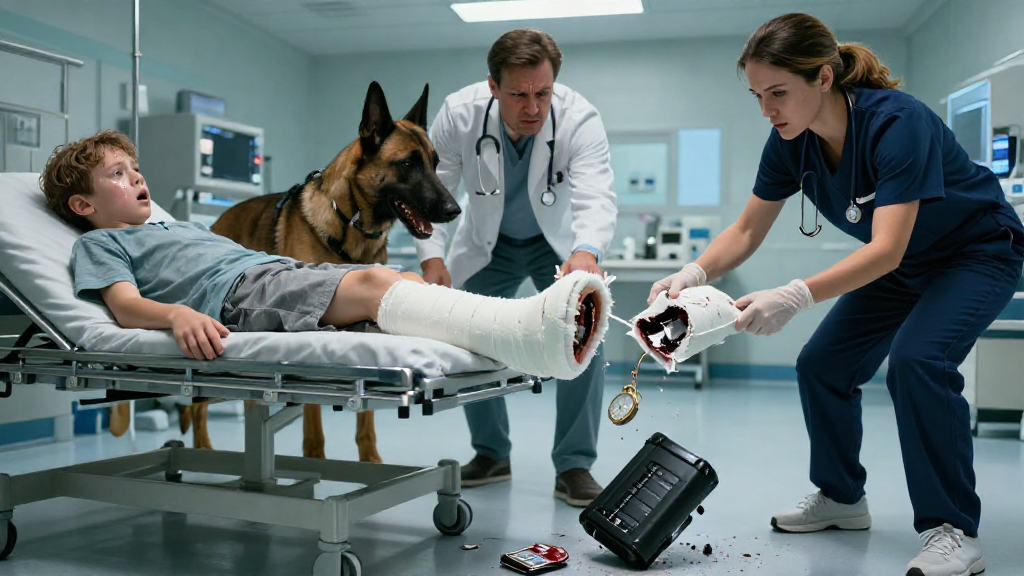
His left leg was encased in a massive, crudely fashioned plaster cast. It ran from his slender ankle all the way up to his mid-thigh.
It was a grotesque, uneven monstrosity. It looked nothing like the clean, sleek fiberglass casts we apply in the clinic; this was thick, lumpy, and smelled faintly of damp basement rot.
Dr. Evans, the attending physician, reached out to assess the boy’s circulation.
A deep, vibrating rumble echoed through the room. Titan stepped directly between the doctor and the bed, baring his teeth in a low, terrifying warning.
Nobody breathed. The air in the room grew instantly heavy.
Slowly, the little boy reached out a tiny, shaking hand. He rested it gently on the dog’s large, muscular head.
Titan’s menacing growl immediately faded into a whimpering sigh, though his intelligent eyes never left Dr. Evans’s hands.
“Let’s get portable X-ray in here, right now,” Dr. Evans whispered, stepping back carefully with his hands raised.
But the imaging was completely useless. The strange, chalky plaster was incredibly dense, blocking the radiation entirely and leaving only a massive white void on the screen.
“We have no choice. We have to cut it off to see what’s underneath,” Dr. Evans ordered.
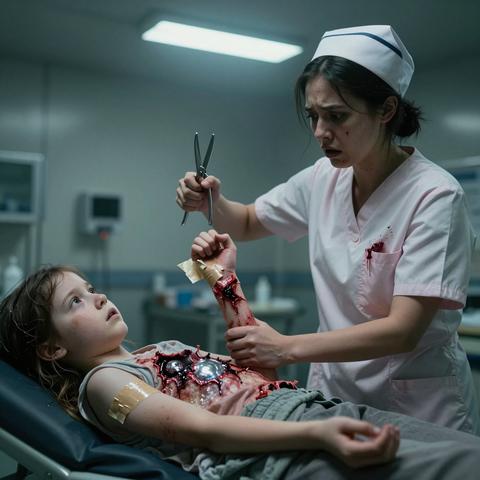
I grabbed the heavy cast saw from the wall mount. My heart ached for this terrified, silent kid.
I turned on the motor. The loud, grating buzz instantly made the boy flinch backward.
Titan immediately hopped up, placing his front paws on the mattress and resting his heavy, warm chin squarely on the boy’s chest to anchor him with a comforting weight.
I pressed the vibrating circular blade against the bulky white surface. Plaster dust plumed into the air as I dragged the blade slowly down the length of his calf.
Halfway down, the resistance completely vanished. The saw plunged forward slightly into empty space.
The blade echoed with a strange, hollow ringing sound.
What on earth is inside this thing? my mind raced as I killed the saw and grabbed the heavy metal cast spreaders.
I jammed the cold steel spreaders into the fresh groove and squeezed the handles with all my strength.
The thick, heavy shell resisted for a second before splitting completely in two with a deafening crack.
There was no fractured bone underneath. There was no swelling.
His pale leg was perfectly healthy, wrapped only in a thin, dirty layer of cotton batting.
Instead, the massive, hollow cavity inside the cast was packed to the absolute brim.
Before I could catch them, several heavy, metallic objects tumbled out from the lining, clattering violently onto the sterile linoleum floor.
The entire trauma room froze in absolute terror.
Nobody moved. The only sound was the steady, rhythmic beeping of the boy’s heart monitor.
Laying in a small pool of white plaster dust was a heavy, custom-engraved gold watch, smeared in dark, dried blood.
Beside it sat a bulky, military-grade encrypted hard drive.
And resting right next to the toe of my sneaker was a crushed, silver star.
Dr. Evans stumbled back a full step, his face instantly draining of all color.
“Oh my god,” a young nurse gasped, covering her mouth in pure horror.
It was a police badge. And it was completely soaked in blood.
I recognized the engraved badge number immediately. It belonged to Chief Robert Callahan—our city’s Chief of Police.
The exact same man who had been reported missing and presumed dead three days ago.
Suddenly, a freezing hand wrapped around my wrist with bruising force.
I looked down in shock. The previously mute eight-year-old boy was staring wildly into my eyes.
But his gaze wasn’t fixed on the bloody badge on the floor. His terrified eyes darted frantically toward the hallway.
Through the sliding glass doors of the trauma bay, the heavy, rhythmic thud of tactical boots was marching quickly down the corridor.
Chapter 2: The Men in Black
The boy’s fingers dug into my wrist with a desperate, bruising force. His skin was ice-cold, but his wide, terrified eyes burned with a silent, frantic warning.
He knows who is coming, I realized, my heart slamming against my ribs. And he’s terrified of them.
The heavy, synchronized thud of tactical boots echoed louder through the quiet ER hallway. They were moving fast, lacking the frantic scramble of paramedics and carrying the deliberate, marching rhythm of an assault unit.
“Hide it. Now!” I hissed, snapping Dr. Evans out of his paralyzed shock.
The attending doctor blinked, tearing his eyes away from the blood-soaked police badge on the floor. He scrambled forward, his sterile gloves slipping clumsily as he scooped up the crushed silver star, the gold watch, and the heavy military hard drive.
Titan, the massive Belgian Malinois, stepped protectively in front of the boy’s gurney. The dog let out a deep, guttural snarl, the fur along his spine standing straight up in rigid, terrifying aggression.
Dr. Evans shoved the bloody evidence deep into the bottom of a red biohazard bin, hastily piling discarded gauze and plastic wrappers over the secrets. He had barely kicked the bin under the trauma bed when the automatic glass doors violently slid open.
Three men strode into the harsh fluorescent light of the trauma bay. They weren’t dressed in standard Seattle PD uniforms; they wore unmarked black tactical gear, their faces hidden behind dark ballistic sunglasses despite the 2:00 AM hour.
“Step away from the patient,” the lead man barked, his voice cold and completely devoid of emotion. “This is a federal matter now. We’re taking immediate custody of the boy.”
I stood my ground, my hands trembling as I pressed them firmly against the edge of the gurney. The K-9 officer who had brought the boy in stepped out from the shadows of the room, his hand resting cautiously on his holstered service weapon.
“Identify yourselves,” the K-9 officer demanded, his voice steady despite the sudden tension suffocating the room. “I didn’t call for federal backup, and dispatch didn’t clear anyone else for this sector.”
The lead tactical officer didn’t even flinch. He reached into his heavy vest, slowly pulling out a piece of laminated paper and shoving it aggressively toward Dr. Evans.
“Transfer orders, signed by the acting Chief of Police. The boy is a material witness in a classified operation,” the man stated flatly.
The acting Chief of Police. The words hit me like a physical blow.
With Chief Callahan missing and presumed dead for three days, his ambitious deputy, Marcus Vance, had immediately seized control of the department. If Vance was sending off-the-books extraction teams at two in the morning, the corruption ran far deeper than anyone could have guessed.
“He’s not medically cleared,” Dr. Evans said, his voice surprisingly firm as he stepped between the men and the bed. “His core temperature is dangerously low and he’s in shock. He isn’t going anywhere.”
The second man in black took a threatening step forward, unhooking heavy zip-ties from his tactical belt. “That wasn’t a request, Doc. Move.”
Suddenly, Titan lunged. The massive K-9 snapped his powerful jaws mere inches from the man’s arm, letting out a deafening, terrifying roar that echoed off the tile walls.
The man stumbled backward in shock, his hand instantly flying to his holstered sidearm.
“Draw that weapon, and I swear to God my dog will tear your throat out,” the K-9 officer warned, his own gun now fully drawn and aimed directly at the intruder’s chest.
The trauma bay fell into a deadly, suffocating silence. Weapons were drawn. A lethal standoff was happening right in the middle of my pediatric emergency room.
I looked down at the silent eight-year-old. He had curled into a tight fetal position, his tiny hands clamped tightly over his ears.
But as I looked closer, I noticed something horrifying about the lead tactical officer standing near the foot of the bed.
His heavy combat boots were caked in thick, wet mud. Mixed into the dirt were crushed, distinctively bright yellow pine needles.
It was the exact same rare mud and pine mixture that had coated the boy when they found him hiding in the storm drain.
These men weren’t here to rescue a material witness.
They were the ones who had hunted him into the sewer in the first place.
“We need a distraction,” I whispered barely audibly to Dr. Evans, my hand slowly reaching behind my back toward the emergency lockdown button on the wall.
Before the doctor could reply, the lights in the entire hospital flickered violently. The steady hum of the medical machines abruptly stuttered and died.
And then, the entire hospital plunged into absolute, pitch-black darkness.
Chapter 3: The Dark Ward
Pitch blackness swallowed the trauma room whole. The sudden silence of the failing medical monitors was instantly replaced by the terrifying, visceral sounds of chaos.
“Titan, engage!” the K-9 officer roared in the dark, his voice booming with absolute authority.
A heavy, wet thud echoed off the tiles, followed immediately by a blood-curdling scream from one of the men in black. The massive Belgian Malinois had found his target in the pitch black.
I didn’t freeze. My adrenaline violently spiked, completely overriding my fear.
I know this ER layout blindfolded. They don’t, I thought, dropping immediately to my hands and knees.
I scrambled desperately across the cold linoleum floor, my hands sweeping the dark until my fingers brushed against the boy’s trembling arm. I pulled him tightly against my chest, feeling his erratic, racing heartbeat pounding through his damp, muddy shirt.
“Hold on to me,” I whispered fiercely into his ear. He wrapped his small, freezing arms around my neck like a vice, burying his face into my shoulder.
With my free hand, I blindly reached under the steel gurney. My fingers scraped the hard plastic edge of the red biohazard bin.
I grabbed the handles tightly, securing the bloody police badge, the gold watch, and the heavy hard drive hidden beneath the bloody gauze.
Suddenly, gunfire erupted. Two deafening shots shattered the glass doors of the trauma bay, showering the room in sharp, crystalline rain.
The brief muzzle flashes illuminated an absolute nightmare.
The K-9 officer was locked in brutal hand-to-hand combat with the second tactical operative, while Titan was fiercely dragging the screaming lead man across the floor by his heavy tactical vest.
“Get him out of here!” the officer shouted over the deafening chaos, violently shoving a heavy metal medical cart into the doorway to block the third operative.
I didn’t hesitate for a single second. I hoisted the boy onto my hip, gripped the red plastic bin, and lunged toward the secondary exit.
Every pediatric trauma bay had a discreet, rear staff door that bypassed the waiting room, leading directly into the central medical supply corridors.
I slammed my shoulder into the heavy crash bar. We slipped into the narrow, unlit hallway just as a third gunshot rang out, striking the heavy steel doorframe right behind us.
The hospital’s emergency backup generators finally kicked in with a massive, groaning mechanical shudder. The long corridor was instantly bathed in a sickly, flickering yellow glow that cast long, unnatural shadows against the walls.
I sprinted past rows of empty stretchers and towering wire shelves of boxed IV fluids. My rubber-soled nursing shoes squeaked frantically against the polished floor, nearly slipping on a stray medical wrapper.
The boy was incredibly light, clearly malnourished from his time on the run, but my muscles burned aggressively from the pure terror of the chase.
The heavy red plastic bin banged rhythmically against my thigh, bruising my leg with every desperate stride. We needed somewhere to hide, somewhere the hospital security cameras didn’t cover.
I made a sharp, sliding left turn toward the basement stairwell—a restricted sub-level zone meant only for maintenance crews and morgue transport.
As we descended the cold concrete steps, the heavy fire doors swinging shut above us, the boy finally loosened his grip on my neck. He tugged urgently on the collar of my scrubs.
I stopped on the landing, gasping for breath and leaning my back against the freezing concrete wall. “It’s okay, you’re safe now,” I panted, kneeling down to his eye level.
But the boy wasn’t crying. His young face was set in a chilling expression of absolute, terrifying focus.
He reached his small, dirt-caked hand directly into the red biohazard bin. He completely ignored the bloody police badge and the expensive gold watch.
His tiny fingers wrapped tightly around the bulky, military-grade encrypted hard drive.
He held it up to me, his hands violently shaking in the dim yellow light, and finally broke his three-day silence.
His voice was a raw, scratchy whisper that made the blood in my veins run perfectly cold.
“He told me to give this to the nurse with the blue eyes,” the boy rasped, staring directly into my face. “He said the men in the dark suits are the ones who buried him.”
Chapter 4: The Buried Truth
The basement air suddenly felt too thick to breathe. I stared down at the small, mud-streaked boy, the flickering yellow emergency lights reflecting off the shiny metal of the encrypted hard drive in his hands.
The nurse with the blue eyes.
A chill violently snaked down my spine. I reached up with trembling fingers, instinctively brushing a stray lock of hair away from my face. My eyes.
Chief Callahan hadn’t just given this boy a random flash drive. He had targeted someone specific.
“Who told you that, sweetie?” I whispered, my voice shaking as I gently took the heavy device from his freezing hands. “Who buried him?”
The eight-year-old swallowed hard, his wide eyes darting toward the concrete ceiling above us.
“The police,” the boy rasped, shivering violently. “The ones who pretend to be good. They put him in the ground. But he gave me this before the dirt fell.”
He was buried alive.
Before I could process the sheer horror of his words, a deafening crash echoed down the stairwell.
The heavy steel fire doors at the top of the landing had been violently kicked open.
I grabbed the boy and practically threw us both behind a massive, humming industrial boiler. The metal was scalding hot, but we pressed ourselves as flat as possible against the damp concrete floor.
Heavy, frantic footsteps clattered down the metal stairs, accompanied by the chaotic clicking of a dog’s claws.
I held my breath, clutching the hard drive so tightly that the metal edges dug painfully into my palm.
A low, familiar whine echoed through the dark, cavernous boiler room.
Titan.
I cautiously peered around the edge of the rusty boiler. The K-9 officer was leaning heavily against the railing, his left arm drenched in dark, slick blood.
The massive Belgian Malinois was furiously sniffing the ground, his ears perked perfectly forward before he locked eyes directly on our hiding spot.
“It’s clear!” the officer hissed through gritted teeth, wincing as he gripped his torn shoulder. “We have to move now. They locked down the upper floors, but the loading dock is still open.”
I scrambled out from behind the machinery, pulling the trembling boy along with me. Titan immediately rushed to the child’s side, pressing his wet nose gently against the boy’s muddy cheek.
“Did you save the drive?” the officer asked, his eyes frantically scanning the dark corridor behind us.
I nodded, holding up the heavy, silver rectangle. “He said the Chief is buried. The men in the black suits did it.”
The officer’s face went completely pale in the dim emergency lighting.
“Vance,” he muttered darkly. “The acting Chief. He must have used his personal tactical squad to disappear Callahan, but he didn’t realize the Chief managed to hand off the system access files to a witness.”
We rushed through the maze of subterranean tunnels, following the fading yellow lines painted on the concrete floor toward the hospital’s rear loading dock.
The harsh, freezing wind instantly hit our faces as we pushed through the final set of double doors into the alleyway.
An unmarked, reinforced tactical SUV was idling in the shadows next to a row of dumpsters.
The officer threw open the heavy rear doors, ushering the boy and Titan into the armored backseat.
I climbed into the passenger side, my scrubs completely soaked with cold sweat and white plaster dust.
As the officer slammed his foot on the gas, tearing out of the alleyway and into the dark, rain-slicked Seattle streets, the boy leaned forward from the backseat.
He pointed a tiny, dirt-caked finger directly at the encrypted drive resting in my lap.
“He said you have to hurry,” the boy whispered into the silence of the rushing vehicle.
“Why?” I asked, looking back at his haunted, hollow eyes.
“Because the metal box they put him in only has enough air for exactly three days. And today is day three.”
Thank you for reading! If you enjoyed this tense medical and police thriller, please leave a comment, like, or follow for more gripping, fast-paced mysteries. Your support means the world!