Chapter 1: The Freezing Glass
Chapter 1: The Freezing Glass
The metallic clack of the deadbolt sliding into place sounded like a gunshot over the howling wind. It was 3:17 a.m., and the temperature had plummeted well below freezing.
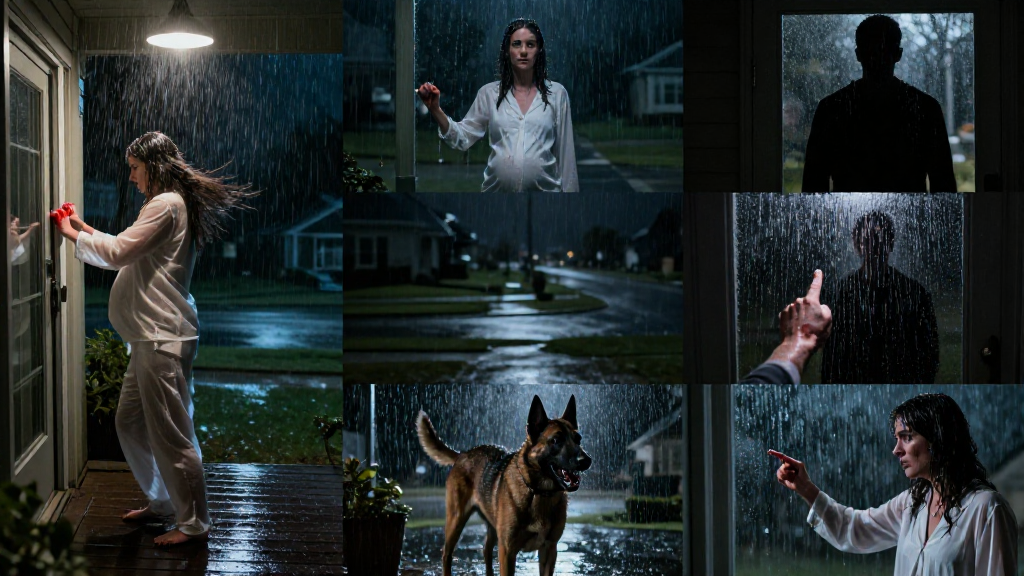
I stood barefoot on the wooden planks of our front porch, wearing nothing but thin, cotton maternity pajamas. The freezing rain was already soaking through the fabric, clinging to my skin like sheets of ice.
A sharp, agonizing cramp seized my swollen, eight-month pregnant belly. I gasped, wrapping my arms protectively around my waist as I stumbled forward against the glass pane of the front door.
“David!” I screamed, my voice cracking against the brutal wind.
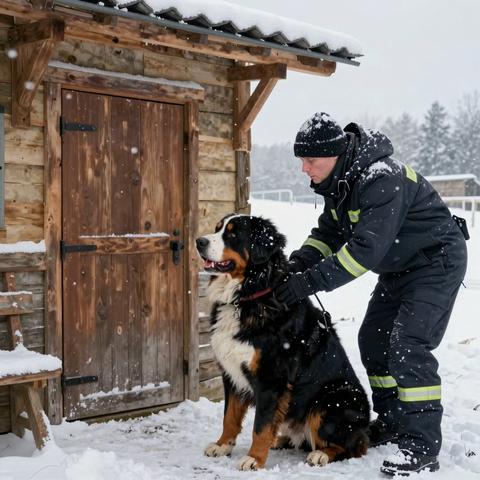
My rescue Belgian Malinois, Bear, whined loudly. He pressed his massive, warm body against my bare legs, shivering as the icy downpour battered his dark, rain-slicked fur.
I slapped my wet palms against the freezing glass, leaving frantic, watery handprints. “David, please! Open the door! It’s freezing!”
But on the other side of the glass, standing in the warm, dimly lit foyer of our home, my husband of four years didn’t move an inch. David just stood there.
He didn’t look angry. He didn’t look panicked, and he certainly didn’t look confused.
His eyes were completely hollow, staring through me as if I were already a ghost. The man I had shared a bed with, the man who had gently kissed my forehead just hours ago, looked like a total stranger.
Why is he looking at me like that? I thought, sheer panic rising in my throat like bile. Please, God, let me in.
Just three hours prior, I had woken up in blinding pain. Terrified of going into premature labor, I had tearfully begged David to take me to the emergency room.
He had been furious. He spent the entire agonizing drive gripping the steering wheel so hard his knuckles turned white, muttering through clenched teeth that I was overreacting to normal pregnancy pains.
The hospital doctors had strapped fetal monitors to my belly, hooked me up to an IV, and eventually concluded it was just severe, stress-induced Braxton Hicks contractions. They discharged me with strict orders to go home and rest.
When we finally returned to our house, the wind had blown the heavy front door ajar. Bear’s heavy-duty leather leash had been knocked off its hook and was resting on the edge of the wet porch.
I had stepped out into the cold for exactly four seconds to grab it. That was all it took for the heavy oak door to slam shut behind me.
Now, looking into David’s dead, unblinking eyes, I knew the wind hadn’t caught the door. He had slammed it. He had locked it.
Bear let out a low, vibrating growl, his hackles raising as he positioned himself squarely between my legs and the door. He bared his sharp teeth at the man he usually greeted with a wildly wagging tail.
Inside the foyer, David slowly raised his right hand. His movements were robotic, deliberate, and terrifyingly calm.
He extended a single index finger. But he wasn’t pointing at my face, or my cramping belly, or even at the dog.
He was pointing directly at my left wrist, which was pressed flat against the foggy, rain-streaked glass.
My breath caught painfully in my chest. I slowly pulled my trembling hand back from the door and looked down.
The white plastic hospital admissions bracelet was still securely fastened around my arm. The freezing rain was dripping off the edges of the synthetic band.
My name, date of birth, and medical record barcode were printed clearly in black, sterile ink. But right beneath that, there was something else.
Someone had hastily scribbled a 10-digit number in blue ballpoint pen.
My mind violently flashed back to the chaotic emergency room just an hour earlier. David had stepped out of our curtained triage area to pay for our parking validation at the hallway kiosk.
The absolute second he was out of sight, the older triage nurse—a pale woman whose name tag read Martha—had practically sprinted to my bedside.
Her hands had been shaking violently as she grabbed my left wrist. She hadn’t said a single word. She just clicked her pen, scribbled the numbers onto my plastic bracelet, and gave me a look of pure, unadulterated terror.
“Don’t let him see,” she had mouthed silently, her eyes wide, just seconds before David pulled the privacy curtain back open.
Standing on the freezing porch, I wiped the rainwater off the plastic to read the smeared blue numbers clearly. The moment my brain processed the sequence, my heart entirely stopped beating in my chest.
I recognized the number immediately. I had dialed it a hundred times four years ago, right before I ever met David.
It was the direct, private cell phone number of Detective Reynolds, the lead investigator on the unsolved murder of my first husband.
The nurse hadn’t just given me a random lifeline. She recognized David. She knew what he really was.
I looked back up through the glass, my blood running colder than the rain. David slowly reached out and flipped the switch for the foyer light, plunging the house into total darkness.
He wasn’t locking me out to punish me for being dramatic. He was locking me out to freeze to death, because he knew I was wearing his darkest secret on my wrist.
Chapter 2: The Shedding of Skin
The darkness was absolute. When the foyer light snapped off, it felt as though the very oxygen had been sucked out of the freezing storm.
I stood paralyzed on the wooden porch, the icy rain turning my thin cotton pajamas into a second layer of frozen skin.
He’s going to let me freeze to death.
The realization hit me with the force of a physical blow. David hadn’t snapped. This wasn’t a sudden fit of rage or a horrible misunderstanding.
The calm, dead look in his eyes told me everything I needed to know. This was a calculated execution.
My first husband, Mark, had been killed in a brutal hit-and-run four years ago. The driver was never found, the vehicle never identified, and the case eventually went devastatingly cold.
I looked down at my shivering wrist, the smeared blue ink mocking me in the shadows. Detective Reynolds.
Martha, the emergency room nurse, hadn’t just recognized David. She knew what he was. She knew what he had done.
Another violent cramp seized my abdomen, sharper and more localized than the last. I doubled over, crying out in agony as the wind howled around me.
“Come on, Bear,” I whispered, my teeth chattering so violently I could barely form the words. “We have to move. Now.”
The Malinois whined, pressing his soaked, heavy body against my leg to keep me steady.
Our house was situated at the end of a long, secluded cul-de-sac, bordered by dense woods on three sides. The nearest neighbor was a quarter-mile down a gravel road, and the temperature was dropping by the minute.
I couldn’t survive the walk. I wouldn’t make it past the driveway before hypothermia set in.
I carefully backed away from the front door, half-expecting the deadbolt to click open and David to drag me back inside. But the house remained completely silent, a dark tomb against the stormy sky.
I stepped off the porch and my bare feet sank into the freezing, mud-slicked grass. The pain was immediate and blinding, like stepping on shattered glass.
My only option was the detached workshop at the back of our property. David spent hours out there, building custom furniture.
It was insulated. It had a space heater. And more importantly, I knew he kept a spare key hidden under a loose brick near the foundation.
I stumbled blindly through the side yard, one arm wrapped protectively around my swollen belly, the other blindly reaching out in the dark.
Bear stayed glued to my side, his ears pinned back against the storm, occasionally pausing to look over his shoulder at the dark house.
The wind whipped wet branches across my face, scratching my cheeks and tearing at my soaked clothes. By the time my frozen fingers found the rough wood of the workshop siding, I was bordering on delirious.
I dropped to my knees in the mud. The freezing slush soaked through my pajama pants instantly.
I dug my numb, bleeding fingers into the frozen earth, frantically prying at the loose brick. It wouldn’t budge.
“Please,” I sobbed, the tears freezing hot against my cold face. “Please, God, let me in.”
With a final, desperate heave, the brick broke free from the mud. Beneath it, encased in a small plastic bag, was the brass key.
I fumbled with the deadbolt, my hands shaking so badly I dropped the key twice before finally guiding it into the lock. It clicked, and I shoved the heavy wooden door open.
Bear bolted inside first, shaking the freezing rain from his coat. I dragged myself over the threshold and slammed the door shut, locking it behind me.
The workshop was pitch black, smelling strongly of sawdust, motor oil, and old wood. It was colder than the house, but shielded from the brutal wind.
I need a phone. I need a weapon. I need warmth.
I felt along the wall until my fingers brushed the familiar plastic of the light switch. I flicked it up.
Harsh, fluorescent overhead lights flickered to life, illuminating the immaculate, terrifyingly organized space.
David’s tools were lined up on pegboards with obsessive precision. Saws, hammers, and heavy wrenches hung like medieval weapons against the pristine white walls.
I stumbled toward his heavy metal workbench, desperate to find anything that could help me break a window or defend myself.
That was when I noticed the locked cabinet beneath the workbench. It was the only thing out of place in the entire shop.
The heavy steel padlock had been left open, hanging loosely from the latch. David never left anything unlocked. In his rush to take me to the hospital, he must have forgotten to secure it.
I dropped to my knees, ignoring the sharp pain in my stomach, and pulled the metal doors open.
Inside wasn’t a stash of power tools or expensive wood stains. It was a single, battered cardboard box.
My trembling hands reached out and pulled the box into the harsh overhead light. I threw the lid off.
Inside sat a familiar, blood-stained silver Rolex.
It was Mark’s watch. The watch he had been wearing the night he was killed in the hit-and-run. The watch the police said must have been stolen by scavengers before they found his body.
David hadn’t just met me by chance after my husband died. He had systematically hunted Mark down, murdered him, and kept a trophy.
A low, guttural growl suddenly erupted from Bear’s throat.
The dog wasn’t looking at me. He was staring directly at the workshop’s locked door.
I froze, the bloody silver watch clutched in my numb fingers, as the heavy brass doorknob slowly began to turn.
Chapter 3: The Master Key
The heavy brass doorknob turned with agonizing slowness, the metal mechanism whining against the freezing cold.
Click. Click. Click.
I stood completely paralyzed beneath the harsh fluorescent lights of the workshop, my wet, freezing pajamas clinging to my shivering skin. In my trembling hand, the silver, blood-stained Rolex felt as heavy as a lead weight.
Bear’s guttural growl escalated into a vicious, snapping bark. He lunged toward the reinforced wooden door, his paws skidding against the sawdust-covered concrete floor.
“Shh, Bear,” I whispered frantically, my voice trembling so violently I could barely form the words. Please, God, don’t let him hear us.
But it was too late.
“I know you’re in there, honey,” David’s voice drifted through the heavy wooden door.
His tone wasn’t muffled by the howling wind, and it wasn’t raised in anger. It was terrifyingly calm, smooth, and conversational—the exact same voice he used when asking what I wanted for dinner.
A fresh, agonizing cramp ripped through my swollen belly. I gasped, dropping to one knee as I quickly shoved Mark’s bloody watch deep into the pocket of my soaked pajama pants.
I couldn’t let him know I had found it. If he realized I possessed the physical proof of his murder, he wouldn’t just leave me to freeze. He would come in and finish the job himself.
“It’s really coming down out here,” David continued, his voice perfectly level. “You shouldn’t have run off. The baby is going to catch a chill.”
My blood ran absolutely cold. The psychological torture of hearing the man I had slept next to for four years, knowing he had systematically hunted and slaughtered my first husband, made my vision blur with nauseating panic.
Weapon. I need a weapon right now.
I forced myself up from the floor, my bare, mud-caked feet numb with frostbite. I stumbled backward toward his meticulously organized pegboards.
My eyes darted frantically over the hanging tools. Hammers, chisels, handsaws.
My shaking fingers closed around the thick, rubberized handle of a heavy steel framing hammer. I pulled it off the hooks, gripping it so tightly my knuckles turned stark white.
“David, stop!” I screamed, backing away until my shoulders hit the cold metal of his workbench. “The police already know! The hospital called them!”
It was a desperate, pathetic lie, but I prayed the mention of Detective Reynolds’s number on my wrist would make him hesitate.
There was a long, agonizing pause on the other side of the door. The only sound was the brutal wind rattling the workshop’s tin roof and Bear’s frantic, aggressive pacing.
Then, David laughed.
It was a low, genuine chuckle that echoed through the freezing rain.
“Martha is a paranoid old woman,” David said casually, confirming my absolute worst fear. He knew exactly who the nurse was. “She’s been trying to prove something for years. But nobody listens to her.”
The doorknob stopped jiggling. For a brief, fleeting second, I thought he might be walking away. I thought the heavy deadbolt I had thrown from the inside was going to hold.
Then came the metallic, unmistakable sound of a heavy steel key sliding into the lock.
He had a master key. Of course he did. He built this workshop. He never left a single detail to chance.
“Stand back from the door, sweetheart,” David said softly.
The deadbolt disengaged with a loud, sickening thwack, and the heavy wooden door slowly began to swing open into the harsh light.
Chapter 4: The Final Stroke
The heavy wooden door swung inward, scraping loudly against the sawdust-covered concrete.
The brutal storm raged behind him, framing David’s tall, broad silhouette in the doorway like a towering shadow. The freezing rain whipped around his shoulders, but he didn’t seem to notice the cold at all.
In his right hand, he held a heavy, industrial steel flashlight. In his left, illuminated by the harsh fluorescent lights of the workshop, was a thick medical syringe filled with a clear liquid.
“It’s just a mild sedative, honey,” David said, his voice entirely devoid of emotion. “You’re stressed. It’s bad for the baby.”
He’s going to drug me. He’s going to stage an accident.
I gripped the heavy steel framing hammer so tightly my hands cramped, pressing my back flat against the cold metal of the workbench.
“Don’t take another step,” I warned, my voice shaking but loud enough to cut through the howling wind.
David merely smiled—a thin, humorless stretching of his lips. He took a calculated step across the threshold.
Bear didn’t wait for a command.
With a ferocious, deafening roar, the eighty-pound Belgian Malinois launched himself off his hind legs. He flew through the air like a guided missile, entirely bypassing the flashlight and aiming straight for David’s left arm.
Bear’s powerful jaws clamped shut around David’s forearm with a sickening crunch.
David let out a startling shriek of pain. His grip faltered, and the glass syringe slipped from his fingers, shattering into a hundred glittering pieces against the concrete floor.
The clear liquid mixed instantly with the dirty sawdust.
“Get off me, you mutt!” David roared, his calm facade completely shattering.
He raised the heavy steel flashlight high above his head, preparing to bash the skull of my fiercely loyal dog.
Adrenaline violently overrode the paralyzing fear and the sharp pregnancy cramps. I didn’t think; I just moved.
I lunged forward, closing the distance between the workbench and the door in two desperate strides. I gripped the thick rubber handle of the framing hammer with both hands, raised it over my shoulder, and swung with absolutely every ounce of strength I had left.
The solid steel head of the hammer connected squarely with David’s kneecap, shattering the bone with a gruesome, echoing crack.
David screamed—a high, unnatural sound that pierced the roar of the storm. His leg buckled entirely in the wrong direction, and he collapsed heavily onto the floor, dropping the flashlight.
Bear instantly repositioned, pinning David’s chest to the concrete with his front paws, his massive teeth bared mere inches from my husband’s exposed throat. A low, continuous growl rumbled in the dog’s chest, daring the man to move an inch.
I stood over him, my chest heaving, the bloody hammer still raised in my trembling hands.
As David writhed in agony, his dark waterproof jacket shifted, and his cell phone slid out of his pocket, skidding across the floor to stop at my bare, frozen feet.
I dropped to my knees, snatching the phone from the sawdust. My numb, bleeding fingers fumbled with the screen, desperately punching in the 10-digit number smeared on my wet hospital bracelet.
The line rang twice.
“Detective Reynolds,” a gruff, tired voice answered on the other end.
A ragged, heavy sob tore its way out of my throat, releasing four years of grief, betrayal, and blinding terror all at once.
“He has Mark’s watch,” I whispered, staring down at the monster pinned to the floor by my dog. “He has Mark’s watch, Detective. And I have him.”
Thank you for reading! I hope you enjoyed this suspenseful thriller.