The Boy Beneath the Floorboards: A 72-Year-Old Woman Discovers Her “Runaway” Lover Never Left Her House
Chapter 1: The Dust of Silence
The humidity in Willow Creek, Georgia, had a way of holding onto things. It held onto the heat of the day long after the sun had set; it held onto the smell of wisteria and wet earth; and in the Dalloway estate, it seemed to hold onto the past with a suffocating grip.
Clara Dalloway stood in the center of her father’s study, a room that felt less like a part of a home and more like a mausoleum dedicated to a man who had been dead for two weeks. At seventy-two, Clara felt much like the house itself—sturdy in her bones but weathering at the edges, her paint peeling, her foundations settling into the lonely soil of a life lived in quiet resignation.
She wiped a bead of sweat from her forehead with the back of a gloved hand. The air conditioner had rattled its last breath three days ago, and the Georgia summer was reclaiming the Victorian mansion. Clara didn’t mind the heat as much as she minded the silence. For fifty years, this house had been filled with the booming, authoritative voice of Judge Elias Dalloway. Even in his later years, when illness had withered him into a husk of the titan he once was, his presence had filled every corner, a heavy fog of expectation and judgment.
Now, he was gone. And Clara, the dutiful daughter who had never married, never left, and never truly lived, was left to clean up the wreckage.
“Termites,” she muttered to herself, looking down at the intricate parquet flooring near the heavy oak desk.
The inspector had been clear. “Ms. Dalloway, the sub-flooring in the east wing is compromised. You’re going to have to rip up those hardwoods to treat the infestation before you can list the property.”
Listing the property. Selling the legacy. It felt like treason, but it also felt like the first breath of fresh air she had taken since 1968.
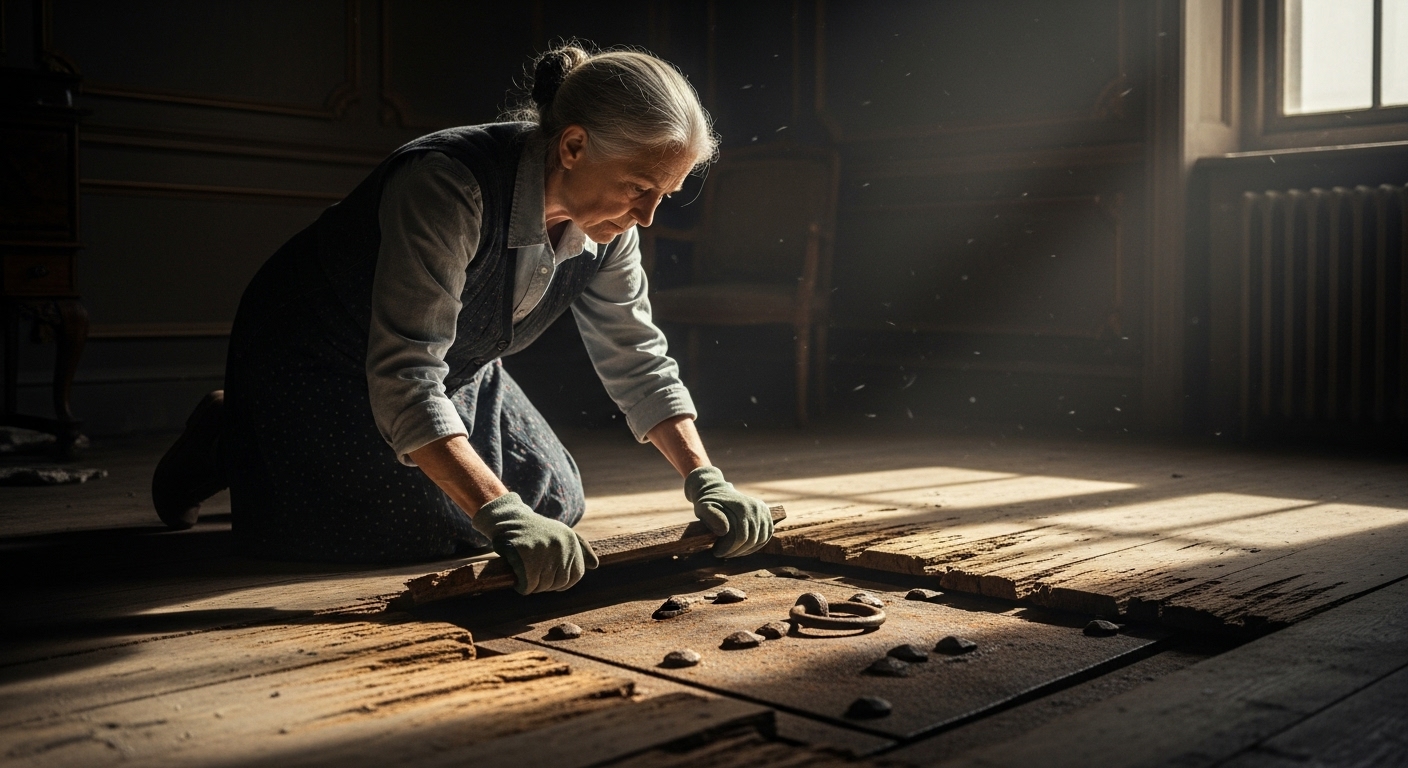
Clara knelt, her knees popping in protest. She jammed a pry bar under the edge of a rotting oak slat. The wood groaned, a sound like a dying animal, before splintering and giving way. She worked methodically, the physical labor a welcome distraction from the memories threatening to seep in from the hallway.
She remembered running down that hallway in a chiffon dress, tears streaming down her face. She remembered the sound of the front door slamming. She remembered her father’s voice, calm and terrifyingly reasonable: “He took the money, Clara. Five thousand dollars. That’s what your love was worth to a boy from the darker side of town.”
Tobias. Toby.
Even thinking his name caused a phantom ache in her chest, a dull throb that half a century hadn’t cured. He was the mechanic’s son, a young man with skin the color of roasted coffee and eyes that held the kindness of the morning sun. In 1968, in Willow Creek, their love wasn’t just forbidden; it was dangerous. But they had a plan. California. They were leaving on the night of her eighteenth birthday.
But he never came.
Clara shook her head, forcing the pry bar deeper. Snap. Another board came loose.
Underneath the layer of insulation and dust, something metallic caught the slice of sunlight filtering through the heavy velvet drapes. Clara paused. She brushed away the debris with her gloved fingers. It wasn’t a pipe or a conduit. It was a handle. A heavy, iron ring, recessed into a square metal plate that was flush with the sub-floor.
“What on earth…” she whispered.
The Dalloway house had been built in the 1920s, but her father had made “modifications” during the height of the Cold War scare in the early sixties. He had spoken often of readiness, of duty, of survival. But he had never mentioned a hatch in his study.
Clara tugged on the ring. It didn’t budge. It was locked, the mechanism rusted but clearly robust.
She sat back on her heels, staring at the metal plate. It sat directly beneath where her father’s desk chair had been for forty years. He had sat right on top of this. Every evening, drinking his scotch, reading his case files, he had been sitting on a secret.
She needed a key.
Clara stood up, her eyes scanning the room. Her father was a creature of habit, a man of meticulous organization. If there was a key, it wouldn’t be in a drawer. It would be hidden in plain sight, somewhere that symbolized his authority.
She walked to the bookshelf, her fingers trailing over the leather spines of law journals and encyclopedias until they rested on the family Bible. It was a massive King James version, bound in black leather, sitting on its own pedestal. Her father read from it every Sunday, quoting scripture to justify his rulings, his harshness, his “justice.”
Clara opened the heavy cover. The pages smelled of old vanilla and piety. She turned to the back, to the family tree. Elias Dalloway. Martha Dalloway. Clara Dalloway.
And there, carved out of the thick stack of concordance pages at the very back, was a hollow square.
Resting inside was a heavy brass key, tarnished by time.
Clara’s heart began to hammer against her ribs, a frantic rhythm that echoed the rising dread in her gut. She took the key. It was cold, heavy.
She returned to the hole in the floor. She inserted the key into the mechanism on the hatch. It resisted, gritty with rust, but Clara leaned her weight into it, using both hands. With a screech of metal on metal that sounded like a scream, the lock turned.
She pulled the iron ring. The hatch was counter-weighted; it swung up heavier than it looked, revealing a dark, gaping maw.
A rush of air escaped the opening. It didn’t smell like a basement. It didn’t smell like mold or earth. It smelled of stagnation. Of ancient dust. And faintly, impossibly, of motor oil and Old Spice—the scent of a ghost she had tried to exorcise for fifty-two years.
Chapter 2: The Time Capsule of Grief
Clara retrieved a heavy flashlight from the kitchen, her hands trembling so badly she almost dropped it twice. The darkness of the hole seemed to pulsate, breathing silently into the study.
There was a ladder, bolted into the concrete wall, descending into the gloom.
“Hello?” Clara called out. Her voice sounded thin, pathetic. Of course, no one answered.
She began to climb down. One rung. Two. The air grew cooler, the humidity of the Georgia summer replaced by a chill that seeped into her bones. It wasn’t a crawl space. It was deep. Ten feet down, her feet hit solid concrete.
She clicked on the flashlight.
The beam cut through the darkness, illuminating a space that was roughly ten by ten feet. It was a bunker. A fallout shelter, designed to survive the end of the world. But as Clara swung the light around, she realized this room hadn’t been built for survival.
It had been built for containment.
There were no shelves of canned food. No water barrels. No Geiger counter.
Instead, there was a single, rusted iron cot frame pushed against the far wall. In the corner, a metal bucket. And in the center of the room, a small, bolted-down metal desk.
Clara stepped forward, the dust crunching loudly under her sneakers. The silence here was absolute. It was a heavy, pressing thing, thicker than the silence upstairs.
On the desk sat two items.
One was a leather-bound journal, the kind sold at the general store for fifty cents back in the sixties.
The other object made Clara’s knees give out. She collapsed onto the dusty floor, the flashlight rolling away, casting long, dancing shadows against the gray walls.
It was a silver locket. Heart-shaped. Tarnished black, but unmistakable.
Clara reached out, her fingers numb. She picked it up. She didn’t need to open it to know what was inside, but she did anyway. The hinge whined. Inside, a tiny, black-and-white photo of a young girl with hopeful eyes and a ribbon in her hair. Her high school graduation picture.
“Toby,” she whispered. The sound was a sob that tore from her throat.
She had given this to him the night before they were supposed to leave. He had sworn he would never take it off. “This is my compass, Clara,” he had said, his voice rough with emotion. “As long as I have this, I’ll always find my way back to you.”
Her father had told her Toby threw it in the trash when he took the money. He said Toby laughed at her foolishness.
Clara grabbed the journal. Her hands shook so violently she could barely turn the cover. The pages were yellowed, brittle. The handwriting was jagged, frantic, sketched in pencil.
October 14, 1968.
He didn’t give me the money. I came to the door like a man. I wanted to ask him, Clara. I wanted to look him in the eye and tell him I loved you and that I’d work until my hands bled to give you a good life. He invited me in. He smiled. He said, “Let’s talk in my private study, son.” He showed me the hatch. Said it was a safe room. Asked me to check the ventilation. I climbed down. Then the door slammed.
Clara read the words, but her brain refused to process them.
October 15, 1968.
It’s dark. He turned the lights off after an hour. I can hear him walking upstairs. I screamed until my throat bled. I banged on the ceiling with the broom handle that was down here. He just walks back and forth. I know he can hear me. Why, Clara? Where are you?
Tears blinded her. She wiped them away furiously, needing to see, needing to know.
October 20, 1968.
He dropped a bag of sandwiches and a jug of water down today. He didn’t say a word. Just opened the hatch, dropped it, and closed it. I screamed your name. I screamed, “Tell Clara I love her!” He laughed. It was a quiet laugh. He said, “She’s already forgotten you, boy. She thinks you took the cash. She’s upstairs crying over a thief.”
“No,” Clara moaned, rocking back and forth on the cold concrete. “No, Papa. No, no, no.”
The cruelty was so precise. So calculated. While she lay in her room, directly two floors above, weeping into her pillow, believing she had been abandoned for cash, Toby was right here. Directly beneath her father’s feet.
The timeline in the journal spanned weeks. Weeks of darkness. Weeks of madness.
November 2, 1968.
I can hear the piano. Is that you playing? It sounds like ‘Moon River.’ I’m singing along, Clara. I’m singing so loud. Can’t you feel me under the floor? I’m right here. I didn’t run. I didn’t take the money. I stayed.
Clara clutched the journal to her chest, screaming a sound of pure, primal anguish. She remembered playing that song. She played it every day for a month because it was his favorite. She played it to comfort her broken heart, never knowing she was playing a serenade to his torture.
Chapter 3: The Judge’s Verdict
The flashlight beam flickered, casting the bunker into momentary twilight before stabilizing. Clara forced herself to stand. She had to see the end. She had to know how it ended.
She walked to the cot.
There was a tarp draped over the corner behind the bedframe, covered in decades of dust. It looked like a pile of discarded rags.
Clara pulled the tarp away.
She didn’t scream. She had no scream left.
There, curled in the fetal position, were the skeletal remains of Tobias Washington. He was still wearing the tattered remnants of his mechanic’s coveralls—the ones with his name patch, Toby, embroidered on the chest.
He hadn’t died of starvation, not immediately. The bucket in the corner suggested he had lived for a while. But the final entry in the journal, lying open on the desk, told the rest.
November 12, 1968.
It’s getting cold. My chest hurts. I think I have pneumonia from the damp. He hasn’t opened the door in four days. No water left. I dreamed of California last night. We were by the ocean, Clara. You were wearing that blue dress. The sun was so warm.
Don’t hate him, Clara. If you ever find this, don’t let the hate eat you like it ate him. Just know I stayed. I didn’t run. I stayed right here. I loved you enough to stay.
Clara touched the fabric of the coveralls. It disintegrated under her touch.
Her father. The Honorable Judge Dalloway. The man who sat on the bench for forty years, sentencing men to prison, speaking of righteousness and the rule of law. He was a monster. A monster who had looked his daughter in the eye every single day for fifty years, watched her wither into a lonely, childless spinster, watched her heart harden, all while he sat on top of the decaying body of the only man she had ever loved.
He had stolen her life. He had stolen Toby’s life. And he had done it with the patience of a saint.
The rage that filled Clara was cold and sharp. It wasn’t the hot fire of temper; it was the glacial, crushing weight of an iceberg.
She looked at the ceiling of the bunker—the underside of the study floor.
“You knew,” she whispered to the ghost of her father. “You sat there. You drank your scotch. You read your Bible. And you listened to him die.”
She understood now why her father never let anyone in the study. Why he was so obsessive about the rugs. Why he never renovated the floors despite the termites. He was the jailer of his own home.
Clara picked up the locket from the desk and fastened it around her neck. The cold metal against her skin felt like a brand, a promise kept five decades too late.
She climbed the ladder.
Emerging into the study, the light of the late afternoon sun seemed offensive. The world outside had kept turning. Wars had been fought, presidents elected, technology invented. All while Toby waited in the dark.
Clara walked to the phone in the hallway. She picked up the receiver. The dial tone hummed—a sound of connection to the outside world.
She dialed 9-1-1.
“911, what is your emergency?”
Clara’s voice was steady. It was the voice of a Dalloway, but stripped of the pretense.
“I need the police,” she said. “And the coroner. There has been a murder. At the Dalloway Estate.”
“Is the assailant still there, ma’am?”
“No,” Clara said, looking at the oil portrait of her father hanging above the mantle, his eyes painted with a deceptive warmth. “The assailant has been dead for two weeks. But his victim… his victim has been waiting to be found for fifty-two years.”
Chapter 4: A Late Resurrection
The scandal hit Willow Creek like a hurricane.
The discovery of Tobias Washington’s remains in the bunker beneath the home of the town’s most revered judge made national news. Satellite trucks parked on the lawn where Clara used to play croquet. Reporters shoved microphones in the faces of the bewildered town council, who were hurriedly debating whether to remove the statue of Judge Dalloway from the courthouse square.
Clara didn’t speak to the press. She didn’t hide, but she didn’t perform.
She sat on the front porch swing, the same swing where Toby had first kissed her cheek in 1967. She watched the police carry the evidence bags out. She watched them bring the small body bag out on a stretcher.
When they brought Toby out, Clara stood up.
The coroner, a young man who looked terrified of the gravity of the situation, paused.
“Ms. Dalloway,” he said softly.
Clara walked down the steps. She placed her hand on the black vinyl of the bag, right over where his heart would be.
“He isn’t a John Doe,” Clara said, her voice carrying over the clicking of the cameras at the gate. “His name is Tobias Washington. And he was the love of my life.”
The investigation revealed everything. The journal was authenticated. The forensic analysis matched the timeline. The “Great Judge” Dalloway was exposed as a kidnapper and a murderer, a man driven by racism and a psychotic need for control. The town stripped his name from the library. They melted down his plaque.
But Clara didn’t care about the Judge’s legacy. She cared about Toby’s.
Two weeks later, on a bright Tuesday morning, a funeral was held.
It wasn’t in the segregated cemetery where Toby’s ancestors were buried. It was in the Dalloway family plot, the prime real estate of the Willow Creek graveyard, under the shade of a massive weeping willow.
Clara had arranged it. She had the gravediggers open the earth right next to the spot reserved for her.
A small crowd gathered. People who remembered Toby—old men who had worked with him at the garage, his distant cousins who had heard rumors of his disappearance. And there was Clara, dressed not in black, but in blue. The color of the dress she was supposed to wear to California.
The preacher spoke of justice delayed, but not denied. He spoke of a love that survived the darkness.
When the service was over and the crowd had dispersed, Clara remained. She sat on a folding chair in the grass, the fresh dirt mounded over Toby’s grave.
She opened the journal, which the police had returned to her. She turned to the last page, the ink faint but legible.
Don’t let the hate eat you.
Clara closed her eyes. For fifty years, she had lived with a hollow space inside her, a void filled with the belief that she wasn’t enough. That she was easily discarded. That she was unlovable.
That void was gone. It was replaced by a grief that was heavy, yes, but it was solid. It was real. She hadn’t been rejected. She had been fought for. A man had endured the unimaginable just to stay close to her.
She wasn’t the lonely spinster in the crumbling house anymore. She was Clara Dalloway, the woman Tobias Washington loved until his final breath.
She touched the silver locket at her throat.
“I know you stayed, Toby,” she whispered to the wind rustling the willow branches. “I know. And now, I’m staying too. I’m not going anywhere.”
Clara looked up at the sky. It was a piercing, California blue. She smiled, a small, sad, but genuine smile. She finally had the one thing her father had tried so hard to steal.
She had the truth