“He Sold My Hair For Gambling Money”: I Ran To The Men Everyone Feared, And They Did The Unexpected.
Chapter 1: The Crown of Thorns
The dirt road stretched out endlessly under the merciless July sun, and I ran like my life depended on it—because in many ways, it did.

My name is Betty. I was eight years old. And I was running toward the monsters to save me from my father.
My small feet kicked up clouds of suffocating dust with every frantic step. My worn-out sneakers slapped against the hard-packed earth in a rhythm that matched the terrified hammering of my heart. Thump-thump. Thump-thump.
But it wasn’t the heat or the exhaustion that consumed me. It was the sensation on my head.
The stubble caught the sunlight in a way that hair never should. It felt raw, exposed, and prickly. My hand kept flying up to touch it, feeling the uneven patches where the skin was nicked, the sudden, violent absence of the weight I’d carried my whole life.
Gone. All of it.
The long, wavy chestnut hair my mother used to braid every morning before she died. The hair she told me was my “crown.” The hair that made me feel like a girl, even when I was wearing ragged clothes and starving.
Sold.
Taken from my head and traded away for money my father would lose before the sun set.
I couldn’t stop touching the rough skin. The memory of the kitchen floor flashed through my mind in jagged fragments. I couldn’t escape my father’s cold, dead eyes. They were calculating. Distant.
He hadn’t looked at me as his daughter. He looked at me like I was a broken toaster he could scrap for parts.
I remembered the metallic snip of the kitchen shears. The sound was wet and crunching. Clumps of my identity falling onto the newspaper he’d spread on the dirty linoleum.
“Please, Daddy,” I had whispered. “Please don’t.”
“Shut up, Betty,” he had muttered, a cigarette dangling from his lips. “Hold still. You move, I cut your ear. Hair grows back. Money doesn’t.”
The humiliation was a living thing inside my chest, hot and suffocating. He’d made me stand perfectly still while he harvested me. When he finished, he swept my hair—my mother’s legacy—into a black plastic trash bag without even looking at my tear-stained face.
He walked out the door with the bag. He was going to the wig maker in the city. He said he could get eighty bucks for “virgin hair” of that length. Eighty bucks. That was the price of my dignity.
But I was running toward something now.
I was running toward a secret I had discovered that very morning while digging through the boxes of my dead mother’s belongings. My father had shoved them into the back of the closet, too ashamed or too high to throw them away.
I’d been looking for a picture. A smell. Anything to remind me that I wasn’t alone.
What I found instead was a worn black leather vest folded beneath old photographs. And on that vest was a patch. A skull with wings. Red and white. Unmistakable.
Hell’s Angels.
I had opened the collar with shaking fingers and saw a name stitched inside in faded white thread.
Tommy Chun.
My uncle. A man I’d never met. A man my father called “criminal scum.” A man my mother had secretly wept for.
That’s where I was running now. Toward the abandoned gas station on the edge of town where the “bad men” gathered. Toward the rumble of engines that terrified everyone else in our neighborhood.
My legs ached. My lungs screamed. Sweat mixed with tears on my face, creating muddy tracks through the dust. But I didn’t slow down. I couldn’t.
Behind me was a house that had become a prison. A father who saw me as inventory.
Ahead, in the shimmering heat of the horizon, was the only hope I had left.
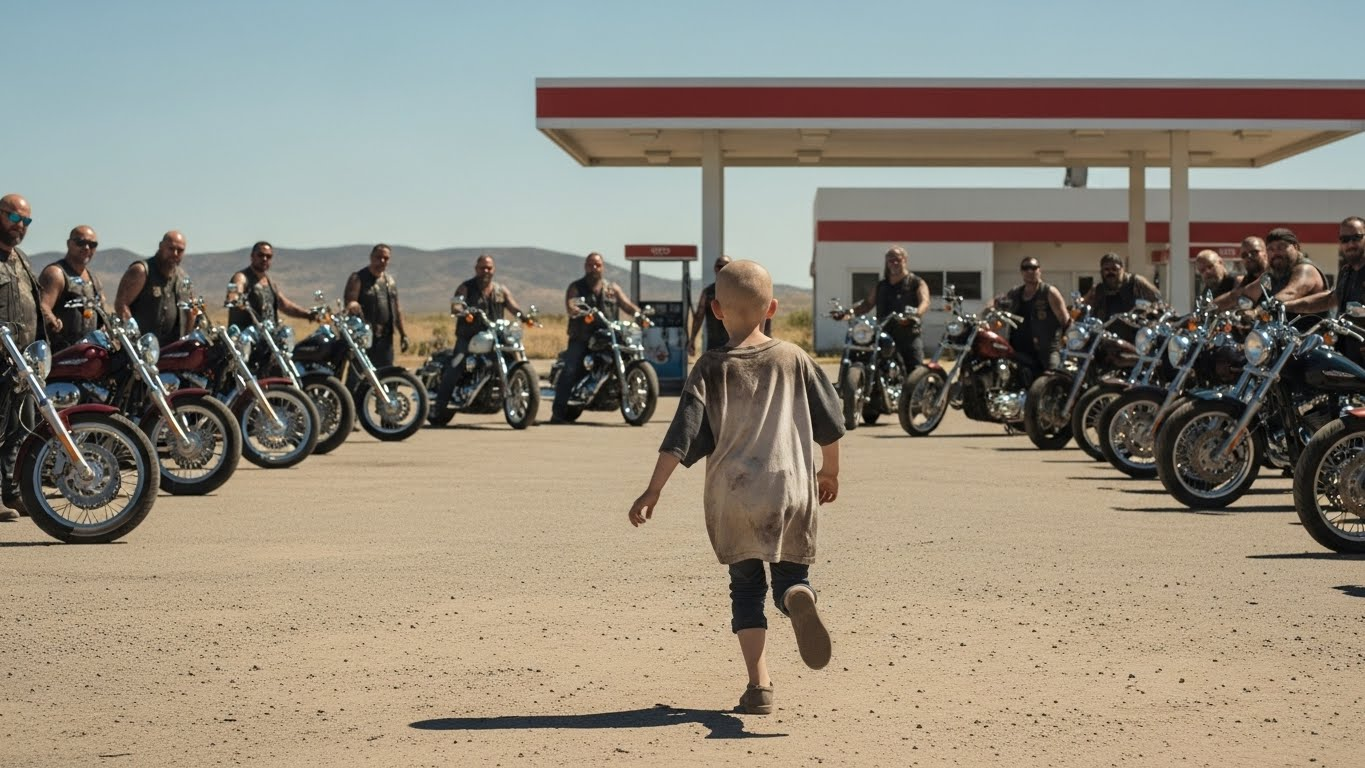
The old gas station materialized through my blurred vision like a mirage. The building was a skeleton—windows boarded up, pumps dry and rusted. But the parking lot? The parking lot was alive.
It glittered with chrome and black leather.
Twenty motorcycles sat in formation. Their riders were gathered in loose circles, checking straps, adjusting mirrors, smoking cigarettes that looked tiny in their massive hands. The Red and White patch blazed on every back.
My legs nearly gave out as I stumbled from the dirt road onto the cracked asphalt. My momentum carried me forward, past the first bike, past the second, straight into the center of their circle.
And then, the world stopped.
The deep rumble of conversations died instantly. Laughter was cut off like a radio cord had been pulled. Even the idling engines seemed to drop to a hush.
Twenty pairs of eyes turned toward me.
I stood there, swaying. A dusty, crying, eight-year-old girl with a butchered head and terror written across every inch of my face.
The silence was heavy. Violent. It was the kind of silence that happens when wolves find a lamb in their den.
I couldn’t breathe. I couldn’t speak. My hand flew up to cover my bald head again, shielding the shame.
Some of the bikers exchanged dark glances. Others just stared, cigarettes burning down to their fingers, frozen.
Then, one of them moved.
He was the largest human being I had ever seen. He must have been six-foot-five. His shoulders were like a mountain range blocking out the sky. His arms were covered in faded tattoos that looked like battle scars.
They called him Big Iron.
He walked toward me, his heavy boots crunching the gravel with deliberate, slow weight. Crunch. Crunch.
I should have run. I should have been terrified. But my tank was empty. I had nowhere else to go.
Big Iron stopped three feet away. He studied me with eyes that were hidden behind dark sunglasses. He stood there for what felt like an eternity, a dark tower of judgment.
Then, slowly, shockingly, he knelt.
His knees cracked loud in the silence as he lowered himself to my level. His shadow covered me completely, creating a small pocket of shade in the brutal sun.
He reached up and took off his glasses. His eyes were gray, lined with wrinkles, and tired. But they weren’t cruel.
“Hey there, little bit,” he said, his voice sounding like gravel wrapped in velvet. “You look like you ran through hell.”
The kindness in his voice—so unexpected, so foreign—broke me.
The sob that tore out of my throat was ugly and ragged. “He… he shaved me,” I gasped, the words tumbling out in a panic. “My father. He shaved my head.”
Big Iron frowned, a dangerous crease appearing between his brows. “Why?”
“To sell it,” I whispered, pointing to my bare scalp. “He sold my hair. for gambling money.”
The silence in the parking lot changed. It shifted from confused to something electric. Something dangerous. I felt the air pressure drop as twenty men simultaneously stiffened.
Big Iron didn’t look away from me. He didn’t look at his brothers. He just reached out a hand—a hand the size of a dinner plate—and gently touched my cheek.
“What’s your name?” he asked.
“Betty,” I choked out. Then, I played my only card. “My mom was Sarah. My uncle… his name was Tommy Chun.”
Big Iron went statue-still.
“Tommy,” he repeated softly. He looked at my face, really looked at me, searching for the ghost of his old friend in my tear-filled eyes.
“Nobody is going to hurt you now,” Big Iron said.
And looking at him, I realized it wasn’t a promise. It was a fact.
Chapter 2: The Harvest
The story came out of me in jagged, broken pieces, like I was vomiting up glass.
Big Iron stayed kneeling in front of me, one hand resting on my small shoulder, anchoring me to the earth. The other bikers had gathered closer, a wall of black leather and denim blocking out the rest of the world.
“It started years ago,” I told them, my voice shaking.
My father, Julius, had always liked cards. But after Mom died three years ago, the cards stopped being a game and became a god. A hungry god that needed to be fed every single day.
At first, it was just money disappearing from the grocery jar. Then the TV vanished while I was at school. Then the furniture.
I described the empty rooms of our house. The dining table Mom had refinished by hand? Gone for fifty bucks. The microwave? Pawned. My school books? Sold.
“He sold my books,” I whispered, looking down at my dirty sneakers. “He told me I was smart enough, I didn’t need them.”
The men around me were silent, but I could hear the creaking of leather as fists clenched. A biker with a long braided beard—Crow, I learned later—lit a cigarette, his hand shaking with suppressed rage.
“But the hair,” Big Iron asked gently. “Tell me about today.”
I squeezed my eyes shut. “He lost big yesterday. I don’t know who to, but he was scared. He was pacing all night.”
I told them how he had stared at me this morning. Not with love. With calculation. He had realized that the only thing left of value in the house wasn’t a thing at all. It was me.
“Virgin hair,” I repeated the words he had used. “He said it’s worth a premium.”
I told them about the newspaper on the floor. The coldness of the scissors against my neck. The way I had begged.
“I promised I wouldn’t eat dinner,” I sobbed, the memory crushing me. “I told him if he let me keep my hair, I wouldn’t ask for food for two days. I promised.”
A sound came from one of the men—a low, animalistic growl of disgust.
“But he didn’t stop,” I whispered. “He said hair is a luxury. Eating is a luxury. Paying debts is a necessity.”
When I finished, Big Iron stood up.
He didn’t say a word for a long ten seconds. He just looked at the horizon, his jaw muscle jumping beneath his gray beard.
Then he looked at Crow. “Check the records. Confirm the uncle.”
Crow was already on his phone. “I don’t need to check, Iron. I remember Tommy. He talked about his sister Sarah. Said she married a loser named Julius. Tommy hated the guy. Said he had ‘rat eyes’.”
Crow looked at me, his expression softening. “She’s got Tommy’s chin. And Sarah’s eyes.”
Big Iron nodded once. That was it. The verification process was over. I wasn’t a stranger anymore. I was blood.
“He’s at the house?” Big Iron asked me.
“He’s waiting for his dealer,” I said. “He got the money for the hair. He’s probably drinking on the porch.”
Big Iron took off his leather vest.
Underneath, he wore a black t-shirt that strained against his chest. He held the heavy vest in his hands for a moment, then draped it over my shoulders.
It was massive. It swallowed me whole. It smelled like oil, tobacco, and old rain. It weighed a ton, dragging on the ground around my ankles.
But the moment it settled on my shoulders, I stopped shaking. It felt like armor. It felt like a shield.
“You keep that on,” Big Iron commanded. “That marks you. You’re with us now. And nobody touches what belongs to the Angels.”
He turned to the pack.
“Mount up.”
The energy in the parking lot exploded. Twenty engines roared to life in unison. It was a symphony of thunder, a mechanical war cry that shook the fillings in my teeth.
Big Iron lifted me up effortlessly, setting me on the front of his bike, right in front of him. I was sandwiched between the handlebars and his massive chest.
“Hold on to the bars,” he yelled over the roar. “And don’t close your eyes. I want you to see this.”
He kicked the bike into gear. The vibration traveled through my entire skeleton.
“Let’s go get your father,” he growled.
Chapter 3: The Rolling Thunder
We rolled out of the gas station like a storm front moving in.
Twenty motorcycles moving in tight formation. Big Iron and I were at the tip of the spear.
I sat perched in front of him, my tiny hands gripping the chrome handlebars between his massive, gloved fists. The wind whipped against my face, cooling the heat of my shame.
For the first time in three years, I wasn’t small. I was part of a giant.
We moved through town slowly, deliberately. This wasn’t a race; it was a parade of intimidation. The rumble of the engines bounced off the storefronts, amplifying the sound until it felt like the sky was falling.
People stopped.
I saw them on the sidewalks. Mothers pulled their children close. Men in suits stopped talking on their phones to stare. Shopkeepers stepped out of doorways.
They saw the chrome. They saw the patches. But mostly, they saw me.
A tiny, bald girl wrapped in a Hell’s Angels vest that was five sizes too big, riding shotgun on the lead bike.
I saw Mrs. Gable from the bakery. She dropped a bag of flour. I saw the kids who bullied me at school for having holes in my shoes; their jaws were on the pavement.
Big Iron leaned forward, his chest pressing against my back, shouting over the wind. “Head up, Betty. Look them in the eye. You have nothing to be ashamed of. You hear me?”
I lifted my chin. I looked at the town that had ignored my bruises, the neighbors who had turned up their TVs when I screamed.
Look at me now, I thought.
We turned onto Maple Street. My street.
The sound of the bikes filled the narrow suburban road. It was deafening. Windows rattled in their frames.
My father’s house was at the end of the block. It looked like a rotting tooth in a smile of manicured lawns. The paint was peeling, the yard was dead, and the blinds were drawn crookedly.
And there he was.
Julius was sitting on the sagging porch steps, a beer in one hand, counting a wad of cash with the other. The money from my hair.
He heard us before he saw us.
He looked up, squinting against the sun. I saw the moment recognition hit him. It was like watching a man get shot.
The beer bottle slipped from his fingers and shattered on the concrete. The cash scattered in the wind.
He stood up, stumbling, his face draining of all color. He looked pale, ghostly.
Big Iron killed the engine. Then the next bike. Then the next. One by one, the roar died, replaced by a silence that was somehow louder than the noise.
We drifted to a stop right in front of the walkway.
Big Iron kicked down his stand and dismounted. He reached for me, lifting me down gently. He placed me on the ground but kept me behind him, his body forming a human wall.
The other nineteen bikers fanned out. They lined the sidewalk, arms crossed, staring at the porch. They didn’t yell. They didn’t curse. They just stood there.
A jury of executioners.
Julius was shaking so hard I could see it from twenty feet away.
“W-what is this?” he stammered, his voice cracking. “Who are you?”
Big Iron didn’t answer. He just took a step forward.
“I… I’m calling the police!” Julius squeaked, backing up toward the door.
“You do that,” Big Iron said. His voice was calm, terrifyingly calm. “Save us the trip.”
“She’s my daughter!” Julius yelled, trying to find some authority. “Betty! Get over here! You brought these… these freaks to my house?”
I flinched, instinctively stepping back. Big Iron’s hand landed on my shoulder, heavy and warm.
“She’s not going anywhere,” Big Iron said.
And then, the doors started opening.
It wasn’t just the bikers. It was the neighborhood.
Mrs. Henderson from next door stepped out onto her porch. Then Mr. Park from across the street. Then the Johnson family.
For years, they had looked away. They had minded their own business while I starved. But seeing twenty Hell’s Angels standing in silence on their street… it broke the dam.
“We heard her screaming,” Mrs. Henderson shouted suddenly, her voice shrill. She pointed a finger at Julius. “This morning! We heard her begging you to stop!”
Julius looked around wildly. “Shut up, you old hag!”
“I saw him selling her bike last week,” Mr. Park yelled, stepping off his porch. “And her clothes!”
“He leaves her alone for days!” another neighbor shouted.
It was a tidal wave. The bikers had acted as a catalyst. Their presence made the neighbors brave. They were shouting out every sin my father had tried to hide.
Julius was backed against his front door, sweating, surrounded by bikers in front and angry neighbors on the flanks.
“It’s not what it looks like!” he pleaded, looking at Big Iron. “I was… I was going to buy her nice things! With the money! I just needed a lucky streak!”
Big Iron stepped onto the porch. The wood creaked under his weight.
He leaned in close to Julius’s face.
“You sold her hair,” Big Iron whispered. It was loud enough for everyone to hear. “You sheared her like a sheep. For eighty dollars.”
Julius whimpered.
“You know what we do to men who hurt kids?” Crow asked from the sidewalk, cracking his knuckles.
Julius fell to his knees. “Please. Please don’t kill me.”
“We ain’t gonna kill you,” Big Iron said, looking down with pure disgust. “That’s too easy.”
In the distance, the wail of sirens began to rise.
Chapter 4: The System Breakers
The police arrived in a chaotic swirl of blue and red lights. Two cruisers skidded to a halt, officers jumping out with hands on their holsters, expecting a gang war.
What they found was a neighborhood town hall meeting led by a biker gang.
“Step away from the man!” the lead officer shouted, pointing his weapon at Big Iron.
Big Iron raised his hands slowly, calm as a monk. “Nobody’s touching him, Officer. We’re just waiting for you.”
Mrs. Henderson rushed the police before they could escalate. “Arrest him! Arrest the father!”
She grabbed the officer’s arm, hysterical. “Look at the girl! Look at her head!”
The officer looked past Big Iron. He saw me.
I was standing by the motorcycles, looking like a refugee from a war zone, clutching the giant leather vest around me. My bald head was gleaming in the afternoon sun.
The officer’s face fell. He holstered his weapon.
They arrested Julius in three minutes. The neighbors provided enough witness statements to put him away for a decade. Child abuse. Neglect. Endangerment.
I watched them cuff him. I watched him cry. He didn’t look at me as they shoved him into the cruiser. He was still muttering about his bad luck.
But as the cruiser pulled away, a white sedan pulled up.
My stomach dropped. I knew that car. I knew that logo on the side.
Department of Child Services.
A woman in a gray suit stepped out with a clipboard. She had “the look.” The pitying, bureaucratic look that meant I was about to become a file number.
“Betty Miller?” she called out, scanning the yard.
Big Iron stepped between me and the woman.
“Who are you?” he asked.
“I’m Ms. Rodriguez, CPS,” she said briskly. “I’m here to take the child into protective custody. We have an emergency placement available at a group home in the city.”
Group home.
I grabbed Big Iron’s jeans leg. I had heard stories about the group homes. Kids stealing your shoes. sleeping with one eye open. No family. Just survival.
“No,” I whispered. “Please, no.”
Big Iron looked down at me. He felt my terror.
He looked at Ms. Rodriguez. “She’s not going to a group home.”
Ms. Rodriguez sighed, clicking her pen. “Sir, I understand you’re… concerned. But unless you are a blood relative with a clean record and a certified home, you have no standing here. Step aside.”
Big Iron didn’t move.
“Crow,” he barked. “Get the lawyer.”
Crow was already handing him a phone.
“She has family,” Big Iron said to the social worker. “Her uncle was a brother. That makes her ours.”
“That’s not a legal definition,” she snapped.
“It is tonight,” Big Iron said.
He turned to the other bikers. “Tank, call your sister at the courthouse. Preacher, get the guest room ready at the clubhouse. We need an emergency foster petition filed within the hour.”
Ms. Rodriguez looked stunned. “You can’t just…”
“I have a clean record,” Big Iron lied—or maybe he didn’t. “My wife and I are certified foster parents. Or we were. We’ll renew it.”
He looked at me. “My wife, Maria… she lost our daughter six years ago. Leukemia.”
His voice cracked, just for a second.
“She’s been waiting for a reason to open that bedroom door again.”
The next hour was a blur of legal shouting matches. The Hell’s Angels didn’t just have muscles; they had resources. They had a lawyer who rode a Harley and wore a suit. They had connections.
By sunset, a temporary order was signed. It was a miracle of intimidation and legal loopholes.
Ms. Rodriguez got back in her sedan, looking defeated but strangely relieved. She knew, deep down, that the group home was a nightmare.
“You take care of her,” she warned Big Iron. “I’ll be checking.”
“You do that,” he said.
The sun was setting now, painting the sky in bruises of purple and gold.
Big Iron lifted me back onto his bike. The other nineteen men mounted up.
“Where are we going?” I asked, my voice small against the roar of the engines.
Big Iron looked back at me. He smiled, and this time, it reached his eyes.
“Home, Betty. We’re going home.”
As we rode away, leaving the empty, rotting house of my father behind, I leaned my bald head against Big Iron’s back. I could feel his heart beating through the leather. Slow. Steady. Strong.
I closed my eyes and, for the first time in my life, I fell asleep without being afraid.
Chapter 5: The Room That Was Waiting
We didn’t go to a dark, smoky clubhouse filled with criminals. We went to a small, neat bungalow with a white picket fence that needed painting and a porch light that glowed warm yellow against the twilight.
Big Iron killed the engine in the driveway. The silence that followed wasn’t heavy like before; it was peaceful. Crickets were chirping. A sprinkler hissed in a neighbor’s lawn.
“We’re here,” he grunted, lifting me off the bike.
The front door opened before we even reached the steps. A woman stood there. She was short, curvy, with streaks of gray in her dark hair and eyes that looked like they had cried a million tears but still knew how to smile.
This was Maria. Big Iron’s wife.
She took one look at me—at the oversized leather vest dragging on the ground, my dirty face, and my shaved, stubbled head—and her hands flew to her mouth.
“Oh, Jack,” she whispered (that was Big Iron’s real name, I learned). “Is this her?”
“This is Betty,” he said softly. “Her dad… he did a number on her, Maria.”
Maria didn’t ask questions. She didn’t ask about paperwork or the police or the logistics. She just dropped to her knees on the porch, ignoring the dirt on my clothes, and pulled me into a hug that smelled like lavender laundry detergent and baking bread.
“You’re safe,” she murmured into my ear, rocking me back and forth. “You’re safe, baby girl.”
They took me inside. The house was cozy, filled with knick-knacks and framed photos. But there was a sadness in the air, a quiet space that hadn’t been filled in a long time.
Maria led me down the hall to a closed door. She hesitated, her hand trembling on the knob. Big Iron came up behind her and rested his hand on her shoulder.
“It’s time, Maria,” he said.
She nodded, took a deep breath, and opened the door.
It was a little girl’s room. But it was preserved in amber. There were posters of pop stars from six years ago on the walls. A bed with a purple comforter that had no wrinkles. A layer of dust on the bookshelf.
“This was Emma’s room,” Maria said, her voice tight. “She… she went to heaven a long time ago. We haven’t touched it since.”
She turned to me, tears spilling over. “But I think she’d want you to sleep here tonight. If that’s okay with you?”
I looked at the purple bed. It looked like a cloud.
“Is it okay if I don’t have hair?” I asked, my voice small. “I don’t want to ruin the pillow.”
Maria let out a choked sob and hugged me again. “Oh, honey. You could never ruin anything.”
That night, after a hot bath where I scrubbed the smell of my father’s house off my skin, I lay in the purple bed. Big Iron sat in a chair in the corner, reading a motorcycle magazine, pretending he wasn’t guarding me.
“Big Iron?” I whispered.
“Yeah, little bit?”
“Thank you.”
He lowered the magazine. In the dim light of the hallway, the monster looked like a teddy bear.
“Go to sleep, Betty. I’ll be right here when you wake up.”
Chapter 6: Growing Pains
The next six months were a blur of transformation.
It wasn’t easy. Trauma doesn’t just disappear because you sleep in a soft bed. I had nightmares. I hoarded food under my mattress because I was terrified I wouldn’t be allowed to eat breakfast. I flinched every time someone raised a hand too quickly.
But the “family” was there for every step.
And I don’t mean just Big Iron and Maria. I mean the entire club.
The Hell’s Angels became my strange, leather-clad fairy godmothers.
Tank, a guy who had done time for assault, came over on Tuesdays to help me with my math homework. It turned out he was a wizard at algebra. “Numbers don’t lie, Betty,” he’d say, tapping the page with a tattooed finger. “People lie. Numbers stick to the code.”
Crow, the one with the braided beard, taught me how to draw. He bought me a professional sketchbook and charcoal pencils. We sat on the back porch for hours, sketching the birds in the feeder.
And my hair.
My hair started to grow back.
At first, it was just a fuzz. I hated it. I wore beanies pulled low over my ears, even when it was hot. I was ashamed of the awkward, spiky stage.
One Saturday, Big Iron took me to the garage. He sat me on a stool in front of a mirror.
“Take off the hat, Betty,” he said gently.
I shook my head, clutching the beanie.
“Betty. Look at me.”
I looked up.
“It’s growing back,” he said. “Every inch is a victory. Every inch is proof that he didn’t win. Don’t hide your victory.”
Slowly, I pulled the beanie off. My hair was about an inch long now, sticking up in every direction.
“You look like a punk rocker,” Big Iron grinned. “Coolest kid in the state.”
From that day on, I left the hat at home.
The hardest part was school. When I finally went back, the rumors were vicious. Kids whispered that my dad was in jail (true). That I lived with a gang (sort of true). That I was “damaged goods.”
I came home crying one afternoon after a boy named Kyle pushed me and called me “Baldy Betty.”
Big Iron was in the kitchen, greasing his boots. He listened quietly as I sobbed.
“You want me to handle Kyle?” he asked, his face darkening.
“No!” I said quickly. “You can’t scare a fourth grader, Jack!”
He laughed, a deep rumble. “Alright. No scaring. But maybe it’s time we showed them who you really are.”
Chapter 7: The Presentation
The opportunity came two weeks later.
Mrs. Patterson announced “Heritage Day.” We had to do a presentation on our families. Who we were, where we came from, what our traditions were.
I panicked. My “heritage” was a gambling addict and a dead mother. My “tradition” was hiding in closets.
I told Maria I was sick. I told her I had the flu. She felt my forehead, which was cool, and smiled knowingly.
“You’re not sick, Betty. You’re scared.”
“I have nothing to show,” I whispered. “Everyone else is going to have pictures of vacations and normal dads who grill burgers. I have… this.”
“You have us,” Maria said firmly. “And that’s a story worth telling.”
On the day of the presentation, I stood at the front of the classroom. My knees were knocking together. My hair was now a cute pixie cut, styled with gel.
I looked at the thirty kids staring at me. I looked at Mrs. Patterson, who gave me an encouraging nod.
Then, I looked at the back of the room.
The door opened.
Mrs. Patterson had agreed to let me have “guests.” She didn’t know exactly how many guests.
Big Iron walked in first. He was wearing his full cut—the leather vest with the patches. He had to duck to get through the doorway.
Behind him came Maria. Then Tank. Then Crow. Then Preacher.
Five of them. They lined up against the back wall of the classroom, their arms crossed, their presence filling the room with the scent of leather and confidence.
The class gasped. Kyle, the bully, looked like he was going to wet his pants.
I took a deep breath.
“My name is Betty,” I started, my voice trembling but gaining strength. “And this is my family.”
I didn’t talk about the gambling. I didn’t talk about the abuse. I talked about loyalty.
“Family isn’t always whose blood you have,” I said, reciting the speech I had practiced in the mirror. “Blood makes you relatives. Loyalty makes you family.”
I pointed to Tank. “That’s my math tutor. He taught me that problems can always be solved.”
I pointed to Crow. “That’s my art teacher. He taught me to see beauty in broken things.”
I pointed to Big Iron and Maria. “And these represent my parents. They taught me that I am not what happened to me. I am who I choose to be.”
I looked at the class. “My heritage is the Hell’s Angels. My tradition is protecting the weak. And my family… my family shows up.”
For a second, there was total silence.
Then, Tank started clapping. His massive hands sounded like gunshots. Then Crow. Then the whole class joined in. Even Kyle was clapping, looking at Tank with wide, admiring eyes.
Big Iron gave me a wink and a thumbs up.
I had never felt taller.
Chapter 8: The Sunset Ride
It’s been exactly one year since that day I ran down the dirt road.
My father was sentenced last month. Fifteen years. The judge threw the book at him. I didn’t go to the sentencing. I didn’t need to. He is my past.
This morning, I woke up in my purple room. The sun was shining, but this time, it didn’t burn.
I walked into the kitchen to the smell of bacon. Maria was singing along to the radio. Big Iron was drinking coffee, reading the paper.
“Happy Anniversary, kid,” he said without looking up, sliding a box across the table.
I opened it. Inside was a helmet.
But not just any helmet. It was custom-painted. Purple metal-flake with silver wings on the sides. And on the back, painted in elegant script: Little Bit.
“Put it on,” he said. “We’re going for a ride.”
We rode out to the canyon roads as the sun began to dip below the horizon. The Golden Hour.
I sat behind Big Iron now, my arms wrapped around his waist, my own purple helmet gleaming in the light. We weren’t running from anything anymore. We were just riding.
The wind rushed past us, but inside the helmet, it was quiet.
I thought about the girl I used to be. The girl who thought she was worth eighty dollars. The girl who thought she was garbage.
She was gone.
In her place was a girl who had a pack of wolves watching her back. A girl who knew that sometimes, the scariest people in the world are the only ones who can save you.
We leaned into a curve, the bike defying gravity, moving as one perfect machine.
I smiled behind my visor.
Family isn’t who you’re born with. It’s who you’d die for. And more importantly, it’s who would live for you.
If this story moved you, please share it. There are thousands of kids like Betty out there waiting for someone to be their Big Iron. Don’t look away.