Chapter 1: The vultures in the Living Room
The ink in the pen felt heavy, like liquid lead.
That’s the only way I can describe it.
I was sitting at the head of my own dining table, but I felt like a prisoner in a courtroom.
Outside, a late-November storm was hammering the siding of our house here in gloomy Seattle. The rain lashed against the windows like handfuls of gravel being thrown by an angry mob. But the storm outside was nothing compared to the hurricane spinning inside my kitchen.

“Just sign the damn papers, David,” my brother Mark hissed.
He was leaning over the table, his knuckles white as they pressed into the mahogany. Mark has always been the successful one. The one with the clean condo in downtown, the Tesla, and the life that doesn’t have room for… mess.
And right now, “mess” was the word he used to describe our father.
“We can’t keep doing this,” Sarah, my sister, chimed in. Her voice was softer, but it cut deeper. She wouldn’t look me in the eye. She was staring at the brochure for Oak-haven Assisted Living like it was a holy scripture. “It’s for his own good. Look at this place, David. It smells like… like decay.”
It didn’t. I scrubbed this house every single day.
But I knew what she meant.
It smelled like old age. It smelled like medicine, Vicks VapoRub, and the subtle, metallic tang of despair.
“He built this house,” I said, my voice cracking. “He laid the foundation with his own hands in ’78. You want me to drag him out of here because he spills his coffee?”
“It’s not just coffee!” Mark slammed his hand down. The sound echoed like a gunshot. “He left the stove on yesterday! He wandered into the street last week! David, look at me. You’re drowning. Your wife is exhausted. Your daughter… Lily shouldn’t have to grow up watching a man disintegrate.”
That hit me.
Lily.
My seven-year-old angel.
She was upstairs in her room, probably drawing or playing with her dolls. I had told her to stay up there because the “adults were talking.”
“I’m not signing,” I whispered, dropping the pen.
Mark laughed. It was a cold, dry sound. “Then you’re killing him. And you’re destroying your own family in the process. We have Power of Attorney if we vote together, David. Sarah and I… we’ve already discussed it.”
My stomach dropped.
Betrayal isn’t a sharp knife; it’s a dull spoon that scoops you out slowly.
“You decided without me?”
“We decided for you,” Sarah said, finally looking up. Her eyes were teary, but hard. “Dinner tonight. That’s the test. If he can’t get through one meal—just one single meal—without an incident, without choking, without making a scene… then he goes. Tomorrow morning. We call the van.”
I looked at the clock on the wall. 5:45 PM.
Dinner was in fifteen minutes.
My father, the man who raised three ungrateful kids on a factory worker’s salary, was sitting in his recliner in the den, staring at the static on the TV, his hands shaking with that rhythmic, unstoppable tremor of Parkinson’s.
I had fifteen minutes to save his life.
Chapter 2: The Impossible Soup
The tension in the kitchen was thick enough to choke on.
My wife, Emily, was moving silently around the stove. She was trying to stay out of it, but I could see the tightness in her jaw. She was tired. We were all tired.
“Make something easy,” I had begged her earlier. “Something he can’t spill.”
But Mark had insisted on stew. “Hearty American beef stew,” he had said with a smirk. “Dad’s favorite.”
It was a trap.
Stew meant spoons. Stew meant balance. Stew meant disaster for a man whose hands shook like a leaf in a gale.
I walked into the den to get him.
“Dad?” I said softly.
He looked up. His eyes were milky, confused. The dementia was a fog that rolled in and out, and tonight, the fog was thick.
“Is it… is it time to work?” he asked, his voice raspy.
“No, Dad. It’s time to eat.”
“Eat,” he repeated. “Okay. Okay.”
Helping him up was a struggle. He was dead weight, his muscles stiff. I guided him to the dining table. Mark and Sarah were already seated, sitting like judges at a tribunal.
The silence was deafening.
I sat Dad down in his usual spot. I tied a napkin around his neck.
Mark rolled his eyes. “He’s not a toddler, David.”
“He needs help,” I snapped.
“If he needs a bib, he needs a facility,” Mark shot back.
Emily placed the bowl in front of Dad. It was full to the brim. Too full. I shot her a look, but she just looked down. Mark must have served it.
“Go on, Dad,” Sarah said. “Eat.”
It felt like we were watching a bomb defusal.
Dad looked at the spoon. He looked at the bowl. He knew. Somewhere, deep inside that confused brain, he knew he was being tested. He knew his freedom depended on this metallic utensil.
He reached out.
His hand was shaking so badly the table vibrated.
He gripped the spoon. His knuckles were gnarly, covered in liver spots. He dipped it into the stew.
Clink. Clink. Clink.
The spoon rattled against the ceramic bowl.
He lifted it.
The journey from the bowl to his mouth was only twelve inches, but it might as well have been a mile across a tightrope.
The red broth sloshed.
“Steady,” I whispered, praying to a God I hadn’t spoken to in years. Just let him take one bite. Please.
He got it halfway up.
Then, a spasm hit. A violent jerk of his wrist.
The spoon flipped.
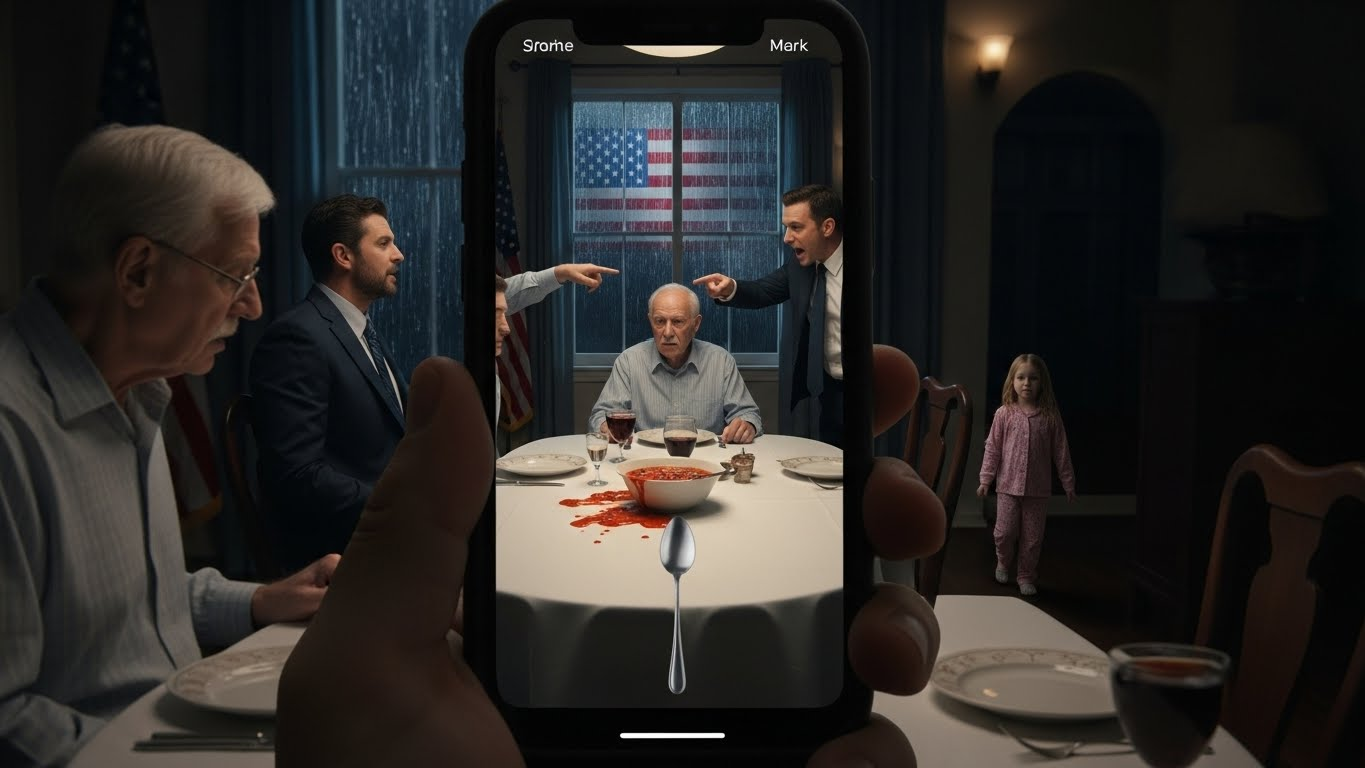
Hot beef stew flew across the table. It splattered onto the white tablecloth. It hit the expensive wine bottle Mark had brought. It landed on Dad’s shirt, soaking the napkin and staining his chest.
The spoon clattered to the floor.
Dad froze. He looked at the mess, his lip trembling. A single tear, thick and heavy, rolled down his cheek.
“God dammit!” Mark yelled, jumping up. “Look at this! Look at the mess!”
“Mark, sit down!” I shouted.
“No! I’m done!” Mark pointed a finger at Dad. “He’s disgusting, David! He can’t feed himself! He’s a hazard! You are selfish for keeping him here! He goes to Oak-haven tomorrow, or I call Adult Protective Services and report you for neglect!”
“He’s your father!” I screamed, standing up.
“He was my father!” Mark roared back. “Now he’s a vegetable that’s ruining our lives!”
The room was spinning. Sarah was crying into her hands. Emily was freezing in the corner. Dad was sobbing silently, looking at his shaking hands like they were foreign objects that had betrayed him.
I felt defeated. The air left my lungs.
Mark grabbed the papers and slammed them in front of me. “Sign it. Now. While the stew is still drying on the walls.”
I picked up the pen again. My hand was shaking as bad as Dad’s.
I was about to touch the paper.
Creak.
The sound came from the hallway.
We all turned.
Standing there, in her pink pajamas with the little cartoon unicorns, was Lily.
She was holding her favorite plastic bowl.
She didn’t look at Mark. She didn’t look at me. She didn’t look at the mess on the table.
She walked straight to her grandfather.
The room went dead silent. Even the rain outside seemed to stop.
She climbed up onto the chair next to him. She looked at his tear-stained face. She looked at his shaking hands.
And then, she did it.
Chapter 3: The Silence of the Unicorns
The silence that followed Lily’s entrance was heavier than the storm outside.
You have to understand, my brother Mark is a corporate lawyer. He makes his living by dominating rooms, by using his voice to crush opposition. He had just finished screaming at the top of his lungs, his face flushed red with self-righteous fury.
But when a seven-year-old girl in unicorn pajamas climbs onto a dining chair, even corporate lawyers shut up.
Lily didn’t say a word.
She didn’t acknowledge the shouting. She didn’t look at the nursing home brochures that were fanned out like a winning poker hand in front of me.
She just sat there, her small legs dangling off the side of the heavy oak chair. She placed her own plastic bowl on the table. It was empty.
Then, she reached for the large serving spoon in the center of the table.
“Lily, honey,” Emily whispered, stepping forward nervously. “Go back to bed. This isn’t… this isn’t for you to see.”
Lily ignored her mother.
With a concentration that looked almost surgical, she scooped a small amount of the beef stew from the serving tureen into her plastic bowl. Just a little bit. Maybe three bites worth.
Then, she turned to my dad.
Dad was still staring at his lap, the shame radiating off him in waves. He was a proud man. He had been a foreman at the steel mill. He had commanded crews. Now, he couldn’t command a spoon.
Lily reached out and touched his hand.
His shaking hand.
“Pop-pop,” she said. Her voice was tiny, clear, and cut through the tension like a laser.
Dad looked up. His eyes were red, rimmed with the exhaustion of fighting his own body.
“I’m hungry, Pop-pop,” Lily said. “But my hands are cold. Can you help me?”
I frowned. Her hands weren’t cold. The heating was on full blast.
Mark let out a sigh, checking his Rolex. “Oh for Christ’s sake, not now, Lily.”
“Mark, shut up,” I whispered. I don’t know where the voice came from, but it was dangerous.
Lily picked up her plastic spoon—it was pink, to match her pajamas. She scooped up a small piece of potato and a chunk of beef.
She didn’t move it toward her own mouth.
She moved it toward Dad’s.
But then she stopped. She pulled it back. She acted like she had missed. She let the spoon clatter into her bowl intentionally.
“Oops,” she said. “I’m clumsy today, Pop-pop. Like you.”
Dad blinked.
“We can be clumsy together,” she said.
She scooped it again. This time, she held the spoon with two hands. She leaned in close to him.
“Open up, Pop-pop. The airplane is coming for a landing.”
It was the game. The game he used to play with her when she was a toddler, before the tremors got bad. Before he became the “burden.”
Dad opened his mouth. He was trembling, terrified of making another mess.
Lily didn’t shove the food in. She waited. She waited for his tremor to swing left, and she moved her hand left. She synced her movement with his chaos.
She placed the spoon gently in his mouth.
He chewed. He swallowed.
No spill.
“Yummy?” she asked.
Dad nodded. Tears were streaming down his face again, but these were different.
“My turn,” Lily said.
She handed the pink spoon to Dad.
“Feed me, Pop-pop.”
My heart stopped. Mark scoffed audibly. “This is ridiculous. He’s going to poke her eye out.”
“One more word, Mark, and I will throw you through that window,” I said. I meant it.
Dad looked at the pink spoon. He looked at his granddaughter.
He took the spoon. His hand was vibrating violently.
Lily didn’t flinch. She leaned forward. She opened her mouth wide. She put her hands on his shaking cheeks to steady his head, effectively anchoring him.
Dad focused. I saw a look in his eyes I hadn’t seen in years. Determination. The steel mill foreman was back.
He fought the tremors. He fought the neurons misfiring in his brain. He guided that pink spoon toward her mouth.
It shook. It wobbled.
But Lily moved her head to meet it. She bridged the gap.
She took the bite.
“Mmm,” she hummed. “Good job, Pop-pop.”
Chapter 4: The Unraveling
Mark slumped back in his chair. The wind had been completely knocked out of his sails.
Sarah was openly weeping now, clutching a napkin to her face.
I looked down at the papers in front of me. The admission forms for Oak-haven. The “Do Not Resuscitate” clauses. The financial liability waivers.
Lily kept going.
One bite for Pop-pop.
One bite for Lily.
“You missed a spot,” she giggled as a drop of gravy hit Dad’s chin. She didn’t recoil in disgust like Mark had. She didn’t panic. She just took her thumb and wiped it away, then licked her thumb.
“Sauce is the best part,” she stated matter-of-factly.
It wasn’t just feeding. It was a dance. It was a partnership.
Where the adults saw a medical condition, she saw a game. Where we saw a broken machine, she saw her grandfather. Where we saw a mess, she saw… just dinner.
“He’s not eating because he can’t,” Lily said suddenly, without looking at us. She was addressing the room while looking at the stew. “He’s not eating because you guys are staring at him like he’s a monster.”
The words hung in the air.
Seven years old.
She had diagnosed the problem better than three adults with college degrees.
Stress exacerbates Parkinson’s. We all knew that. But we had created a pressure cooker environment, stared at him like hawks, and expected him to perform surgery.
“I…” Mark started, but his voice failed him. He looked at the wine stain on the tablecloth. Then he looked at Dad, who was actually smiling now as he chewed a piece of carrot.
I reached out and grabbed the papers.
The paper sounded loud as I crunched it into a ball.
“David?” Sarah asked, her voice trembling.
“He stays,” I said.
Mark looked up. The anger was gone from his eyes, replaced by something else. Shame? Exhaustion?
“David, be realistic,” Mark tried, but it was weak. “You can’t… Lily can’t feed him every meal. You have jobs. You have lives.”
“We’ll figure it out,” I said, standing up. I felt ten feet tall. “We get weighted utensils. We get spill-proof bowls. We stop treating dinner like a formal interrogation. We make it messy. If he spills, he spills. It’s just food, Mark. It’s just dirt. It washes off.”
I walked over to the trash can and threw the crumpled ball of paper in.
“We aren’t sending him away because he’s messy,” I said, turning back to them. “He wiped my ass when I was a baby. He cleaned up my vomit when I had the flu. He fed you, Mark, when you broke both your arms falling off that bike in high school. Remember?”
Mark flinched.
“He didn’t send us to a facility when we were inconvenient,” I said. “We don’t do it to him.”
Chapter 5: The Departure
The rest of the dinner was quiet, but peaceful.
Mark didn’t eat. He just drank his wine, watching Lily and Dad.
Sarah got up and started helping Emily in the kitchen, silently trying to atone for her earlier alliance with Mark.
When the meal was done, Dad was full. His shirt was a mess, yes. The table was a mess, yes. But he was full, and he was humming a little tune.
Lily hopped down from the chair. “I’m tired,” she announced.
“Go to bed, peanut,” I said, kissing her forehead. “You did… you did good today.”
She stopped at the doorway and looked at Mark.
“Uncle Mark?”
Mark looked up, startled. “Yeah, kiddo?”
“Pop-pop isn’t broken,” she said. “He just shakes. Like a maraca.”
She shimmied her hips to demonstrate a maraca shake, then turned and ran up the stairs.
Mark put his head in his hands. I think he might have been crying, but Mark doesn’t cry, so he was probably just rubbing his eyes very hard for a very long time.
Ten minutes later, Mark and Sarah were putting on their coats. The storm outside had settled into a steady, rhythmic rain.
“I’ll… I’ll look into the weighted silverware,” Mark said, not meeting my eyes. He pulled out his phone. “There’s a brand called Gyro-Lift or something. Supposed to cancel out the tremors. I’ll order it.”
It was an olive branch. A clumsy one, but an olive branch.
“Thanks, Mark,” I said.
Sarah hugged me. “I’m sorry, David. We just… we worry.”
“I know,” I said. “But worry can’t replace love.”
They left. I locked the door behind them. The house felt lighter. The air felt cleaner.
I walked back into the living room. Dad was in his recliner again.
“David?” he called out.
“Yeah, Dad?”
“Did I… did I make Mark mad?”
My heart broke all over again.
“No, Dad,” I said, kneeling beside him. “Mark’s just… Mark is just scared of getting old. You showed him it’s not so bad if you have the right people around you.”
Dad nodded, his eyes closing. “That little girl,” he whispered. “She’s got your mother’s spirit.”
“Yeah,” I smiled. “She does.”
Chapter 6: The Aftermath
The next few weeks were a battle, but a different kind of battle.
We weren’t fighting against Dad anymore; we were fighting with him.
The weighted spoons arrived three days later. Amazon Prime, courtesy of Mark. They looked like futuristic gadgets.
The first time Dad used them, he cried.
Not because he was sad, but because he could lift soup to his mouth without spilling. The gyroscope inside the handle counteracted his tremors. It wasn’t perfect, but it was dignity. And dignity is a powerful drug.
I posted a video of it on Facebook. Just a short clip of Dad eating cereal with the new spoon, with Lily cheering him on in the background.
I didn’t expect much. Maybe a few likes from cousins.
I woke up the next morning to 50,000 shares.
People from all over the world were commenting. Strangers were sharing their own stories of caring for parents with Parkinson’s, Alzheimer’s, ALS.
“Thank you for not giving up on him,” one comment read.
“This made me call my dad for the first time in ten years,” read another.
But the real change wasn’t on the internet. It was in our kitchen.
Dinner time became the main event. We stopped trying to have “civilized” adult meals. We started eating finger foods. We started using straws. We made “messy night” a tradition on Fridays where we all—me, Emily, Lily—ate without utensils just to make Dad feel normal.
Mark even came over one Friday.
He sat there, in his thousand-dollar suit, eating a sloppy joe with his hands. He got sauce on his tie.
Dad laughed. It was a raspy, wheezing laugh, but it was the best sound I’d ever heard.
“Look who’s the messy one now,” Dad teased.
Mark wiped his chin, smiling. “Yeah, yeah, old man. Eat your burger.”
Chapter 7: The Lesson of the Spoon
It’s been six months since that night.
Dad is still with us. He’s slower now. The bad days are more frequent than the good days. We know the end is coming. We aren’t delusional.
We know that eventually, the care he needs might exceed what we can give in this house.
But it wasn’t that night. And it wasn’t the next week. And it wasn’t this month.
We bought him time. We bought him love.
I watch Lily with him now. She reads to him when he can’t focus on the TV. She holds his hand when the tremors get so bad his whole body vibrates.
She isn’t afraid of the decay. She leans into it.
I realized something profound watching my seven-year-old daughter.
We adults are so obsessed with perfection. We want the clean house, the clean shirt, the clean death. We want to antisepticize the messy parts of life. We want to sign a paper and have professionals handle the “unpleasantness.”
But love is unpleasant.
Love is messy. Love is a stained tablecloth. Love is wiping gravy off a chin. Love is slowing down your own hunger to make sure someone else gets fed.
Lily taught me that I wasn’t protecting my father by trying to keep everything orderly. I was sterilizing him.
He didn’t need a sterile environment. He needed to be allowed to be messy and still be loved.
Chapter 8: The Legacy
Last night, I was tucking Lily into bed.
“Daddy?” she asked.
“Yeah, sweetie?”
“When I get old,” she said, looking at her ceiling, “will you feed me if I shake?”
I felt a lump in my throat the size of a grapefruit.
“I won’t be around when you’re old, honey,” I said gently. “I’ll be… I’ll be gone.”
She frowned, processing this. “Oh. Right.”
Then she looked at me with those fierce, intelligent eyes.
“Well,” she said. “Then I hope I have a granddaughter like me.”
I laughed. I couldn’t help it. “I hope you do too, Lily. The world needs more granddaughters like you.”
I kissed her goodnight and turned off the light.
I walked downstairs. The house was quiet. Dad was asleep in his room. Emily was reading on the couch.
I went into the dining room.
I looked at the table. The mahogany still had a faint, dark ring where the wine bottle had sat that night. The stain on the rug never fully came out.
I ran my hand over the imperfections.
I wouldn’t change them for anything.
Because every time I look at that stain, I don’t see a mess.
I see the moment my family was saved.
I see the moment I put down the pen and picked up the spoon.
And if there is one thing I want you to take away from this story, it is this:
Don’t sign the papers when you’re angry. Don’t value your carpet more than your father. And never, ever underestimate the wisdom of a seven-year-old in unicorn pajamas.
Sometimes, the smallest hands are the only ones strong enough to hold a family together.