My “Dying” Mother Stole 20 Years of My Life and Ruined My Marriage. When I Found What Was Hidden in Her Cedar Chest, I Finally Walked Out.
Chapter 1: The Bell and the Cage
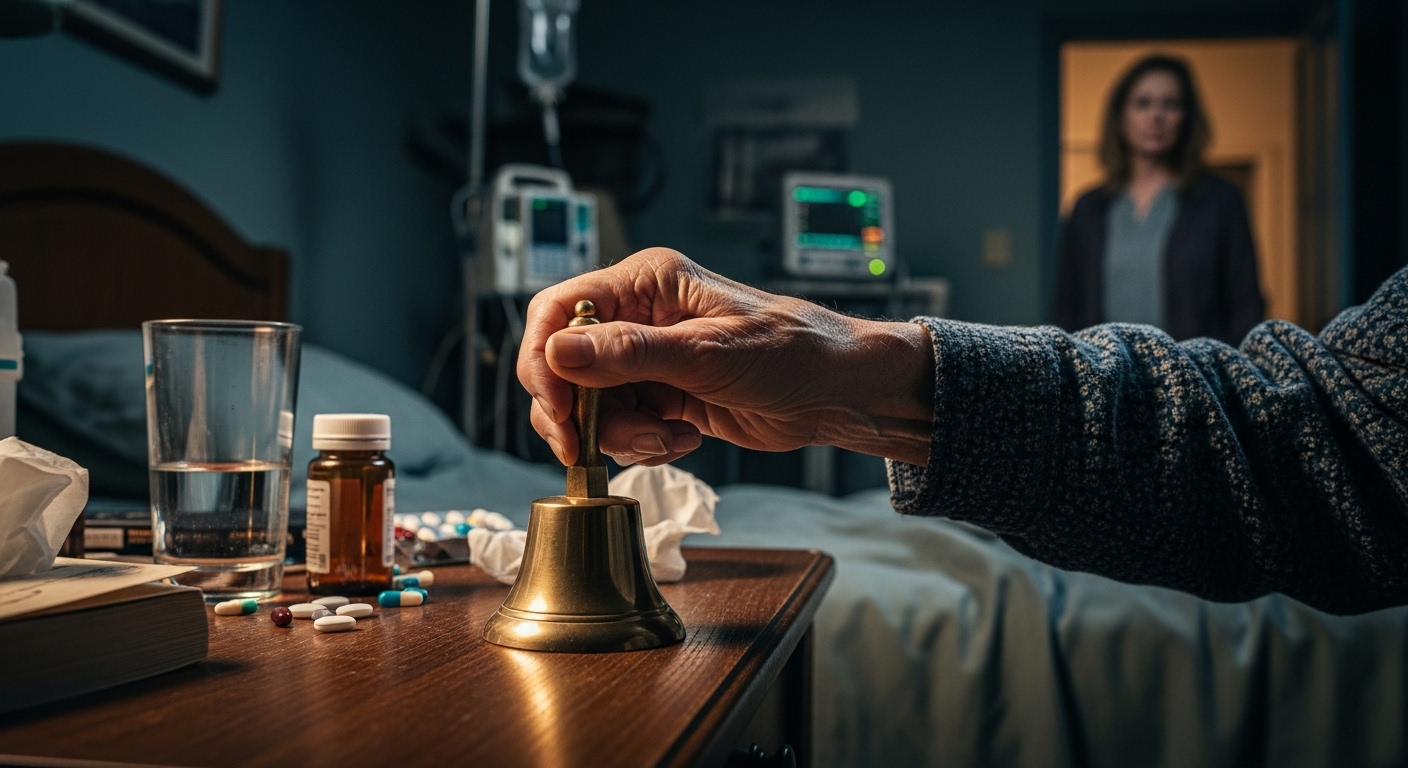
The sound was not loud, but it cut through the silence of the house like a serrated knife. Ding. Ding.
Sarah froze in the middle of the kitchen, her hand hovering over the sponge in the sink. It was 3:14 AM. The digital clock on the microwave glowed a hostile green in the darkness. Sarah closed her eyes, exhaling a breath that rattled in her chest. She was fifty-two years old, but in this house, under the peeling wallpaper and the scent of stale lavender and sickness, she felt like a frightened child.
Ding. Ding. Ding.
“I’m coming, Mother,” Sarah whispered to the empty kitchen, her voice raspy from lack of use.
She wiped her hands on her apron—she wore it even at night, sometimes falling asleep in it on the recliner downstairs just in case—and trudged up the stairs. Her knees popped with every step. She was a handsome woman once, with vibrant auburn hair and eyes the color of sea glass. Now, the hair was streaked with iron-gray, pulled back in a severe, fraying bun, and her eyes were dull, rimmed with the permanent shadows of chronic exhaustion.
Sarah entered the master bedroom. It was stiflingly hot. Martha insisted the heat be turned up to seventy-eight degrees, even in October.
“Water,” Martha rasped. She was propped up against three pillows, her frail body looking lost in the floral duvet. At seventy-eight, Martha looked ninety. Her skin was like parchment paper, translucent and webbed with blue veins. To the outside world, to the neighbors and the church deacons, Martha was a saintly figure, a poor widow battling a mysterious, degenerative heart condition with grace.
To Sarah, she was the anchor that had dragged her to the bottom of the ocean.
“Here, Mom,” Sarah said, lifting the glass with a bendy straw to her mother’s lips.
Martha took a tiny sip, then turned her head away sharply. “Too cold. It hurts my teeth. You know I can’t have ice water, Sarah. Are you trying to kill me?”
“It’s tap water, Mom. It’s room temperature.”
“It’s freezing,” Martha snapped, her voice suddenly finding a surprising amount of strength. “Go warm it up. And fix my blankets. My feet are exposed.”
Sarah did as she was told. She always did. For twenty years, this had been her life. The routine was a cage made of medicine schedules, nebulizer treatments, and that accursed brass bell.
As she tucked the blankets around Martha’s feet, Sarah’s gaze drifted to the nightstand. There was a framed photo of Sarah from twenty-five years ago, standing next to Mark. Mark, with his broad shoulders and kind smile. Mark, who had loved Sarah more than anything.
Martha followed her gaze. “He wasn’t good for you, Sarah. You remember that, don’t you? Leaving you when things got hard. A fair-weather husband.”
Sarah stiffened. “He didn’t want to leave, Mom. He… he just couldn’t handle the situation.”
“He couldn’t handle that you had responsibilities,” Martha corrected, her eyes glittery and hard. “He was selfish. Unlike you. You’re a good girl. You know your duty.”
Sarah retreated downstairs, the ghost of an old argument rising in her throat. She sat at the kitchen table and pulled a crumpled envelope from her pocket. It had arrived yesterday.
It was an invitation. The Maplewood Community Art Center was hosting a “Local Legends” showcase. The curator, a woman Sarah had gone to college with a lifetime ago, had remembered Sarah’s old landscapes. She wanted to display three of Sarah’s paintings.
It was a small thing. A tiny, insignificant thing in the grand scheme of the world. But to Sarah, it felt like a life raft.
The next morning, while feeding Martha her oatmeal, Sarah gathered her courage.
“Mom,” she started, staring at the spoon. “I received a letter yesterday. The Art Center… they want to show some of my old work next Saturday evening. It’s just for three hours. Mrs. Gable next door said she would come sit with you.”
The spoon stopped halfway to Martha’s mouth. The silence stretched, heavy and suffocating.
“Leave?” Martha said, the word coming out as a wheeze. “You want to leave me? Next Saturday?”
“It’s just three hours, Mom. I haven’t been out in months. And Mrs. Gable is a retired nurse, she knows what to do if—”
Suddenly, Martha dropped the spoon. It clattered into the bowl, splattering oatmeal onto the pristine white sheets. Martha clutched her chest, her mouth opening in a silent scream. Her eyes rolled back slightly.
“Mom!” Sarah dropped the bowl and scrambled to the bedside. “Mom! Breathe! Is it the palpitations?”
“Chest… heavy…” Martha gasped, gripping Sarah’s wrist with a strength that bruised. “Darkness… Sarah… don’t let me die alone…”
“I’m here! I’m not going anywhere!” Sarah cried, panic flooding her veins, washing away the dream of the art gallery instantly. She fumbled for the blood pressure cuff, her hands shaking. “I’ll call Dr. Evans. Just breathe.”
“No… no doctors…” Martha moaned, her grip tightening. “Just stay. Promise me… promise you won’t leave me with that stranger.”
“I promise!” Sarah sobbed, tears leaking from her eyes. “I won’t go. I’ll call them and cancel right now. Just please, hold on.”
Within twenty minutes, after Sarah had made the call to the gallery and declined the invitation in a voice devoid of hope, Martha’s breathing miraculously stabilized. The color returned to her cheeks. She settled back into the pillows, looking small and victorious.
“It’s for the best, Sarah,” Martha murmured, closing her eyes. “Your paintings were never that good anyway. They were just hobbies. Who would look after me if you were off playing artist? God has a plan for you, and it’s here.”
Sarah sat in the chair by the window, watching the autumn leaves fall in the front yard. A flashback hit her, visceral and sharp.
Fifteen years ago. The living room. Mark was packing a suitcase.
“She’s not sick, Sarah! Or at least, not as sick as she says!” Mark had shouted, his face red with frustration. “Every time we book a vacation, she falls ill. Every time we have a date night, she has a ‘spell.’ She is eating you alive.”
“She’s my mother, Mark! She has a weak heart! How can you be so cruel?” Sarah had screamed back, defending the woman upstairs.
“It’s not cruelty, it’s survival!” Mark had grabbed her shoulders. “Come with me. We can hire a nurse. We can put her in a home where she gets professional help. But if you stay here, you will die here. Not physically, but your soul will rot.”
Sarah had pulled away. She chose the guilt. She chose the duty.
Mark had walked out the door. Sarah remembered running upstairs, crying, to find Martha sitting at the top of the landing. Martha wasn’t crying. She wasn’t having a spell. She was smiling—a cold, thin smile that didn’t reach her eyes.
“Now we don’t have to share you,” Martha had whispered.
Back in the present, Sarah wiped a tear from her cheek. She looked at her mother, sleeping peacefully now that she had secured her daughter’s attendance for another evening.
The cage was locked. And Sarah had thrown away the key years ago.
Chapter 2: The Diagnosis and the Cedar Chest
Three days after the “episode,” Dr. Evans called.
Dr. Evans was new. He had taken over the practice after old Dr. Miller retired. Dr. Miller had been Martha’s doctor for thirty years—a kindly, easily manipulated man who often prescribed medication just to stop Martha’s complaining. But Dr. Evans was different. He was sharp, specialized in geriatric toxicology, and he didn’t care for charm.
“Sarah, I need you to come into the office today,” Dr. Evans said over the phone. “Alone. Leave your mother with a caregiver.”
“I… I can’t,” Sarah stammered. “She gets very anxious when I leave.”
“This is not a request, Sarah. It concerns your mother’s latest blood work. It is urgent. I have arranged for a visiting nurse to be there at 2:00 PM. You will be here at 2:30.”
The authority in his voice left no room for argument. When the nurse arrived—a stern woman named Brenda who looked like she could bench press a Buick—Martha didn’t dare throw a fit. She just glared at Sarah with pure venom.
“Don’t be long,” Martha hissed. “If I die while you’re gone, it’s on your head.”
At the clinic, Dr. Evans didn’t waste time. He sat Sarah down and turned his computer monitor toward her.
“Sarah, I’ve reviewed Martha’s history going back ten years. And I’ve analyzed the blood samples we took last week.” He paused, taking off his glasses. “Your mother does not have Congestive Heart Failure.”
Sarah blinked, the words not computing. “What? But… she has attacks. She can’t breathe. Her heart races.”
“She has mild hypertension, common for her age. But her heart is strong. Stronger than yours, probably,” Dr. Evans said grimly. “However, I found high levels of beta-blockers and sedatives in her system. Levels that fluctuate wildly.”
“She takes medication for her anxiety…”
“No, Sarah. She is overdosing herself systematically,” Dr. Evans pointed to a chart. “See this spike? This correlates to last Tuesday. Did anything happen last Tuesday?”
“I… I told her I wanted to go to an art show,” Sarah whispered, a cold dread pooling in her stomach.
“She is crushing pills into her food to induce lethargy and bradycardia—slow heart rate,” Dr. Evans said. “She is making herself sick on purpose. It’s a form of Munchausen, but directed at controlling you. She isn’t dying, Sarah. She’s keeping you hostage.”
The drive home was a blur. Sarah felt like the world was tilting on its axis. Every memory of the last twenty years—the missed weddings, the lost career, the divorce—flashed before her eyes, tainted by this new truth.
She isn’t sick.
When Sarah arrived home, Brenda the nurse gave a curt nod. “She slept the whole time. Faking sleep, mostly. Watching me through her eyelashes.”
Sarah went upstairs. Martha was ‘asleep’. Sarah didn’t wake her. Instead, she went to the spare room, which used to be her father’s study. In the corner sat a large, antique cedar chest. It was always locked. Martha said it contained “painful memories” of Sarah’s father and financial documents.
Painful memories.
Sarah went to the kitchen junk drawer. She knew where the spare key was. She had seen Martha move it once years ago.
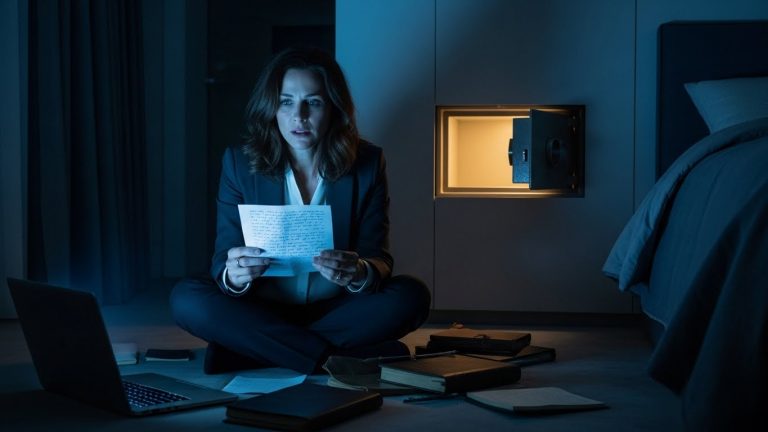
Heart hammering against her ribs like a trapped bird, Sarah unlocked the chest. The smell of cedar and old paper wafted up.
Inside, there were no financial documents. There were stacks of letters. Bundles of them.
Sarah picked up a bundle tied with blue ribbon. Her breath hitched. The handwriting was unmistakable. It was Mark’s.
She tore open the top one. It was dated six months after he left.
My Dearest Sarah, I know you’re angry. I know you think I abandoned you. But I’ve written every week. Why won’t you answer? I’ve found a specialist in Chicago who says he can help Martha. We can move her there. I want to save our marriage. Please, Sarah. Call me.
Sarah opened another. Dated two years later.
Sarah, I saw you at the grocery store today, but you looked right through me. Your mother called my lawyer again. She threatened to sue me for elder abuse if I tried to contact you. She says you hate me. If that’s true, tell me yourself. Don’t let her speak for you.
There were dozens. Birthday cards. Anniversary cards. Letters from gallery owners asking where she had gone. Letters from friends she thought had forgotten her.
Martha had intercepted the mail. For fifteen years.
Sarah dropped the letters. Her hands were shaking so violently she couldn’t clasp them together. It wasn’t just selfishness. It was a systematic dismantling of her reality. Martha hadn’t just needed care; she had needed to consume Sarah completely.
A floorboard creaked behind her.
Sarah turned. Martha was standing in the doorway. She wasn’t using her cane. She stood straight, her eyes dark and alert.
“You shouldn’t be in here, Sarah,” Martha said. Her voice wasn’t raspy. It was cold, clear, and dangerous. “That is private property.”
Chapter 3: The Rebellion
For a moment, Sarah couldn’t speak. She looked at the woman who had birthed her, the woman she had bathed, fed, and worshipped for two decades. She didn’t see a mother. She saw a monster in a floral nightgown.
“You stole them,” Sarah said, her voice trembling with a rage so new and hot it felt like lava. “Mark. My friends. My life. You stole it all.”
Martha didn’t flinch. She stepped into the room, kicking the door shut behind her. “I protected you. Mark was a weak man. He would have left you eventually for some younger, prettier thing. I saved you the heartbreak.”
“You lied!” Sarah screamed, grabbing a handful of letters. “You aren’t sick! Dr. Evans told me everything. The pills. The fake seizures. You’re healthy!”
Martha’s face twisted. The mask of the frail old woman slipped completely. “Dr. Evans is a fool. And you are an ungrateful child. After everything I sacrificed to raise you? I gave you life!”
“And then you took it back!” Sarah retorted.
She pushed past her mother, clutching the letters to her chest.
“Where are you going?” Martha demanded, panic finally edging into her voice.
“I’m going out,” Sarah said. “I’m going to buy groceries. Alone. And I’m going to be gone for two hours.”
“If you walk out that door, I’ll have a heart attack! A real one!” Martha shrieked. “I can feel it coming on! My arm is numb!”
“Then call 911,” Sarah said, not looking back. “I’m sure the paramedics will be happy to see you again.”
Sarah drove to the grocery store, but she sat in the parking lot for an hour, reading the letters, sobbing until her throat felt raw. Mark hadn’t abandoned her. He had fought for her. And she had been too blind, too brainwashed to see it.
She wiped her face. She looked in the rearview mirror. The gray woman staring back looked pathetic. Sarah opened her purse, found a tube of red lipstick she had bought five years ago and never worn, and applied it. It was a slash of war paint.
When she returned to the house, the atmosphere was toxic. The house was silent.
Sarah walked into the kitchen. The smell hit her instantly. Feces.
Martha was sitting in her wheelchair in the middle of the living room. She had soiled herself. She sat there, arms crossed, staring at the TV, sitting in her own filth.
“Look what you made me do,” Martha said calmly, not looking at Sarah. “You left me alone. I couldn’t get to the bathroom. This is your fault. Clean it up.”
It was a power move. The ultimate degradation. She was forcing Sarah to literally clean up her mess, to bow down and serve.
Sarah stared at her. In the past, she would have rushed forward, apologizing, crying, begging for forgiveness while she scrubbed.
Today, Sarah stood still.
“No,” Sarah said.
Martha turned her head, eyes wide. “What did you say?”
“I said no. You can walk. I saw you standing in the study without your cane. You soiled yourself on purpose to punish me. I am not cleaning it.”
“You will clean it!” Martha screamed, her face turning purple. “I am your mother! You are my servant! That is what you are here for!”
“Not anymore.” Sarah turned and walked toward the stairs. “I’m packing a bag.”
“You can’t leave me!” Martha howled, the sound echoing like a demon’s shriek. “I own this house! I own you!”
Sarah went to her room—the small, cramped guest room she had slept in for years. She pulled out a dusty suitcase from the closet. She packed blindly. Clothes, her sketchbook, the letters.
She heard a crash downstairs. Then the sound of shattering glass.
Sarah zipped the bag. Her heart was pounding, but her mind was clear. She wasn’t just leaving a house; she was escaping a cult of one.
She walked down the stairs. The living room was a wreck. Martha had thrown a vase against the wall. But Martha wasn’t in the wheelchair.
She was standing by the front door, blocking the exit. In her hand, she held a large bottle of prescription sleeping pills—the ones she had been using to drug herself. The cap was off.
“You take one more step,” Martha said, her voice trembling with manic desperation, “and I swallow the whole bottle. Right here. You’ll watch me die, Sarah. And it will be your fault. You’ll live with that guilt forever. Everyone will know you killed your mother.”
Chapter 4: The Severing and The Breath
The air in the hallway was electric. The standoff was absolute.
Sarah looked at the bottle. It was full. Enough to kill a horse, let alone an elderly woman. Martha’s eyes were wild, dilated with adrenaline. She wasn’t bluffing about the action, but her motive wasn’t despair—it was spite. She would rather destroy herself than lose her possession.
Sarah tightened her grip on the handle of her suitcase. The old Sarah would have dropped the bag. The old Sarah would have fallen to her knees, promised to never leave, promised to burn the paintings, promised to be the slave forever just to save Martha from herself.
But the old Sarah had died when she read Mark’s letters.
Sarah took a step forward.
“Do it,” Sarah said softly.
Martha blinked. “What?”
“I said, do it. If that is your choice, Martha, then take them.” Sarah’s voice didn’t shake. “I have given you twenty years. I gave you my youth. I gave you my marriage. I gave you my art. I have nothing left to give you.”
“I… I’ll really do it!” Martha poured a handful of pills into her palm. Her hand shook, scattering a few on the floor. “I’ll die! Right now!”
“That is a decision between you and God,” Sarah said, continuing to walk toward the door. “But I am not staying to watch. And I am not staying to stop you. I am taking the rest of my life back.”
Sarah reached the door. Martha stood there, stunned, the pills clutched in her hand. She had never encountered resistance. She didn’t know how to process a victim who refused to be victimized.
Sarah reached around her mother and opened the door. The cold autumn air rushed in, smelling of rain and dead leaves. It smelled like freedom.
“You ungrateful bitch!” Martha screamed, lunging at her. She didn’t take the pills. She threw the bottle at Sarah’s head. It missed, smashing against the doorframe, scattering pills like white confetti across the porch. “I curse you! You’ll never be happy! You’ll die alone!”
Sarah stepped out onto the porch. She didn’t look back. She walked down the steps, the gravel crunching under her boots.
She got into her rusty sedan. As she fumbled for her keys, she saw Martha in the doorway, screaming silently, her face twisted into a mask of pure hatred. She looked like a gargoyle.
Sarah started the car. She backed out of the driveway.
She didn’t just drive away, though. She pulled over two blocks down. Her hands were shaking uncontrollably now. She picked up her phone and dialed 9-1-1.
“911, what is your emergency?”
“My name is Sarah Miller. I need a welfare check on my mother, Martha Miller, at 42 Oak Street. She is threatening suicide and has access to medication. She is a danger to herself. Please send professionals.”
“Are you with her now, ma’am?”
“No,” Sarah said, looking at the road stretching out before her. “I’m not. I’m gone.”
She hung up. It was the hardest thing she had ever done. But by calling, she had done her duty. She had handed the burden to those equipped to carry it.
Chapter 5: The Aftermath
The fallout was immediate and brutal.
Small towns talk. For weeks, Sarah was the villain. The church ladies whispered in the grocery store aisles. “Abandoned her poor sick mother.” “Left her to rot.” “Selfish.”
Martha had been taken to the hospital on a 72-hour psychiatric hold after the police found her screaming on the porch. From there, since she refused to pay for private care (despite having a substantial savings account Sarah knew nothing about), she was transferred to a state-run assisted living facility.
Sarah didn’t visit. Not for the first month. She stayed in a cheap motel, then found a tiny studio apartment above a bakery in the next town over.
She had to rebuild herself from zero. She got a job at a library shelving books. It was quiet, peaceful work. No bells. No screaming.
Gradually, the truth came out. Dr. Evans spoke to Sarah’s aunt, breaking HIPAA regulations slightly to hint that Martha was not the victim she claimed to be. The neighbors began to notice that “sick” Martha was terrorizing the nurses at the facility with the energy of a linebacker. The narrative shifted.
Six months later.
Sarah stood in front of a canvas. It was a landscape—a storm breaking over a dark ocean, with a single beam of light piercing the clouds. It was violent and beautiful.
Her phone buzzed. It was a text from Mark.
Coffee is still on for 2 PM? – M
Sarah smiled. They had met twice. It wasn’t a romance yet. Too much time had passed, too much damage. But it was a friendship. A rediscovery. He was divorced now, too. They were two survivors comparing scars.
Yes. See you there, she typed back.
But first, she had one last errand.
Sarah drove to the “Shady Pines Care Center.” The smell of antiseptic triggered a momentary panic attack, but she breathed through it.
She found Martha in the common room. Martha was in a wheelchair, staring out the window. She looked smaller now. Defeated. The staff didn’t tolerate her tantrums, so she had retreated into silence.
“Hello, Mother,” Sarah said.
Martha turned slowly. Her eyes narrowed. “You came back. I knew you would. You ran out of money, didn’t you? You need me.”
Sarah laughed. It was a genuine, light sound. “No, Mom. I have a job. I have an apartment. I’m painting again.”
Martha scowled. “Then why are you here? To gloat?”
“No,” Sarah said. She reached out and placed her hand on Martha’s cold, withered hand. Martha tried to pull away, but Sarah held firm. “I came to tell you that I forgive you.”
Martha blinked, confused. “Forgive me? I did nothing wrong!”
“I forgive you,” Sarah repeated firmly. “Not because you deserve it. But because I can’t carry the hate anymore. It’s too heavy. And I have a lot of living left to do.”
Sarah let go of her hand. “I won’t be visiting again, Mom. The nurses here take good care of you. You have what you always wanted—people waiting on you hand and foot. Goodbye.”
Sarah walked away.
“Sarah!” Martha yelled after her, her voice cracking. “Sarah, come back here! I need my water! Sarah!”
Sarah didn’t stop. She pushed through the double doors and stepped out into the spring sunshine. The air was sweet.
She took a deep breath. In, out.
For the first time in fifty-two years, the air didn’t belong to her mother. It didn’t belong to the debt. It belonged to her.
She checked her watch. 1:45 PM. She didn’t want to be late for coffee