THE LIE BURIED IN THE PENTHOUSE: My Parents Claimed My Brother Died of a Heart Attack, But The Letter I Found In His Safe Just Destroyed Their Empire
Chapter 1: The Facade of Mourning
The scent of lilies in the funeral home was so thick it felt like a physical weight, pressing down on my chest, competing for space with the grief that had lodged itself in my throat three days ago. Lilies and floor wax. That was the smell of death in high society.
I stood by the entrance of the Viewing Room A at the Chatsworth Funeral Home in Greenwich, Connecticut. My hands were trembling, so I clasped them tightly in front of my black dress—a dress I had bought off the rack at Macy’s two days ago because my mother, Margaret, had deemed my existing wardrobe “too pedestrian for a Sterling funeral.”
“Stand up straight, Elena,” a voice hissed in my ear.
I didn’t need to turn around to know it was her. My mother’s presence was always preceded by the click of expensive heels and the scent of Chanel No. 5, applied heavily enough to mask any human scent beneath it.
“I am standing straight, Mother,” I whispered, my eyes fixed on the closed mahogany casket at the front of the room. It was polished to a mirror shine, reflecting the recessed lighting above. It looked cold. It looked nothing like Daniel.
“You’re slouching,” she corrected, her hand darting out to pinch the fleshy part of my upper arm. It was a sharp, practiced pinch—one she had perfected over forty years. It didn’t bruise the skin, but it bruised the spirit. “Look at the Mayor over there. He’s walking toward your father. Pull yourself together. You are embarrassing us.”
“Embarrassing you?” I choked out, turning to look at her.
Margaret Sterling was seventy-two, but thanks to the best plastic surgeons in Manhattan, she looked a frozen fifty. Her face was a mask of stoic perfection. There were no tears in her eyes. Her makeup was flawless. She looked like she was hosting a garden party, not burying her only son.
“Daniel is dead, Mother,” I said, my voice cracking. “I’m allowed to cry.”
“Not this loudly,” she snapped, smoothing the lapel of her Chanel suit. “And not when the Senator is arriving in ten minutes. We have an image to uphold. People look to the Sterlings for strength, not… whatever this mess is.” She gestured vaguely at my tear-streaked face.
I looked away, biting my lip until I tasted iron. This was the dynamic. It had always been the dynamic. Daniel was the Golden Child, the brilliant heart surgeon, the handsome philanthropist, the one who could do no wrong. I was Elena, the “Invisible Child,” the disappointment who worked as a librarian, drove a Honda, and got divorced at forty.
But Daniel was in that box. And the Sterlings were treating it like a PR crisis.
I watched my father, Richard Sterling, shaking hands with the Mayor near the front of the room. Richard was tall, imposing, with silver hair that looked like it was spun from steel. He wasn’t crying either. He was nodding solemnly, accepting condolences with the grace of a monarch accepting tribute.
I walked away from my mother, needing to be close to him. To Daniel.
As I approached the casket, I overheard a conversation between two women in pearls standing near the floral arrangements.
“…so tragic,” one whispered. “Only forty-eight. A massive aneurysm, they said. Just dropped dead in his penthouse.”
“At least it was quick,” the other replied. “The Sterlings said he didn’t suffer. It’s a blessing, really, that it wasn’t something scandalous.”
I froze.
Aneurysm?
My blood ran cold. I knew how Daniel died. I was the one who identified the body because my parents “couldn’t bear the trauma.” I saw the empty bottle of prescription painkillers. I saw the empty bottle of scotch. I saw the note that the police had bagged as evidence.
Daniel hadn’t had an aneurysm. He had killed himself.
I felt a wave of nausea so violent I had to grab the edge of a pew to steady myself. They were lying. Even in death, they were rewriting his history to fit their narrative. Suicide was messy. Suicide implied unhappiness. And the Sterlings were never unhappy.
I looked back at my parents. Richard was now laughing softly at something the Mayor said—a polite, controlled chuckle. Margaret was directing the funeral director to adjust a wreath of white roses that was slightly off-center.
They weren’t mourning him. They were curating him.
The rest of the service was a blur of eulogies given by people who didn’t really know Daniel. They spoke of his steady hands in the operating room, his charitable donations, his perfect golf swing. No one spoke of his laugh, which was rare and loud. No one spoke of how he used to sneak me candy when we were kids because Mother put us on strict diets. No one spoke of the sadness that had haunted his eyes for the last decade.
After the service, the reception was held at the “Glass House”—my parents’ sprawling modernist mansion on the cliffside. It was an architectural marvel of steel and floor-to-ceiling windows, beautiful to look at but impossible to live in. There was nowhere to hide in that house. You were always on display.
I managed to escape the suffocating condolences by volunteering to go to Daniel’s penthouse in the city.
“We need it sanitized,” my father had told me as he handed me the keys, swirling his scotch. “Get his personal effects out. We’re listing it on Monday. The market is hot right now, and we don’t want it sitting empty.”
“He was buried two hours ago, Dad,” I had said, stunned.
“Sentimentality doesn’t pay the property taxes, Elena. Go. Make yourself useful for once.”
Now, standing in Daniel’s penthouse on the Upper East Side, the silence was deafening. The apartment was just like my parents’ house—pristine, expensive, and cold. Beige leather furniture that looked untouched. Abstract art that cost more than my annual salary.
I walked into his bedroom. This was where it happened. The police had cleaned up the scene, but the air still felt heavy.
I sat on the edge of his bed, clutching his pillow to my chest, finally allowing myself to sob. I cried for the brother who used to protect me from Richard’s temper. I cried for the man who had achieved everything the world told him to want, only to find it empty.
“Why, Danny?” I whispered into the darkness. “Why didn’t you call me?”
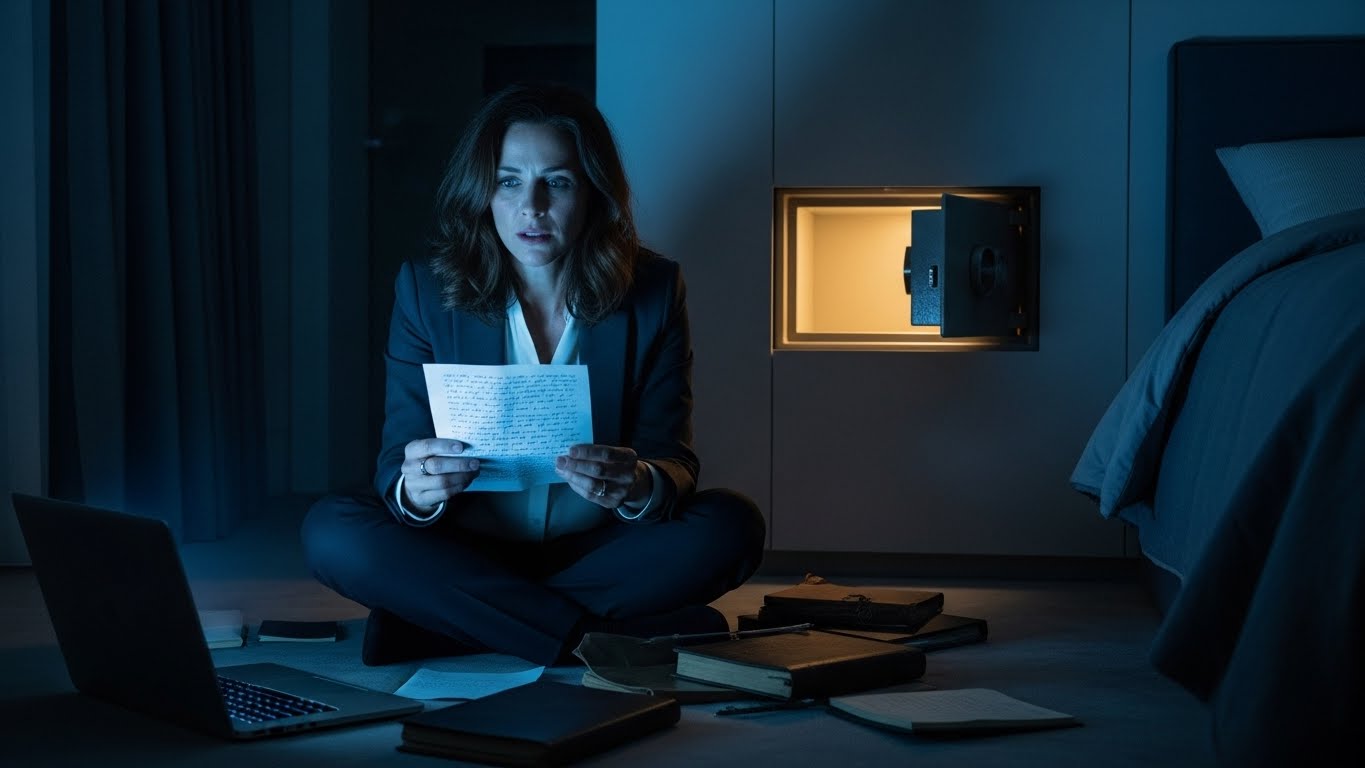
I stood up to wipe my face and knocked a stack of medical journals off his nightstand. As I bent to pick them up, I noticed something odd about the wall panel behind the nightstand. It was slightly uneven.
I ran my fingers along the molding. There was a small groove. I pressed it.
With a soft click, a hidden panel popped open.
My heart hammered against my ribs. A wall safe.
I didn’t know the combination. I tried his birthday. Nothing. I tried our parents’ anniversary. Nothing. Then, I remembered the one date that actually meant something to him. The day we built a treehouse in the backyard, the only project we ever finished before Richard had it torn down because it was an “eyesore.”
0-7-1-2.
The light turned green. The heavy door swung open.
Inside, there were no stacks of cash. There were no diamonds or watches.
There was just a stack of worn, leather-bound notebooks and a single, sealed envelope with my name on it: Elena.
My hands shook as I took the envelope. I sat on the floor, the cold hardwood biting into my legs, and tore it open.
“El,” the letter began, in Daniel’s erratic, doctor scrawl.
“If you’re reading this, I’m finally free. I’m sorry I left you behind. You were the only real thing in my life. But I can’t do it anymore. I can’t be their trophy. I can’t be the perfect surgeon. I hate the sight of blood, El. I always have. I wanted to build things. I wanted to smell sawdust, not antiseptic.
They knew. I told them on Sunday. I told them I was drowning. I begged them to let me step down, to go to a clinic. Dad told me to stop being a coward. Mom told me to think about the gala.
They don’t love us, Elena. They only love the reflection of themselves they see in us. You escaped because they thought you were broken. I was the one who broke. The journals explain everything. Burn the house down, El. Don’t let them turn me into a statue. Tell the truth.
Love, Danny.”
I stared at the letter, the tears drying on my cheeks, replaced by a heat that started in my stomach and spread to my fingertips.
Indignation. Pure, white-hot indignation.
They knew. He had asked for help, and they had worried about a gala.
I reached into the safe and pulled out the first journal. It was dated 1985. Daniel would have been ten years old.
I opened it.
“Dad made me practice sutures on a grape for four hours today. I wanted to go play catch. He said surgeons don’t play catch. Surgeons have steady hands. If I drop the needle, no dinner. I’m so hungry.”
I grabbed the next one. 2005.
“Chief of Surgery. Everyone is clapping. I feel like vomiting. I’m a fraud. I just want to sleep and never wake up. Mom called. She didn’t ask how I was. She asked if the title comes with a raise so I can buy into the Hampton’s club.”
I read for hours. Forty years of torture. Forty years of a soul being ground down into dust, day by day, expectation by expectation.
Then, at the bottom of the safe, I found a USB drive taped to a piece of paper that said: “The Voicemail – Oct 25th.”
I pulled out my laptop and plugged it in. There was one audio file. I clicked play.
Daniel’s voice filled the room, slurred and thick with panic.
“Mom, Dad… please. It’s the dark again. I can’t… I can’t go into the hospital tomorrow. I’m scaring myself. I have the pills on the counter. Please, just come over. Just tell me it’s okay to stop. I just want to stop.”
Then, a pause. And the sound of a notification. A text message reply.
I opened the text log file saved next to the audio.
Sender: Mother Time: 11:42 PM Message: “Stop being dramatic, Daniel. You are hysteria personified. Take a sleeping pill and go to work. Do not ruin the gala this weekend. We have the Legacy Award to accept.”
I slammed the laptop shut.
The scream that ripped from my throat wasn’t sadness. It was war.
They killed him. They didn’t pull the trigger, or swallow the pills, but they handed them to him. They watched him drown and complained that his splashing was getting them wet.
I looked at the stack of journals. “Burn the house down, El.”
I stood up. I packed the journals, the letter, and the laptop into my bag.
The Sterling family valued reputation above all else. They valued the “perfect image.”
Well, I was about to introduce them to the ugly truth.
Chapter 2: The Echoes of Silence
The drive back to Connecticut felt different. The fear I had lived with my entire life—the fear of my father’s disapproval, the fear of my mother’s criticism—was gone. It had been incinerated by the contents of my bag.
I arrived at the Glass House around 8:00 PM. The reception was over. The caterers were loading their trucks.
I walked into the massive living room. Richard and Margaret were sitting in their usual spots—Richard in his Eames chair reading the Wall Street Journal, Margaret on the beige sofa, reviewing a guest list with a red pen.
They looked remarkably composed for two people who had just buried their son.
“You’re back,” Margaret said without looking up. “Did you clear the closet? The realtor is coming at nine tomorrow.”
“I found the safe,” I said.
The rustling of the newspaper stopped. Richard lowered the paper slowly. His steel-gray eyes locked onto mine. “The safe?”
“Daniel’s safe,” I said, walking further into the room. I dropped my bag onto the glass coffee table with a heavy thud. “I found his journals. And the letter he left for me.”
Margaret finally looked up. Her expression wasn’t one of concern, but of calculation. “Those are personal effects, Elena. They belong to the estate. Hand them over.”
“He wrote to me, Mother. He told me everything.”
“He was sick,” Richard said, his voice deep and dismissive. “He wasn’t in his right mind. Whatever he wrote, it was the depression talking.”
“Was it the depression talking when he was ten years old and you starved him for dropping a suture needle?” I asked, my voice trembling with rage. “Was it the depression talking when he begged you for help three nights ago, and you told him not to ruin your gala?”
Silence. Absolute, suffocating silence.
Margaret stood up, her face flushing a delicate shade of pink. “How dare you? We did everything for him. We gave him a life most people dream of. Success. Wealth. Respect.”
“He hated it!” I screamed. “He wanted to be a carpenter! He wanted a simple life! You forced him into a mold that suffocated him!”
“We made him great!” Richard roared, standing up to join her. He towered over me, a tactic that used to make me cower. Now, I just glared back. “We pushed him to achieve his potential. If we had left him to his own devices, he would be a nobody. Like you.”
The words hung in the air. Like you.
“Yes,” I said quietly. “A nobody. But a living nobody. Daniel is dead, Dad. He is dead because he couldn’t be you.”
I pulled the laptop out of the bag. “I have the voicemail. And your text response.”
Margaret’s eyes widened. For the first time, I saw fear. Not guilt—fear. Fear of exposure.
“Elena,” she said, her voice dropping to a dangerous purr. “Think very carefully about what you are doing. We are the Sterlings. We are pillars of this community.”
“You are monsters,” I spat.
“If you show those to anyone,” Richard threatened, stepping closer, “we will cut you off completely. You will not see a dime of the inheritance. You will be dead to us. You will be erased from this family.”
“I was never part of this family,” I said. “I was just the audience for your performance.”
“You’re jealous,” Margaret sneered, regaining her composure. “This is all about jealousy. You couldn’t compete with him when he was alive, so now you’re trying to tarnish his legacy now that he’s gone. You are pathetic, Elena.”
I looked at them—really looked at them. They were terrified. They weren’t grieving a son; they were managing a liability. They truly believed that their social standing was worth more than Daniel’s life.
“You’re right, Mother,” I lied, my voice turning eerily calm. “I am jealous. I’m jealous that he got all the attention.”
I picked up the bag.
“Where are you going?” Richard demanded.
“Home,” I said. “I’m tired.”
“Leave the journals,” he commanded.
“No,” I said. “I’m going to read them again. Maybe… maybe I’ll understand him better.”
Margaret studied me, her eyes narrowing. She thought she had won. She thought she had cowed me into submission like she always did. She thought the threat of disinheritance was the ultimate leash.
“Fine,” she said. “Take them. Read them. Then bring them back on Sunday. We have the Gala on Saturday night. We are accepting the Legacy Award on Daniel’s behalf. We expect you to be there. And wear something appropriate this time. No off-the-rack rags.”
“I’ll be there,” I said. “I wouldn’t miss it for the world.”
I turned and walked out of the Glass House. As I reached my car, I looked back at the illuminated window. I could see them sitting back down. Richard picked up his paper. Margaret picked up her red pen.
They went right back to their lives.
They had no idea that I wasn’t going home to sleep. I was going home to prepare.
Daniel had asked me to burn the house down.
I wasn’t going to use fire. I was going to use the truth.
Chapter 3: The Shattering
The St. Jude’s Hospital Charity Gala was the event of the season. The grand ballroom of the Ritz-Carlton was transformed into a wonderland of winter white—white roses, white tablecloths, crystal chandeliers dripping light like frozen rain.
Tickets were $5,000 a plate. The room was filled with senators, CEOs, old money, and new ambition.
I sat at the head table, stage left. My parents were in the center, basking in the sympathetic glances of the elite. They played the role of the grieving parents perfectly—somber but brave, resilient in the face of tragedy.
“And now,” the Master of Ceremonies announced, his voice booming over the speakers, “we have a very special moment. To accept the Lifetime Legacy Award on behalf of the late, great Dr. Daniel Sterling… please welcome his parents, Richard and Margaret Sterling, and his sister, Elena.”
Applause rippled through the room. Polite, respectful applause.
My parents stood up. Richard buttoned his tuxedo jacket. Margaret adjusted her diamond necklace. They motioned for me to follow.
We walked up the stairs to the stage. The lights were blinding. I looked out at the sea of faces—hundreds of strangers who thought they knew my brother.
Richard took the microphone first.
“Thank you,” he said, his voice deep and gravelly. “It is with a heavy heart that we stand here. Daniel was a light. A prodigy. He gave his life to medicine…”
He spoke for five minutes about Daniel’s awards, his surgeries, his accolades. He didn’t mention Daniel’s name without attaching a title to it.
Margaret took the mic next. “Our son was a perfectionist,” she said, dabbing a dry eye with a lace handkerchief. “He strove for excellence in all things. We only hope to honor his memory by continuing his work.”
She turned to me, a tight, warning smile on her lips. “And now, his sister, Elena, would like to say a few words.”
This was it. The script they had given me was simple: Thank everyone for coming, say I loved him, and sit down.
I took the microphone. It felt heavy in my hand.
I looked at my parents. They were standing a few feet behind me, smiling that practiced, camera-ready smile.
I looked at the audience.
“My brother,” I started, my voice shaking slightly before I found my footing. “My brother was not a perfectionist.”
The room went quiet. The smile on Margaret’s face faltered slightly.
“He was a mess,” I continued. “He was messy, and funny, and kind. He hated kale, but he ate it because our mother told him to. He hated medicine, but he practiced it because our father told him to.”
I heard Richard clear his throat—a warning sound.
I reached into the clutch purse I had brought on stage. I didn’t pull out the index cards with the approved speech.
I pulled out the letter. And the journals.
“I found these in his safe,” I said, holding them up. “My parents told you all that Daniel died of an aneurysm. A sudden, tragic medical event.”
I paused. The silence in the room was absolute. You could hear a pin drop.
“That is a lie,” I said clearly.
“Elena!” Richard barked, stepping forward.
I turned my back to him and faced the crowd. “My brother committed suicide three days ago. He swallowed a bottle of painkillers because he couldn’t spend one more day being the ‘perfect son’ for two people who only loved his resume.”
Gasps rippled through the room. A woman in the front row covered her mouth.
“He wrote this letter,” I said, opening the paper. “He says, ‘I died to escape them. I died because I was drowning, and when I asked for help, they told me not to ruin the gala.'”
“Cut the mic!” I heard my father scream. He was lunging for me now.
I spoke faster, shouting into the microphone before they could silence me. “He texted them the night he died! He begged for help! And my mother replied: ‘Stop being dramatic. Take a pill. We have an award to accept.'”
The microphone cut out with a sharp screech of feedback.
But it didn’t matter. I had said it. The room heard it.
Richard grabbed my arm, his grip bruising. “You ungrateful bitch,” he hissed, his face purple with rage. “You’ve ruined everything.”
I yanked my arm away. I looked him in the eye, right there on center stage, in front of the entire city.
“No, Dad,” I said, my voice projecting into the stunned silence of the room without the mic. “I just finished what Daniel started. I burned the house down.”
I threw the journals at his feet. They landed with a heavy slap on the stage floor.
“Here is your legacy,” I said. “Read it.”
I turned and walked off the stage.
I didn’t run. I walked. I walked past the frozen waiters. I walked past the Mayor, who was looking at my parents with open horror. I walked past the socialites whispering frantically behind their hands.
I walked out of the ballroom, through the lobby, and into the cool night air.
My phone started buzzing immediately. Texts from cousins, calls from family friends. I turned it off.
I got into my car and drove. But I didn’t go home.
I drove three hours north, into the countryside of upstate New York.
Daniel had bought a small plot of land up here years ago. He had told me about it once, in secret. He called it “The Sanctuary.” It had a small, dilapidated barn on it.
I arrived as the sun was rising, painting the sky in hues of violent orange and soft pink.
The barn was old, the wood gray and weathered. I pushed open the creaking door.
Inside, it smelled of cedar and sawdust.
There were tools everywhere. Hand planes, chisels, saws. And in the center of the room, covered by a dusty tarp, was a project.
I pulled the tarp off.
It was a rocking chair. It was beautiful, hand-carved from cherry wood. The joints were seamless. The curves were gentle. But it wasn’t finished. The armrests were still rough, waiting to be sanded.
I ran my hand over the wood. This was Daniel. Not the surgeon in the suit, but the man who loved to create.
I sat in the unfinished chair. It creaked softly.
For the first time since he died, I felt him. He wasn’t in the casket. He wasn’t in the penthouse. He was here.
I thought about my parents. The humiliation they were facing right now. The investigations that would follow. The social ostracization. Their “glass house” had shattered. They were alone in the wreckage of their own ego.
I didn’t feel guilty. I felt light.
I looked at the workbench. There was a sanding block sitting there, covered in dust.
I stood up, walked over, and picked it up.
“Okay, Danny,” I whispered.
I sat back down in the chair and began to sand the rough armrest. Back and forth. Back and forth. The rhythmic sound of sandpaper on wood filled the quiet barn.
I would finish it for him. And then, I would build something of my own.
I was finally free.