I Tracked My Husband to a Slum, Expecting a Mistress. What I Found Destroyed My Soul.
Chapter 1: The Algorithm of Betrayal
The silence in Martha and Henry’s suburban Philadelphia home was usually a comfort. It was the silence of paid-off mortgages, of children grown and gone to Denver and Austin, of a forty-year marriage that had settled into a rhythm as predictable as a metronome. It was the silence of safety.
But lately, the silence felt thin. Brittle.
Martha, sixty-eight years old and a retired high school history teacher, sat at the kitchen island, the morning light illuminating the dust motes dancing in the air. Her iPad was propped up against a bowl of wax fruit. She wasn’t reading the news or checking the weather. She was looking at a spreadsheet.
It had started three months ago with a declined transaction at the grocery store. A glitch, Henry had said. He had laughed it off, his eyes crinkling at the corners in that way that had made Martha trust him since 1983. But Martha hadn’t taught teenagers for thirty years without learning how to spot a lie. A lie didn’t look like fear; it looked like forced casualness.
She tapped the screen, zooming in on their joint checking account statement. A withdrawal of $400 from an ATM in West Philly. Another for $600 two weeks later. A transfer of $1,200 to a PayPal account labeled simply “H.M. Services.”
“Crypto,” Henry had told her last week, his voice tight. “Just trying to build a little nest egg for the grandkids, Marty. You know how volatile the market is. Takes money to make money.”
Martha looked out the window to the driveway where Henry was polishing his beige Buick LaCrosse. He was seventy. He still used a flip phone because touchscreens made his arthritic thumbs ache. He thought “The Cloud” was a literal weather phenomenon until 2015. The idea of Henry trading Ethereum was as likely as him taking up breakdancing.
She watched him now. He wasn’t just polishing the car; he was stalling. He checked his watch—the gold Timex she’d given him for their 25th anniversary—and cast a nervous glance toward the house. He pulled his phone from his pocket, read a text, and his shoulders slumped. It was a posture of defeat.
“Who are you meeting, Henry?” Martha whispered to the empty kitchen.
In her circle of friends, the answer was always the same. It was the “Late-Life Crisis Cliché.” When Linda’s husband started withdrawing cash, he was seeing a twenty-five-year-old barista. When Susan’s husband became secretive, he was gambling at the casino in Atlantic City.
Martha felt a cold knot tighten in her stomach. She loved Henry. They had built a life of quiet dignity. They had their retirement planned down to the cent: trips to the Outer Banks in September, the grandkids’ college funds, the premium assisted living facility deposit for when the time came.
She opened a new tab on her iPad. The Amazon order history. Delivered Yesterday: Mini GPS Magnetic Tracker (Real-Time Tracking, 4G LTE). Delivered Yesterday: Voice Activated Audio Recorder (64GB, 500 Hours Storage).
She hadn’t told him, of course. She had intercepted the package from the porch before he came back from his “golf game.”
Martha stood up, her knees popping slightly. She walked to the hallway closet and retrieved the devices from inside her winter boots. They were small, black, innocuous plastic bricks.
She waited until Henry came inside to use the bathroom. As soon as the flush echoed, she moved with a speed she hadn’t possessed in years. She slipped out the front door, crouched by the rear bumper of the Buick, and reached underneath. The magnet clunked solidly against the frame. She shoved the voice recorder into the seat pocket behind the driver’s seat—a place Henry never checked because no one ever sat back there.
She was back in the kitchen, pouring a second cup of coffee, by the time Henry walked in.
“I think I’ll head to the driving range,” Henry said, not meeting her eyes. He was wearing his windbreaker, though it was seventy degrees out. “Work on my slice.”
“Have fun,” Martha said, her voice steady. “Don’t be too late. I’m making pot roast.”
“I won’t. Love you, Marty.”
“Love you, Henry.”
As the front door closed, Martha felt a tear slide down her cheek. It felt like a goodbye.
She waited ten minutes. Then, she opened the tracking app on her iPad. A small blue dot pulsed on the map. Vehicle Moving. Speed: 45 MPH. Heading: South.
He wasn’t going to the country club. The club was North. Henry was heading straight toward Interstate 95. toward the city. Toward the parts of the city that didn’t have golf courses.
Martha sat there for four hours, glued to the screen. The dot moved past the airport, past the stadiums, and exited into a tangle of streets in a neighborhood Martha only saw on the evening news during crime reports. The dot stopped on a street called “Cobbs Creek Parkway.” It stayed there for three hours.
When the dot finally started moving back toward the suburbs, Martha felt a mix of nausea and fury. She had the location. Tonight, she would retrieve the recorder. Tonight, she would hear the voice of the woman who was stealing her life.
Chapter 2: The Voice in the Static
The following week was a masterclass in deception. Martha played the role of the doting wife, cooking Henry’s favorites—meatloaf, scalloped potatoes, apple crumble—while her heart turned to stone in her chest.
Henry was disintegrating. He lost weight. Dark circles bruised the skin under his eyes. He jumped when the landline rang. To an outsider, he looked like a man guilty of an affair. To Martha, he looked like a man being blackmailed.
That makes sense, she reasoned during her sleepless nights. A young mistress needs money. Rent. Clothes. Maybe drugs. He’s trapped.
On Wednesday morning, while Henry was in the shower, Martha retrieved the voice recorder from the car. She took it to her sewing room, locked the door, and plugged it into her laptop.
There were twelve files. Most were silence or the hum of the engine. File number four had voices.
Martha put on her noise-canceling headphones. Her hand trembled as she clicked ‘Play’.
Rustling. The sound of the car door opening. Henry’s voice, sounding small and terrified: “I’m here. I brought the cash. It’s all I could get today. The limit on the card…”
A female voice cut him off. She sounded young. Maybe early twenties. Her tone was sharp, exhausted, and devoid of warmth. “Two thousand? Henry, the machine rental alone is three grand a month. The nurse creates a bill every week. You know the deal.”
“I know, I know,” Henry’s voice cracked. “I’m liquidating the bond account. It takes time to clear without Martha noticing. Please, Maya. Just keep her comfortable. Don’t let them transfer her to the state facility. You know what happens there.”
Maya. The name tasted like bile in Martha’s mouth.
“I don’t want her there either, Henry,” the girl, Maya, sighed. The aggression leaked out, leaving only desperation. “But I have no life. I’m twenty-four and I’m changing diapers and managing feeding tubes because of you. You owe us this. You owe her everything.”
“I know,” Henry whispered. “I’ll get the rest by Friday. I promise. Just… is she awake?”
“No. She’s never awake, Henry. You know that.”
The recording ended.
Martha sat back, the headphones sliding down her neck. The conversation didn’t fit the script she had written in her head. Feeding tubes? Nurse bills? “She’s never awake”?
Was this a child? Did Henry have a secret child with a disability from an affair decades ago? “You owe us this.” The phrase echoed.
Martha looked at the bank tallies on her notepad. Over the last six months, nearly $45,000 had vanished. Their liquid savings were almost dry. Next, he would have to touch the retirement accounts, which required her signature. Or he would mortgage the house.
He was bleeding them dry to support a secret family.
The rage that surged through Martha wasn’t the hot, fiery anger of the first day. It was cold. It was calculating. It was the anger of a woman who had worked for forty years to ensure she wouldn’t eat cat food in her eighties, only to have her husband give it all away to a stranger named Maya.
Friday. He said he’d get the rest by Friday.
Today was Friday.
Martha stood up. She went to the closet and put on her raincoat. She grabbed her purse, checking for her car keys and her cell phone. She walked into the garage, but she didn’t take her car. She waited.
At 1:00 PM, Henry backed the Buick out of the driveway. He told her he was going to the hardware store.
Martha waited two minutes, then got into her Toyota Camry. She didn’t need the tracker app anymore. She knew exactly where he was going. She had looked up the address from the GPS coordinates on Google Maps. It was a row house in a neighborhood where the streetlights didn’t work and the windows were boarded up.
She drove in silence. No radio. Just the drumming of rain on the windshield and the drumming of her heart in her ears.
She arrived at the street forty minutes later. It was desolate. Trash clogged the gutters. Henry’s beige Buick was parked in front of a house with peeling blue paint and a porch that sagged in the middle.
Martha parked three cars down. She watched Henry get out. He was carrying a black duffel bag—likely filled with cash he had pulled from who-knows-where. Maybe a loan shark. Maybe he pawned his watch.
He walked up the steps, his head hung low, and knocked. The door opened, and he disappeared inside.
Martha gripped the steering wheel. She could turn around. She could call a lawyer. She could protect what was left of her assets. But she needed to see them. She needed to look Maya in the eye. She needed to scream.
Martha exited the car. The rain plastered her gray hair to her forehead. She marched up the sidewalk, stepping over broken glass. She didn’t knock. She turned the knob—it was unlocked—and shoved the door open.
“Henry!” she screamed, her voice tearing through the gloom of the hallway. “It’s over, Henry!”
Chapter 3: The Ghost in the Living Room
The interior of the house smelled of bleach, boiled cabbage, and sickness—that heavy, sweet scent of decaying biology masked by antiseptics.
Martha stormed down the narrow hallway, her wet shoes squeaking on the linoleum. She burst into the living room, ready to confront the mistress, the illegitimate child, the secret life.
“I know everything, you basta—”
The words died in her throat.
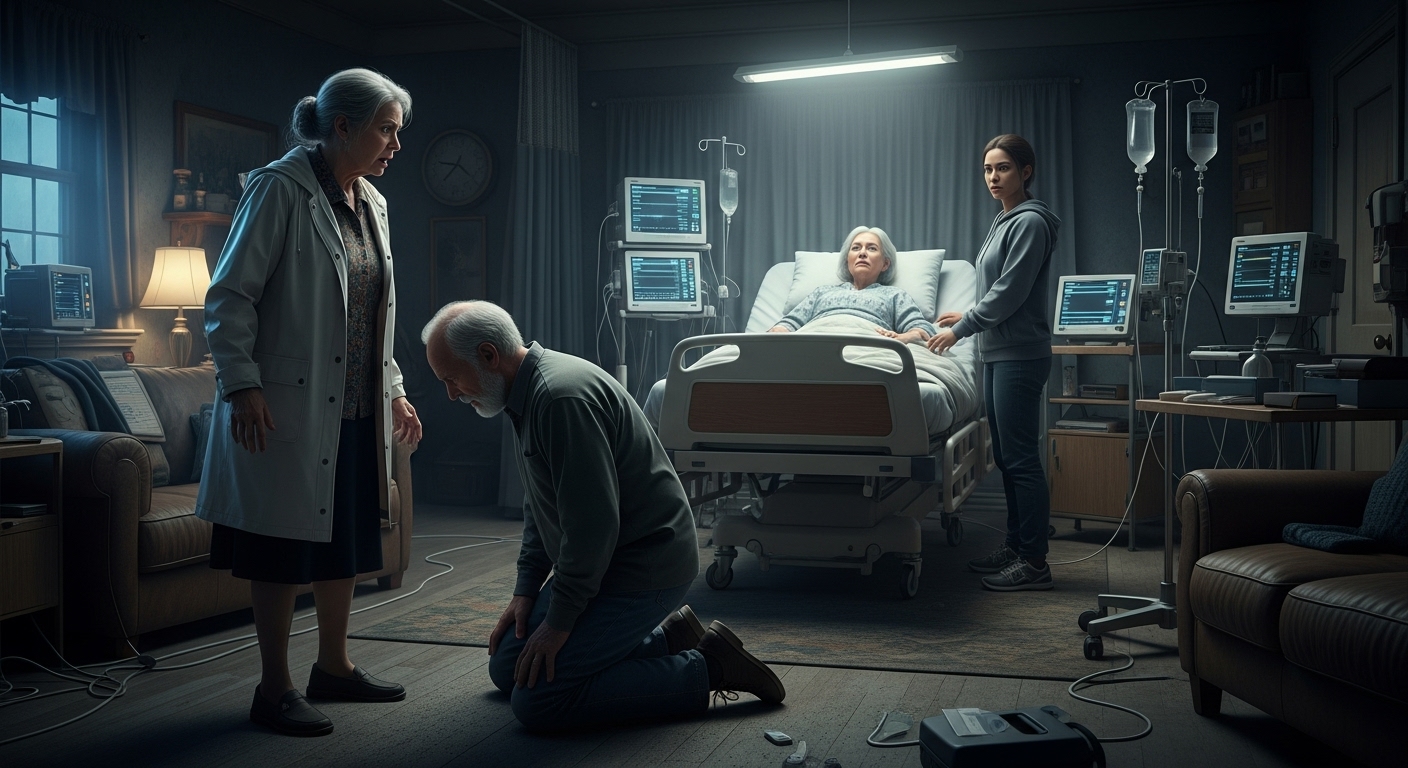
The living room was not a love nest. It was a makeshift ICU. Blackout curtains covered the windows. In the center of the room, taking up almost all the space, was a hospital bed. Monitors beeped rhythmically in the semi-darkness. Tangled tubes snake from a pole down to the figure lying in the bed.
Standing by the bed was a young woman—Maya. She wore oversized sweatpants and a stained hoodie. Her hair was pulled back in a messy bun, and her eyes were dark pits of exhaustion. She looked at Martha with zero surprise, only weary resignation.
And Henry. Henry was on his knees beside the bed, holding the hand of the person lying there. He looked up at Martha, his face streaked with tears, his complexion gray as ash. He didn’t look like a man caught cheating. He looked like a man caught dying.
“Marty,” he croaked.
Martha didn’t look at him. She looked at the bed. Lying there was a woman. She was old—perhaps Henry’s age. Her hair was thin and white, spread out on the pillow. Her face was slack, her eyes closed. A feeding tube ran into her nose. Her breathing was assisted by a machine that clicked and hissed.
“Who is she?” Martha whispered. The anger was leaking out, replaced by a terrifying confusion. “Is she… is she your lover?”
Maya let out a dry, humorless laugh. She walked over to a table filled with pill bottles and began crushing a tablet. “Lover? That’s rich.”
Henry stood up, his legs shaking. He held out his hands, as if to shield the woman in the bed from Martha’s gaze.
“No, Marty. She’s not my lover.” Henry took a breath that sounded like a rattle. “She’s my wife.”
The world tilted. Martha grabbed the doorframe to steady herself. “I’m your wife, Henry. We’ve been married for forty-two years.”
“You are my wife in every way that matters,” Henry sobbed. “But legally… I never divorced her. I couldn’t found her to divorce her. I ran away.”
“Ran away?”
“Sit down,” Maya commanded sharply. She pointed to a tattered armchair. “Before you faint. I don’t have enough hands to take care of two old ladies today.”
Martha sat. She felt numb.
Henry wiped his face. He didn’t look at Martha; he looked at the floor. “It was 1974. Before I met you. I wasn’t the man you know. I was a drunk. A bad one. Clara… she was my high school sweetheart. We got married at nineteen.”
He gestured to the woman in the bed. Clara.
“We had a baby,” Henry continued. “A little girl. Sarah.” He pointed at Maya. “Maya’s mother.”
“I was driving,” Henry whispered, the confession pouring out like poison he’d held in for half a century. “I was drunk. We argued. I hit a patch of ice on the bridge. The car flipped. I walked away with scratches. Sarah was in the back seat, she was fine. But Clara…”
He looked at the invalid woman. “Brain damage. Severe. The doctors said she’d never wake up, never be the same. I was twenty-two. I was terrified. They were going to charge me. The guilt… it was eating me alive. So I ran.”
Martha stared at him. The gentle, accountant husband she knew was dissolving. In his place was a coward who had abandoned a brain-damaged wife and an infant daughter.
“I changed my name,” Henry said. “Moved three states away. Got sober. Met you. I told myself Clara was dead. I told myself Sarah was better off without a drunk father. I built a new life. A ‘good’ life. I buried it, Marty. I buried them.”
“And then Sarah died,” Maya said, her voice cutting through the air. She was standing over her grandmother, adjusting the blanket. “My mom. She died of cancer six months ago. She spent her whole life taking care of Grandma Clara. Alone. Because her dad was ‘dead’.”
Maya turned to Henry, her eyes blazing. “But Mom found some old papers before she passed. She hired a PI. She found you. The ‘dead’ father living in a four-bedroom house with a pension and a lake cottage.”
“Maya contacted me,” Henry said. “She didn’t want to expose me. She just said… she couldn’t do it anymore. The money was gone. Sarah’s savings were gone. The state wanted to put Clara in a warehouse facility—one of those places where they rot in their own filth. Maya wanted to keep her home. She demanded I pay for the care.”
“It costs eight thousand a month for the equipment and the night nurse,” Maya said. “He owes us that. He owes us fifty years.”
Martha looked around the room. The poverty was suffocating. This girl, Maya, had sacrificed her twenties to care for a grandmother who couldn’t even speak, solely because Henry had run away.
“So you’ve been paying,” Martha said, her voice flat.
“I gave them everything I could access without you knowing,” Henry wept. “But it’s gone, Marty. The cash is gone. I was about to forge your signature on the retirement fund transfer. I didn’t know what else to do.”
“You could have told me,” Martha said. But as she said it, she knew it wasn’t true. If he had told her, the illusion of their life would have shattered.
“I’m a bigamist,” Henry whispered. “I’m a fraud. Our marriage… it’s not legal.”
Martha looked at the ring on her finger. It felt heavy. “You’re right,” she said. “You are a fraud.”
Suddenly, a high-pitched alarm began to scream from one of the monitors. Clara’s body began to convulse. Her back arched off the mattress.
“Seizure!” Maya yelled. She dropped the pill bottle and rushed to the bed. “Henry, grab the suction! She’s choking!”
Henry froze. He was panic-stricken, useless.
Martha watched for a split second. She saw the young girl struggling to hold down the trashing woman. She saw the foam forming at Clara’s mouth.
The anger was still there, but Martha was a teacher. She knew how to handle a crisis. She knew how to handle children, and right now, Henry and Maya were both children.
Martha stood up, throwing her raincoat to the floor. “Move,” she barked at Henry, shoving him aside.
She reached the bedside. “Turn her on her side! We need to clear the airway!”
Chapter 4: The Debts of Silence
The seizure lasted three minutes. It felt like three hours. When it ended, Clara lay still, her breathing ragged but unobstructed. Maya wiped her grandmother’s face with a damp cloth, her hands trembling.
Martha stood on the other side of the bed, her chest heaving. She looked at Clara. Really looked at her. This woman was the victim. Not Martha. Martha had enjoyed forty years of Henry’s best self—the sober, kind, attentive Henry. Clara had received the drunk, the wreck, and then the silence. Clara had paid the price for Henry’s redemption.
The room was quiet, save for the hum of the oxygen concentrator.
“She’s stable,” Maya whispered. She looked up at Martha. There was no hostility in her eyes anymore, only a profound exhaustion. “Thank you.”
Martha nodded. She turned to Henry. He was slumped in the corner, his head in his hands.
“Get up, Henry,” Martha said.
He looked up, eyes red. “I’ll leave. I’ll pack a bag. You can have the house. I’ll turn myself in if you want.”
“Stop it,” Martha snapped. “Stop running. You’ve been running for fifty years. You are not running from this.”
She walked over to the window and pulled back the blackout curtain slightly. The rain had stopped. The street outside was gray and grim.
“We have no money left?” Martha asked, not looking at him.
“Liquidity? No. Maybe two thousand dollars,” Henry admitted. “The retirement accounts are still there, but…”
“We can’t touch the principal without penalties that would ruin us,” Martha finished. “And we can’t sustain this level of care on our social security.”
She turned back to the room. She looked at Maya, who was adjusting the sheets. “You’re young,” Martha said to the girl. “You should be in college. Or working. Or falling in love. Not rotting in this house.”
“It’s not rotting,” Maya said defensively. “It’s family.”
“It’s a prison,” Martha corrected gently. “One he built for you.”
Martha took a deep breath. She thought about the lake house in the Poconos. It was her sanctuary. She had picked out every curtain, planted every hydrangea. It was the only thing of real value they owned outright, free and clear. It was worth half a million dollars in this market.
She looked at Henry. She didn’t feel love right now. She felt pity. And she felt a heavy, burdensome sense of duty. “We’re selling the lake house,” Martha said.
Henry’s head snapped up. “Marty, no. That’s your dream. You love that place.”
“I do,” Martha said, her voice trembling slightly. “But we are selling it. We will list it Monday.”
“Why?” Maya asked, confused.
“Because,” Martha walked over to the bed and touched Clara’s cold hand. “Because this woman needs to be in a top-tier facility. One with doctors and therapists. One where she is safe.”
She looked at Maya. “And you… you are going to take the rest of the money. And you are going to go to school. You are going to get a life.”
“I can’t take your money,” Maya said, stepping back.
“It’s not my money,” Martha said firmly. “It’s back pay. It’s the child support he never paid. It’s the alimony he owes her. It’s the debt of silence.”
Martha walked over to Henry. She didn’t hug him. She didn’t take his hand. She simply stood before him, a tower of gray-haired strength.
“You are going to handle the sale, Henry. You are going to do all the paperwork. You are going to find the best facility in the state for her. And you are going to apologize to your granddaughter every single day for the rest of your life.”
Henry nodded, tears streaming freely now. “And then? What about us?”
Martha looked at him. The trust was gone. It would take years to rebuild, if it ever could be. But forty years wasn’t nothing. And seeing him here, broken by guilt, she knew he wasn’t a monster. He was just a weak man who had made a terrible mistake and compounded it with fear.
“Then,” Martha said, picking up her purse. “We go home. We live on our Social Security. We eat store-brand soup. And we tell the truth. No more secrets, Henry. Ever.”
She opened the front door. The air outside was fresh after the rain.
“Are you coming?” she asked.
Henry stood up. He looked at Clara one last time, touched her cheek, and whispered, “I’m sorry.” He looked at Maya, who stood stunned in the center of the room. “Thank you,” he said to the girl.
He followed Martha out the door.
They walked to the car in silence. Martha got into the driver’s seat. Henry got into the passenger side. As she started the engine, Henry reached out and tentatively covered her hand on the gear shift.
“I don’t deserve you,” he said.
Martha didn’t pull her hand away. But she didn’t squeeze back, either. “No,” she said, putting the car in drive. “You don’t. But you have the rest of your life to try to earn it.”
They drove away from the crumbling row house, leaving the past behind, heading toward a future that was poorer, harder, but finally, mercifully, real.