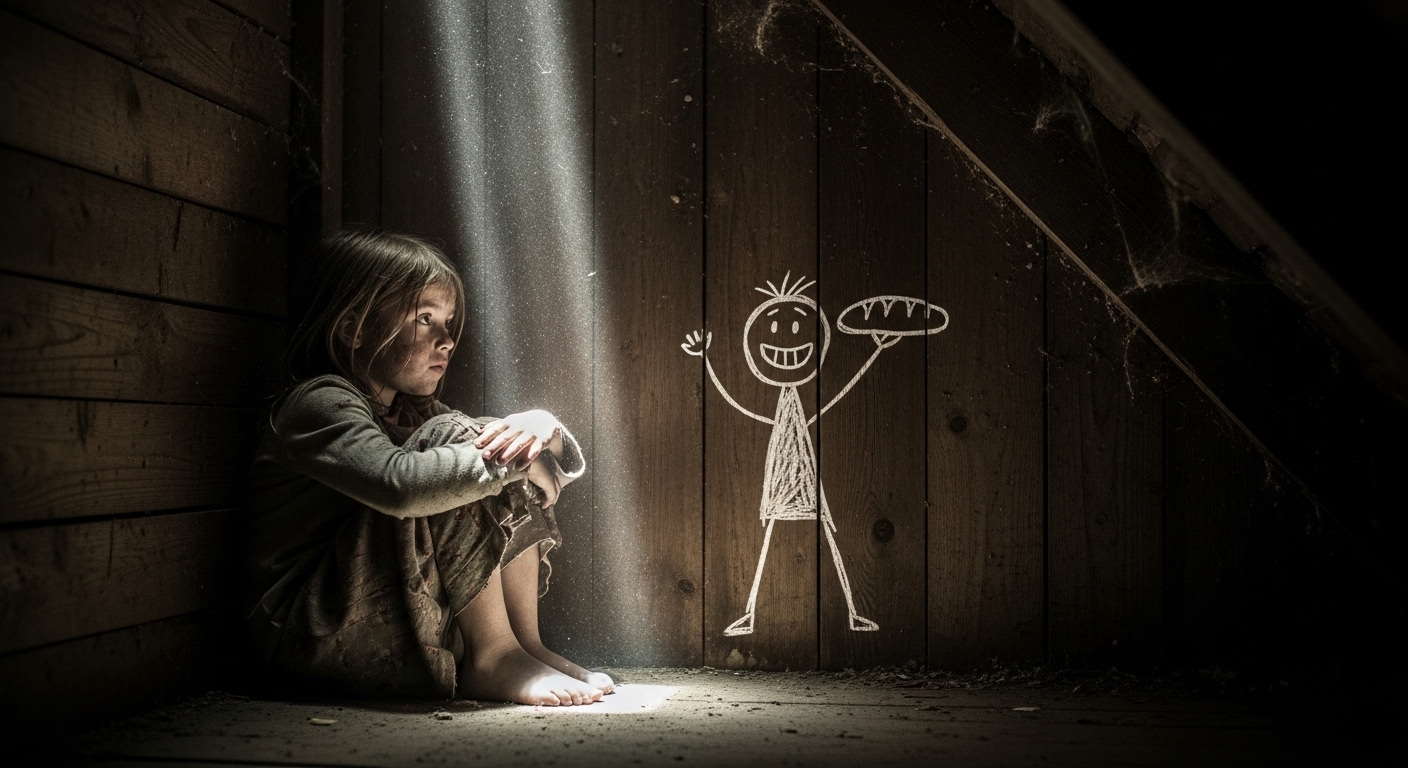
The Slice on the Railing: My Adopted Son Fed the ‘Raccoons’ Every Night. When I Threw the Bread Away, He Shattered a Window and Revealed a Secret That Launched a Manhunt.
Chapter 1: The Silent Ritual
The porch was Mark’s pride and joy. It was a wrap-around masterpiece of mahogany and cedar, stained to a deep, rich amber that glowed under the recessed lighting of their suburban Connecticut home. Mark, an architect by trade and a perfectionist by nature, saw the porch as the boundary between the chaos of the natural world and the orderly sanctuary of his home.
But every morning for the past three months, that boundary had been breached.
It was 6:00 AM on a crisp Tuesday in October. Mark stood in his bathrobe, holding a steaming mug of dark roast coffee, staring at the railing. There, sitting stark white against the dark wood, was a single slice of Wonder Bread.
It was soggy from the morning dew. A corner had been gnawed off, likely by a squirrel or one of the bold raccoons that lived in the wooded ravine behind their property.
Mark sighed, the sound heavy with a specific kind of middle-aged fatigue. He walked over, picked up the wet bread with a napkin, and tossed it into the outdoor trash bin.
“Again,” he muttered.
Inside the kitchen, Jessica was buttering toast for herself. She looked tired. Her blonde hair was pulled back in a messy bun, and there were dark circles under her eyes that no amount of concealer could hide.
“He did it again?” Jessica asked without looking up.
“Every single night, Jess,” Mark said, washing his hands vigorously at the sink. “It’s attracting pests. Yesterday I saw a possum the size of a Buick near the garage. We just spent fifteen thousand dollars refinishing that wood. I don’t understand why he does it.”
“He” was Leo.
Leo was seven years old, though he looked five. He was a whisper of a boy with eyes that seemed too big for his face—eyes that were perpetually wide, scanning for threats that Mark couldn’t see. Mark and Jessica had adopted him six months ago from the state foster care system. The case file was thick and depressing: neglect, drug-addicted biological parents, malnutrition.
Leo didn’t speak. In six months, the most they had gotten out of him was a nod or a shake of the head. He moved through their large, expensive house like a ghost, touching nothing, asking for nothing.
Except for the bread.
Every night after dinner, Leo would take one slice of white bread. He would slide off his chair, walk to the back door, step onto the porch, and place the bread on the railing. He would stand there for exactly sixty seconds, staring into the dark tree line, and then he would go to bed.
“It’s a trauma response, Mark,” Jessica said, sipping her tea. “The therapist said he probably has food insecurity. Maybe he’s saving it for later.”
“But he doesn’t eat it later,” Mark argued, leaning against the granite island. “He leaves it for the animals. It’s wasteful. And frankly, it’s weird behavior. We give him three square meals a day. The pantry is open. He needs to learn that he’s safe here, that he doesn’t need to… to perform these rituals.”
“He’s seven,” Jessica snapped softly. “Give him time.”
“I have given him time. I’m just saying, we need to set boundaries. We can’t have a raccoon hotel on the back deck.”
At that moment, Leo entered the kitchen. He was wearing his dinosaur pajamas, the ones Jessica had bought him. They were a size too big, swallowing his thin frame. He stopped in the doorway when he saw Mark. His shoulders hunched up, a reflexive flinch that always broke Mark’s heart, even as it frustrated him.
“Morning, Leo,” Mark said, forcing his voice to be cheerful.
Leo looked at Mark, then at the back door, then at the trash can. He saw the napkin. He knew.
Leo didn’t cry. He didn’t stomp his feet. He just lowered his head, walked to the table, and sat down. He didn’t touch his breakfast.
That evening, the tension in the house was palpable. Dinner was pot roast, rich and savory. Leo ate mechanically, his eyes darting to the loaf of sliced bread on the counter.
As Mark cleared the table, he watched Leo out of the corner of his eye. He saw the boy’s hand reach out. Leo took a slice. He looked at Mark, his eyes pleading, terrified.
Mark stiffened. He wanted to be a good dad. He wanted to be understanding. But he also believed in order. He believed that indulging this behavior was keeping Leo stuck in the past.
“Leo,” Mark said firmly.
Leo froze.
“No more bread outside,” Mark said. “We don’t feed the bugs. Put it back.”
The silence in the kitchen was deafening. Jessica stopped loading the dishwasher.
Leo’s lower lip trembled. He held the bread to his chest like a shield. He didn’t put it back. He turned and walked toward the back door.
“Leo, stop,” Mark said, stepping in front of him. “I said no.”
Leo looked up. Tears were spilling over his lashes now. He tried to step around Mark. Mark blocked him.
“It’s for your own good,” Mark said, taking the bread from Leo’s small, shaking hand. “We are done with this.”
Mark tossed the bread into the trash compactor and pressed the button. The crunching sound filled the room.
Leo didn’t scream. He didn’t run. He just stood there, watching the machine eat the bread. Then, a sound escaped him—a high, keening whimper that sounded like a wounded animal. He turned and ran up the stairs to his room.
“Mark,” Jessica whispered, “that was too harsh.”
“He has to learn, Jess,” Mark said, though he felt a pit forming in his stomach. “He has to learn that the food isn’t going anywhere.”
Chapter 2: The Storm and the Shattered Glass
Two days later, the weather turned.
A nor’easter rolled in off the coast, battering Connecticut with gale-force winds and torrential rain. The sky turned a bruised purple by 4:00 PM. The wind howled around the eaves of the house, rattling the gutters.
Mark was on edge. The storm was playing havoc with the electrical grid, and he had a deadline for a commercial zoning project. He sat in his home office, the blue light of the monitor illuminating his stressed face.
Downstairs, the house was dark. The power had flickered and died twenty minutes ago.
Mark navigated the hallway with his phone flashlight. “Jess? You okay?”
“I’m in the kitchen with candles,” Jessica called out. “Leo is hiding under the dining room table.”
Mark sighed. He walked into the kitchen. The rain was lashing against the sliding glass doors leading to the porch. The wind was so strong the deck chairs were sliding across the wood.
“We need to make sure the back door is dead-bolted,” Mark said. “With this wind, it could blow open.”
He walked over and turned the heavy brass lock. Click.
Under the table, Leo watched. His eyes were wide, reflecting the candlelight. He was rocking back and forth.
Dinner was cold sandwiches. Mark tried to make light of the situation. “Camping indoors, right buddy?”
Leo didn’t eat. He was staring at the loaf of bread on the counter. The clock on the wall—battery operated—ticked past 7:00 PM. The time of the ritual.
Leo crawled out from under the table. He moved fast. He grabbed the entire bag of bread.
“Leo?” Jessica asked. “Honey, what are you doing?”
Leo ran to the back door. He grabbed the handle and pulled. Locked.
He pulled again, harder. He rattled it. He started to hyperventilate.
“Leo, stop,” Mark said, standing up. “It’s a hurricane out there. You are not going outside.”
Leo turned to look at them. The terror on his face was absolute. It wasn’t the fear of a child who is told ‘no.’ It was the fear of a soldier who has left a comrade behind on the battlefield.
He dropped the bread bag, ripped it open, and grabbed a handful of slices. He turned back to the door and pounded on the glass.
Thump. Thump. Thump.
“Leo!” Mark shouted, his patience snapping. The stress of work, the storm, the constant silent battle—it all boiled over. “Enough! Get away from the door!”
Mark grabbed Leo by the shoulders to pull him away.
Leo screamed.
It was a sound Mark had never heard before. It was raw, guttural, and piercing. “NO! NO! OPEN! OPEN!”
It was the first time he had spoken.
Leo wrenched himself free from Mark’s grip. He looked at the locked handle, then at the glass pane. He looked at the bread in his hand.
With a ferocity that defied his size, Leo pulled his small fist back and punched the glass.
CRASH.
The sound of shattering glass competed with the thunder. The pane didn’t completely give way, but it spider-webbed and broke in the center.
“Oh my god!” Jessica screamed.
Leo didn’t care about the glass. He didn’t care about the blood that immediately started dripping from his knuckles. He shoved his hand through the jagged hole he had made and pushed the bread slices out onto the wet, wind-swept deck.
He pushed them through, watching them get soaked instantly by the rain, watching the wind blow them off the railing into the dark abyss of the yard.
Only when the bread was gone did Leo collapse. He sank to the floor amidst the shards of glass, curling into a ball, sobbing so hard his entire body convulsed.
“OPEN! SHE CAN’T REACH! SHE CAN’T REACH!”
Mark stood frozen, the wind blowing rain into his kitchen through the broken window. He looked at the boy. He looked at the blood on the floor. And for the first time, he realized this wasn’t about a raccoon.
This was about a ghost.
Chapter 3: The Promise in the Dark
The kitchen was illuminated by the harsh beam of a camping lantern. Jessica was sitting on the floor, weeping silently as she wrapped gauze around Leo’s hand. The cut wasn’t deep enough for stitches, thank God, but there was a lot of blood.
Mark was sitting on a kitchen chair, his head in his hands. He felt like a monster. He had pushed a traumatized child to the point of self-harm over a piece of bread.
The storm raged outside, but inside, the silence was heavy.
“Leo,” Mark said. His voice was cracked, gentle. He slid off the chair and knelt on the floor, ignoring the glass shards that dug into his knees. “Leo, look at me.”
Leo sniffled, clutching his bandaged hand to his chest. He looked at Mark. The fear was gone, replaced by a deep, crushing defeat.
“You spoke,” Mark whispered. “You said, ‘She can’t reach.’ Who, Leo? Who can’t reach?”
Leo looked at the broken window. He took a shuddering breath.
“Mia,” he whispered.
Mark and Jessica exchanged a look. There was no Mia in the file. Leo was listed as an only child.
“Who is Mia?” Jessica asked softly, stroking Leo’s hair.
“My sister,” Leo said. His voice was raspy, unused to forming words. “She’s little. She’s five.”
Mark felt a chill run down his spine that had nothing to do with the draft. “Where is she, Leo?”
“The Bad House,” Leo said. “We lived in the Bad House. With… with Him and Her.” (The biological parents).
Leo began to speak, the words tumbling out like water from a broken dam. He told them about the house with the boarded-up windows in the city. He told them about the needles on the floor. He told them about days without food, when “Him and Her” were sleeping and wouldn’t wake up.
“I took care of her,” Leo said, his eyes unfocused, staring into the past. “I went to the store. I stole the white bread. It’s soft. She has bad teeth. It’s soft for her.”
“Why the porch?” Mark asked, tears streaming down his face. “Why do you leave it on the railing?”
“The attic,” Leo explained. “When the bad people came—the dealers—I hid Mia in the attic crawlspace. It’s high up. She couldn’t climb down. I told her to stay there. I told her I would bring the bread to the ledge. The high ledge. So the rats couldn’t get it, but she could reach it.”
Leo looked at Mark, his eyes imploring.
“The police came,” Leo said. “I was outside getting the bread. They grabbed me. I screamed. I told them! I told them Mia is in the attic! But they said I was high. They said I was lying. They put me in the car.”
Leo started to cry again, a quiet, hopeless sound.
“I promised her,” he whispered. “I promised. ‘Look for the white bread. I’ll always leave it where you can find it.’ If I don’t leave it… she thinks I forgot her. She thinks I died. She’s waiting in the dark, Mark. She’s hungry.”
Mark stood up. He walked to the window and looked out at the storm.
Six months. For six months, this boy had been leaving a signal fire for a sister he thought was watching from the woods. For six months, the system had failed to check an attic.
“Mark?” Jessica asked, her voice trembling. “What do we do?”
Mark turned around. The architect, the man of rules, the man who worried about porch finishes, was gone. In his place was a father.
“Get the car keys,” Mark said. “And get his file. We’re going to the police station.”
“The roads are flooded,” Jessica said.
“I don’t care,” Mark growled, grabbing his coat. “We are going to find her.”
Chapter 4: The Hunt
The police station was chaotic. The storm had caused accidents all over the county. Phones were ringing; officers were rushing in and out in wet raincoats.
When Mark walked in, dragging a reluctant desk sergeant’s attention away from a phone call, he looked like a madman.
“I need to speak to Detective Miller. Now,” Mark demanded.
“Detective Miller is on flood duty, sir. Take a number,” the sergeant said dismissively.
Mark slammed his hand on the desk. “My son was extracted from a squatter house at 402 Elm Street six months ago. The police left a five-year-old girl in the attic. She has been missing for six months.”
The station went silent.
An hour later, Mark, Jessica, and a terrified Leo were in a small interview room. Detective Miller, a weary man with coffee stains on his tie, was reviewing the old report.
“Mr. Thorne,” Miller said, rubbing his temples. “I was on that raid. The parents were comatose. The place was a biohazard. We swept the house. There was no girl.”
“Did you check the crawlspace inside the upstairs closet?” Leo spoke up. His voice was small but clear. “The one behind the water heater panel?”
The detective stopped. He looked at the file. “Water heater panel?”
“I hid her,” Leo said. “I put the panel back so the bad men wouldn’t find her.”
Miller’s face went pale. He grabbed his radio. “I need a squad at 402 Elm. Now. And bring the K-9 unit.”
The drive to the city was a blur of rain and flashing lights. Mark drove their SUV, following the police cruiser. He held Jessica’s hand so tight his knuckles were white.
When they arrived at the house, it was condemned. Boarded up. A hollow shell of misery.
Mark watched from the street as the police broke down the door. He held Leo, shielding the boy from the sight of his past trauma. They waited. Ten minutes. Twenty.
The radio crackled on the policeman’s shoulder standing near them.
“Dispatch. We cleared the attic. The crawlspace… it’s empty.”
Mark felt his heart shatter. Leo let out a sob.
“But…” the voice on the radio continued, “We found evidence. There’s a sleeping bag. Wrappers. And drawings on the wall. Fresh drawings. Someone was here. But they aren’t here now.”
They hadn’t found a body. That was the only good news.
Mark marched up to Detective Miller. “Where is she? If she wasn’t here when you raided it, and she’s not here now, where is she?”
Miller looked shaken. “If a five-year-old wandered out of here alone… in this neighborhood…” He didn’t finish the sentence.
“Run a search,” Mark commanded. “Jane Does. Found children. State custody. Hospitals. Search everything within a fifty-mile radius from the date of the raid.”
“Sir, that’s thousands of records,” Miller protested.
“I don’t care!” Mark roared. “I will hire every private investigator on the East Coast. I will sue this department into the ground. Find. That. Girl.”
It took three days.
Three days of Mark pacing the living room. Three days of Leo sitting on the porch, not with bread, but with a pair of binoculars, scanning the treeline.
Then, the phone rang.
It was Miller.
“We found a match,” Miller said. His voice was thick. “Three days after the raid, a patrol car found a female child wandering near the interstate, five miles from the house. She was dehydrated and non-verbal. No ID. No parents came forward. Because the system had no record of a sibling for Leo, they didn’t connect the dots.”
“Where is she?” Mark asked.
“She’s at the St. Jude’s Group Home in Bridgeport. They’ve been calling her ‘Jane’.”
Chapter 5: The White Square
The recreation room at St. Jude’s smelled of floor wax and cafeteria food. It was a loud, chaotic place filled with children who had been let down by the world.
Mark and Jessica stood at the door, holding Leo’s hands.
“She’s in the back,” the caseworker said. “She doesn’t interact much. We think she has selective mutism.”
Mark looked down at Leo. “You ready, buddy?”
Leo nodded. He was holding something in his hand. A single slice of white bread.
They walked through the crowd of playing children. In the far corner, sitting on a beanbag chair facing the window, was a tiny figure. Her hair was matted and cut short. She was thin, painfully thin.
Leo stopped. He took a step forward.
He didn’t say her name. He didn’t run.
He simply walked up to the beanbag chair and held out the bread.
The little girl turned. Her eyes were hollow, dull. But then she saw the white square.
Her eyes widened. They shifted from the bread to the boy holding it.
“Leo?”
It was a whisper, dry as dust.
“I brought it,” Leo said, tears running down his face. “I promised. It’s the soft kind.”
Mia scrambled out of the chair. She didn’t take the bread. She launched herself at Leo.
They collided in a tangle of limbs and tears. They fell to the floor, holding onto each other with a desperation that silenced the entire room.
“You came back,” she sobbed into his neck. “You came back.”
“I was lost,” Leo cried. “But Mark found me. And we found you.”
Mark stood in the doorway, his arm around Jessica. He watched the two children—survivors of a war he couldn’t imagine—clinging to each other. He wept. He wept for the time lost. He wept for the cruelty of the world. But mostly, he wept with gratitude for the messy, beautiful reality of the bread on the floor.
Chapter 6: The Messy Porch
One year later.
The summer sun was setting over the Thorne residence. The porch, once the pristine symbol of Mark’s control, looked different.
The railing was scratched. There was a bird feeder that spilled seeds everywhere. A plastic squirrel picnic table (a gift from Leo) was nailed into the mahogany, piled high with corn and, yes, bread crusts.
Mark sat in a rocking chair, a cat asleep on his lap—a stray Mia had insisted they keep.
The back door slid open.
“Dad! Dinner!” Leo yelled. He was louder now. He laughed. He argued. He was a boy.
“Coming!” Mark yelled back.
Mia ran out, her hair long and braided. She grabbed a handful of crackers and scattered them on the deck.
“For the birds, Daddy,” she smiled.
“Good job, sweetie,” Mark said.
He looked at the crumbs on the expensive wood. He looked at the scratches. He looked at the chaos.
He smiled. It was the most beautiful mess he had ever seen.
“Some messes,” Mark whispered to the cat, “are worth making. As long as everyone gets fed.”
He stood up, left the crumbs for the raccoons, and went inside to have dinner with his family.