The Boy Who Screamed in Silence: Why a Wealthy Neighbor Paid $5,000 for a Stray Dog on Christmas Eve
Chapter 1: The Ruler of Willow Creek
Silas Vance was a man who believed in the geometry of order. His world was measured in inches, angles, and decimals. At seventy-two years old, Silas was the President of the Willow Creek Homeowners Association, a position he wielded not as a public servant, but as a warden.
Willow Creek was a pristine enclave in the suburbs of Chicago. It was the kind of neighborhood where the snow seemed to fall more politely than in the city, where the Christmas lights were all uniform white LEDs (Rule 14.b), and where the silence was heavy, expensive, and absolute.
Silas lived in the largest house at the top of the cul-de-sac. It was a brick fortress with Corinthian columns and windows that looked like unblinking eyes. Inside, the house was immaculate. The mahogany floors gleamed, the Persian rugs were vacuumed in perfect parallel lines, and the air smelled of lemon polish and loneliness. Silas lived alone. His wife had passed five years ago, tired of the silence, and his children had stopped calling when he critiqued their career choices one too many times.
On the morning of December 23rd, Silas stood by his living room window, a cup of Earl Grey tea in his hand, looking down at the neighborhood like a king surveying his subjects.
His gaze landed on the sore thumb of the street: 402 Maple Lane.
It was a small, rental cottage, a remnant of the farm that used to be here before the developers came. It was currently occupied by a woman named Sarah and her son, Davey. They were… untidy. Not dirty, but untidy. There were no wreaths on the door. The car in the driveway was a rusted Honda that wheezed when it started.
And then, there was the dog.
Silas’s lip curled. It was a Golden Retriever mix, but that was being generous. It was a beast—shaggy, oversized, with one ear that flopped lazily and a tail that knocked over garbage cans.
“Disgusting,” Silas muttered to the empty room.
He watched as the boy, Davey, ran out into the yard. Davey was eight, small for his age, frail-looking in a way that annoyed Silas. The boy was wearing a knitted cap pulled low. He was throwing a tennis ball for the beast. The dog barked—a deep, booming woof that echoed off Silas’s expensive brickwork.
Silas flinched. Noise. Chaos. Violation.
He set his tea down and walked to his study. He pulled the leather-bound HOA by-laws from the shelf. He didn’t need to read them; he had written most of them. But he enjoyed the confirmation.
He flipped to Section 9, Article 4: Pet Restrictions. “No household shall harbor animals exceeding forty (40) pounds in weight without a specialized ‘Large Breed Permit’ approved by the board, accompanied by an annual fee of $500.”
Silas knew for a fact Sarah hadn’t applied for a permit. He also knew, looking at her rusted car and the fact that she worked double shifts at the diner, that she didn’t have five hundred dollars.
He sat at his desk. He pulled out a fountain pen. He began to fill out the complaint form for the County Animal Control. He wasn’t doing this to be cruel, he told himself. He was doing this for standards. If you let one rule slide, the whole fabric of society unravels. First, it’s a big dog. Next, it’s broken-down cars on lawns. Then, it’s anarchy.
He licked the stamp. It tasted bitter. He smiled.
“Merry Christmas,” he whispered to the envelope.
Chapter 2: The Approaching Storm
Down at 402 Maple Lane, the air inside the cottage was drafty, but it smelled of cinnamon and wet dog.
Sarah was in the kitchen, counting tips from her morning shift. It wasn’t enough. It was never enough. The heating bill had doubled, and Davey needed new batteries for his hearing aids.
“Mom! Look at Buster!”
Sarah looked up. Davey was on the floor, giggling. Buster, the eighty-pound behemoth, was lying on his back, paws in the air, letting Davey use his stomach as a pillow.
Sarah smiled, but her eyes were tired. “He’s a good boy, Davey. But don’t get him too riled up. We don’t want the neighbors complaining.”
Davey didn’t hear her. He was looking at the dog. He reached up and tapped his hearing aid, then gave a thumbs up. He could hear the vibrations of the dog’s growls through his chest.
Davey lived in a world that was often underwater. Without his aids, sounds were muffled, distant throbs. With them, the world was sharp and sometimes scary. The high-pitched whine of sirens, the shouting of kids at school—it all hurt.
But Buster didn’t hurt. Buster was safe.
“Mom,” Davey said, his voice thick and slightly slurred, the way it often was when he was tired. “Is Santa coming for Buster too?”
Sarah swallowed the lump in her throat. “We’ll see, baby. We’ll see.”
Outside, the sky was turning a bruised purple. The weatherman had predicted a “historic blizzard” for Illinois. The wind was already picking up, rattling the thin window panes of the cottage.
Sarah worried about the draft. She worried about the car starting in the morning. She worried about Mr. Vance up on the hill, who stared at them whenever they checked the mail. She had seen him measuring the length of their grass with a ruler last week.
She didn’t know that the real storm wasn’t the snow. The real storm was a white van with the city emblem on the side, currently navigating the slippery roads toward their cul-de-sac.
Chapter 3: The Knock at the Door
The snow began to fall in earnest around 4:00 PM. It came down in heavy, wet sheets, blanketing Willow Creek in white silence.
Silas Vance sat in his leather armchair by the window, watching the flakes bury his manicured hedges. He felt a sense of satisfaction. The snow covered the imperfections of the world. It made everything clean.
Then, he saw headlights cutting through the swirl.
A white van pulled up to the curb of 402 Maple Lane. Animal Control.
Silas checked his watch. Right on time. He took a sip of his tea. Justice was a dish best served promptly.
Inside the cottage, Sarah jumped when the heavy knock pounded on the door. Buster barked, a deep warning sound.
“Hush, Buster,” Sarah whispered. She opened the door, letting a gust of freezing wind into the small living room.
A man in a thick uniform stood there, looking miserable. Snow was already piling up on his shoulders.
“Ma’am? Sarah Miller?”
“Yes?”
“I’m Officer Higgins, Animal Control. We received a report of an unregistered animal on the premises exceeding the weight limit of the Homeowners Association guidelines, and violating city ordinance 45-B regarding dangerous breeds in a residential zone.”
Sarah blinked, confused. “Dangerous? Buster is a Golden Retriever mix. He’s a marshmallow.”
“The report says he showed aggression,” the officer lied—or rather, repeated the lie Silas had written. “And more importantly, the HOA by-laws state you need a permit. Do you have the $500 permit?”
“Five hundred dollars?” Sarah’s face went pale. “I… I didn’t know. Can I pay it later? I get paid on Friday.”
“I’m sorry, Ma’am. The complaint demands immediate removal. I have to take the dog until the fees are paid and the animal is assessed.”
“Take him?” Sarah stepped back, trying to block the door. “No. You can’t. It’s Christmas Eve tomorrow. You can’t take our dog.”
“I have a court order, Ma’am. If you don’t comply, I have to call the police for obstruction. Please. Don’t make this harder.”
Behind Sarah, Davey appeared. He wasn’t wearing his hearing aids. He had taken them out to nap. But he saw the man. He saw the catch-pole in the man’s hand. He saw his mother crying.
And he saw them looking at Buster.
Chapter 4: The Scream in the Snow
The realization hit Davey like a physical blow. They were taking Buster.
He didn’t put on his boots. He didn’t put on his coat. He just ran.
“No!”
Davey burst past his mother, barefoot into the snow. The cold was shocking, biting instantly into his toes, but he didn’t feel it. He threw his arms around Buster’s thick, furry neck.
“Davey! Get back inside!” Sarah screamed, grabbing his arm.
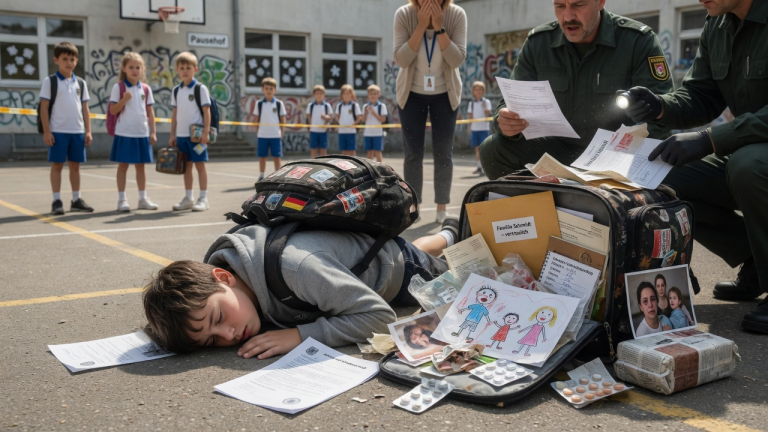
“No! No! No!” Davey wailed. The sound was guttural, raw. Because he couldn’t hear himself, he had no volume control. It was a scream that tore through the quiet neighborhood.
The officer looked uncomfortable. “Son, let go of the dog.”
“He’s not a dog!” Davey screamed, looking up at the stranger. Tears were streaming down his face, freezing on his cheeks. “He’s my ears!”
The officer paused. “What?”
Davey was hyperventilating now. He grabbed Buster’s face, pressing his forehead against the dog’s wet nose.
“I can’t hear!” Davey sobbed, his speech slurring in his panic. “When I sleep, I can’t hear the fire alarm! I can’t hear the bad men! Buster wakes me up! He licks my face when the timer goes off! If you take him, I’ll die! I’ll die in the dark!”
Up on the hill, behind the double-paned glass, Silas Vance froze.
He had heard the scream. It was loud enough to penetrate his fortress. He saw the boy in the snow. He saw the pajamas. He saw the mother trying to shove a crumpled handful of dollar bills into the officer’s hand, begging.
He’s my ears.
The words echoed in Silas’s mind, triggering a memory he had buried ten years ago.
Ethan.
His grandson. Ethan had been born deaf. Silas, busy with his mergers and acquisitions, had never learned sign language. He had bought the boy expensive toys, but he had never learned to talk to him. He remembered the awkward Christmases, Ethan sitting in the corner, isolated in a room full of chatting adults.
And he remembered the phone call. The car accident. Ethan hadn’t heard the horn.
Silas’s teacup rattled in the saucer. He set it down. His hand was shaking.
Down on the street, the scene was escalating. Neighbors were stepping out onto their porches. The lady from number 404 wrapped in a quilt. The young couple from 406. They stood watching, paralyzed by the raw display of grief. They judged Sarah for being poor, but they couldn’t watch a boy lose his best friend.
“I have to take him, son,” the officer said, his voice breaking. He reached for Buster’s collar.
Davey collapsed. He didn’t fight; he just crumpled into the snow, curling into a ball at the dog’s feet, giving up. It was the posture of total defeat.
Chapter 5: The Cane and the Checkbook
The front door of the mansion at the top of the hill opened.
Silas Vance stepped out. He wasn’t wearing an overcoat. He was wearing his three-piece charcoal suit and his Italian leather shoes. He grabbed his cane—a heavy piece of polished ebony with a silver handle.
He marched down the driveway.
The wind whipped his gray hair. The snow soaked his expensive shoes instantly. He slipped once, nearly falling, but caught himself with a grunt of pain. He didn’t stop.
He walked past the neighbors who were staring at him with open hostility. They knew who had called. They knew he was the villain of this story.
Silas reached the driveway of 402 Maple Lane. He was out of breath. His heart was hammering against his ribs.
“Officer!” Silas barked. The command in his voice was practiced, authoritative.
The Animal Control officer looked up, startled. “Sir? Step back, please.”
Silas ignored him. He walked straight up to the boy and the dog. Buster growled low in his throat, sensing the tension, shielding Davey.
Silas looked down at the boy. Davey looked up, his eyes red, swollen, and filled with terror. He expected the old man to yell. He expected the cane to come down.
Instead, Silas turned to the officer. He raised his cane and hooked the tip of it around the catch-pole the officer was holding. He pushed it down into the snow.
“There has been a clerical error,” Silas said. His voice was trembling, not from cold, but from emotion.
“Excuse me?” the officer asked.
“I am Silas Vance. President of the HOA.” Silas reached into his jacket pocket. His hands were numb, but he managed to pull out his checkbook and a gold pen. “I filed the report. And I am retracting it.”
“It’s already in the system, Sir. The permit fees…”
“Are paid,” Silas interrupted. He scribbled furiously on the check. He ripped it out and shoved it into the breast pocket of the officer’s uniform.
“That is a check for five thousand dollars,” Silas said. “That covers the permit. The late fees. The penalty. And a donation to your department for the inconvenience. Now, get your van off my street.”
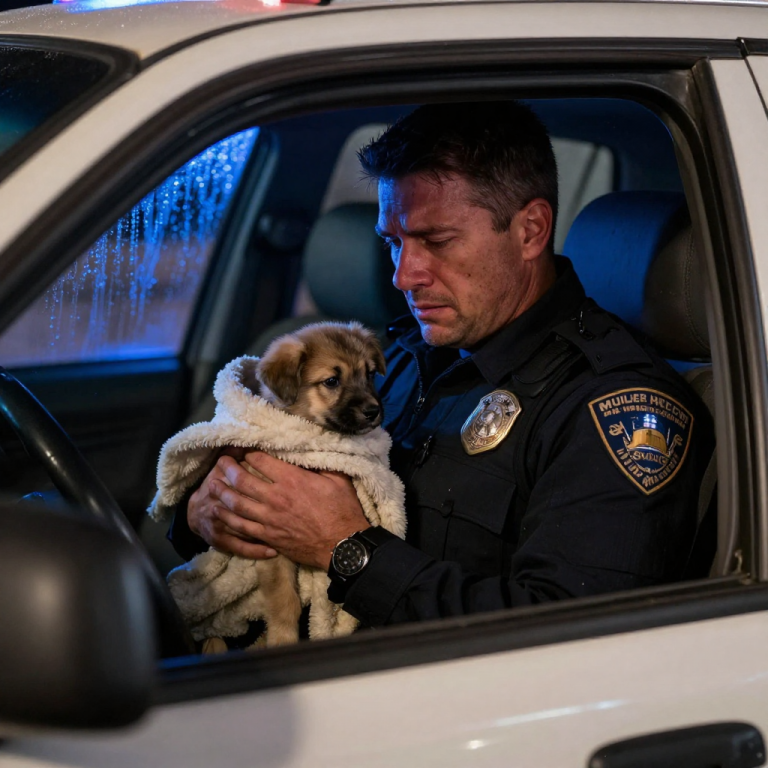
The officer pulled out the check. He looked at the zeros. He looked at the old man, who was shivering violently in his suit.
“Sir,” the officer said softly. “This is… this is irregular.”
“It’s Christmas,” Silas snapped, though there was no bite in it. “And if you touch that dog, I will sue the city for emotional distress so fast your grandchildren will be paying the legal fees.”
The officer smiled. A genuine, relieved smile. He tipped his cap. “Understood, Mr. Vance. Merry Christmas.”
He turned and walked back to his van.
Chapter 6: The Language of Mercy
The van drove away, taillights fading into the white swirl.
Silence returned to the street. But it wasn’t the heavy, oppressive silence of before. It was a stunned, fragile silence.
Sarah stood there, shivering, holding Davey’s shoulders. She looked at Silas. She saw a man who was soaking wet, turning blue, and looking at her son with an expression of profound sorrow.
“Why?” Sarah whispered. “You hate us. You reported us.”
Silas looked at Davey. The boy was still clutching Buster, but he was watching Silas now.
“I didn’t know,” Silas whispered. His arrogance was gone, washed away by the snow. “I didn’t know he was your ears.”
Silas leaned heavily on his cane. The cold was seeping into his bones, making his arthritis scream.
“My grandson,” Silas said, his voice cracking. “Ethan. He was deaf. I was… I was a busy man. A proud man. I didn’t learn sign language. I thought if I ignored it, it would go away. He died ten years ago. I never got to tell him I was proud of him. I never got to hear him say he loved me.”
Tears mixed with the melting snow on Silas’s wrinkled face. He looked at Davey.
“I will not let another boy live in silence because of a rule book I wrote.”
Davey stood up. He wiped his nose on his sleeve. He didn’t hear what Silas said—he wasn’t wearing his aids—but he saw the old man crying. He saw the old man save his dog.
Davey walked over to Silas. He reached out a small, freezing hand and took Silas’s hand.
Then, Davey made a sign. He placed his open palm on his chest and circled it. Please. Then he touched his forehead and moved his hand down to his chin. Thank you.
Silas stared at the hand. He didn’t know the signs. But he understood the language.
“You’re welcome,” Silas choked out.
Chapter 7: The Warmth of the Village
The spell broke. The neighborhood, which had been a collection of strangers hiding behind blinds, suddenly came alive.
Mrs. Gable from next door came running down with a thick wool blanket. She threw it over Silas’s shoulders.
“You old fool,” she said, but her voice was kind. “You’re going to catch pneumonia.”
Mr. Henderson from across the street came over with a thermos. “The boy needs to get inside,” he said. “Sarah, your windows look drafty. I have a portable generator and a space heater in my garage. I’ll bring them over.”
“I have a casserole!” someone shouted from three doors down.
For the first time in the history of Willow Creek, the garage doors opened not to leave, but to give.
They ushered Silas and Davey into the small cottage. It was shabby, yes. But soon, it was filled with people. Someone fixed the pilot light on the stove. Someone else brought a bottle of wine.
Buster, the “dangerous beast,” lay in the center of the living room rug, thumping his tail happily as the neighbors petted him. He knew he was the star.
Silas sat in the worn-out armchair in the corner. He was wrapped in a quilt. He held a mug of hot cocoa. For the first time in five years, he wasn’t alone. He watched Sarah laughing with Mrs. Gable. He watched Davey showing the other kids how Buster could shake hands.
He realized that for all his money, all his perfect lawns, and all his rules, he had been the poorest man on the street. Until tonight.
Chapter 8: Christmas Morning
Christmas morning dawned bright and blindingly white. The storm had passed, leaving the world scrubbed clean.
At the big house on the hill, the curtains were open. But Silas wasn’t there.
Silas was sitting on the porch of 402 Maple Lane. He was wearing a ridiculous, floppy Santa hat that Davey had put on his head.
On his lap lay a book: American Sign Language for Beginners.
Davey sat next to him, wearing new batteries in his hearing aids and a smile that lit up the street. Buster was asleep across both their feet, acting as a living radiator.
“Okay,” Silas said, looking at the book and then at the boy. He formed his stiff, arthritic fingers into a shape. Two fingers up, thumb crossed.
“K,” Davey said, nodding.
Silas formed another letter. “L.”
They were spelling names.
“You try,” Silas said.
Davey thought for a moment. He pointed to Silas. Then he made a sign Silas had learned on page one. He placed his hands over his heart. Friend.
Silas Vance, the terror of the HOA, the man who measured grass with a ruler, closed the book. He looked at the boy, and then at the dog who had started it all.
“Merry Christmas, Davey,” Silas said, and he signed it as he spoke.
The silence of Willow Creek was gone, replaced by the sound of a dog barking, a boy laughing, and a community finally, truly, listening.