The Janitor Was a 2-Star General: How One ‘Invisible’ Dad Took Down a Corrupt Admiral
Chapter 6: The Tribunal of Shadows
The trial of Admiral Riker Blackwood was not merely a military tribunal; it was a national reckoning that dominated American news cycles for weeks. The narrative was irresistible: the decorated “Janitor General” who had scrubbed floors to protect his son versus the corrupt Admiral who had built a career on stolen valor and blood. But as Thorne Callaway sat in the witness box of the heavily guarded courtroom in Washington D.C., he knew the narrative was dangerous. It simplified a complex web of corruption into a single villain, and Thorne knew Blackwood had not acted alone.
Blackwood’s defense team was ruthless, a phalanx of high-priced lawyers paid for by “legal defense funds” with untraceable donors. They didn’t attack Thorne’s evidence regarding Operation Hermes Fall; the documentation was too watertight. Instead, they attacked his character. They painted him as an unstable deserter, a man who had abandoned his post due to grief and constructed a paranoid fantasy to justify his cowardice. “If General Callaway truly had evidence of a crime,” the lead defense attorney thundered, pointing an accusing finger at Thorne, “why did he hide for 15 years? Why did he allow Admiral Blackwood to rise if he was so dangerous? Unless, of course, the General was simply waiting for a moment to maximize his own fame.”
Thorne sat stoically, his face a mask of calm that infuriated the defense. When it was finally his turn to speak, he didn’t shout. He didn’t grandstand. He leaned into the microphone, his voice scraping the silence of the room. “I waited,” Thorne said, his eyes locking with Blackwood’s, “because a dead man cannot testify. And a father with a target on his son’s back cannot seek justice. I didn’t hide to save myself. I hid to ensure that when this day came, there would be no shadows left for you to run to.”
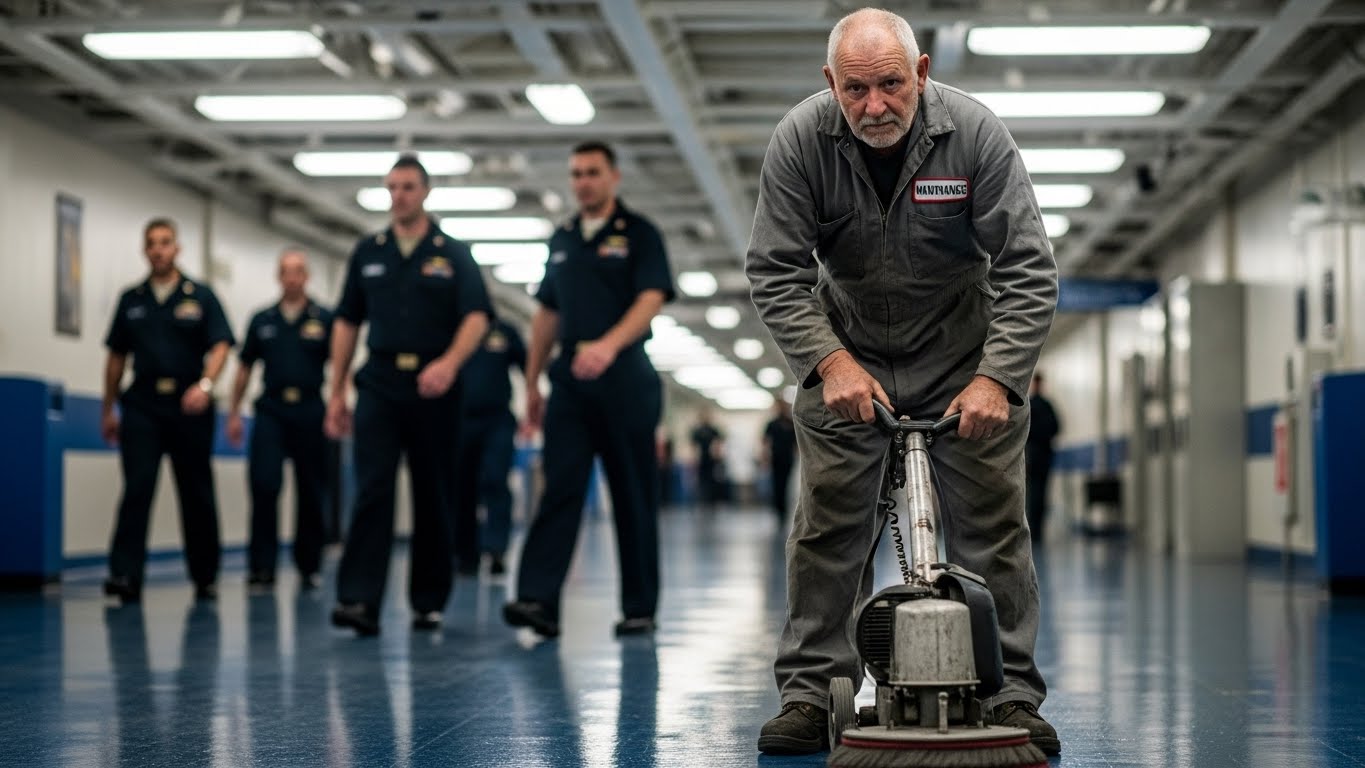
The turning point came on the third day. Blackwood, arrogant to the end, believed his political connections would save him. He didn’t know that Thorne had spent his years of invisibility gathering more than just military secrets. Thorne produced the “Janitor’s Log”—digitized records of conversations overheard in the secure conference rooms of the naval facility. He had recorded dates, times, and specific unauthorized meetings between Blackwood and defense contractors.
One recording, played for the stunned courtroom, captured Blackwood laughing about “silencing the analyst”—a direct reference to Catherine Callaway. The courtroom erupted. The color drained from Blackwood’s face. In that moment, the Admiral didn’t look like a titan of the Navy; he looked like what he was: a small, frightened man who had underestimated the quiet dignity of the person emptying his trash. The verdict was swift. Guilty on all counts. But for Thorne, the gavel bringing down the sentence wasn’t a sound of victory. It was the sound of a heavy door finally closing.
Chapter 7: The Lesson of the Mop
Six months later, the autumn air in Cambridge, Massachusetts, was crisp and smelling of dry leaves. The large lecture hall at MIT was packed beyond capacity. Students sat in the aisles; faculty lined the back walls. They were there for the new visiting lecturer in Strategic Systems and Ethics, but the curiosity was driven by the legend of the “Janitor General.”
Thorne walked onto the stage. He wasn’t wearing his uniform. He wore a simple tweed jacket and slacks, looking every bit the academic, yet he moved with that undeniable military precision. He placed a single object on the podium: a standard-issue industrial scrub brush. The room went silent.
“For fifteen years,” Thorne began, his voice carrying without a microphone, “this was my primary tool of trade. Most of you look at this and see manual labor. You see something beneath you. You see a job for the invisible.” He paused, scanning the faces of the brilliant young minds before him—the future engineers, physicists, and leaders of America.
“But in my previous line of work,” Thorne continued, “and in the line of work you are entering, invisibility is a superpower. The people who ignored me in the hallways, who spoke freely in front of me because they thought I didn’t understand their language, they made a fatal strategic error. They assumed rank equaled intelligence. They assumed status equaled worth.”
He picked up the brush, turning it over in his hands. “Strategy,” he told them, “is not about the boldest move on the board. It is about seeing the board from the perspective of the piece no one is watching. In engineering, you call it the edge case. In the military, we call it the blind spot. If you want to build systems that save lives, if you want to lead people, you must be willing to be the janitor. You must be willing to see what others are too proud to look at.”
In the front row, Emory sat with his notebook open, a small smile playing on his lips. He had heard variations of this speech over dinner tables for years, but seeing his father commanded the respect of the world’s intellectual elite was a different kind of validation. After the lecture, a line of students formed, not just to ask about tactical simulations, but to shake his hand. Thorne didn’t just teach them physics or strategy; he taught them how to see.
Chapter 8: The Visible Man
The final stop of their journey wasn’t a courtroom or a university. It was a quiet hillside cemetery in Virginia, overlooking the Potomac River. The grass was green, manicured with the same precision Thorne had once applied to the naval facility floors.
Thorne and Emory stood before a white marble headstone. Catherine Callaway. Beloved Wife and Mother. Truth’s Guardian.
“It’s done, Cath,” Thorne whispered, placing a single white rose on the stone. “The record is corrected. The bad men are gone. Emory is safe.”
Emory stood shoulder-to-shoulder with his father. The boy who had been a terrified child, then a confused teenager, was now a young man with a clear path. “Do you think she knew?” Emory asked softly. “Do you think she knew you’d pull it off?”
“She knew I was stubborn,” Thorne chuckled, a sound that felt lighter than it had in decades. “And she knew I loved you. That was enough.”
As they walked back toward the car, a black government sedan pulled up. Captain Hargrove, now promoted to Rear Admiral, stepped out. He waited respectfully by the gate. Thorne nodded to Emory to go to the car and walked over to his former boss.
“General,” Hargrove said, offering a salute that was sharp and genuine.
“Admiral,” Thorne returned the salute, his form perfect. “To what do I owe the honor?”
“I wanted you to know,” Hargrove said, “we’re renaming the training facility. The Blackwood tactical center is gone. It’s now the Callaway Center for Strategic Operations. And… we’ve made some changes to the maintenance staff protocols.”
Thorne raised an eyebrow. “Oh?”
“Full security clearance integration,” Hargrove smiled. “Better pay. And mandatory acknowledgment protocols for all officers. No one is invisible in my command anymore, Thorne.”
Thorne looked past Hargrove, toward the city skyline in the distance. He thought about the years of silence, the smell of bleach, the ache in his back, and the shadows he had lived in. He looked at his son waiting in the car, reading a textbook on quantum physics, free to be exactly who he was meant to be.
“That’s good to hear, Admiral,” Thorne said, extending his hand. “Because you never know who might be pushing the mop.”
Thorne got into the car, started the engine, and merged onto the highway. For the first time in fifteen years, he didn’t check the rearview mirror for tails. He didn’t scan the exits for ambush points. He simply drove, a father with his son, heading home, fully and completely seen.
[End of Story]