“They Spilled Milk On My Son Because He Has No Mom. They Thought Money Could Fix It. They Forgot That Before I Fixed Engines, I Fixed Problems For The U.S. Government.”
Chapter 1: The Smell of Sour Chocolate
The first thing I noticed wasn’t the bruise. It was the smell.
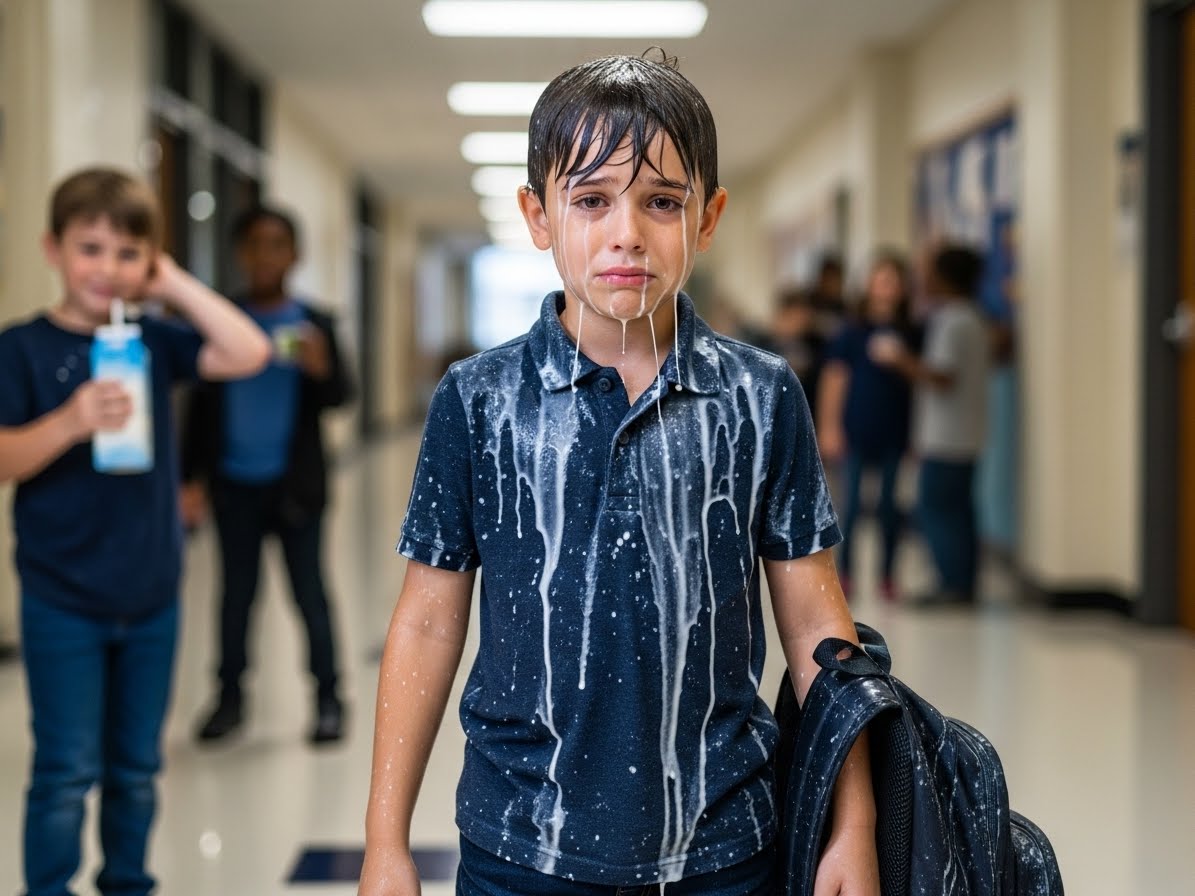
It was distinct—sickly sweet, curdled, and unmistakable. Chocolate milk that had been drying on fabric for at least two hours.
My son, Leo, walked through the front door of our small rental in Fayetteville, North Carolina, and went straight for the stairs. He didn’t do his usual routine—dropping his backpack by the heater, checking the fridge for leftovers, or asking if I’d fixed the transmission on the neighbor’s truck yet.
He just kept his head down. He’s twelve, but in that moment, he looked six. Shoulders hunched, trying to make himself disappear into the drywall.
“Leo,” I said. My voice came out lower than I intended. It’s the voice I used to use on deployment, the one that meant stop moving and assess the threat.
He froze on the third step. “Hey, Dad.”
“Turn around.”
He hesitated. The silence in the house was heavy. Since Sarah passed away three years ago, the silence has been a third roommate, taking up space on the couch, eating at the dinner table with us. But this silence was different. It was loud with shame.
Leo turned.
His favorite hoodie—the gray one with the NASA logo Sarah bought him right before the cancer took her—was stained dark brown from the neck down to the hem. His hair was matted with sticky residue. But it was his eyes that gutted me. They weren’t crying. They were hollow. Resigned. Like he had accepted that this was just his place in the world.
“What happened?” I asked, walking over to him. I smelled the sour dairy, but under that, I smelled his sweat. The distinct pheromone of fear.
“I tripped,” Leo lied. He’s a terrible liar. He gets that from me. “In the cafeteria. I just… I tripped and my milk went everywhere.”
I reached out and gently tilted his chin up. There was a scratch on his cheek, fresh and angry. “You tripped and the milk flew up onto the top of your head? And scratched your face?”
He pulled away, wiping his nose with his sleeve. “It’s not a big deal, Dad. Really. I’ll wash it.”
“Who did it?”
“Dad, please—”
“Leo. Who?”
He looked at the floor, his voice barely a whisper. “Tyler Vance.”
The name didn’t surprise me. Tyler Vance. The kid who lived in the gated community three miles east. The kid whose father owned the largest car dealership in the county and whose mother, Brenda, ran the PTA like it was her own private cartel.
“He… he poured it on me because I wouldn’t move tables,” Leo stammered, the dam finally breaking. “He said the table was for people with two parents. He said… he said since my mom’s dead, I’m only half a person, so I should sit on the floor.”
The air left the room.
My heart didn’t speed up. My hands didn’t shake. In fact, everything slowed down. My pulse dropped to a steady 50 beats per minute. A cold, familiar calm washed over me. It’s a feeling I haven’t let myself feel since I hung up my Marine Corps uniform six years ago. It’s the feeling of a safety switch being flipped off.
“Go shower,” I said softly. “Put the hoodie in the sink. I’ll scrub it out.”
“Dad, don’t go to the school,” Leo begged, seeing something in my face I tried to hide. “Ms. Miller won’t do anything. She never does. Tyler’s mom bought the new scoreboard for the gym. Just let it go.”
“I’m not going to the school right now, Leo,” I lied. “Go shower.”
I watched him walk up the stairs. Small. Fragile. The only good thing left in my world.
I walked into the kitchen, picked up my phone, and stared at it. I could call the principal. I could scream. I could threaten. But Leo was right. Men like Tyler’s dad and women like Brenda Vance think the world is a vending machine—you put money in, and you get whatever pass you want.
They thought they were dealing with a single dad, a mechanic who lived paycheck to paycheck in a duplex. They thought I was weak because I was quiet.
They forgot that before I fixed engines, I fixed problems for the United States government in places that don’t exist on tourist maps.
I didn’t call the school. I dialed a number I hadn’t called in four years.
“Reynolds?” a gravelly voice answered on the first ring. “It’s 3 AM in Munich, Jack. This better be good.”
“It’s not good, Marcus,” I said, staring at the chocolate stain on the floor. “I need a full workup. Financials, digital footprint, legal blind spots. The Vance family. Fayetteville.”
“Is everyone okay?”
“No,” I said, my voice devoid of emotion. “They spilled milk on the wrong kid.”
Chapter 2: The Checkbook Defense
The next morning, the school parking lot was filled with SUVs that cost more than my entire education. I pulled my faded 2015 Ford F-150 into a spot next to a gleaming white Range Rover. HER Range Rover.
I had dropped Leo off at the side entrance so he wouldn’t see me. I wasn’t here to make a scene. I was here to deliver a forecast.
The school office smelled like hand sanitizer and cheap coffee. The secretary, a woman named Mrs. Higgins who usually looked at me with pity, now looked nervous.
“Mr. Reynolds,” she squeaked. “Principal Miller is in a meeting with—”
“I know who she’s with,” I said, bypassing the desk. I didn’t run. I didn’t shout. I just walked to the frosted glass door and opened it.
Principal Miller, a man whose spine was seemingly made of gelatin, was sitting behind his desk. Across from him sat Brenda Vance. She was wearing tennis whites, though I knew for a fact she didn’t play tennis. She held a Starbucks cup like a scepter.
“Mr. Reynolds,” Miller stood up, flushing pink. “We were just discussing… the incident.”
“You mean the assault,” I corrected, standing in the doorway. I filled the frame. At 6’2″, 220 pounds of work-hardened muscle, I tend to take up space.
Brenda swiveled in her chair. She looked me up and down, her eyes lingering on the grease stain on my work boots. A smirk touched her lips—not of amusement, but of dismissal.
“Mr. Reynolds,” Brenda said, her voice dripping with fake Southern charm. “Look, boys will be boys. Tyler was just horsing around. I’m sure your son… what’s his name? Liam?”
“Leo,” I said.
“Right. Leo. I’m sure he provoked it. Tyler is very sensitive to social cues.” She reached into her designer purse and pulled out a checkbook. “But, I know how hard it must be for you, being a… single income household. I’m happy to write a check for the dry cleaning. Shall we say… two hundred dollars? That should cover the hoodie and maybe a new pair of shoes?”
She uncapped her pen. The sound was deafening in the quiet office.
She was buying my son’s dignity for two hundred dollars.
Principal Miller looked at me, pleading with his eyes to take the money and leave. Don’t make this hard, Jack, his eyes said. She pays for the air conditioning.
I looked at the checkbook. Then I looked at Brenda.
“You think this is about laundry?” I asked.
“Well, isn’t it?” Brenda sighed, bored. “Let’s be adults, Mr. Reynolds. Tyler is a high-spirited boy. He has a bright future. We aren’t going to put a black mark on his permanent record over some spilled milk. Take the money.”
I took a step into the room. The air temperature seemed to drop ten degrees.
“Your son didn’t just spill milk,” I said, my voice quiet, almost monotone. “He mocked a grieving child about his dead mother. He used my wife’s memory as a punchline to show off for his friends.”
Brenda rolled her eyes. “Oh, stop being so dramatic. Kids say things. They don’t mean them.”
“I mean what I say,” I said. “And I’m telling you this once. You will ensure your son is suspended. You will ensure he publicly apologizes to Leo. And you will step down from the PTA board for creating a toxic environment that enables bullies.”
Brenda laughed. It was a sharp, barking sound. “Excuse me? Do you know who my husband is? Do you know who I am? I could buy this school and turn it into a dog park. You’re a mechanic, Mr. Reynolds. Fix cars. Don’t try to fix my son.”
She ripped the check out and tossed it onto the desk. It fluttered and landed near my hand.
“Take it,” she commanded. “And get out.”
I picked up the check. I looked at the signature. Large, looping, arrogant.
Slowly, deliberately, I tore the check in half. Then in quarters. I let the pieces fall like confetti onto Principal Miller’s desk.
“You’re right, Brenda,” I said. “I am a mechanic. I understand how things work. I know that if you ignore a rattle in the engine long enough, the whole car explodes.”
I turned to the door.
“Is that a threat?” she shrieked, standing up.
I stopped, hand on the knob, and looked back. “No. It’s a diagnostic.”
I walked out. As I reached my truck, my phone buzzed. A text from Marcus in Munich.
Attached: Vance_Auto_Group_Tax_Shelters_v2.pdf Attached: Brenda_Vance_Offshore_Accounts.pdf Attached: Tyler_Vance_Juvenile_Records_Sealed_State_Police.pdf
I looked at the gleaming white Range Rover next to me.
The war had just begun. And they didn’t even know they were on the battlefield.
Chapter 3: The Ghost in the Ledger
My garage, “Reynolds Repair,” is a converted barn about fifty yards behind the house. It smells of oil, old rubber, and solitude. It’s where I go when the world gets too loud, or in this case, when I need to dissect an enemy.
It was 9:00 PM. Leo was upstairs in his room. He hadn’t come down for dinner. I’d brought him a sandwich, but when I checked twenty minutes later, the plate was untouched on his nightstand. He was wearing headphones, staring at the ceiling, probably replaying the cafeteria incident in 4K resolution in his mind.
I sat on a stool next to a disassembled 1969 Mustang engine, my laptop glowing blue in the dim light.
Marcus is the best intelligence analyst I’ve ever worked with. We spent three years together in a unit that officially didn’t exist, tracking funding for terror cells across Eastern Europe. He didn’t just find information; he found the narratives hidden inside the numbers.
I opened the first file: Vance_Auto_Group_Inventory_Audit.
Robert Vance—Brenda’s husband—owned five dealerships across the state. On the surface, he was a pillar of the community. Local commercials, charity golf tournaments, teeth so white they looked radioactive.
But the PDF Marcus sent told a different story.
“Sloppy,” I muttered to myself, scrolling through the lines of code and scanned documents.
Robert was running a “ghost car” scheme. It’s an old trick, risky if you don’t pay off the right people at the DMV. He was logging trade-ins as “scrapped” to avoid sales tax, then flipping them to private buyers in neighboring states for cash. He was also inflating the interest rates on loans for military families from the nearby Fort Liberty base.
That part made my blood run cold. He was ripping off young privates and sergeants, kids who were deploying to war zones, saddling them with 24% interest rates on lemons that would break down before they even finished basic training.
I opened the second file: Brenda_Vance_Philanthropy_Log.
Brenda wasn’t just a bully in tennis whites; she was a thief. She was the treasurer for the “Sunshine Foundation,” a local charity supposedly raising money for underprivileged kids.
According to Marcus’s notes, 60% of the “donations” were being funneled into a consulting firm owned by… Brenda’s brother in the Cayman Islands. She was stealing money meant for foster kids to pay for her Range Rover and her son’s immunity.
I leaned back, rubbing my eyes. This was ammunition. High-caliber, armor-piercing ammunition.
I could go to the police. But the police in this town played golf with Robert Vance. I could go to the IRS. But an audit takes years.
I needed something immediate. I needed something that would hurt them the way they hurt Leo. I needed to dismantle their shield of invincibility.
The door to the garage creaked open.
I quickly minimized the windows. Leo stood there in his pajamas, holding the untouched sandwich plate.
“I’m not hungry,” he said softly.
“You need to eat, bud. You’re growing.”
He walked over and sat on a stack of tires. He looked at the Mustang engine. “can we work on this tomorrow?”
“Sure,” I said. “We can get the pistons in.”
Leo picked at a loose thread on his pajama bottoms. “Dad… Tyler said something else today. Before the milk.”
“What did he say?”
“He said that if I told anyone, he’d get you fired. He said his dad knows the landlord of our house and they could kick us out.” Leo looked up, terror in his eyes. “Can they do that? Are we going to lose the house because of me?”
The rage that flared in my chest was so hot it felt like heartburn, but I forced my face to remain a mask of calm.
“Leo,” I said, getting off the stool and kneeling in front of him. “Look at me.”
He met my eyes.
“We are not going to lose the house. You are not going to lose me. And Tyler Vance is never, ever going to scare you again. Do you understand?”
“But his dad is rich. Brenda says they own this town.”
“They own things, Leo,” I said, my voice steady. “They own cars. They own buildings. But they don’t own people. And they definitely don’t own us.”
I took the plate from him. “Go to bed. Try to sleep. I have some work to finish.”
He nodded, looking slightly relieved, but the shadow was still there. He walked back to the house.
I turned back to the laptop.
Tyler threatened my livelihood. Brenda threatened my dignity. Robert preyed on my brothers-in-arms.
I wasn’t just going to report them. I was going to dismantle them.
I picked up my phone and typed a message to Marcus.
Phase 1 is a go. Release the bots on the review sites. And send the raw data on the charity fraud to the local investigative reporter, the one Brenda got fired from the gazette last year. She runs a blog now. Let’s give her a scoop.
I hit send.
Then I opened a new tab. I needed a burner phone and a very specific set of tools for tomorrow. Because tomorrow, I wasn’t going to the school.
I was going to the dealership.
It was time to take a test drive.
Chapter 4: The Shark Tank
Vance Auto Group sat on a prime acre of asphalt right off the highway, a sprawling kingdom of glass, balloons, and inflated interest rates. The banners screamed “ZERO DOWN!” and “MILITARY SPECIALS!” in aggressive red font.
I parked my truck across the street. I didn’t want my license plate on their cameras just yet. I adjusted my grease-stained cap, zipped up my jacket, and walked onto the lot.
I played the part. Shoulders slumped, looking at the ground, touching the price stickers with the hesitation of a man who checks his bank balance before buying a gallon of milk.
A salesman, a kid no older than twenty-five with too much gel in his hair, looked right through me. I wasn’t a commission. I was a waste of time. He turned his attention to a young couple looking at a terrifyingly overpriced SUV.
I wandered toward the service bay, then circled back to the “Certified Pre-Owned” section.
That’s where I saw him. Robert Vance.
He looked exactly like his billboards, only sweatier. He was standing next to a black Dodge Charger, his arm draped around the shoulders of a kid in uniform. The kid had a high-and-tight haircut and the bewildered look of a Private First Class who had just gotten his first signing bonus.
I moved closer, pretending to inspect the tires of a nearby sedan. My hearing is damaged from years of gunfire, but I can still pick out a conversation in a crowded room. It’s a survival skill.
“…listen, son,” Robert was saying, his voice booming with false camaraderie. “I love the troops. My father served. Because of that, I’m gonna waive the doc fee. But with your credit history being so thin, the bank is pushing back. I can get you into this beast today, but we’re looking at twenty-four percent APR. It’s the best I can do.”
The kid nodded, looking at the shiny rims. “Twenty-four… is that high?”
“Standard for a first-time buyer,” Robert lied. He lied with the ease of breathing. “Refinance in six months. Easy peasy. Just sign here, and you drive it off the lot.”
The kid reached for the pen.
I stepped forward.
“Actually,” I said, my voice cutting through the humid air. “Twenty-four percent is illegal under the Military Lending Act if they bundle the insurance, which I’m guessing you did, Bob.”
Robert’s head snapped up. The smile didn’t leave his face, but his eyes went cold. Shark eyes.
“Excuse me?” Robert stepped away from the soldier, sizing me up. “Who are you?”
“I’m a mechanic,” I said. “And I’m a guy who knows that this Charger was in a flood in Louisiana three months ago. You can smell the mildew if you turn on the AC. You swapped the VIN, didn’t you?”
The soldier dropped the pen. He looked from me to the car, then back to Robert.
“Is that true?” the soldier asked.
“Of course not!” Robert laughed, a nervous, hacking sound. “This guy is crazy. Probably drunk. Get security over here!”
I looked the soldier in the eye. “Check the bolt under the driver’s seat. If it’s rusted, walk away. And check your credit union on base. They’ll give you four percent.”
The soldier hesitated, then knelt down. He looked under the seat. He stood up, his face red.
“It’s rusted to hell,” the kid said. He threw the keys on the ground. “I’m leaving.”
“Wait! Let’s talk numbers!” Robert yelled, but the kid was already walking away, flipping him off.
Robert turned to me, his face a mask of purple rage. He stepped into my personal space. He was three inches shorter than me and fifty pounds lighter, but his ego weighed a ton.
“You have no idea what you just did,” Robert hissed. “You’re trespassing. I see you again, I’ll have you arrested.”
“I’m Jack Reynolds,” I said quietly.
Robert blinked. The name registered. “The mechanic? The one with the crybaby kid?”
“My son isn’t a crybaby,” I said. “And you’re not a businessman. You’re a predator.” I leaned in close, so only he could hear. “I know about the tax shelters, Robert. I know about the ‘scrapped’ inventory being sold in Georgia. I know everything.”
Robert’s confidence faltered for a microsecond, but he recovered. “You’re a nobody. You’re a grease monkey living in a rental. You think you can scare me? I have lawyers who cost more per hour than you make in a year.”
“Lawyers can’t fix what’s coming,” I said.
I turned and walked away. I didn’t look back. But I heard him screaming at his sales team, his voice cracking with panic.
I had rattled the cage. Now I had to wait for the beast to bite.
Chapter 5: The Digital Wildfire
By noon the next day, the fuse I lit had reached the powder keg.
I was in the garage, changing the brake pads on a customer’s Honda, when my phone started buzzing. It was a text from Marcus.
It’s live. Check the link.
I wiped my hands on a rag and opened the browser.
The headline on The Fayetteville Watchdog—a local independent news blog—was simple and devastating:
“CHARITY OR SCAM? How the ‘Sunshine Foundation’ Funnels Local Donations to Offshore Accounts.”
The article was brutal. It had charts. It had dates. It showed how Brenda Vance had used donation money to pay for “consulting fees” to a shell company that listed her brother as the sole director. It even had a photo of the “company headquarters” in the Caymans—a PO Box at a strip mall next to a liquor store.
I scrolled down to the comments.
User12: “My kid goes to school with her son. She made us donate $500 for a silent auction last month! Where did that money go?”
User88: “I always knew she was fake. She treats the cafeteria staff like dirt.”
UserVeteran: “Her husband ripped me off on a truck in 2018. This whole family is rotten.”
I smiled. It was a grim smile, but it felt good.
“Dad?”
Leo was standing at the garage door. He had his backpack on. He looked terrified.
“What’s wrong?” I asked, dropping the phone.
“Mom… I mean, Brenda Vance. She came to the school.”
I was moving before he finished the sentence. “Did she touch you?”
“No,” Leo said quickly. “But she was screaming. She was in the parking lot yelling at Ms. Miller. She said you hacked her computer. She said you’re a criminal. Everyone was watching. Tyler… Tyler was crying.”
I knelt down and put my hands on Leo’s shoulders. “Tyler was crying?”
“Yeah. He was hiding in the car.”
I felt a twinge of pity for the boy. Tyler was a bully, but he was a monster made, not born. He was the product of two people who valued profit over humanity. Now, his shield was cracking.
“Listen to me, Leo. Brenda is angry because she got caught doing bad things. That has nothing to do with you. You are safe.”
“Are you sure?” Leo asked, his voice trembling. “She said… she screamed that we were going to be homeless by Friday.”
My blood ran cold.
“She’s just making noise, Leo. bullies scream when they’re scared.”
But as I said it, a dark sedan pulled into our driveway. It wasn’t a police car. It was a private security vehicle. A man in a cheap suit got out, carrying a thick envelope.
He walked past Leo without looking at him and thrust the envelope at my chest.
“Jack Reynolds?”
“Yeah.”
“You’ve been served.”
He turned and got back in the car.
I opened the envelope. It wasn’t a lawsuit.
It was an eviction notice.
Reason: Violation of Lease Agreement Section 4.2 – Unauthorized Commercial Activity (Operating a repair shop on residential property).
And underneath that, a Restraining Order filed by Brenda Vance against Jack Reynolds for “Stalking and Harassment.”
I looked at the paperwork. They had moved fast. They had called the landlord—who probably owed Robert a favor—and found a loophole. I had been fixing neighbors’ cars for cash to make ends meet. Technically, it was a violation.
“What is it, Dad?” Leo asked, watching my face.
I folded the paper and put it in my pocket.
“It’s just paperwork, buddy,” I lied. “Go inside and start your homework.”
I watched him go. The pity I felt for Tyler Vance evaporated.
They were coming for my home. They were coming for my son’s stability. They wanted to put us on the street to teach us a lesson about hierarchy.
I pulled out my burner phone. I dialed Marcus.
“They escalated,” I said. “They’re trying to evict us.”
“I saw the court filing,” Marcus said. “They paid an expedited fee. They want you out in 72 hours.”
“Okay,” I said. The calm was back. The icy, dangerous calm. “Take the gloves off, Marcus. Release the audio.”
“Jack, are you sure? That’s nuclear. Once that’s out, there’s no going back. The Feds will get involved.”
I looked at the house. I saw Leo in the window, petting our old cat, trying to find comfort in a world that kept trying to crush him.
“Burn it down,” I said. “Burn it all down.”
Chapter 6: The Tape
The “nuclear option” was a recording Marcus had found on a cloud server linked to Robert’s phone. Robert was tech-illiterate; he backed up everything, including his voice memos.
One memo, dated three months ago, was a recording of a meeting between Robert, the town mayor, and the chief of police.
I sat in my dark living room, listening to the file one last time before giving Marcus the green light.
Robert’s voice: “Look, the zoning for the new lot is a nightmare. I need those low-income houses on Oak Street condemned. Just find some code violations. Rats, mold, whatever.”
Mayor’s voice: “Robert, there are families there. Twenty families.”
Robert’s voice: “I don’t care about the families. I care about the expansion. I’ll put fifty grand in your reelection fund. And Chief? I’ll lease the department five new Chargers for a dollar a year. Just get those people out.”
It was corruption, pure and simple. It was a conspiracy to destroy a neighborhood for a parking lot.
I poured myself a glass of water. My hand was steady.
I wasn’t just fighting for Leo anymore. I was fighting for the twenty families on Oak Street who didn’t even know they were in the crosshairs.
I texted Marcus: DO IT.
Then, I waited.
The explosion didn’t happen on the internet this time. It happened on the TV.
Two hours later, the local 6:00 PM news was interrupted. The anchor, a woman who usually covered cat rescues and bake sales, looked pale.
“Breaking news,” she said. “We have received an anonymous digital file that appears to implicate local businessman Robert Vance and several city officials in a bribery scheme.”
They played the audio.
It was grainy, but clear enough. “…I don’t care about the families…”
I watched the screen.
Suddenly, a rock shattered the front window.
Glass sprayed across the living room floor. Leo screamed from the kitchen.
“Dad!”
I was on the floor in a second, crawling toward the kitchen. “Stay down! Leo, stay down!”
I reached him and pulled him behind the refrigerator.
“What happened?” he was sobbing.
“Someone threw a rock. It’s okay.”
I peeked around the corner. Through the broken window, I saw a truck peeling away. It was a black pickup. I recognized the custom decal on the back window.
It was the foreman from Vance’s service department. Robert’s goon.
They weren’t fighting legally anymore. They were resorting to violence.
I checked Leo for cuts. He was shaking, but unharmed.
“Pack a bag,” I whispered. “Just the essentials. We’re leaving.”
“Are we running away?” Leo asked, his eyes wide with betrayal. “You said we wouldn’t lose.”
“We’re not running away, Leo,” I said, standing up and grabbing my keys. “We’re moving to a secure location. Because tonight, the police aren’t coming to help us. Tonight, we’re on our own.”
I walked to the closet and unlocked the steel safe in the back. I pulled out a black duffel bag I hadn’t touched in years. Inside was a tactical vest, zip ties, a flare gun, and a few other non-lethal tools of my old trade.
I wasn’t going to kill anyone. I wasn’t that man anymore. But I was going to make sure that when Robert Vance went to sleep tonight, he would see me in his nightmares.
“Where are we going?” Leo asked as we ran to the truck.
“We’re going to pay Mr. Vance a visit,” I said, starting the engine. “He likes to throw rocks? Let’s see how he likes a landslide.”
I backed out of the driveway, tires screeching.
The war council was over. The raid was beginning.
Chapter 7: The Landslide
The Vance estate was a fortress of pretension—a Georgian-style mansion sitting behind twelve-foot iron gates. Under normal circumstances, it was impenetrable. But tonight, panic had left the drawbridge down.
I parked my truck a half-mile away in a wooded cul-de-sac and moved on foot. I wasn’t wearing a mask. I wasn’t hiding. I wanted the cameras to see me.
Leo was safe in the truck, locked in with the engine running and a phone programmed to dial 911 if I wasn’t back in fifteen minutes.
I reached the gate. It was slightly ajar. A delivery van—probably a shredding service—was idling in the driveway. Robert was trying to destroy the evidence.
I slipped past the van and into the shadows of the manicured hedges. I could see into the study through the French doors. Robert was there. He wasn’t the confident shark I’d met at the dealership. He was frantic, stuffing piles of paper into a rolling trash bin. Brenda was pacing behind him, holding a glass of wine with both hands, her face streaked with tears and mascara.
I didn’t knock. I picked up a cast-iron patio chair and threw it through the French doors.
The crash was thunderous. Glass exploded inward.
Brenda screamed and dropped her wine. Robert spun around, slipping on the papers scattered on the floor.
I stepped through the shattered frame, glass crunching under my boots.
“You!” Robert scrambled back, grabbing a heavy brass trophy from his desk. “Get out! I have a gun! I’ll shoot!”
He didn’t have a gun. He had a golf trophy.
“You don’t have a gun, Robert,” I said, my voice eerily calm in the chaos. “And you don’t have a police chief anymore. I just heard on the police scanner. The FBI picked him up ten minutes ago.”
Robert’s face went the color of ash. “No… that’s impossible.”
“You threw a rock through my window,” I said, taking a step forward. “You terrified my son. You tried to take our home.”
I stopped three feet from him. I could smell his fear. It smelled worse than the sour milk.
“I didn’t mean to!” Robert stammered, dropping the trophy. It clattered uselessly on the floor. “It was just… business! I can fix this. How much? How much do you want? I have cash in the safe. Fifty thousand? Hundred thousand?”
“You still don’t get it,” I said. “You think money is the only currency in the world.”
I pulled out my phone. The screen was glowing.
“I didn’t come here to hurt you, Robert. I know you expected me to beat you up so you could play the victim. I’m not going to touch you.”
“Then… then what do you want?”
“I came to make sure you didn’t run.”
Sirens wailed in the distance. Not the chirp of a local patrol car. The deep, multi-layered wail of a convoy. State Troopers. Federal agents.
Robert ran to the window. Blue and red lights were flooding the long driveway, washing over the shredding van, the iron gates, the manicured lawn.
“It’s over,” I said. “The tax fraud. The charity theft. The bribery. The predatory loans. Marcus sent the files to the State Attorney General this morning. The local news was just the warning shot.”
Brenda collapsed onto the leather sofa, sobbing into her hands. “My reputation… my club membership…”
Robert slumped against his desk, watching the lights get closer. He looked small. A man made of paper money, dissolving in the rain.
I turned to leave.
“Reynolds!” Robert croaked.
I stopped.
“Why?” he asked. “Why go this far? It was just a spilled milk carton.”
I looked back at him, framed by the flashing police lights.
“It was never about the milk,” I said. “It was about the entitlement. You forgot that the people you step on are the ones holding up the ground you stand on.”
I walked out into the cool night air. As the Federal agents swarmed the front door, shouting commands, I slipped back into the darkness of the trees.
I made it back to the truck in twelve minutes.
Leo was sitting exactly where I left him, eyes wide.
“Dad?”
“It’s done, Leo,” I said, putting the truck in gear. “Let’s go get some pancakes.”
Chapter 8: The Quiet Engine
Two weeks later, the silence in our house was different. It wasn’t the silence of shame or fear. It was the comfortable silence of peace.
The “Vance Scandal” was national news. Robert was looking at twenty years for racketeering and fraud. Brenda was facing her own charges for embezzlement. The dealership was seized. The school board had dissolved the PTA and fired Principal Miller for “gross negligence and failure to report misconduct.”
The eviction notice against us had been withdrawn. The landlord, terrified of being associated with the Vance investigation, had actually lowered our rent by fifty dollars and fixed the back porch.
It was a Tuesday morning. I was in the kitchen, packing Leo’s lunch.
“Dad?”
Leo walked in. He was wearing the NASA hoodie. It was clean. The stain was gone.
“Yeah, bud?”
“I… I don’t want to take the bus today.”
I paused, knife hovering over the sandwich. “Why? Is someone bothering you?”
“No,” Leo said. “It’s just… Tyler.”
“What about him?”
“He’s back at school today. His aunt is taking care of him. I saw him yesterday at the library. He looked… lonely. Nobody talks to him anymore. They all hate him because of what his parents did.”
I put the knife down. I looked at my son. He had every reason to gloat. He had every reason to dance on the ashes of the family that tried to destroy us.
“What do you want to do?” I asked.
Leo looked at his shoes, then up at me. “I want to bring an extra chocolate milk.”
I stared at him for a long moment. My chest tightened, but not with anger. With a pride so fierce it almost hurt.
Jack Reynolds, the soldier, would have crushed the enemy until they couldn’t breathe. Leo Reynolds, the son of Sarah, wanted to offer mercy.
“Do it,” I said, my voice thick.
I drove him to school. We pulled up to the curb. The media vans were gone. The heavy SUVs were dropping off kids.
I watched Leo walk toward the entrance. He spotted Tyler Vance sitting alone on a bench near the flagpole, head down, picking at his fingernails.
Leo hesitated. Then, he walked over.
I couldn’t hear what they said. But I saw Leo reach into his lunchbox. He pulled out the extra carton of chocolate milk and held it out.
Tyler flinched at first, expecting a blow. Then, he looked at the carton. He looked at Leo. He took it.
There were no hugs. No cinematic handshakes. Just two boys, sitting on a bench, drinking milk in the morning sun.
I put the truck in gear and pulled away.
The engine of my old Ford hummed. A steady, rhythmic, unbreakable sound.
I didn’t need to fix anything else. The world wasn’t perfect, but for the first time in a long time, it was balanced.
And my son? He wasn’t just safe. He was a better man than I would ever be.
I rolled down the window and let the wind hit my face. It smelled like rain and gasoline.
It smelled like victory.