The Soldier’s Grip: An Abusive Aunt, A Dead Father’s Letter, and the Stranger Who Changed Everything
Chapter 1: The Ghost in the Living Room
The house on Elm Street, located on the outskirts of a fading industrial town in Ohio, always smelled of stale cigarette smoke and damp carpet. For ten-year-old Leo, it wasn’t a home; it was a cage disguised as a bungalow. The paint on the porch was peeling in long, gray strips that looked like dead skin, and the screen door had a hole in the mesh that Brenda had promised to fix three years ago. She never did. Brenda didn’t fix things; she only broke them, or sold them, or complained about them.
Leo sat at the small, wobbly kitchen table, his legs dangling a few inches off the floor. He was small for his age, a fact Brenda reminded him of daily. He wore a faded oversized t-shirt that had once belonged to a cousin he’d never met, the fabric worn so thin it was almost translucent. Outside, the autumn wind whipped dead leaves against the windowpane, a scratching sound that made the silence inside the house even louder.
“Stop tapping your foot,” Brenda’s voice cut through the air from the living room. She didn’t even turn around. She was sprawled on the floral sofa, her eyes glued to the flickering television set, a glass of cheap Chardonnay balanced precariously on her stomach.
“Sorry, Aunt Brenda,” Leo whispered. He stilled his leg immediately.
He looked down at the notebook in front of him. It was a standard composition book, the black-and-white marbled kind, but to Leo, it was a sanctuary. He picked up his pencil, a gnawed-down yellow stub, and reread the prompt his teacher, Mrs. Gable, had written on the chalkboard two days ago: What A Hero Means to Me.
Most of the kids in his fifth-grade class were writing about superheroes—Batman, Superman, or maybe a famous athlete. One kid, Tommy, was writing about his dad who was a firefighter. Leo didn’t have a dad. Not anymore. He had a folded American flag in a triangular case that Brenda kept shoved in the back of the hallway closet, underneath a pile of old towels. He had a vague memory of a rough beard and the smell of peppermint and engine oil, but that was fading, like an old photograph left in the sun.
Leo wrote: A hero isn’t someone who flies. A hero is someone who stays, even when they are scared.
He paused. His stomach rumbled, a low growl of protest. There was a box of cereal in the cupboard, but it was empty. There was milk in the fridge, but Brenda had marked the jug with a black Sharpie line to track if he drank any without asking.
“Is the mail here yet?” Brenda shouted during a commercial break.
“I checked it when I got off the bus,” Leo called back, his voice steady despite his hunger. “Just flyers.”
“Useless,” she muttered. “Checks should’ve been here yesterday. If the government thinks I can feed a growing boy on air, they’ve got another thing coming.”
Leo flinched. He knew exactly what checks she was talking about. The survivor benefits. The money the government sent because his father, Corporal Jack Miller, had died in a dusty valley in Afghanistan six years ago. Leo also knew that the money wasn’t “feeding a growing boy.” It was feeding the slot machines at the riverboat casino on weekends and buying the endless cartons of cigarettes that lined the kitchen counter.
Leo looked back at his essay. He closed his eyes and tried to summon the face of his father. He remembered the last time he saw him. A train station? No, a bus depot. His dad kneeling down, looking giant in his camouflage uniform. He remembered his dad handing him a small toy soldier. “You keep him safe, Leo. And I’ll keep you safe. Deal?”
“Deal,” Leo whispered to the empty kitchen.
He began to write again, the graphite scratching furiously against the paper. He poured everything into that essay. He wrote about the sacrifice. He wrote about the letters his mom used to read to him before she got sick and passed away, leaving him alone with Brenda. He wrote about how a hero is someone who gives up their tomorrow so someone else can have a today.
By the time he finished, his hand was cramping, but his heart felt lighter than it had in months. He carefully tore the page out, folded it, and placed it in his backpack. It was just a piece of paper, but it felt heavy with importance. It was his truth.
In the living room, Brenda let out a harsh laugh at something on the TV. “Look at that idiot,” she sneered at the screen. “Thinking he can win just because he cried a little.”
Leo looked at his aunt—her disheveled hair, the bitterness etched into the lines around her mouth. She was his mother’s sister, but they were nothing alike. His mother had been soft, warm, smelling of vanilla. Brenda was sharp angles and cold calculation.
“I’m going to bed,” Leo said softly.
“Don’t forget to take the trash out first,” she replied, not looking away from the screen. “And don’t drag the bag. I don’t want juice leaking on the porch.”
Leo nodded. He pulled the heavy bag from the bin, struggling slightly with the weight, and carried it out into the cold night. He looked up at the stars. Somewhere up there, he hoped his dad was watching. He hoped his dad knew that tomorrow, Leo was going to read his essay to the whole class. He was going to be proud.
Chapter 2: The Paper Trophy
The school auditorium smelled of floor wax and nervous sweat. It was the monthly assembly, and the principal, Mr. Henderson, stood at the podium adjusting the microphone.
“And finally,” Mr. Henderson boomed, his voice echoing off the brick walls, “for the district-wide essay contest on ‘Modern Heroism,’ we have a very special winner from the fifth grade.”
Leo sat in the third row, his heart hammering against his ribs like a trapped bird. He gripped his knees, his knuckles turning white.
“For his moving tribute to his late father, the Certificate of Merit goes to… Leo Miller.”
The applause was polite at first, then grew louder as Mrs. Gable stood up and started clapping enthusiastically. Leo stood up, his legs shaking. He walked up the stairs to the stage. The lights were blinding. Mr. Henderson handed him a thick, cream-colored paper with gold foil stamping and a red ribbon.
Certificate of Merit – First Place.
Leo took it. For the first time in years, he didn’t feel small. He felt tall. He felt seen. He looked out at the sea of faces. He wished, with a desperate ache, that someone was there for him. Not Brenda—she had refused to sign the permission slip to attend, saying she had a migraine. But maybe… just maybe… his dad was there in spirit.
“Good job, son,” Mr. Henderson said, shaking his small hand.
The rest of the day passed in a blur of congratulations. Even the kids who usually ignored him or made fun of his baggy clothes nodded at him with respect. The certificate sat on his desk all afternoon, a beacon of validation.
When the final bell rang, Leo carefully placed the certificate between two textbooks in his backpack so it wouldn’t get creased. The bus ride home felt shorter than usual. He had a plan. He knew Brenda didn’t care about school, but this was different. This was First Place. This came with a $50 gift card for books. Maybe, just maybe, if he showed her he was good, if he showed her he could achieve something, she would look at him with something other than annoyance.
He walked up the driveway, the gravel crunching under his sneakers. The house looked the same—gloomy and uninviting—but Leo carried a shield of gold foil in his bag.
He opened the front door. “Aunt Brenda?”
She was in the kitchen, furiously scrubbing a stain on the counter. She looked up, her eyes narrowing. “You’re late. The bus passed ten minutes ago.”
“I… I had to pack my bag carefully,” Leo said, stepping inside and closing the door.
“Whatever. Did you get the mail?”
“Yes.” Leo placed a stack of envelopes on the table. One of them was the government envelope she had been waiting for.
Brenda snatched it immediately, tearing it open. She scanned the check, a look of relief washing over her face, quickly replaced by greed. “Finally. Now I can pay off that… bill.” She shoved the check into her pocket.
Leo took a deep breath. It was now or never.
“Aunt Brenda, look.”
He pulled the certificate out. He smoothed it down on the table, right next to where she had been scrubbing. The gold foil caught the dim light of the kitchen bulb.
“I won,” Leo said, his voice trembling with pride. “It’s for the essay contest. About heroes. I wrote about Dad.”
Brenda froze. She looked down at the paper, then at Leo. Her expression didn’t soften. It hardened.
“You wrote about Jack?” she asked, her voice low and dangerous.
“Yes. About how he was a hero and—”
“A hero?” Brenda laughed, a sharp, barking sound that made Leo flinch. “Your father wasn’t a hero, Leo. He was a fool. He ran off to play soldier because he didn’t know how to hold down a real job here. He got himself blown up and left my sister to rot, and left me stuck with you.”
The words hit Leo like physical blows. “That’s not true,” he whispered. “He saved people.”
“He saved no one!” Brenda shouted, slamming her hand on the table. “He left a mess. That’s what he did. And you… writing stories to get pity from your teachers? Is that it? You think you’re special because your daddy is dead?”
“I won first place,” Leo said, tears welling in his eyes. “Mr. Henderson said it was beautiful.”
“It’s trash,” Brenda spat. She reached out and grabbed the certificate.
“No!” Leo lunged forward, but he was too small. Brenda held it up high, out of his reach.
“Please, Aunt Brenda! Give it back!” Leo cried, jumping, trying to grab the corner of the paper.
“You need to learn a lesson, Leo,” Brenda said, her eyes manic. “There are no heroes. There’s just money and bills and misery. This paper? It means nothing. It’s garbage. Just like your father’s promises.”
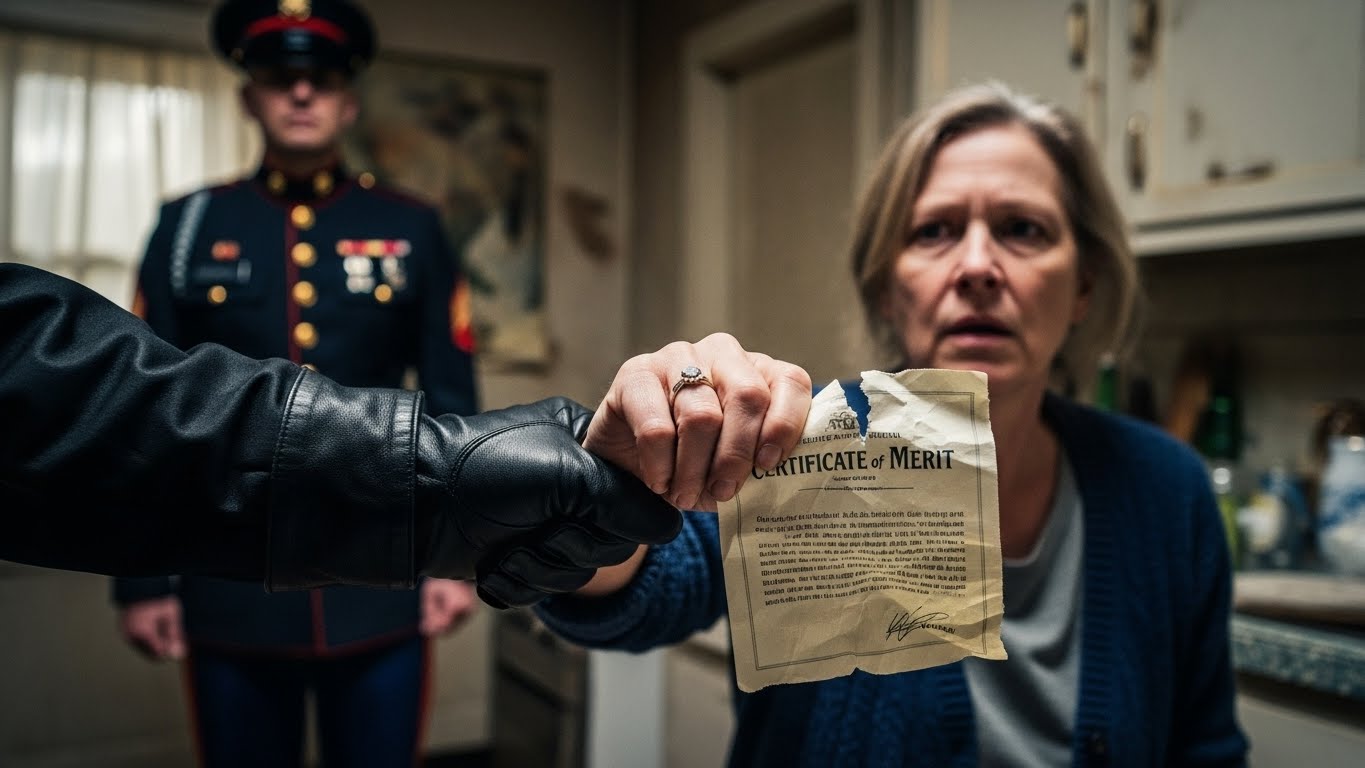
She gripped the top of the certificate with both hands. Her knuckles turned white. She positioned her fingers to tear it right down the middle, right through his name.
“Don’t!” Leo screamed, a sound of pure heartbreak.
Brenda sneered. “Time to grow up, Leo.”
She began to pull. The paper pulled taut, the fibers straining, about to snap.
Chapter 3: The Iron Grip
The sound of the paper straining was the loudest noise in the world to Leo. He squeezed his eyes shut, unable to watch his pride be destroyed.
But the tearing sound never came.
Instead, there was a gasp. A sharp intake of breath from Brenda.
Leo opened his eyes.
A hand—large, gloved in black leather—had clamped down on Brenda’s wrist. It had come from behind her, seemingly out of nowhere. The grip was absolute, immovable. Brenda’s arm was frozen in mid-air.
Standing in the open doorway leading from the living room was a man. He was huge, towering over six feet, filling the frame like a mountain. He wore a military dress uniform that was impeccably pressed, though the medals on his chest jingled softly with his movement. His face was weathered, etched with deep lines of pain and survival, and a thick scar ran from his jawline down to his collar.
He hadn’t made a sound entering the house. Brenda had been so focused on her cruelty she hadn’t heard the screen door open.
“You have three seconds,” the man said. His voice was a low rumble, like distant thunder. It wasn’t shouting; it was terrifyingly calm. “Three seconds to take your hand off that boy’s property.”
Brenda stared at him, eyes wide with shock and fear. She tried to yank her wrist away, but the gloved hand didn’t budge. It was like her arm was caught in a vice.
“Who the hell are you?” Brenda shrieked, though her voice wavered. “Get out of my house! I’ll call the cops!”
“One,” the man counted.
“You’re hurting me!”
“Two.”
Brenda dropped the certificate. It fluttered to the floor, landing safely at Leo’s feet.
The man immediately released her wrist. Brenda stumbled back, clutching her arm, rubbing the red marks where the glove had been.
The stranger didn’t look at her. He looked down at Leo. The terrifying intensity in his eyes vanished, replaced by a profound softness. He knelt down, his knee cracking slightly, and picked up the certificate. He dusted it off gently with his gloved right hand.
“It’s a fine essay, Leo,” the man said. “I read a copy of it in the hallway while your aunt was screaming.”
Leo stared at him, stunned. “Who are you?”
The man stood up and turned to Brenda. “I’m Sergeant Major MacAllister. But your father called me Mac.”
Brenda was backing away toward the sink, looking for a weapon, maybe a knife. “I don’t care who you are. You’re trespassing. You have no right—”
“I have every right,” Mac interrupted, stepping fully into the kitchen. The room suddenly felt very small. “Jack Miller saved my life. Twice. The second time cost him his own.”
Mac raised his right hand—the one in the black leather glove. He reached over with his left hand and unstrapped the velcro at the wrist. He pulled the glove off.
There was no flesh underneath. Just carbon fiber and steel. A mechanical prosthetic.
Leo gasped. Brenda went silent.
“He pulled me out of a burning Humvee,” Mac said, staring at the mechanical hand. “I lost the hand. He lost his life covering our evac. He made me promise, right there in the dirt, that if I made it back, I’d look after his boy.”
Mac looked at Brenda, his eyes turning to steel again. “It took me a few years. Hospitals. Rehab. Dealing with my own demons. But I’m here now. And just in time, it seems.”
“He’s fine,” Brenda stammered, trying to regain her composure. “I feed him. I clothe him. I have custody.”
“Custody,” Mac repeated the word like it tasted of poison. “I saw the boy’s clothes, Brenda. I saw the empty cupboards when I looked through the window. And I know about the checks.”
Brenda’s face went pale. “What checks?”
“The Survivor Benefit Plan,” Mac said, pulling a folded document from his uniform pocket. “And the life insurance payouts. I have a friend at the VA. We tracked the disbursements. Six years of maximum benefits. That’s over two hundred thousand dollars, Brenda. Where is it?”
He gestured to the run-down kitchen, the peeling paint, the boy in rags. “It certainly isn’t here.”
“I… I have expenses,” Brenda lied, sweat beading on her forehead.
“Gambling debts are expenses, I suppose,” Mac said dryly. “And liquor.”
He took a step closer to her. “There is a police cruiser pulling into your driveway right now. And a caseworker from Child Protective Services. I called them an hour ago. They’re very interested in your ‘expenses’.”
As if on cue, the red and blue lights flashed through the kitchen window, illuminating the fear in Brenda’s eyes.
Chapter 4: The Promise Kept
The next hour was a blur of activity, but for the first time in his life, Leo wasn’t afraid. He sat on the front porch steps, the certificate of merit resting safely on his lap.
He watched as the police officers spoke to Brenda. She was crying now, loud, fake sobs, trying to explain that she was a “victim of circumstance.” The officers weren’t buying it. They escorted her to the cruiser, not in handcuffs yet, but clearly under detainment for fraud investigation. She didn’t even look at Leo as she was led away.
Mac sat down next to Leo on the wooden steps. The evening air was cool, but Mac’s presence radiated warmth.
“Is she coming back?” Leo asked quietly.
“Not for a long time, kid,” Mac said. “And even if she does, you won’t be here.”
“Where will I go? A foster home?”
Mac sighed, a deep, rumbling sound. He reached into his pocket and pulled out a worn, yellowed envelope. It was stained with something dark—dried blood and oil.
“Your dad wrote this,” Mac said, his voice thick with emotion. ” The night before the ambush. He gave it to me. Said, ‘Mac, if I don’t make it, you give this to Leo when he’s old enough to understand honor.'”
Leo took the envelope with trembling hands. He opened it. The handwriting was jagged, hurried.
My dearest Leo,
If you are reading this, it means I didn’t make it home. I’m sorry. I wanted to teach you how to throw a baseball and how to fix a carburetor. But I need you to know why I’m here. I’m here so that boys like you can sleep safe at night. I’m here because bad things happen when good men do nothing.
Mac is a good man. If he’s there with you, trust him. He’s my brother, not by blood, but by bond. Be brave, Leo. Being brave doesn’t mean you aren’t scared. It means you do the right thing even when your knees are shaking.
I love you, to the moon and back.
— Dad.
Leo read the letter twice. Tears streamed down his face, hot and fast. He didn’t wipe them away.
“He loved you,” Mac said softly. “He talked about you every single day. ‘My Leo is gonna be a scientist,’ he’d say. Or ‘My Leo is gonna be President.'”
Leo looked up at Mac. “He said you’re his brother.”
“That I am,” Mac nodded.
“Does that mean… you’re my uncle?”
Mac smiled, a genuine, crooked smile that lit up his scarred face. “I guess it does, in a way.”
The CPS caseworker, a kind-faced woman named Sarah, stepped out onto the porch. “Mr. MacAllister? We’ve reviewed the emergency paperwork. Given your status as the designated guardian in the father’s will—which Brenda conveniently hid—and the current situation… we’re clearing you for temporary custody effective immediately. We’ll sort out the permanent details next week.”
Mac nodded at her. “Thank you, ma’am.”
He stood up and extended his good hand to Leo. “You ready to get out of here, Leo?”
Leo stood up. He looked at the crumbling house, the place of hunger and cold. Then he looked at the massive truck parked on the street, and the giant man who had stopped a monster with one hand.
“I need to get my stuff,” Leo said.
“We’ll buy you new stuff,” Mac said firmly. “Leave it all. Except the certificate. And the letter.”
Leo looked down at the paper in his hand. Certificate of Merit.
“Okay,” Leo said.
They walked down the driveway together. The sun was setting, casting long shadows across the yard. Leo reached out and, tentatively, took Mac’s hand. Not the flesh one, but the mechanical one. The metal was cold, but the grip was secure. It felt unbreakable.
Mac squeezed back, gently.
“Hey Mac?” Leo asked as they reached the truck.
“Yeah, kid?”
“Do you think… do you think we can frame this?” He held up the certificate.
Mac opened the truck door and lifted Leo inside. “Kid, we’re gonna frame it in the finest mahogany wood we can find. And then we’re gonna go get the biggest steak dinner in the state of Ohio.”
As the truck engine roared to life, playing the low hum of a country song on the radio, Leo watched the house disappear in the rearview mirror. He touched the letter in his pocket. He wasn’t alone anymore. The hero hadn’t flown in; he had driven a truck. And he had stayed.