I Swore I’d Never Return To My Childhood Home. Then My ‘Dead’ Sister Called Me From The Landline And Said: “He Found The Hiding Place.”
PART 1
Chapter 1: The Call from the Grave
The human brain is wired to protect itself. It buries trauma under layers of routine, caffeine, and ambition. I had built a skyscraper of a life on top of a graveyard of memories. I was “Emily Vance” now—Senior VP of Marketing, owner of a sleek condo in San Diego, a woman who drank kale smoothies and ran marathons.
Hannah, the scared girl from Blackwood, Maine, was dead. Or so I told myself every morning when I looked in the mirror and saw the contact lenses that hid my natural eye color.
It was 2:14 PM on a Tuesday. I was in the middle of a pitch meeting, explaining the Q3 projections to a room full of bored executives. My phone was face down on the mahogany table, set to silent.
It buzzed. A long, angry vibration against the wood.
I ignored it.
It buzzed again. And again.
“Sorry,” I muttered, flipping it over to reject the call.
My heart stopped.
The screen didn’t show “Spam Risk” or a client’s name. It showed a number.
(207) 555-0198.
I hadn’t seen those digits in twelve years, but I would know them in the dark. I would know them in a coma. It was the landline to the farmhouse on Oakhaven Road. The house with the rotting porch steps. The house with the basement door that had five locks.
My father’s house.
The room went silent. The executives were looking at me, but their faces blurred into gray smears. The air conditioning vent suddenly sounded like a roar.
He found me.
That was my first thought. The monster had finally tracked me down. He knew I had broken the pact. He knew I had left.
I grabbed the phone and stood up, knocking my chair over. “I… I have to take this. It’s an emergency.”
I didn’t wait for a response. I walked out of the conference room, my heels clicking like gunshots on the tile floor. I made it to the stairwell before my legs gave out. I slid down the wall, clutching the phone like a grenade.
It was still ringing.
If I answered, he would win. If I answered, the voice would drag me back to the cold, damp earth of the cellar.
But if I didn’t…
My thumb hovered over the green button. I was a grown woman. I was thirty years old. He couldn’t hurt me from three thousand miles away.
I swiped right.
“Hello?” My voice was a shard of glass. Sharp, defensive, terrified.
I expected the gravelly baritone of my father. I expected threats. I expected him to say, “I know where you are, Hannah.”
Instead, there was static. A heavy, wet static, like the line was underwater.
Then, a sound that made my vision tunnel.
A hum. A childish, off-key humming of a melody. “Twinkle, twinkle, little star…”
But not the normal version. It was our version. The one we made up when we were hiding in the closet while Dad threw plates at the wall.
“Twinkle, twinkle, little star… please don’t let him see where we are.”
“Who is this?” I demanded, pressing the phone so hard against my ear it hurt. “Is this a sick joke? Dad, put the phone down.”
“Hannah?”
The voice was tiny. Fragile. It sounded like dry leaves skittering on pavement.
“Hannah, are you coming home for tea?”
I stopped breathing.
“Lily?” I whispered.
“The Bad Man is digging again,” the voice said. It wasn’t a recording. It was responsive. “He’s got the crowbar. He found the loose board in the pantry. The one where we put the locket.”
The world tilted on its axis.
Lily was my little sister. She was six years old when she disappeared. The police said she wandered into the woods and fell into the river. They found her shoe. They never found her body. We had a funeral. An empty casket.
I was eighteen then. I left the next day. I left because I knew she didn’t fall in the river. I knew because I saw Dad washing mud off his boots that night. Mud that smelled like lime and copper.
But I was a coward. I ran instead of fighting.
“Lily is dead,” I said, tears instantly flooding my eyes, hot and stinging. “Who is this? Why are you doing this?”
“I’m not dead, Hannah,” the voice whimpered. “I’m in the wall. I’ve been in the wall for a long time. But he’s going to move me. He says the wood is rotting. He says he needs to feed me to the garden.”
Feed me to the garden.
A memory flashed—Dad’s prized rose garden. The one he spent hours tending. The one he never let us step foot in. The one that bloomed red even in the driest summers.
“He has the saw, Hannah,” the voice cried, pitch rising in panic. A sound of metal scraping on wood echoed in the background. Scrrrtch. Scrrrtch. “He’s cutting the floor. Please. He’s going to see me.”
The line clicked.
Then, a dial tone.
Chapter 2: The Sprint
I didn’t go back to the meeting. I didn’t go back to my desk to get my purse. I didn’t tell my boss I was leaving.
I ran to the elevator. I hit the lobby button, bouncing on the balls of my feet, a primal scream building in my throat.
I’m in the wall.
It wasn’t possible. It was biologically, physically impossible. Lily would be twenty years old now. If she was alive… if she had been in that house for fourteen years…
The thought made me vomit. I retched into a trash can in the lobby, wiping my mouth with the back of my hand.
I ran out onto the street and flagged a taxi, practically throwing myself onto the hood.
“Airport,” I screamed at the driver. “San Diego International. Now! drive like you’re stealing it!”
The driver looked at my wild eyes and floored it.
In the back seat, I tried to rationalize. Someone was pranking me. Maybe Dad hired an actress? But who knew about the locket? We hid that locket—a cheap plastic heart from a cereal box—under the third floorboard in the pantry. We pried it up with a butter knife. We put it there as a “time capsule.”
Only Lily and I knew.
And the voice… it wasn’t a twenty-year-old woman’s voice. It sounded like a child. A child frozen in time.
Or a child whose development had been arrested by fourteen years of captivity.
My phone pinged. A text message. From the same number.
I looked at it, my hands shaking so bad I almost dropped the device.
It was a photo.
It was dark, grainy, taken with a flash in a tight space. It showed a sliver of a face. One eye, wide and terrified, staring through a crack in wooden laths. And in the foreground, illuminated by the flash, was a hand holding a plastic heart locket.
The locket was covered in dust. But I could see the scratch on the front where I had carved an ‘H’ with a safety pin.
He’s coming.
That was the caption.
“Faster!” I yelled at the driver. “Drive faster!”
We screeched up to the terminal. I threw my credit card at him—I didn’t wait for it back. I sprinted into the airport.
I had no luggage. No ID except the driver’s license in my phone case. I was wearing a pencil skirt and a silk blouse. I looked like a crazy person.
I ran to the ticket counter.
“Next flight to Bangor, Maine,” I gasped, slamming my hands on the counter. “Or Portland. Or Boston. Anything heading northeast. Right now.”
The agent looked at me with alarm. “Ma’am, the next flight to Bangor connects through Chicago, leaving in forty minutes, but it’s fully booked.”
“Get me on it,” I snapped. “I don’t care about the cost. First class, cargo hold, I don’t care. Someone will sell their seat for five thousand dollars. Ask them.”
She typed furiously. “I… I have a cancellation in Economy. Boarding starts in ten minutes.”
“I’ll take it.”
Security was a blur. I didn’t have a bag to check. I walked through the metal detector, my mind already three thousand miles away.
I was going back to Blackwood.
I was going back to the house that smelled of bleach and old anger.
I was going back to the man who I believed had killed my sister.
But if she was alive… if he had kept her…
I sat at the gate, staring out at the tarmac. The plane was fueling.
I dialed the number back.
Ring. Ring. Ring.
Someone picked up.
But it wasn’t the little voice this time.
It was heavy breathing. Wet, rattling breaths. The sound of a smoker’s lungs.
“Hello, Hannah,” my father said.
His voice hadn’t changed. It was still the sound of nightmares.
“Where is she?” I hissed, not caring that the woman next to me was moving her children away. “Where is Lily?”
There was a long pause. I heard a sound in the background. A rhythmic thud… thud… thud. Like a shovel hitting dirt.
“You should have stayed gone,” he said calmly. “You broke the rules.”
“I’m coming for you,” I said. “I’m coming, and I’m bringing the police.”
“The police?” He laughed. It was a dry, rasping sound. “The police act for the town, Hannah. And the town knows better than to dig in my garden. Besides…”
The thudding sound stopped.
“By the time you get here,” he whispered, “the hole will be filled. And the wall will be patched. Come if you want. But bring a black dress.”
The line went dead again.
“Flight 492 to Chicago is now boarding.”
I stood up. My fear was gone. It had been replaced by a cold, sharp rage.
I wasn’t running away this time. I was running toward the fight.
I boarded the plane, gripping my phone until my knuckles turned white.
Hang on, Lily, I thought. Big sister is coming.
Here is Part 2 of the story.
PART 2
Chapter 3: The Town That Doesn’t Forget
The plane touched down in Bangor at 11:45 PM. The landing was rough, the kind where the tires slam against the asphalt and the whole cabin rattles, but I didn’t flinch. My internal turbulence was far worse.
I sprinted through the terminal to the rental car counter. The agent, a sleepy teenager named Kyle, moved with agonizing slowness.
“Do you have a reservation?” he yawned.
“No,” I said, slapping my credit card down. “I need the fastest car you have. And I need it thirty seconds ago.”
He looked at me—my disheveled hair, my wrinkled silk blouse, the wild look in my eyes—and decided not to argue. He handed me keys to a black Ford Explorer.
“It’s got four-wheel drive,” he said. “Storm’s coming in. supposed to be a bad one.”
“Thanks,” I muttered, snatching the keys.
I peeled out of the parking garage and hit I-95 South. The highway was a ribbon of black nothingness, swallowed by the dense Maine pine forests on either side.
As soon as I hit cruising speed, I dialed the Blackwood Police Department. I knew the number. I knew the Sheriff. Sheriff Brody had been my father’s hunting buddy for twenty years.
“Blackwood Police, Dispatch,” a woman’s bored voice answered.
“This is an emergency,” I said. “My name is Hannah Vance. I need you to send a unit to 42 Oakhaven Road immediately. I have reason to believe a homicide is in progress. Or a kidnapping. Or both.”
There was a pause. The clicking of keys stopped.
“Hannah Vance?” the dispatcher asked. Her tone shifted from bored to icy. “Robert Vance’s girl? The runaway?”
“Yes, I’m Robert’s daughter. Listen to me. My sister Lily… she might be alive. She called me. She said he’s digging up the floor. You need to get there now.”
Silence stretched on the line.
“Hannah,” a male voice cut in. It was Sheriff Brody. He must have been listening in. “You shouldn’t be calling this line with pranks, darlin’. It’s a felony.”
“It’s not a prank, Brody!” I screamed, gripping the steering wheel. “I heard her! She’s in the wall! He’s going to kill her!”
“Your sister is dead,” Brody said. His voice was calm, authoritative, and terrifyingly dismissive. “We dredged the river ourselves. Your father is a good man who has suffered enough without his estranged daughter stirring up ghosts.”
“He’s not a good man! He’s a monster!”
“I suggest you turn around, Hannah,” Brody said, his voice dropping an octave. “Blackwood isn’t the place for you anymore. Roads are slick. Accidents happen.”
The line clicked dead.
My phone screen went black.
I wasn’t just fighting my father. I was fighting the whole town. The Town knows better, Dad had said.
I threw the phone onto the passenger seat. I pressed the accelerator until the speedometer hit 90.
The rain started then. Big, fat drops that splattered against the windshield like bugs.
“Fine,” I whispered to the empty car. “I’ll do it myself.”
Chapter 4: The Green Tunnel
The drive from the highway to Oakhaven Road usually took forty minutes. I made it in twenty-five.
The woods seemed to close in on me as I turned onto the county road. In Maine, we call it the “Green Tunnel”—where the trees grow so thick and high they block out the sky. At night, it’s a black tunnel.
Memories assaulted me with every mile marker. The bridge where I had my first kiss. The general store where I stole a pack of gum. The turnoff to the quarry.
And the dread. The physical, crushing dread that I hadn’t felt in twelve years. It sat on my chest like an anvil.
I slowed down as I approached the turn for Oakhaven. I killed the headlights.
If Dad was really “digging,” I couldn’t just roll up the driveway. He was a hunter. He had traps. He had motion sensors. He had a rifle collection that could arm a small militia.
I pulled the car onto an old logging trail about half a mile from the house. I killed the engine.
The silence was deafening. Just the rain on the roof and the ticking of the cooling engine.
I opened the glove box. Nothing but a manual.
I needed a weapon.
I got out and opened the trunk. I lifted the floor mat and found the tire iron. It was cold, heavy, and rusted. It wasn’t much, but it could crack a skull if I swung it hard enough.
I checked my phone. No signal. Of course. Oakhaven was a dead zone.
I started walking.
The rain soaked my blouse instantly. My expensive heels sank into the mud. I kicked them off and walked in my stocking feet. I didn’t feel the cold. I was running on pure adrenaline.
I cut through the woods, avoiding the main driveway. I knew these woods. I used to hide in them when Dad’s temper flared. I knew the deer trails.
Ten minutes later, the trees thinned.
I saw the house.
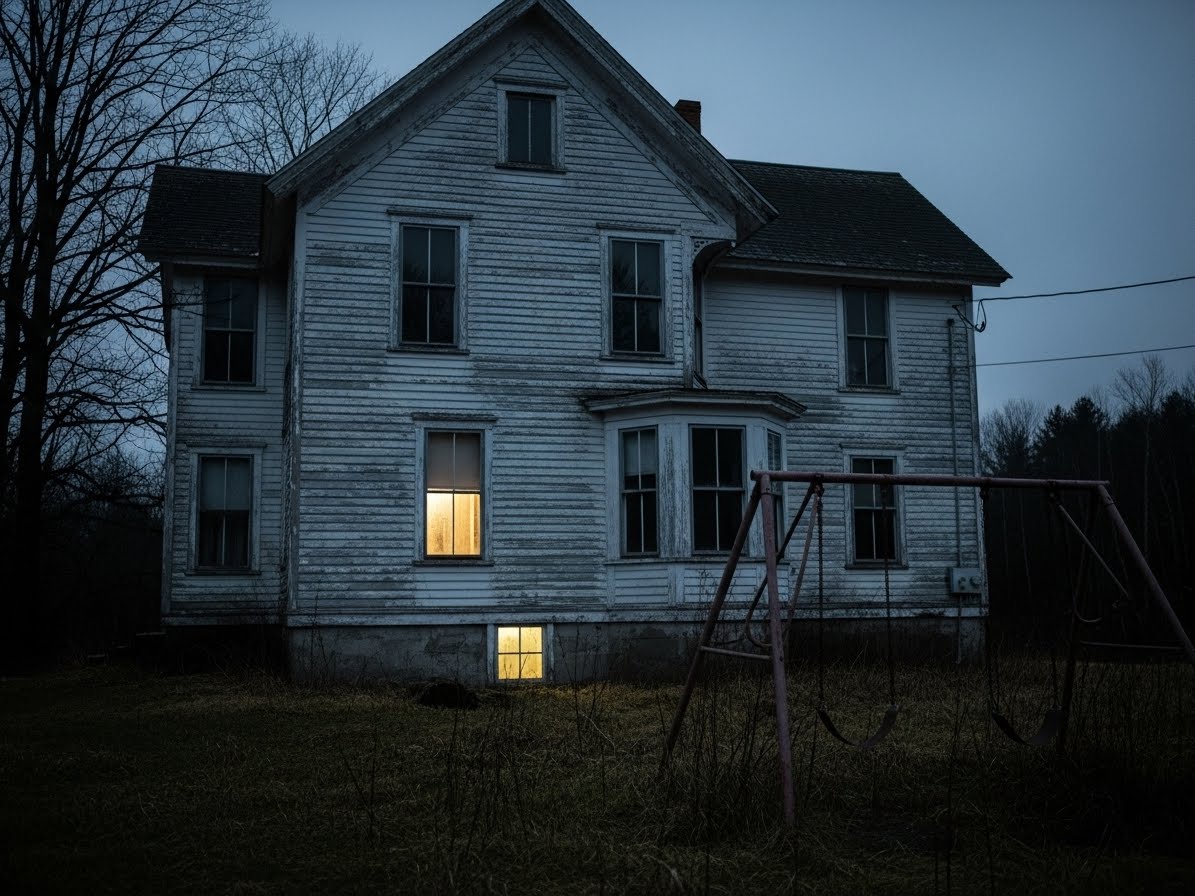
It looked exactly like my nightmares. A hulking, Victorian monstrosity with a wrap-around porch that sagged like a frowning mouth. The white paint was gray in the moonlight. The windows were dark, staring like empty eye sockets.
Except for one.
The kitchen window on the ground floor. A faint, yellow light was flickering inside.
And from the backyard, I heard a sound.
Thump. Squelch. Thump.
I crept closer, hiding behind the trunk of a massive oak tree.
I peered into the backyard.
The rose garden.
My father was there. He was wearing a yellow raincoat that glistened in the wet dark. He was waist-deep in a hole.
He was digging.
And lying next to the hole, wrapped in a black trash bag, was a shape.
It was small. About the size of a child. Or a small woman.
My hand flew to my mouth to stifle a scream. The trash bag moved. It twitched.
She was in the bag.
Chapter 5: The Pantry
Rage is a funny thing. It overrides fear. It overrides logic.
Seeing that bag move, seeing my father raising the shovel to slap more mud onto the pile… I didn’t plan. I didn’t think.
I just moved.
But I didn’t run at him. He had the shovel. He was strong. And if I screamed, he might finish the job before I reached him.
I needed to get inside. I needed to get to the “wall” Lily spoke of. I needed to know what he had kept hidden for fourteen years before I killed him.
I ran to the side of the house, staying in the shadows. I scrambled up the trellis—the one I used to sneak out of when I was sixteen. The roses tore at my clothes, thorns digging into my palms, but I pulled myself up to the porch roof.
I crawled to my old bedroom window. It was painted shut, but the wood was rotten.
I jammed the flat end of the tire iron under the sash and heaved.
CRACK.
The wood splintered. The window slid up with a groan.
I slipped inside.
My old room smelled of dust and mothballs. The bed was stripped. The posters were gone. It was a dead room.
I crept to the door and opened it. The hallway was pitch black.
I heard the sound of the rain on the roof, and from downstairs… a low, rhythmic murmur.
Wait. Dad was outside. Who was talking downstairs?
I gripped the tire iron and descended the stairs. I stepped on the edges of the treads to avoid the creaks, muscle memory taking over.
I reached the bottom landing. The kitchen light was spilling into the hallway.
I peeked around the corner.
The kitchen was empty. The back door was open, letting in the wind and rain. Muddy boot prints led from the door to the pantry.
The pantry door was ajar.
I moved toward it. My heart was hammering against my ribs so hard I thought it would crack them.
I pushed the pantry door open with the tip of the tire iron.
The floor of the pantry had been ripped up. The linoleum was peeled back. The subfloor was sawed open, revealing a dark, gaping hole between the joists.
A hole big enough for a person.
But the hole was empty.
Except for one thing.
Sitting at the bottom of the hole, nestled in a bed of dirty insulation and candy wrappers, was a phone. An old, landline cordless phone.
And next to it… a tape recorder.
It was playing.
“Hannah? Are you coming home for tea? The Bad Man is digging again.”
It was a recording.
My stomach dropped. I spun around.
“Welcome home, star-shine,” a voice rasped.
I didn’t have time to swing.
A heavy, wet hand clamped over my mouth. A cloth smelling of chloroform and old earth was pressed against my nose.
I thrashed. I kicked. I swung the tire iron backward, connecting with something hard, but the grip didn’t loosen.
“You’re just in time,” the voice whispered in my ear. It wasn’t Dad’s voice.
It was higher. Raspy. Unused.
“We have to fill the hole, Hannah. Daddy made it for you.”
My vision blurred. The kitchen tilted sideways.
The last thing I saw before the blackness took me was the figure standing in the doorway of the kitchen.
My father walked in from the rain, holding the shovel. He looked tired. He looked old.
And he looked terrified.
He wasn’t looking at me. He was looking at the person holding me.
“Let her go, Lily,” he begged. “Please. Not her.”
The darkness swallowed me whole.
PART 3
Chapter 6: The Girl in the Wall
Waking up from chloroform isn’t like the movies. You don’t gasp and sit up. You swim through a sickening, black sludge of nausea. Your head pounds like a bass drum, and your limbs feel like they belong to someone else.
I opened my eyes. The world was blurry, swinging in and out of focus.
I was in a chair. A heavy, wooden dining chair. My wrists were zip-tied behind me. My ankles were duct-taped to the chair legs.
I wasn’t in the kitchen anymore. I was in the basement.
But it wasn’t the dark, cobweb-filled cellar I remembered. It had been transformed. Mattresses covered the walls for soundproofing. A small cot sat in the corner. There were piles of my old clothes—sweaters I hadn’t seen since 2008, jeans I wore in middle school—stacked neatly like a shrine.
And standing in front of me was a woman.
She was small, frail-looking, with pale, translucent skin that looked like it had never seen the sun. Her hair was a matted, tangled nest of dark brown. She was wearing my old prom dress—a cheap pink satin thing I had thrown out years ago. It hung loosely on her emaciated frame.
She was holding the tire iron.
“You have nice skin, Hannah,” she said.
Her voice wasn’t the child’s voice from the phone anymore. It was raspier, adult, but with a strange, halted cadence, like someone who had learned to speak by listening to the radio.
“Lily?” I croaked. My throat felt like sandpaper.
She smiled. Her teeth were yellow and crooked, crowded in her small mouth. “I told you I was in the wall. You didn’t believe me.”
“Lily, please,” I whispered. “Let me go.”
“No,” she said, tilting her head like a bird. “You left. You went to the sun. You left me in the dark. But now you’re back. And we’re going to trade.”
“Trade?”
“I’m going to be Hannah now,” she said, twirling a lock of my hair that she had cut from my head while I was unconscious. “I’m going to San Diego. I’m going to drink smoothies. And you…”
She pointed to the corner of the room.
My father was there.
He was slumped against the wall, bleeding from a gash on his forehead. He wasn’t tied up. He just looked… broken. Defeated. He was clutching his chest, his breathing ragged.
“Dad?” I choked out.
He looked up. His eyes were filled with tears. “I’m sorry, Hannah. I tried to keep her in. The lock on the pantry… it rusted.”
“Why?” I screamed at him. “Why didn’t you tell me she was alive?”
“Because she’s not right,” Dad whispered, looking at Lily with terrifying fear. “She never was. You don’t remember, do you? You don’t remember why we hid the locket?”
I shook my head. “We hid it for fun.”
“No,” Dad said, his voice trembling. “We hid it because she used the pin to hurt the neighbor’s cat. We hid it to hide the evidence, Hannah. She was six. And she enjoyed it.”
My blood ran cold.
“I didn’t want them to take her away,” Dad sobbed. “I thought I could fix her. I thought if I kept her close, if I kept her safe… but she got stronger. And smarter.”
“He’s a liar,” Lily spat. She swung the tire iron, smashing a lamp on the table. “He kept me here because he was ashamed! But I watched you, Hannah. I listened to you through the vents. I heard you planning to leave. And when you left… I promised I would take your life back.”
She stepped closer to me, raising the tire iron.
“But first,” she whispered, “I need to make sure you fit in the hole.”
Chapter 7: The Trade
“Lily, wait!” I screamed, pulling at the zip ties. Plastic dug into my wrists, drawing blood. “You can’t be me! You don’t know anything about the world! They’ll catch you in five minutes!”
“I learn fast,” she said. She reached into the pocket of my prom dress and pulled out my iPhone. She held it up. “Face ID. It works on me too. We look alike, sister.”
She swiped the screen. “I already text your boss. I quit. I told him I’m taking a sabbatical. To be with family.”
She laughed. It was a dry, hacking sound.
“Dad!” I yelled. “Do something!”
My father groaned and tried to push himself up. Lily didn’t even look at him. She just swung the tire iron backward, casual as a tennis swing, and hit him in the kneecap.
CRUNCH.
Dad screamed and collapsed, clutching his shattered leg.
“Be quiet, old man,” Lily hissed. “You’re next. The hole in the garden is big enough for two.”
She turned back to me. Her eyes were wide, dilated, manic.
“I practiced,” she said. “I practiced your walk. I practiced your voice. I called you to test it. It worked, didn’t it? You came running.”
She leaned in close. Her breath smelled of rot.
“You felt guilty,” she whispered. “Good.”
She raised the iron again, aiming for my head.
“Wait!” I yelled. “The locket! I have the key!”
Lily froze. The iron hovered inches from my face.
“What key?” she asked. “It’s a plastic heart. It opens with a snap.”
“No,” I lied, my mind racing at a million miles an hour. “The new one. The one I brought. It has the money inside. The money I saved for you.”
Greed flickered in her eyes. “Money?”
“I have a million dollars,” I lied. “In a safe deposit box. But you need the key. It’s in my car. Under the seat.”
She stared at me, processing. She was smart, but she was sheltered. She didn’t know how banks worked. She didn’t know that safe deposit keys didn’t just sit under car seats.
“If you kill me,” I said, keeping my voice steady, “you get nothing. You’ll starve in San Diego. But if you get the money… you can be a queen.”
She lowered the iron. “Show me.”
“I can’t,” I said, lifting my bound wrists. “I’m tied up.”
She narrowed her eyes. She looked at Dad, who was moaning on the floor, useless. She looked at the door.
“If you run,” she said, pulling a jagged, rusty knife from her waistband, “I will cut your Achilles tendons.”
She walked behind me. I felt the cold blade against my skin.
Snip.
The zip ties fell away.
I rubbed my wrists, adrenaline flooding my system.
“The car,” she commanded. “Move.”
I stood up. My legs were shaky. I looked at Dad. He met my eyes. He gave a tiny, almost imperceptible nod.
He was reaching for something under the mattress he was leaning against.
I turned and walked toward the basement stairs. Lily was right behind me, the knife pressed against my spine.
We climbed up into the kitchen. The back door was still open. The rain was pouring down, thundering against the roof.
“Outside,” Lily hissed.
We walked out onto the porch. The wind whipped my hair across my face.
My rental car was parked down the logging road.
“It’s far,” I shouted over the rain.
“Walk,” she said.
We stepped off the porch into the mud.
I knew I had one chance. Just one.
I needed to get her to the garden. To the hole she made Dad dig.
“It’s easier this way,” I yelled, pointing toward the rose garden. “Short cut to the road!”
She shoved me forward.
We trudged through the muck. The hole was gaping in front of us. A black maw in the earth. The pile of wet dirt next to it was slick.
“Stop,” she said when we were five feet from the edge. “Where is the key?”
I turned to face her. The rain was plastering her hair to her skull. She looked like a drowned rat. A dangerous, lethal rat.
“There is no key, Lily,” I said.
Her face twisted in fury. She raised the knife.
But before she could lunge, a deafening BOOM echoed from the house.
A gunshot.
Lily flinched, spinning around toward the back door.
My father was dragging himself out onto the porch, clutching his old hunting rifle. He had pulled it from under the mattress.
He didn’t hesitate. He didn’t warn her.
He racked the bolt and fired again.
BANG.
The bullet hit Lily in the shoulder.
She screamed—a high, unearthly shriek—and spun backward from the impact.
She slipped on the mud.
Her arms windmilled. She tried to grab me, her fingers brushing my blouse.
I stepped back.
She fell.
She tumbled backward into the grave she had forced our father to dig.
I heard a wet thud as she hit the bottom.
Chapter 8: The Good Sister
I ran to the edge of the hole.
It was deep. Six feet. Dad hadn’t skimped.
Lily was at the bottom, writhing in the mud, clutching her shoulder. She looked up at me, her face a mask of mud and blood and pure hatred.
“Hannah!” she screamed. “Help me! Please! I’m your sister!”
I looked at her. I looked at the creature that had lived in the walls, listening, plotting, hating.
Then I looked up at the porch.
Dad had collapsed. The rifle had fallen from his hands. He wasn’t moving.
I looked back down at the hole.
“Help me!” Lily shrieked. She tried to climb the wall, but the mud was too slick. She slid back down. “I’ll be good! I promise! I’ll go back in the wall!”
The rain was falling harder now. It was washing the dirt from the pile back into the hole. The water was rising at the bottom.
I saw the shovel lying in the grass next to my feet.
I thought about the phone call. I thought about the fear in my father’s eyes. I thought about the neighbor’s cat.
I picked up the shovel.
“Hannah?” Lily whispered, her eyes widening. “What are you doing?”
“I’m finishing the job,” I said.
I didn’t hit her. I wasn’t a killer.
I shoved the pile of dirt.
A massive mound of wet, heavy clay slid over the edge.
“NO!” she screamed.
I shoveled again. And again.
I worked with a rhythm. Thud. Splash. Thud.
Her screams turned to muffled pleas. Then to gurgles.
I didn’t stop until the hole was filled. I didn’t stop until the ground was level. I didn’t stop until my arms were numb and my blisters had burst.
I dropped the shovel.
I walked back to the house.
Dad was alive, but barely. He had lost a lot of blood from his knee. I called 911 on the landline.
When Sheriff Brody arrived, he didn’t ask questions. He saw the rifle. He saw the fresh dirt in the garden.
He looked at me, soaking wet, standing over my father.
“Gas leak,” Brody said, lighting a cigarette. “Caused an explosion. Old man Vance was cleaning his gun. Accidental discharge.”
He looked at the garden.
“And the landscaping looks good,” he added. “Real flat.”
I nodded.
Three Months Later
I’m back in San Diego. I have a new apartment. A new phone number.
I visit Dad in the nursing home once a month. He lost his leg, but he seems lighter. He smiles more. We don’t talk about Oakhaven Road. We don’t talk about Lily.
But sometimes, at night, when the wind whistles through the high-rise vents, I wake up sweating.
I check the locks. I check the closets.
Yesterday, I bought a house. A modern one. Concrete and glass. No attic. No basement. No crawl spaces.
I was unpacking my boxes this morning when I found something I didn’t pack.
It was tucked inside my winter coat pocket.
It was a plastic heart locket. Cheap. Scratched.
And inside, there was a tiny, folded piece of paper.
I opened it with trembling fingers.
The handwriting was jagged, scratchy.
I held my breath.
I stared at the note.
I ran to the balcony and threw the locket as far as I could, watching it disappear into the city traffic below.
It doesn’t matter if she’s really gone. It doesn’t matter if she’s under six feet of dirt in Maine.
Because I know the truth now.
We never really leave our families. We just carry their ghosts in our pockets.
And sometimes, if you listen closely to the walls…
They’re still scratching to get out.
(THE END)