The Judge’s Secret: A Widow Uncovers the Horrifying “Blood Money” Ledger That Destroyed a Generation of Foster Children
Chapter 1: The Saint’s Shadow
The rain in Blackwood, Pennsylvania, didn’t wash things clean; it just made the rust streak darker down the sides of the abandoned steel mills. It was a fitting backdrop for the funeral of Judge Arthur Vance.
Eleanor Vance stood under the black canopy of the gravesite, her posture rigid, her face a mask of practiced stoicism. She was seventy-two years old, a retired schoolteacher known for her iron-gray hair and her unwavering moral compass. Beside her, the polished mahogany casket seemed too bright, too perfect for the gloomy day.
“He was a titan,” the Governor said, his voice booming over the sound of the drizzle hitting the umbrellas. “A guardian of the innocent. The Family Court has lost its greatest champion.”
Eleanor nodded mechanically. She accepted the folded American flag with gloved hands, feeling the heavy weight of the fabric. The town of Blackwood had turned out in droves. Men in ill-fitting suits, women clutching tissues, police officers standing at attention. They were mourning a saint. They were mourning the man who had supposedly saved their crumbling community from moral decay.
But Eleanor felt a strange hollowness. Arthur had been a good husband—distant, perhaps, and work-obsessed—but a provider. A rock. Yet, in the last few months of his life, as the cancer ate away at his formidable frame, he had muttered things in his sleep. Numbers. Names. The Farm. Eleanor had dismissed it as the morphine talking.
The reception at the Vance estate was suffocating. The house, a sprawling Victorian mansion on the hill, had always felt too large for just the two of them. It was a house bought with Arthur’s hard work, or so she had always believed.
By 8:00 PM, the last guest had departed. The silence that followed was heavier than the noise. Eleanor couldn’t sleep. She wandered into Arthur’s study, a room she rarely entered. It smelled of pipe tobacco and old paper. The walls were lined with awards: Humanitarian of the Year, Justice Award, Friend of the Orphan.
She sat at his massive oak desk. She needed to sort out the will, the accounts. She unlocked the center drawer with the key she’d taken from his bedside table. It was neat, organized, just like Arthur. But as she pulled the drawer out to its full extension, something caught, a subtle friction that shouldn’t have been there.
Eleanor frowned. She felt under the drawer. A latch. She clicked it, and a false bottom popped up with a soft thud.
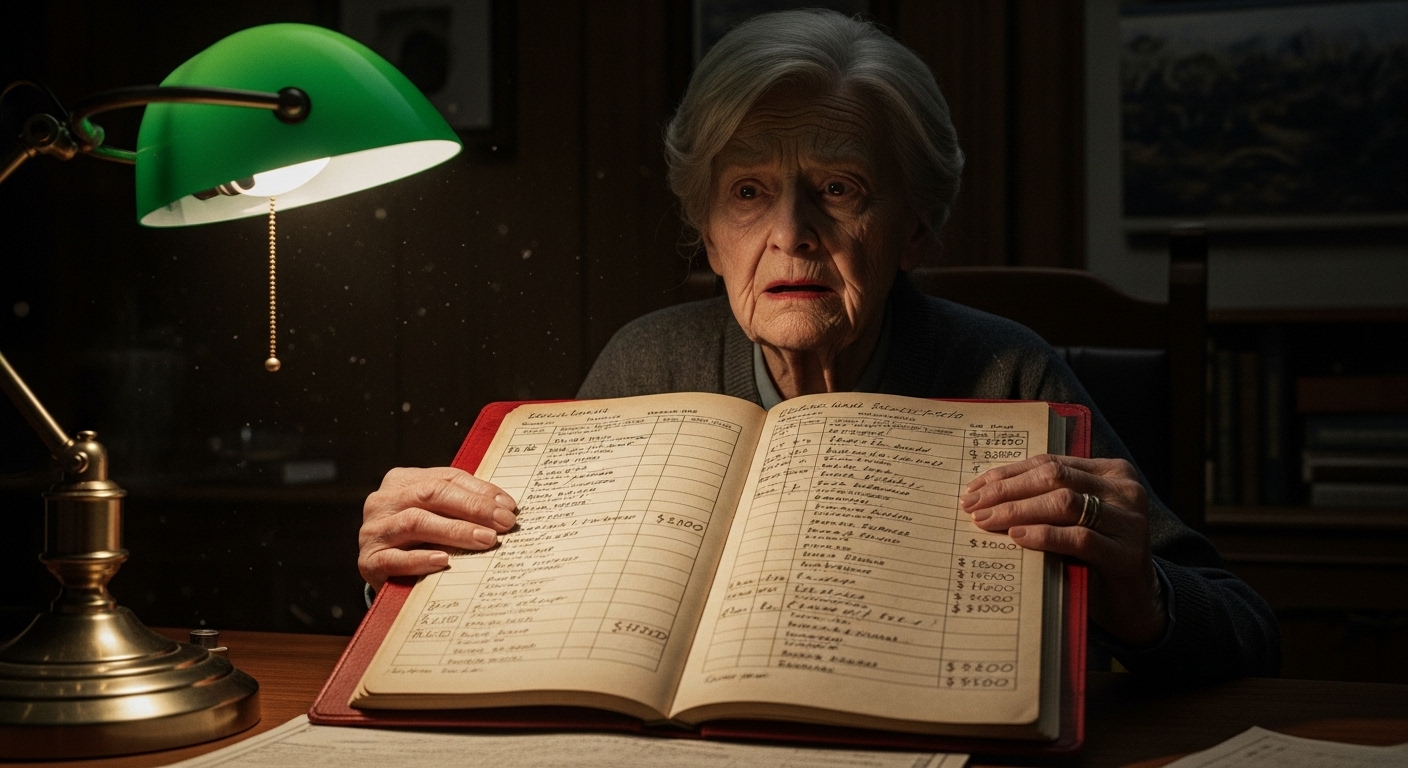
Her heart began to hammer against her ribs—a slow, heavy rhythm of dread. There was no cash, no illicit love letters. Just a single, leather-bound book. It was red, the color of dried blood, worn at the corners.
She opened it.
It wasn’t a diary. It was a ledger. The handwriting was unmistakably Arthur’s—sharp, angular, precise.
May 12, 1984: The Johnson Siblings. Disposition: Sterling Farm. Payment: $5,000. Status: Closed/Sealed. August 4, 1985: Baby Doe (Male). Disposition: State Overflow/Sterling. Payment: $2,500. Status: Erased. November 20, 1985: The Miller Twins (Jax & Lily). Disposition: Sterling Farm. Payment: $8,000. Note: High risk. Do not file.
The pages went on for years. Hundreds of names. Beside each entry were initials that made Eleanor’s blood run cold: Paid by R.S.
R.S. Robert Sterling. The current Mayor. The man who had just delivered the eulogy, weeping about losing his “best friend.”
Eleanor grabbed a magnifying glass, her hands trembling so violently she nearly dropped it. She focused on the entry for the Miller Twins. The official court records—which she knew Arthur kept copies of in the filing cabinet—would say these children were adopted or moved to state facilities. But this ledger said Sterling Farm.
“What did you do, Arthur?” she whispered to the empty room. “Dear God, what did you sell?”
She spent the entire night cross-referencing. She pulled the public files from Arthur’s archives. Every name in the red ledger was listed in the official system as “File Lost,” “Runaway,” or “Adoption Closed.” But in the red book, they were all sent to one place.
Sterling Farm.
Eleanor knew the place. It was now the “Sterling Vineyard and Winery,” a tourist trap that Mayor Sterling used for fundraising galas. But in the 80s? It was just acres of isolated land and old barns.
As the sun rose, casting a gray light over the study, Eleanor Vance realized the life she lived—the silk curtains, the paid-off mortgage, the respect of the town—wasn’t built on justice. It was funded by the sale of human beings.
She closed the ledger. She could burn it. She could protect Arthur’s legacy. She could remain the widow of the Saint.
Instead, she went to the closet, put on her heavy wool coat, and grabbed her car keys. The Saint was dead. The Teacher was awake. And she had attendance to take.
Chapter 2: The Vineyard of Bones
The drive to the outskirts of Blackwood took forty minutes. The landscape shifted from the decaying industrial downtown to the rolling, wooded hills of Pennsylvania wine country. Mayor Sterling had done well for himself. The entrance to Sterling Winery was grand—iron gates, manicured hedges, and a long driveway lined with oak trees.
But Eleanor didn’t drive through the gates. She parked her Buick sedately on the shoulder of the county road, half a mile down. She wasn’t here to taste Pinot Noir. She was looking for the old service road she had seen on the property maps from 1985.
She found it—a dirt track overgrown with brambles, blocked by a rusted chain. Eleanor, clutching her purse which contained a taser she had bought years ago for self-defense and the photocopy of the ledger page, stepped over the chain. Her arthritic knees protested, but she ignored them.
The woods were silent. As she walked deeper, the pristine image of the winery faded. Here, the old structures remained. Rotting sheds. Collapsed fences. And the “Farm.”
It wasn’t a farmhouse. It was a barracks. A long, low wooden building with small windows, now boarded up. It looked like a chicken coop, but big enough for people.
“Hey! You can’t be back here!”
The voice was raspy, aggressive. Eleanor spun around.
Emerging from a cluster of blue tarps and tents hidden in the thicket was a man. He looked to be in his forties, but his face was weathered like old leather. He wore a dirty army jacket, his beard was matted, and his eyes were wild—darting left and right as if expecting an airstrike.
“I said get lost,” the man spat, stepping closer. He held a jagged stick like a baseball bat. “Sterling’s security comes by at noon. You don’t want to be here.”
Eleanor stood her ground. She was a teacher; she had stared down bullies larger than him. “I am looking for someone,” she said, her voice steady. “I am looking for Jackson Miller.”
The man froze. The stick lowered an inch. A tremor went through his body, distinct and violent. “Who sent you?” he hissed. “The cops? The social workers? I didn’t do nothing.”
“My name is Eleanor Vance,” she said. “My husband was Judge Arthur Vance.”
The reaction was instantaneous. The man dropped the stick. He stumbled back as if she had physically struck him. He grabbed his head, hyperventilating. “Vance… Vance… the Gavel. The man with the Gavel.”
“You’re Jackson, aren’t you?” Eleanor softened her voice. She took a step forward. “Jax?”
“Don’t say that name!” he screamed, backing into a tree. He slid down the trunk, curling into a ball. “Jax is gone. Jax is in the hole. Just Miller. Just Miller now.”
Eleanor’s heart broke. This wreckage of a man was the six-year-old boy from the ledger. 1985. He should be forty-two. He looked sixty.
She knelt in the dirt, ignoring the mud staining her coat. “Miller,” she said softly. “I found a book. A red book. It says you and your sister Lily were sent here. To the farm.”
At the mention of “Lily,” Miller stopped shaking. He looked up, and the raw agony in his eyes was enough to make Eleanor want to look away. But she didn’t.
“They told you we were adopted,” Miller whispered, his voice cracking. “That’s what the Judge told us. ‘You’re going to a special camp to learn to work, and then a family will come.’ That’s what he said.”
“What happened here, Miller?”
Miller looked toward the boarded-up barracks. “Work. We picked the grapes. We fixed the fences. Six years old. Seven. Eight. If we didn’t work, we didn’t eat. If we cried, we went in the Box.”
“Where is Lily?” Eleanor asked, dreading the answer.
Miller’s eyes filled with tears that cut clean tracks through the grime on his face. “She was pretty. Lily was real pretty. Sterling… the man, not the place… he liked the pretty ones. One night, a black car came. Big black car. Sterling took her by the hand. She was screaming my name. Jax! Jax! Help me!“
Miller began to sob, a guttural, ugly sound of a grown man reliving his childhood impotence. “I tried to stop them. The guards broke my arm. They took her. Sterling said she was going to a ‘better place.’ I never saw her again. That was thirty years ago.”
He looked at Eleanor, his eyes burning with hate. “Your husband signed the paper. I saw him here. He came to collect envelopes. Thick envelopes. He watched us working in the fields, bleeding, and he just… smiled. He drank wine with Sterling on the porch while we starved.”
Eleanor felt bile rise in her throat. The “saintly” Judge Vance hadn’t just looked the other way. He had inspected the merchandise.
“I need you to come with me,” Eleanor said, standing up. Her legs were shaking, but her resolve was steel.
“No,” Miller scrambled back into his tent. “Sterling is Mayor now. He’s gonna be Senator. You can’t touch him. He kills what he can’t sell.”
“I don’t want to touch him,” Eleanor said, reaching into her bag and clutching the ledger. “I want to bury him.”
Chapter 3: Sins of the Fathers
Convincing Miller to leave the woods was the hardest thing Eleanor had ever done. He was terrified of the open world, terrified of “The System.” But a hot meal and the promise of a shower at a motel—not her house, he refused to go to the “Judge’s House”—coaxed him out.
For three days, Eleanor kept him hidden in the motel on the edge of town. She bought him clean clothes. She listened to his story, recording every word. It wasn’t just Jax and Lily. There were dozens. “The Throwaways,” Sterling had called them. Kids who were hard to place—too old, too traumatized, or minority children that the wealthy white families of Blackwood didn’t want in the 80s.
Sterling had run a black-market labor camp and a trafficking ring under the guise of a foster care overflow facility. And Judge Vance had kept the legal paper trail clean, ensuring no social worker ever came looking.
On the fourth day, Eleanor went to the Mayor’s office. She needed to look him in the eye.
Robert Sterling welcomed her with open arms. His office was plush, smelling of expensive cologne. “Eleanor! My dear! To what do I owe the pleasure? Is there something we can do for the memorial?”
Eleanor sat down, placing her handbag on her lap. She didn’t smile. “I found the ledger, Robert.”
The smile didn’t leave Sterling’s face, but it froze. The warmth evaporated from his eyes, leaving them dead and cold like a shark’s. “I don’t know what you’re talking about, Ellie.”
“The red ledger,” she clarified. “The Miller Twins. The Johnson Siblings. The payments. I know about the Farm, Robert. I know about the labor. I know about Lily.”
Sterling sighed, leaning back in his leather chair. He tented his fingers. “Arthur always was a meticulous note-taker. I told him to burn that thing.”
“You admit it?”
“Admit what? That we solved a problem?” Sterling’s voice dropped, becoming menacingly low. “Those children were drains on the state, Eleanor. Nobody wanted them. I gave them purpose. I gave them discipline. And yes, some were… relocated to benefactors who paid handsomely. That money built this town. It built Arthur’s career. It paid for your house, your car, your pension.”
He leaned forward. “You think you’re innocent? You lived like a queen on the suffering of ‘throwaways.’ You are just as guilty as we are.”
“I didn’t know,” Eleanor whispered.
“Doesn’t matter,” Sterling sneered. “You speak a word of this, and I will destroy Arthur’s memory. I will paint him as a pedophile, a monster, and I will claim I knew nothing. Who will they believe? The beloved Mayor, or the senile widow? And your pension? Gone. You’ll be on the street with that bum Miller.”
Eleanor stood up. She was trembling, but not with fear. With rage. “You think Arthur’s reputation matters to me now? You think I care about the money?”
“Everyone cares about the money, Ellie,” Sterling chuckled. “Go home. Knit something. Let the dead stay dead.”
Eleanor walked out. Sterling thought he had won. He thought she was a fragile old woman protecting her lifestyle. He forgot that before she was a Judge’s wife, she was a teacher. And she knew how to handle a bully.
That night, she called the local news station. They hung up on her as soon as she mentioned Sterling. The editor was Sterling’s nephew. She called the police chief. He was Sterling’s old college roommate.
“The system protects its own,” Miller had said.
“Fine,” Eleanor said, looking at the flyer for the Town Hall meeting the next day. It was being televised live. “If they won’t listen to the truth, we’ll force them to watch it.”
Chapter 4: Judgment Day
The Blackwood Community Center was packed. Banners read: STERLING FOR SENATE: A LEGACY OF FAMILY.
Eleanor pushed the wheelchair down the center aisle. Miller sat in it, wearing a cheap suit Eleanor had bought him. He was shaking, his head down, gripping the armrests until his knuckles were white. The crowd murmured. Who was this homeless man? Why was Mrs. Vance pushing him?
On stage, Sterling was mid-speech. “…and just as Judge Vance watched over us, I will watch over…”
He stopped when he saw Eleanor. A flicker of panic crossed his face, but he recovered. “And look! Eleanor Vance, here to give her blessing!”
Eleanor didn’t go to the reserved seats. She went straight to the stage stairs. Security guards stepped forward, but Eleanor raised her voice—the projection of a woman who had commanded auditoriums for forty years.
“I am not here to bless you, Robert! I am here to confess!”
The crowd went silent. The cameras zoomed in. Sterling signaled the guards to grab her, but the front row was filled with the Elderly Ladies Auxiliary—Eleanor’s friends. They instinctively blocked the guards, confused but protective of their friend.
Eleanor grabbed the microphone stand on the podium, wrestling it away from a stunned Sterling.
“My husband was not a saint!” Eleanor’s voice boomed through the speakers. “He was a monster! And this man,” she pointed a shaking finger at Sterling, “is the devil who paid him!”
“Cut the feed!” Sterling screamed at the tech booth. But the tech kid was frozen in shock.
Eleanor pulled the red ledger from her coat. “May 12, 1984. The Johnson Siblings. Sold to Sterling Farm. November 1985. The Miller Twins. Sold.”
She looked at the camera. “This man here,” she gestured to Miller in the wheelchair below the stage. “This is Jackson Miller. The state says he was adopted. But he was enslaved at Sterling’s winery for ten years!”
The crowd gasped. A low rumble of anger began to build.
“Lies! She’s senile!” Sterling yelled, lunging for the mic.
Miller stood up. He didn’t need the wheelchair; it was just for support. He looked up at Sterling. The fear was gone, replaced by a cold, dead stare.
“Where is my sister, Robert?” Miller shouted. His voice was raw, carrying over the crowd without a microphone. “Where did you bury Lily?”
The silence that followed was deafening.
Then, chaos. The police moved in, but not to arrest Eleanor. The State Troopers, who were present for the Governor’s security detail, stepped onto the stage. The Governor looked horrified. The allegations were too specific, the ledger too visible.
“Mayor Sterling,” a Trooper said, “we need to have a conversation.”
Epilogue: The Garden of Ghosts
The investigation took six months. The “Sterling Scandal” was national news. They tore apart the winery. They found the financial records hidden in the walls of the main house confirming everything in Arthur’s ledger.
But the real evidence was in the ground.
Under the supervision of the FBI, excavators dug up the fallow field behind the old barracks. Eleanor stood by the yellow tape every day, holding Miller’s hand.
On a Tuesday in November, under a grey sky much like the day of Arthur’s funeral, they found them. Small, unmarked graves.
Miller fell to his knees in the mud when they brought up a small, plastic bag containing personal effects found with remains labeled “Jane Doe #4.” Inside was a silver locket. Cheap, tarnished metal.
“I gave that to her,” Miller wailed. The sound was primal. A forty-year-old man crying for the six-year-old girl he promised to protect. “I told her to hide it so Sterling wouldn’t take it. She kept it. She kept it.”
Eleanor knelt beside him, ignoring the mud soaking her dress. She wrapped her arms around him, rocking him as he screamed. She couldn’t fix this. No amount of justice could bring Lily back or heal the decades of torture Miller had endured.
But she had done the only thing she could. She had told the truth.
Six Months Later
The Vance Estate was sold. The proceeds, along with Arthur’s entire pension and savings, went into a trust.
Eleanor now lived in a small, one-bedroom apartment near the park. She sat on a bench, watching the construction crew across the street. The sign read: The Lily Miller Center for At-Risk Youth.
Miller sat beside her. He was clean-shaven, gaining weight, working as a counselor for the center’s outreach program. He still had nightmares. He still flinched at loud noises. But he was alive.
“You okay, Miss Ellie?” Miller asked.
Eleanor looked at him. She had lost her friends, her status, and her husband’s legacy. She was a pariah to the country club set, a hero to the poor. She took Miller’s hand.
“I’m fine, Jax,” she said, using the name he finally allowed her to speak. “We’re both still here.”
They sat in the quiet sunlight, two survivors of a shipwreck caused by the man Eleanor had loved. She couldn’t rewrite the ledger. But she had balanced the books