THEY LAUGHED WHILE FILMING HER PAIN FOR LIKES, BUT THE LAUGHTER DIED THE SECOND MY ENGINE CUT AND I STEPPED OFF THE BIKE.
The asphalt was radiating heat, shimmering in waves that distorted the horizon, but I didn’t mind. When you’re on the bike, the heat feels like a living thing, something you wrestle with, something that reminds you you’re still breathing. I was riding lead, with Miller and Tiny staggered behind me. We weren’t going anywhere in particular, just burning gas and clearing our heads. That’s the therapy. The vibration of the engine in your chest shakes loose the things you can’t talk about.
We took the exit toward the old industrial park, a stretch of cracked concrete and rusted chain-link fences where the city had given up trying to be pretty. It’s quiet back there usually. Just the hum of tires and the occasional distant train. That’s why we liked it. We could pull over, smoke a cigarette, and not have anyone looking at us like we were trouble just because we wore leather in July.
But today, it wasn’t quiet.
I saw the movement first. Behind the skeleton of what used to be a shipping warehouse, there’s a dead-end alley cluttered with illegal dumping—old mattresses, tires, bags of trash. Something was happening there. I saw bright colors, neon hoodies that didn’t belong in the gray wash of the alley. I saw arms winding up. I saw stumbling.
I raised a fist, signaling the slow down. Miller and Tiny dropped gears instantly, the roar of our engines deepening into a guttural growl as we rolled to a crawl. We weren’t looking for a fight. We’re too old for drama. But then I heard it.
A yelp. High-pitched, sharp, and terrified.
It cut through the rumble of the Harleys. It wasn’t a dog barking in defense. It was a dog crying for help.
I killed the engine. The silence that followed was heavy, sudden, and violent. Miller and Tiny cut theirs a second later. In the sudden quiet, the sound from the alley became crystal clear. It was laughter. High, cracking, adolescent laughter.
“Get a better angle, dude, she’s trying to hide behind the tire!” one voice shouted.
“Throw the big one near her head, make her jump!” another laughed.
My blood didn’t boil. That’s a cliché people use in movies. Real anger, the kind that sits in your marrow, runs cold. It slows everything down. I felt the temperature of the air drop in my mind. I kicked the kickstand down, the metal scraping loud against the grit. I dismounted slowly. I’m six-foot-four, and I’ve spent thirty years lifting things heavier than these kids. My boots hit the pavement with a heavy thud.
I walked toward the gap in the fence, Miller and Tiny flanking me without a word. They knew. They heard it too.
There were three of them. They couldn’t have been older than sixteen. They were dressed in that way kids are now—expensive sneakers that had never seen dirt, oversized hoodies, hair perfectly styled. They were clean. They looked like they came from homes with full fridges and soft beds. And they were cornering a creature that had none of those things.
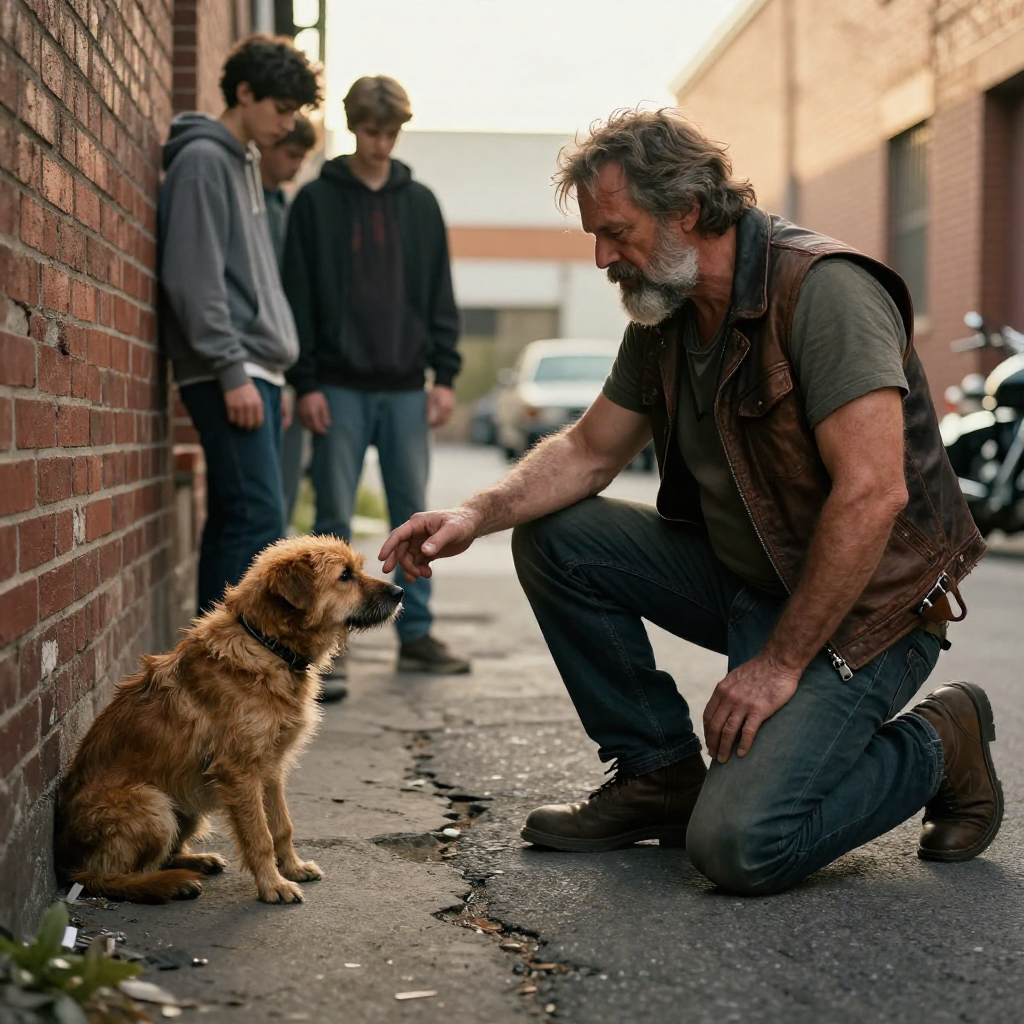
The dog was a mutt, maybe forty pounds, ribs showing through patchy brown fur. She was pressed into the corner formed by a dumpster and a concrete wall. She was shaking so hard it looked like a seizure. There was no aggression in her, only a paralyzing terror. She wasn’t growling; she was trying to become invisible.
One boy, the tallest one holding a rock the size of a grapefruit, was winding up. Another was crouched low with a smartphone, the screen glowing, recording the “content.” The third was kicking dust at her, trying to force a reaction, trying to make her snap so they could justify whatever they did next.
“Do it!” the camera boy urged. “Before she runs!”
The tall kid raised his arm.
“I wouldn’t do that,” I said. My voice wasn’t loud. I didn’t shout. I just projected it, deep and flat, so it carried across the twenty feet between us like a physical weight.
The tall kid froze. The rock stayed in the air for a split second before his hand lowered, trembling. All three of them whipped around.
I saw the calculation happen in their eyes. They expected a security guard, maybe a homeless guy yelling at them to get lost. They didn’t expect three men who looked like us. They didn’t expect Tiny, who is almost as wide as he is tall, with a beard that reaches his chest and arms covered in ink that tells stories you don’t want to read before bed. They didn’t expect Miller, who stands like a coiled spring, eyes hidden behind dark aviators, chewing on a toothpick with unnerving calm.
And they didn’t expect me.
I kept walking. I didn’t rush. I wanted them to have time to feel the situation change. I wanted them to feel the shift in power. The air in the alley seemed to get thinner. The laughter was gone, replaced by a suffocating tension.
” We… we were just…” the kid with the phone stammered. He lowered the device, trying to slide it into his pocket, trying to hide the evidence.
“Keep it out,” I said, stopping ten feet from them. “You like filming, right? Keep filming.”
The boy froze, his hand hovering near his pocket. He looked at his friends, but they were paralyzed. The tall kid dropped the rock. It hit the ground with a dull clatter that sounded like a gunshot in the silence.
“We weren’t doing anything,” the tall one lied. His voice cracked. He was trying to summon some of that bravado he had thirty seconds ago, but it had evaporated. “It’s just a stray. It bit us.”
I looked at the dog. She hadn’t moved. She was pressed so hard into the brick she looked like she was trying to merge with it. There was no blood on the boys, no torn fabric. The dog was the only thing bleeding—a small cut above her eye where a rock had already landed.
“She bit you?” I asked, taking another step forward. The gravel crunched under my boot. “That dog is too scared to breathe, let alone bite. You boys are confused. You think because she has no collar, she has no people. You think because she’s alone, she’s yours to break.”
I looked at the boy with the phone. “Unlock it.”
“What?” he squeaked.
“The phone. Unlock it. Open the video you just took.”
He hesitated. He looked at the exit of the alley, but Miller had already drifted to the left, blocking the clear path. Tiny was on the right. They were boxed in. Not by violence, but by consequence. That’s the thing about bullies—they rely on the assumption that nobody will check them. They rely on the world looking away.
“I’m not gonna ask twice,” I said softly.
The boy’s fingers fumbled over the screen. He tapped it, his hands shaking so bad he almost dropped it. The video started playing. I could hear the tinny sound of their laughter coming from the speaker. I could hear the thud of a rock hitting the dumpster, missing the dog by inches. I could hear the fear in the animal’s whimpers.
“You think that’s funny?” I asked, pointing at the screen. “You think fear is entertainment?”
“No, sir,” the tall kid whispered. He was looking at the ground now. The defiance was gone, replaced by the primal fear of a child who realizes they have made a catastrophic error.
I stepped past them, ignoring them for a moment, and crouched down near the dumpster. The boys flinched, thinking I was coming for them, but I wasn’t. I turned my back to them—the ultimate sign that I didn’t consider them a threat—and looked at the dog.
“Hey, mama,” I whispered, keeping my voice low and rumbling. “It’s okay.”
She trembled, her eyes showing the whites, watching my hands. I kept them low, palms open. I didn’t reach for her. I just existed in her space, letting her smell the leather and the gasoline and the sweat, letting her see that I wasn’t winding up to hurt her.
“You boys stay right there,” Miller said from behind me. His voice is different than mine—raspy, dry. “If I see a sneaker move, I’m gonna be very disappointed.”
I stayed crouched. The dog let out a small exhale, a tiny release of tension. She sniffed the air. She knew. Animals always know. They can smell intent better than humans can hear words.
“You know what happens to dogs like this?” I said, not turning around, addressing the silence behind me. “They starve. They freeze. They get hit by cars. Their life is hard enough without three suburban punks deciding to make their last moments a horror movie.”
I stood up slowly, my knees popping. I turned back to face them. The three of them were huddled together now, shoulders hunched. They looked small. They looked exactly like what they were: children pretending to be men.
“You want to be tough?” I asked. “You want to feel powerful?”
I reached into my vest pocket. They flinched again. I pulled out a crumpled twenty-dollar bill and a receipt from the gas station.
“Power isn’t making something weak suffer,” I said, staring hard at the ringleader. “Power is having the strength to stop it. And right now, you boys are weak. You’re the weakest things in this alley.”
The kid with the phone looked like he was going to cry. “We’re sorry. We won’t do it again.”
“I know you won’t,” I said. “Because you’re not leaving yet.”
“What… what are you going to do?” the tall one asked, his voice barely audible.
I looked at Miller, then at Tiny. Tiny cracked his knuckles, a sound like dry wood snapping. But he was smiling. It wasn’t a nice smile.
“We’re not going to touch you,” I said. “We don’t hit kids. That’s beneath us. But that dog needs help. She needs water. She needs food. And she needs to not be afraid anymore.”
I pointed a gloved finger at the tallest boy.
“Give me the phone.”
He handed it over, his hand shaking. I looked at the video one last time, then hit delete. Then I went to the ‘Recently Deleted’ folder and wiped it from there too. I handed it back.
“Now,” I said, crossing my arms. “You boys are going to fix this. You see that water spigot over there by the wall? You see that old plastic bowl in the trash? Go wash it out. Fill it up. Bring it here. Crawl if you have to, keep your movements slow. If you scare her again, we have a problem.”
They didn’t move fast enough.
“Go!” Tiny barked.
They scrambled. The dynamic had flipped completely. Five minutes ago, they were the predators. Now, they were the ones frantic to please, desperate to avoid the wrath of something bigger than themselves.
I watched them run to the spigot. I watched the tall kid scrubbing the dirty plastic bowl with his expensive sleeve, not caring about the fabric anymore. I watched the realization sink in that their afternoon of fun had turned into a lesson in humility.
But as I watched them, I noticed something else. The dog had moved. She had inched forward, just a few inches, away from the wall. She was looking at me. Not with trust, not yet. But with curiosity.
This wasn’t over. I wasn’t just going to make them give her water and let them walk away. They needed to understand the weight of a life. They needed to feel the shame of what they had done, not just the fear of getting caught.
“Miller,” I said quietly. “Call the van. We’re gonna need a crate.”
“On it,” Miller said, pulling out his cell.
I turned back to the boys as they approached with the water, walking on eggshells.
“Put it down,” I commanded. “Slowly.”
They did. The dog stretched her neck, sniffing the water. She was parched. She lapped at it, eyeing the boys warily.
“Look at her,” I told them. “Don’t look at me. Look at her.”
They looked. For the first time, they actually looked at the animal, not as a prop, but as a living thing drinking water because it wanted to survive.
“You see that shaking?” I asked. “That’s you. You did that. You put that fear in her heart. And that doesn’t go away when you delete a video.”
The tall kid wiped his nose. He looked ashamed. Good.
“So here’s the deal,” I said, stepping closer, my shadow falling over all three of them. “My friends and I, we ride through here every Thursday. Sometimes Tuesday. Sometimes we just pop up.”
I let that hang in the air.
“If I ever hear about you bothering a stray again, if I ever see your faces on a video doing something like this… I won’t be this polite. Do we understand each other?”
“Yes, sir,” they chorused.
“Good. Now sit down. On the ground. Wait until she finishes drinking. You’re going to sit there and watch her until she decides she’s done. You’re on her time now.”
They sat in the dust, ruining their jeans, silent and small. I leaned back against my bike, crossed my arms, and waited. The sun was hot, but the air felt cleaner now.
CHAPTER II
The white van didn’t come with a siren, but its arrival felt like the end of a long, breathless battle. It was an old Ford Transit, the kind that had seen better decades, with a faded logo of a local animal rescue plastered on the side. When it pulled into the alley, the tires crunched over the broken glass and gravel with a sound like grinding teeth. I didn’t move. I kept my boots planted in the dirt, my shadow still draped over the three boys like a heavy, suffocating blanket. They were still sitting there, their expensive sneakers ruined by the industrial dust, watching the stray dog lap up the last of the water we’d given her.
Sarah climbed out of the driver’s seat. She was a woman built of wire and grit, her hair pulled back into a messy knot that looked like it hadn’t been touched in days. She took in the scene—the three bikers in leather, the three terrified teenagers, and the shivering, broken animal in the center. She didn’t ask questions. She had seen the worst of humanity in this city for fifteen years; she knew the math of an alleyway.
“She’s in bad shape, Elias,” Sarah said, her voice low as she walked toward me. She didn’t look at the boys. She looked at the dog.
“I know,” I said. My voice felt like it was coming from the bottom of a well. The adrenaline was starting to recede, leaving behind a cold, hollow ache in my chest. “She’s got a limp. Maybe a broken rib. And she’s terrified of everything that moves.”
Miller and Tiny stepped back, giving her room. Miller lit a cigarette, the smoke curling around his bearded face, his eyes never leaving the kids. He was the one who usually kept us level, but today, I could see the twitch in his jaw. We had all seen things on the road, but there was something about the casualness of what these boys had done—the way they had filmed it for a digital audience—that had scratched at a scab we all carried.
As Sarah knelt by the dog, the youngest of the boys, a kid with a pale face and a nervous tic in his left eye, tried to stand up.
“Stay down,” I said. I didn’t shout. I didn’t have to. The two words just hung there, heavy as lead. He sank back into the dirt, his eyes welling up.
“We didn’t mean anything by it,” the lead boy, the one who’d been holding the phone, muttered. He was trying to find his bravado again, now that there was a woman present. “It was just a joke. For the ‘gram.”
I looked at him, really looked at him, and for a second, I wasn’t in an alley in 2024. I was back in a wood-paneled garage in 1988. I was ten years old, watching my father hold a belt, explaining to me that ‘weakness was an invitation.’ I remembered the way the air felt right before he swung—the same charged, static silence that was currently vibrating through my own bones. That was the old wound. I had spent forty years trying to be the opposite of that man, trying to use my size to build instead of break, yet here I was, using fear to teach a lesson about cruelty. The irony tasted like copper in my mouth.
I had a secret, one I kept even from Miller and Tiny. They saw me as the ‘Big Man,’ the stoic leader of our small pack. They didn’t know that every time I stood up to a bully, I was really just trying to protect the ten-year-old version of myself who had never been rescued. They didn’t know that my professional life—my real life—was as a high school counselor three towns over. If the school board saw me now, standing over these kids with my colors on, I wouldn’t just lose my job; I’d lose my identity. I was a man who lived on a razor’s edge, balancing the violence I was capable of against the empathy I was supposed to teach.
Sarah got the crate ready. It took twenty minutes of soft murmurs and slow movements to get the dog inside. The dog didn’t growl once. She just trembled until she went limp, surrendering to whatever came next because she had no more fight left.
As Sarah slid the side door of the van shut, the triggering event happened. It wasn’t a gunshot or a punch. It was the sound of a luxury SUV screeching to a halt at the mouth of the alley.
A man jumped out before the engine had even stopped. He was dressed in a suit that cost more than my motorcycle, his face flushed a deep, angry purple. He was screaming before his feet hit the pavement.
“Leo! Get away from those thugs!”
It was the lead boy’s father. He didn’t see the dog. He didn’t see the bowl of water. He saw three large men in leather vests standing over his son. And he did what everyone does now. He didn’t call for help. He pulled out his phone, held it up like a shield, and started recording.
“I’m filming this!” he yelled, his voice cracking with a mixture of fear and entitlement. “I’ve got your faces! You’re assaulting minors! You’re dead, do you hear me? I know the police chief! I’m going to ruin you!”
I felt the world shift. This was the moment. The public exposure. The irreversible turn. I looked at the lens of that phone, knowing that within an hour, my face would be on every local community board. ‘Biker Gang Terrorizes Local Teens.’ The truth—the dog, the abuse, the deleted video—would be buried under the optics of the situation.
“Sir,” I said, stepping forward, trying to keep my voice measured. “Your son was torturing an animal. We stopped him.”
“I don’t care if he was burning down the city!” the father screamed, his eyes darting around wildly. “You don’t touch him! You don’t speak to him! Look at them! They’re traumatized!”
He reached down and grabbed Leo by the arm, yanking him up. The other two boys followed suit, scrambling toward the SUV. They looked emboldened now, the shame replaced by the realization that they were the ‘victims’ in their father’s narrative. Leo looked back at me as he reached the car. He didn’t look sorry. He looked triumphant.
“See you on the news, asshole,” Leo mouthed.
The SUV peeled away, leaving a cloud of acrid smoke and a silence so thick you could choke on it.
Sarah looked at me from the driver’s window of the van. Her expression was one of profound pity. “Elias, you need to get out of here. He’s going to call it in.”
“Go,” I told Miller and Tiny. They hesitated, looking at me with concern. “I mean it. Go. I’ll handle this. There’s no reason for all three of us to be on that video.”
They didn’t want to leave, but they knew I was right. They kicked their bikes to life, the roar of the engines echoing off the brick walls, and disappeared into the city. I stayed. I stood there in the empty alley for a long time, looking at the spot where the dog had been.
Two weeks later, the world had indeed changed. The video had gone viral locally. I had been placed on administrative leave from the high school. The ‘investigation’ was ongoing, but in the court of public opinion, I was a violent vigilante. My secret was out—not the secret of my past, but the secret of my dual life. The ‘Biker Counselor’ was the headline of the week.
I was sitting on my back porch, the sun setting behind the jagged skyline, when I felt a cold nose press against my hand.
I had taken her in. Sarah had told me the shelter was full, that this dog—with her trauma and her broken ribs—would likely be euthanized if she didn’t find a foster immediately. It was a moral dilemma that had kept me awake for three nights. If I took her, I was admitting to being at the scene. I was tying myself to the event that was destroying my career. If I let her go, I was no better than the boys in the alley. I was choosing my own comfort over a life I had promised to protect.
I chose her.
I named her Mercy. It was a cliché, maybe, but I needed the reminder. She was a grey-and-white pit mix, her ears scarred from old fights she’d never asked for. For the first ten days, she wouldn’t leave the corner of my kitchen. She wouldn’t eat if I was in the room. She jumped at the sound of the refrigerator cycling on.
But tonight, she was on the porch.
“Hey, girl,” I whispered, my hand trembling slightly as I stroked the soft fur behind her ears. She leaned into me, a heavy, solid weight against my thigh. It was the first time she had initiated contact.
The cost of this bond was high. My lawyer had told me that if I didn’t issue a public apology to the boys and their families, the school would move to terminate my contract. The father, Mr. Henderson, was pushing for assault charges. He wanted a pound of flesh. To apologize would be to lie—to say that what the boys did was okay, or that my intervention was wrong. To refuse was to lose everything I had built over twenty years of education.
I looked down at Mercy. Her breathing was slow now, rhythmic. She trusted me. In her world, the tall man in the leather vest wasn’t a threat; he was the one who brought the water and the quiet.
I thought about the old wound again. My father would have laughed at me. He would have called me a fool for throwing away a career for a ‘mutt’ and a point of pride. But as I sat there in the fading light, I realized that for the first time in my life, I wasn’t afraid of his voice in my head.
The conflict was no longer about the boys or the alley. It was about what happened next. The video was still out there, a ticking time bomb of reputation. The school board meeting was in two days. I had to decide if I would go in there and beg for my job, or if I would stand my ground and tell the truth about what happened in that dust, even if it meant I’d never step foot in a classroom again.
Mercy let out a long sigh and rested her head on my boot. She didn’t know about the school board. She didn’t know about the viral video or the legal threats. She only knew that she was safe.
I felt a strange sense of peace settle over me, even as the walls were closing in. I had caused harm to those boys’ sense of invincibility, and in return, they were harming my future. It was a fair trade in a crooked world. But as I looked at the scar on Mercy’s side, I knew I couldn’t go back. The person I was before that day was gone, buried under the weight of a choice that had no clean ending.
I reached for my phone. It was buzzing again—another notification, another stranger calling me a monster or a hero. I didn’t open it. I turned it off and tossed it onto the wooden table.
The silence of the yard was better. The feeling of the dog’s warmth against my leg was real. Everything else was just noise. But I knew the noise was coming for me. The Henderson father wasn’t going to stop until I was broken. He saw himself as the protector of his son, just as I saw myself as the protector of the dog. We were two men convinced of our own righteousness, headed for a collision that would leave someone shattered.
I closed my eyes and whispered her name again. “Mercy.”
She looked up at me, her golden eyes reflecting the last bits of the sun. She was the only witness who mattered, and she couldn’t say a word.
The next forty-eight hours would decide the rest of my life. I had the secret of the boys’ cruelty on my side, but they had the power of the image. I wondered if the truth was enough to save a man when the world had already decided he was the villain.
I stayed on the porch until the stars came out, a man and a dog, both waiting for the storm to break. The old wound didn’t hurt so much tonight. The secret was out, the dilemma was clear, and the public had already judged me. All that was left was the truth, and the truth was a heavy thing to carry alone.
But as Mercy shifted her weight and licked my hand, I realized I wasn’t alone anymore. And maybe, just maybe, that was worth the ruin of everything else.
CHAPTER III
The silence of my house at five in the morning wasn’t the peaceful kind. It was the heavy, pressurized silence of a storm cellar. I sat at the kitchen table, the wood grain worn smooth by decades of meals I hadn’t eaten and conversations I hadn’t had. My suit hung on the back of the chair. It was a charcoal grey thing, expensive and stifling, the uniform of the man I had spent ten years trying to be. In the corner, Mercy stirred in her sleep. Her paws twitched. She was dreaming of running, or maybe she was dreaming of the alley. I reached down and touched her head. She didn’t wake up, but she leaned into my hand. That small, unconscious trust felt like a weight I wasn’t sure I could carry into the boardroom.
I didn’t wear the leather today. I didn’t wear the boots with the steel toes or the rings that made my fists look like heavy machinery. I dressed like a victim. I tied the silk tie with a double Windsor, my fingers thick and clumsy. Every time I looked in the mirror, I saw the ghost of my father. Not the man he was at the end, but the man he was when he was ‘respectable.’ The man who could charm a judge at ten and break a rib at eleven. I hated the suit. It felt like a lie designed to hide the beast. But today, the beast had to stay in the basement. My career, my reputation, and my ability to keep Mercy depended on me being the ‘stable professional’ the board expected.
Driving to the school felt like heading to a funeral. My funeral. The parking lot was already beginning to fill with the cars of people who had seen the viral video. I saw the way they looked at my truck. They didn’t see the counselor who had spent thousands of hours helping their kids navigate depression and broken homes. They saw the giant in the leather jacket looming over a teenager. They saw a threat. I parked in the far lot, near the athletic fields, and sat for a moment. My heart was a dull, rhythmic thud against my ribs. I closed my eyes and tried to find the center, the quiet place I taught my students to find. All I found was the memory of the alley and the sound of Leo’s laughter.
I walked through the front doors. The smell of floor wax and industrial lemons hit me—a smell that usually meant safety and routine. Today, it felt like the smell of a cage. I headed toward the administrative wing. People stopped talking as I passed. Mrs. Gable, the receptionist who had brought me cookies every Christmas for six years, looked down at her desk as I walked by. That was the first cut. It was deeper than anything Leo or his father could have done. It was the sound of a door closing.
Inside the boardroom, the air was thin. Superintendent Vance sat at the head of a long mahogany table. He was a man of optics, a man whose spine was made of polling data. To his left sat three board members I knew only by their cold expressions. To his right was Mr. Henderson. He wasn’t in a suit. He was wearing a polo shirt and khakis, the ‘everyman’ father defending his son. Leo sat next to him, looking scrubbed and innocent in a button-down shirt. He didn’t look like the boy who had held a brick over a dog’s head. He looked like a victim. It was a masterpiece of staging.
“Elias,” Vance said, his voice flat. “Please take a seat.”
I sat. I placed my hands flat on the table. I didn’t want them to see the tremor. Henderson didn’t wait for the formal opening. He leaned forward, his face reddening with a practiced, righteous indignation. “I want to know how this man is still on the payroll. My son is traumatized. He can’t sleep. He’s afraid to walk down the street because some… some biker decided to play judge and jury. This isn’t about a dog. This is about a grown man assaulting a child.”
“Assault is a strong word, Arthur,” Vance said, though there was no conviction in it. He looked at me. “Elias, the video we’ve all seen is… difficult. It shows you using your physical stature to intimidate minors. It shows you forcing them to delete personal property from their phones. There is no mention of a dog in that footage. Only you, shouting.”
“The video was edited,” I said. My voice was low, vibrating in my chest. “You know it was. I told you what happened. They were torturing an animal. I stopped it. I didn’t touch them. I didn’t hurt them. I stopped a crime.”
“A crime?” Henderson scoffed. “They’re boys, Elias. They were playing. Maybe they were being rowdy, but you? You’re a professional. You’re supposed to be the adult. Instead, you showed them that might makes right. You showed them that if you’re big enough and scary enough, the rules don’t apply to you. Is that what we’re teaching here?”
One of the board members, a woman named Sarah Miller, leaned forward. “Elias, we’ve looked at your file. It’s impeccable. But the public outcry… the parents are terrified. They see that video and they see a man who could snap at any moment. They see the tattoos, the bike, the… history. We have to consider the safety of the entire student body.”
‘The history.’ They meant the things I had told Vance in confidence when I was hired. The things about my childhood. The things about the cycle of violence I had fought every day to break. They were using my own healing against me. The heat started to rise then. It started in my stomach and moved up my throat. It was the old fire. It was the urge to stand up, flip the table, and show them exactly what a ‘threat’ looked like. I gripped the edge of the mahogany until my knuckles turned the color of bone.
“I am not the threat here,” I said, my voice straining against the leash. “The threat is a culture that allows children to find joy in the suffering of those weaker than them. The threat is a parent who ignores the cruelty in his own house because it’s easier to blame the man who caught him.”
Henderson stood up. He slammed his hand on the table. “How dare you! You’re a failure, Elias. You’re a thug in a cheap suit. My son is a good boy. He’s an athlete. He’s a student. You’re nothing but a—”
There was a knock at the door. It wasn’t a timid knock. It was the sharp, metallic rap of authority. The door opened, and a man in a dark suit entered, followed by a young boy I recognized. It was Toby, the youngest of the three from the alley. He looked terrified. His face was pale, his eyes darting toward Leo and then away, as if looking at him might burn.
“Superintendent Vance?” the man in the suit said. “I’m Detective Miller with the county’s digital forensics unit. We were contacted this morning by this young man’s mother.”
The room went dead silent. Henderson sank back into his chair, his confidence visibly leaking out of him. Leo turned even paler than Toby.
“We were told there was a discrepancy in the narrative being presented to this board,” the detective continued. He held up a small evidence bag containing a smartphone. “Toby here didn’t delete his video. He was too scared to tell his friends, but he was also too guilty to keep it hidden. He showed his mother last night. She called us immediately.”
Vance looked at the board members. “Detective, this is a private administrative hearing.”
“It’s also an active investigation into animal cruelty and evidence tampering,” Miller said, his voice hard. “I suggest you watch this. It puts Mr. Elias’s actions into a very different perspective.”
The detective walked to the front of the room and plugged the phone into the media system. The large screen on the wall flickered to life. For a moment, it was just shaky footage of the ground. Then, the audio kicked in. It was the sound of whistling. Cheering.
The video didn’t start where Henderson’s video started. It started five minutes earlier. I saw the dog—Mercy—cowering against the brick wall. I saw Leo. He wasn’t ‘playing.’ He was methodical. He held a length of rusted wire. He was laughing as he talked about where to cut first. The other boys were filming, egging him on. The cruelty was casual. It was celebratory.
Then, I appeared on the screen. The camera swung around as I walked into the alley. My voice, which had sounded so terrifying in Henderson’s version, now sounded like a lifeline. I saw myself stand between the boys and the dog. I saw Leo raise the wire toward me. I saw the moment I realized what they were doing—the moment my face changed from confusion to a cold, focused rage.
But I didn’t strike. Even on the video, with my blood boiling, I watched myself breathe. I watched myself de-escalate, even as I forced them to delete the footage. I saw myself pick up the dog with a tenderness that didn’t match the size of my hands.
The video ended. The silence that followed was different. It was the silence of a vacuum. No one looked at me. Every eye in the room was fixed on Leo and his father.
“Arthur,” Vance said. His voice was no longer flat; it was disgusted. “Did you know about this?”
“It… it’s just a prank,” Henderson stammered. His face was a mottled purple. “He’s a kid. They were just messing around. This man still had no right—”
“He had every right,” Sarah Miller interrupted, her voice trembling with anger. “He did what any decent human being should have done. And you… you sat here and lied to us. You used this board to try and ruin a man’s life to cover up your son’s sociopathy.”
I looked at Henderson. This was the moment. The power had shifted completely. I could see the sweat on his upper lip. I could see the fear in Leo’s eyes. This was the point where the beast usually took over. My father would have used this moment to crush them. He would have used the truth as a hammer to break their bones and their spirits.
The heat was there, pulsing in my jaw. I wanted to scream at them. I wanted to demand an apology. I wanted to watch them crawl.
Instead, I stood up. Slowly. I didn’t look at the board. I didn’t look at Vance. I walked over to Toby, the boy who had come forward. He was shaking. I put a hand on his shoulder—not a heavy hand, just a light touch.
“Thank you, Toby,” I said. “That was the hardest thing you’ve ever had to do. You’re a good man.”
Toby looked up at me, and for the first time, the fear in his eyes vanished. He nodded, a small, jerky movement.
I turned to the board. “I’m done here. You have my statement. You have the truth. If you want me back, you know where I live. But I’m not defending myself anymore. I’ve spent my whole life defending myself against people like the Hendersons. I’m tired of it.”
I walked toward the door. Henderson stood up, trying to find one last bit of bravado. “You think this is over? You think you can just walk out? I’ll sue you for everything you—”
“Mr. Henderson,” the detective interrupted, stepping in front of him. “Right now, you should be worried about the animal cruelty charges and the filing of a false police report. I wouldn’t say another word if I were you.”
I walked out of the room. I walked down the long, lemon-scented hallway. I didn’t look at the teachers who were now peeking out of their classrooms. I didn’t look at the cameras. I walked out into the bright, blinding sunlight of the parking lot.
I got into my truck. My hands were finally steady. I drove home, the grey suit feeling like it was melting off me.
When I got back, Mercy was waiting at the door. She didn’t care about the board. She didn’t care about the video or the suit or the ‘history’ of the man who lived in this house. She just wagged her tail, a slow, rhythmic thump against the doorframe.
I sat on the floor, still in my tie, and let her lick my face. The house was quiet again. But this time, the silence didn’t feel like a storm. It felt like the air after the rain has finally stopped.
I reached into my pocket and pulled out my phone. I had a dozen missed calls. One was from Miller. One was from Tiny. I didn’t call them back. Not yet. I just sat there with the dog.
The beast wasn’t gone. It never would be. It was part of me, just like the scars on my back. But today, it hadn’t won. Today, for the first time in my life, I hadn’t used my father’s tools to build my own house.
I looked at Mercy. She was safe. I was… well, I was still here. My career was a question mark. My reputation was a battlefield. But as I watched her settle back down into a patch of sunlight on the rug, I realized that the things they could take from me weren’t the things that actually mattered.
I stood up and started to unbutton the suit. I threw the tie on the table. I went to the closet and pulled out my old leather jacket. The weight of it felt right. It felt like the truth.
I wasn’t the man in the charcoal suit. I wasn’t the monster in the alley. I was something else entirely. Something I was still figuring out.
I opened the back door and whistled. Mercy followed me out into the yard. The world was still out there, messy and loud and full of people who would never understand. But for now, the sun was out, and we had nowhere else to be.
CHAPTER IV
The silence after the hearing was almost worse than the noise. The kind of silence that buzzes in your ears, amplifies every doubt, and makes you question if you heard the applause or imagined it. I walked out of the school board room with Mercy at my side, Detective Miller offering a nod that felt more like a farewell than a congratulation. The TV cameras were there, of course, but this time they weren’t angled to make me look like a monster. They just looked… bored.
My phone blew up the second I stepped onto the sidewalk. Texts, voicemails, social media notifications—a tidal wave of digital debris. Most were supportive, even celebratory. ‘Justice!,’ some screamed. ‘We knew it!,’ others proclaimed. But mixed in were the whispers: ‘Is he really safe around kids?,’ ‘What kind of counselor is a biker?,’ ‘Maybe Henderson had a point…’ The internet giveth, and the internet taketh away.
The first real blow came from the school district. A formal letter arrived two days later, delivered not by email but by a solemn-faced woman in a dark suit. It wasn’t a firing, not exactly. More like an… indefinite leave of absence. ‘Pending further review,’ it said, in sterile bureaucratic language. I knew what that meant. My career as Elias Thorne, high school counselor, was likely over.
Mercy seemed to sense the shift. She stayed close, her head resting on my knee as I stared blankly at the TV screen, watching the local news cycle dissect my life. Henderson was nowhere to be seen, his lawyer issuing a statement about ‘misunderstandings’ and ‘taking responsibility.’ Leo had been quietly pulled from school. I heard whispers of juvenile charges, animal abuse, psychological evaluations. The system was grinding into motion, but it all felt…distant.
The emptiness was a physical thing. It settled in my chest, a cold weight that made it hard to breathe. I’d spent years building that life, the one where I could help kids without resorting to the violence that haunted my past. Now? I wasn’t sure what I was anymore.
The biker community was… complicated. Tiny showed up at my door that evening, a six-pack in hand and a grim look on his face. ‘Heard about the leave,’ he said, by way of greeting. ‘Figured you could use some company.’ We sat in silence for a long time, the only sound the clinking of bottles and Mercy’s soft snores. ‘They gonna press charges on that kid?’ Tiny asked finally. I shrugged. ‘Doesn’t matter,’ I said. ‘The damage is done.’ Tiny looked at me, his eyes filled with a mixture of pity and something else… respect?
‘You did good, Elias,’ he said, slapping me on the back. ‘You showed restraint. Something most of us wouldn’t have done.’ But his words didn’t feel like praise. They felt like a eulogy.
My phone rang again. It was Sarah, the rescue worker. ‘Elias,’ she said, her voice tight. ‘They’re… they’re getting another dog.’
That was the new event, the fresh wound. Henderson, or rather his wife, had gone to a breeder and bought a purebred golden retriever puppy. Pictures were already surfacing online: the perfect family, the perfect dog, the perfect image. It was a slap in the face, a calculated move to erase the past and rewrite the narrative. And it worked. The news cycle shifted again, focusing on the ‘healing power of pets’ and the ‘Henderson family’s commitment to animal welfare.’ I wanted to break something. I wanted to scream. But all I could do was stare at the screen, feeling the cold weight in my chest grow heavier.
I called Miller. ‘Anything?’ I asked. ‘On Henderson?’
‘We’re looking into his finances,’ Miller said, his voice flat. ‘Some irregularities. But it’s slow going. He’s covered his tracks well.’
‘And Leo?’
‘He’s talking to a therapist,’ Miller said. ‘That’s all I can say.’
Therapy. As if therapy could erase what he’d done. As if talking about it could make Mercy’s whimpers disappear from my head.
I hung up and looked at Mercy, curled up at my feet. Her tail thumped softly against the floor. She was safe, at least. But at what cost?
The days that followed were a blur of legal consultations, media requests, and awkward encounters. People I hadn’t spoken to in years suddenly emerged, offering support, advice, or just wanting to be part of the story. My apartment felt like a zoo, filled with well-wishers and rubberneckers. I started to dread the sound of the doorbell.
One evening, I found a note slipped under my door. It was handwritten, on cheap notebook paper. ‘You’re not a hero,’ it read. ‘You’re just like your father.’
I crumpled the note in my fist, the words burning in my brain. Was it true? Had I become the thing I hated most? Had my attempt to do good just unleashed more darkness into the world?
I drove to the old biker bar, the one I hadn’t visited since… well, since Mercy. The air was thick with smoke and the music was loud, but it felt… comforting. Familiar. I sat in a dark corner, nursing a beer and watching the faces around me. These were my people, the ones who didn’t care about school board hearings or public opinion. They just cared about loyalty, respect, and riding.
Tiny found me, of course. ‘You look like hell,’ he said, sliding into the booth across from me.
‘Thanks,’ I said.
‘What’s eating you?’
I told him about the note, about the feeling that I’d somehow failed. Tiny listened without interrupting, his face impassive. When I was done, he took a long swig of his beer and then looked at me, his eyes hard.
‘Elias,’ he said. ‘You saved that dog. You stood up to those bastards. That’s all that matters. Don’t let anyone tell you different.’
But it wasn’t enough. It wasn’t enough to save one dog, to win one battle. The world was still full of cruelty, full of people like Henderson and Leo. And I was just one man, with a past that wouldn’t let me go.
I went back to my apartment, the biker bar’s tough love doing little to ease the ache inside. Mercy greeted me at the door, her tail wagging furiously. I knelt down and hugged her, burying my face in her fur. ‘What do we do now, girl?’ I whispered.
She licked my face, as if to say, ‘We keep going.’
The next day, a different kind of letter arrived. This one was from a law firm, addressed to Arthur Henderson. It was a cease-and-desist order, demanding that he remove the edited video from the internet and issue a public apology. It was a small victory, but it was something. I hadn’t hired the lawyers. Miller had. He was still digging, still fighting, even when everyone else had moved on.
That afternoon, Sarah called again. ‘I need your help,’ she said. ‘There’s another dog…’
This time, it wasn’t about rescue. It was about training. A local organization needed someone to work with abused dogs, to help them overcome their fear and trauma. They’d heard about Mercy, about what I’d done. They wanted me.
I hesitated. ‘I don’t know, Sarah,’ I said. ‘I’m not a professional trainer.’
‘But you understand them,’ she said. ‘You know what they’ve been through. That’s more important than any certification.’
I looked at Mercy, who was watching me intently. Her eyes seemed to say, ‘It’s time.’
The offer was tempting, a chance to use my skills and my past for something good. But it also meant embracing a new identity, one that blurred the lines between biker and counselor, between violence and healing. Was I ready for that?
The school district called again, offering me a different kind of deal. They wouldn’t reinstate me as a counselor, not right away. But they would offer me a position as a… mediator. Working with troubled students, helping them resolve conflicts without resorting to violence. It was a way for them to save face, to show that they were committed to ‘restorative justice.’
It was also a chance for me to prove that I wasn’t my father. That I could use my past to help others, not hurt them. But it meant going back into the system, the same system that had almost destroyed me. Could I trust them? Could I trust myself?
I sat down at my desk, the two letters side by side. The training offer, the mediation job. Two paths, two futures. Both uncertain, both demanding. Mercy nudged my hand with her nose, as if to say, ‘Choose.’
That night, I couldn’t sleep. The events of the past few weeks replayed in my mind, each scene more vivid and unsettling than the last. The alley, the hearing, the note under my door… It all swirled together, a chaotic mix of triumph and despair.
I got out of bed and walked to the window, looking out at the city lights. The world was still turning, indifferent to my struggles. But I wasn’t indifferent. I had a choice to make, a life to rebuild. And Mercy was counting on me.
Then the phone rang. It was Miller. His voice was low, serious. “Elias,” he said. “We found something. Something big. About Henderson.”
He paused, letting the weight of his words sink in. “It’s not just financial,” he continued. “It’s… something else. Something you need to see.”
He gave me an address, a warehouse on the outskirts of town. “Be careful,” he said. “And bring Mercy.”
This was the new event, the complication that would prevent any easy resolution. The darkness wasn’t over. It was just beginning to reveal its true form.
CHAPTER V
The letter sat on my counter, a stark white rectangle against the scarred wood. “Like father, like son,” it had said. Three simple words that had clawed their way into my gut and refused to let go. Mercy nudged my leg, her big brown eyes questioning. I knelt down, burying my face in her fur, the familiar scent of dog and earth a small comfort.
Detective Miller called later that morning. “I think we finally have Henderson,” he said, his voice grim. “It’s bigger than we thought. Embezzlement, yes, but also…witness intimidation. Seems he tried to bury a workplace accident years ago. Someone died. Henderson paid off the witnesses, falsified the reports.”
The news hit me like a physical blow. Arthur Henderson, the picture of respectability, had a body count. The anger, cold and familiar, began to rise inside me. It was the same anger I’d felt as a kid, watching my father’s rage consume everything in its path. I pushed it down, the way I’d learned to, but it lingered, a dark undercurrent.
My first thought was Leo. What kind of legacy was his father leaving him? What twisted lessons had he learned at that man’s knee?
I spent the next few days in a daze. The school board had tentatively offered me my job back, with a focus on conflict resolution. It was what I’d secretly wanted, but now, standing at this crossroads, I wasn’t sure I could do it. Could I go back into that sterile environment, pretending that everything was normal, when I knew the darkness that lurked beneath the surface? The darkness that I, myself, carried within me?
I looked at Mercy, curled up at my feet. She was a living testament to the power of forgiveness, of second chances. But Henderson hadn’t earned forgiveness. He deserved to pay.
**PHASE 1**
I drove to the animal shelter. It was a small, cluttered place, filled with the barking and meowing of unwanted creatures. But there was also a sense of hope there, a feeling that even the most damaged beings could find a new beginning.
The director, a woman named Sarah, greeted me with a smile. “Elias! Good to see you. How’s Mercy?”
“She’s good,” I said. “She’s… helped me a lot.”
“That’s what they do,” Sarah said, her eyes twinkling. “They have a way of seeing past all the…stuff, and getting right to the heart of things.”
I spent the next few hours volunteering at the shelter, cleaning kennels, feeding the animals, and just being present. There was a quiet satisfaction in the work, a sense of purpose that I hadn’t felt in a long time. A scared pitbull mix cowered in the corner of its pen, its tail tucked between its legs. I sat down on the floor, talking to it in a low, soothing voice. Slowly, cautiously, it crept towards me, sniffing my hand. I gently stroked its head, feeling the tension ease from its body.
As I worked, I thought about Toby. He’d shown incredible courage at the hearing, but I knew that kids like him, kids who’d been caught in the crossfire, often paid a price later. They carried the weight of secrets, the burden of knowing too much, too soon. I couldn’t let him end up like Leo, poisoned by his father’s choices.
That evening, I called Toby’s mother. “I was wondering if Toby might want to come by the ranch sometime,” I said. “I’ve been working with Mercy, teaching her some tricks. Maybe he’d be interested in learning too.”
There was a pause on the other end of the line. “He’d love that, Elias,” she said, her voice thick with emotion. “He really looks up to you.”
**PHASE 2**
Toby came by the following Saturday. He was quiet and withdrawn at first, but Mercy quickly broke the ice, showering him with licks and tail wags. I showed him how to give her commands, how to use positive reinforcement to shape her behavior. He was a natural, patient and intuitive.
“She really likes you,” he said, beaming as Mercy rolled over for a belly rub.
“She can sense a good heart,” I said, ruffling his hair.
As we worked with Mercy, I gently steered the conversation towards the hearing. “That was a brave thing you did, Toby,” I said. “It couldn’t have been easy.”
He shrugged. “I just told the truth,” he said. “Leo was being a jerk. And Mr. Henderson… he was lying.”
“Sometimes, telling the truth is the hardest thing to do,” I said. “But it’s always the right thing.”
I told him about my father, about the mistakes I’d made in my own life. I didn’t sugarcoat anything. I wanted him to know that even people who’d messed up could still find a way to do good.
“Leo’s not a bad kid, really,” Toby said after a while. “He just… he wants to be like his dad.”
“I know,” I said. “And that’s the problem. Sometimes, the people we look up to the most are the ones who lead us astray.”
I saw a flicker of understanding in his eyes. He was a smart kid, perceptive and sensitive. He just needed someone to show him a different path.
Over the next few weeks, Toby became a regular fixture at the ranch. He helped me with the horses, cleaned the stables, and spent hours playing with Mercy. He started to come out of his shell, laughing and joking. I could see his confidence growing, his sense of self-worth solidifying.
One afternoon, Detective Miller stopped by. “Henderson’s been arrested,” he said. “He’s facing some serious charges. And Leo… well, he’s not taking it well.”
I felt a pang of sympathy for the boy. He was a victim too, in his own way.
“I was thinking of paying him a visit,” I said. “Maybe I can get through to him.”
Miller raised an eyebrow. “That’s your call, Elias. But be careful. That boy’s got a lot of anger inside him.”
**PHASE 3**
The juvenile detention center was a bleak, sterile place. The air was thick with the smell of disinfectant and despair. Leo sat hunched over in a corner, his eyes hollow and empty.
He looked up when I approached, his face contorted with rage. “What do you want?” he spat.
“I just wanted to see how you were doing,” I said, pulling up a chair.
“Get out of here,” he said. “This is all your fault.”
“No, Leo,” I said. “This isn’t my fault. This is your father’s fault. He made his choices, and now he has to pay the price.”
“He did it for me!” Leo shouted. “He was protecting me!”
“No, he wasn’t,” I said. “He was protecting himself. He was using you, just like he used everyone else.”
I told him about his father’s crimes, about the accident, the cover-up, the lies. He didn’t want to believe me, but I could see the doubt creeping into his eyes.
“You have a choice, Leo,” I said. “You can follow in your father’s footsteps, or you can choose a different path. You can be better than him.”
He stared at me, his expression unreadable. “I don’t know how,” he whispered.
“Yes, you do,” I said. “You have a good heart, Leo. I saw it that day at the park. You just need to find the courage to listen to it.”
I stood up to leave. “Think about it,” I said. “And if you ever need someone to talk to, I’m here.”
As I walked away, I wondered if I’d gotten through to him. I didn’t know. But I had to try. I had to believe that even the most lost souls could find their way back to the light.
Back at the ranch, I found Toby waiting for me. He’d brought a drawing he’d made of Mercy, a vibrant, colorful portrait that captured her spirit perfectly.
“It’s beautiful, Toby,” I said, giving him a hug.
“I was thinking,” he said, “maybe we could start a program, teaching kids how to train dogs. Kids who don’t have a lot of money, kids who need a friend.”
I smiled. “That’s a great idea, Toby,” I said. “Let’s do it.”
**PHASE 4**
The following months were a whirlwind. With Toby’s help, I started the dog training program. We worked with rescue dogs, teaching them basic obedience, agility, and tricks. The kids loved it. They learned patience, responsibility, and compassion. And the dogs… well, they finally found a place where they were loved and appreciated.
The program grew quickly, attracting kids from all walks of life. It was a messy, chaotic, beautiful thing. And it was exactly what I needed.
The school board called again, offering me the conflict resolution position. This time, I accepted. I knew I couldn’t hide from the darkness. I had to face it head-on, using my own experiences to help others navigate their way through the shadows.
I didn’t forgive my father. I didn’t forget the pain he’d caused. But I refused to let his legacy define me. I chose to create my own legacy, one of healing, of hope, of second chances.
Arthur Henderson was convicted and sentenced to a long prison term. Leo was placed in a foster home and began therapy. He still had a long way to go, but he was finally on the right path.
Mercy stayed by my side, my constant companion, my furry reminder that even the most broken hearts can be mended.
One evening, as I sat on the porch, watching the sunset, Toby came out to join me. He was holding Mercy’s leash. “She wants to go for a walk,” he said.
I smiled and stood up, the three of us together, silhouetted against the fading light. We walked in silence, the only sound the gentle crunch of gravel beneath our feet. It wasn’t a perfect ending. There were still scars, still shadows. But there was also hope, and healing, and the quiet satisfaction of knowing that we were doing our best to make the world a little bit better, one dog, one kid, at a time.
I realized then that true strength wasn’t about suppressing the darkness, but about embracing it, acknowledging it, and using it to fuel the light.
That night, as I lay in bed, Mercy curled up at my feet, I thought about my father, about Henderson, about Leo, about Toby, about all the broken people I’d encountered in my life. And I realized that we were all just trying to find our way, to make sense of the chaos, to find a little bit of peace in a world that often felt cruel and unforgiving.
And sometimes, the only way to do that was to reach out a hand, to offer a little bit of kindness, to show someone that they weren’t alone.
It wasn’t a grand epiphany, no sudden moment of clarity. It was a quiet, simple truth, hard-earned and deeply felt.
I finally understood.
The scars remain, but they no longer define me; they remind me.
END.