I FOUND THEM ROTTING IN THE POURING RAIN WHILE HE SAT INSIDE WARM AND DRY, AND WHEN HE SMIRKED AT ME, I PROMISED HIM HIS LIFE WAS OVER.
The rain wasn’t just falling; it was punishing the earth. It came down in sheets, cold and relentless, turning the dirt road into a slurry of brown slime that sucked at my boots with every step. I pulled the collar of my jacket up, but the dampness had already settled into my bones. It was a specific kind of cold—the kind that comes not from the weather, but from knowing exactly what you are about to see.
I’ve been an agent for twelve years. I’ve worked bank robberies, interstate fraud, and kidnappings. People think the FBI is all suits and sunglasses, standing behind podiums. They don’t see days like this. They don’t see us standing in the mud of a rural backyard three hours outside of the city, waiting for a warrant to clear, knowing that every second we wait is a second something innocent is suffering.
This wasn’t officially a Bureau case yet. It started as a tip I couldn’t ignore, a favor for a local deputy who knew I had a soft spot for cases involving interstate animal trafficking. He’d called me at 4:00 AM. “You need to see this, Jack,” he’d said. “The locals won’t touch him. He’s got money. But what he’s doing back there… it’s evil.”
So here I was. The property was massive, hidden behind a perimeter of dense pines. The main house was pristine—a sprawling two-story brick estate with a wrap-around porch and warm, yellow light spilling from the windows. It looked like a postcard of the American dream. But the smell betrayed it.
Even through the heavy rain, the stench of ammonia and decay cut through the air like a knife. It was the smell of neglect.
I walked past the expensive SUV parked in the driveway, my hand resting instinctively near my hip, though not on my weapon. Today, my authority was my presence. I walked around the side of the house, leaving the manicured lawn behind. As soon as I crossed the threshold into the backyard, the illusion of the wealthy estate vanished.
The backyard was a swamp. Debris was scattered everywhere—rusted metal, overturned buckets, piles of lumber. And in the center of it all, about fifty yards back, stood a row of wire cages.
They were makeshift, cobbled together from chicken wire and rotting wood. There was no roof over them. The rain was hammering down directly onto the mud inside.
My chest tightened. I moved faster, my boots splashing heavily. As I got closer, I saw movement.
“Hey!” A voice boomed from the back porch.
I didn’t stop.
“I said, hey! You’re trespassing! Get the hell off my land!”
I ignored him. I reached the first cage and froze. The world seemed to stop spinning. The sound of the rain faded into a dull roar in my ears.
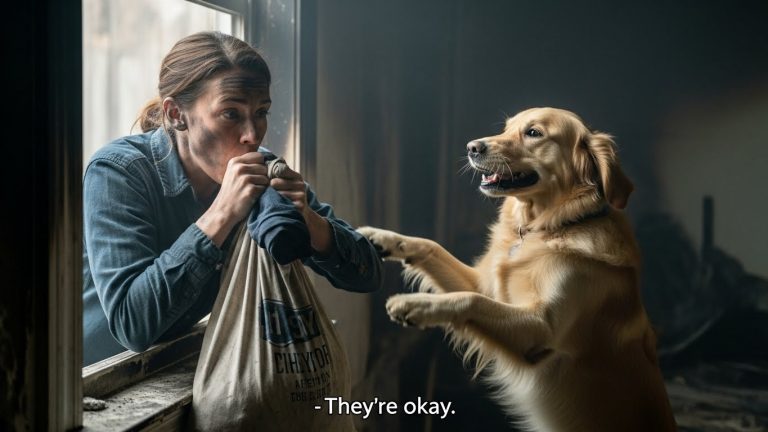
Inside the wire, huddled together in a pile of mud and their own filth, were three hounds. They were Coonhounds, or at least they used to be. Now, they were skeletons wrapped in wet fur. Their ribs pushed against their skin so sharply it looked like they might break through. They were shivering so violently the wire of the cage rattled.
One of them, a female with patches of black and white, lifted her head. Her eyes were sunken, rimmed with infection. She didn’t bark. She didn’t growl. She just looked at me. It was a look of total, crushing defeat. She let out a soft, wheezing breath and laid her head back down in the mud. The water was rising around them. They were drowning in the cold.
“Did you hear me?”
The man was behind me now. I turned slowly.
He was wearing a raincoat, holding a heavy flashlight, though it was barely afternoon. He was a big man, well-fed, with a face that looked like it had never known a day of hunger in its life. He looked annoyed, like I had interrupted his lunch.
“I’m Agent Jack Miller,” I said, my voice sounding strange to my own ears. Low. Dangerous. “FBI.”
He scoffed, shining the light in my face. “I don’t care if you’re the Pope. You don’t have a warrant to be in my backyard. These are my dogs. My property.”
“Your property?” I repeated. I looked back at the dogs. The rain was washing the filth off their spines, revealing sores and scars.
“They’re breeding stock,” he said, dismissing them with a wave of his hand. “Had a bad season. Feed is expensive. They’ll bounce back when the market turns. Now get off my land before I call the Sheriff.”
He truly believed he was untouchable. He stood there, dry in his expensive coat, while three living creatures were slowly dying five feet away from him. He didn’t see suffering. He saw inventory. He saw numbers on a spreadsheet that weren’t adding up.
Something inside me snapped. It wasn’t the professional break; it was the human one. The part of me that had seen too many crime scenes, too many victims who couldn’t speak for themselves.
I stepped toward him. He faltered, stepping back, slipping slightly in the mud.
“You think this is about money?” I asked. I closed the distance. The rain dripped from the brim of my hat, masking the tears of rage I was fighting back. “Look at them.”
“I told you—”
“LOOK AT THEM!” I roared, the sound tearing out of my throat.
He flinched, silencing himself.
I pointed at the female dog. “That is a living soul. She is starving to death. She is freezing. And you are sitting inside watching television.”
He sneered, trying to regain his composure. “They’re just animals. You city types are all so soft. It’s nature.”
“It’s torture,” I whispered.
I turned my back on him. I couldn’t look at him anymore without doing something that would cost me my badge. I grabbed the latch of the cage. It was rusted shut, padlocked.
“Don’t touch that,” he warned. “That’s destruction of property.”
I didn’t hesitate. I grabbed a rusted iron bar lying in the mud nearby. I smashed it against the lock. Once. Twice. The metal groaned and gave way.
I threw the door open and dropped to my knees in the mud. The smell was overpowering now, but I didn’t care. I reached in. The dogs flinched, expecting to be hit. That reaction broke my heart more than their physical state.
“It’s okay,” I whispered, my voice trembling. “I’ve got you. I’m here.”
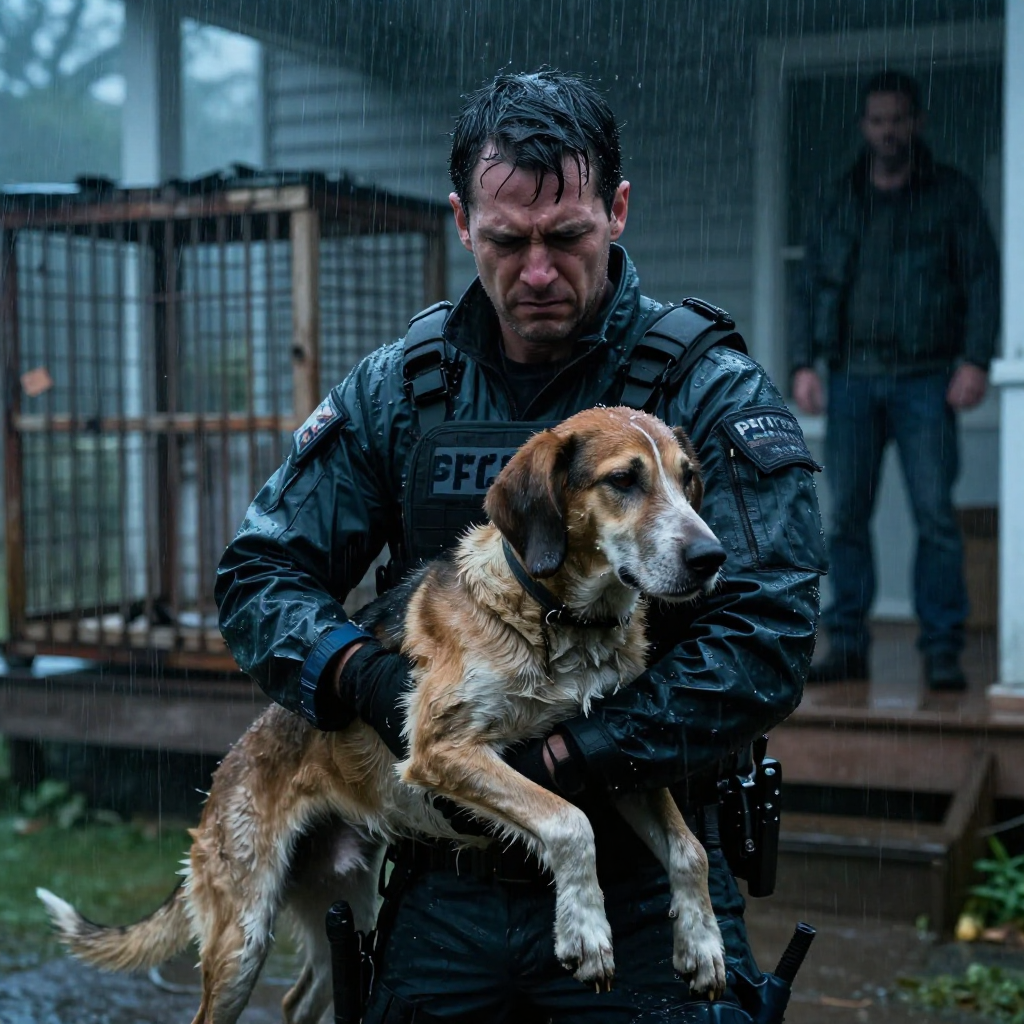
I scooped the female up into my arms. She weighed nothing. She was like a bundle of twigs. She groaned, a sound of pure agony, and rested her muddy head against my chest. Her body heat was dangerously low.
I stood up, holding her tight against my jacket, trying to share whatever warmth I had. I turned to face the breeder.
He was on his phone now. “Yeah, Sheriff? It’s Rick. I got a fed out here destroying my fences. Yeah. Send a car.”
He looked at me and smirked. That smirk. It was the face of a man who thought the system was built to protect him.
I walked right up to him, the dying dog in my arms. I stared into his eyes, letting him see the absolute promise of destruction in mine.
“You better hope they send every car they have,” I said, my voice a low growl over the sound of the rain. “Because I am going to bury you. Not with a shovel. With paper. With charges. With the federal government. You are going to wish you had starved with them.”
In the distance, the wail of sirens began to cut through the storm. But they weren’t coming to save him. I had already made the call.
I looked down at the dog in my arms. She blinked, looking up at me. For the first time, I saw a flicker of something in her eyes. Not hope, not yet. But relief.
“You’re finished,” I whispered to the man, as the blue and red lights began to flash against the wet trees. I turned away from him and walked toward the sirens, carrying the evidence of his cruelty against my heart.
CHAPTER II
The interior of the emergency veterinary clinic was too bright. After the oppressive gray of the rain and the suffocating rot of Rick’s shed, the fluorescent lights felt like needles against my retinas. I was covered in a layer of filth that didn’t belong in a place this clean—dried mud, the copper scent of old blood, and the pervasive, cloying stench of canine waste. I didn’t care. I stood in the middle of the lobby, my FBI windbreaker soaked through, holding the female Coonhound against my chest. She was so light. That was the thing that kept catching in my throat—she felt like a bundle of dry sticks wrapped in damp velvet.
“I need someone!” I didn’t yell, but my voice had that serrated edge that usually makes people move.
A young technician behind the desk looked up, her eyes widening as they landed on the skeletal shape in my arms. She didn’t ask for a credit card. She didn’t ask for my name. She just hit a buzzer and a door swung open. A woman in green scrubs, maybe in her late forties with graying hair pulled into a tight, practical bun, came running out. This was Dr. Sarah. She took one look at the dog and then at me.
“Triage room three,” she said, her voice a calm anchor in the chaos of my own adrenaline. “Follow me. Don’t set her down yet.”
We moved into a small, sterile room. The air smelled of rubbing alcohol and floor wax. It was a sharp contrast to the world I’d just come from. I laid the dog down on the stainless-steel table. The metal was cold, and the dog—God, she didn’t even flinch. She just let out a long, shuddering breath, her clouded eyes fixed on nothing.
“What happened?” Sarah asked, already snapping on gloves. She began running her hands over the dog’s ribs, which protruded like the hull of a wrecked ship.
“Neglect,” I said. My hands were shaking. I shoved them into my pockets. “Starvation. Confined in a space with no ventilation. There are two others still out there, but the local deputies are processing the scene. I couldn’t wait. She stopped moving.”
Sarah was professional, methodical. She checked the dog’s gums—pale, almost white—and then moved a stethoscope to the thin chest. The silence in the room was heavy. I watched her face, looking for a flicker of hope or a sign of the end.
“She’s in hypovolemic shock,” Sarah muttered, more to herself than me. “Body temperature is dangerously low. We need warmed IV fluids, a glucose bolus, and we need to start a refeeding protocol, but very slowly. If we give her too much too fast, her heart will stop. It’s a delicate balance when they’ve been this close to the edge for this long.”
I watched as the staff swarmed in. They worked with a quiet, practiced urgency. A needle went into a prominent vein in the dog’s front leg. She didn’t even whimper. That was the worst part—the lack of fight. A dog should have a spark, a bit of teeth, or at least a cry of pain. This creature was just waiting for the lights to go out.
I stepped back, hitting the wall. I felt like an intruder. I was a federal agent, a man trained to deal with the worst of human nature, but standing in that clinic, I felt small. I felt like the ten-year-old boy I used to be, standing in a dusty backyard in Ohio, watching my father’s hunting dogs waste away because ‘a hungry dog hunts better.’
That was my old wound. It wasn’t a physical scar, but a jagged memory of a dog named Bo. Bo had been a Black and Tan, much like this female. I remember trying to sneak him scraps of my own dinner, only to have my father catch me and throw the food into the dirt, telling me I was ‘ruining the tool.’ Bo had died tied to a stake in the sun while I was at school. I never got to say goodbye. I never got to save him.
Seeing this hound on the table brought it all back—the helplessness, the burning resentment toward men who viewed living things as disposable inventory.
“Agent Miller?”
Sarah’s voice snapped me back. She was looking at me with a mix of pity and exhaustion.
“She’s stabilized for the moment,” Sarah said, wiping her hands on a towel. “But I have to be honest. Her organ systems are flagging. We’ll know more in the next twenty-four hours. For now, she’s on a heating pad and a slow drip. She’s a fighter, though. Most would have given up miles back.”
“Keep her alive,” I said. It wasn’t a request. “Whatever it costs. I’ll cover it.”
“It’s not just about the cost, Jack,” she said, using my name for the first time. “There’s a legal side to this. Who owns this dog?”
“A man named Rick. A breeder. A piece of work.”
“If he’s the legal owner, he has the right to dictate treatment or—God forbid—demand her return. Unless there’s a court order, my hands are tied if he shows up here with a lawyer.”
I felt a cold stone settle in my stomach. I knew she was right. I had a secret, one that I hadn’t even admitted to the deputy on the scene. I hadn’t actually had a warrant for that shed. My tip was for the main house—a suspected tax fraud and interstate commerce violation involving illegal puppy sales. I had used the ‘exigent circumstances’ clause to break into that shed, but any decent lawyer would argue I’d overstepped. If Rick played his cards right, he could claim I stole his property. My career, my badge, my entire identity was built on the law, yet here I was, praying for the law to stay far away from this room.
I walked out to the lobby to find a chair and wait. I needed a moment to breathe, to think about how to leverage the Bureau’s resources without triggering an internal affairs investigation.
I didn’t get that moment.
The glass front doors of the clinic swung open with a violent thud. The rain followed the intruder in, splashing across the linoleum. It was Rick. He wasn’t the disheveled, arrogant man I’d left in the mud. He was wearing a dry, expensive-looking Barbour jacket, and he wasn’t alone. Beside him was a man in a sharp charcoal suit carrying a leather briefcase, and a local police officer I didn’t recognize—not the deputy from the property.
“There he is,” Rick shouted, pointing a finger at me. His face was flushed, his eyes wild with a different kind of rage now—the rage of a man whose pride had been wounded. “That’s the man who trespassed on my land and stole my property.”
The lobby went silent. A woman holding a cat carrier in the corner shrank back into her seat. The receptionist frozen, her hand hovering over the phone.
“Mr. Miller,” the lawyer stepped forward, his voice smooth and devoid of emotion. “My name is Marcus Thorne. I represent Mr. Vance. We are here to recover his livestock. You took a registered animal from his property without a warrant or a transfer of ownership. That is a felony in this state.”
I stood up slowly. I’m not a small man, and I’ve learned how to use my shadow to intimidate. I didn’t reach for my badge. I didn’t reach for my sidearm. I just stood there, looking at them.
“The ‘livestock’ you’re referring to is currently in intensive care, Rick,” I said, my voice low. “She’s dying because you didn’t think she was worth the price of a bag of kibble.”
“That’s irrelevant to the law!” Rick barked. He was playing to the room now, trying to regain the upper hand. “You can’t just walk onto a man’s property and take what’s his because you feel bad. This isn’t a charity. Those dogs are my business. They’re inventory. And I want my inventory back. Now.”
The officer with them looked uncomfortable. He was young, probably new to the force. “Agent Miller, I’ve got a complaint of theft here. Mr. Vance has the registration papers for the animal. Unless you have a seizure warrant, I’m supposed to facilitate the return of the property.”
This was the triggering event. It was happening right here, in the middle of a public waiting room. If I handed that dog back, she was dead. Rick wouldn’t treat her; he’d likely ‘dispose’ of her to get rid of the evidence of his cruelty. If I refused, I was a federal agent committing a state-level felony on camera, in front of witnesses. The irreversible nature of the moment hung in the air like a guillotine blade.
“She stays here,” I said.
“On what grounds?” Thorne, the lawyer, asked. He pulled out a smartphone, his thumb hovering over the record button. “Are you acting in your official capacity as an FBI agent, or is this a personal matter? Because if it’s official, I’ll need to see the federal filing. If it’s personal, you’re just a common thief.”
I looked at Sarah, who had come out of the back and was standing by the door to the triage area. Her face was pale. She knew what was at stake. If the clinic got caught in the middle of a legal battle over ‘stolen property,’ her license could be at risk.
I had a choice. A moral dilemma that felt like a chokehold. I could play it by the book—give the dog back, go to a judge in the morning, and hope she survived the night in Rick’s hands. But I knew she wouldn’t. Or, I could lie. I could use the secret I’d been keeping—the fact that I had already found evidence of interstate animal racketeering on Rick’s computer records during a preliminary digital sweep I wasn’t supposed to have done yet.
If I admitted I knew about the racketeering, I’d be admitting to an illegal search. But if I didn’t, the dog would die.
“The dog is evidence in an ongoing federal investigation into interstate racketeering and animal fighting,” I lied. Or rather, I anticipated a truth I hadn’t legally secured yet. “She is currently under federal seizure. Anyone who attempts to move her or interfere with her medical treatment will be charged with obstruction of justice and tampering with evidence.”
Rick’s face went from red to a sickly shade of white. He looked at his lawyer. Thorne narrowed his eyes, sensing the bluff.
“I’d like to see the seizure notice, Agent Miller,” Thorne said. “The paperwork usually precedes the seizure.”
“The paperwork is being processed at the field office as we speak,” I said, stepping closer to him, entering his personal space. I could smell his expensive cologne. “But here’s how this is going to go. You can try to take that dog. You can call my supervisor. You can make a scene. But by the time you get a judge to listen to you, I will have every tax record, every digital footprint, and every ‘inventory’ log you’ve ever kept under a microscope. And I don’t think you want that, Rick. I don’t think your business can handle that kind of light.”
It was a gamble. A massive, career-ending gamble. I was threatening a civilian without a solid legal footing. I was using my badge as a bludgeon to cover for a ‘theft’ I had committed out of pure, unadulterated empathy.
Rick looked at the officer, then back at me. He was a bully, and bullies are fundamentally cowards when the stakes get too high. He didn’t care about the dog; he cared about his money. And I had just threatened his money.
“This isn’t over,” Rick spat. He turned to his lawyer. “Do something. He can’t do this.”
Thorne looked at me, a long, calculating stare. He was a smart man. He knew I was probably overreaching, but he also knew that an FBI investigation, even a bunk one, was a cancer that would eat his client alive.
“We will be filing a formal grievance with the Department of Justice, Agent Miller,” Thorne said, tucking his phone away. “And we will be seeking a court order for the return of the property first thing tomorrow morning. I suggest you have your paperwork in order by then.”
They turned and walked out. The heavy glass doors swung shut behind them, muffling the sound of the rain. The silence that followed was even heavier than the confrontation.
I leaned against the reception desk, my legs suddenly feeling like water. I felt sick. I had just put a target on my back. I had broken the rules I’d spent fifteen years defending.
Sarah walked over to me. She didn’t say anything at first. She just put a hand on my arm. Her touch was warm, a reminder of why I’d done it.
“You shouldn’t have done that,” she whispered. “They’ll come back. And they’ll come back harder.”
“I know,” I said. I looked toward the back, toward the room where the hound was lying under a warm blanket, fightings for her life. “But she’s safe tonight. That’s all that matters.”
“Is it?” Sarah asked. “What happens tomorrow? What happens when the law catches up to you?”
I didn’t have an answer. I thought about Bo. I thought about the smell of the shed. I thought about the way the dog had looked at me when I broke the lock—not with hope, but with a total, devastating lack of expectation.
“Tomorrow can wait,” I said.
But as I sat down in the plastic chair to wait out the night, I knew I was lying to myself. The secret of my illegal entry was a ticking clock. Rick’s lawyer wasn’t going to let this go. And the Bureau… the Bureau didn’t forgive agents who went rogue for a ‘worthless’ piece of inventory.
I watched the clock on the wall. Every tick was a second closer to a reckoning. I had saved the dog from the shed, but now I had to save myself from the system I represented. And I wasn’t sure I had enough fight left in me to do both.
I looked at my hands. They were still stained with the mud from the property. I realized then that I could never go back to being the man I was before I broke that lock. I had crossed a line, and there was no path leading back. The moral dilemma had been resolved, but the consequences were only just beginning to bloom.
I closed my eyes and for a moment, I could hear the sound of a dog barking in the distance—not the weak, dying sound of the hound in the back, but a strong, vibrant baying. It sounded like Bo. It sounded like justice. But when I opened my eyes, there was only the hum of the vending machine and the sterile, lonely light of the clinic.
I was alone in this. And the storm was far from over.
CHAPTER III
The silence in the clinic didn’t feel like peace. It felt like a vacuum, the kind that happens right before a storm wall hits and levels everything in its path. I sat on a plastic chair that felt too small for my frame, my hands clasped between my knees. My knuckles were white, the skin stretched tight over the bone. Across the room, the Coonhound—I had started calling her ‘Lady’ in my head—was hooked up to a machine that hissed and clicked. It was the only sound in the hallway, rhythmic and cold. It reminded me of a heart monitor from a life I’d tried to forget. I could smell the antiseptic, the sharp tang of floor cleaner, and the underlying scent of wet fur and sickness. It was the smell of my career dying in real-time.
I heard the glass doors slide open at the front of the clinic. The sound was sharp, like a gunshot in the quiet. I didn’t have to look up to know who it was. The heavy, deliberate footfalls on the linoleum were familiar. They belonged to Assistant Director Arthur Sterling. He didn’t walk like a man who was here to offer support; he walked like a man coming to perform an autopsy. Behind him, I heard the lighter, more frantic steps of Marcus Thorne, Rick Vance’s lawyer. Thorne was probably already drafting the civil suit in his head, counting the zeroes on the settlement check.
I stood up as they rounded the corner. Sterling looked at me, and for a second, I saw something in his eyes that wasn’t just anger. It was disappointment. That hurt worse. He had been my mentor for a decade. He was the one who taught me that the law was a bridge—it’s the only thing that keeps us from falling into the swamp. And here I was, standing in the middle of the swamp with mud up to my neck. Sterling stopped three feet from me. He didn’t offer a hand. He just looked at the badge clipped to my belt, then up at my face.
“Jack,” he said. His voice was a low rumble, the kind of sound a mountain makes before it slides. “Tell me there’s a file. Tell me there’s a signed warrant in a drawer somewhere that I just haven’t seen yet. Tell me I’m not standing here because you decided to play god with a badge.”
I looked him in the eye. My throat felt like it was full of glass. “There’s no file, Arthur. Not a federal one. Not yet.”
Thorne stepped forward, his face flushed with a triumphant sort of glee. “Not yet? Agent Miller, you’ve committed a dozen felonies in the last six hours. You trespassed on private property, you stole livestock, and you used your federal credentials to intimidate a private citizen. You didn’t just break the bridge, you burned it.” He turned to Sterling, his voice rising. “My client, Mr. Vance, is outside with the local police. We are here to reclaim his property. Now. If you don’t hand over that animal, we’ll be filing charges against the Bureau by sunrise.”
Sterling didn’t look at Thorne. He kept his eyes on me. “Is the dog here, Jack?”
I nodded toward the ICU door. “She’s in there. She’s dying, Arthur. If she goes back to that farm, she’ll be dead before the sun comes up. Rick Vance isn’t a breeder. He’s a butcher.”
“That’s an allegation without a shred of evidence,” Thorne snapped. “What we have evidence of is a rogue agent. Arthur, hand over the dog.”
Sterling sighed, a long, weary sound. He looked through the glass at the Coonhound. She looked small under the lights, her ribs casting long shadows against her skin. “Jack,” he said quietly. “Hand me your creds. You’re on administrative leave, effective immediately. I’m turning this over to the local authorities. We can’t protect you on this one. You’re on your own.”
I felt the weight of the badge leave my belt. It felt like losing a limb. I handed the leather case to Sterling, and the metal felt cold and heavy in my palm. I wasn’t an agent anymore. I was just a man in a vet clinic, standing between a dying animal and a man who saw her as nothing more than a line item on a ledger.
Suddenly, the monitor inside the room began to scream. A flat, high-pitched whine that cut through the tension like a blade. Dr. Sarah burst through the door, her face pale. She didn’t look at Sterling or Thorne. She looked straight at me.
“Jack! She’s crashing!”
I didn’t think. I didn’t ask for permission. I pushed past Thorne, shoving him aside so hard he hit the wall. I ran into the room. Sarah was already over the dog, her hands moving with a frantic, practiced grace. The dog’s body was rigid, her eyes rolled back in her head. Her chest was barely moving.
“The internal bleeding,” Sarah gasped, her voice shaking. “The trauma to her abdomen… her organs are shutting down. I need to get her into surgery now, but I can’t stabilize the pressure.”
Thorne appeared in the doorway, his face twisted in a snarl. “Stop! Don’t touch her! That animal is evidence now. We’re taking her.”
I turned on him. I didn’t have a badge anymore, and for the first time in my life, that made me truly dangerous. I stepped into his space, my shadow looming over him. “If you step into this room,” I said, my voice a whisper that carried more weight than a shout, “I will forget every rule I ever learned. Get out.”
Thorne blinked, his bravado flickering. He looked at Sterling, who was standing in the hall, watching. Sterling didn’t move. He didn’t stop me. He just watched.
“Sarah, do what you have to do,” I said, turning back to the table. I grabbed the dog’s paw. It was cold. I felt the familiar ache in my chest, the ghost of Bo, the dog I couldn’t save when I was a kid. I wasn’t going to let this one go. Not like this.
As Sarah worked, she had to cut away the remaining matted fur on the dog’s neck to clear a path for a central line. As the clippers hummed, something caught the light. A thick, leather collar, so encrusted with mud and filth that I hadn’t even noticed it before. It was buckled tight, almost cutting into the skin.
“Wait,” I said, pointing. “That collar. It’s too tight. It might be restricting her airway.”
Sarah nodded and took a pair of heavy-duty shears. She snipped through the leather. As the collar fell away, I noticed something odd. It wasn’t just a strap of leather. It was double-layered, stitched with heavy industrial thread. And it was heavy. Too heavy.
I picked it up. The leather felt strange—there was a hard, rectangular lump sewn into the lining. My instincts, the ones that hadn’t been stripped away with my badge, screamed at me. I took a scalpel from the tray and sliced through the stitching.
Inside the lining was a small, ruggedized USB drive and a laminated piece of paper. I pulled the paper out. It was a list. Names. Dates. Amounts. But it wasn’t for dogs. These were coordinates and serial numbers for heavy machinery and industrial chemicals. It was a ledger. Not for a breeding operation, but for a massive, multi-state theft ring.
I looked at the USB drive. On the side, there was a small engraving: *Property of V-Logistics*.
I looked out into the hallway. Rick Vance had just walked through the front doors. He was smiling, looking like a man who had already won. He saw me holding the collar, and his smile didn’t just fade—it vanished. His face went gray, the color of ash. He took a step back, his eyes fixed on the USB drive in my hand.
“Arthur!” I yelled, my voice echoing through the clinic. “Look at this!”
Sterling walked into the room, his eyes scanning the ledger. He looked at the USB drive, then at Vance, who was now trying to back toward the exit. But the doors didn’t open for him. Two uniformed officers were standing there, blocking his path. They weren’t local police. They were State Troopers, and behind them was a woman in a dark suit I recognized from the District Attorney’s office.
“Mr. Vance,” the woman said, her voice echoing in the sterile hallway. “We’ve been looking for that drive for six months. We knew you were the courier, but we couldn’t find where you hid the keys. We never thought to check the livestock.”
Sterling took the drive from my hand. He looked at it, then at me. The disappointment in his eyes was gone, replaced by a grim sort of respect. He looked at the dog on the table. She was still struggling, but her heart rate was starting to level out. The pressure was lifting.
“Jack,” Sterling said, his voice quiet. “You’re still a reckless, impulsive idiot.”
“I know,” I said, my eyes never leaving the dog.
“But it looks like you were right,” he continued. He turned to Thorne, who was trying to disappear into the shadows. “Mr. Thorne, I suggest you stop talking. Your client is no longer a victim of a civil rights violation. He’s the primary suspect in a federal racketeering and grand larceny investigation. And as for this animal…”
He looked at the dog, then at Sarah. “She’s no longer property. She’s a protected federal witness.”
I let out a breath I felt like I’d been holding for twenty years. I leaned over and pressed my forehead against the dog’s cool, damp fur. She let out a small, weak whimper, her tail giving a single, microscopic twitch. It wasn’t much, but it was enough.
The room was suddenly crowded with people—agents, paramedics, the DA’s team. Vance was being handcuffed in the hallway, his protests muffled as he was led away. Thorne was being questioned by Sterling. But I stayed right where I was, my hand on the dog’s side, feeling the slow, steady rise and fall of her breath.
I didn’t have my badge. I might never get it back. The legal fallout of what I’d done was still coming, a tidal wave that would probably wash away my career and my reputation. I had broken the law to find the truth, and while the truth had saved me from a jail cell, it wouldn’t save me from the consequences.
But as I watched the dog’s eyes flutter open—a deep, soulful brown—I realized I didn’t care. For the first time in a long time, I didn’t feel like a cog in a machine. I felt like a human being. I had saved her. And in the wreckage of my life, that was the only thing that mattered.
CHAPTER IV
The silence was the worst part. Not the silence of the woods, or the comfortable quiet of my old house. This was the silence of waiting. The kind that fills your ears until they ache, a heavy blanket smothering any hope of good news. It had been three days since they’d taken Rick Vance away, three days since my world had been turned inside out in Dr. Sarah’s clinic. Three days since I’d last worn my badge.
My apartment felt alien. Every familiar object seemed to accuse me. My gun, locked in its case, was a monument to my failure. The photos of Bo, my old Coonhound, mocked me with their innocent joy. I hadn’t heard from anyone at the Bureau.
I spent those days replaying everything in my head, second-guessing every decision, every word. Could I have handled Vance differently? Should I have waited for Sterling to approve a real warrant? Was Lady worth the risk?
The news was a relentless drumbeat. “FBI Agent Exposes Dog Breeding Ring… But at What Cost?” “Hero or Rogue? The Jack Miller Controversy.” The faces of talking heads blurred together, each with their own opinion about whether I was a righteous whistleblower or a reckless cowboy.
I knew what I was. I was a federal agent who’d broken the law. The ends might have justified the means, but that didn’t change the fact that I’d crossed a line.
The only person who called was Sarah. Her voice was cautious, but warm. “How are you holding up, Jack?”
“About as well as Lady did when you found her,” I said. “Which is to say, not great.”
“She’s doing better,” Sarah said. “She’s eating, she’s walking… she even wagged her tail a little today.”
A tiny spark flickered inside me. “That’s… that’s good to hear.”
“They want to put her up for adoption,” Sarah said, her voice losing some warmth. “The state, I mean. They say she’s evidence.”
The spark died. “Evidence of what? Vance’s cruelty? My stupidity?”
“Evidence of a crime,” Sarah corrected gently. “They have to follow procedure.”
Procedure. That word felt like a punch in the gut.
I didn’t sleep that night. Every creak of the building, every siren in the distance, sounded like the footsteps of Internal Affairs coming to drag me away.
***
The call came at 8:00 AM. A dry, professional voice informed me that I was required to appear before an internal review board the following week. My badge and weapon were to remain surrendered until further notice.
The next few days became a blur. I barely ate, barely slept. My lawyer, a weary woman named Ms. Eleanor Hayes, tried to prepare me. She explained the charges, the possible outcomes, the political pressures involved. It was all a fog.
“They’re going to paint you as a loose cannon,” she said bluntly. “Someone who couldn’t follow orders, who put his own emotions ahead of the law.”
“Is that not true?” I asked.
She sighed. “It’s… complicated. You did expose a major criminal operation. But you did it illegally. That’s the problem.”
Sarah visited me that evening. She brought a casserole, which I barely touched. She seemed hesitant, unsure of what to say.
“I saw Lady today,” she said finally. “She’s… she misses you.”
My throat tightened. “I miss her too.”
“The state… they’re being difficult,” Sarah continued. “They say she needs to be in a neutral environment. They’re talking about sending her to a shelter, maybe even out of state.”
The thought of Lady alone, scared, in a strange place… it was unbearable. It was like Bo all over again.
“I can’t let that happen,” I said, my voice barely a whisper. “I won’t.”
Ms. Hayes warned me against it, but I went to see Arthur Sterling. He agreed to meet me at a bar near the Bureau. The place was dimly lit, smelled of stale beer and regret. Sterling looked tired, his face etched with worry lines.
“Jack,” he said, his voice weary. “What am I going to do with you?”
“I don’t know, sir,” I said. “But I need your help.”
“Help?” He laughed, a short, bitter sound. “You’re facing federal charges, Jack. I can’t just make this go away.”
“I’m not asking you to make it go away,” I said. “I’m asking you to tell the truth. Tell them what Vance was doing. Tell them how I found out. Tell them that I saved lives.”
Sterling looked at me, his eyes filled with a mixture of frustration and something else… maybe respect.
“You know this could cost me, too,” he said quietly. “Defending you could damage my own career.”
“I know, sir,” I said. “And I’m sorry. But Lady… she deserves a chance. And so do I.”
He stared into his drink for a long moment. Then he sighed, a heavy, resigned sound.
“Alright, Jack,” he said. “I’ll do what I can.”
***
The internal review board was a sterile, intimidating place. Three stone-faced officials sat behind a long table, their eyes cold and judgmental. Ms. Hayes sat beside me, whispering instructions and reassurances. But I barely heard her.
The charges were read: unauthorized search and seizure, theft of property, insubordination. Each word felt like another nail in my coffin.
The prosecution presented their case. They painted me as a rogue agent, a cowboy who disregarded protocol and endangered the integrity of the Bureau. They emphasized the seriousness of my crimes, the potential damage to the Bureau’s reputation.
Then it was my turn. I told them about Bo, about the bond I’d had with him. I told them about finding Lady, about seeing the neglect and abuse she’d suffered. I told them about the USB drive, about the evidence of Vance’s criminal enterprise.
“I know I broke the law,” I said, my voice shaking slightly. “But I did it for the right reasons. I did it to save a life, and to bring criminals to justice.”
Sterling testified on my behalf. He confirmed the extent of Vance’s operation, the importance of the evidence I’d uncovered. He acknowledged my dedication and my commitment to justice. But he also admitted that I’d acted without authorization, that I’d put the Bureau in a difficult position.
The board members asked questions, probing, challenging, trying to find cracks in my story. I answered as honestly as I could, trying to convey the emotions that had driven me.
The hearing lasted for hours. By the end, I was exhausted, drained. I had no idea how it had gone. I had no idea what my future held.
As I left the building, I saw a group of reporters waiting outside. They swarmed me, shouting questions, thrusting microphones in my face.
“Agent Miller, do you regret your actions?”
“Agent Miller, are you worried about losing your job?”
“Agent Miller, what will happen to the dog?”
I didn’t answer. I pushed my way through the crowd and walked away, the noise fading behind me.
Back at my apartment, I sat in the dark, waiting. Waiting for the phone to ring, waiting for the verdict, waiting for my life to begin again.
Sarah called later that night. Her voice was subdued.
“The state… they’re not backing down,” she said. “They’re still planning to move Lady.”
Desperation clawed at my throat. “I can’t let them do that,” I said. “I just can’t.”
“I know,” Sarah said softly. “I know.”
***
The new event came in the form of a letter. It arrived a week after the hearing, a crisp white envelope with the official seal of the Department of Justice.
My hands trembled as I opened it. The words blurred before my eyes.
I was suspended from duty without pay for six months. I was required to undergo psychological counseling. And I was barred from owning or possessing any animal for a period of one year.
The last sentence hit me like a physical blow. One year. One year without Lady.
I sank into a chair, the letter falling from my numb fingers. It was over. I’d lost. I’d saved a dog, but I’d lost everything else in the process.
But then, I noticed something else in the envelope. A second letter, smaller, less official. It was from Sarah.
“They may have taken your badge, Jack,” she wrote. “And they may have taken your dog. But they can’t take your heart.”
She went on to explain that she had been working with a local animal rescue organization. They had offered to foster Lady for the next year, to keep her safe and loved until I was allowed to have her back. And they had agreed to let me visit her, as often as I wanted.
A wave of relief washed over me, so intense it almost brought me to my knees. It wasn’t a perfect solution. It wasn’t the happy ending I’d hoped for. But it was something. It was a chance.
I called Sarah immediately.
“Thank you,” I said, my voice thick with emotion. “Thank you for everything.”
“She’s waiting for you, Jack,” Sarah said. “She knows you’ll come back for her.”
I hung up the phone and looked around my empty apartment. It still felt alien, still felt accusatory. But now, there was something else in the air. A glimmer of hope. A sense of possibility.
I had a long road ahead of me. I had to face the consequences of my actions, to rebuild my career, to prove that I was worthy of a second chance. But I wasn’t alone. I had Sarah, I had Sterling, and I had Lady, waiting for me at the end of the line. And maybe, just maybe, that was enough.
That night, I dreamt of Bo. He was running through a field of tall grass, his tail wagging, his bark filled with joy. And beside him, running just as fast, was Lady. For the first time in a long time, I slept soundly.
CHAPTER V
The drive to the counselor’s office felt longer each week. It wasn’t the traffic; it was the anticipation. Each session was a forced march through the wreckage of my choices, a guided tour of my failures. I knew I needed it. I knew I was a mess. But knowing didn’t make it any easier. The suspension still stung, the internal review felt like a dark cloud hanging over me, and the ban on owning an animal felt like a cruel joke.
Dr. Evans was waiting, her expression as neutral as ever. I sometimes wondered if she ever judged me, but her face remained an unreadable mask. I sat down heavily, the chair groaning in protest.
“How are you this week, Jack?”
“Fine,” I lied. It was the default answer. The one that required no explanation.
She raised an eyebrow, a small, almost imperceptible movement, but enough to let me know she wasn’t buying it.
“The review board is still… reviewing,” I admitted, finally. “Sterling is making sure they take their time.”
“And how does that make you feel?”
“Angry,” I said, the word clipped and sharp. “Frustrated. Helpless.”
“Helpless is a strong word, Jack. You’re rarely helpless.”
“I am now,” I countered. “I can’t do my job. I can’t even have a dog.”
“That’s not entirely true,” she said softly. “You can visit Lady.”
Her words were like a small pinprick of light in the darkness. Lady. The one good thing to come out of all of this. The one reason I hadn’t completely lost it.
“I went yesterday,” I said, a small smile finally gracing my lips. “She’s doing better. Sarah’s doing a great job with her.”
“Tell me about your visit.”
And so I did. I told her about Lady’s improving health, about the spark returning to her eyes, about the way she would nudge my hand with her nose, asking for attention. I told her about Sarah, about her patience and her unwavering dedication to Lady’s recovery. As I spoke, I realized something. I wasn’t just talking about Lady; I was talking about hope.
—
The next few weeks were a blur of counseling sessions, internal reviews, and visits to Lady. The review board was relentless, grilling me about my methods, my motives, and my past. Sterling seemed to be enjoying himself, his questions dripping with thinly veiled disdain. I answered them all, calmly and truthfully, refusing to give him the satisfaction of seeing me crack.
I started to understand what Dr. Evans was trying to get me to see. It wasn’t about blindly following the rules; it was about understanding them, about knowing when to bend and when to break. It was about finding a way to do what was right, even when the system seemed determined to stop me.
One afternoon, Sarah called. Her voice was hesitant.
“Jack, can you come over? There’s something I need to talk to you about.”
My heart sank. Something was wrong. Something was terribly wrong.
I drove to Sarah’s house, my hands gripping the steering wheel so tightly that my knuckles turned white. When I arrived, she was waiting for me on the porch, her face etched with worry.
“What is it?” I asked, my voice barely a whisper.
“Lady’s foster application… it was denied,” she said, her voice trembling. “They said… they said she needs a more experienced home. Someone without… complications.”
My blood ran cold. This wasn’t just about Lady; it was about me. It was about my suspension, my review, my reputation. They were using Lady as a weapon, punishing me for stepping out of line.
“That’s bullshit,” I said, the words erupting from my throat. “That’s complete and utter bullshit.”
“I know,” Sarah said, her eyes filled with tears. “But what can we do?”
I stared at her, my mind racing. I could fight it, of course. I could file an appeal, hire a lawyer, make a scene. But that would take time, time that Lady didn’t have. And even if I won, the damage would be done. They would find another reason to take her away.
There was only one thing to do.
“I’ll take her,” I said, my voice firm. “I’ll take her and they can damn well try to stop me.”
—
The next day, I went to the animal shelter. I walked into the director’s office, my heart pounding in my chest.
“I want to adopt Lady,” I said, my voice leaving no room for argument.
The director, a middle-aged woman with tired eyes, looked at me with a mixture of sympathy and apprehension.
“Mr. Miller, I understand your attachment to this dog, but…”
“But nothing,” I interrupted. “I know about the denied foster application. I know this is about me, not her. And I’m not going to let you use her as a pawn in your little game.”
“It’s not a game, Mr. Miller. It’s about finding the best home for this animal.”
“And I’m telling you, this is it,” I said, my voice rising. “I love this dog. I will take care of her. And if you try to stop me, I will make your life a living hell.”
The director stared at me, her eyes narrowing. She knew I meant it. She knew I was capable of anything.
“Fine,” she said, finally. “Fill out the paperwork.”
I filled out the paperwork, my hands shaking. It felt surreal. After everything I had been through, after all the obstacles, I was finally going to get her back.
When I finished, the director handed me the adoption certificate. I looked at it, my eyes blurring with tears. Lady Miller. It was official.
I went to her kennel, my heart overflowing with joy. She saw me and her tail started wagging furiously. I opened the door and she bounded into my arms, licking my face with unrestrained enthusiasm.
“Hey, girl,” I whispered, burying my face in her fur. “We’re going home.”
—
The internal review concluded a week later. The verdict was… complicated. I was cleared of any malicious intent, but I was still found guilty of violating protocol and exceeding my authority. My suspension was lifted, but I was placed on probation for six months. And the ban on owning an animal was… waived, with a stern warning about responsible pet ownership.
I didn’t care. I had Lady. That was all that mattered.
We settled into a routine. I would wake up early, take her for a walk in the park, go to work, come home, and spend the evening with her. She was my constant companion, my furry shadow, my best friend.
One evening, as I was sitting on the porch, watching Lady chase fireflies in the yard, Sarah came over.
“She’s happy, isn’t she?” Sarah asked, her voice soft.
“She is,” I said, smiling. “We both are.”
“You know, Jack,” Sarah said, turning to me, “I think you needed her as much as she needed you.”
I looked at Lady, her eyes shining in the darkness, and I knew she was right. I had saved her life, but she had saved mine as well. She had given me a reason to believe, a reason to hope, a reason to keep fighting.
I had learned that true justice wasn’t always about following the rules, but about standing up for what’s right, even when it’s hard. And sometimes, the greatest rewards came from the smallest acts of kindness.
The sun dipped below the horizon, painting the sky in hues of orange and purple. Lady trotted over to me, nudging my hand with her nose. I scratched her behind the ears, feeling a sense of peace I hadn’t felt in years.
I still went to counseling, and Dr. Evans continued to help me unpack the baggage I had accumulated over the years. It wasn’t easy, but it was necessary. I was learning to forgive myself, to accept my flaws, and to move forward with my life.
I knew I would never be the same. The events of the past few months had changed me, hardened me, but they had also made me stronger, more resilient, more compassionate.
I had lost a lot, but I had also gained something invaluable: a second chance.
The crickets chirped, the fireflies danced, and Lady rested her head on my lap, her warm breath a comforting presence. The world felt quiet, still, and full of possibilities.
Sometimes, the only way to find peace is to make a little for yourself.
END.