They Left My Grandson to Rot Under the Bleachers—So I Burned Their “Golden Boy” Empire to the Ground
Chapter 1: The Sketchbook in the Shadows
The silence in my house used to be a comfort. After forty years as the head librarian at the Oakhaven Public Library, I had grown accustomed to the quiet. It was the smell of old paper, dust motes dancing in the afternoon sun, and the soft rustle of turning pages. But since my daughter, Sarah, passed away five years ago, leaving me with her nine-year-old son, Leo, the silence had changed. It became heavy, filled with the weight of responsibility.
Now, Leo was fourteen. He was the kind of boy who apologized to flowers if he stepped on them. He was lanky, all elbows and knees, with Sarah’s doe eyes and a spirit so gentle it terrified me. The world eats gentle things, I often thought, watching him hunch over his sketchbook at the kitchen table.
“Grandma, look,” Leo said one Tuesday evening, pushing a permission slip across the oak table. His voice was a soft murmur, barely rising above the hum of the refrigerator. “Mr. Evans… Principal Evans recommended me for the Student Leadership Program. He says it’ll look good for college.”
I wiped my hands on my apron, the scent of pot roast clinging to the fabric. “Leadership? That’s wonderful, Leo! I didn’t know you were interested in… well, leading.”
Leo shrugged, avoiding my gaze. He was drawing furiously, the charcoal scratching against the paper. “I’m not. But Caleb… Caleb Vance is the head of it. He said I’d fit right in.”
My stomach gave a small, involuntary lurch. Caleb Vance. The name was practically royalty in Oakhaven. Star quarterback, son of the School Board President, poster child for “All-American Excellence.” He was fifteen going on thirty, with a smile that was too bright and eyes that were too cold.
“That’s nice of him,” I lied, pouring Leo a glass of milk.
“Yeah,” Leo whispered.
Two weeks later, the silence in the house changed again. It wasn’t heavy anymore; it was terrified.
Leo started coming home late. “Library,” he’d say. “Art club,” he’d mumble. But his clothes told a different story. A torn hem on his favorite flannel shirt. Mud on the knees of his jeans, though it hadn’t rained in a week.
One evening, I found him icing his ribs with a bag of frozen peas.
“I tripped,” he said quickly, pulling his shirt down before I could see the bruising. “During gym. I’m clumsy, Grandma. You know that.”
“Leo,” I said, stepping closer, my librarian’s instinct for reading between the lines kicking in. “Did someone hurt you?”
“No!” He stood up too fast, wincing. “Stop asking. I’m fine. Just leave me alone.”
He retreated to his room, slamming the door. It was the first time he had ever raised his voice at me.
That night, after he had fallen into a restless sleep, I did something I promised I would never do. I invaded his privacy. I needed to know. I crept into his room, the floorboards groaning softly under my slippers. The moonlight washed over his sleeping face, highlighting the dark circles under his eyes.
I reached under his mattress. I knew that’s where he kept his “venting” sketchbook—the one he didn’t show me.
I pulled it out. It was a spiral-bound notebook, battered and bent. I opened it, expecting teenage angst, maybe some dark poetry.
What I saw made my blood run cold.
It wasn’t poetry. It was a catalogue of horrors.
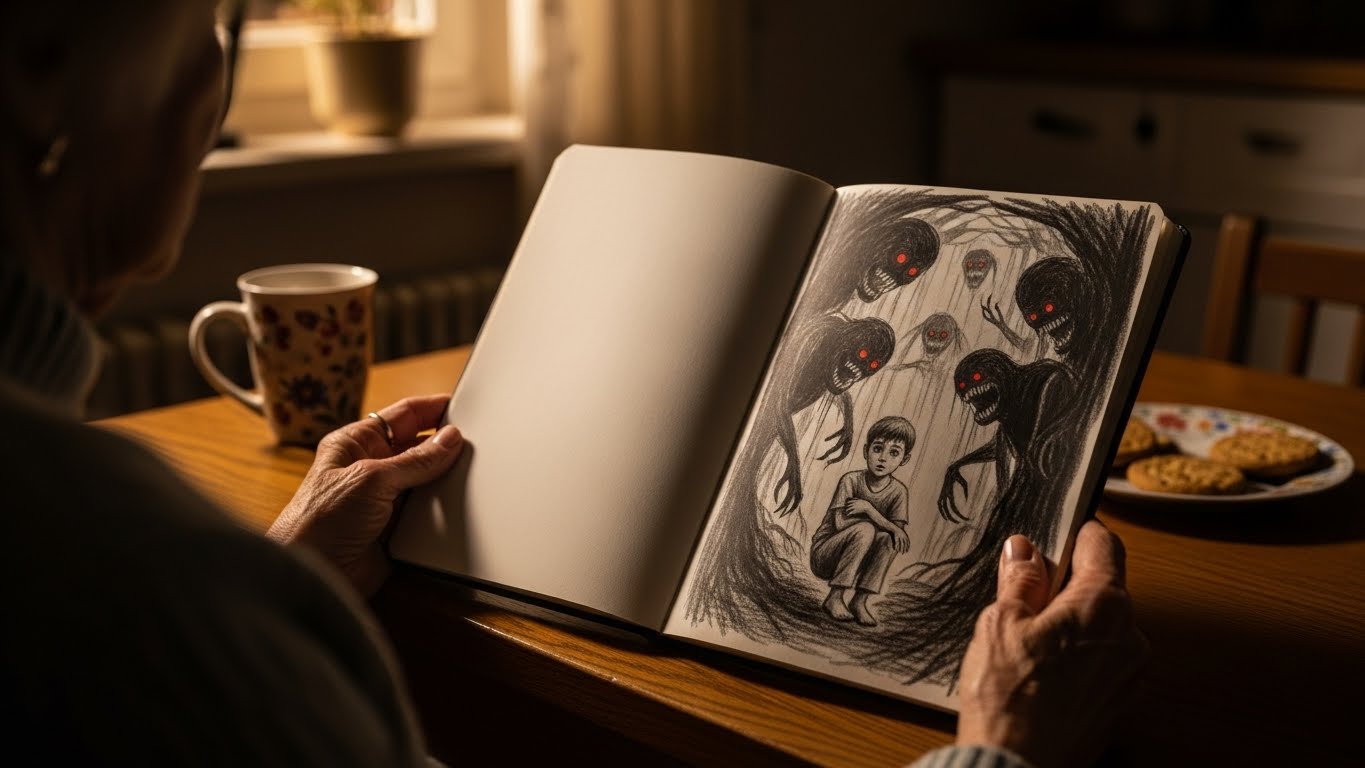
Page one: A sketch of a small stick figure surrounded by hulking, faceless giants. The giants had mouths filled with jagged teeth. Page ten: A locker, meticulously drawn, but inside, instead of books, there was a boy curled into a ball, weeping. Page twenty: A drawing of Caleb Vance. It was unmistakably him—the square jaw, the varsity jacket. But Leo had drawn him with no eyes, just black hollows, and his hands were transformed into claws.
Scribbled in the margins, in frantic, heavy strokes, were words that stopped my heart: Freak. Waste of space. Do it. Jump. No one hears you.
I flipped to the most recent page, dated yesterday. It was just a black page. He had colored the entire sheet with black charcoal, pressing so hard the paper had torn. In the center, in tiny white letters left by an eraser, it read: The Bleachers. Friday.
I didn’t sleep that night. I sat in my rocking chair, clutching the sketchbook to my chest, feeling the rage simmer in my gut like a pot left on the burner too long. They were hunting him. My gentle boy.
The next morning, I drove Leo to school. I watched him walk up the steps, his shoulders hunched as if expecting a blow. As soon as he disappeared through the double doors, I parked the car and marched into the administration office.
“I need to see Principal Evans,” I told the secretary, a woman named Sharon who had been chewing the same piece of gum since 1995.
“Do you have an appointment, Mrs. Higgins?”
“No, Sharon. I have a sketchbook. And I have a very loud voice that I haven’t used since I retired. Which would you like me to use?”
Ten minutes later, I was in Evans’ office. It smelled of stale coffee and floor wax. Principal Evans, a man whose suits were too tight and whose ambition was too obvious, smiled that patronizing smile men give to old women they deem irrelevant.
“Martha,” he said, leaning back. “Always a pleasure. How’s the retirement treating you?”
I slammed the sketchbook onto his mahogany desk. “My grandson is being terrorized, Robert. By Caleb Vance and his friends.”
Evans sighed, picking up the book gingerly, as if it were contaminated. He flipped through a few pages, his expression unchanging. “These are… disturbing drawings, Martha. But they’re just drawings. Leo has always been… imaginative.”
“He’s coming home with bruises,” I snapped. “His clothes are torn. And look at the captions. ‘Freak.’ ‘Jump.’ That’s not imagination. That’s documentation.”
Evans closed the book and slid it back to me. “Martha, look. We have a zero-tolerance policy here. But I can’t punish Caleb Vance based on your grandson’s art project. Caleb is a model student. He’s organizing the Fall Pep Rally. Leo… well, Leo struggles socially. Sometimes, boys roughhouse. Sometimes, boys who are a little ‘different’ misinterpret playful banter.”
I felt the heat rise up my neck. “Different? You mean kind? You mean artistic?”
“I mean weak,” Evans said, his voice dropping, the smile vanishing. “High school is a food chain, Martha. You can’t protect him from nature. If Leo is having trouble adjusting, perhaps we should discuss a guidance counselor for him. Maybe he’s the one provoking these situations with his… attitude.”
I stood up, my knees shaking not with age, but with fury. I grabbed the sketchbook.
“You’re not protecting the students, Robert,” I said, my voice low and steady. “You’re protecting the football team. You’re protecting your funding. But mark my words. If one more hair on Leo’s head is harmed, I won’t come back here with a sketchbook. I’ll come back with a lawyer.”
Evans chuckled, actually chuckled, as he checked his Rolex. “Always the dramatic librarian. Have a nice day, Martha.”
I walked out of that school feeling smaller than I ever had in my life. I thought I had done my duty. I thought I had warned them.
I didn’t know that by showing them the sketchbook, I had just painted a target on Leo’s back. I didn’t know that Evans would call Caleb into his office five minutes later—not to scold him, but to warn him.
“The kid’s grandmother is making noise,” Evans likely said. “Keep it quiet. Handle it.”
And Caleb, the Golden Boy, decided to handle it.
Chapter 2: The Tomb Beneath the Stadium
Friday arrived with a suffocating humidity that hung over the town of Oakhaven. It was the day of the “Fall Pep Rally,” the sacred event where the town worshipped at the altar of high school football.
Leo was pale at breakfast. He barely touched his oatmeal.
“Do you have to go?” I asked, placing a hand on his shoulder.
“Required attendance,” he mumbled. “Leadership Program members have to set up the bleachers.”
“I can pick you up right after,” I promised. “3:00 PM sharp. Right out front.”
“Okay, Grandma.” He hugged me then. A long, tight hug that felt like a goodbye. I should have known. I should have locked the doors and kept him home. But we trust systems. We trust schools. We are fools.
At 3:00 PM, I was parked in the pickup lane. The bell rang. A sea of teenagers flooded out, laughing, shouting, energized by the prospect of the weekend. I scanned the crowd for Leo’s messy brown hair and oversized hoodie.
3:10 PM. The crowd thinned. 3:20 PM. The buses pulled away. 3:30 PM. The schoolyard was empty, save for a few cheerleaders practicing on the lawn.
I called his cell phone. It went straight to voicemail.
Panic, cold and sharp, pricked at my skin. I got out of the car and walked to the front doors. Locked. The custodians were already waxing the floors. I banged on the glass until a janitor looked up. It was Mr. Henderson, a man I knew from the library. He had a limp and a face etched with weary lines.
He opened the door a crack. “Mrs. Higgins? School’s closed.”
“Leo didn’t come out,” I said, my voice trembling. “He was supposed to meet me.”
“Most kids went to the pizza place down on Main,” Henderson suggested kindly. “Or over to the Vance’s for the pre-game party.”
“Not Leo,” I said. “Please, can you check the art room? The library?”
He let me in. We searched for an hour. We checked the classrooms. We checked the bathrooms. Nothing.
“Maybe he walked home?” Henderson suggested.
I drove home, breaking every speed limit. The house was empty. The silence was screaming now.
I called the police. Sheriff Miller, a man who played golf with Caleb’s father every Sunday, answered the dispatch.
“Martha, he’s fourteen,” Miller said, his tone bored. “He probably skipped town for a few hours. Ran off with a girl. We don’t file missing persons until 24 hours.”
“He doesn’t run off!” I screamed into the receiver. “He’s being bullied! I told the Principal!”
“Boys will be boys. Give it time. If he’s not home by morning, call us back.”
Night fell. I didn’t sleep. I drove around town, checking the parks, the 24-hour diner, the bridge by the creek. Every shadow looked like my grandson. Every rustle of leaves sounded like his voice.
Saturday passed in a blur of terror. I printed flyers. I taped them to telephone poles. People looked at me with pity, then looked away. I saw Caleb Vance driving his red convertible downtown, laughing with his friends. They looked carefree. Innocent.
Sunday morning came. The town was quiet, recovering from the football game hangover.
My phone rang at 6:00 AM. It was Mr. Henderson, the janitor.
“Martha,” he choked out. He was crying. “Martha, get to the hospital. Saint Mary’s. Now.”
“Is he…?” I couldn’t finish the sentence.
“I found him,” Henderson sobbed. “I was cleaning up the stadium trash… I heard a noise near the boiler room… under the old bleachers. Martha… they welded the door shut.”
Welded.
I drove to the hospital blind with tears.
When I arrived, the doctors wouldn’t let me in the room immediately. They spoke in hushed, medical terms that sounded like a death sentence. Severe dehydration. Hypothermia. Blunt force trauma to the abdomen. Infection.
Finally, they led me to the ICU.
Leo looked so small in the bed, hooked up to tubes and wires. His face was swollen, purple and yellow. One eye was completely shut. His hands—his beautiful, artistic hands—were bandaged, raw from clawing at a steel door for two days in total darkness.
He had been locked in the boiler room beneath the football bleachers. It was a soundproof concrete box. No light. No water. No food. For forty-eight hours. While the town cheered for Caleb Vance just twenty feet above his head, stomping their feet on the aluminum stands, drowning out his screams.
I collapsed into the chair beside him, holding his uninjured fingers.
Sheriff Miller entered the room an hour later, hat in hand. But he didn’t look apologetic. He looked annoyed.
“Mrs. Higgins,” he said. “We have a statement from the school.”
“Arrest them,” I whispered. “Arrest Caleb Vance.”
“Now, hold on,” Miller said, raising a hand. “Principal Evans says Leo has a history of… seeking attention. The security cameras near the stadium were down for maintenance on Friday. There’s no proof anyone put him in there. The theory is… well, Leo might have locked himself in. A suicide attempt, or a cry for help that went wrong.”
I stared at him. The room spun.
“He clawed his fingers to the bone trying to get out,” I hissed. “Does that look like he wanted to be there?”
“Mental illness is tricky,” Miller said, backing away. “We’ll write it up as an accident pending further investigation. Focus on his recovery, Martha.”
He left.
I sat there, listening to the beep of the heart monitor. The system had failed. The law had failed. The community had failed.
They thought I was just a sad old woman. They thought I would mourn, accept the “accident” story, and fade away.
I looked at Leo’s broken face. I kissed his forehead.
“Rest now, my love,” I whispered. “Grandma is going to the library.”
Chapter 3: The Librarian’s Revenge
I didn’t go home. I went to the one place where I held power. The Oakhaven Public Library.
I still had my keys. I let myself in at midnight. The smell of books was no longer comforting; it smelled like ammunition.
I wasn’t a detective. I was a librarian. I knew how to find things. I knew that nothing is ever truly deleted, and that arrogance always leaves a paper trail.
I sat at the main computer terminal. I didn’t hack into the Pentagon. I didn’t need to. I simply looked at public records, social media archives, and the school board’s publicly available meeting minutes.
I started digging into Caleb Vance.
It took me four hours to find the pattern. Leo wasn’t the first. Three years ago, a boy named Sammy moved away suddenly. Two years ago, a girl transferred to a private school in the next county after an undisclosed “incident.”
I cross-referenced the dates of these incidents with the school board’s financial logs.
November 2022: Sammy leaves. Two weeks later, the school receives a “anonymous donation” for new scoreboard equipment. The donor LLC was registered to Caleb’s father’s business partner. March 2023: The girl leaves. Principal Evans pays off his mortgage in full the following month.
It was a payoff scheme. They were buying silence.
But I needed hard proof. I needed something that linked Caleb directly to Leo.
Monday morning, I was back at the hospital. Leo was awake, but he wouldn’t speak. He just stared at the ceiling.
Mr. Henderson came to visit, holding a bouquet of cheap daisies. He looked terrified.
“They fired me this morning,” he whispered, sitting beside me. “Evans said I violated protocol by entering the boiler room without authorization. They’re trying to silence me, Martha.”
“Did you see anything else down there, John?” I asked, gripping his arm.
He reached into his pocket. “I found this. It was kicked under the heater. The police didn’t look. They didn’t even sweep the room.”
He handed me a cell phone. Leo’s phone. The screen was cracked, but it was still functional.
“Thank you,” I breathed.
I waited until Henderson left. My hands shook as I plugged the phone into the charger I had brought. It powered on. 1% battery.
I bypassed the passcode—I knew it was his mother’s birthday.
I went to the voice memos. Leo, being an artist, often recorded sounds for inspiration. Rain, traffic, birds.
The last recording was dated Friday, 3:05 PM. Duration: 4 minutes.
I pressed play.
First, the sound of a metal door slamming. Then, Leo’s voice, trembling. “Guys? This isn’t funny. Let me out.”
Then, Caleb’s voice. Clear as a bell. Arrogant. Cruel. “Relax, Freak. Think of it as a cocoon. Maybe you’ll come out a butterfly. Or maybe you’ll just dry up.”
Laughter. A group of them.
Then, a voice I didn’t expect. An adult voice. “Make sure the lock is jammed tight, Caleb. My dad says the cameras are looped until Monday. Just make sure he learns his lesson about snitching.”
It was Principal Evans.
He was there. He wasn’t just covering it up. He was there when they locked him in.
I stopped the recording. A cold calm settled over me. It was the calm of a hurricane’s eye.
I copied the file to a USB drive. Then I emailed it to three different cloud servers. Then I called the local news station, but I hung up before they answered. No. The news would just ask for a comment from the school, and Evans would spin it before it aired.
I needed a stage where they couldn’t cut the mic.
Tomorrow was Tuesday. The monthly School Board Meeting. It was being televised live on the local cable access channel and streamed on Facebook because they were presenting the “State Champion” rings to the football team.
Perfect.
Chapter 4: The Lioness Roars
The Oakhaven High School auditorium was packed. Parents, boosters, students. Banners hung from the ceiling: PRIDE. EXCELLENCE. TRADITION.
I sat in the back row, wearing my Sunday best—a floral dress and a gray cardigan. I looked like every other grandmother there. Invisible. Harmless.
On the stage, the School Board members sat at a long table draped in blue cloth. Caleb’s father sat in the center. Principal Evans was at the podium, beaming. Behind them, the football team stood in a row, wearing their jerseys. Caleb stood front and center, looking like a young god.
“And so,” Evans boomed into the microphone, “it is with great pride that we honor these young men who exemplify the spirit of Oakhaven. Character. Integrity. Strength.”
The crowd applauded. It was a thunderous, mindless sound.
“Any new business from the community?” Caleb’s father asked, checking his watch, clearly expecting none.
I stood up.
“I have something,” I said. My voice wasn’t loud, but in the sudden lull, it carried.
Heads turned. I walked down the center aisle. My cane tapped rhythmically on the linoleum. Tap. Tap. Tap.
“Mrs. Higgins,” Evans said, his smile faltering. “This isn’t the appropriate time. We have a schedule…”
“I won’t take long, Robert,” I said, climbing the stairs to the stage. I didn’t look at the crowd. I looked at Caleb. He saw me, and for the first time, the smugness vanished from his eyes. He looked scared.
I reached the podium. Evans tried to block me, but I sidestepped him with surprising agility. I leaned into the microphone.
“My grandson, Leo, is in the ICU tonight,” I said. The room went silent. “Principal Evans told you it was an accident. Sheriff Miller told you he was mentally unstable.”
“Cut the mic,” Caleb’s father shouted. “Cut the damn feed!”
But I had anticipated this. I pulled a portable Bluetooth speaker from my oversized handbag—the kind teenagers use at the beach, loud enough to fill a room. I had already paired it with Leo’s phone.
I held the speaker up high, like the head of Goliath.
“Listen,” I commanded.
I pressed play.
The audio wasn’t just loud; it was crystal clear.
“Relax, Freak… Maybe you’ll just dry up.” Caleb’s voice echoed off the rafters. The football team behind him shuffled, looking at their captain in horror.
Then, the death blow.
“Make sure the lock is jammed tight, Caleb… My dad says the cameras are looped…”
Principal Evans froze. His face drained of color, turning a sickly shade of gray. Caleb’s father stood up, knocking his chair over.
“This is fake! This is AI!” Evans screamed, lunging for me.
But the crowd had heard it. The parents had heard it. The cameras were rolling.
A murmur started in the front row and grew into a roar. It wasn’t applause this time. It was the sound of a mob realizing they had been lied to.
“You left him to die!” A mother in the third row stood up screaming. “You monster!”
I didn’t move. I stood at the podium, staring Evans down. “He didn’t dry up, Robert. He survived. And he remembers everything.”
The doors at the back of the auditorium burst open. It wasn’t the local Sheriff. It was the State Police. I had sent the file to the Attorney General’s office that morning.
“Robert Evans, Caleb Vance,” an officer shouted, marching down the aisle. “Stay where you are.”
Caleb tried to run. He actually tried to sprint off the stage, but his own teammates blocked him. They stepped aside, revealing him to the police like the coward he was.
I watched as they handcuffed the Principal. I watched as they handcuffed the Golden Boy. Caleb was crying now, begging his father to do something. But his father was too busy talking to his lawyer on the phone, trying to save himself.
I walked off the stage. The crowd parted for me like the Red Sea. No one touched me. No one spoke. They just looked at me with a mixture of fear and awe.
I drove back to the hospital.
Leo was awake. He was sitting up, sipping water through a straw.
“Grandma?” he rasped. “Where were you?”
“I was just returning a book,” I said, smoothing his hair. “It was overdue.”
Epilogue
It took six months for the trials to finish. Evans got ten years for child endangerment, conspiracy, and obstruction of justice. Caleb got juvenile detention until he was twenty-one. The school board was dissolved and re-elected.
Leo didn’t go back to Oakhaven High. I used my savings to send him to a private arts academy two towns over. He still has nightmares. He still hates small, dark spaces. But he’s healing.
One afternoon in spring, we were sitting in the park. Leo was sketching. He looked different now—older, a scar running through his eyebrow, but his eyes were clear.
“Why did you do it, Grandma?” he asked, not looking up from his pad. “You went to war for me. You took on the whole town.”
I watched a bird peck at a crumb on the sidewalk. “Because, Leo,” I said softly. “People think old women are harmless. They think we’re just history. They forget that history is written by the survivors.”
He turned his sketchbook around to show me.
It was a drawing of a lioness. She was old, her fur scarred and gray, her teeth worn. But she was standing over a cub, roaring at a pack of hyenas. The hyenas were cowering in fear.
“It looks like you,” Leo said, a small smile touching his lips.
“No,” I said, taking his hand. “It looks like us.”