The Janitor Wore Robes: A Mute Orphan, A Cruel Bully, and The Day The School Broom Closet Became A Courtroom
Chapter 1: The Invisible Witness
The autumn wind whipped through the manicured grounds of Oak-Hill Academy, sending dry leaves skittering across the cobblestone paths like nervous whispers. For fourteen-year-old Leo, the chill in the air wasn’t just the weather; it was the perpetual temperature of his existence. Oak-Hill was a fortress of privilege, a place where the tuition cost more than the total lifetime earnings of the foster parents who currently housed him. Leo was the “charity case,” the scholarship kid, the mute boy who wore thrift-store flannel in a sea of Egyptian cotton and cashmere.
Leo didn’t speak. He hadn’t spoken since he was eight years old, the night the sirens came and took him away from a home that was no longer a home. The doctors called it selective mutism; the kids at Oak-Hill called it “retarded.” But silence had a benefit they didn’t understand. Silence made you invisible. And when you are invisible, you see everything.
He sat on a cold stone bench near the library, his knees pulled to his chest, a tattered composition notebook resting on his lap. His pen moved furiously, not writing prose, but data. He was recording the license plate of the delivery truck parked illegally in the faculty lot. He noted the time—3:14 PM. He noted the man slipping an envelope to the Vice Principal by the back door. Leo had a mind like a steel trap; he forgot nothing.
“Hey, Mute-o.”
The voice was a lazy drawl, dripping with the kind of arrogance that is bred, not learned. Leo didn’t look up. He didn’t need to. He knew the expensive clack of those loafers. Braden Thorne.
Braden was the son of the School Board President. He was the golden boy of Oak-Hill, the quarterback, the legacy. He was also a monster.
“I’m talking to you, trash,” Braden said, his shadow falling over Leo’s notebook. Two of his cronies, Trent and Davis, flanked him, snickering like hyenas.
Leo closed the notebook calmly and slipped it into his backpack. He stood up to leave, but Trent shoved him back down onto the bench. The stone bit into Leo’s spine.
“Where you going?” Braden asked, leaning in close. He smelled of expensive cologne and stale cigarettes. “We haven’t had our daily chat. Oh, wait. You don’t chat. You just stare like a creepy little gargoyle.”
Braden snatched Leo’s backpack. Leo reached for it, his mouth opening in a silent cry, but Davis held his arms back.
“What’s in here?” Braden unzipped the bag. “Textbooks… garbage lunch… ah, look at this.”
He pulled out a plastic, heart-shaped locket. It was cheap, the gold paint flaking off to reveal grey plastic underneath. It was the only thing Leo had left of his mother.
“Please,” Leo mouthed, the word soundless but desperate.
“Aww, look at him,” Braden mocked, dangling the locket by its thin chain. “He wants his mommy. Is she in here? Is this why you don’t talk? Mommy didn’t teach you words?”
They were standing near the loading dock behind the cafeteria. A large industrial trash compactor hummed nearby, a metal maw waiting to be fed.
Braden walked to the edge of the compactor. “You know, my dad says clutter is the sign of a weak mind. This looks like clutter to me.”
He held the locket over the dark, grinding opening.
Leo struggled, kicking out, his eyes wide with panic. The teachers in the breakroom window, just twenty yards away, looked out. Mr. Henderson, the history teacher, made eye contact with the scene, paused, and then turned his back to pour another cup of coffee. It was the Oak-Hill way. Don’t see what you can’t fix. Don’t fix what pays your salary.
“Bark,” Braden said, his eyes dead and cold. “Bark like a dog, and I’ll give it back.”
Leo froze. The humiliation burned in his throat, hotter than bile.
“Do it!” Braden yelled. “Bark, trash!”
Leo trembled. He looked at the locket, spinning in the air. He opened his mouth. A guttural, broken sound tried to escape, a rasping squeak.
The boys laughed. It was a cruel, raucous sound that echoed off the brick walls.
“Pathetic,” Braden sneered. He didn’t drop the locket. Instead, he threw it hard into the mud at Leo’s feet. “Pick it up. It belongs in the dirt, just like you.”
As the boys walked away, high-fiving, Leo fell to his knees. He dug the locket out of the mud, wiping it frantically with his shirt. His hands were shaking so hard he could barely clasp it.
From the shadows of the doorway, a figure watched.
Arthur “Artie” Vance leaned on his mop handle. He was a man composed of angles and grit, seventy-something years old with skin like old parchment and eyes that were unsettlingly sharp for a janitor. He wore the grey uniform of the invisible class, a heavy ring of keys on his belt that jingled like chimes of servitude.
Artie didn’t move to help. Not yet. He just watched, his jaw set so tight a muscle feathered in his cheek. He watched Braden Thorne walk away with the swagger of a king. And he watched the small boy in the mud, carefully checking the hinge of a plastic locket.
Artie spat on the ground, a distinct, violent sound. He turned back to the hallway and began to mop, the strokes aggressive and precise. He was cleaning the floor, but his mind was deliberating a verdict.
The incident that changed everything happened two days later. It was “Pizza Thursday,” the most chaotic day in the cafeteria. The noise level was deafening—a cacophony of shouting teenagers, clattering trays, and scraping chairs.
Leo sat at the table nearest the kitchen doors—the “leper colony” table where the outcasts sat. He was eating quietly, his notebook open beside his tray. He was sketching the layout of the ventilation system.
Braden Thorne was holding court at the center table. He was agitated today. He had failed a math test, and for people like Braden, failure required a scapegoat. He needed to reassert his dominance. His eyes scanned the room and landed on Leo.
Braden stood up, grabbing his tray which was still piled high with spaghetti and red sauce (the special of the day). He walked over to Leo’s table. The cafeteria went quiet, a wave of silence spreading outward from the epicenter.
“You sat in my seat,” Braden lied.
Leo looked up. He was sitting where he always sat.
“I said,” Braden raised his voice for the audience, “you are in my seat. Move.”
Leo began to gather his things. He didn’t want trouble. He just wanted to disappear.
“Too slow!” Braden shouted.
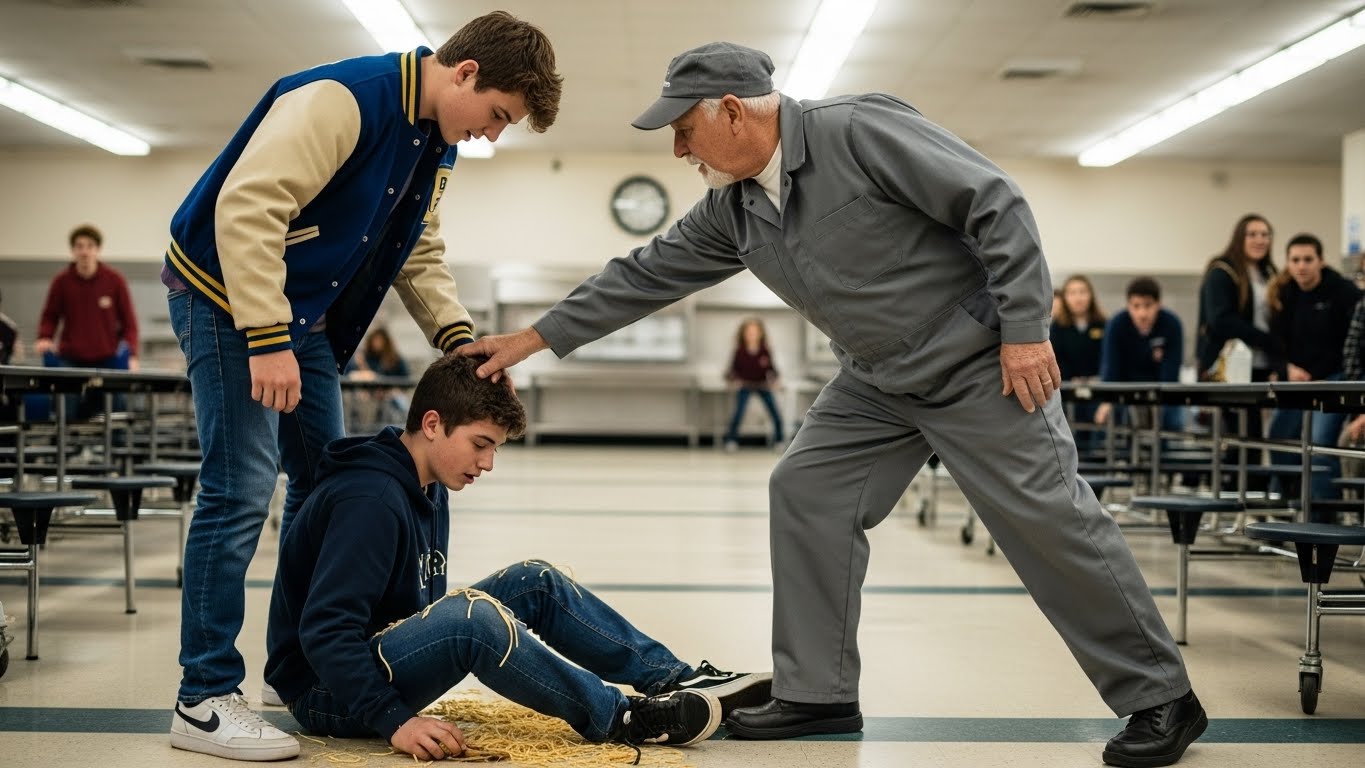
With a violent shove, Braden kicked the chair out from under Leo. Leo crashed to the linoleum floor, his head bouncing with a sickening thud. Before he could recover, Braden upended his tray. A mountain of spaghetti, meatballs, and bright red sauce cascaded over Leo’s head, ruining his shirt, matting his hair, and splattering his precious notebook.
“Look at that!” Braden roared to the laughing crowd. “A silent mess! Say something now! Speak! Tell me to stop!”
Leo sat amidst the food and broken glass from a shattered juice bottle. He wiped tomato sauce from his eyes. He didn’t cry. He didn’t flinch. He stared up at Braden with terrifying, calm eyes. His hand gripped a pen, not to stab, but as if ready to write. He was calculating the assault.
Braden raised his foot, aiming a kick at Leo’s ribs. “I said speak!”
Suddenly, the air in the room seemed to compress.
A grey blur moved from the kitchen doorway. It was fast—impossibly fast for an old man.
A calloused, scarred hand slammed onto Braden’s chest. It wasn’t a push; it was a halt. It was the kind of stop that rattled teeth.
Artie stood between the boy and the bully. He was breathing heavily, his grey uniform stained with grease, but he stood as tall as a redwood.
“Get your hands off me, janitor!” Braden shrieked, his face turning red. “Do you know who my father is?”
Artie didn’t shout. He didn’t bluster. He stepped forward, forcing Braden to take a step back. The silence in the cafeteria was absolute. Even the kitchen staff had stopped working.
Artie leaned down, his face inches from Braden’s. His voice was a low rumble, like thunder on the horizon, audible only to Braden and Leo.
“I don’t care who your father is, son. But I know who you are,” Artie whispered. The menace in his tone was palpable. “And I know what you did to the Wilson girl behind the bleachers last summer. I know she didn’t want to be there.”
Braden’s face drained of color. His arrogance evaporated, replaced by the sheer terror of exposure. “I… I don’t know what you’re talking about.”
“Sit down,” Artie commanded. It wasn’t a request. It was an order from a higher power. “Sit down and shut your mouth, or the police get the photos.”
Braden stumbled back, his legs hitting a chair. He collapsed into it, trembling.
Artie turned his back on the bully—the ultimate sign of disrespect. He reached down a hand to Leo.
“Up you get, kid,” Artie said softly. “Let’s get you cleaned up.”
As Artie led Leo out of the cafeteria, the entire student body watched in stunned disbelief. The janitor had just checkmated the king. But the game had only just begun.
Chapter 2: The Boiler Room Verdict
The walk to the boiler room was silent. Artie guided Leo through the labyrinthine basement corridors of Oak-Hill, past the noisy steam pipes and the humming generators. This was the underbelly of the school, the machinery that kept the privileged warm, unseen and unappreciated.
Artie’s “office” was a small, concrete room tucked behind the main furnace. It was surprisingly cozy. There was a worn leather armchair, a small hotplate, shelves lined with books that looked far too intellectual for a custodian (titles like Constitutional Law, The Nature of Justice, Tort Reform), and a chessboard set up on a crate.
“Sit,” Artie said, pointing to the armchair. He wet a rag in a utility sink and handed it to Leo. “Get that sauce off your face. You look like a crime scene.”
Leo wiped his face. He looked around the room, his eyes landing on a framed photograph on Artie’s desk. It was a picture of a young boy, about Leo’s age, smiling in a baseball uniform. A black ribbon was draped over the corner of the frame.
Artie saw him looking. “That’s Davey,” he said, his voice gruff but cracking slightly. “My grandson. He’s been gone ten years now.”
Artie pulled up a milk crate and sat opposite Leo. The adrenaline of the cafeteria was fading, replaced by the weary reality of what he had just done.
“Skinner is going to come down here in about five minutes,” Artie said, looking at the ceiling as if he could see through the floorboards to the Principal’s office. “He’s going to fire me. Assaulting a student. That’s the line.”
Leo’s eyes widened. He reached for his notebook, which Artie had rescued. He scribbled quickly and held it up: I’m sorry.
Artie chuckled, a dry, rasping sound. “Don’t be. Best part of my day. Maybe the best part of my decade.”
Heavy footsteps echoed in the hallway. The door burst open. Principal Skinner stood there, his face flushed, looking like a sweating ham in a cheap suit.
“Vance!” Skinner bellowed. “What the hell do you think you’re doing? Braden Thorne called his father. Do you have any idea the storm you’ve caused?”
Artie didn’t stand up. He crossed his legs and lit a cigarette, ignoring the ‘No Smoking’ sign above his head. “Hello, Seymour. You’re sweating. Bad for the heart.”
“You’re fired!” Skinner screamed. “Pack your trash and get out. Now! I’ll have security escort you.”
“I don’t think so,” Artie said calmly.
“Excuse me?” Skinner blinked, confused by the lack of begging.
“I said, I don’t think so.” Artie reached under his desk and pulled out a thick manila envelope. He tossed it onto the crate between them. “You see, Seymour, when you empty trash cans for five years, you learn things. People think janitors are furniture. They talk in front of us. They throw away… interesting documents.”
Skinner eyed the envelope. “What is that?”
“Copies,” Artie lied smoothly (though the truth was close enough). “Receipts from the ‘renovations’ on the new gym. The ones where you paid your brother-in-law three times the market rate. And the emails about changing grades for donors’ kids.”
The color drained from Skinner’s face faster than water from a tub.
“Now,” Artie took a drag of his cigarette. “I’m not fired. In fact, I’m getting a raise. And this boy here? He’s going to have a full scholarship, books included, meals included, and no one—I mean no one—is going to touch him. If Braden Thorne so much as breathes in his direction, I send this envelope to the State Attorney General. Are we clear?”
Skinner opened his mouth, closed it, and then nodded jerkily. He backed out of the room, looking like a ghost.
When the door clicked shut, Artie exhaled a long breath and slumped slightly. His hands were shaking.
Leo stared at him, his mouth slightly open. He wrote on his pad: Who are you?
Artie looked at the boy. He looked at the photo of Davey. “I used to be someone else, kid. I used to be the Honorable Judge Arthur Vance. Superior Court.”
Leo’s eyes went wide.
“I sat on the bench for thirty years,” Artie continued, his voice heavy with old grief. “I believed in the law. I believed in the system. Then… then Davey happened.” He gestured to the photo. “Bullied. relentless. Online, at school. He came to me for help. I told him to be tough. I told him to ignore it. I used words like ‘resilience.’ And then one day, he didn’t come home. He took his own life.”
The silence in the boiler room was heavy, a suffocating blanket of sorrow.
“The boys who did it? Wealthy families. Good lawyers. They got a slap on the wrist. ‘Boys will be boys,’ the judge said. My colleague. My friend.” Artie’s fist clenched. “I quit the next day. Sold my house. Moved three towns over. Took a job where I didn’t have to make decisions. I just wanted to clean up dirt, not wallow in it.”
He looked at Leo, his eyes piercing. “But I watched you. I saw what Thorne was doing. It’s happening again. And I’ll be damned if I let it happen twice.”
Leo flipped his notebook to a new page. He hesitated, then handed the book to Artie.
Artie took it. He expected doodles, or angry scrawls. What he saw made his eyebrows shoot up.
It was a ledger.
September 12th: Braden Thorne. 12:05 PM. Stole lunch money from 3rd grader. Locker 402. September 15th: Principal Skinner. Meeting with Contractor. Discussed “hiding the surplus.” Audio recorded on phone. October 1st: Braden Thorne. Discussion with Math teacher. “My dad will fire you if I don’t get an A.”
Page after page. Dates. Times. Witnesses. And notations of “Audio File 12,” “Video File 4.”
Artie flipped through the book, his judge’s eyes scanning the evidence. It was impeccable. It was a case file.
“You haven’t just been taking it,” Artie whispered, a slow smile spreading across his face. “You’ve been building a case.”
Leo nodded. He pulled a cracked smartphone from his pocket.
Artie laughed. It was a genuine, deep laugh. “I told Skinner I had dirt. I was bluffing. But you… you actually have it.”
Artie stood up and paced the small room. The energy of the courtroom was returning to him. The slump in his shoulders vanished.
“You don’t need fists to beat a guy like Thorne, Leo. Fists heal. bruises fade. But a criminal record? A public scandal? That lasts forever.”
Artie grabbed a dusty law book from the shelf and slammed it onto the crate, sending a cloud of dust into the air.
“Discovery is complete,” Artie declared, his voice booming. “It is time to prepare for trial. Founder’s Day is next week. Everyone will be there. The Mayor. The Board. Thorne’s father.”
He looked at Leo. “Are you brave enough to take the stand?”
Leo looked at the locket around his neck. He thought of the spaghetti in his hair. He thought of the mothers and fathers who looked away.
He picked up his pen and wrote in bold, block letters: OBJECTION OVERRULED.
Chapter 3: The Gavel Drops
Founder’s Day at Oak-Hill Academy was a display of opulence that bordered on the grotesque. The auditorium was draped in red and gold bunting. A twenty-foot American flag hung behind the stage. The front rows were filled with the town’s elite—men in three-piece suits and women in pearls, all smiling tightly, congratulating each other on their genetic superiority.
Braden Thorne sat in the front row next to his father, Mr. Reginald Thorne, a man who looked like a vulture in a tuxedo. Braden looked smug. He whispered something to his father, and they both chuckled.
Leo stood backstage, hidden in the wings. He was wearing his best clothes—a clean white shirt Artie had bought him and a tie that Artie had taught him to knot. His heart was hammering against his ribs like a trapped bird.
Principal Skinner took the podium. “Welcome, distinguished guests, to another year of excellence at Oak-Hill…”
The speech droned on. Self-congratulatory drivel about honor and integrity.
Then came the “Disciplinary Segment.” This wasn’t on the public schedule, but Skinner wanted to make an example. He had concocted a plan with Braden’s father to remove the “problem.”
“Before we proceed to the awards,” Skinner announced, his voice grave, “we have a sorrowful duty. We pride ourselves on character. And sadly, we have a student who has violated that trust. Leo Williams, please come to the stage.”
A murmur went through the crowd. Leo walked out. He looked small against the vast stage.
“Leo was found in possession of stolen property,” Skinner lied, holding up an iPad that Braden had planted in Leo’s locker that morning. “Theft is not tolerated. As of this moment, Leo is expelled and will be returned to state custody.”
Braden smirked. He started a slow clap. A few others joined in.
Leo stood at the podium. He didn’t hang his head. He looked out at the sea of faces. He reached into his pocket. Not for a tissue, but for a cable.
“Get off the stage, son,” Skinner hissed away from the mic.
“I don’t think he’s done yet,” a voice boomed from the back of the stage.
The heavy velvet curtains parted.
Gasps filled the room.
Walking forward was not the janitor in grey coveralls. It was a man in flowing, black judicial robes. They were old and slightly moth-eaten at the hem, but the authority they conveyed was absolute. Artie Vance walked with the stride of a lion. He carried a wooden gavel he had carved himself in the boiler room.
“Who are you?” Reginald Thorne stood up, shouting from the front row. “Security! Remove this clown!”
“Sit down, Mr. Thorne!” Artie’s voice didn’t need a microphone. It projected with thirty years of bench experience. “This court is now in session!”
The sheer absurdity and power of the moment stunned the room into silence.
“You want to talk about theft?” Artie said, stepping up to the mic, pushing Skinner aside effortlessly. “Let’s talk about theft. Let’s talk about the theft of dignity. The theft of funds. The theft of a child’s future.”
Artie nodded to Leo.
Leo plugged the cable into the podium’s A/V system. The giant screen behind them, intended for a slideshow of the football team, flickered to life.
“Exhibit A,” Artie announced.
The screen showed a video. It was shaky, filmed from a backpack mesh pocket. But the audio was crystal clear. It was the cafeteria scene. The cruelty of Braden Thorne was played out in 4K resolution on a twenty-foot screen. The kick. The food. The racial slurs. The demand to “bark like a dog.”
The auditorium gasped. Mrs. Thorne put a hand to her mouth.
“Turn it off!” Braden screamed, jumping up.
“Sit down!” Artie slammed the gavel onto the podium. The sound cracked like a gunshot.
“Exhibit B,” Artie continued.
The screen changed. It was an audio waveform. A voice filled the room—unmistakably Principal Skinner’s. “Don’t worry, Reginald. I’ll fail the Williams kid. We’ll say he cheated. Just make sure that check for the ‘library fund’ clears into my personal account.”
Reginald Thorne froze. The color drained from his face.
“Exhibit C,” Artie roared, pointing a finger at the School Board President.
A video played of Braden and his friends vandalizing the rival school’s bus, laughing about how “Dad will pay them off.”
The room was in chaos. Parents were shouting. Skinner was trying to crawl away. Braden was crying.
Artie looked at the crowd. “You send your children here to learn to be leaders. Instead, you let them be led by cowards and bullies. You ignored the silence of this boy because his clothes were cheap. But the truth? The truth doesn’t care about your bank account.”
Artie turned to the back of the room. “Officers?”
The doors swung open. Three state troopers and a detective walked in. They weren’t there for the janitor.
They walked straight to the front row. The detective handcuffed Reginald Thorne. Another officer grabbed a sobbing Braden. A third intercepted Skinner as he tried to sneak out the fire exit.
Artie stripped off his robes. Underneath, he wore a simple suit he had bought from the Salvation Army. He looked at Leo.
The crowd was stunned silent. Then, slowly, a single person started clapping. It was the Physics teacher. Then a parent. Then another. Soon, the entire auditorium was on its feet. Not a polite golf clap, but a thunderous ovation.
Leo didn’t look at the crowd. He looked at Artie.
Artie smiled. “Court is adjourned.”
Epilogue: The First Words
Two weeks later.
The snow was beginning to fall, dusting the world in clean, white powder.
Leo stood on the steps of the courthouse. The legal proceedings were messy, but the outcome was clear. Skinner was indicted. The Thornes were facing multiple lawsuits.
Leo held a gym bag. It wasn’t the tattered backpack anymore. It was new.
A vintage Ford sedan pulled up to the curb. Artie rolled down the window. He wasn’t working at the school anymore. He had been reinstated to the bar association just that morning. He was opening a small practice: Vance & Associates: Legal Aid for the Invisible.
“Get in, partner,” Artie grunted. “We have a lot of work to do. There are a lot of bullies out there.”
Leo climbed into the passenger seat. He buckled his seatbelt. He reached into his pocket and pulled out a piece of paper. It was a formal document. Petition for Adoption.
Artie looked at it. He swallowed hard, his eyes glistening. “You sure about this, kid? I’m an old grump. I listen to talk radio and I smoke too much.”
Leo looked at the man who had given him a voice without forcing him to speak. He looked at the man who had stepped in when the world looked away.
Leo took a breath. The air filled his lungs. He looked Artie in the eye.
“Case closed,” Leo rasped. His voice was rusty, unused, but strong. “Dad.”
Artie Vance, the man who never cried, let a single tear roll down the roadmap of wrinkles on his cheek. He put the car in gear.
“Case closed,” Artie whispered.
They drove off into the falling snow, leaving the silence behind them forever.