I Was Groomed To Inherit A Kingdom Of Rust And Blood, But When I Opened The Trunk Of A ’78 Lincoln, I Realized The Price Of My Inheritance Was My Soul—So I Decided To Burn The Family Legacy To The Ground.
PART 1
CHAPTER 1: The Iron Cage
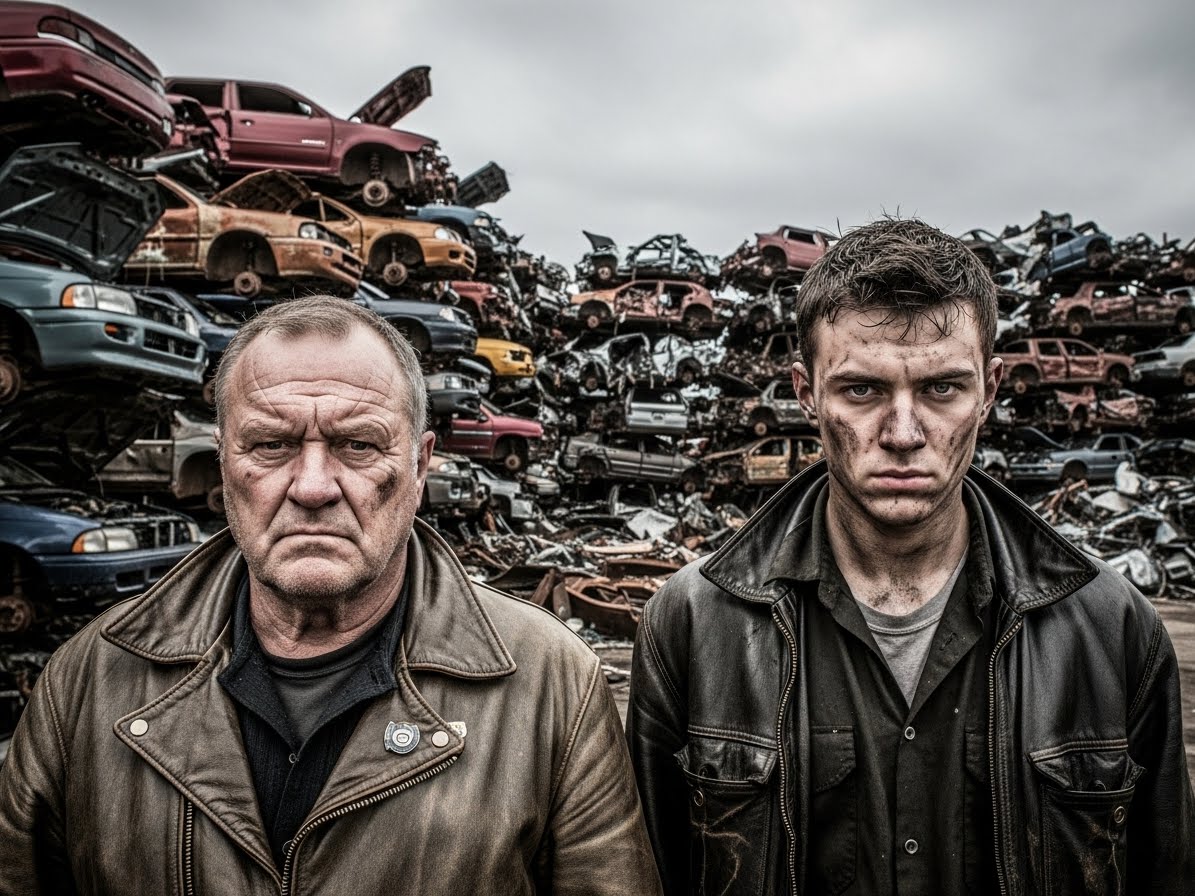
The smell of Miller’s Auto Salvage was a distinct cocktail of oil, wet rust, and despair. It was a smell that clung to the back of your throat, coating your tongue with a metallic film that no amount of coffee could wash away.
I was born in this smell.
My first memory wasn’t a lullaby or a warm blanket; it was the screech of the electromagnetic crane dropping a ton of steel onto a pile of broken dreams.
My father, Frank “The Vise” Miller, didn’t believe in daycare. He believed in labor. By the time I was seven, I could strip a radiator. By twelve, I could hotwire a Ford in under thirty seconds. By eighteen, I knew how to make a car disappear so thoroughly that even the memories of it seemed to fade.
We were located in the armpit of Ohio, a place where the factories had closed down two decades ago and never came back. The town was dying, rotting from the inside out, just like the cars we processed.
But while the rest of the town starved, the Millers feasted.
“Trash is cash, Jack,” my father would say, his voice like gravel grinding in a cement mixer. He’d point his thick, scarred finger at the mountains of twisted metal surrounding us. “People throw away their mistakes. We catch them. We clean them up. We profit.”
He made it sound noble. Like we were the janitors of society.
But janitors don’t carry unregistered .38 specials in their waistbands. Janitors don’t have encrypted phones that only ring between 2:00 AM and 4:00 AM.
The “Legacy,” as he called it, was a lie wrapped in a legitimate business license. Sure, we sold parts. We crushed metal for recycling. But that was just the cover charge. The real money—the blood money—came from the devastating service we offered to the criminal underworld of the Tri-State area.
Get-away cars. Vehicles involved in hit-and-runs. Sedans where a deal went south and the upholstery was ruined by splatter.
They brought them to Big Frank. And Big Frank gave them to me.
My job was “The Process.”
Strip the plates. Grind the VINs—dashboard, door jamb, engine block, firewall. Bleach the interiors if necessary. Then, feed it to “The Beast”—our industrial car crusher.
Within five minutes, a felony became a two-foot cube of scrap metal. Untraceable. Anonymous. Gone.
I hated it. Every single second of it.
I hated the fear I saw in the eyes of the people who dropped off the cars. I hated the way the local sheriff would drive by, wave at my dad, and keep driving, his trunk undoubtedly heavier with a thick envelope.
But mostly, I hated the way my father looked at me. He didn’t see a son. He saw a successor. He saw a tool he had sharpened for twenty years.
“You’re soft, Jack,” he’d tell me when I hesitated, when I asked too many questions. “The world is a hard place. It eats soft things. I’m making you hard. I’m making you iron.”
He wasn’t making me iron. He was making me hollow.
I had dreams once. I wanted to go to college. I wanted to study architecture. I wanted to build things, not destroy them.
I remember the day I got my acceptance letter to Ohio State. I was nineteen. I left it on the kitchen table, proud, terrified, hoping he would see that I could be something else.
When I came home from the yard that evening, the letter was gone. In its place was a set of keys to the office and a new work schedule. Seven days a week. Night shift.
“You build here,” he had said, not even looking up from his newspaper. “This is your university. Now go get your boots on. A shipment is coming in from Detroit.”
I didn’t fight him. I was a coward. I let him crush that dream just like we crushed those cars.
But five years later, at twenty-four, the pressure was building. The silence in my head was getting louder. I felt like a steam pipe ready to burst.
I knew I couldn’t do this forever. I knew one day, the law would come, or a rival gang would come, or I would just snap.
I needed a catalyst. I needed a reason to stop being afraid of him.
I didn’t know that reason was rolling down the highway right now, inside a black 1978 Lincoln Town Car.
CHAPTER 2: The Red Duffel Bag
It was a Tuesday. Tuesdays were usually slow, but the encrypted phone had chirped at 1:00 AM.
One unit. Heavy. 30 minutes.
“Heavy” meant it was bad. Heavy meant high priority. Heavy meant don’t screw up.
I was alone in the yard. Dad was in the office, “doing the books,” which usually meant drinking cheap scotch and counting cash.
The wind was vicious that night. It whipped through the stacks of cars, making them groan. The floodlights cast long, jagged shadows that looked like grasping hands.
The Lincoln rolled in with its lights off. It was a classic, a boat of a car. Beautiful, really, if you ignored the reason it was here.
The driver was a guy I didn’t recognize. Skinny, twitchy, wearing a hoodie that obscured his face. He didn’t say a word. He just hopped out, left the engine running, tossed the keys on the frozen ground, and sprinted toward a waiting van at the gate.
They were in a hurry. That was never a good sign.
I picked up the keys. They were warm.
“Jack!” My father’s voice boomed over the intercom system. “Don’t stare at it. Crush it. Now.”
“Yeah, yeah,” I muttered, shivering.
I walked to the car. My boots crunched on the gravel. I opened the driver’s side door to drive it onto the conveyor belt leading to The Beast.
The interior smelled wrong.
Usually, these cars smelled like fear. Sweat. Sometimes burnt gunpowder.
This one smelled like perfume. Expensive, floral perfume. And underneath that… the copper tang of blood.
I sat in the driver’s seat. The leather was sticky. I didn’t look down. I knew better.
I put the car in gear, but my foot hesitated on the gas.
There was a noise.
Thump.
It came from the back.
My blood froze. The engine idled, a low rumble that vibrated through the steering wheel.
Thump. Thump.
It wasn’t mechanical. It was rhythmic. Deliberate.
Someone—or something—was in the trunk.
My father’s rule was absolute: Never open the trunk. What you don’t see can’t haunt you.
But if someone was alive in there…
I looked up at the office window. Dad was there, watching. He couldn’t hear the noise over the distance and the wind. He just saw me stalling.
The intercom crackled again. “What are you waiting for? An invitation? Move it!”
“Engine trouble!” I yelled back, hoping the wind carried my lie.
I killed the engine.
I stepped out and walked to the back of the car. My hand hovered over the trunk lock. I was shaking so hard my teeth chattered. If I opened this, there was no going back. If I found someone in there, I had a choice: become a murderer, or become a dead man.
I took a breath that tasted like ice and grit. I turned the key.
The trunk popped open.
There was no person.
I let out a breath, half-relief, half-confusion.
But then I saw it.
Tucked into the spare tire well was a red duffel bag. And next to it, a stack of file folders.
The thumping had been the loose spare tire hitting the wall of the trunk as the engine vibrated.
I shouldn’t have touched it. I should have slammed it shut and crushed it.
But curiosity is a dangerous thing.
I unzipped the bag.
It was cash. More cash than I had ever seen in my life. Stacks of hundreds, wrapped in rubber bands. It had to be half a million dollars.
But it was the folders that caught my eye. They were marked with the emblem of the City Council.
I opened the top one.
Photos. Surveillance photos.
And then, a list of names.
The third name on the list was Frank Miller.
Next to his name were dates and dollar amounts. And next to those, notes.
“Disposal of witness vehicle – Judge Harris case.” “Disposal of evidence – 5th Street Shooting.”
This wasn’t just a drop-off. This was leverage. This was an insurance policy. Someone was blackmailing my father, or my father was part of something much bigger than just cleaning up messes for local thugs.
And then I found the last photo in the stack.
It was a picture of me.
Me, leaving my high school graduation. Me, at the grocery store. Me, asleep in my bedroom, taken through the window.
A note was scrawled on the back in handwriting I didn’t recognize:
“If Miller misses a payment, take the son.”
The world tilted on its axis.
My father wasn’t just protecting the business. He wasn’t just “hardening” me.
I was collateral. I was the hostage that kept him in line. Or maybe… maybe I was the sacrifice he was willing to make.
He knew about this. He had to know.
I looked up at the office window again. The light was cutting through the dark. He was still there, pouring another drink, completely unaware that his son was standing over a pile of dynamite that could blow his entire empire to hell.
I realized then that I had to leave. Not next month. Not next week.
Tonight.
But I couldn’t just run. If I ran, they would find me. The people who took these photos, the people who owned this money—they would hunt me down.
Unless.
Unless I burned it all down first.
I zipped up the bag. I grabbed the files.
I looked at The Beast, its massive hydraulic jaws waiting for a meal.
“Okay, Dad,” I whispered, the rage finally overtaking the fear. “You want me to take out the trash? Let’s take out the trash.”
I slammed the trunk. But I didn’t put the car in the crusher.
I put it in reverse.
PART 2
CHAPTER 3: The Sleight of Hand
I sat in the idling Lincoln, my heart hammering like a piston firing out of time.
“Jack!” The intercom screeched again. “I want to hear that metal screaming!”
I had seconds.
If I drove this car into the crusher, the evidence—and the money—would be gone. But the leverage I needed to escape would be gone, too.
If I drove it out the front gate, Dad would see. He’d have his shotgun out the window before I hit second gear.
I needed a third option.
I looked at the “Dead Row”—a stack of cars three high, waiting to be stripped for copper wiring. It was a blind spot from the office window, blocked by the massive bulk of the crane.
I shifted into reverse, killed the lights, and rolled the Lincoln silently backward. I tucked it deep behind a rusted-out school bus and a gutted semi-truck cab. It was tight, but it fit.
I grabbed the red duffel bag and the files, shoving them under my grease-stained jacket. I sprinted toward a pile of scrap we called “The Decoy.”
It was a 1985 Crown Victoria. Similar shape, similar weight to the Lincoln. We kept it around for parts, but it was mostly a shell.
I jumped into the loader—a massive forklift with a claw—and picked up the Crown Vic.
I drove it into the crusher’s maw.
From the office, all my father would see was a large, dark sedan entering the machine.
I pulled the lever.
CRUNCH.
The sound was satisfyingly violent. Glass shattered. Steel groaned and buckled. The hydraulic press whined as it compressed the car into a dense cube of unrecognizable debris.
I watched it happen, breathing hard. I had just destroyed a worthless piece of junk, but to my father, I had just completed a contract for the mob.
I grabbed the cube with the loader and stacked it on the outgoing pile.
Then, I ran to the back of the workshop, to my “apartment.” It was a converted storage container where I slept. No windows. Just a cot, a hot plate, and a locker.
I threw the bag and files into the bottom of my locker, piling dirty coveralls on top of them. I locked it with a padlock only I knew the combination to.
I washed the grease off my hands, staring at myself in the cracked mirror. My eyes looked wild.
I had to calm down. I had to go back to the office and look the Devil in the eye.
I walked across the frozen mud to the main building. I pushed the door open.
The heat hit me first, then the smell of stale cigar smoke.
Big Frank was sitting behind his desk, a glass of amber liquid in his hand. He didn’t look up.
“Done?” he asked.
“Done,” I said. My voice was steady. Surprising.
“Good. Clean?”
“Cube is on the stack. No VINs. No plates. Nothing left but dust.”
He finally looked up. His eyes were bloodshot, heavy bags under them. He looked old. For a second, I almost felt sorry for him.
“You’re a good boy, Jack,” he muttered, sliding a thick envelope across the desk. “Here. Your cut.”
I took the envelope. It was thin. Maybe five hundred bucks.
“Thanks, Dad.”
“Don’t spend it all on girls,” he grunted, turning back to his ledger. “We got a big shipment coming Thursday. Get some sleep.”
I walked out. The cold air felt like freedom.
He didn’t know. He had no idea the Lincoln was sitting fifty yards away, intact. He had no idea his “good boy” was about to become his worst nightmare.
CHAPTER 4: The Ledger of Betrayal
I waited until I saw the lights in the office go out. That meant Frank had passed out on the leather couch.
I went back to my container and locked the door. I pulled out the files.
I sat on my cot, the only light coming from a small desk lamp. I opened the folder labeled Project: Legacy.
I thought I knew the business. I thought we were just the cleaners.
I was wrong.
We weren’t just disposing of cars. We were a distribution hub.
According to the documents, the cars we “crushed” were often packed with narcotics before they arrived. We were supposed to strip the drugs out, repackage them in hollowed-out auto parts—alternators, transmissions, mufflers—and ship them out as “refurbished goods” to shops all over the Midwest.
My father wasn’t just a localized fixer. He was a mid-level logistics manager for a cartel.
But that wasn’t the worst part.
I found a transcript of a meeting. It was dated three years ago.
Subject: Succession Plan.
Associate 1: We need assurances, Frank. You’re getting old. The liver is failing. Who runs the yard when you drop?
Frank Miller: The boy. Jack.
Associate 1: He’s soft. He wanted to go to art school or some garbage.
Frank Miller: I broke him of that. I own him. He does what I say.
Associate 1: We need collateral. If he flinches, if he talks to the Feds, we lose the hub.
Frank Miller: He won’t talk. I’ve isolated him. He has no friends. No money. No life outside the gate. I made sure of it. And if he does wobble… you have my permission to liquidate the asset.
I read that line three times.
Liquidate the asset.
He was talking about his own son.
The acceptance letter from Ohio State? The one that disappeared? He didn’t just hide it. He probably burned it while laughing.
He had systematically dismantled my life, cut off every escape route, and sabotaged my future, just so he could have a slave to run his drug empire.
I wasn’t a partner. I wasn’t an heir. I was a hostage.
The sadness I had felt earlier evaporated. It was replaced by a cold, hard rage. It felt like liquid nitrogen pumping through my veins.
I looked at the cash in the bag. Half a million dollars.
That was enough to disappear. I could take the truck, drive to Mexico, and never look back.
But that wasn’t enough anymore.
If I left, he would just find someone else. Or the cartel would track me down.
No.
I looked at the photo of me sleeping.
They had been watching me. They thought I was a sheep.
It was time to show them I was a wolf.
I took out my phone. Not the encrypted one. My personal burner.
I searched for a number I had seen on a billboard a thousand times but never thought I’d call.
Detective Miller. No relation. Just a coincidence. He was the one cop in town everyone said was “too stupid to take a bribe.”
But maybe he wasn’t stupid. Maybe he was just honest.
I didn’t call him. Not yet. I couldn’t trust the police. Not with my father’s payroll.
I needed to create chaos.
I needed to turn the yard into a war zone.
I started sketching a plan on the back of the cartel documents.
I knew every inch of this yard. I knew which stacks were unstable. I knew where the gas lines ran. I knew how to override the safety protocols on the crane.
The “Big Shipment” was coming Thursday.
That gave me 48 hours to turn Miller’s Auto Salvage into a death trap.
CHAPTER 5: The Architect of Ruin
Wednesday was a blur of preparation.
I worked the yard like normal, but every move had a double purpose.
“Jack, move those propane tanks to the south wall!” Dad yelled from the porch.
“Sure thing, Pop!”
I moved them. But I didn’t secure them. I placed them next to the main generator, loosening the valves just enough so that a single spark would turn them into a bomb.
I spent the afternoon “fixing” the hydraulic lines on the crane. In reality, I was bypassing the weight limiters and the remote kill switch. I wanted manual control only.
I went to the back lot, where the “Dead Row” was. I found the Lincoln I had hidden.
I popped the trunk again. I took the cash, but I left the files.
Then, I did something specific. I took a can of bright orange spray paint—the kind we used to mark cars for crushing—and I painted a massive “X” on the roof of the Lincoln.
Next, I went to the perimeter fence. I cut the chain-link in three specific spots. Escape routes.
By sunset, the yard looked the same to the untrained eye. But to me, it was a chessboard set for checkmate.
That night, I sat with my father in the office. It was a ritual. We’d eat takeout burgers and he’d lecture me about the business.
“Tomorrow is big, Jack,” he said, wiping grease from his chin. “The Detroit crew is coming personally. They’re bringing the product. We strip the cars, load the parts, and they leave us a bag with fifty grand in it.”
“Fifty grand,” I repeated. “That’s a lot of money.”
“It’s respect,” he said, pointing a fry at me. “It’s power. One day, this will all be yours.”
I looked around the dingy office. The stained carpet. The flickering fluorescent light. The smell of despair.
“I know, Dad,” I said, smiling. “I can’t wait.”
I stood up. “I’m gonna do a final perimeter check.”
“Good boy. Keep it tight.”
I walked out into the dark.
I went to the encrypted phone in the workshop.
I found the contact for the Detroit crew.
I sent a text.
“Deal is compromised. Feds are watching the yard. Do not come tomorrow. Meet tonight. 2 AM. Come heavy. Frank is trying to flip on you.”
Then, I took the burner phone and dialed the local police tip line. I didn’t speak. I just played a recording I had made earlier—the sound of gunshots and a man screaming for help—and left the phone near the gate.
Then, I climbed up into the cabin of the electromagnetic crane. It was fifty feet in the air. The highest point in the yard.
I sat in the operator’s chair, looking down at the kingdom of rust.
The stage was set.
The Detroit crew would arrive thinking my father was a traitor. The police would arrive thinking there was an active shooter. And my father? He would be caught in the middle.
I looked at my watch. 1:45 AM.
Headlights appeared on the horizon. Three SUVs. Moving fast.
The Detroit crew. They were early.
I powered up the crane. The massive magnet hummed to life, swinging gently in the wind like a pendulum of doom.
“Showtime,” I whispered.
PART 3
CHAPTER 6: The Weight of Judgment
From fifty feet up, the world looked like a toy set. A violent, rusted toy set.
I sat in the operator’s cab of the crane, the controls humming under my hands. The heater was broken, and the glass was frosted at the edges, but I was sweating.
The three black SUVs tore through the main gate, ignoring the “Stop” sign, ignoring the speed bumps. They fanned out in front of the office, their headlights cutting through the darkness like searchlights seeking a prisoner.
The office door flew open. Big Frank stepped out onto the porch. He was wearing his bathrobe and holding a shotgun. He looked small from up here. Confused.
“Who the hell is that?” he shouted, his voice barely reaching me over the wind.
The doors of the SUVs opened. Six men stepped out. They didn’t look like customers. They looked like soldiers. Tactical vests. Long rifles.
The leader, a man I knew only as “Vargas,” stepped forward.
“You talk too much, Frank,” Vargas yelled.
“What?” Frank lowered the shotgun slightly. “Vargas? What are you doing? The shipment isn’t until Thursday!”
“We got your message,” Vargas spat. “You want to flip? You want to sell us to the Feds?”
“I don’t know what you’re talking about!” Frank screamed.
That was the moment. The seed of doubt I planted had bloomed into a tree of violence.
Vargas raised his rifle.
I didn’t wait.
I slammed the left joystick forward. The crane groaned, the massive steel boom swinging out over the yard.
Hanging from the magnet was a 1990 Chevy Caprice—a two-ton block of steel I had pre-loaded.
I positioned it directly over the lead SUV.
“Hey!” one of the gunmen shouted, pointing up at me.
I hit the release button.
CLANG-CRUNCH.
The sound was deafening. The Caprice fell twenty feet and flattened the SUV like a soda can. Glass exploded outward. The horn of the crushed car blared continuously, a long, dying scream.
Chaos erupted.
The gunmen scattered, diving behind the other cars. They started firing—not at Frank, but at me.
Bullets pinged off the steel underbelly of the crane cab. Sparks flew. I ducked low, peering through the reinforced floor window.
“Jack!” I heard my father scream. “Jack, what are you doing?!”
He realized it then. He looked up, his face twisted in a mixture of horror and realization. He knew.
I grabbed the radio mic.
“I’m cleaning the yard, Dad!” I yelled, my voice booming over the external speakers. “I’m finally doing what you told me!”
I swung the crane again. I energized the magnet and lowered it toward the second SUV. The magnetic field was so strong it ripped the rifles out of the hands of two men standing too close.
I picked up the second SUV—with the driver still inside screaming—and lifted it thirty feet into the air.
“Drop the guns!” I roared over the speakers.
Then, the sirens started.
Wailing. Dozens of them. Coming from the highway.
I had timed the recording perfectly. The police were descending on Miller’s Auto Salvage expecting a massacre.
Vargas looked at the gate, then at Frank.
“You set us up!” Vargas screamed. He turned his rifle on my father.
Frank dove behind a stack of tires just as the bullets shredded the porch where he had been standing.
The yard was now a war zone. The cartel shooting at Frank. Frank shooting back. Me dropping cars from the sky. And the police closing in.
It was the most beautiful thing I had ever seen.
CHAPTER 7: The Kingdom Burns
The first police cruiser smashed through the chain-link fence at the south perimeter. Blue and red lights washed over the rust, making the blood on the ground look black.
“Police! Drop your weapons!”
The cartel gunmen didn’t drop them. They panicked. They engaged.
The air filled with the popping of gunfire. It sounded like firecrackers, but with a deadly, snapping echo.
I saw a stray tracer round zip past the office and hit the generator shed.
The propane tanks.
I had loosened the valves. The gas had been leaking for hours, pooling in the low-lying shed.
BOOM.
The explosion wasn’t a Hollywood fireball. It was a concussive wave. A flash of white heat that knocked the wind out of me even fifty feet up.
The shockwave blew the windows out of the office. The stack of tires Frank was hiding behind caught fire instantly.
The fire spread fast, fed by the spilled oil and gasoline that saturated the ground of the yard. Within minutes, the kingdom of rust was becoming a kingdom of fire.
I needed to get down. I had to get to the Lincoln.
I neutralized the magnet, dropping the SUV I was holding onto the pile of burning debris. I killed the power to the crane.
I kicked the door of the cab open. The heat rising from below was intense. Smoke was billowing up, thick and black.
I stepped onto the catwalk to climb down the ladder.
But someone was already climbing up.
It was Frank.
He was scorched. His bathrobe was gone, his shirt torn. He was bleeding from a cut on his forehead, blood streaming into his eyes. He looked like a demon rising from hell.
He had a tire iron in his hand.
“You ungrateful little rat!” he screamed, pulling himself up onto the catwalk. The firelight danced in his eyes.
There was nowhere to go. It was a narrow steel walkway, fifty feet above a burning inferno.
“It’s over, Dad!” I yelled. “The cops are here! Vargas is down! Just give up!”
“Give up?” He swung the tire iron. It clanged against the railing, inches from my ribs. “I built this! I built you! And you burn it down?”
He swung again. I dodged, but the tip caught my shoulder. Pain exploded in my arm.
I backed up, pressing against the cab door.
“You didn’t build me,” I spat. “You broke me. You turned me into a criminal so you wouldn’t have to be one alone.”
He lunged.
He was strong, fueled by adrenaline and a lifetime of violence. He grabbed my throat with his free hand. His grip was like a vice.
I gagged, clawing at his hand. He pushed me back over the railing.
I looked down. The fire was raging below. If I fell, I would be incinerated.
“You’re weak,” he hissed, his face inches from mine. “You were always weak. I should have crushed you when you were a baby.”
That was it. The final severance. The last thread of “father” died in my heart.
I stopped clawing. I looked him in the eye.
“Iron rusts, Frank,” I choked out.
I jammed my thumb into the bullet wound on his shoulder—the one he had taken during the shootout with Vargas.
He screamed and his grip loosened for a split second.
I brought my knee up, driving it into his stomach. He doubled over.
I grabbed the tire iron from his hand and shoved him back.
He stumbled. His boot slipped on the oil-slicked grating.
He flailed, grabbing for the railing.
He missed.
He didn’t scream. He just looked at me. A look of pure shock.
He fell backward into the smoke.
I didn’t watch him hit the ground. I didn’t want to know if the fall killed him or the fire.
He was gone. The shadow was lifted.
I scrambled down the ladder, sliding the last ten feet, burning my hands on the hot metal.
The yard was chaos. Police were rounding up the surviving cartel members. Firefighters were trying to spray foam on the chemical fires.
Nobody was looking at the back lot.
I ran to the “Dead Row.”
The flames were licking the sides of the school bus, but the 1978 Lincoln was still safe in its cocoon.
I jumped in. The keys were still in the ignition.
I turned it. It roared to life. A deep, American V8 rumble.
I threw it in reverse, smashing through the rotting wooden fence at the back of the property—the third escape route I had prepared.
I hit the dirt road that led into the woods.
I didn’t turn on the headlights. I drove by moonlight and memory.
Behind me, the sky glowed orange. Miller’s Auto Salvage was gone.
CHAPTER 8: The Architect
Three Years Later.
The ocean breeze in San Diego is different from the wind in Ohio. It smells like salt and possibilities, not rust and oil.
I sat on the patio of a small coffee shop, a sketchbook open in front of me.
I was drawing a bridge. A suspension bridge. Elegant. Strong. Built to connect things, not crush them.
“Jack?”
I looked up. A woman was standing there. She was smiling.
“Hey, Sarah. Ready to go?”
“Yeah. The site manager is waiting for the blueprints.”
I closed the sketchbook.
My name isn’t Jack anymore. It’s Michael. Michael Newman. A little on the nose, maybe, but I liked it.
I touched the scar on my shoulder, the one the tire iron had left. It was a reminder.
The police report said Frank Miller died in the fire. They said it was a gang dispute gone wrong. They found the “evidence”—the cartel bodies, the drugs. They closed the case.
They never found the red duffel bag. They never found the ledger.
I used the money to buy a new identity. I used the rest to put myself through architecture school.
I didn’t keep all of it. I sent envelopes of cash to the families of people my father had hurt. Anonymous donations. It didn’t bring anyone back, but it felt like paying a debt.
I still have nightmares sometimes. I dream of the crushing machine. I dream of the sound of metal screaming.
But then I wake up. I see the sun hitting the ocean. I see the lines on my drafting paper.
I realized something that night in the crane.
My father was right about one thing. The world is hard.
But he was wrong about the iron.
You don’t survive by being hard. You survive by being flexible. By being able to melt down and recast yourself into something new.
He was scrap metal. Old, rusted, dangerous.
I am the architect.
And I’m finally building something that will last.
“You coming?” Sarah asked, holding out her hand.
I took it. Her hand was warm.
“Yeah,” I said. “I’m coming.”
We walked away from the coffee shop, leaving the shadow of the umbrella behind, stepping into the bright, unblemished sunlight.
The legacy was dead.
Long live the future.
[END OF STORY]