The Proctor: They poured industrial adhesive on the poor boy’s seat to break him, but they didn’t know the old man with the cane used to be a Homicide Detective.
Chapter 1: The Smell of Acetone
The silence in the gymnasium of Oakhaven High wasn’t peaceful; it was pressurized. It was the kind of silence that hummed with the anxiety of three hundred teenagers terrified that a piece of paper was about to determine their entire worth as human beings.
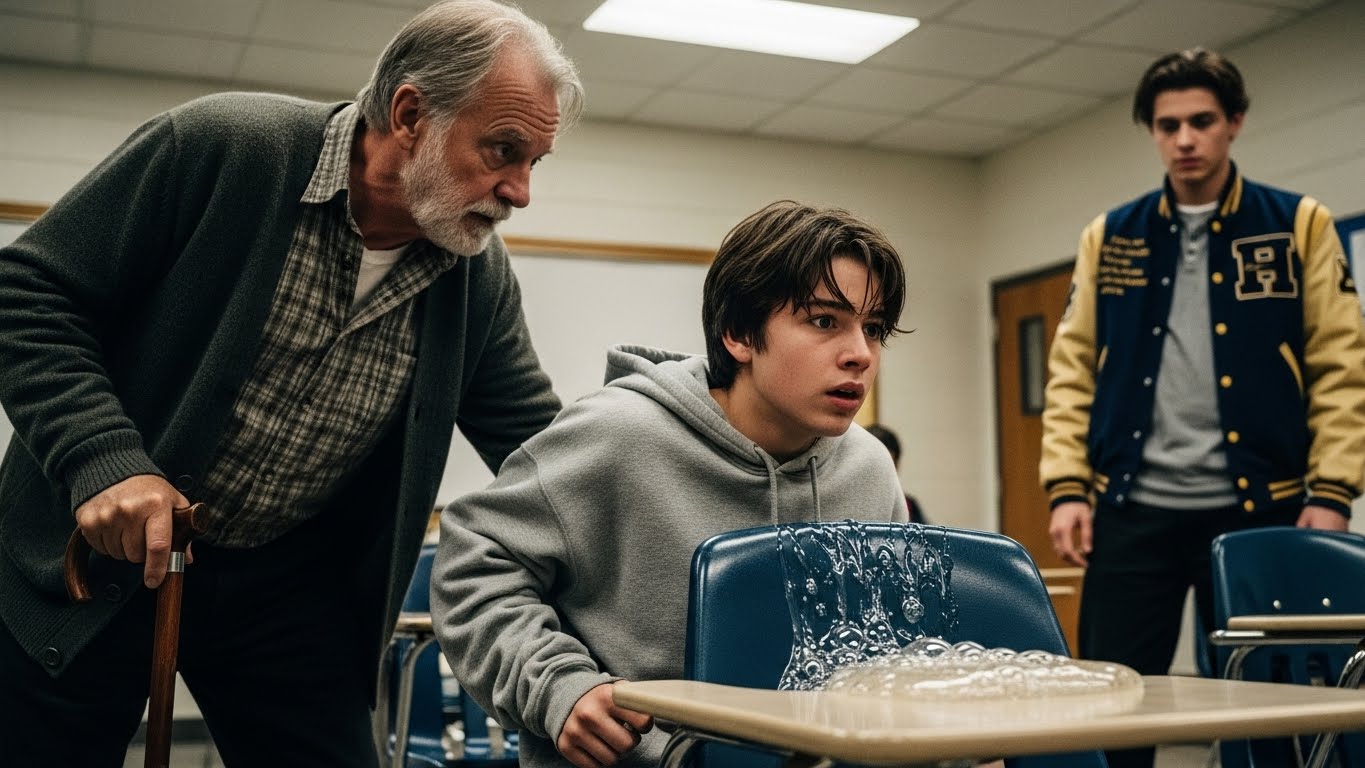
I’m Elias Thorne. I’m sixty-two years old. I wear a gray cardigan that’s seen better decades, and I walk with a heavy cane because of a bullet fragment lodged in my right knee—a souvenir from a drug bust in Baltimore back in ’98.
For the last five years, I’ve been invisible. To these kids, I’m just “The Limp.” I’m the old guy who hands out the Scantron sheets, tells them to put their phones away, and watches the clock. They think I’m slow. They think I’m checking out.
They don’t know that when you spend thirty years working Homicide, you never really stop watching. You learn to read the room not by faces, but by the micro-movements. The twitch of a hand. The sweat on a brow. The eyes that dart to a specific corner when they think no one is looking.
Today, the predator in the room was Caleb Vance.
Caleb was Oakhaven royalty. His father, Marcus Vance, owned the dealerships that lined the highway and half the real estate board. Caleb sat three rows back, wearing a varsity jacket that probably cost more than my monthly pension check. He wasn’t looking at his exam paper. He wasn’t nervously chewing his pen like the others.
He was staring at the empty desk in the front row—Seat 4A.
That was Leo Rossi’s seat.
Leo was the prey. A scholarship kid, small for his age, with clothes that were always clean but clearly third-hand. Leo tried to shrink into the walls. He walked with his head down, ate lunch in the library, and apologized when people bumped into him.
Leo was ten minutes late.
That’s when I smelled it.
My olfactory senses are the only things sharp left on me. It cut through the smell of stale gym air, cheap deodorant, and teenage fear.
It was chemical. Sharp. Acrid. A solvent smell, like nail polish remover but heavier.
Acetone. Or… Cyanoacrylate.
I started walking down the aisle, my cane thumping rhythmically against the polished wood floor. Thump. Step. Thump. Step.
I saw the students around Seat 4A. They were too still. A girl named Jenny, who usually smiled at me, looked at the empty chair and then quickly looked down at her shoes, her face drained of color. She was trembling.
They all knew. Silence is the loudest admission of guilt.
The double doors of the gym creaked open.
Leo rushed in, breathless, his backpack sliding off one shoulder. He looked like he’d run the whole three miles from the trailer park. “I’m sorry, Mr. Thorne,” he wheezed, pushing his taped-up glasses up his nose. “The bus… the engine died. I ran as fast as I could.”
“Just take your seat, Leo. You still have fifty minutes,” I said. My voice was calm, but my eyes didn’t leave Caleb Vance.
Caleb was smirking. It was a subtle thing, a tightening of the corner of his mouth. A look of anticipation.
Leo nodded frantically, terrified of drawing more attention to himself. He kept his eyes on the floor, rushing toward Seat 4A. He turned, shifting his weight, ready to drop his exhausted body into the plastic chair.
I was ten feet away.
From this angle, the light from the high windows caught the seat. A thick, clear gel had been smeared across the surface. It wasn’t Elmer’s glue. It was bubbling slightly.
Industrial epoxy. The kind used for car parts. The kind that bonds in seconds.
If Leo sat in that, it wouldn’t just ruin his pants. It would bond to his skin. It would burn. To get him out, paramedics would have to cut the clothes off him, maybe even take skin with it. He would be humiliated in front of the entire junior class. It was a social execution.
Leo began to lower himself.
“Sit down, loser,” Caleb whispered, soft enough that only the front row heard it.
My bad knee screamed in protest, but muscle memory took over. I wasn’t the old proctor anymore. I was Detective Thorne, and I was seeing a crime in progress.
I moved faster than I had in twenty years.
Chapter 2: The Black Notebook
“DON’T!”
The shout echoed off the rafters like a gunshot.
I lunged. My hand, calloused and scarred, clamped onto the back of Leo’s oversized hoodie just as his thighs were inches from the plastic.
I yanked him upward and backward with a force that surprised even me.
RIIIP.
The sound of fabric tearing was loud in the silent room. Leo’s collar gave way, but I had him. He stumbled back, crashing into my chest, his feet tangling.
“Mr. Thorne?! I… I didn’t mean to be late!” Leo cried out, terrified he was being assaulted.
“Look,” I growled, breathless, pointing my cane at the chair.
Leo adjusted his glasses and looked. The class looked.
A single heavy drop of the clear liquid dripped from the seat onto the floor. Hiss. It reacted with the wax on the gym floor, bubbling white.
“That,” I said, my voice projecting to the back of the room, “is industrial-grade epoxy. It generates heat as it cures. If you had sat there, Leo, you would be in the hospital right now with third-degree chemical burns.”
Leo went pale. He stared at the seat, then at me. His lip trembled. He realized how close he had come to a nightmare.
I straightened up, feeling the adrenaline vibrate in my fingertips. I looked at the rows of students. Faces of shock. Faces of guilt.
“Who?” I asked.
Nobody spoke. This was Oakhaven. The rich kids ruled, and the rich kids protected their own.
I turned my gaze slowly to Caleb Vance.
The smirk was gone. In its place was a look of feigned, wide-eyed innocence that I had seen on a hundred guilty suspects in interrogation rooms.
“Mr. Thorne, are we taking the test or not?” Caleb said, leaning back, clicking his expensive pen. “This little drama is eating into my time. Some of us have Ivy League futures to worry about.”
I gently moved Leo aside. “Stay here, son.”
I limped toward Caleb’s desk. The thump of my cane was the only sound in the room.
“Futures,” I repeated, stopping right in front of him. “That’s an interesting word, Caleb.”
I saw his eyes flicker toward his backpack on the floor. Just a split second. A ‘tell’.
“You got a problem, janitor?” Caleb sneered, his voice raising so his friends would hear his bravado.
“Stand up,” I said.
“Make me.”
I didn’t argue. I didn’t yell. I reached down and grabbed the strap of his backpack.
“Hey! That’s my property! You can’t touch that! My dad—”
“Your dad isn’t here,” I said, hoisting the heavy bag onto the desk. “And under school district policy section 4.2, any item brought into an exam hall is subject to search if suspected of containing prohibited materials. I suspect you have the glue bottle.”
I unzipped the main compartment. Caleb jumped up, his face flushing red. “I’ll sue you! I’ll get you fired!”
I ignored him. I dug my hand in.
I didn’t find the glue bottle. He was too smart for that; he’d likely passed it off or ditched it in the bathroom trash.
But my fingers brushed against leather.
I pulled out a notebook. It was sleek, black, expensive leather. Not a school notebook. I opened it.
The handwriting was jagged, aggressive.
The Project. Phase 1: The Locker Incident (Rat in the vent). Status: Success. Phase 2: The Gym Shorts (Bleach). Status: Success. Phase 3: The Adhesive. Status: Pending.
And next to Leo’s name, there was a drawing. It wasn’t a doodle. It was a detailed sketch of a tombstone with Leo’s name on it.
This wasn’t bullying. This was pathology. This was a serial offender escalating.
“Give that back!” Caleb lunged.
I blocked him with my cane, pressing the rubber tip firmly into the center of his chest, pushing him back into his seat. “Sit.”
“You’re dead, old man,” Caleb hissed.
“I’ve been dead before,” I muttered.
I was about to close the bag when I saw something else tucked into the mesh side pocket. A small, clear plastic sandwich bag. Inside it was a silver object.
I pulled it out.
The room went cold.
It was a locket. A silver, heart-shaped locket.
I knew this locket. Everyone in Oakhaven knew this locket. It was on the posters stapled to every telephone pole for ten miles. It was on the evening news every night for the last three months.
It belonged to Sarah Jenkins. The girl who vanished after football practice in October.
I held the baggie up to the light. The cheap fluorescent bulb glinted off the tarnished silver.
“Caleb,” I said, my voice devoid of any anger now, replaced by the icy professionalism of a detective who just found the smoking gun. “Why do you have Sarah Jenkins’ locket?”
Caleb’s face didn’t just turn pale. It went gray. For the first time, the arrogance evaporated, leaving behind naked, primal panic.
“I… I found it,” he stammered. “I just found it. Outside.”
“In a plastic bag?” I asked. “Preserved?”
I looked at the class. They were frozen. Jenny, the girl in the front row, let out a sob and covered her mouth.
“Exam is over,” I announced. “Nobody leaves. Nobody touches their phones. I am locking the doors.”
I pulled my own phone from my pocket. I didn’t dial the Principal. I dialed the direct line to the Sheriff’s station.
Chapter 3: The Weight of Gold
Five minutes is a long time in a silent room.
I stood by the door, cane in one hand, Sarah Jenkins’ locket in the other. Leo was sitting on the floor near my desk, shaking. Caleb was staring at his hands, his leg bouncing uncontrollably.
The silence was broken by the wail of sirens. Not one. Three.
I unlocked the double doors as two uniformed officers burst in, followed by Principal Higgins.
“Elias, what the hell is going on?” Higgins shouted, his face red and sweaty. “You can’t hold students hostage! I have parents calling the office screaming!”
“He assaulted me!” Caleb yelled, jumping up instantly, the mask of the victim sliding back into place. “He ripped Leo’s shirt and then he shoved me and stole my personal property!”
Principal Higgins turned on me. “Is this true, Elias?”
“The boy put industrial epoxy on a student’s chair,” I said calmly. “Attempted assault. And when I searched his bag for the weapon, I found this.”
I held up the evidence bag.
One of the officers, a young deputy named Miller, stepped forward. He recognized it immediately. “Is that…?”
“Sarah’s,” I said. “Found in Caleb Vance’s backpack. Wrapped and hidden.”
Miller moved to cuff Caleb. “Caleb Vance, stand up and put your hands behind your back.”
“Don’t you touch him!”
The voice boomed from the hallway.
Marcus Vance strode in. He was wearing a three-piece suit that cost more than the school’s library budget. He didn’t look like a concerned father; he looked like a CEO arriving to manage a hostile takeover.
“Dad!” Caleb whined. “They’re arresting me!”
Marcus walked straight past the principal, past the deputy, and stopped inches from my face. He smelled of expensive cologne and intimidation.
“Mr. Thorne, isn’t it?” Marcus said. ” The cripple who hands out papers.”
“Mr. Vance,” I nodded.
“You have illegal search and seizure issues here, Deputy,” Marcus barked at Miller, not even looking at him. “My son is a minor. That backpack was opened without a warrant and without a guardian present. Anything found inside is fruit of the poisonous tree. It’s inadmissible.”
He looked at me. “And as for you. You touched my son. That’s assault.”
“He was trying to maim another student,” I said, standing my ground. I’d stared down cartel bosses; a car salesman didn’t scare me.
“Boys pull pranks,” Marcus waved a hand dismissively. “We’ll buy the Rossi kid a new wardrobe. But this?” He pointed at the locket. “You planted that. Everyone knows you’re a washed-up ex-cop desperate for glory. You probably had that in your pocket for weeks waiting to frame someone with money.”
Principal Higgins stepped in, looking terrified of Marcus. “Elias… maybe we should discuss this in my office. Marcus is right, the search… it’s problematic.”
I looked at Higgins. Then at the Deputy, who looked unsure, his hand hovering over his cuffs but not moving.
Money was winning. It was happening right in front of me. The narrative was shifting. I was the crazy old man. Caleb was the victim of a prank gone wrong.
“Give me the locket, Elias,” Higgins said, holding out his hand. “We’ll handle this internally.”
“Internally?” I laughed, a dry, bitter sound. “This is evidence in a missing person’s case. It goes to the police.”
“Give it to me, or you’re fired for insubordination and assault,” Higgins said. His voice wavered, but the threat was real.
I looked at Leo. He was watching me. For the first time in his life, someone had stood between him and the wolves. If I handed this over, the locket would disappear. Caleb would walk. Leo would be tormented until he broke. And Sarah Jenkins… her family would never know.
I looked at the badge on my belt—not a police badge anymore, just a plastic school ID.
“You can’t fire me,” I said softly.
I took the badge off and tossed it onto the floor.
“I quit.”
I turned to Deputy Miller. “Miller, you’re a sworn officer of the law. I am handing this evidence directly to you. If it disappears, I will go to the State Police, and I will testify that I gave it to you. Do you understand?”
Miller straightened up. He looked at Marcus Vance’s furious face, then at the locket. He took the bag.
“I got it, Elias,” Miller said. “I’ll log it in.”
“You’re making a mistake, Deputy,” Marcus hissed. “A career-ending mistake.”
“Caleb Vance,” Miller said, his voice stronger now. “You’re coming with us.”
As they dragged a screaming Caleb out, Marcus turned to me. His eyes were black pits of rage.
“You have no idea what you’ve just done,” Marcus whispered. “You think you’re a hero? You’re a janitor with a bad leg. I will bury you. You’ll never work in this state again. I’ll take your pension. I’ll take your house.”
I leaned on my cane, feeling the ache in my knee, sharp and familiar.
“Mr. Vance,” I said. “I lost everything that mattered to me twenty years ago. You have nothing to threaten me with.”
I turned and walked toward Leo. He scrambled up.
“Mr. Thorne…” Leo whispered. “Thank you.”
“Go home, Leo,” I said. “Lock your doors.”
I walked out of the gym, leaving the whispers and the stunned principal behind. I walked out into the bright afternoon sun.
I was unemployed. I had a powerful enemy. But for the first time in five years, the ghost of the detective inside me was awake.
And I knew one thing for certain: Caleb didn’t act alone. A boy like that doesn’t just find a locket. He didn’t kill Sarah Jenkins. He was too weak.
He was holding it for someone else.
I got into my rusted Ford sedan, threw my cane in the passenger seat, and opened the glove box. I pulled out a fresh notebook.
I wrote down one name. Marcus Vance.
Then I started the engine. The test was over. The investigation had just begun.
Chapter 4: Cold Case and Warm Whiskey
My house smelled like old books and loneliness. It was a small bungalow on the wrong side of the tracks, the kind with peeling paint and a porch that sagged in the middle—much like me.
I poured three fingers of cheap bourbon into a glass and swallowed it neat. It burned, distractingly enough to dull the throbbing in my knee.
I had been unemployed for exactly four hours.
On the coffee table lay my old police files. I wasn’t supposed to have them—I’d “accidentally” boxed them up when I retired—but old habits die hard. Next to them was a notepad where I had scribbled everything I remembered from Caleb’s black book.
The Glue. The Gym Shorts. The Locket.
The phone rang. Landline. Only telemarketers and debt collectors called the landline.
I picked it up. “Thorne.”
“He made bail.”
It was Deputy Miller. His voice was hushed, like he was cupping the receiver.
“That was fast,” I said, not surprised. “What about the locket?”
“It’s in evidence,” Miller whispered. “But the Chief is already talking about ‘chain of custody errors.’ Marcus Vance has a lawyer who costs more an hour than I make in a month. They’re spinning it, Elias. They’re saying Caleb bought the locket at a pawn shop as a gift for a girlfriend and didn’t know it was Sarah’s. They’re saying you planted the drugs—I mean, the notebook.”
“And the glue?”
“A science project,” Miller scoffed. “Gone wrong.”
I gripped the phone tighter. “And you believe that?”
“Hell no. But the DA is golfing buddies with Marcus Vance. They’re going to bury this, Elias. And they’re coming for you. There’s talk of a lawsuit. Harassment of a minor.”
“Let them come,” I said. “Miller, the epoxy. It was industrial grade. Two-part mix. Where does a seventeen-year-old get that?”
“Hardware store?”
“No,” I said, closing my eyes, visualizing the smell. “That was structural adhesive. The kind used in heavy construction. Used for bonding concrete and steel.”
There was a pause on the line.
“Vance Construction,” Miller said. “They’re building the new luxury condos on the East River.”
“Exactly. Caleb didn’t buy it. He stole it from daddy’s supply.”
“Elias, stay out of it,” Miller warned. “You’re a civilian now. A civilian with a bad leg and no badge. If you go poking around Vance’s sites, they’ll arrest you for trespassing, or worse.”
“I’m just a concerned citizen, Deputy,” I lied.
“Watch your back, Elias. A squad car has been parked down the street from your house for an hour. Just watching.”
I walked to the window and peered through the blinds. Sure enough, a cruiser sat under the streetlamp. Intimidation tactics 101.
“Thanks, Miller.”
I hung up. I looked at the bourbon. Then I looked at my cane.
I wasn’t going to sit here and wait to be sued. If Caleb had the locket, he knew where the body was. Or his father did.
I grabbed my coat. I wasn’t going out the front door. I slipped out the back, through the overgrown garden, and hopped the neighbor’s fence with a grunt of pain.
I needed to talk to the only other witness to the crime in that classroom. The boy who was supposed to be the victim.
Chapter 5: The Invisible Boy
The Starlight Diner was a chrome-and-neon relic on Route 9. It was the kind of place where truck drivers stopped for pie and locals stopped to complain about the weather.
Leo Rossi was in a booth in the back, nursing a milkshake that looked melted. He was wearing a fresh shirt, but he still looked small. He was writing in a notebook, furiously.
I slid into the booth opposite him.
Leo jumped, nearly knocking over his glass. When he saw it was me, his shoulders relaxed, but his eyes remained darting and anxious.
“Mr. Thorne?”
“Just Elias, Leo. I don’t work for the school anymore.”
Leo looked down at his fries. “I heard. Everyone’s talking about it on Snap. They say you assaulted Caleb. They say you’re crazy.”
“What do you say?” I asked.
Leo looked up. Behind the taped glasses, his eyes were intelligent, sharp. “I say you saved my life. Or at least my skin.”
“Why you, Leo?” I asked gently. “Caleb is a bully, sure. But that stunt today… that wasn’t just bullying. That was an attempt to remove you. To hurt you bad enough you wouldn’t come back to school.”
Leo stayed silent. He played with a straw wrapper.
“The notebook I found,” I pressed. “He had a tombstone drawn next to your name. That’s hatred, Leo. Or fear. What do you have on him?”
“I don’t have anything!” Leo whispered, his voice rising in panic. “I’m nobody. I just… I deliver papers. I do my homework. I don’t talk to anyone.”
“You deliver papers,” I repeated. “Where?”
“The Heights. The rich neighborhoods. It pays better tips.”
The Heights. Where Marcus Vance lived. Where the winding driveways hid secrets behind ten-foot hedges.
“Leo,” I leaned in. “Did you deliver to the Vance house?”
Leo froze. He stopped breathing for a second.
“It was October,” Leo whispered. “The morning after the homecoming game. Sunday. I was early. 5:00 AM. It was still dark.”
“And?”
“I rode my bike up the driveway. The gate was open. That never happens. I saw… I saw Mr. Vance’s truck. The big black Ford.”
He looked around the diner to make sure no one was listening.
“The bed of the truck was covered with a tarp. But it was… lumpy. And Caleb was there. He was crying. He was standing in the driveway, holding a shovel. And his dad… Mr. Vance was screaming at him. Slapping him. Telling him to ‘man up’ and ‘get in the truck’.”
My blood ran cold. “Did they see you?”
“I thought they didn’t,” Leo said, his voice trembling. “I threw the paper and pedaled away as fast as I could. I didn’t look back. But the next day at school… Caleb came up to my locker. He didn’t hit me. He just smiled. And he said, ‘Nice bike, Leo. Be a shame if something happened to it.'”
Leo started to cry, silent tears tracking through the grease on his cheeks.
“Two days later, my bike was crushed in the bike rack. Run over by a truck. Since then… the glue, the gym shorts… he’s been trying to scare me into silence. Or maybe… maybe he was working up to killing me too.”
I reached across the table and put my hand on Leo’s trembling arm.
“You’re not crazy, Leo. You saw them disposing of the body.”
“But I can’t tell anyone!” Leo hissed. “Mr. Vance owns the police. He owns the town. If I talk, my mom loses her job at the diner. He owns the building. He told me that.”
“He told you that?”
“Last week. He pulled up beside me walking home. He rolled down the window and asked how my mom was doing. It wasn’t a question. It was a threat.”
I sat back. This was worse than I thought. Marcus Vance wasn’t just covering up for his son; he was an active participant. Caleb might have killed Sarah—accidentally or on purpose—but Daddy cleaned it up. And Daddy was using his son to terrorize the only witness.
“Leo,” I said firmly. “You are done being a victim. Tonight, you’re going to stay with your aunt in the city. You have an aunt in Philly, right? On your emergency contact card?”
Leo nodded.
“Go there. Tonight. Don’t tell anyone. Don’t post on social media.”
“What are you going to do?” Leo asked, wiping his eyes.
I stood up, buttoning my coat. My knee didn’t hurt anymore. The anger was a better painkiller than the whiskey.
“I’m going to go to a construction site,” I said. “And I’m going to find what they buried.”
Chapter 6: The Concrete Tomb
The “Riverside Luxury Lofts” were nothing more than a skeleton of steel and concrete rising out of the mud by the river. It was a desolate place at midnight.
I parked my car a mile away and walked. The rain had started, a cold, miserable drizzle that soaked through my coat.
I wasn’t alone. I had called in a favor.
“You look like hell, Elias.”
I turned. Standing in the shadows of a bulldozer was Frank “Iron” Miller—no relation to the deputy. Frank was an ex-foreman for Vance Construction who had been fired for refusing to cut corners on safety. He hated Marcus Vance more than I did.
“Good to see you too, Frank. You bring it?”
Frank held up a heavy canvas bag. “Ground Penetrating Radar. Rented it from a buddy. If there’s an anomaly in the concrete, this will find it. But Elias… if Vance finds us here, we’re trespassing on a multi-million dollar site. He has armed security.”
“We’ll be quick.”
We moved into the unfinished basement level of Block B. It was a vast, echoing chamber of gray pillars and dirt floors.
“Where do we look?” Frank whispered.
“The timeline,” I said, shining my flashlight. “Sarah disappeared October 14th. Which foundation was poured on October 15th?”
Frank pulled a crumpled blueprint from his pocket. “Block B, section 4. The retaining wall. They rushed the pour. I remember because the guys were complaining about the overtime.”
We walked to the far wall. It was a massive slab of concrete, ten feet high, holding back the earth of the riverbank.
“Here,” I said. “Scan it.”
Frank fired up the machine. It hummed softly. He ran the sensor over the rough surface of the floor where it met the wall, and then up the wall itself.
Minutes ticked by. The rain drummed on the metal decking above us.
Beep.
Frank stopped. He moved the sensor back.
Beep. Beep.
“What is it?” I asked.
“Density change,” Frank muttered, staring at the screen. “Right here. In the footer. It’s… it’s a void. Or something organic. Concrete is solid. This… isn’t.”
He looked at me, his face grim. “It’s about five feet long. Wrapped in something. Plastic?”
“The tarp,” I whispered. Leo’s story checked out.
“Oh God,” Frank said, crossing himself. “He put her in the foundation.”
“We need to call the State Police,” I said. “Local cops won’t touch this without hard proof.”
“Hey!”
A beam of light cut through the darkness, blinding us.
“Don’t move! Hands in the air!”
Two security guards. And behind them, a man in a raincoat holding a flashlight like a club.
Marcus Vance.
“I knew you were stupid, Thorne,” Marcus’s voice echoed in the concrete chamber. “But I didn’t think you were suicidal.”
Frank dropped the scanner. “Mr. Vance, we were just—”
“Shut up, Frank,” Marcus snapped. He stepped into the light. He wasn’t holding a flashlight. He was holding a pistol. A suppressed .22. Quiet. Deadly.
“You see, Elias,” Marcus said, walking closer, the gun trained on my chest. “The problem with ex-cops is they don’t know when the movie is over. You think this is the part where you find the body and I go to jail? No.”
He cocked the gun.
“This is the part where you have a tragic accident. A confused old man, drunk, wandering a construction site, falls into an open elevator shaft. Tragedy.”
I gripped my cane. My bad knee was trembling, but my hands were steady.
“You killed her,” I said.
“Caleb killed her,” Marcus corrected, his voice devoid of emotion. “Stupid kid. Got too rough. She hit her head. He called me crying. What is a father supposed to do? Let his son’s life be ruined because of one mistake? No. We build. We cover up. We move on.”
“She was sixteen, Marcus.”
“She was a liability. Just like you.”
He raised the gun.
“Goodbye, Detective.”
I didn’t wait for the flash. I did the only thing a “cripple” could do.
I threw my cane.
Not at Marcus. At the light above his head.
CRASH.
The bulb shattered. Darkness swallowed us.
“Get him!” Marcus screamed.
I dropped to the floor, rolling toward the pile of rebar I had spotted earlier. My knee screamed in agony, a white-hot lance of pain.
A shot fired. Pfft. It hit the concrete inches from my head.
I was unarmed. I was outnumbered. I was sixty-two years old.
But I was in the dark. And in the dark, the man with the gun is just as blind as the man without one.
I reached out and my hand closed around a length of rusted steel rebar.
Game on.
Chapter 7: The Blind Man’s Game
Darkness is an equalizer. It strips away the advantages of youth and the arrogance of wealth. In the pitch black of that basement, Marcus Vance wasn’t a CEO anymore. He was just a terrified man with a gun and a heart rate spiking toward a coronary.
I was on my belly, dragging myself through the mud and gravel. My knee was throbbing with a dull, rhythmic agony that I used as a metronome. Move. Wince. Move. Wince.
“Flashlights! Turn them on, you idiots!” Marcus screamed. His voice cracked. He was losing control.
A beam of light cut through the gloom, sweeping frantically from left to right. One of the security guards.
I wasn’t fast, but I knew angles. I knew that when you hold a flashlight in the dark, you are a target.
I gripped the rusted rebar. It was three feet of heavy, ribbed steel.
I waited until the beam swept over the pile of lumber I was hiding behind. The guard stepped closer, his boots crunching on the debris.
“I see movement,” the guard shouted.
He was five feet away.
I didn’t stand up. I swung low. I put every ounce of my sixty-two years of frustration, every memory of the precinct, every moment of humiliation in that high school hallway into that swing.
CRACK.
The steel connected with the guard’s shinbone. The sound was sickening, like a dry branch snapping.
The guard didn’t scream immediately. He just collapsed, the air rushing out of his lungs in a wheeze. The flashlight spun away, strobing across the wet concrete walls.
“One down,” I whispered to myself.
“Shoot him! Just shoot!” Marcus roared.
Bang! Bang!
The suppressed pistol spit fire into the darkness. Bullets chipped the concrete pillar above my head, dusting my hair with pulverized cement.
I rolled. I had to keep moving.
“Frank,” I hissed into the dark, hoping my old friend could hear me. “Stay down.”
I heard a scuffle to my left. The second guard. He was smarter. He wasn’t using a light. He was listening.
I stopped breathing. I closed my eyes. I let the smell guide me—cheap aftershave and nervous sweat. He was close.
I reached into my pocket and pulled out my Zippo lighter. I didn’t light it. I slid it across the concrete floor, away from me.
Scrape. Clink.
The guard turned toward the sound. “Over there!”
He fired his taser. The blue arc of electricity illuminated the room for a split second.
That second was all I needed.
I rose up on my good leg. I was a shadow detachment from the wall. I swung the rebar again, this time aiming for the wrist holding the weapon.
The steel struck home. The taser clattered to the floor. Before he could cry out, I drove the butt of the rebar into his solar plexus. He folded like a cheap lawn chair.
Now, it was just me and Marcus.
“Come out, Thorne!” Marcus yelled. He sounded close. Too close. “You think you can stop me? I built this town! I own the judges! I own the station!”
“You don’t own gravity, Marcus,” I said, my voice echoing from everywhere and nowhere.
Marcus spun around, firing blindly. Pfft. Pfft. Pfft.
Click.
The slide locked back. He was empty.
Silence rushed back into the room, heavy and suffocating.
I stepped out from behind the pillar. I limped into the faint gray light filtering down from the street level.
“It’s over, Marcus.”
Marcus fumbled in his pocket, trying to reload. His hands were shaking so bad he dropped the magazine. It clattered into a puddle.
He looked up. I was standing ten feet away, leaning on my makeshift steel cane, looking like a spectre rising from the grave.
“I’ll pay you,” Marcus gasped, backing up until he hit the cold retaining wall—the tomb he had built for a teenage girl. “Name your price, Elias. A million? Two? You can retire in Florida. You can fix that leg.”
I looked at my leg. Then I looked at the concrete wall.
“My leg is fine,” I said. “But your soul is broken beyond repair.”
I raised the rebar.
Marcus flinched, covering his face. “Don’t kill me!”
“I’m not going to kill you,” I said, dropping the steel bar with a heavy clang.
Sirens.
Not the distant wail of a patrol car. The deafening, overwhelming screech of a dozen units converging at once. Blue and red lights flooded the basement from the ramp above, turning the concrete nightmare into a disco of justice.
“Police! Drop it! Hands on your heads!”
“I didn’t call them,” I said to a stunned Marcus. “Miller did.”
Deputy Miller came sliding down the mud ramp, gun drawn, followed by four state troopers. He saw me standing there, covered in mud and blood that wasn’t mine. He saw Marcus Vance cowering against the wall.
Miller lowered his gun. He looked at me and shook his head.
“I told you not to come here, Elias.”
“I told you I was bad at listening.”
Miller walked up to Marcus Vance, who was trying to regain his composure, straightening his tie with trembling fingers.
“Officer,” Marcus started, his voice regaining that oily confidence. “Thank God you’re here. This madman attacked me and my staff. I want him arrested for—”
“Marcus Vance,” Miller interrupted, his voice booming. “You are under arrest for accessory to murder, obstruction of justice, and conspiracy.”
“You can’t prove anything!” Marcus shrieked as the cuffs clicked onto his wrists. “It’s just a wall! It’s just concrete!”
I pointed to the spot Frank had marked with the scanner.
“Start digging there, Miller,” I said softly. “She’s waiting to go home.”
Chapter 8: The Grade
The extraction took six hours.
I sat on the tailgate of an ambulance, a blanket wrapped around my shoulders, watching the jackhammers work. The noise was deafening, but to me, it sounded like a prayer.
When they finally broke through, the site went silent. Even the rain seemed to stop.
They brought her out in a body bag. Small. Too small.
I saw the coroner nod to Miller. It was her. Sarah Jenkins. She was still wearing her cheerleading uniform.
I looked away. I had seen enough death in my life. I didn’t need to see one more child.
Marcus and Caleb were arraigned the next morning. The “accident” defense fell apart instantly. The autopsy showed Sarah hadn’t died from a fall. She had been strangled. Caleb had snapped. Marcus had covered it up.
The black notebook became Exhibit A. The epoxy on the chair became Exhibit B—proof of Caleb’s pattern of sociopathic behavior.
Oakhaven changed overnight. The Vance dealerships were boycotted. The construction sites were halted. The fear that had gripped the high school evaporated like mist in the sun.
Two weeks later, I was sitting on my porch, reading the paper.
VANCE DYNASTY CRUMBLES. FATHER AND SON DENIED BAIL.
A bicycle pulled up to my curb. It was a new bike. Shiny red.
Leo Rossi walked up the path. He looked different. He was standing straighter. He wasn’t wearing a hoodie; he was wearing a t-shirt. He didn’t look like he wanted to be invisible anymore.
“Mr. Thorne,” Leo said.
“Leo. Nice wheels.”
“The town council bought it for me,” he said, a shy smile touching his lips. “They’re calling me a hero for coming forward.”
“You are a hero, kid. It takes guts to speak up when your voice shakes.”
Leo scuffed his sneaker on the wood of my porch. “I stopped by the school. They… they want you back, Mr. Thorne. Principal Higgins was fired. The board says they need a Head of Security. Someone who can actually… see things.”
I chuckled. I looked at my cane, then at the peaceful street.
“Head of Security, huh?”
“The students want you back too,” Leo said. “Jenny. Mike. Even the jocks. They feel safer knowing… knowing the ‘Limp’ is watching.”
I stood up slowly. The pain in my knee was there, familiar and constant, but it didn’t feel like a burden anymore. It felt like a reminder. A reminder that I was still standing.
“Tell them I’ll think about it,” I said. “But first, I have an exam to finish grading.”
Leo looked confused. “What exam?”
I tapped the side of my head.
“The test of character,” I said. “And Leo? You passed with flying colors.”
Leo smiled, a real, wide smile that reached his eyes. He got back on his bike and pedaled away, the sun glinting off the handlebars.
I watched him go until he disappeared around the corner.
I went back inside and poured the bourbon down the sink. I brewed a pot of coffee instead.
I wasn’t a ghostwriter of my own life anymore. I wasn’t just a proctor watching the clock.
I was Elias Thorne. And I had a job to do.
The End.