I walked through a gauntlet of slurs and spit every morning, taught to keep my head down and my mouth shut. But when they came for my grandmother’s house, I realized that silence wasn’t dignity—it was surrender. So I stood on the porch with nothing but the truth, and I watched their hate crumble.
PART 1
CHAPTER 1: THE INVISIBLE LINE
The school bus smelled of diesel fumes, stale gym clothes, and the sharp, metallic scent of fear. My fear. I sat in the third row from the back, pressing my shoulder so hard against the window that the vibration of the engine rattled my teeth. If I looked out at the passing pine trees and the red clay ditches of Oakhaven, Alabama, I could pretend I wasn’t there. I could pretend I couldn’t hear the whispers.
“She’s still wearing those shoes,” a voice hissed. It was Caleb Boyd. The ringleader. “Probably dug ’em out of the trash,” another voice snickered. I tightened my grip on my backpack straps. Don’t react, Grams had said. Reaction is their fuel. Starve them, Maya. But starving them was hard when they were hungry for your pain.
Oakhaven was a town where the train tracks didn’t just divide the geography; they divided the humanity. We lived on the “The Hill,” a collection of small, neat houses that had been there since my great-grandfather bought the land with money he earned picking cotton. It was a proud neighborhood. But to Caleb Boyd and his friends, it was just a target. The bus hit a pothole. My head banged against the glass. “Careful there, midnight,” Caleb laughed. He kicked the back of my seat. Thump.
I closed my eyes. I was fourteen years old. I was an Honor Roll student. I played the cello. But none of that mattered on this bus. Here, I was just a color. The bus screeched to a halt at the high school. The air brakes hissed—a sound that signaled the beginning of the gauntlet. “Alright, move it!” the driver, Mr. Henderson, yelled. He never looked in the rearview mirror when they messed with me. He only looked when I took too long to get off.
I stood up. My legs felt heavy, like I was wading through mud. As I stepped into the aisle, Caleb stuck his leg out. It was casual, practiced. I saw it. I tried to step over it. But his friend, a lineman named Trent, shoved me from behind. I stumbled. My sneaker caught Caleb’s boot. I went down hard. My knees hit the rubber matted floor with a sickening thud. My books spilled out of my bag, sliding down the aisle toward the front of the bus.
Laughter erupted. It wasn’t just Caleb and Trent. It was the whole bus. A chorus of cackles that sounded like breaking glass. “Watch your step,” Caleb mocked, leaning over me. He smelled of chewing tobacco and malice. I scrambled to my knees, my face burning so hot I thought my skin might blister. I gathered my books—my Biology textbook, my sheet music, my notebook filled with poetry.
I stood up. I didn’t look at them. I looked straight ahead, focusing on the back of Mr. Henderson’s head. “Sit down or get off, Maya,” Mr. Henderson grunted, not turning around. I walked off the bus. The morning sun was blinding. I walked toward the school entrance, my knees throbbing, my pride bruised deeper than my skin. I heard a sound behind me. Ptu. Something wet hit the back of my neck.
I froze. I reached back and wiped it. It was spit. A glob of tobacco spit. The laughter behind me grew louder. Everything in me wanted to turn around. I wanted to scream. I wanted to throw my heavy Biology book right into Caleb Boyd’s grinning face. I wanted to burn the world down. But I heard Grams’ voice in my head. Fire cannot put out fire, child. Only water can do that. I wiped my neck on my shirt collar. I didn’t turn around. I kept walking, my spine straight, my head high. But inside, the dam was cracking.
CHAPTER 2: THE BLOOD ON THE FENCE
Home was a white clapboard house with a wrap-around porch and a garden that Grams tended to like it was the Garden of Eden. It was my sanctuary. Or at least, it used to be. I walked up the long gravel driveway that afternoon, the weight of the day pressing down on my shoulders like a physical load. I had spent six hours being invisible, dodging shoulders in the hallway, eating lunch in the library to avoid the cafeteria. I just wanted to sit on the porch swing and drink Grams’ sweet tea.
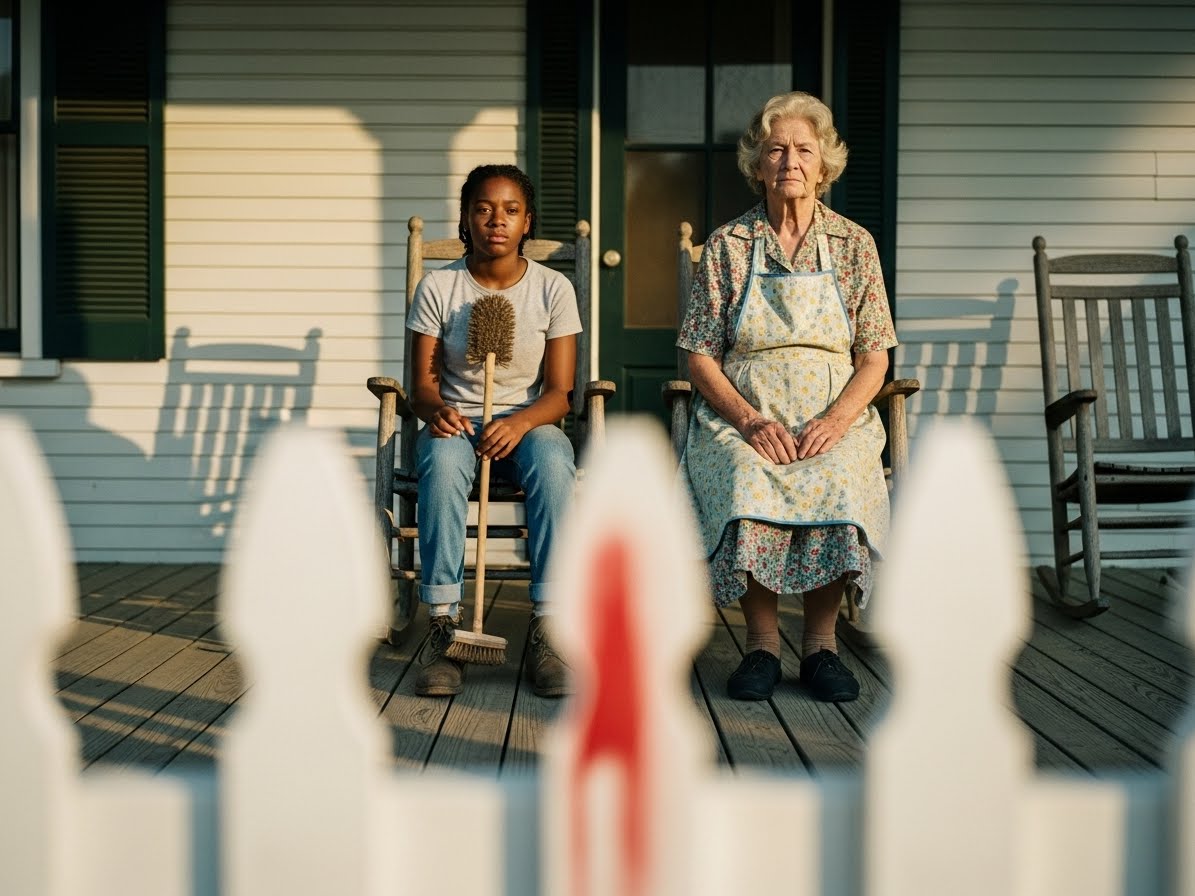
But as I rounded the bend, I stopped. Grams was standing by the white picket fence—the fence she painted every spring. She was scrubbing it with a wire brush and a bucket of soapy water. Her back was to me, but I could see her shoulders shaking. “Grams?” I called out, dropping my bag. She turned around. Her face, usually a map of gentle wrinkles and warmth, was tight with anger and sorrow. “Don’t come over here, Maya,” she said, her voice trembling. “Go inside.”
I didn’t listen. I ran to her. Then I saw it. Spray-painted across the pristine white wood in jagged, angry red letters was a word. One word. Six letters. The word that had been used to hang men like my grandfather. The word that was spat at me on the bus, implied in the stores, and now, branded on our home. And hanging from the fence post, tied by a piece of twine, was a dead raccoon. Its eyes were open, glassy and staring.
I gasped, covering my mouth. The smell hit me then—paint fumes and death. “Who did this?” I whispered, tears springing to my eyes. “You know who,” Grams said, scrubbing harder. The red paint was stubborn; it was soaking into the wood grain. “The Boyd boys. Or their kin. It’s all the same rot.” “Did you call the police?” Grams stopped scrubbing. She looked at me, her eyes sad and ancient. “I called Sheriff Brody,” she said. “He came by. Said it looked like ‘kids being kids.’ Said he’d file a report, but without a witness, there ain’t much he can do.”
“Kids being kids?” I shouted, the rage finally bubbling over. “This is a hate crime, Grams! That animal… the word…” “Lower your voice, Maya,” she commanded sternly. “Do not let the neighbors see you unravel. That is what they want. They want to see us screaming in the street. They want to see us afraid.” “I am afraid!” I cried. “They know where we live. They came onto our property!”
Grams dropped the brush into the bucket. Splash. She wiped her hands on her apron and took my face in her rough, warm palms. “Listen to me,” she said fierce and low. “Fear is a reaction. Dignity is a choice. We will not give them our fear. We will clean this fence. We will plant more flowers. And we will keep living.”
“It’s not fair,” I sobbed. “Fair is a fairy tale,” she said. “Strength is reality.” I grabbed a rag from the bucket. My hands were shaking. Together, we scrubbed. We scrubbed until the sun went down and the crickets started to sing. We scrubbed until our fingers were raw and the red paint was just a faint pink stain on the wood. But the stain on my heart wasn’t fading.
That night, I lay in bed, staring at the ceiling fan spinning lazily. I listened to the sounds of the night. Every creak of the floorboards sounded like a bootstep. Every rustle of the leaves sounded like a whisper. I got up and went to the window. I looked out at the road. A truck was parked down the street, just at the edge of the streetlight’s glow. The engine was idling. I recognized the silhouette. It was Caleb Boyd’s truck. He was watching. Waiting to see if we had broken. I placed my hand on the cold glass. You want a war? I thought. You think you can scare us out of here? I wasn’t Grams. I didn’t have her patience. I didn’t have her forgiveness. Inside me, the water was boiling away, and the fire was starting to burn.
PART 2
CHAPTER 3: THE ZERO TOLERANCE TRAP
The next morning, the air in the school hallway felt heavy, like the atmosphere before a thunderstorm.
I walked to my locker, keeping my head down, but I could feel the eyes. They had seen the paint on the fence. Small towns talk, and in Oakhaven, gossip traveled faster than light.
“Nice house decoration, Maya,” a voice whispered as I spun the combination lock.
I ignored it. Click. Click. Click.
I opened my locker.
A cascade of trash fell out. Banana peels, crumpled papers, and a half-empty carton of chocolate milk exploded onto my shoes.
The hallway went silent. Then, the laughter started. It rippled outward from Caleb Boyd, who was leaning against the lockers ten feet away, arms crossed, looking satisfied.
My hands clenched into fists. I looked at my ruined sneakers—the ones Grams had saved up for three months to buy.
Something inside me snapped. It wasn’t a loud snap. It was the quiet, terrifying sound of a cable giving way under too much tension.
I stepped over the trash. I walked straight up to Caleb.
He straightened up, towering over me. He was a linebacker, thick-necked and broad. I was a cello player, skinny and shaking.
” You got a problem, girl?” he sneered.
“You are a coward,” I said. My voice was steady. “You paint fences in the dark because you’re too scared to show your face in the light.”
The smile dropped from his face. “Watch your mouth.”
“Or what?” I challenged, stepping closer. “You’ll throw milk at me? You’ll spit on me? Is that all you have, Caleb? Are you that empty?”
His face turned red. He wasn’t used to the targets fighting back. He raised his hand to shove me.
“Hey!”
Mr. Gable, the principal, came striding down the hall. “What is going on here?”
Caleb instantly dropped his hand and put on a mask of innocence that was so practiced it was sickening.
“She’s crazy, Mr. Gable,” Caleb said, pointing at me. “She just came up and started screaming at me. threatening me.”
“He trashed my locker!” I shouted, pointing at the mess. “And he vandalized my grandmother’s house!”
Mr. Gable looked at the trash. Then he looked at Caleb, whose father was the biggest booster for the football team and owned half the car dealerships in the county.
Then he looked at me.
“Maya,” Mr. Gable sighed, adjusting his tie. “We have a zero-tolerance policy for aggression.”
“Aggression?” I choked out. “I’m the victim!”
“You instigated a confrontation in the hallway,” he said coldly. “I heard you raising your voice. Caleb was standing still.”
“But—”
“Three days suspension,” he said. “Go to the office and call your grandmother.”
“And him?” I pointed at Caleb.
“Caleb, help the janitor clean up that mess,” Mr. Gable said, dismissing him with a wave. “And get to class.”
Caleb smirked at me as he walked away. He didn’t even have to clean it up; I saw him high-five the janitor five minutes later.
I sat in the office, waiting for Grams. I didn’t cry. I was done crying.
I realized then that the system wasn’t broken. It was working exactly how it was designed. It was designed to protect them and police me.
If I was going to survive this, I couldn’t rely on the rules. I had to change the game.
CHAPTER 4: THE NIGHT OF FIRE
Suspension meant I was stuck at home. Grams didn’t scold me. When she picked me up, she just held my hand in the car and hummed an old hymn. She knew. She knew the game better than I did.
Two nights later, the wind picked up. It howled around the eaves of the old house, making the timbers groan.
I couldn’t sleep. I was sitting on the floor of my room, reading To Kill a Mockingbird by flashlight, finding irony in every page.
It was 2:00 AM when I heard the glass break.
SMASH.
It came from the front of the house.
I jumped up, my heart hammering against my ribs.
“Grams!” I screamed, running into the hallway.
Then came the woosh sound. The sound of air being sucked into a vacuum.
And then, the orange glow.
I ran to the living room. The front window was shattered. A brick lay on the rug. And outside, on the wooden porch, flames were licking up the white columns.
“Fire!” I yelled.
Grams appeared from her bedroom, wearing her nightgown, her eyes wide with terror.
“The hose!” she yelled. “Maya, get the garden hose!”
I didn’t think. I ran out the back door. The night air was cold, but the heat coming from the front of the house was intense.
I scrambled for the spigot. My fingers fumbled with the cold metal. Turn, damn it, turn!
The water sputtered, then shot out.
I dragged the green rubber snake around the side of the house.
The fire was growing. It was eating the wicker rocking chair where Grams drank her tea. It was reaching for the roof.
“Spray it!” Grams screamed from the doorway, clutching a bucket of water she had filled in the kitchen sink.
I aimed the nozzle. The water hit the flames with a hiss of steam.
I fought the fire. I sprayed the columns. I sprayed the floorboards. I sprayed until my arms ached and my pajamas were soaked with sweat and soot.
The fire hissed and fought back, but we were lucky. It hadn’t reached the dry attic wood yet.
Slowly, agonizingly, the orange glow faded to a smoldering black char.
I dropped the hose, gasping for air.
Grams was slumped against the doorframe, clutching her chest.
“Are you okay?” I rushed to her.
“My house,” she whispered. “My father built this house.”
I looked at the porch. It was scarred. Blackened. The smell of burnt wood and gasoline was overpowering.
Gasoline.
I walked over to the edge of the porch, where the fire had started.
Lying in the azalea bushes, gleaming in the moonlight, was a glass bottle. A rag was stuffed in the neck. A Molotov cocktail that hadn’t fully shattered.
And next to it, something else.
I reached down and picked it up.
It was a lighter. A silver Zippo.
I flicked it open. It was heavy. Expensive.
I held it up to the moonlight. Engraved on the side were three initials: C.J.B.
Caleb James Boyd.
He had been careless. Arrogant. He thought he was untouchable, so he didn’t bother to be careful.
I closed my fist around the cold metal.
Grams was crying softly on the steps.
“They want to kill us, Maya,” she sobbed. “We have to leave. We have to sell the house.”
I looked at my grandmother—the strongest woman I knew—broken by fear.
Then I looked at the lighter in my hand.
“No,” I said.
My voice sounded strange. It wasn’t the voice of a child anymore.
“We aren’t going anywhere.”
CHAPTER 5: THE EVIDENCE OF SILENCE
Sheriff Brody arrived at dawn. He walked up the steps, kicking at the charred wood with his boot. He didn’t take notes. He didn’t take pictures.
He looked at the broken window.
“Probably a prank gone wrong,” Brody said, adjusting his belt. “Kids playing with fireworks.”
“Fireworks?” I said, standing behind the screen door. “It smelled like gasoline, Sheriff.”
“Old wood smells like that when it burns,” he dismissed.
“I found a bottle,” I said. “In the bushes.”
“I’ll take a look,” he grunted. He walked over, picked up the bottle with a handkerchief, and sniffed it. “Could be anything.”
I had the lighter in my pocket. My hand was gripping it so tight the edges were digging into my palm.
I wanted to give it to him. I wanted to scream, Look! I have proof! Arrest him!
But I looked at Brody’s face. He looked bored. He looked like he wanted to go get breakfast.
If I gave him the lighter, it would disappear. It would get “lost” in the evidence locker. Or he would say I stole it to frame Caleb.
The system wasn’t just broken; it was the enemy.
“Did you see anyone?” Brody asked, looking at Grams.
“No,” Grams whispered. “It was dark.”
“Well, without a witness…” Brody shrugged. “I’ll file a report. But you folks might want to check your wiring. Old houses, you know.”
He left.
I watched his cruiser disappear down the road.
Grams went inside to sweep up the glass. She looked ten years older than she had yesterday. She was defeated. She was already mentally packing boxes.
I sat on the blackened steps.
I flicked the Zippo open. Clink. I flicked it closed. Clack.
I had the weapon. But I couldn’t use it in a court of law because there was no law for us here.
So, I had to use it in the court of public opinion.
Tonight was the Oakhaven Town Hall meeting. It was held in the high school gymnasium. The Mayor would be there. The City Council. And Caleb’s father, Mr. Boyd, who was receiving a “Community Pillar” award for donating a new scoreboard to the football field.
The whole town would be there.
Grams told me to stay inside. She told me to be safe.
But safety was a myth.
I went to my room. I put on my best dress—the navy blue one I wore for cello recitals. I brushed my hair back. I put on the shoes that Caleb had made fun of, even though they were stained with milk.
I put the lighter in my pocket.
I grabbed my cello case. Not because I was going to play, but because it was my shield. It was the symbol of who I was—something they couldn’t understand and couldn’t take away.
I walked out the back door. I didn’t take the road. I took the path through the woods that led to the school.
I wasn’t afraid anymore. Fear requires hope that things will turn out okay if you follow the rules. I had lost that hope.
Now, I only had the truth.
I walked into the gymnasium just as the Mayor was tapping the microphone.
“Testing, one, two.”
The bleachers were packed. Five hundred people. The air conditioning was humming.
I walked down the center aisle.
People turned to look. The girl from The Hill. The girl who got suspended. The girl whose house almost burned down last night.
Whispers spread like wildfire.
Caleb was sitting in the front row with his football team, wearing his jersey. He looked bored.
Then he saw me.
He nudged Trent. He laughed. He didn’t look scared. He looked amused. He thought I was there to beg. Or to cry.
I didn’t stop at the bleachers.
I walked straight to the podium.
The Mayor looked confused. “Excuse me, young lady, we’re about to start.”
I didn’t ask for permission. I walked up the stairs to the stage.
I stood next to the Mayor. I was shaking, but I locked my knees.
I reached into my pocket.
I pulled out the silver Zippo.
I held it up to the microphone.
“Does anyone lose a lighter?” I asked. My voice boomed through the speakers, echoing off the rafters.
The room went dead silent.
Caleb’s face went pale. His father, sitting next to him, frowned.
“I found this on my porch last night,” I said, my voice gaining strength. “Right after someone threw a firebomb at my grandmother’s house.”
I turned the lighter over.
“It has initials on it,” I said. “C.J.B.”
I looked directly at Caleb.
“Do you want it back, Caleb?” I asked. “Or should I give it to your father?”
For a second, nobody breathed.
Then, Mr. Boyd stood up. “Now see here! You can’t just accuse my son—”
“I didn’t accuse him,” I cut him off. “I just asked if he lost his property.”
I looked out at the crowd. I saw the faces of the people who had ignored the bullying. The people who had looked away.
“You all know what’s happening,” I said. “You see the paint. You hear the slurs. And you do nothing. You let hate define this town.”
I took a deep breath.
“But I won’t let it define me.”
I tossed the lighter.
It tumbled through the air, silver over silver.
It landed with a loud clatter right at Mr. Boyd’s expensive leather shoes.
“You can keep your hate,” I said into the silence. “I have a life to live.”
I turned around, picked up my cello case, and walked off the stage.
I walked down the center aisle.
Nobody stopped me. Nobody said a word.
But as I reached the doors, I heard a sound.
One person clapping.
Then another.
Then another.
I didn’t look back to see who it was. I didn’t care.
I pushed the doors open and walked out into the cool night air. The fire was out. The truth was out.
And for the first time in a long time, I could breathe.
CHAPTER 6: THE ECHO IN THE DARK
Walking home from the high school that night was the longest mile of my life. The adrenaline that had carried me up the stage stairs had evaporated, leaving me shivering in the cool Alabama air. My cello case banged against my leg with every step, a heavy rhythm to my racing heart. Grams was waiting on the porch. The smell of charred wood was still heavy in the air, a ghost that wouldn’t leave. “You shouldn’t have done that, child,” she whispered, pulling me into a hug that felt like a vice grip. “You poked the bear.”
“The bear was already eating us, Grams,” I said, leaning into her shoulder. “I just showed everyone its teeth.” We went inside and locked every door. We pushed a heavy oak chair under the doorknob of the front entrance. We slept in the living room on the floor, away from the windows. The morning sun brought no relief. The phone started ringing at 6:00 AM. First, it was Mrs. Higgins from down the street. The white lady who usually only waved from her mailbox.
“I saw what you did, Maya,” she said, her voice crackling over the line. “And… I saw that truck leave your house the night of the fire. I was too scared to say anything to the Sheriff. But I’m calling him today.” Then, it was Mr. Abernathy, the grocer. Then, the pastor of the AME church. The dam had broken. My act of defiance hadn’t isolated me; it had given the silent majority permission to speak. But silence is safer. Noise brings consequences.
When I got to school, the atmosphere had shifted. It wasn’t the heavy dread of the day before. It was electric. People were whispering, but they weren’t looking through me anymore. They were looking at me. Some with awe, some with fear. I walked to my locker. It was clean. The janitor had scrubbed it. I opened it to get my books. “You think you’re smart, don’t you?”
I didn’t turn around. I knew the voice. It was deeper today, stripped of the mockery, replaced by raw, seething hatred. Caleb Boyd stood there. But his posse wasn’t with him. Trent and the others were standing ten feet back, looking at the floor. The lighter had spooked them. They knew Caleb was radioactive now. “I think I’m tired, Caleb,” I said, closing my locker. “Tired of you.”
“My dad says you stole that lighter,” he hissed, stepping into my personal space. “He says you’re going to jail for theft and slander. He’s going to sue your grandmother until she loses that shack you call a house.” The old fear flickered in my chest. Mr. Boyd had money. Money bought lawyers. Money bought judges. “Tell your dad,” I said, my voice shaking but audible, “that Mrs. Higgins saw your truck. Tell him the gas station has security footage of you filling up a glass bottle. Sheriff Brody might be lazy, but the State Police aren’t.”
It was a bluff. I didn’t know if the State Police were involved. But Caleb didn’t know that. His eyes widened. The arrogance cracked. “You little—” He raised his fist. He was going to hit me. Right there in the hallway. He didn’t care anymore. He was cornered. I flinched, bracing for the impact. But the blow never came. A hand caught Caleb’s wrist in mid-air. I opened my eyes. It wasn’t a teacher. It wasn’t the principal.
It was Trent. His best friend. The lineman. “Let it go, man,” Trent said quietly. “Get off me!” Caleb ripped his arm away, staring at his friend in betrayal. “You’re siding with her?” “I’m not going to jail for you, Caleb,” Trent muttered. “My dad saw the news. It’s over.” Caleb looked around. The hallway had stopped moving. Everyone was watching. The illusion of his power had shattered. He looked at me one last time—a look of pure venom—and stormed off toward the exit. I let out a breath I felt like I’d been holding since kindergarten.
CHAPTER 7: THE CRUMBLING CASTLE
The bluff turned out to be prophecy. By noon, two black sedans pulled into the school parking lot. Men in suits got out. Not Sheriff Brody’s beige uniform. These were suits. The State Bureau of Investigation. The fire at my grandmother’s house had crossed a line. It wasn’t just vandalism; it was attempted arson on an occupied dwelling. A hate crime. And because I had made such a public spectacle at the Town Hall, the media from Birmingham had picked up the story. Oakhaven was under a microscope.
I was called to the principal’s office. Not to be punished, but to give a statement. I sat in the leather chair, telling the agents everything. The bullying. The paint on the fence. The dead raccoon. The fire. The lighter. When I walked out of the office, I saw Mr. Boyd arguing with the agents in the lobby. He was red-faced, sweating, pointing fingers. “This is a witch hunt!” he was screaming. “My son is a good boy! A pillar of this community!” “Your son is a suspect in a felony arson case, Mr. Boyd,” one of the agents said calmly. “And unless you want to be charged with obstruction, I suggest you step aside.”
I watched as they walked toward the cafeteria. I followed, along with half the school. They found Caleb sitting at his usual table, surrounded by empty seats. He looked small. “Caleb Boyd?” the agent asked. Caleb looked up. He didn’t look tough. He looked like a child who realized the game was over. “Stand up, son,” the agent said. They didn’t cuff him. They just escorted him out. But the image was burned into the collective memory of Oakhaven High School forever. The king was dethroned.
I walked home that afternoon with my head high. But when I turned the corner to my street, I stopped. There were cars parked all along the road. Pickup trucks. Sedans. My heart stopped. Did his friends come for revenge? I started running toward my house. When I got to the driveway, I stopped dead in my tracks. There were twenty people in my yard. Mrs. Higgins. Mr. Abernathy. People I didn’t even know.
They had buckets. They had paintbrushes. They had tools. They weren’t destroying the house. They were fixing it. A man was on a ladder, replacing the charred boards of the porch column. Mrs. Higgins was on her knees by the fence, painting over the faint pink stain of the slur with fresh, bright white paint. Grams was on the porch, holding a tray of lemonade, tears streaming down her face. I walked up the driveway, my cello case bumping against my leg. Mrs. Higgins looked up. She had a smudge of white paint on her nose.
“We figured,” she said, wiping her hands on a rag, “that it was about time this town decided what it wanted to be. And we don’t want to be that.” She pointed to the spot where the word used to be. It was gone. Covered by a layer of clean, white hope. I dropped my bag. I walked over to the fence. “Thank you,” I whispered. “Here,” she said, handing me a brush. “Finish it.” I took the brush. I painted the last picket. With every stroke, I covered the hate. With every stroke, I reclaimed my home.
CHAPTER 8: THE SONG REMAINS
Epilogue: Ten Years Later
The applause in Carnegie Hall is different than any other sound in the world. It sounds like rain—heavy, cleansing rain. I lowered my bow, resting my hand on the neck of my cello. The varnish gleamed under the stage lights. I stood up and bowed. My dress was navy blue—a nod to the girl who walked onto a gymnasium stage a decade ago. I walked off stage, my heart full. In the dressing room, there was a bouquet of white magnolias. The card read: “From the Garden on The Hill. We are watching. Love, Grams.” She was too old to travel now, but she watched every performance on the iPad I bought her.
I sat down at my vanity and wiped the stage makeup off my face. I looked at myself in the mirror. I wasn’t the scared girl on the bus anymore. I wasn’t the victim of Oakhaven. I was Maya. I picked up my phone to call her. “Did you hear it, Grams?” I asked when she answered. “I heard it, baby,” she rasped. “You made the wood sing.” “I did.” “I have news,” she said. “You remember the Boyd house?” “Hard to forget,” I said. “Sold today,” she said. “Bank took it years ago, but it finally sold. To a nice young couple. They’re turning it into a community center. A library.”
I smiled. Caleb had pleaded guilty. He spent time in juvenile detention. His family lost their status, their dealership, and eventually, they left town. Hate is expensive. It costs you everything in the end. “And the fence?” I asked. “How’s the fence?” “White as snow,” Grams said. “And the flowers are blooming.” I hung up the phone and packed my cello.
I walked out into the busy streets of New York City. The noise was chaotic, loud, and indifferent. But I knew who I was. I was the girl who walked through fire and refused to burn. I was the girl who turned a weapon into a gavel and a melody. I walked to the subway, humming the tune I had just played. It was a song about storms. About how they rage and how they break. But mostly, it was a song about the quiet, unshakeable strength of the roots that hold on when the wind tries to blow you away.
THE END.