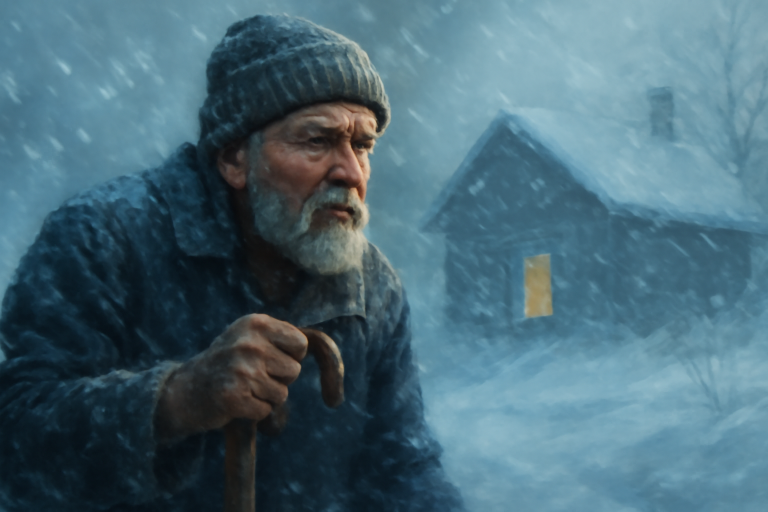
I Buried My Two Sons After A Horrific Car Crash, Or So I Thought. Then, A Stranger At The Cemetery Whispered Six Words That Shattered My Reality And Led Me To A House Of Nightmares.
Chapter 1: The Hollow Routine
The fog in Seattle doesn’t just obscure your vision; it seeps into your bones. It’s a cold, wet blanket that suffocates everything, especially hope. For the last year, my life has been nothing but that fog. It was a physical weight I dragged around, heavy enough to crush a person, yet I somehow kept standing.
Every morning began exactly the same way, a ritual of misery I couldn’t break. I would wake up at 4:30 AM, staring at the ceiling of a house that was far too quiet. The silence was the loudest thing in the world. It screamed at me. It reminded me that there were no cartoons playing on the TV, no cereal bowls clinking against the table, and no footsteps thumping down the hallway. The house, once vibrant with the chaos of two young boys, had become a museum of memories I couldn’t bear to touch.
I would dress in black—not because I was trying to be dramatic, but because color felt like an insult to them. How could I wear yellow or red when their light had been extinguished? I’d grab a bouquet of white lilies from the kitchen counter, holding them so tightly the stems bruised my palms, and I’d drive the three miles to the Evergreen Cemetery.
My boys, Liam and Noah, were there. Or at least, that’s what the stone markers said. They rested in a small, fenced-off plot beneath an old weeping willow that seemed to mourn right along with me. They had left this world far too early. Liam was seven, just starting to lose his baby teeth. Noah was only five, still needing a nightlight to sleep. So small. So helpless against the twisted metal of a car wreck.
It happened on a Tuesday. Tuesdays were supposed to be boring. After the divorce, my ex-husband, Mark, and I had a strict schedule. We were civil, mostly for the sake of the kids. I had them on weekdays because their elementary school was two blocks from my house. Mark took them on weekends. But that Tuesday was special—Mark had taken them to a Mariners baseball game in the city. It was a treat. A bonding moment.
I remember the phone call. I remember the exact texture of the phone in my hand, the hum of the refrigerator in the background. I remember the voice of the Sheriff. It sounded hollow, like he was speaking from inside a tunnel, detaching himself from the horror he was delivering.
“Ma’am, there’s been an accident on I-5. A semi-truck lost control. Your husband’s sedan… it was crushed.”
They told me it was instantaneous. They told me the car was flattened like a tin can against the concrete median. They told me that for my own sanity, I shouldn’t identify the bodies. “Closed casket is best,” the coroner had said, his eyes filled with a pity that made me want to vomit. He spoke of “severe trauma” and “unrecognizable remains.”
So, I did what they told me. I signed the papers. I chose the caskets. I buried two empty boxes. Or rather, boxes filled with things I was told were my children.
For the last year, the world collapsed. Days blurred into a gray smear. I stopped living; I merely existed as a ghost in my own life. Friends stopped calling—they didn’t know what to say to the woman who lost everything. My only purpose was this morning ritual—kneeling in the mud, talking to two laser-etched photographs on cold granite, tracing their smiles with my trembling fingers.
“I miss you,” I whispered to the stone, the damp earth soaking through the knees of my jeans. “Mommy misses you so much it hurts to breathe.”
I was waiting for a sign. I was waiting for the wind to whisper back. I was waiting to wake up from this nightmare.
But on this dark, unusually foggy Tuesday—exactly one year to the anniversary of the crash—something happened. Something that defied logic, reason, and sanity.
Chapter 2: The Boy in the Striped Hat
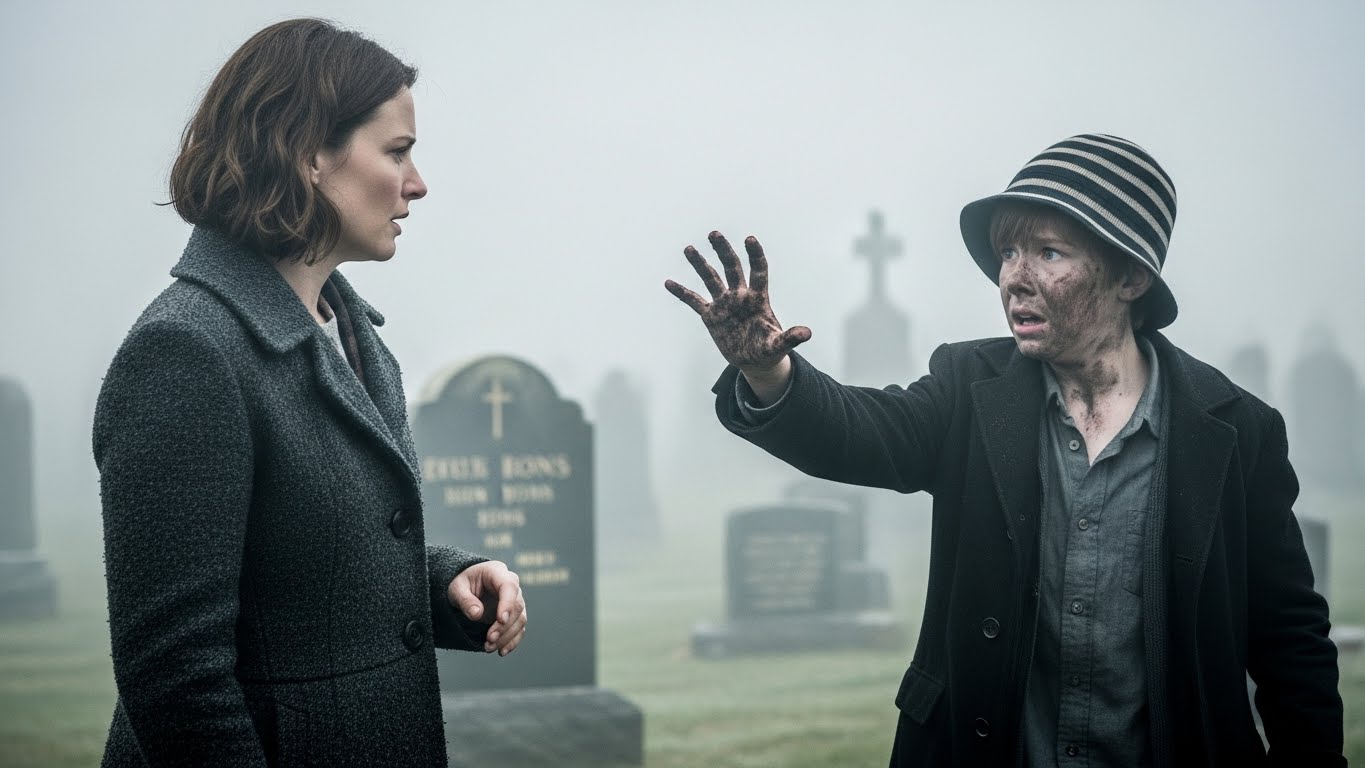
I was standing by the grave, tears mixing with the mist on my cheeks. The cold was biting today, stinging my exposed skin, but I barely felt it. I was so lost in my grief, replaying the memory of their laughter in my head, that I didn’t hear the footsteps. They were light, hesitant, like a deer moving through dry leaves.
Suddenly, a presence appeared beside me.
I gasped, my hand flying to my chest, and spun around. Standing there, shivering in the damp air, was a boy. He couldn’t have been more than eight years old. He was wearing a dirty blue windbreaker that was two sizes too big, the sleeves hanging over his hands, and a knit striped hat pulled low over his ears. His face was smudged with dirt and grease, and his eyes… his eyes were wide, terrified, and hauntingly familiar.
He wasn’t a ghost. He was breathing hard, his breath pluming in the cold air. He smelled of damp earth and something stale, like old mold. He looked at me timidly, wringing his hands together, his knuckles white.
“Ma’am?” his voice cracked. It was raspy, unused. “Why are you crying?”
I wiped my face quickly, trying to compose myself. It wasn’t unusual for kids to cut through the cemetery to get to the middle school, but this boy looked… neglected. Lost. Like he hadn’t seen a warm meal in weeks.
“I lost my sons… sweetheart,” I whispered, my voice thick with emotion. I gestured to the headstone. “Today is the anniversary.”
The boy didn’t look at me. He looked past me, fixing his gaze intently on the granite marker. He stepped closer, his battered sneakers squelching in the mud. He stared at the laser-etched photos of Liam and Noah. He leaned in, squinting, as if confirming something he already knew.
He stood there for a long time, tilting his head. The silence stretched out, tense and heavy. The wind howled through the willow tree, sounding like a warning.
“These boys…” he pointed a dirty finger at the stone. “Are they your children?”
“Yes,” I nodded, a fresh wave of tears threatening to spill over. I didn’t understand where he was going with this. “They went to heaven a year ago.”
The boy went silent again. He looked over his shoulder, scanning the cemetery fence line, his eyes darting back and forth as if he was afraid of being watched. He looked terrified of being seen. Then, he turned back to me.
He said something that made the air leave my lungs.
“But they aren’t in heaven.”
I froze. A chill that had nothing to do with the weather shot down my spine. The world seemed to stop. “What did you say?”
The boy looked up at me, his eyes clear and incredibly serious. He spoke with a calmness that was terrifying, a stark contrast to his shaking hands.
“They’re alive. They live with me.”
My heart hammered against my ribs like a trapped bird. Anger flared first—how dare this kid play a prank like this? How sick could someone be? But then I saw his face. There was no malice. There was only fear and a strange, desperate urgency.
“That’s not funny,” I snapped, my voice trembling. “My sons died in a car accident. The police… the funeral… I buried them right here.”
“The police didn’t look in the basement,” the boy interrupted softly.
The world seemed to tilt on its axis. The gray sky spun. My knees felt weak.
“Come,” he said, reaching out a hand that was caked with dried mud. “I’ll show you. But we have to be quiet. If He hears us, he’ll put me in the box, too.”
I looked at the grave, then at the boy. Every instinct in my body screamed danger. Every logical part of my brain told me this was impossible. My sons were dead. I had the death certificates. But a mother’s instinct is different. A mother’s instinct is primal. And right now, a tiny, impossible flame of hope had just been lit in the darkness of my soul.
“Where?” I choked out, the word barely a whisper.
“Home,” the boy whispered. “OUR home. Your children are there. They cry for you every night.”
He turned and began to walk toward the broken section of the cemetery fence, moving with a surprising speed.
“Are you coming?” he hissed over his shoulder.
I didn’t think. I didn’t call the police. I didn’t worry about my car left running on the road. I simply followed.
Here is Part 2 of the story, containing Chapters 3, 4, and 5.
PART 2
Chapter 3: The Path to Nowhere
“Come, I’ll show you,” he repeated, his voice barely audible over the rustling of the dead leaves.
The woman felt everything inside her collapse. Logic told her to run the other way, to get back to her car, to call the Sheriff. But instead of fear, a strange coldness settled in—the kind of numbness that comes when a person has already lived through the worst thing imaginable and realizes they can’t fall any further. If this was a trap, she didn’t care. If this was a delusion, she welcomed the madness.
“Alright… lead the way,” she managed to say, her voice trembling.
The boy walked confidently through the maze of headstones, moving toward a rusted section of the wrought-iron fence that had been bent open. He moved with a familiarity that was unsettling, as if he walked this path every single day. She could barely keep up, her boots slipping on the wet grass.
They squeezed through the gap in the fence. The cemetery was behind them now, but the heavy atmosphere followed. They emerged onto a narrow dirt trail that cut through a patch of dense woods bordering the town.
“Where are you taking me?” she asked, her breath coming in short, sharp gasps.
“Home,” the boy said without looking back.
She stumbled over an exposed tree root, catching herself on a mossy trunk.
“Whose… home?”
The boy stopped. He turned slowly, his face shadowed by the canopy of trees.
“OURS,” he replied calmly. “Your children live there. I’ll show you.”
Ours. The word hung in the air, heavy and wrong. It implied a family, a unit, a shared existence that she was not part of.
They continued walking. The trail eventually opened up to an old, wooden footbridge that crossed a swollen creek. The water rushed below, black and angry. Across the bridge lay a neighborhood she recognized—the older part of town, where the houses were large, Victorian, and mostly falling into disrepair. It was a place where people kept their blinds drawn and their secrets close.
The boy didn’t hesitate. He crossed the bridge, the wood creaking under his small frame. He turned into a quiet cul-de-sac and walked straight toward the last house on the left.
It was a towering structure with peeling gray paint and overgrown ivy choking the porch lattice. The windows were dark, staring out like hollow eyes. An old rusted swing set sat in the yard, motionless.
“It’s here,” he said, stopping at the edge of the cracked driveway.
The woman stared at the house. It looked abandoned. It looked like a place where happiness went to die. A profound sense of dread washed over her, heavier than the grief she had carried for a year.
Chapter 4: The Basement Secret
We stood at the bottom of the porch steps. The wood was rotting, and the air smelled of wet cedar and something metallic.
“Sweetheart…” I began to cry, the adrenaline finally giving way to exhaustion. The insanity of the situation crashed down on me. “You don’t understand… my sons died in the accident. They were found… there was a funeral… documents… the coroner signed the papers… everything…”
I was listing these things as if to convince myself, not him. I needed the world to make sense again. I needed the anchor of my tragedy to hold firm, because if it didn’t, if he was right, then the horror was far worse than death.
The boy looked at me as if he had heard that same story a hundred times. His expression was pitiless, stripped of childhood innocence.
“They didn’t die.”
He walked up the stairs, the boards groaning under his weight. He reached the heavy oak door but didn’t open it. He just stood there.
I followed, drawn by an invisible thread. I stood behind him, my heart pounding so hard I could feel it in my throat.
“Why are we stopping?” I whispered.
He turned to me, his hand hovering over the wood.
“They rarely come out,” he said softly. “Because they’re kept in the basement.”
The woman felt her heart seize. The world went silent. The wind stopped. The only sound was the blood rushing in her ears.
“W-what did you say?..”
The basement. The word triggered a primal fear. Basements were for storage, for darkness, for things you wanted to forget.
“They make noise sometimes,” the boy continued, his voice devoid of emotion, like he was reciting a grocery list. “But He put soundproofing on the walls. That’s why the neighbors don’t hear. But I hear. I hear them calling for you.”
I grabbed the boy’s shoulders, shaking him slightly. “Who? Who keeps them there?”
He flinched but didn’t pull away. “The Man. And the Woman. They say they are our parents now. They say our real parents didn’t want us.”
My knees gave out. I collapsed onto the dirty porch floor, sobbing. “I wanted them! I never stopped wanting them!”
“I know,” the boy said. He reached out and knocked on the door. It was a specific knock—three fast taps, a pause, then two slow ones. A code.
“Get up,” he hissed. “You have to see.”
I scrambled to my feet, wiping the tears from my eyes. I had to be strong. If Liam and Noah were in there, if there was even a one percent chance this wasn’t a hallucination, I had to be ready to tear this house apart with my bare hands.
Chapter 5: The Rescuers
We waited. Seconds felt like hours. I stared at the brass doorknob, willing it to turn.
Finally, I heard the slide of a deadbolt.
The door didn’t open fully. It just cracked open a few inches, held by a security chain. A slice of darkness was visible inside.
Then, a face appeared in the crack.
It was a little girl. She looked to be about the same age as the boy, maybe seven. She was pale, her skin translucent in the gloom. Her hair was matted, and she wore a dirty pink dress that was torn at the hem.
She looked at the boy, then her eyes shifted to me. Her eyes went wide.
“That’s their mother…” she whispered. Her voice was terrified, barely a breath. “I told them you would come… I dreamed it.”
She glanced nervously over her shoulder, peering into the dark hallway behind her, as if afraid someone might hear her.
“Open the door, Sarah,” the boy urged. “It’s okay. They aren’t home. I saw the van leave.”
The girl hesitated, her hands trembling on the chain. Then, with a sudden resolve, she slid the chain off and pulled the heavy door open.
The smell hit me first. It wasn’t the smell of a home. It was the smell of bleach, old food, and unwashed bodies.
“They’re downstairs,” the girl said, stepping back to let us in. “They cry at night. They asked me to tell you to save them.”
I stepped into the foyer. It was dim, the curtains drawn tight. Dust motes danced in the slivers of light.
“WHO is keeping my children?!” I screamed, my voice echoing off the bare walls. I couldn’t hold it back anymore. The rage was boiling over.
The girl flinched and put a finger to her lips.
“Shhh,” she pleaded. “The neighbors might call Them.”
She walked closer to me, looking up with big, watery eyes.
“The people who took them out of the car on the day of the accident,” she whispered.
I froze. My mind flashed back to that day. The Sheriff’s report. The details I had been told. First responders were on the scene within minutes.
“The rescuers?” I asked, confused. “The paramedics?”
The girl shook her head violently.
“No. Not real police. Not real doctors. They have a van with lights. They listen to the radio to find the crashes.”
She took a deep breath, and her next words shattered the last remnants of my reality.
“They were never buried, ma’am. They were kidnapped. The people… the Man and Woman… they wait for accidents. They take the children before the real police come. They switch them.”
“Switch them?” I felt like I was going to vomit.
“With… other things,” the boy interjected from the doorway. “To make it look like… like bodies.”
The room spun. It was a monstrous, elaborate scheme. A nightmare born of chaos. While I was grieving over closed caskets, while the world thought my children were crushed metal and bone, they had been stolen from the wreckage. Stolen by wolves dressed as shepherds.
“Where are they?” I growled, a sound I didn’t recognize coming from my own throat. “Take me to them. NOW.”
The girl pointed to a narrow door under the main staircase. It was padlocked from the outside.
“Down there,” she said. “But we don’t have the key.”
I didn’t care about keys. I looked around the hallway. My eyes landed on a heavy iron fire poker resting by the cold fireplace.
I grabbed it. The metal was cold and heavy in my hand.
“Stand back,” I told the children.
I was going to get my sons back, or I was going to burn this house to the ground with everyone inside.
Here is the final part of the story.
PART 3
Chapter 6: The Descent Into Hell
I didn’t hesitate. I didn’t think about the legal consequences of breaking and entering. I didn’t think about my own safety. The only thing that existed in my universe was that padlock and the children behind it.
I raised the heavy iron fire poker over my head. My arms, usually weak from months of not eating properly, surged with a hysterical strength. I swung it down with a guttural scream.
CLANG!
The metal struck the padlock, sending a shockwave up my elbows. The sound was deafening in the quiet hallway.
“Faster!” the boy in the striped hat hissed, watching the front window. “They’ll see the car!”
I swung again. And again. On the fourth strike, the old wood of the doorframe splintered. The hasp tore free, screws flying like shrapnel. The padlock fell to the floor with a heavy thud.
I yanked the door open.
Darkness poured out like a physical weight, carrying a stench that made me gag—urine, mold, and fear. A single set of wooden stairs descended into the black abyss.
“Liam? Noah?” I called out, my voice cracking.
There was no answer. Only the sound of rustling, like small animals scurrying into a corner.
I fumbled for the light switch on the wall, praying the electricity worked. I flicked it. A single, naked bulb in the center of the basement buzzed to life, casting harsh, swinging shadows against the concrete walls.
The room was a dungeon. There were no windows. The walls were lined with egg crate foam—soundproofing, just like the boy had said. In the corner, on a filthy mattress stained with grime, sat two huddled figures.
They were pressing themselves into the wall, trying to become invisible. They were thin. So incredibly thin. Their ribs showed through their ragged T-shirts. Their skin was the color of paste, untouched by the sun for a year.
But I knew them. I knew the curve of their ears. I knew the cowlick on the older one’s hair.
“Liam…” I whispered, stepping off the last stair.
The older boy, my brave seven-year-old who was now eight, looked up. He was shielding his younger brother, Noah, with his own body. His eyes were wide, feral, filled with a terror that broke my heart into a million pieces. He didn’t recognize me at first. I was the woman in black who cried at the stone.
Then, he squinted. He tilted his head.
“Mommy?”
The word was so quiet it barely existed.
I fell to my knees and scrambled across the cold concrete. “It’s me, baby. It’s Mommy. I’m here.”
I reached them, and for a split second, they flinched. They expected to be hit. That reaction killed the last part of the woman I used to be and birthed something dangerous in her place.
“Mommy!” Noah screamed, finally realizing it was real.
They launched themselves at me. I buried my face in their dirty hair, sobbing uncontrollably. I felt their bony arms wrap around my neck, their hearts beating like frantic drums against my chest. They were solid. They were warm. They were alive.
“I thought you died,” Liam sobbed into my coat. “The Man said you died in the crash. He said you didn’t want us anymore.”
“He lied,” I growled, clutching them tighter. “He lied, baby. I never stopped looking. I never stopped loving you.”
I kissed their foreheads, their cheeks, their hands. I checked them for injuries. They were covered in bruises, some old, some new.
“We have to go,” the boy in the striped hat called down from the top of the stairs. His voice was panic-stricken. “Ma’am! The van! It’s pulling in!”
Chapter 7: The Wolf at the Door
My blood ran cold. The reunion was over; the war had begun.
I stood up, pulling my boys with me. “Listen to me,” I said, my voice low and fierce. “We are leaving. Right now. Do not let go of my hand.”
I looked up at the stairs. The little girl and the boy in the striped hat were backing away from the front door.
Then I heard it. The heavy slam of a car door. Then another. Heavy footsteps crunched on the gravel driveway.
“Well, looks like we forgot to lock the gate, honey,” a deep, gravelly voice boomed from outside. It was casual, terrifyingly normal.
I looked around the basement for a weapon. I still had the fire poker gripped in my right hand. It wasn’t enough against two adults, but it would have to do.
“Get behind me,” I told the boys. “Stay behind me no matter what.”
We reached the top of the stairs just as the front door handle jiggled. Then the realization hit the person on the other side—the chain was off.
The door swung open.
A man filled the frame. He was huge, wearing a stained mechanic’s jumpsuit. He had a thick beard and eyes that looked like shark glass—dead and black. Behind him stood a woman, thin and sharp-featured, holding a grocery bag.
The Man stopped. He looked at the broken padlock on the floor. He looked at the boy in the striped hat, who was trembling in the corner. Then he looked at me, holding the poker, shielding his “merchandise.”
He didn’t look afraid. He smiled. A sick, yellow-toothed smile.
“ well, well,” he drawled. “Looks like we have a visitor. Didn’t anyone tell you it’s rude to barge in?”
“Get out of my way,” I warned, raising the iron bar. “I’m taking my children.”
The Woman dropped the groceries. A carton of milk burst on the floor. “Call the cops, Earl! She broke in!”
The Man laughed. “We ain’t calling no cops. We handle our own problems.”
He reached behind his back and pulled out a large wrench. He took a step into the hallway.
“You’re making a mistake, lady. You should have just kept crying at that grave. It was cleaner that way.”
He lunged.
He moved faster than a man his size should. He swung the wrench at my head. I ducked, the wind of the weapon rushing past my ear. I screamed—a primal, animalistic sound—and thrust the fire poker forward like a spear.
It connected. The iron tip drove into his shoulder.
He roared in pain and dropped the wrench, staggering back.
“Run!” I screamed to the kids. “Run to the neighbors!”
But the Woman was there. She blocked the doorway, pulling a small knife from her pocket. She looked at the little girl, Sarah. “You ungrateful brat! I feed you! I house you!”
“Don’t touch her!” Liam yelled. My seven-year-old, malnourished and terrified, picked up a heavy glass vase from the hallway table and threw it with all his might.
It smashed into the Woman’s face. She shrieked, clutching her bleeding nose, and stumbled sideways.
The path was clear.
“GO!” I shoved the boys toward the door.
The Man was recovering. He grabbed my ankle as I tried to follow them. I hit the floor hard, my chin slamming against the wood. He dragged me backward, his bloody hand gripping my leg like a vice.
“You aren’t going anywhere,” he hissed, crawling on top of me.
I kicked. I scratched. I fought with the fury of a mother who had already lost her children once and refused to lose them again. My hand scrambled across the floor and found the dropped wrench.
I didn’t think. I swung it upward, blindly, with every ounce of strength I had left.
It struck him in the temple.
His eyes rolled back. His grip loosened. He collapsed onto me, a dead weight.
I shoved his heavy body off me, gasping for air, shaking violently. I scrambled to my feet. The Woman was cowering in the corner, blood streaming through her fingers, terrified of the demon I had become.
I grabbed the hands of the boy in the striped hat and the little girl.
“Come on,” I panted. “We’re leaving.”
Chapter 8: The Resurrection
We stumbled out onto the front lawn just as the world exploded in blue and red light.
Sirens wailed, cutting through the heavy Seattle fog. Tires screeched as three Sheriff’s cruisers skidded to a halt in front of the house.
It turned out I wasn’t the only one watching. The neighbor across the street, an old veteran who spent his days peering through his blinds, had seen me break down the door with a fire poker. He had called 911 to report a burglary.
He ended up saving us all.
I collapsed on the wet grass, pulling all four children into a pile with me. Liam and Noah were clinging to my jacket, sobbing. The boy in the striped hat and the little girl, Sarah, sat in silence, stunned by the fresh air.
“Ma’am! Show me your hands!” a deputy shouted, weapon drawn, running toward us.
I raised my trembling hands. “They’re alive,” I choked out. “My babies are alive.”
The next few hours were a blur of blankets, flashing lights, and questions.
The police raided the house. They found the Man unconscious in the hallway and the Woman trying to flush hard drives down the toilet.
The truth came out in pieces over the next few weeks. It was a ring. A sophisticated, horrific operation. They listened to emergency scanners, targeting accidents involving children. They had someone on the inside at the towing company who helped stage the “crushed” vehicles to hide the fact that the bodies were missing. They sold the children to “adoptive” parents on the black market—people who didn’t ask questions.
Liam and Noah hadn’t been sold yet because they were “too old” and “too difficult.” They had been kept in the basement for a year, waiting.
The boy in the striped hat? His name was Ethan. He had been taken from a playground in Portland two years ago. The little girl, Sarah, was from Vancouver.
They were all safe now.
A month later, the fog had lifted. The sky was a crisp, brilliant blue.
I stood in the Evergreen Cemetery, but this time, I wasn’t wearing black. I was wearing a yellow sundress.
A crew of workmen was there. A crane lifted the granite headstone—the one with the laser-etched photos of my sons—out of the ground.
“Where do you want this, ma’am?” the foreman asked.
“Crush it,” I said. “Turn it into gravel.”
I turned around. Standing by the car, waiting for me, were three boys.
Liam and Noah looked healthier. The color was back in their cheeks. They were laughing, hitting each other with sticks. And standing right beside them, wearing a brand new baseball cap and a jacket that actually fitted him, was Ethan.
I had petitioned the court for emergency foster custody of him while they located his distant relatives. But until then, he was ours. He had saved my sons. He had saved me.
He saw me looking and waved. A real smile, one that reached his eyes.
I walked back to the car, leaving the empty patch of dirt behind me. I didn’t look back at the grave. There was no death there. Only the past.
I got into the driver’s seat and looked at the three faces in the rearview mirror.
“Who wants ice cream?” I asked.
The cheer that erupted from the back seat was the most beautiful sound I had ever heard.
The End.