The School Bully Removed The Safety Guard To Crush My Hand In Woodshop, But He Forgot One Fatal Detail. When The Smoke Cleared, I Was The One Holding The Weapon, And The Forensics Would Reveal A Truth That Shocked The Entire School Board.
Chapter 1: The Sanctuary of Cedar and Dust
The air inside the Industrial Arts building of Oak Creek High always smelled the same: a rich, earthy perfume of curing pine, sawdust, and machine oil. For seventeen-year-old Lucas Miller, it was the only air worth breathing. Outside these walls, in the linoleum hallways and the clamorous cafeteria, Lucas was a ghost—invisible, awkward, and easily overlooked. He walked with his shoulders hunched, hugging his textbooks to his chest like armor, trying to minimize the space he occupied in the world. But here, amidst the humming band saws and the heavy iron lathes, he was a maestro.
Mr. Henderson, the woodshop teacher, was a man cut from the same rugged cloth as the materials they worked with. He was a retired carpenter with hands like catchers’ mitts and a patience that seemed geological in its endurance. He wore a denim apron that was stiff with glue and memories, and he had recognized Lucas’s talent early in the semester. While other boys were busy turning shapeless bats on the lathe or making crude boxes that wouldn’t close, Lucas was crafting a complex roll-top desk from black walnut and cherry. It was his entry for the State Industrial Arts Competition, a ticket to a scholarship that Lucas’s family desperately needed.
Lucas’s father had walked out three years ago, leaving behind a mountain of debt and a 2004 pickup truck that only started when it felt like it. His mother worked double shifts at the diner, her ankles swollen and her eyes permanently bruised with fatigue. This scholarship wasn’t just a prize; it was a lifeline. It was the only way Lucas was going to college, the only way he could build a life where his mother didn’t have to count quarters for milk.
“Easy on that grain, Lucas,” Mr. Henderson said, his voice a low rumble as he walked past Lucas’s workbench. “Walnut is unforgiving if you rush it. Treat it like a lady, not a linebacker.”
Lucas smiled, not looking up. “I know, Mr. Henderson. I’m just smoothing the dovetails before the final glue-up.”
“Good man,” Henderson nodded, wiping his hands on his denim apron. “You keep that up, and you’re going to walk away with the Gold Ribbon next week. I haven’t seen joinery this tight since I was an apprentice back in ’85.”
The praise warmed Lucas’s chest, a rare feeling of validation. But the warmth was quickly sucked away by a loud, crashing sound from the other side of the shop.
“Whoops. My bad, teach.”
The voice belonged to Brock Danton. If Lucas was the ghost of Oak Creek High, Brock was the poltergeist. Standing six-foot-two with a varsity jacket that cost more than Lucas’s entire wardrobe, Brock was the kind of apex predator who thrived on the fear of others. He was currently standing over a pile of scrap wood he had “accidentally” knocked off a shelf.
Brock didn’t care about woodshop. He was only here because he needed an elective to graduate, and he assumed it would be an easy ‘A’ where he could slack off. But Mr. Henderson didn’t hand out easy grades, and he certainly didn’t tolerate disrespect. This friction had been building all semester. Brock hated Henderson for making him work, and he hated Lucas even more—for being Henderson’s favorite, for being talented, and for being an easy target who never fought back.
“Pick it up, Danton,” Henderson said, his tone losing its warmth. “And put on your safety goggles. How many times do I have to tell you?”
Brock smirked, bending down with exaggerated slowness. “Relax, old man. It’s just wood.”
He cast a glance toward Lucas. It wasn’t a casual look; it was a promise of violence. Lucas quickly averted his eyes, focusing intensely on the sandpaper in his hand. He could feel Brock’s stare burning into the back of his neck, heavy and suffocating.
“Alright, listen up!” Henderson’s voice boomed over the low hum of the ventilation system. “I’ve got to head to the main office. Principal Miller needs to sign off on the budget forms for the new belt sanders. I’ll be gone ten minutes. Ten minutes.”
He pointed a calloused finger around the room. “The power to the main grid stays OFF. No machinery runs while I’m out. You sand by hand, you sweep, or you sit quietly. If I hear a single motor running, everyone gets detention until you’re thirty. Danton, I’m looking at you.”
“I’m an angel, Mr. Henderson,” Brock said, flashing a shark-like grin.
Henderson narrowed his eyes but grabbed his clipboard and headed for the double doors. “Ten minutes. Behave.”
The moment the heavy metal door clicked shut, the atmosphere in the room shifted. The sanctuary vanished. The air grew heavy with a different kind of tension—predatory and sharp.
Lucas kept his head down, sanding the drawer of his desk. Swish, swish, swish. The rhythmic sound was the only thing keeping his heart rate steady. He just needed to survive ten minutes. Just ten minutes.
“So,” a voice drawled from right beside his ear. “Mr. Perfect is going to win a ribbon, huh?”
Lucas froze. He didn’t have to look up to know Brock was leaning against his workbench. The smell of expensive cologne mixed with the stale odor of cigarette smoke overpowered the scent of the walnut wood.
“I’m just working, Brock,” Lucas whispered, his hand tightening on the sanding block.
“Just working,” Brock mocked, kicking the leg of Lucas’s desk with his heavy boot. Thud. “You think you’re better than us, don’t you? Walking around here like you own the place just because you’re the teacher’s pet.”
“I don’t think that,” Lucas said, his voice trembling slightly. “Please, don’t kick the desk. The glue is still setting.”
“Oh, the glue is setting?” Brock laughed, a harsh, barking sound. He turned to his two friends, Kyle and Mason, who were snickering by the lumber rack. “Did you hear that, boys? The glue is setting. We better be careful.”
Brock leaned in closer, his face inches from Lucas’s. “You know, my dad says people like you end up working for people like me. You build the furniture; we buy it and put our feet on it.”
Lucas said nothing. He just wanted the ten minutes to be over.
“Hey,” Brock said, his voice dropping to a sinister whisper. “I bet this wood burns real nice.”
Lucas looked up, alarm widening his eyes. “What?”
Brock walked over to the large industrial belt sander in the corner of the room. It was a beast of a machine, capable of stripping a 2×4 to a toothpick in seconds. A massive belt of 40-grit sandpaper sat idle on the rollers.
“Brock, don’t,” Lucas said, standing up. “Henderson said no power.”
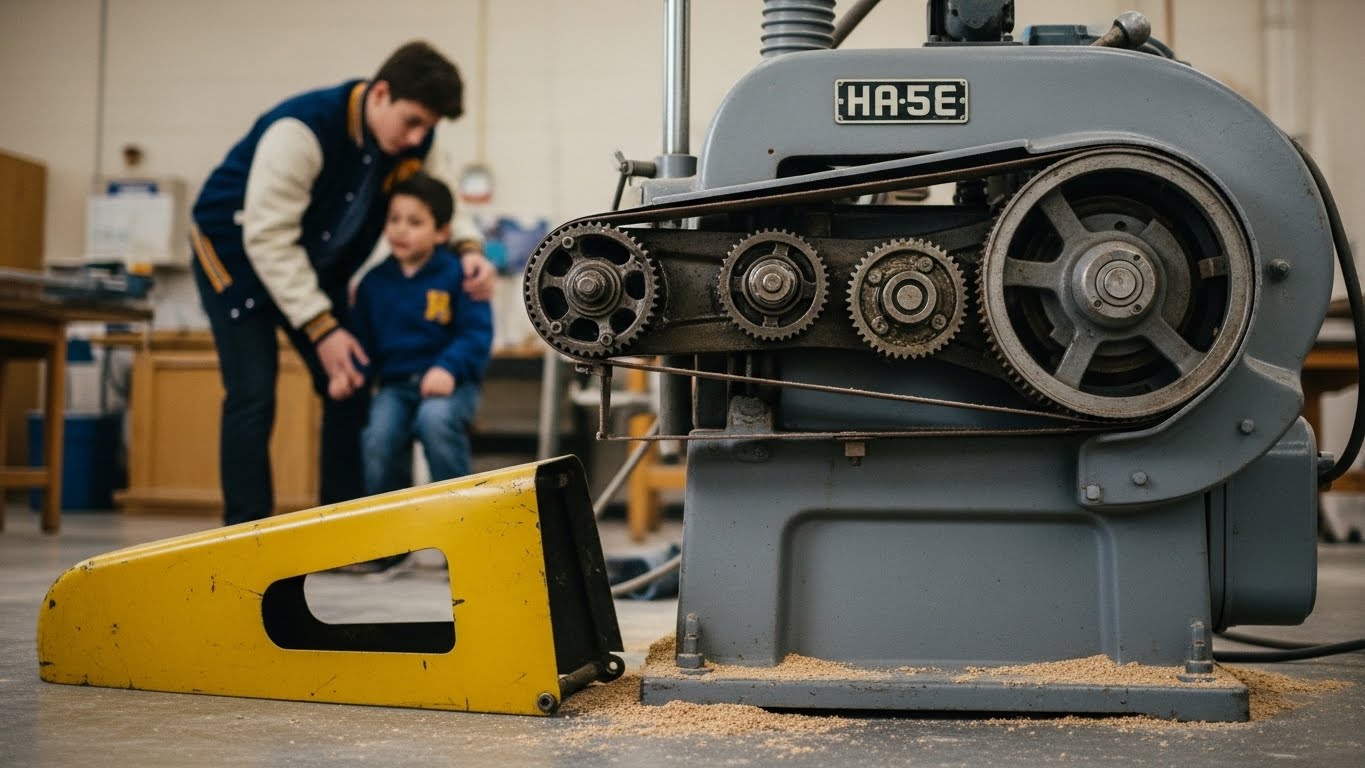
“Henderson isn’t here,” Brock said. He reached down to the side of the machine. There was a bright yellow safety guard bolted over the drive belt and the pinch point—designed to keep fingers from getting sucked into the mechanism.
From his pocket, Brock pulled out a multi-tool. He flicked out a screwdriver.
“What are you doing?” Lucas asked, taking a step forward.
“This guard,” Brock muttered, twisting a screw. “It’s in the way. It slows things down. Real men don’t need safety guards.”
“You can’t take that off,” Lucas pleaded. “It’s illegal. It’s dangerous.”
Brock tossed the yellow plastic guard onto the floor with a clatter. The exposed gears and the edge of the sandpaper belt looked naked and menacing. “I can do whatever I want, woodworm.”
Brock looked at the red ‘ON’ button. Then he looked at Lucas. “Come here.”
“No.”
“I said, come here,” Brock snapped. Kyle and Mason stepped forward, blocking Lucas’s path to the door. Lucas was trapped. He walked slowly toward the machine, his legs feeling like lead.
“Put your hand on the table,” Brock commanded, pointing to the metal plate just millimeters from the rough belt.
“Brock, stop. This isn’t funny.”
“I want to see how steady your hands are,” Brock sneered. His finger hovered over the green start button. “If you’re such a master craftsman, you should be able to hold your hand right next to the spinning belt without flinching. Right?”
Chapter 2: The Predator in the Dust
The room fell deathly silent. The silence wasn’t empty; it was pressurized, like the moment before a thunderclap. The other students in the class—mostly freshmen and sophomores who were terrified of Brock—shuffled backward, pressing themselves against the far walls lined with clamps and saw blades. They were the audience to a gladiatorial execution, and none of them dared to intervene. Brock Danton was not just a bully; he was an institution at Oak Creek High, protected by his linebacker status and his father’s checkbook.
Lucas looked at the machine, then at Brock. The safety guard lay on the floor like a discarded shield, a piece of bright yellow plastic that screamed ‘DANGER’ in a language only the sensible could hear. Without it, the gap between the intake and the sanding belt was wide open. It was a maw. Lucas knew the mechanics of this machine intimately. He knew that if anything—a sleeve, a finger, a loose thread—caught that belt moving at 3,000 RPM, it would pull the limb in before the brain could even register the pain.
“I’m not doing it, Brock,” Lucas said, his voice gaining a fraction of strength from sheer survival instinct. He tried to lock his knees, to ground himself.
“You scared?” Brock taunted, his eyes dancing with a cruel light. “Scared of a little sandpaper? I thought you loved this stuff.”
“I’m scared of stupidity,” Lucas retorted.
The room gasped. It was a collective inhale of shock. Brock’s face flushed a deep, angry crimson. He wasn’t used to pushback, certainly not from the “ghost.”
“Grab him,” Brock ordered, his voice low and dangerous.
Kyle and Mason moved in. They weren’t as malicious as Brock—few were—but they were followers, and fear of Brock made them obedient dogs. They grabbed Lucas by the arms. He struggled, twisting his body, but he was slight of build, honed for dexterity and precision, not wrestling. They dragged him toward the sander.
“Let me go!” Lucas shouted, thrashing. “Henderson is going to be back any second! You’re going to get expelled!”
“He’s busy kissing up to the Principal,” Brock spat. “We got time. Plenty of time to teach you a lesson about respect.”
Brock slammed his hand onto the green button.
VRRRROOOOM.
The machine roared to life. The sound was deafening in the enclosed space, a mechanical scream that vibrated through the floorboards and up into the soles of Lucas’s shoes. The belt became a blur of grey motion, screaming as it spun around the rollers. The noise filled Lucas’s head, drowning out his own rapid breathing.
“Hold his hand there,” Brock yelled over the roar of the motor.
Kyle and Mason forced Lucas’s right hand—his dominant hand, the hand that carved intricate dovetails and smoothed walnut to glass—down toward the vibrating metal table of the sander.
“Closer,” Brock commanded, his eyes gleaming with a sick excitement. He was leaning over the machine, watching the gap where the safety guard used to be. “I want to see if he flinches. I want to see the master craftsman cry.”
“Brock, this is crazy,” Mason said, looking nervous. The noise of the machine was making him jittery. “If he touches that…”
“Shut up! Just hold him!”
Lucas’s fingers were inches from the belt. He could feel the wind coming off it—a hot, dry breeze smelling of abrasive grit and friction. He curled his fingers into a fist to protect them, tucking his thumb inside, but Brock grabbed his wrist, forcing the fingers open.
“Open up,” Brock hissed. “Let’s sand off those calluses. Let’s see what you’re made of.”
The heat radiating from the friction of the belt was palpable. Lucas stared at the spinning belt. It was a grey river of destruction. He knew the physics of it. He knew that without the guard, the “pinch point” was exposed. If his finger touched the belt, the downward rotation would snag the skin and drag his hand down into the mechanism, between the belt and the steel table. It wouldn’t just scrape him; it would de-glove his hand. It would crush the bones. It would end his scholarship, his future, his ability to create.
“Stop!” Lucas screamed, the vibration of the machine rattling his teeth. “You’re going to break my hand! I need this hand!”
“Beg for it,” Brock laughed, leaning closer, shouting over the mechanical scream. “Beg me to stop. Tell everyone you’re a coward.”
“Please!”
“Louder!”
Brock was enjoying this too much. He was leaning over the machine, bracing himself with one hand on the chassis, using his other hand to try and push Lucas’s wrist closer. He was so focused on Lucas’s terror, so focused on the power trip, that he forgot the one rule Mr. Henderson taught on day one, the rule written in big red letters on the wall above them: LOOSE CLOTHING KILLS.
Brock was wearing his varsity jacket. Unzipped. The drawstrings of his hoodie dangled beneath it, swinging like pendulums with every movement of his body.
As Brock leaned in to shout in Lucas’s face, the suction created by the high-speed belt grabbed the dangling aglet of his hoodie string.
It happened in a microsecond.
One moment, Brock was the tyrant, the king of the shop, his face twisted in a mask of cruel delight. The next, his head was yanked violently downward, as if an invisible giant had grabbed him by the throat.
Chapter 3: The Screech of Iron
The physics of a 3-horsepower industrial motor are absolute. It does not negotiate. It does not care about popularity, money, football stats, or who your father is. It only understands torque and rotation.
When the drawstring of Brock’s hoodie caught in the exposed gears—the very gears he had stripped naked by removing the safety guard—it wound tight instantly.
“AGHH!”
Brock’s scream was a gargled, wet choke that was cut short as his windpipe was compressed against the hard steel chassis of the machine. His head slammed down onto the metal table with a sickening thud, inches from the sanding belt that was still screaming at full velocity.
The string was pulling his neck tight, acting like a garrote. But the nightmare was only just beginning. Because Brock had been leaning forward, his varsity jacket sleeve—loose, bulky, and made of synthetic nylon and wool—flopped onto the moving belt.
SCREEEEECH.
The sound of fabric hitting 40-grit sandpaper moving at high speed was like a banshee’s wail, high-pitched and terrifying. The belt grabbed the sleeve instantly. Friction turned to heat in a fraction of a second. Smoke billowed up immediately—thick, acrid, black smoke that smelled of melting plastic and burning hair.
“Turn it off! Turn it off!” Kyle shrieked, his voice cracking into falsetto. He let go of Lucas and jumped back, his face pale with horror. He was watching his friend being eaten alive by a machine, and panic had erased any thought of how to help.
Brock was pinned. His face was being pulled inexorably toward the belt. He was choking, his eyes bulging, his free hand flailing wildly, trying to push himself up. But the machine was eating his jacket, reeling him in like a fish on a line. The belt was grinding through the layers of wool and leather, shredding the sleeve, getting closer and closer to the skin of his forearm.
The other students were frozen in shock. Mason was screaming something unintelligible, backing away until he hit the lumber rack. The room was a chaotic tableau of noise and terror.
Lucas was free. He stood there, rubbing his bruised wrist where Brock had gripped him. He looked at the scene before him. The bully who had tormented him for years, the boy who had just tried to maim him, was now helpless.
In that moment, time seemed to dilate. Lucas could see the terror in Brock’s eyes. It was a primal, animalistic fear. Brock was no longer the king of the school; he was just meat and bone caught in a grinder.
Lucas had a choice. A dark, intrusive thought flashed through his mind: Walk away.
He could just step back. He could let the machine finish what Brock started. It would be poetic justice. The guard Brock removed was the only thing that would have prevented the string from catching in the gears. If Brock lost an arm, or worse, it was entirely his own fault. No jury would convict Lucas for freezing in fear.
But then Lucas looked at the desk he was building. He looked at the tools hanging neatly on the wall. He was a craftsman. He respected the tools, and he respected life. Even a pathetic, cruel life.
He didn’t panic. He didn’t scream. He moved with the precision of a surgeon entering an operating theater.
He lunged forward, diving under Brock’s flailing legs. He didn’t try to pull Brock away—he knew that would only tighten the noose around his neck. Instead, Lucas slammed his palm against the large, red ‘EMERGENCY STOP’ paddle located at hip height on the front of the machine.
THUNK.
The electrical contact broke. The power cut.
But momentum is a killer. The heavy iron flywheel and the sanding belt didn’t stop instantly. They coasted, spinning down with lethal inertia. The belt was still moving fast enough to strip skin from bone. It was still dragging Brock’s arm into the pinch point.
Brock let out a muffled whimper as the heat on his arm became searing. The friction was burning him through the remaining shreds of his jacket.
Lucas scanned the workbench. He needed a brake. He needed something harder than bone but softer than the hardened steel of the rollers.
His hand closed around the handle of a 1-inch bevel-edge chisel. It was one of the shop’s good ones, sharpened to a razor edge.
“Don’t move!” Lucas yelled, though Brock couldn’t move if he wanted to.
With a single, fluid motion, Lucas jammed the steel blade of the chisel into the narrow gap between the spinning rubber roller and the sandpaper belt.
CRUNCH. SNAP.
The sound was like a gunshot. The chisel blade shattered under the immense pressure, sending a shard of metal skittering across the concrete floor. But the handle and the remaining tang acted as a wedge. The friction spiked. The belt groaned, smoked violently, and then seized to a halt.
Silence returned to the room. It was heavier than before, a suffocating blanket of quiet.
The only sound was Brock’s wet, gasping wheezes as he clawed at the hoodie string around his neck. The smell of burnt plastic, ozone, and fear filled the air.
Brock collapsed to the floor as the tension released, coughing violently, clutching his arm. His jacket sleeve was destroyed—a melted, fused mess of plastic and wool. The skin beneath was angry red and blistered from the friction heat, but his arm was intact. It wasn’t crushed. He was alive.
Lucas stood over him, his chest heaving. He was shaking now, the adrenaline crash hitting him hard. In his hand, he still gripped the wooden handle of the broken chisel.
The double doors at the end of the shop swung open with a bang.
“I heard the motor!” Mr. Henderson roared, storming in, his face red. “I told you—”
He stopped dead in his tracks.
He saw the thick haze of blue smoke hanging in the air. He saw the crowd of terrified students pressed against the back wall. He saw the yellow safety guard lying on the floor like a piece of evidence at a crime scene.
And then he saw Brock on his knees, gasping for air, tears streaming down his face, with Lucas standing over him, holding a broken weapon.
Chapter 4: The Silent Witness
“What in God’s name happened here?”
Mr. Henderson’s voice was barely a whisper, but in the dead silence of the shop, it carried the weight of a thunderclap. He didn’t wait for an answer. He rushed to Brock, dropping to one knee. He checked the boy’s breathing and inspected the burns on his arm.
“Someone call the nurse!” Henderson barked over his shoulder. “And the Principal! Now!”
A freshman scrambled out the door, happy to escape the suffocating tension of the room.
Henderson looked up at the machine. His experienced eyes took in the scene with forensic speed. He saw the missing guard. He saw the screwdriver on the floor. He saw the melted remains of the varsity jacket tangled in the gears. He stood up, his face transforming into a mask of cold fury.
“Who removed the guard?” Henderson asked. His voice was level, but there was a dangerous edge to it.
Brock was still coughing, clutching his throat where a dark bruise was already forming. Tears of pain and shock were streaming down his face. But as he looked up, his eyes landed on Lucas.
The fear in Brock’s eyes shifted. The primal terror of death faded, replaced by a sudden, desperate realization of self-preservation. He was in trouble. Serious trouble. He had violated the cardinal rule of the shop, endangered himself, and destroyed school property. His father would kill him. The school would suspend him from the football team.
Unless…
Unless he wasn’t the villain.
“He did!” Brock croaked, his voice raspy and damaged. He pointed a shaking finger at Lucas.
“What?” Lucas stepped back, stunned. The accusation hit him harder than a physical blow.
“He… he tried to hurt me,” Brock gasped, lying through his teeth with the ease of a sociopath who had practiced manipulation his entire life. “I caught him messing with the machine… he was trying to bypass the safety… I tried to stop him… he turned it on and shoved me… he took the guard off to fix his project and got mad when I told him to stop.”
“That’s a lie!” Lucas shouted, his voice cracking. “He tried to force my hand into the sander! He took the guard off! I saved him!”
Henderson looked between the two boys.
On one side, Brock: the star athlete, currently injured, looking pathetic and victimized, with visible wounds on his neck and arm.
On the other side, Lucas: the quiet kid, standing unharmed, holding a broken chisel that looked suspiciously like a weapon, standing over the fallen boy.
“Kyle? Mason?” Henderson turned to the two boys who had been holding Lucas moments ago. “What did you see?”
Kyle looked at Brock. Brock didn’t say anything, but he didn’t have to. The look in his eyes was enough. Stick to the script.
“Yeah,” Kyle stammered, sweating. “Lucas was… he was acting weird, Mr. Henderson. He was frustrated with his desk. He started taking the machine apart. Brock tried to help him, tell him it was dangerous. Then Lucas just… snapped.”
“It’s true,” Mason added, looking at his shoes, unable to meet the teacher’s eyes. “Lucas pushed him. It was an accident, maybe, but… yeah.”
“You liars!” Lucas screamed. He felt tears of frustration stinging his eyes, hot and blurring his vision. “Ask anyone! Ask the class! They saw it all!”
Henderson turned to the huddled group of students at the back of the room. “Is this true? Did anyone see what happened?”
The students looked at each other. They were freshmen. They were sophomores. They were the nobodies of the school hierarchy. They looked at Brock, who was glaring at them even while clutching his burnt arm. They knew what happened to snitches at Oak Creek High. They knew Brock’s father was on the school board. They knew that if they spoke up, their lives would become a living hell.
Silence. Heavy, guilty silence.
“I… I didn’t see anything,” one kid mumbled, turning away.
“Me neither,” said another. “I was sweeping.”
“It happened so fast,” a girl whispered.
Lucas felt his world collapsing. The injustice was physical; it felt like a punch to the gut that knocked the wind out of him. He looked at Mr. Henderson, pleading with his eyes. You know me. You know I respect the wood. You know I wouldn’t do this.
Henderson’s face was unreadable. He looked at the broken chisel in Lucas’s hand. He looked at the safety guard on the floor.
“Lucas,” Henderson said slowly. “Did you jam a chisel into the machine?”
“To stop it! To save him! The button didn’t stop it fast enough!”
“You put a tool into a running machine?” Henderson asked, his voice devoid of emotion.
“Yes, but—”
“That is a violation of safety protocol Level One,” Henderson said. He wasn’t looking at Lucas anymore; he was looking at the door where the Principal was just arriving with the school nurse.
“Mr. Henderson, please! Look at the desk! Look at my work! Why would I risk my hands? Why would I risk the competition?”
“Go to the Principal’s office,” Henderson said, his voice cold and final. “Now. Take your things. Do not return to this shop until further notice.”
“But—”
“Go!” Henderson barked.
Principal Miller walked in, his face grim. “Lucas, come with me. Now.”
Lucas dropped the broken chisel handle on the workbench. It clattered loudly, a sound of finality. He grabbed his backpack. He didn’t look at his desk—his beautiful, unfinished walnut roll-top desk that sat in the corner, a masterpiece that would never be finished.
He walked out of the shop, his head hanging low, flanked by the Principal. As he passed the spot where the nurse was tending to Brock, he saw it.
Through the tears and the pain, Brock looked up. And just for a second, a faint, painful smirk tugged at the corner of his mouth.
He had won. He had almost died, but he had won.
The next three days were a nightmare of bureaucracy and silence. Lucas was suspended pending an expulsion hearing. He sat in his room, staring at the wall. His mother cried in the kitchen, worrying about lawsuits. The State Competition was in two days. He was going to miss it. He was going to lose his scholarship. His future was being sanded away, grit by grit, by a lie.
But inside the silent woodshop, late that night, the lights were still on. Mr. Henderson was there alone. He wasn’t cleaning up. He was wearing latex gloves. He was kneeling next to the belt sander, holding a magnifying glass.
Mr. Henderson didn’t like bullies. And more importantly, he didn’t like mysteries where the pieces didn’t fit. He knew wood. He knew machines. And he knew that sawdust, like history, remembered everything.
Chapter 5: Polished Justice
The school was empty, save for the janitorial staff buffering the floors in the distant hallways. But inside the Industrial Arts shop, the lights hummed with a clinical brightness. Mr. Henderson wasn’t going home. He couldn’t.
He stood before the belt sander like a homicide detective at a crime scene. The police had come and gone, taken a few photos, and accepted the statements of three “witnesses” over the word of one suspect. To them, it was just a high school fight gone wrong. But Henderson knew wood, and he knew machines. More importantly, he knew the physics of a lie.
“You don’t just take a guard off by accident,” Henderson muttered to himself.
He put on a pair of latex gloves he usually reserved for applying heavy chemical finishes. He picked up the yellow safety guard from the evidence box the administration had left behind. He turned it over. It was greasy on the underside, coated in a fine film of machine oil and sawdust.
He looked at the screw holes. The paint around them was chipped fresh.
Then, he turned his attention to the dust bin—the collection bag attached to the machine’s exhaust. He detached it carefully. He wasn’t looking for wood dust. He was looking for debris.
He sifted through the pile of sawdust on a clean sheet of white paper. Walnut dust (dark). Pine dust (light). And then… something else.
Tiny, microscopic shards of yellow plastic.
Henderson frowned. He went back to the machine. He looked at the threads of the bolt holes where the guard had been attached. He took out a magnifying glass.
There, caught in the threads of the bolt hole, were tiny yellow shavings.
“He stripped it,” Henderson whispered. “He didn’t unscrew it carefully to fix a project. He forced it.”
He looked at the screwdriver found on the floor. It was a cheap multi-tool, not one of the shop’s high-quality drivers. It was a brand Henderson didn’t stock.
He bagged the screwdriver. He bagged the guard. Then, he did something illegal. He walked over to the trash can where Brock had thrown his soda can earlier that day—the can he had been drinking from against class rules. He carefully fished it out with tongs and placed it in a separate bag.
He had a friend in the county forensics lab, a man named Detective Miller (no relation to Lucas) who owed Henderson a favor for a custom mahogany mantlepiece Henderson had built for him last year.
“I need a rush job, Jim,” Henderson said into his phone, his voice grim. “I need to know whose fingerprints are on a screwdriver, and I need to know if they match the prints on a soda can. And I need it by tomorrow morning.”
“That’s tight, Earl,” the voice on the other end crackled. “Is this a murder case?”
“It’s about the life of a young man,” Henderson said. “So, yes. In a way, it is.”
Chapter 6: The Kangaroo Court
The expulsion hearing was held in the administrative conference room, a sterile box with grey carpet and a long table made of particle board covered in fake mahogany veneer. Lucas sat on one side, shrinking into his chair. His mother sat beside him, clutching her purse, her eyes red-rimmed and terrified.
On the other side sat Brock, his arm heavily bandaged, his neck bruised purple from the hoodie string. Next to him was his father, Mr. Danton, a man who wore a suit that cost more than Lucas’s mother made in a year. He was leaning back, checking his watch, radiating an aura of impatience and power.
Principal Miller sat at the head of the table, looking tired.
“We are here to discuss the incident on Tuesday,” the Principal began, shuffling papers. “The expulsion of Lucas Miller for assault with a deadly weapon and reckless endangerment.”
“It’s an open-and-shut case,” Mr. Danton interrupted, his voice booming. “This boy attacked my son. He tampered with safety equipment. My son is lucky to be alive. We are pressing charges, by the way. But first, we want him gone from this school.”
“Lucas claims he was saving your son,” the Principal said weakly.
“Lucas is a liar,” Brock said. He didn’t look at Lucas. He looked at the wall, his voice devoid of emotion. “He was jealous. He’s always been jealous. He went crazy.”
“I didn’t!” Lucas cried out, his voice trembling. “I was working on my desk! Why would I stop working to attack him? I have the competition!”
“Maybe you knew you weren’t going to win,” Mr. Danton sneered. “Maybe you wanted to take out the competition.”
“Brock isn’t even in the competition!” Lucas shouted.
“Enough,” the Principal sighed. “Lucas, we have three witness statements—Brock, Kyle, and Mason—all confirming that you removed the guard and initiated the conflict. We have no evidence to support your story.”
Lucas looked at his mother. She squeezed his hand, but her grip was weak. She knew how the world worked. The rich kids won. The poor kids got crushed.
“If there is no further evidence,” the Principal said, uncapping his pen to sign the expulsion order, “I have no choice but to…”
The heavy oak door to the conference room didn’t just open; it slammed against the wall.
Chapter 7: The Evidence of the Grain
Mr. Henderson stood in the doorway. He wasn’t wearing his shop apron. He was wearing a charcoal suit that was twenty years out of style but pressed to a razor’s edge. He held a cardboard box in his hands.
“Mr. Henderson,” the Principal said, startled. “We are in a closed session.”
“You’re about to make a mistake,” Henderson said, his voice filling the room. He walked to the table and set the box down with a heavy thud. “A mistake that will cost this school a lawsuit it can’t afford.”
“Excuse me?” Mr. Danton stood up. “Who is this?”
“I’m the man who teaches your son how not to kill himself,” Henderson said, locking eyes with the father. “And I’m the man who knows exactly what happened in that shop.”
Henderson opened the box. He pulled out the yellow safety guard. He pulled out the multi-tool screwdriver. And he pulled out a manila envelope with the seal of the County Sheriff’s Forensics Lab.
“You said Lucas removed the guard,” Henderson said, looking at Brock.
“He did,” Brock said, though his voice wavered slightly.
“Interesting,” Henderson said. “Because I had the shop dusted. You know, sawdust is a funny thing. It holds onto oils from skin remarkably well. But plastic? Plastic holds onto prints forever.”
He slid a high-resolution photo across the table. It showed a thumbprint, dusted in black powder, clear as day on the yellow plastic of the guard.
“That print,” Henderson said, pointing to the photo, “was found on the inside of the guard. The part that faces the machine. The only way to get a print there is to be holding the guard while you pry it off.”
He slid a second photo. This one showed the multi-tool.
“And this multi-tool. It doesn’t belong to the shop. It’s a cheap brand. ‘Red Wolf’. Does that sound familiar, Brock?”
Brock went pale. He had a Red Wolf sticker on his locker.
“The fingerprints on the screwdriver match the fingerprints on the guard,” Henderson said. “And guess whose prints they are?”
He slammed the report down on the table.
“They aren’t Lucas’s. Lucas’s fingertips are covered in micro-abrasions from sanding walnut for three weeks straight. He doesn’t have clear prints right now. But these prints? They are pristine. And they match the prints I lifted from the soda can you threw in my trash.”
The room went dead silent. Mr. Danton looked at the photos, then at his son.
“But here is the nail in the coffin,” Henderson continued, relentless. He pulled out a small plastic bag containing a pinch of fibrous fluff.
“I found this inside the motor housing. Deep inside the gears. It’s red and white wool. From a varsity jacket.”
Henderson leaned in, his face inches from Brock’s.
“The only way—the only way—jacket fibers get that deep into the gear housing is if the guard is removed before the accident occurs. If Lucas had removed the guard to attack you, or if it came off during a struggle, the fibers would be on top of the gears. But they were wound under the drive shaft.”
Henderson stood up straight and addressed the Principal.
“Brock removed the guard. He did it to intimidate Lucas. He leaned in to threaten him, and his loose clothing—which he was warned about—caught in the machine. Lucas didn’t attack him. Lucas saved his life. That broken chisel? That was the only thing that stopped the belt from stripping the flesh off your son’s arm.”
Henderson turned to Mr. Danton. “Your son isn’t a victim. He’s a criminal. And Lucas is a hero.”
Mr. Danton looked at Brock. “Is this true?”
Brock looked down at his bandaged arm. The weight of the evidence, the science, the undeniable logic of the craftsman—it crushed him.
“I… I was just trying to scare him,” Brock whispered.
Chapter 8: The Masterpiece
The fallout was swift.
Mr. Danton, realizing the legal liability his son had just admitted to, withdrew the complaint immediately. Brock was suspended for the remainder of the semester and stripped of his captaincy on the football team. The school board, terrified of a lawsuit from Lucas’s mother now that the truth was out, offered to cover all of Lucas’s material costs for the rest of the year.
But none of that mattered to Lucas. All that mattered was the wood.
Two days later, the State Industrial Arts Competition was held at the Convention Center in the state capital. The hall was filled with the smell of varnish and the nervous energy of hundreds of students.
Lucas stood next to his project.
The roll-top desk was finished. The black walnut glowed with a deep, chocolate luster under the exhibition lights. The cherry wood accents burned like embers. The tambour door—the rolling cover—glided open and shut with a whisper-soft whoosh, a testament to perfect geometric alignment.
The judges, three master woodworkers with grey beards and critical eyes, spent twenty minutes examining it. They opened every drawer. They checked the dovetails. They ran their hands over the finish, looking for a single flaw, a single ripple.
They found none.
“Son,” the head judge said, looking at Lucas over his spectacles. “Did you use a CNC machine for these joints?”
“No, sir,” Lucas said, his voice steady. “Hand cut. Chisel and saw.”
The judge smiled. “I haven’t seen handwork like this in a very long time.”
When the awards were announced, Lucas didn’t hear his name at first. He was too busy looking at Mr. Henderson in the front row. The old teacher was grinning, giving him a subtle nod.
“And the Gold Ribbon, along with the Full Ride Scholarship to the State Architecture & Design Program… goes to Lucas Miller of Oak Creek High!”
The applause was thunderous. Lucas walked up to the stage, his legs shaking, but this time, not from fear. He accepted the ribbon and the heavy glass trophy.
He looked out at the crowd. He saw his mother, crying tears of joy. He saw Mr. Henderson, the man who had saved him by teaching him that truth, like wood, has a grain—and if you follow it, it will never lead you astray.
Lucas Miller was no longer a ghost. He was built of solid stuff. And as he held the trophy, he looked at his right hand—the hand Brock had tried to destroy. It was calloused, stained with walnut oil, and rough.
It was the hand of a craftsman. And it had built a future that no one could tear down.