My Gym Coach Read a Magazine While the Star Pitcher Used My Body for Target Practice. Then the Principal Found the Photos.
hapter 1: The Killing Floor
The gymnasium at Oakhaven High School didn’t smell like victory to me. It smelled of fifty-year-old floor wax, stale popcorn, and the sharp, copper tang of my own anxiety. To the parents in our town, this place was the “Multi-Purpose Athletic Center,” the home of the Tigers, the pride of the county. To the faculty, it was just third period. But to me, Artie Penhaligon, it was simply the Killing Floor.
It was 2:15 PM on a Tuesday. Third period. Physical Education.
The fluorescent lights hummed overhead, a low-frequency drone that seemed to vibrate right inside my teeth. I stood near the back wall, trying to make myself look as two-dimensional as possible against the blue padded mats. I was sixteen, but my frame suggested a malnourished fourteen-year-old. My wrists were thin, my shoulders slumped forward in a perpetual posture of defense, and my eyes were constantly darting, assessing threats.
Today, the threat was wearing a gray mesh jersey with the number 12 printed on it.
Brad “The Cannon” Miller stood at the center line. He was the golden boy of Oakhaven, a varsity pitcher with a fastball that had already attracted scouts from three different state universities. He was six-foot-two, carved out of granite and arrogance, with a smile that didn’t quite reach his cold, blue eyes. In his right hand, he held a red rubber dodgeball.
In anyone else’s hand, it was a toy. In Brad’s hand, it was a weapon.
“All right, ladies! Pick your sides!” Coach Grubbs blew his whistle, the sound piercing the air like a shriek. Grubbs was a man who had peaked in 1982 and had been coasting downhill ever since. He wore polyester coaching shorts that were disturbingly short and a polo shirt permanently stained with mustard. He waddled over to the bleachers, sat down with a heavy grunt, and pulled a folded car magazine out of his back pocket.
That was the signal. The laws of civilization were suspended. The purge had begun.
The game was Dodgeball. In theory, it was a game of elimination, agility, and strategy. In practice, under the negligent eye of Coach Grubbs, it was sanctioned execution.
I tried to shuffle behind a group of taller boys, using them as human shields. I knew the strategy well. Stay low. Stay hidden. Wait until the herd thinned out. But Brad Miller was a predator who enjoyed the hunt more than the kill.
“Hey, Artie!” Brad’s voice boomed across the polished wood floor. It wasn’t a friendly greeting. It was target acquisition.
The other students, sensing the danger, parted like the Red Sea. They stepped aside, leaving me exposed. I don’t blame them. It was the survival instinct—better him than me. The silence that fell over the gym was heavy, suffocating. It was the silence of complicity. Thirty other students, boys and girls, watched. They knew what was coming. They knew it was wrong. But fear is a powerful gag order in high school.
I looked up. I didn’t run. There was no point in running from a fastball pitcher in a confined space. I just braced myself.
Brad wound up. It was a seamless, practiced motion. The step, the hip rotation, the whip of the arm.
Thwack.
The sound was distinct. It wasn’t the soft poof of a ball hitting a wall. It was the wet, meaty slap of rubber impacting soft tissue. The ball slammed into my left thigh, just above the knee.
The physics of the impact were brutal. The ball, traveling at upwards of sixty miles per hour, compressed against the muscle. The kinetic energy transferred instantly, sending a shockwave through the tissue, rupturing capillaries, and vibrating against the femur.
I gasped, my leg buckling underneath me. I didn’t scream. I had learned long ago that screaming only encouraged them. It was like blood in the water for a shark. I bit the inside of my cheek, tasting the metallic tang of blood, and stumbled backward.
“You’re out, Artie!” someone yelled from the sidelines, their voice trembling with false bravado.
But in Coach Grubbs’ class, “out” didn’t mean you got to leave. It meant you went to the back of the line, and if a teammate caught a ball, you came right back in. And Brad’s team wasn’t trying to win. They were farming the other team for revivals. They would intentionally drop easy lobs to let me back in.
It was a cycle. A meat grinder designed for one person.
I limped to the sideline, my thigh throbbing with a heat that felt like a chemical burn. I looked toward the bleachers, hoping, praying for intervention. Coach Grubbs turned a page in his magazine, completely engrossed in an article about carburetors. He hadn’t seen a thing. Or maybe he had, and simply didn’t care. To Grubbs, this was just boys blowing off steam. It was “character building.”
“You okay, man?” whispered Toby, a heavyset kid with asthma who usually got eliminated first on purpose to avoid the running.
“I’m fine,” I lied. My voice was tight, strained, barely a whisper.
“He’s aiming for you,” Toby said, stating the obvious. “Just stay down next time. Pretend you twisted your ankle.”
“If I stay down, he’ll just aim for my head,” I whispered back. “He likes a moving target, but he loves a stationary one even more.”
Just then, one of my teammates caught a lazy fly ball. “Artie! You’re back in!”
The dread washed over me, cold and slimy. It felt like ice water in my veins. I had to go back out there. I had to walk back onto the wood, back into the line of fire. I limped forward, the pain in my leg flaring with every step, a hot wire pulling tight in my muscle.
Brad was waiting. He had two balls now. He juggled them casually, a smirk playing on his lips. He looked at me, then looked at the Coach, ensuring the authority figure was still disengaged. Then, he locked eyes with me again.
He mouthed one word: Dance.
Chapter 2: The Palette of Bruises
The locker room was a sanctuary of steam and shame. The air was thick with the smell of cheap body spray—an aggressive attempt to mask the scent of sweat, mildew, and fear. For me, this was the second phase of the ordeal. The damage assessment.
I waited until the majority of the boys had changed and left before I peeled off my gym shorts. I moved slowly, wincing as the fabric dragged over my skin. Every movement was a reminder of my status in the food chain.
I looked down at my thigh.
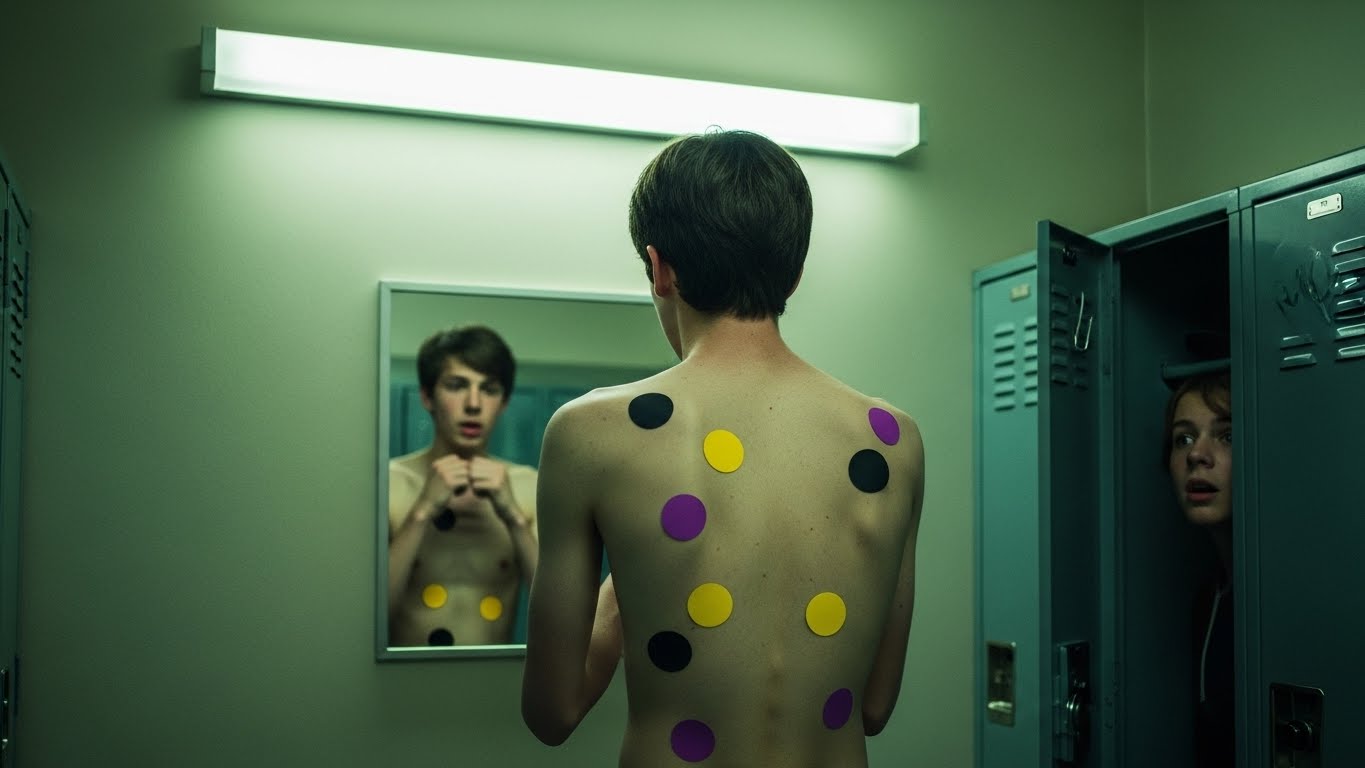
The bruise was already forming, a violent bloom of color against my pale skin. It was the shape of a starburst, a deep, angry crimson in the center, fading to a sickly purple at the edges. It was hot to the touch, pulsing in time with my heartbeat. It looked like something had exploded beneath the surface of my skin.
This wasn’t the only one. My body was a map of Brad Miller’s pitching practice. There was a greenish-yellow blotch on my ribs from last Thursday—a fast ball that had knocked the wind out of me for a full minute. A fading brown smear on my shoulder from the week before. And the faint, ghost-like remnant of a hit to my shin from a month ago.
I was a canvas of trauma. I was a walking evidence locker.
“Jesus, Artie.”
The voice was soft, startled. I jumped, instinctively grabbing my towel to cover my leg. It was Marcus, the team captain of the debate squad. Marcus was a nice guy, smart, kept his head down. He was drying his hair a few lockers away, his eyes wide as he looked at my leg.
“It’s nothing,” I muttered, turning away, my face burning with humiliation. “I bruise easily. Iron deficiency.”
“That’s not iron deficiency,” Marcus said, his voice low. He glanced toward the heavy metal door to make sure we were alone. “That’s Miller. I saw him. He wasn’t even looking at anyone else. He was hunting you.”
I pulled my jeans on, wincing as the denim pressed against the fresh hematoma. The friction felt like sandpaper on a sunburn. “It’s just a game, Marcus.”
“It’s not a game when the coach doesn’t watch,” Marcus replied bitterly. He walked closer, lowering his voice further. “You should tell someone. Tell Principal Vance.”
“And say what?” I snapped, surprising myself with the venom in my voice. “That the star pitcher throws the ball too hard in gym class? You know how this town works. Brad Miller is going to take the Tigers to State. He’s untouchable. If I complain, I’m just the whiny kid who can’t take a hit. It’ll only make it worse.”
Marcus fell silent. He looked at the floor, kicking at a discarded towel. He knew I was right. Oakhaven was a football and baseball town. The athletes were gods; the rest of us were just tithes. We existed to fill the stands and pay the taxes.
“I could…” Marcus started, then stopped. “I could take a picture. For proof.”
“No,” I said sharply. “No pictures. I just want to go home.”
I finished dressing and slammed my locker shut. The metallic clang echoed in the tiled room like a gunshot. I grabbed my backpack, slinging it over one shoulder. I needed to get home. I needed ice. I needed to disappear.
The walk home was a blur of pain and resentment. When I entered my house, the smell of pot roast greeted me—comfort food. My mother, Sarah, was in the kitchen. She was a kind woman, perpetually worried, sensing something was wrong with her son but unable to pierce the wall I had built around myself.
“How was school, honey?” she asked, wiping her hands on a dish towel.
“Fine,” I said, heading straight for the stairs. “Just tired. Lots of homework.”
“Dinner’s in an hour. Are you… are you limping?”
I froze on the third step. I forced myself to straighten my leg, fighting through the spike of pain that shot up my hip. I turned to look at her, forcing a smile that felt like a mask. “No. Just… leg fell asleep sitting in history class. Mr. Henderson lectures for too long.”
She studied me for a second, her eyes searching mine. “Okay. Let me know if you need anything.”
I fled to my room, locking the door behind me. I dropped my bag and went straight to the mirror. I lifted my shirt.
The bruise on my ribs was turning a nasty shade of black. I pressed my fingers against it, testing for a break. It hurt, a sharp, breathtaking stab, but the bone felt intact. I exhaled, a long, shaky breath.
I lay on my bed, staring at the ceiling. The silence of my room was usually my refuge, but today, it felt heavy. I replayed the gym class in my mind. The sound of the ball. The laugh. The silence of thirty kids watching me get pulverized.
Why him? That was the question that haunted me. I wasn’t loud. I wasn’t annoying. I didn’t provoke anyone. I was invisible. Or I tried to be.
Maybe that was it. Maybe Brad hated me because I was quiet. Because I represented something Brad wasn’t—someone who didn’t need the roar of a crowd to exist. Or maybe it was simpler. Maybe Brad was just cruel, and I was just soft, and in the animal kingdom of high school, that was all the justification required.
He rolled over, burying his face in the pillow. Tomorrow was Wednesday. No gym. But Thursday… Thursday was Dodgeball again.
I closed my eyes, and all I could see was the red rubber ball, spinning, growing larger, coming for me. I didn’t know it then, but Thursday wasn’t just going to be another game. Thursday was going to be the day everything broke.
Chapter 3: The Breaking Point
Thursday arrived with the heavy, suffocating inevitability of a funeral procession. The sky outside my bedroom window was a flat, slate gray, perfectly mirroring my internal landscape. I lay in bed for ten minutes, debating the merits of faking a seizure or perhaps tumbling down the stairs just to break an ankle on my own terms.
I had tried the fever rout earlier, pressing my forehead against the steaming radiator before my mom came in to check on me. But she had seen through it, or maybe she just couldn’t afford to take a day off work to baby a teenager who looked physically fine. She kissed my forehead, told me to drink juice, and left.
So, I was here.
Period three. The Killing Floor.
The atmosphere in the gym was different today. It wasn’t just the usual low-level dread; there was a frantic, vibrating energy in the air. It was the last week before Spring Break, and the student body was restless, feral. The teachers were exhausted, checking out mentally.
Coach Grubbs seemed even less interested than usual, which I hadn’t thought was possible. He had upgraded his lunch today. Instead of a bag of chips, he had brought a massive Italian sub, wrapped in white butcher paper. He was unwrapping it with the tenderness of a father holding a newborn, picking off banana peppers with surgical precision.
“Championship rules today, ladies!” Brad shouted, rallying his troops at the center line. “Headshots count!”
Technically, headshots were illegal in school dodgeball. It was a safety rule written in the district handbook in bold, underlined text. But rules require enforcement, and the enabler-in-chief was currently wiping mayonnaise off his chin.
I stood in the back corner, as far away from the center line as the geometry of the room allowed. My thigh from Tuesday had stiffened into a hard, agonizing knot of muscle. I could barely walk, let alone run. I wasn’t just a target; I was a stationary target. I was a sitting duck in a barrel, and Brad held the shotgun.
The whistle blew. The chaos erupted.
Balls flew through the air like artillery shells. The acoustics of the gym turned the sound into a war zone—shouts, squeaking sneakers, the rhythmic thwack-thwack-thwack of rubber impacts.
Brad was on fire. He eliminated three kids in the first thirty seconds. He was efficient, brutal, and focused. He cleared the field, stripping away my human shields one by one. He wasn’t even looking at them when he threw; his eyes were scanning the backfield, looking for me.
My teammates fell away like autumn leaves. A girl named Jenny took a brutal shot to the shoulder and scrambled off the court, looking relieved to be out of the kill zone. She didn’t look back.
Then, the court cleared. It was just me.
I stood alone on the vast expanse of the varnished wooden floor. On the other side, Brad stood with three red balls at his feet. His teammates backed off, fanning out to the sides to give him the stage. They were grinning, nudging each other. They expected a show. They expected a slaughter.
“Come on, Artie!” Brad jeered, his voice echoing off the rafters. “Show me some hustle! Let’s see you dance!”
I didn’t move. I couldn’t. My leg had locked up completely. The pain was a dull roar, but suddenly, a cold clarity washed over me. It was a strange sensation, like stepping out of a hot room into a blizzard. I looked at Brad, really looked at him. I saw the cruelty in his eyes, the need for dominance. And I realized something.
I was done running.
“Throw it,” I said. It was a whisper, but in the sudden, anticipatory hush of the gym, it carried like a shout.
Brad’s smile faltered for a microsecond. He looked confused by the lack of fear, by the stillness. But then his expression hardened into something ugly.
“Heads up,” he sneered.
Brad picked up a ball. He didn’t just throw it; he launched it. He wound up, putting his entire body weight, all six-foot-two of varsity muscle, behind the motion. He was pitching for a strikeout in the bottom of the ninth inning of the World Series.
The ball screamed through the air. You could actually hear the air tearing around it.
I didn’t dodge. I didn’t duck. I didn’t raise my hands. I just stood there and watched it come.
The ball struck me in the face. Specifically, the left orbital bone, just below the eye.
The sound was sickening. It wasn’t a thwack. It was a crack. A dry, snapping sound, like a dead branch breaking under a heavy boot in the winter woods.
My head snapped back violently. The world spun—a kaleidoscope of ceiling lights, floorboards, and darkness. I spun halfway around from the force and collapsed to the floor.
The gym went instantly silent.
No one cheered. No one laughed. The sound of the impact had been too visceral, too wrong. It was the sound of damage.
I lay on the floor, curled into a fetal position. I didn’t make a sound. The shock was so intense it had temporarily short-circuited my pain receptors. My hands clutched over my face. I felt something warm and wet seeping between my fingers. It was flowing fast, terrifyingly fast.
I opened my right eye. I saw a small pool of crimson forming on the polished wood, bright red against the honey-colored varnish. It was my blood.
“Artie?” someone whispered. The fear in their voice was palpable.
Coach Grubbs dropped his sandwich. The car magazine slid to the floor, forgotten. For the first time all semester, perhaps for the first time in years, he moved with speed.
“Back! Everyone get back!” he roared, his voice cracking. He waddled onto the court, his face draining of color as he saw the blood.
Brad stood frozen at the center line. His arm was still hanging loosely at his side. He stared at me, then at the ball that had rolled away, innocent and red.
“I… I didn’t mean to…” Brad stammered. The arrogance had evaporated, replaced by the terrified realization of a child who has broken something expensive that he cannot fix.
Coach Grubbs knelt beside me. “Penhaligon? Can you hear me? Move your hands, son. Let me see.”
I groaned, a low, guttural sound of pure agony as the shock began to wear off and the pain arrived like a freight train. I moved my hands slightly. The left side of my face felt enormous, hot, and pulsing.
“Call the nurse!” Grubbs screamed at a student standing nearby, frozen in shock. “No, forget the nurse! Call 911! Now!”
The class erupted into panicked whispers. The illusion of the game was shattered. This wasn’t dodgeball anymore. This was a crime scene.
Chapter 4: The White Room
The hospital room was white. Sterile, blinding, aggressive white. It smelled of antiseptic, industrial floor cleaner, and that vague, underlying scent of illness. It was a sharp contrast to the sweat and rubber smell of the gym, but somehow, it felt safer.
I lay in the bed, propped up by stiff pillows. The left side of my face felt like it didn’t belong to me. It was a ruin. A heavy bandage covered my eye and cheek. My nose was packed with gauze. I had a mild concussion that made the room swim if I moved my head too fast.
My mother was asleep in the vinyl chair next to me. Her face was stained with dried tears, her posture slumped. She looked ten years older than she had this morning. Her purse was clutched tightly in her lap, as if she were ready to flee.
The door opened softly. It wasn’t a nurse.
It was Mrs. Vance, the Principal of Oakhaven High.
She was a tall, severe woman who usually terrified the student body. She walked the halls with a clipboard and a gaze that could peel paint. But today, her expression was soft, pained. She held her hands clasped in front of her.
I shifted, the hospital bed creaking loudly. My mother stirred but didn’t wake.
“Arthur,” Mrs. Vance said softly, stepping into the room. She closed the door behind her with a gentle click. “How are you feeling?”
“Like I got hit by a truck,” I mumbled. My jaw hurt when I spoke; everything felt tight and swollen.
Mrs. Vance nodded. She pulled up a metal stool and sat down. She didn’t have a notepad. She didn’t have a recorder. She just looked at me, studying the bandages.
“I spoke to the doctors,” she said quietly. “You’re going to heal. The vision in the eye is fine, thank God. Just bone damage. Orbital fracture and a broken nose.”
I nodded slowly. “Okay.”
“Arthur,” she leaned in closer, her voice dropping to a conspiratorial whisper. “I need you to tell me exactly what happened. Not the version Coach Grubbs told me. Not the version the other students are whispering about on social media. The truth.”
I looked at her with my one good eye. A wave of exhaustion hit me. “Does it matter? It was an accident. That’s what they’ll say. That’s what they always say.”
Mrs. Vance’s lips pressed into a thin line. “Coach Grubbs filed an incident report an hour ago. He said it was a ‘tragic mishap during spirited play.’ He said you tripped into the ball.”
I let out a short, dry laugh that turned into a grimace of pain. “I tripped? Into a ball moving sixty miles an hour?”
“Exactly,” Mrs. Vance said. Her eyes flashed with anger, but it wasn’t directed at me. “I know Grubbs. I know he’s lazy. But lying on an official report is different.”
She paused, glancing at my sleeping mother, then back to me.
“Arthur, a student came to my office this morning. While the ambulance was taking you away.”
I froze. “Who?”
“Marcus,” she said. “He showed me his phone.”
My heart hammered against my ribs. Marcus. The quiet kid. The one I had shut down in the locker room.
“He showed me photos, Arthur,” Mrs. Vance continued. “Photos he took of you in the locker room a week ago. Your back. Your legs. The bruising.”
I looked away, staring at the white wall. The shame burned hotter than the fracture in my face. “He wasn’t supposed to do that.”
“Thank God he did,” Mrs. Vance said firmly. “He told me everything. He told me about the targeting. The rules Brad made up. The way the other students would feed you back into the game just so Brad could hit you again. He told me about the magazine reading.”
She took a deep breath, and for a moment, the stern Principal mask slipped completely. She looked just like a person. A person who was horrifyingly angry.
“I saw the bruises in those photos, Arthur. That wasn’t a game. That was systematic abuse. That was assault.”
I looked down at my hands. “Brad is the varsity pitcher. The town loves him. The boosters just bought the team new uniforms because of him.”
“I don’t care if he’s the second coming of Babe Ruth,” Mrs. Vance said, her voice trembling with suppressed rage. “My job is to protect my students. All of them. Not just the ones who can throw a ball over a plate. This stops today.”
She reached out and placed a hand gently on my arm, avoiding the IV line.
“I was bullied, Arthur. When I was your age. I was tall, awkward, had bad teeth. They used to trip me in the hallway. Teachers looked the other way because the boys doing it were popular. I promised myself if I ever had the power, I wouldn’t look away. I wouldn’t be like Grubbs.”
She looked me dead in the eye.
“But I need your statement. I need you to confirm what Marcus told me. If you do, I can end this. I can make sure Grubbs never coaches again. I can make sure Brad faces real consequences. Not just a slap on the wrist.”
I looked at my mother sleeping in the chair. I thought about the fear I felt every Tuesday and Thursday morning. I thought about the silence of the gym, the complicity of the crowd. I thought about the sound of my own bone snapping.
I looked back at Mrs. Vance.
“He didn’t just throw the ball,” I whispered. “He waited until I was the only one left. He told me to dance. And Coach Grubbs… he wasn’t watching. He was reading an article about carburetors. He was eating a sandwich while Brad broke my face.”
Mrs. Vance nodded slowly, absorbing every word like it was gospel. She stood up, smoothing her skirt. She looked like a general preparing for war.
“Thank you, Arthur,” she said. “Rest now. Heal. I’ll handle the rest.”
She turned and walked out of the room. As the door closed, I felt a strange sensation in my chest. It wasn’t pain. It wasn’t fear.
It was the first flicker of hope I’d felt in years.
Chapter 5: The Court of Public Opinion
Coming home from the hospital didn’t feel like a victory lap. It felt like a retreat into a bunker.
My face was a landscape of violence. The swelling had started to recede, gravity pulling the bruises down my face so that my jawline was now a sickly shade of yellow and green, while my eye remained a deep, angry purple. My nose was splinted, making me breathe through my mouth, a constant dry rasp that kept me awake at night.
But the physical pain was manageable. That’s what painkillers are for. The real agony was the noise.
You see, Oakhaven isn’t just a town; it’s an ecosystem. And when you disturb the apex predator, the whole jungle screams.
By Friday morning, the story hadn’t just leaked; it had flooded. But it wasn’t the story I knew. It wasn’t the story of a victim and a bully. It was the story of a “tragedy” that was threatening to ruin the life of a “promising young athlete.”
My mom tried to keep my phone away from me, but I found it while she was in the shower. I logged onto Facebook. I wish I hadn’t.
The “Oakhaven Tigers Booster Club” page was on fire.
“I heard the Penhaligon kid stepped right into the throw. Why wasn’t he looking? You don’t walk onto a court if you aren’t ready to play.” — Posted by a dad whose son was a linebacker.
“Brad Miller is a D1 prospect. Are we really going to let a gym class accident ruin his scholarship chances? This is cancel culture run amok!” — Posted by a local car dealership owner.
There were hundreds of them. Comments defending Brad. Comments blaming Coach Grubbs for not blowing the whistle sooner. Comments blaming me for being “too soft” for varsity sports.
I felt a pit open in my stomach. They were rewriting history in real-time. To them, I wasn’t a human being with a broken face. I was an obstacle. I was a speed bump on Brad Miller’s road to greatness.
“Don’t read that trash, Artie.”
I looked up. My mom was standing in the doorway, a towel around her hair. Her eyes were red. She had been reading them too.
“They hate me,” I whispered. “The whole town hates me.”
“No,” she said, her voice fierce, trembling with a mother’s protective rage. “They don’t hate you. They just love winning more than they love the truth. It’s easier to blame the victim than to admit their golden boy is a monster.”
She walked over and took the phone from my hand. “Principal Vance called. There’s a meeting on Monday morning. The Superintendent, Brad’s parents, their lawyer, and the school board attorney. They want to ‘discuss the situation.'”
“A lawyer?” I asked, my voice cracking. “Brad has a lawyer?”
“Brad’s father hired the most expensive firm in the county,” Mom said, sitting on the edge of my bed. She took my hand. “They’re going to try to intimidate us, Artie. They’re going to try to make this go away. They’re going to offer to pay the medical bills if we sign a paper saying it was an accident.”
I looked at the splint on my nose. I remembered the sound of the bone snapping. I remembered the way Brad had mouthed Dance before he threw the ball.
“I won’t sign,” I said.
Mom squeezed my hand. “Good. Because I already told them to go to hell.”
Chapter 6: The War Room
Monday morning. The conference room at the district office smelled like stale coffee and expensive cologne.
I sat on one side of the long mahogany table. My mom was on my left, Mrs. Vance on my right. On the other side sat the opposition.
Brad wasn’t there. He was being shielded, kept away from the “trauma” of the proceedings. Instead, his father, Mr. Miller, sat there. He was a man who wore suits that cost more than my mother’s car. Next to him was a lawyer with a shark-like smile and a briefcase that looked like it contained a sniper rifle.
The Superintendent, a nervous man named Dr. Aris, sat at the head of the table, sweating profusely.
“Let’s keep this civil,” Dr. Aris said, wiping his forehead.
“Civil?” Brad’s lawyer started, his voice smooth as silk. “My client’s son has been suspended without due process. He is being vilified in the press. We are talking about a young man with a bright future, a young man who has brought glory to this district.”
He turned his shark eyes toward me. “Now, Arthur. We are all very sorry about your… injury. But we have witness statements suggesting the game was chaotic. That you were disoriented. Is it possible you moved into the path of the ball?”
My mom started to stand up, her face flushing with anger, but Mrs. Vance put a hand on her shoulder to steady her.
“Mr. Sterling,” Mrs. Vance said, her voice ice-cold. “We aren’t here to debate physics. We are here to discuss assault.”
“Assault is a strong word for a gym class mishap,” Mr. Miller scoffed. He looked at me with disdain. “The kid got hit with a ball. It’s dodgeball. It happens.”
“It wasn’t a mishap,” I said. My voice was quiet, muffled by the splint, but the room went silent.
Mr. Miller glared at me. “Speak up, son.”
“It wasn’t a mishap,” I said louder. “He targeted me. For weeks. He waited until I was alone. He aimed for my head.”
“That’s your word against a Varsity Captain,” the lawyer said dismissively. “And frankly, Arthur, your word doesn’t hold much weight against the record of a star athlete.”
Mrs. Vance stood up. She didn’t shout. She didn’t slam the table. She simply reached into her folder and pulled out a stack of 8×10 photographs.
She slid them across the table. They fanned out like a winning poker hand.
The photos Marcus had taken.
The close-up of the starburst bruise on my thigh. The black hematoma on my ribs. The greenish-yellow map of pain on my back.
“This isn’t just Arthur’s word,” Mrs. Vance said. “This is a timeline. These photos were taken over the course of a month. Every Tuesday and Thursday. The medical examiner reviewed them. He confirmed the impact patterns are consistent with high-velocity blunt force trauma. Repeated. Targeted.”
Mr. Miller looked down at the photos. His face paled. He saw the violence etched into my skin.
“And,” Mrs. Vance continued, dropping the final bombshell, “we have the sworn statement of Marcus Gwen, who witnessed Brad Miller betting his teammates ten dollars that he could make Arthur cry before the bell rang.”
The silence in the room was absolute. The air conditioning hummed, sounding like a roar.
The lawyer picked up one of the photos. He looked at it, then looked at his client. The shark smile was gone.
“This… this changes the complexion of the situation,” the lawyer muttered.
“It certainly does,” Mrs. Vance said. “Dr. Aris, you have a choice. You can expel Brad Miller and fire Coach Grubbs for gross negligence today. Or, Arthur’s mother calls the State Police, and I hand these photos to the District Attorney. And then I call the local news station.”
Mr. Miller slammed his fist on the table. “You can’t do that! The scouts are coming next week! You’ll ruin his life!”
I looked Mr. Miller in the eye. For the first time, I didn’t feel small. I didn’t feel like the victim.
“He ruined his own life,” I said. “When he decided mine didn’t matter.”
Chapter 7: The Fall of the King
The assembly was held three days later.
The gymnasium—the Killing Floor—was packed. But the mats were gone. The balls were locked away in a cage. The entire student body sat in the bleachers, a sea of whispers and rumors.
I wasn’t supposed to be there. My doctor had told me to stay home for another week. But I needed to see it. I stood in the back, near the exit doors, hidden in the shadows of the mezzanine.
Dr. Aris didn’t speak. He was too cowardly. It was Mrs. Vance who took the podium. She looked like a judge delivering a verdict from on high.
“There are traditions at Oakhaven,” she began, her voice amplified by the speakers, echoing off the rafters where championship banners hung. “We value strength. We value competition. But somewhere along the way, we confused strength with cruelty. We confused negligence with tradition.”
The students were silent. They knew. The rumors had shifted. The photos hadn’t been released publicly, but the description of them had leaked. The “accident” narrative was dead.
“Effective immediately,” Vance continued, “Coach Grubbs is no longer employed by this district.”
A ripple of shock went through the crowd. Grubbs had been a fixture for twenty years. A bad fixture, like a leaky faucet, but a fixture nonetheless.
“Furthermore,” Vance looked directly at the section where the baseball team sat. They looked uncomfortable in their letterman jackets, shifting in their seats. There was an empty space in the center of their row.
“Brad Miller has been expelled from Oakhaven High School,” she said.
The gasp was audible. It sucked the air out of the room.
“We have a zero-tolerance policy for violence,” Vance said, her voice rising, cutting through the shock. “And let me be clear: using a game as an excuse to inflict pain is violence. Watching it happen and doing nothing is cowardice.”
She scanned the crowd. Her eyes seemed to land on every single person who had stood by and watched me get hit, week after week.
“We are better than this. We have to be.”
I watched from the shadows. I saw Toby, the kid with asthma, sitting with his head high. I saw Marcus, looking solemn but proud.
And I saw the empty spot where Brad used to sit.
Later that afternoon, the news broke on Twitter. The University of Florida had rescinded their scholarship offer. Then the state colleges followed suit. Brad Miller was radioactive.
He hadn’t just lost his school. He had lost his future. The scouts weren’t coming to see a kid who had been expelled for assault. The dream was over.
I walked out of the gym. The sun was setting, casting long shadows across the parking lot. My face still throbbed. My nose still hurt. But the weight on my shoulders? It was gone.
Chapter 8: The New Normal
Two weeks later, I returned to school.
I walked through the double doors of the main entrance, bracing myself. I expected stares. I expected whispers. And they were there. People looked. They saw the healing fracture on my cheek, the yellowing bruises. I looked like a prizefighter who had gone twelve rounds.
But the look in their eyes was different.
It wasn’t pity. And it wasn’t the predatory glare of the bullies.
It was respect. Or maybe just caution.
I walked down the hallway, the sea of students parting for me. Not because they were afraid I would hurt them, but because they knew I had taken down the giant. I was the kid who didn’t run. I was the kid who stood still and let the system break itself against me.
I reached my locker. Marcus was there, leaning against the metal bank.
“Hey,” Marcus said.
“Hey,” I replied.
“Gym class is different now,” Marcus said, a small smile playing on his lips. “We have a new teacher. Mrs. Halloway. She’s… intense. She makes us play badminton.”
I smiled. It hurt my cheek, a sharp pinch of healing skin, but I smiled anyway. “Badminton sounds dangerous. Those shuttlecocks can be sharp.”
Marcus laughed. “Yeah. But nobody’s aiming for your head.”
“Did you hear about Brad?” I asked.
Marcus nodded. “His parents sent him to a military academy upstate. Boarding school. They sold their house. I think they couldn’t handle the shame.”
I nodded. I didn’t feel happy about it. I didn’t feel a rush of vengeance. I just felt… balanced. The scales had tipped back.
The bell rang for third period.
“You going?” Marcus asked.
“Yeah,” I said. “I have a doctor’s note, but I want to go.”
We walked to the gym together.
The smell was the same—floor wax and old popcorn. But the feeling was different. The lights didn’t seem as harsh.
Mrs. Halloway was there, setting up a net. She was young, energetic, and actually wearing athletic clothes. There was no chair. No magazine.
I walked in. A few students stopped what they were doing and looked at me. Then, Toby walked over. He held out a badminton racket.
“Want to sub in, Artie? I’m terrible at this.”
I looked at the racket. Then I looked at the spot on the floor where I had fallen. The blood was gone, scrubbed away by the janitors. The floor was clean.
I took the racket.
“Sure,” I said. “But I’m serving.”
I walked onto the court. I wasn’t hiding against the back wall anymore. I stood right in the center.
The game was over. And for the first time in my life, Artie Penhaligon had won.