He Destroyed My Only Chance At A Future, Then I Held His Life In My Hands
Chapter 1: The Sound of Breaking
The silence of Oakhaven High School at 2:00 AM was a heavy thing, smelling of floor wax and stale locker room sweat. For seventeen-year-old Leo Vance, it was the only peace he knew. While the rest of the senior class was asleep in their warm beds in the subdivision on the hill, Leo was pushing a mop bucket across the cafeteria tiles, the wheels squeaking a lonely rhythm that echoed off the cinderblock walls.
Leo wasn’t just a student at Oakhaven; he was the night shift janitor. It was a humiliating duality that defined his existence. By day, he tried to be invisible, hiding his calloused hands and fraying cuffs. By night, he cleaned up the messes his classmates left behind. It was the only way to keep the lights on in the single-wide trailer he shared with his grandmother, Nana Rose.
But Leo had a secret weapon against the drudgery: the cello case tucked safely in the janitor’s closet.
It had been his grandfather’s cello, a bruised and battered instrument that possessed a voice of pure gold. Leo had been practicing for the State Solo & Ensemble Competition for six months. The prize was a full scholarship to the conservatory in Philadelphia. It was his exit ticket. It was the only way he could afford full-time memory care for Nana Rose, whose mind was slowly drifting away like a boat untethered from a dock.
Leo finished mopping the hallway and checked his watch. 3:30 AM. He had two hours to practice before he had to run home, shower, feed Nana, and return for first period.
He went to the music room, his sanctuary. He carefully opened the case. Inside lay the cello, and beside it, a fresh package of strings. Larsen strings. They had cost him three months of overtime pay. He hadn’t eaten lunch since October to afford them. They were necessary for the competition; his old strings were dead, buzzing against the fingerboard.
He sat down, the wood cold against his chest, and began to restring the instrument. He treated it with the reverence of a priest handling a holy relic. When the new A-string was tuned, he drew the bow. The sound was piercingly beautiful, a clear, crying note that seemed to wash away the smell of bleach and poverty.
“Touching,” a voice sneered from the doorway.
Leo froze. The bow skittered across the strings with a harsh screech.
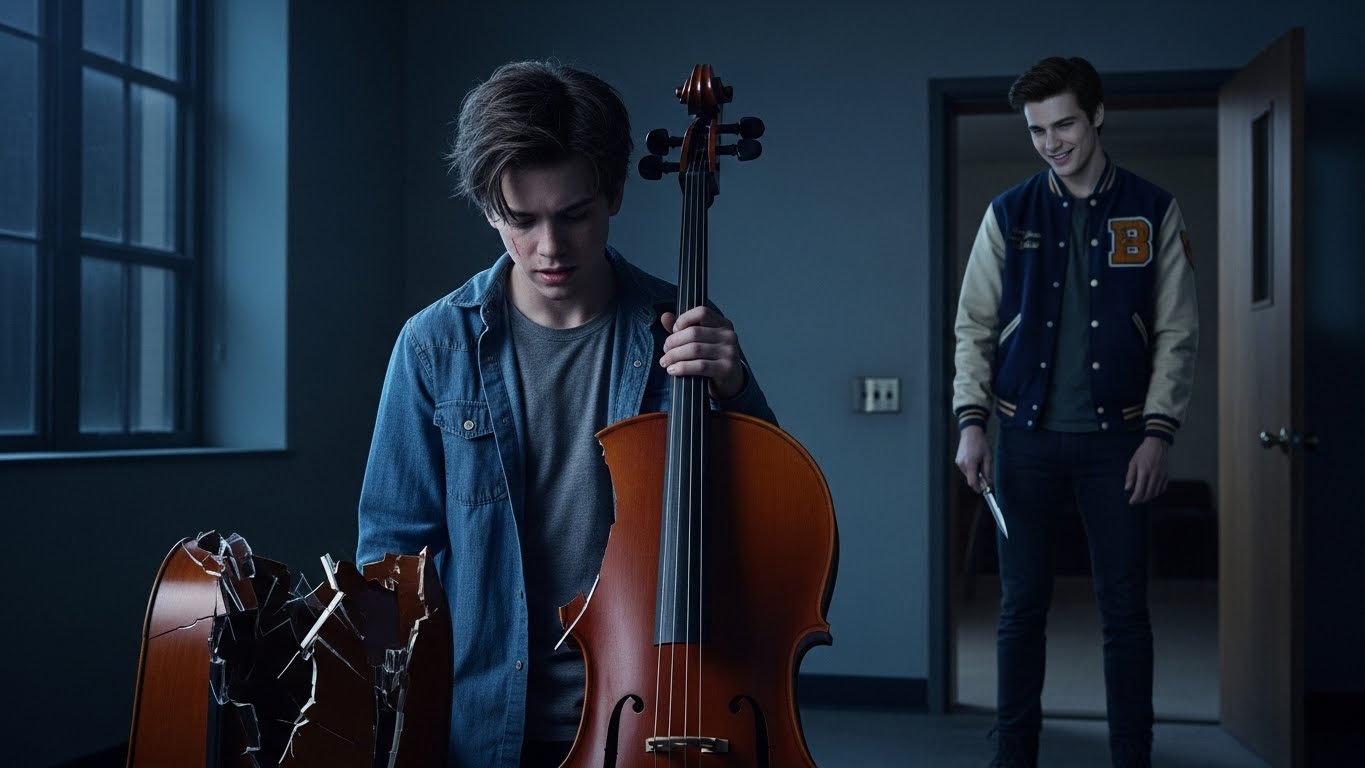
Brad Sterling was leaning against the doorframe. The Mayor’s son. The quarterback. The golden boy of Oakhaven. He was wearing his varsity jacket, smelling of expensive cologne and cheap beer, likely coming down from a late-night party. He wasn’t supposed to be here, but Brad Sterling went wherever he wanted.
“I didn’t know you played,” Brad said, walking into the room. He didn’t walk like Leo; he prowled. “I thought you just scrubbed toilets.”
“I’m practicing, Brad,” Leo said, his voice steady despite the thumping in his chest. “Please. I have to finish.”
Brad looked at the cello, then at the empty package of expensive strings on the floor. “Fancy strings for a janitor. Did you steal them?”
“I bought them,” Leo said, standing up, placing himself between Brad and the instrument. “Leave me alone.”
Brad laughed, a hollow, cruel sound. “You think you’re better than us, don’t you, Vance? Walking around the halls with your head down, like you’re some tragic hero. You’re just trash. My dad says your trailer park should be condemned.”
“Get out,” Leo said.
Brad’s eyes darkened. He hated resistance. He hated that Leo, the poorest kid in school, had never once begged for his approval. He stepped forward and shoved Leo hard.
Leo stumbled back, tripping over the music stand. He hit the floor hard. Before he could scramble up, Brad had grabbed the cello.
“No!” Leo screamed, scrambling forward. “Brad, don’t! Please!”
Brad held the instrument by the neck, swinging it casually. “It’s just wood, Vance. Like the floor you mop.”
“It’s my grandfather’s,” Leo begged, tears stinging his eyes. “Please. The competition is on Saturday.”
“The competition?” Brad smirked. He looked at the bridge of the cello, at the brand-new strings shimmering under the fluorescent lights. “You think you’re going to win?”
Brad reached into his pocket and pulled out a pocketknife.
Time seemed to slow down. Leo lunged, but Brad kicked him in the chest, sending him sprawling back onto the linoleum.
“Watch closely,” Brad whispered.
He didn’t smash the cello. That would be too loud. Instead, he brought the knife down on the A-string.
Snap.
The sound was like a gunshot in the quiet room. The string coiled back, dead.
“No…” Leo gasped, the air leaving his lungs.
Snap. The D-string.
“Stop it! You’re killing it!” Leo screamed, pulling himself up, ignoring the pain in his ribs.
Snap. The G-string.
Snap. The C-string.
In ten seconds, three months of hunger and labor were destroyed. The bridge of the cello collapsed with a clatter as the tension released. The instrument lay limp in Brad’s hands, voiceless.
Brad dropped the cello onto the floor. It landed with a sickening thud, the wood cracking slightly near the f-hole.
“Oops,” Brad said, folding his knife. He pulled out his phone, snapped a picture of Leo sobbing on the floor next to the broken instrument, and typed a caption. “Look at the Crybaby Janitor. Can’t handle the pressure.”
Leo stared at the tangled wires of the strings. A red haze filled his vision. It wasn’t just strings. It was Nana’s medicine. It was his dignity. It was his life.
He roared—a primal sound of pure anguish—and threw himself at Brad.
It was exactly what Brad wanted. He didn’t fight back; he let Leo shove him. Brad stumbled back, purposely tripping over a chair and hitting his head against the wall with a theatrical thud. He immediately slumped down, holding his head, groaning loudly.
“Help!” Brad yelled, though no one was there. “He’s crazy! He attacked me!”
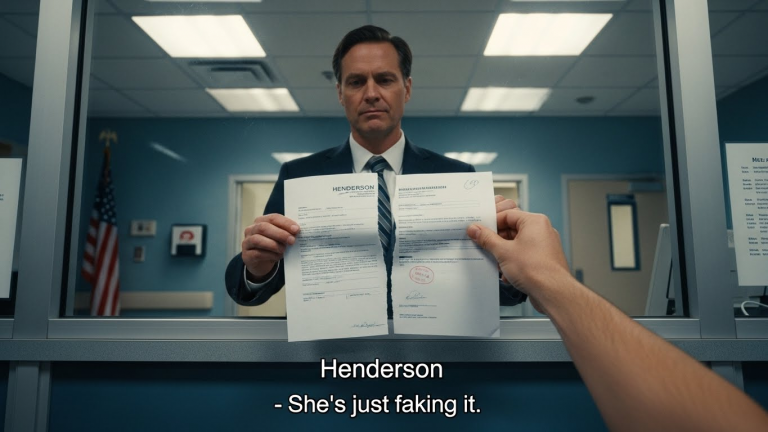
The door burst open. The night security guard, old Mr. Henderson, rushed in, flashlight beaming.
He saw Leo standing over the Mayor’s son, fists clenched, face contorted with rage. He saw Brad on the floor, clutching his head.
“Vance!” Mr. Henderson barked. “Back away! Now!”
“He cut my strings!” Leo screamed, pointing at the cello. “He destroyed it!”
“He attacked me,” Brad whimpered, putting on the performance of a lifetime. “I just came in to get my playbook… he just snapped…”
The next morning, the narrative was set. The Principal didn’t care about the strings. He cared that the star quarterback had a “concussion” before the playoffs and that the Mayor was on the phone threatening a lawsuit.
Leo was suspended for two weeks. Banned from school grounds.
Disqualified from the State Competition.
Leo walked out of the school gates at 10:00 AM, the broken cello strapped to his back. The winter wind bit through his thin coat. He had lost. The system hadn’t just beaten him; it had chewed him up and spat him out on the sidewalk. He looked up at the grey sky, waiting for tears, but he was too empty to cry. He was just a ghost now.
Chapter 2: The Longest Night
The walk to the trailer park was five miles. By the time Leo crunched up the gravel driveway, his hands were numb. The trailer sat on a patch of dead grass, the aluminum siding peeling like sunburned skin.
He opened the door, expecting the television to be blaring. Instead, silence.
“Nana?”
Leo dropped the cello case and ran to the bedroom. Empty. The bathroom. Empty.
Panic, cold and sharp, pierced through his numbness. The back door was ajar, swinging slightly in the wind.
“Nana!”
He ran outside. The snow had started to fall, dusting the grime of the trailer park in white. He followed the faint footprints leading toward the woods behind the lot. He ran until his lungs burned, screaming her name.
He found her a half-mile away, standing near the frozen creek. She was wearing only her nightgown and Leo’s oversized wool slippers. She was staring at the ice, shivering violently, her lips blue.
“Nana!” Leo scrambled down the bank and wrapped his coat around her frailty.
She looked at him, her eyes cloudy. “Walter?” she whispered, using his grandfather’s name. “The music stopped, Walter. I can’t hear the music.”
“I’m here, Nana. It’s Leo. Come on, we have to go inside.”
He practically carried her back. Inside, he wrapped her in every blanket they owned and cranked the heating unit, praying the propane wouldn’t run out. He sat by her side for hours, rubbing her freezing hands until the color returned.
When she finally fell asleep, Leo went to the kitchen table. He looked at the eviction notice buried under a pile of junk mail. He looked at the empty refrigerator. Then, his eyes drifted to the corner where the broken cello lay.
He had failed. He couldn’t protect the cello. He couldn’t protect Nana. He was seventeen, and his life was already over.
The thought came to him then, seductive and dark. The bridge. The high bridge over the Oakhaven River. One step, and the cold would take it all away. No more scrubbing floors. No more hunger. No more Brad Sterlings.
He stood up, putting his hand on the doorknob.
“Leo?”
Nana’s voice was weak, but clear. He froze.
“Leo, come here.”
He walked back to the sofa. She was looking at him, and for the first time in months, the fog in her eyes had lifted. She saw him.
“You were thinking of leaving,” she said softly. It wasn’t a question.
Leo fell to his knees beside her, burying his face in the blankets. “I can’t do it, Nana. They won. They broke the strings. I can’t play. I’m just… I’m just the janitor.”
Nana Rose reached out, her gnarled hand resting on his head. “Your grandfather didn’t play for trophies, Leo. He played because the music kept his soul from turning hard. You think strength is winning? You think strength is that boy who hurt you?”
She lifted his chin. “Strength isn’t in the fist, Leo. It’s in the heart. It’s in staying soft when the world tries to freeze you. If you break now, they win forever. But if you stand up… if you just stand up… you change the song.”
Leo wept. He cried for the strings, for the unfairness, for the cold. But when he stopped, the hollowness was gone. It was replaced by a cold, hard resolve.
He wouldn’t go to the bridge.
The next few days were a blur. Leo spent his suspension working odd jobs—shoveling driveways, fixing fences—anything to buy cheap replacement strings. They weren’t Larsens, they were generic wire strings, harsh and tinny, but they worked. He glued the crack in the cello’s body with wood glue.
He couldn’t go to the competition. But there was one event left.
The Winter Formal.
It was tonight. The school gym. The Mayor would be there. The whole town.
Rumors had spread on social media. Brad was bragging about a “special surprise” for the “Janitor King.” Someone had leaked that Brad had rigged the voting to make Leo the prom king as a joke.
Leo knew it was a trap. He knew walking into that gym was social suicide.
He put on his black suit—a thrift store find he had tailored himself. It was slightly shiny from wear, but he pressed it until the creases were razor-sharp. He polished his work boots until they gleamed.
He picked up the cello case.
“Where are you going?” Nana asked from her chair, watching him with knowing eyes.
“To finish the song,” Leo said.
Chapter 3: The Symphony of Mercy
The Oakhaven High gymnasium was transformed into a “Winter Wonderland.” Silver streamers hung from the rafters, and artificial snow covered the floor. The air was thick with perfume and the bass of pop music.
When Leo walked in, the music didn’t stop, but the conversation did. A ripple of silence spread outward from the door.
He wasn’t supposed to be there. He was suspended. But the teachers at the door were too stunned by his audacity to stop him. He didn’t look like the janitor tonight. He walked with his head high, the cello case in his hand like a weapon.
He walked straight to the stage, set up for the band. He placed the cello down.
Brad Sterling was standing near the punch bowl, surrounded by his entourage. He saw Leo and grinned. This was perfect. Better than he planned.
“Ladies and Gentlemen!” the DJ announced, clearly paid off by Brad. “We have a surprise entrant for King! Let’s welcome the man who cleans up our messes… Leo Vance!”
The crowd erupted in mock applause and laughter. Brad nudged his friends. “Watch this,” he whispered. “Carrie style.”
Brad slipped away from the crowd and headed toward the maintenance ladder behind the bleachers. He had spent the afternoon rigging a bucket of mop water mixed with trash from the cafeteria dumpsters up in the catwalks directly above center stage. All he had to do was pull the release pin.
Leo stood on the stage. The spotlight hit him. He blinked, blindingly bright. He saw the mocking faces. He saw the Mayor laughing in the front row.
“Speech! Speech!” someone chanted.
Leo stepped to the microphone. “I don’t have a speech,” he said, his voice amplified, echoing slightly. “I just have this.”
He sat down and opened the cello case.
High above, in the dark rafters, Brad was crawling along the catwalk. He was laughing to himself, imagining the sludge covering Leo’s cheap suit. He reached for the bucket.
But Brad, in his arrogance, had ignored the caution tape on the old catwalk section. The school budget had been cut to pay for the new football stadium, and maintenance had been deferred.
As Brad shifted his weight to pull the pin, the metal grating beneath his feet gave a groan.
CREAK.
Brad froze.
Then, with a screech of tearing metal, the bolt sheared off.
The catwalk swung down like a trapdoor.
The crowd below gasped as a shower of dust and screws rained down. Then, a scream.
Brad fell.
He didn’t hit the stage. His foot caught in a tangle of lighting cables and the safety netting of the broken catwalk. He was jerked to a violent halt, dangling upside down twenty feet above the stage, swinging wildly.
“Dad! Help!” Brad shrieked, flailing his arms.
The heavy lighting rig, destabilized by the sudden weight, groaned. A massive spotlight tore loose and smashed onto the stage, feet from where Leo was sitting. Glass exploded.
Panic erupted. The students screamed and stampeded toward the exits. The Mayor stood frozen, mouth agape, watching his golden son sway precariously above the hard wooden floor.
“The rig is coming down!” a teacher shouted. “Get back! Everyone back!”
The metal structure above groaned louder. Brad was slipping. The cable wrapped around his ankle was fraying against the sharp metal edge of the broken grate.
“I’m slipping! I’m slipping!” Brad sobbed. The arrogance was gone. He was just a terrified boy hanging over an abyss.
Leo stood up. He looked at the fleeing crowd. He looked at the Mayor, who was paralyzed by fear. He looked up at Brad.
This was it. Justice. Brad had destroyed his future. Fate was destroying Brad. All Leo had to do was walk away. No one would blame him.
Leo looked at his hands. Strength isn’t a fist.
Leo didn’t run away. He ran toward the maintenance ladder on the side of the stage.
“Leo, no! It’s unstable!” Mr. Henderson yelled from the floor.
Leo ignored him. He climbed. The ladder shook with every step. The structure was vibrating, threatening to collapse entirely.
He reached the catwalk level. It was tilted at a forty-five-degree angle. He crawled out onto the beam, the metal biting into his knees.
He was ten feet away from where the cable was holding Brad.
“Leo!” Brad screamed, seeing him. “Don’t touch me! You’ll drop me!”
“Shut up and reach out your hand!” Leo yelled, the command cracking like a whip.
Leo wrapped his legs around the main structural beam, locking himself in. He extended his body out over the drop. He was dangling now too, relying on his core strength—the strength built from pushing heavy mops and lifting heavy trash cans for years.
“Grab my hand!” Leo shouted.
The cable around Brad’s ankle snapped one strand. Ping. Brad dropped another six inches.
With a scream of terror, Brad reached out.
Leo caught his wrist. The weight was immense. It felt like his shoulder was being dislocated. He gritted his teeth, tears of pain squeezing out.
“I got you,” Leo grunted. “I’m not letting go.”
He pulled. He pulled with everything he had. He pulled with the anger, with the sadness, with the love for his grandfather.
“Grab the beam, Brad! Grab it!”
Brad scrambled, his fingers clawing at the metal beam Leo was perched on. He found a hold. Leo grabbed Brad’s belt and hauled him up onto the solid steel.
They lay there on the beam, twenty feet in the air, gasping for breath. The cable that had held Brad snapped fully and fell to the stage below with a whip-crack sound.
Silence filled the gym. The stampede had stopped. Everyone was looking up.
Brad was shaking uncontrollably, sobbing into the dusty metal. He looked at Leo. He looked at the boy whose life he had tried to ruin.
“Why?” Brad whispered, his voice trembling. “Why did you save me?”
Leo looked at him, his suit torn, his hands bleeding from the sharp metal.
“Because one of us had to be a man,” Leo said quietly.
The fire department got them down twenty minutes later.
When they reached the ground, the gym was silent. The Mayor rushed forward to hug his son. “Brad! My boy! Are you okay? We’ll sue the school! This is an outrage!”
Brad pushed his father away.
He stood wobbly on his feet. He looked at the crowd. He looked at the broken spotlight. He looked at Leo, who was quietly packing his cello, preparing to leave.
“Wait,” Brad said.
He walked over to Leo. The crowd held its breath.
Brad fell to his knees.
He didn’t care about the suit. He didn’t care about the image. He bowed his head.
“I’m sorry,” Brad choked out, loud enough for the room to hear. “I broke your strings. I rigged the vote. I… I was the one.”
He looked up, tears streaming down his face. “You saved my life.”
Leo zipped the case closed. He looked down at the boy who had tormented him. He didn’t feel triumph. He just felt peace.
“Don’t waste it, Brad,” Leo said.
Epilogue: Ten Years Later
The concert hall in Philadelphia was sold out.
Leo Vance stood at the podium, the conductor’s baton in his hand. He was older now, filled out, the haunted look of hunger long gone from his eyes.
He tapped the stand. The orchestra raised their instruments.
“This next piece,” Leo said to the audience, “is an original composition. It is dedicated to the memory of Rose Vance.”
He paused.
“And it is made possible by the Sterling Foundation for the Arts.”
In the front row, a man sat with his wife and child. He had a slight limp in his walk—a permanent reminder of a fall long ago. Brad Sterling smiled, watching the man on stage. He wasn’t the Mayor; he was a guidance counselor at Oakhaven High, working with at-risk kids.
Leo raised his baton. The music began. It started with a single cello, deep and resonant. It sounded like a struggle. It sounded like winter.
But then, the violins joined in. Soaring. Triumphant.
It was the sound of something broken, becoming whole again.