Bullies Threw a Disabled Orphan’s Most Prized Possession into a Tree—They Didn’t Know Who Was Watching.
Chapter 1: The Weight of the Wood
The October wind in Oak Creek, Virginia, possessed a cruelty that felt personal. It wasn’t just the temperature; it was the way the chill hunted for weaknesses. For twelve-year-old Danny O’Connor, that weakness was explicitly mechanical. The cold seeped into the steel hinges and the high-density polymer of the brace wrapped around his atrophied left leg, turning the metal into a ring of ice against his skin.
Walking was never a subconscious act for Danny. It was a manual operation, a constant mental checklist. Lift the hip. Swing the weight. Lock the knee. Plant.
Clunk. Drag. Step. Clunk. Drag. Step.
It was a jagged, syncopated rhythm that had become the soundtrack of his life for the last seven hundred and thirty days. Two years. Two years since the wet pavement on I-95. Two years since the screech of tires that sounded like the world tearing in half. Two years since he woke up in a hospital bed with a shattered leg and a shattered life, told by a weeping nurse that his father wasn’t in the room next door. His father wasn’t in any room anymore.
Danny paused at the edge of the sidewalk, adjusting the straps of his navy blue backpack. It cut into his shoulders, heavier than usual, but he welcomed the burden. The weight centered him. It reminded him of what he was carrying.
Inside the canvas bag, swaddled in his father’s old red-and-black flannel shirt—which still faintly smelled of cedar and gun oil—was a wooden shadow box. It was a heavy, mahogany rectangle, eighteen inches by twelve, sealed behind UV-protected glass.
Inside that glass lay the geometry of sacrifice: a tightly folded American flag, the blue field starry and dominant, displaying the precision of a military funeral. Pinned directly beneath the fabric was a silver shield, polished to a mirror shine, though it bore the microscopic scratches of a decade of service.
Sergeant. Precinct 4. Badge #4022.
Today had been “Heritage Day” at Oak Creek Middle School. The assignment was simple: bring something that represents where you come from.
Other kids had brought in sourdough starters that had been in their family since the Gold Rush. Some brought Civil War coins or quilts stitched by great-grandmothers. Danny had walked to the front of the class, the clunk-drag of his leg silencing the whispers, and he had placed the box on the teacher’s desk.
He hadn’t given a speech. He hadn’t read from a notecard. He just touched the glass above the badge and said, “This is my dad. He was a hero. And because of him, a whole family is alive today.”
He had seen the teacher, Mrs. Gable, wipe a tear from her eye. He had felt, for a fleeting moment, that he wasn’t just the “crippled kid.” He was Sergeant O’Connor’s son.
Now, walking home through Veterans Memorial Park, that armor of pride was beginning to thin. The park was a shortcut he usually avoided, a sprawling expanse of dying Bermuda grass and towering oaks that were currently shedding their fiery red leaves. It was isolated, quiet, and beautiful in a melancholic way.
But as Danny rounded the bend near the dilapidated gazebo, the beauty evaporated.
They were there.
Jason Miller was holding court on a park bench, his legs splayed wide in a display of aggressive relaxation. Jason was sixteen, a high school junior with a varsity jacket for a wrestling team he was on the verge of being kicked off of. He possessed a predator’s boredom—the kind that required a victim to alleviate. Flanking him were Kyle and Trent, two sophomores who functioned as his external hard drive for cruelty, laughing at jokes they didn’t get just to remain in his gravitational pull.
Danny’s heart hammered against his ribs. He kept his head down, eyes fixed on the gray asphalt. Just the rhythm. Clunk. Drag. Step. Don’t look up. Invisibility is a superpower. Use it.
“Well, well,” Jason’s voice drifted over, lazy and sharp, like a cat swiping at a mouse. “If it isn’t Lieutenant Limp.”
The laughter from Kyle and Trent was instant, a dry, crackling sound.
Danny didn’t stop. He tightened his grip on his backpack straps until his knuckles turned the color of bone. Mom is waiting. Pizza tonight. Just keep moving.
“Hey!”
The sound of boots hitting the pavement stopped Danny cold. Jason had moved with terrifying speed, the easy, fluid grace of someone whose body obeyed their commands without question. He stepped directly into Danny’s path, blocking the sun.
“I’m talking to you, Gimp,” Jason sneered, looking down. “What’s in the bag? You look like a turtle carrying a condo.”
“It’s nothing,” Danny whispered, his voice small. He tried to shuffle to the left.
Jason mirrored him, a wall of varsity wool and arrogance. “Doesn’t look like nothing. Looks heavy. You shouldn’t be carrying heavy things with that peg leg. Let me help.”
“No!”
Before Danny could retreat, Jason lunged. He grabbed the top handle of the backpack and yanked upward.
Danny’s center of gravity was a fragile thing. The sudden force threw him off. His braced leg locked, the metal strut catching at an awkward angle, and he went down. He hit the asphalt hard, the grit scraping his palms, a sharp jolt of pain shooting through his hip.
The backpack was ripped from his shoulders.
“Give it back!” Danny scrambled up, panic overriding the pain. “Please! It’s not a toy!”
Jason ignored him. He unzipped the bag with agonizing slowness, peering inside like he was inspecting contraband. He reached in and pulled out the flannel bundle. The shirt fell away, pooling on the ground, leaving the mahogany box exposed to the afternoon light.
The silver badge caught the sun, flashing a brilliant beam of light into Jason’s eyes.
“Ooh,” Jason mocked, feigning awe. “What do we have here? A participation trophy?”
“It’s my dad’s!” Danny screamed, lunging for it.
Trent stepped in, shoving Danny back with a firm hand to the chest. Danny stumbled, barely keeping his feet.
Jason held the box up, tilting it. He looked at the flag. He looked at the badge. There was no recognition of sanctity in his eyes. There was only the calculation of leverage. He saw a way to hurt, and he took it.
“Your dad?” Jason scoffed. “What, is he a mall cop? Did he get this for catching a shoplifter?”
“He was a Sergeant!” Danny yelled, the tears finally spilling over, hot and humiliating. “He died saving people!”
Jason weighed the box in his hands. He looked up. Above them, the Great Oak of the park stood like a sentinel. Its massive, gnarled limbs stretched toward the sky, a chaotic web of wood. The lowest branches were perhaps ten feet up, but the dense, secure crooks were much higher—twenty, maybe twenty-five feet.
“You want it?” Jason grinned. It wasn’t a smile; it was a baring of teeth. “Go get it.”
He stepped back, winding up his arm like a quarterback going for a Hail Mary.
“No! Don’t!” Danny screamed, a raw, guttural sound.
Jason launched the shadow box.
It spun end over end, a dark blur against the blue sky. The wood glinted. It soared upward, punching through the canopy of drying leaves, snapping small twigs. It reached the apex of its arc and then fell, wedging itself firmly into a V-shape between two thick branches, high above the ground.
It sat there. High. Unreachable. Silent.
Danny stared up, his mouth open, his breath hitching in his throat. It looked so small up there.
“There you go,” Jason dusted his hands off, satisfied with his work. “Go on, Spider-Man. Climb up and get it.”
Danny looked at the tree. The bark was rough, deep-fissured, and slick with moss on the north side. He looked down at his heavy, metal-encased leg. He couldn’t even navigate a curb without planning. Climbing a tree was a biological impossibility.
“I… I can’t,” Danny whispered, the despair crushing him.
“Aww,” Jason pouted, pulling out his smartphone. “Look at him, guys. He’s gonna cry. Should we call his mommy? Oh wait…”
Danny dragged himself toward the trunk. He had to try. He placed his hands on the rough bark, the grit digging into his skin. He tried to pull himself up, gritting his teeth, straining his arms. But as soon as he tried to engage his legs, the brace acted like an anchor. He slipped, scraping his chin against the wood, and collapsed back into the dirt.
The laughter from the three boys echoed through the park, loud, jagged, and devoid of mercy.
Chapter 2: The Silence of the Siren
The humiliation was a physical sensation, heavy and suffocating, like wet concrete being poured into Danny’s chest. He lay at the base of the oak tree, his cheek pressed against the cold, damp earth. He could smell the decay of the fallen leaves and the metallic scent of the asphalt.
Above him, the laughter continued. It had evolved. It wasn’t just amusement anymore; it was performance art.
“Do it again!” Trent jeered. He was holding his phone horizontally, the camera lens a black, unblinking eye trained on Danny’s misery. “Try to jump this time! Come on, hop for us!”
Danny squeezed his eyes shut. In the darkness behind his eyelids, he tried to summon his father. He tried to remember the sensation of being lifted, of strong arms tossing him into the air in the backyard, the feeling of absolute safety. Dad would know what to do. Dad would fix this.
But Dad was in the box. And the box was twenty-five feet in the air, held prisoner by gravity and the cruelty of bored teenagers.
“What’s the matter?” Jason taunted, kicking a spray of dirt near Danny’s face. “Cat got your tongue? Or did the cat eat your legs too?”
Danny pushed himself up to a seated position. He wiped the dirt from his face with a trembling hand. He wouldn’t give them the satisfaction of a sob. He swallowed the scream building in his throat.
“It’s a burial flag,” Danny said. His voice shook, but it was clear. “It’s sacred.”
“Sacred,” Jason mimicked, making a mocking sign of the cross in the air. “It’s wood and cloth, kid. It’s trash if you can’t reach it. It’s bird nesting now.”
Danny stared at them. He realized, with a terrifying clarity, that they didn’t care. They truly didn’t care. To them, the flag was just a colored rag. The badge was just shiny metal. The world was just things to be broken.
Suddenly, the air changed.
It wasn’t a sound at first. It was a feeling. A subtle vibration in the ground that traveled up through Danny’s good leg. The squirrels on the nearby lawn froze.
Then came the noise. It wasn’t the long, wailing siren of a movie chase. It was a short, sharp, aggressive sound.
WHOOP-WHOOP.
It cut through the laughter like a guillotine blade.
Jason froze mid-laugh. Trent lowered his phone, the screen going dark against his leg. Kyle took a nervous step back.
Fifty yards away, a black, unmarked Chevrolet Tahoe hopped the curb. It didn’t slow down for the grass. It tore across the park lawn, its all-terrain tires tearing up long strips of sod, heading straight for them. The front grille guard looked like the bared teeth of a predator.
Behind it, two marked patrol cruisers swerved into the park entrance, their blue and red lights silent but blindingly bright, creating a strobe effect that boxed in the entire area.
The Tahoe slammed to a halt ten feet from the boys. The suspension groaned as the heavy vehicle settled. Dust swirled in the air, coating Jason’s varsity jacket.
The driver’s door opened. A heavy black tactical boot hit the grass.
Chief Frank Garrison stepped out.
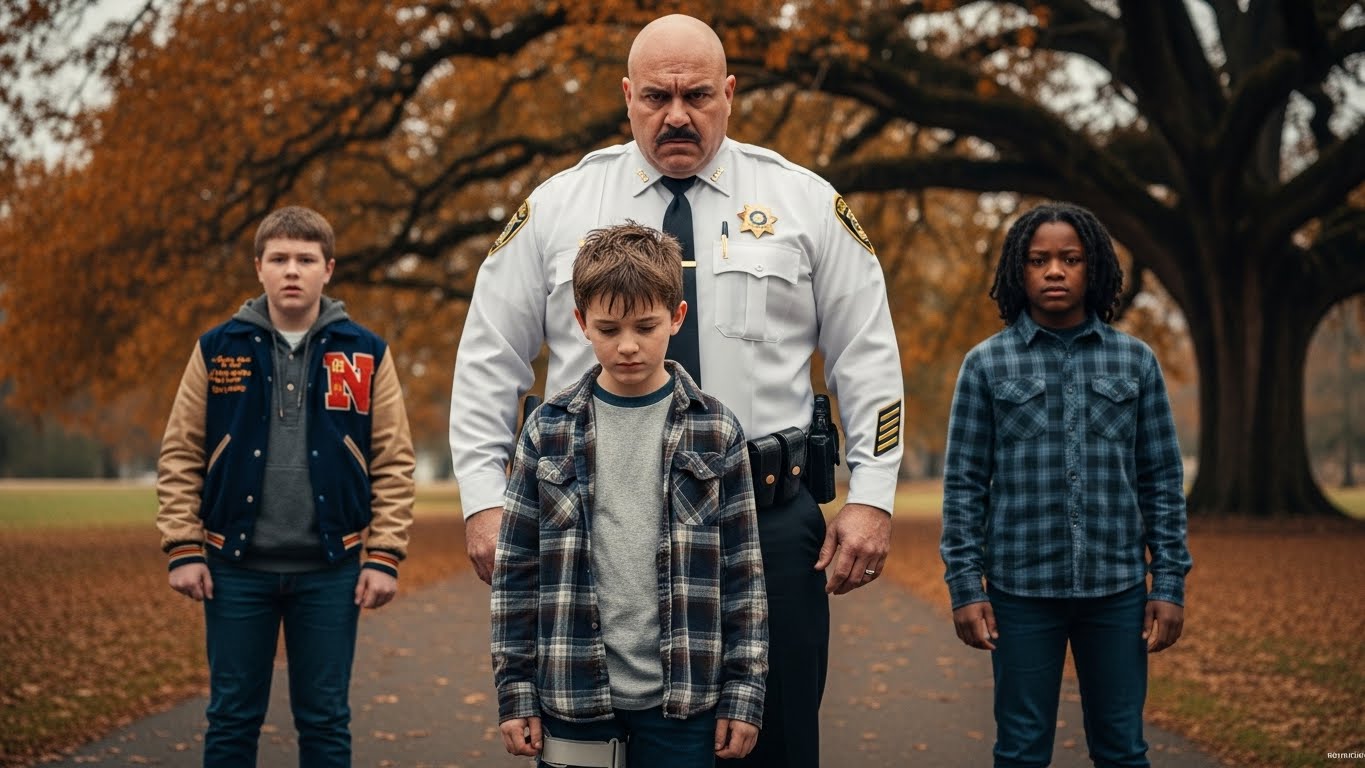
In Oak Creek, Frank Garrison was not just a police officer; he was a geographical feature. He was a man carved out of granite and Old Testament morality. He had thirty years on the force, hair the color of steel wool cropped close to a scarred scalp, and shoulders that looked like they carried the weight of the entire county. He was wearing his white command shirt, the gold stars on his collar catching the sun.
He didn’t look angry. He looked disappointed. And for anyone who had grown up in Oak Creek, Frank Garrison’s disappointment was infinitely worse than his anger. Anger passed. Disappointment lingered like a scar.
He slammed the car door. The sound echoed like a gunshot across the quiet park.
He didn’t look at the bullies. He didn’t acknowledge their existence yet. He walked straight past them, a battleship cutting through water, creating a wake of silence. He walked directly to Danny.
He knelt.
The movement was slow, deliberate. The bullies shrank back. Jason, usually so full of bravado, looked suddenly very young and very small.
“You hurt, son?” Garrison asked. His voice was a low rumble, like distant thunder.
Danny looked up, wiping his nose with his sleeve. He recognized the Chief. Everyone did. Garrison had been at the funeral. He had handed Danny the flag two years ago.
“No, sir,” Danny stammered. “Just… just scraped.”
“Can you stand?”
“Yes, sir.”
Garrison offered a hand. It was the size of a catcher’s mitt, calloused and warm. He pulled Danny up gently, holding him steady, waiting until the boy found his balance on the brace. He dusted off Danny’s shoulder with a tenderness that seemed impossible for a man of his size.
“What happened here?” Garrison asked. He still hadn’t looked at Jason.
Danny pointed a shaking finger upward. “My dad. They threw him in the tree.”
Garrison frowned, his brow furrowing deep channels in his forehead. “Your dad?”
“His flag,” Danny choked out, fresh tears spilling. “And his badge. It’s in the box.”
Garrison’s head snapped up. He followed the boy’s finger. He squinted against the sun, scanning the complex network of branches.
He saw it. The mahogany box, wedged high in the oak, gleaming dully.
He stared at it for a long moment. His jaw tightened. A muscle in his cheek jumped. He took a slow breath, inhaling through his nose, exhaling through his mouth.
Then, slowly, terrifyingly slowly, he turned to face Jason, Kyle, and Trent.
He took off his sunglasses. His eyes were steel gray and colder than the bottom of the ocean.
The silence that descended on the park was heavy enough to crush lungs.
Chapter 3: The Definition of Worth
Chief Garrison walked toward the three teenagers. He moved with a heavy, deliberate cadence, his boots crunching on the dry autumn leaves. He stopped exactly two feet away from Jason Miller.
Jason was tall for his age, nearly six feet, but standing in front of Frank Garrison, he looked like a child trying to wear his father’s suit. The Chief didn’t blink. He seemed to suck the oxygen out of the immediate vicinity.
“Do you know what that is?” Garrison asked.
His voice wasn’t loud. It didn’t need to be. It was a subsonic rumble that vibrated in the chest cavity. It was the voice of a man who had told mothers their sons were never coming home, a voice that commanded attention not through volume, but through gravity.
Jason swallowed hard, his Adam’s apple bobbing nervously. He looked at his friends, but Kyle and Trent were staring at their shoes, paralyzed.
“It… it was just a joke,” Jason stammered. His hands, usually so confident when shoving smaller kids, were now trembling at his sides. “We were just… you know, messing around. It’s just a box, sir.”
“Just a box,” Garrison repeated. He tasted the words, chewing on them as if they were spoiled meat.
He took a half-step closer. Jason instinctively took a step back, nearly tripping over the park bench.
“That box,” Garrison said, his voice rising just enough to cut through the wind, “contains the burial flag of Sergeant Mike O’Connor. Do you know who that is?”
Jason shook his head rapidly. “No. No, sir. I didn’t know.”
“Two years ago,” Garrison began, addressing the boys but speaking with a volume that carried to the gathering crowd on the sidewalk, “Mike O’Connor was off duty. He was driving home to his wife and ten-year-old son. He was on I-95, near the Occoquan bridge.”
Garrison pointed a finger at Danny, who was watching with wide, watery eyes, clutching his backpack straps.
“He saw a minivan—a Honda Odyssey—lose traction in the rain. It hit the jersey barrier, flipped three times, and landed on its roof. The fuel line ruptured immediately. The car was on fire before it stopped sliding.”
The park was silent. Even the wind seemed to die down to listen.
“Mike didn’t call it in and wait,” Garrison continued, his eyes drilling into Jason. “He pulled over. He ran toward the fire. The heat was so intense it was melting the paint off the guardrails. He crawled into the backseat.”
Jason’s face went pale. The color drained out of him so fast he looked translucent.
“He pulled a seven-year-old boy out of the backseat,” Garrison said, his voice cracking slightly with suppressed rage. “He handed him to a bystander. Then he went back in. He cut the mother’s seatbelt. He dragged her out through the broken glass. He went back for the father.”
Garrison leaned in, his face inches from Jason’s. The Chief smelled of coffee and old leather.
“The tank exploded,” Garrison whispered. “Mike O’Connor burned to death so a family of strangers could sit at a dinner table tonight. That flag was draped over a closed casket, son, because there wasn’t enough of Mike left to show his family. That badge is the only thing his son has left to prove his father walked this earth.”
Garrison straightened up, towering over the boy. “And you threw it in a tree because you were bored.”
“I… I didn’t know,” Jason whispered. Tears were forming in his eyes now—not tears of remorse, but tears of terrified self-preservation. “I swear, Chief, I didn’t know.”
“Ignorance is not a defense for cruelty,” Garrison snapped. “You saw a boy who couldn’t walk, a boy carrying a heavy load, and you decided to make his life harder. You didn’t just throw wood and glass, son. You desecrated a monument.”
Garrison turned away from them, visibly disgusted, as if looking at them caused him physical pain. He grabbed the radio microphone clipped to his shoulder.
“Dispatch, this is Chief Garrison.”
The static crackle was loud in the quiet park. “Go ahead, Chief.”
“I have a Priority One situation at Veterans Memorial Park,” Garrison said, his eyes fixed on the shadow box high in the tree. “I need Ladder Company 4. Get them here. Now.”
“Ladder 4? Is there a fire, Chief?”
“No,” Garrison said, his voice thick with emotion. “There’s a rescue operation.”
Chapter 4: The Ascent
The wail of the fire engine was different from the police sirens. It was a deep, guttural roar that shook the windows of the houses lining the park. It was a sound that commanded the road.
Within three minutes, the massive red truck, Ladder 4, turned the corner. Its air brakes hissed as it slowed, the sheer size of the machine seeming to fill the entire street.
By now, a crowd had gathered. It wasn’t just passersby anymore. Neighbors had come out onto their porches. Parents picking up kids from the nearby elementary school had stopped. People walking dogs paused.
They all saw the tableau: The police cruisers, the black SUV, the three teenage boys huddled together looking like they wanted to dissolve into the molecular structure of the air, and the boy with the leg brace standing next to the Chief of Police.
Captain Miller of the Fire Department jumped out of the rig before it had even fully settled. He was a wire-thin man with soot-stained gear and eyes that had seen too much. He saw Garrison and jogged over.
“What’s the situation, Frank? Everyone okay? We heard Priority One.”
Garrison pointed to the tree. “Sergeant O’Connor’s shadow box. It’s twenty-five feet up, wedged in the fork.”
Captain Miller looked up. He squinted. Then he stiffened. He had been at the funeral. He remembered the bagpipes playing ‘Amazing Grace.’ He remembered the hollow look in Danny’s eyes that day.
He looked at the teenage boys. His expression shifted from professional concern to a look of pure, unadulterated disdain. Then he looked at Danny.
“We’re on it,” Miller said softly.
He turned to his crew, who were already stepping off the truck. “Alright, listen up! We are deploying the main aerial. This is not a standard retrieval. This is a delicate recovery operation. I want white gloves. Treat that object like it is a living infant. Do you understand me?”
“Yes, Sir!” the four firefighters shouted in unison.
The crowd watched in awe. This wasn’t just a retrieval; it was a ceremony.
The hydraulic stabilizers of the truck hissed and extended, planting into the asphalt like the legs of a giant metal spider. The truck lifted slightly off its suspension. The massive white ladder began to extend, rising from its bed, rotating toward the canopy of the oak tree.
A firefighter named Sanchez, wearing full turnout gear, clipped himself into the safety harness at the top of the ladder bucket. He didn’t rush. He moved with practiced, reverent precision.
Danny held his breath. He watched the white bucket rise. It pushed through the lower branches, shaking loose a cascade of orange leaves that drifted down like confetti.
Sanchez reached the top. He signaled the operator below to stop. The bucket hovered inches from the wedged box.
The park was dead silent. A hundred people were watching, and nobody made a sound.
Sanchez reached out. He tested the stability of the branch. He gently dislodged the box. He checked the glass. He used a microfiber cloth from his pocket to wipe a smudge of dirt off the wood.
Then, he didn’t just toss it in the bucket. He held the box against his chest, covering it with his arms to protect it, and signaled for the descent.
As the ladder retracted, a collective breath was released by the crowd.
When the bucket reached the ground, Sanchez stepped out. He didn’t hand the box to the Captain. He walked straight over to Chief Garrison and Danny.
He stopped in front of Danny. He was a large man, smelling of smoke and sweat, but his eyes were kind. He held the box out with two hands, presenting it.
“Your dad was a good man, son,” Sanchez said, his voice thick. “We worked that crash. He was… he was the best of us. It’s an honor to bring him back to you.”
Danny took the box. It was cold from the wind, but it felt warm in his hands. He hugged it to his chest, burying his face in the flannel, smelling the faint scent of cedar.
“Thank you,” he sobbed into the wood. “Thank you.”
Chief Garrison and Captain Miller stood at attention. Slowly, Garrison raised his hand to his brow in a crisp, sharp salute. Captain Miller followed. Then the other officers. Then the firefighters.
For ten seconds, the only sound in the park was the wind in the trees and the quiet, relieved crying of a twelve-year-old boy.
Chapter 5: The Tallest Man in the Park
The ceremony ended. The reality returned.
Chief Garrison dropped his salute. The moment of reverence evaporated, replaced by the cold, hard machinery of justice. He turned back to Jason, Kyle, and Trent.
The crowd was watching them now. Hundreds of eyes. It wasn’t just anger; it was judgment. The community had seen what they did. The boys were trembling uncontrollably now. The adrenaline of the bully had been replaced by the nausea of the accused.
“Am I… am I going to jail?” Jason asked, his voice a high-pitched squeak that betrayed his age.
Garrison looked at him. “You committed Assault when you shoved him. You committed Disorderly Conduct. And, in the eyes of this department, you committed Desecration of a Venerated Object.”
Jason started to cry. Ugly, heaving sobs. “I’m sorry. I’m sorry. Please don’t call my dad.”
“You’re sorry you got caught,” Garrison said, his voice devoid of sympathy. “And your father is already on his way. I called him myself.”
Garrison pulled a pair of handcuffs from his belt. The metallic click-click as he cuffed Jason’s hands behind his back was loud and final.
“You wanted attention, Jason?” Garrison said, guiding him toward the patrol car, his hand firmly on the boy’s neck. “You wanted an audience? Well, you got one. Everyone here sees you. And they don’t see a tough guy. They don’t see a varsity wrestler. They see a coward who picks on orphans.”
The other officers cuffed Kyle and Trent. As they were led into the back of the cruisers, the crowd didn’t boo or shout. They just stared. It was the stare of a community that had decided these boys were no longer part of the tribe. It was a social exile far worse than any detention.
Garrison closed the door on the cruiser, sealing Jason inside the cage. He walked back to Danny.
“Come on, Danny,” Garrison said gently. “I’m driving you home.”
“In the Chief’s car?” Danny asked, looking at the black Tahoe.
“In the Chief’s car,” Garrison smiled, the first time his face had softened all afternoon. “I think you’ve earned a police escort. And I think we’ll run the lights, just for fun.”
The ride to Danny’s house was quiet. Danny held the box on his lap, tracing the outline of the badge with his finger. The lights flashed against the passing houses, but the siren was off.
“Chief?” Danny asked after a few miles.
“Yeah, son?”
“Why did you come? How did you know?”
“Mrs. Higgins across the street called it in,” Garrison said, keeping his eyes on the road. “She said some punks were messing with Mike’s boy. But even if she hadn’t… Danny, your father was my friend. In this family—the blue family—nobody fights alone. When you mess with a cop’s kid, you get the whole force.”
They pulled up to Danny’s driveway. His mother was already on the porch, looking terrified seeing the police car, her hands covering her mouth, until she saw Danny wave through the window.
Garrison put the car in park. He turned in his seat to look at the boy. The hard lines of his face seemed to melt away, leaving just a tired, kind man.
“Danny, look at me.”
Danny looked up.
“I saw you try to climb that tree,” Garrison said. “I saw you try to fight them when they took the bag.”
“I fell,” Danny said, looking down at his brace, shame coloring his cheeks. “I couldn’t do it. I was weak.”
“You didn’t fall,” Garrison said firmly. “You stood your ground. A man isn’t measured by how fast he can run or how high he can climb. He’s measured by what he’s willing to defend.”
Garrison reached over and squeezed Danny’s shoulder. His grip was reassuring, solid as oak.
“My knees aren’t what they used to be either, kid. But remember this: A man stands tallest when he kneels to help others. Or when he stands up for what’s right, even when he’s standing on one leg. You were the tallest man in that park today, Danny. Never forget that.”
Danny looked at the Chief. For the first time in two years, the shame of the brace felt a little lighter. The metal didn’t feel like a cage; it felt like armor. He looked down at his dad’s badge. It seemed to shine a little brighter.
“Thanks, Chief,” Danny smiled.
“Go on,” Garrison nodded toward the house. “Your mom is waiting. And Danny? Next time someone gives you trouble… you call me. Directly.”
Danny opened the door. He stepped out. Clunk. Drag. Step.
But this time, his head was up. He walked up the path to his mother, carrying his father’s legacy in his arms, while the Chief of Police waited until he was safely inside before driving away to finish his shift.
Chapter 6: The Digital Wildfire
The morning after the incident, the silence in Danny’s room was heavy, but it was a different kind of silence. It wasn’t the lonely, cold silence of the previous months. It felt charged.
Danny woke up to the sound of rain tapping against his windowpane. For a moment, he lay there, staring at the ceiling, the ghost of yesterday’s humiliation trying to creep back in. He reached down and touched his left leg. The scar tissue was still there. The metal brace was sitting on the nightstand, waiting like a loyal dog.
He reached for his phone to check the time.
His screen was a wall of white notifications.
Instagram: 99+ notifications. TikTok: You have been tagged in a video. Local News Oak Creek: “Viral Video Shows Police Chief Defending Veteran’s Son.”
Danny’s heart skipped a beat. His fingers trembled as he unlocked the phone.
The video was everywhere. It had been filmed by someone standing near the gazebo. The camera was shaky, but the audio was crystal clear.
It showed everything. It showed Jason throwing the box. It showed Danny falling in the dirt. It showed the laughter.
And then, it showed the Tahoe tearing across the grass.
Danny watched, mesmerized, as the digital version of Chief Garrison stepped out of the car. On the small screen, the Chief looked like an avenging angel. The video cut to the firefighter, Sanchez, handing the box to Danny. It ended with Garrison’s line, captioned in bold yellow text: “A man stands tallest when he kneels to help others.”
The views were climbing by the second. 2.4 million views. 2.5 million.
Danny opened the comments. He expected the usual internet toxicity. He braced himself for jokes about his walk or his fall.
Instead, he saw a tidal wave of support.
“Who is this kid? I want to send him a new backpack.” “My dad was a Sergeant in Philly. This made me cry. Respect to the Chief.” “Those bullies need to be expelled. Name and shame!” “That walk… that kid is tougher than those three punks combined.”
Danny lowered the phone. He looked over at his dresser. The shadow box was there, safe, the glass polished clean.
Downstairs, he heard his mother on the phone. Her voice was frantic but happy. “Yes, hello? Oh, my goodness. Thank you. Yes, he’s awake. No, we don’t need money, but thank you.”
Danny put on his brace. Click. Snap. Tighten.
He stood up. He walked to the mirror. He looked at himself. Yesterday, he had seen a broken thing. Today, millions of people were seeing a survivor.
He walked downstairs. His mother was in the kitchen, holding a cup of coffee with two hands. She looked at him, her eyes red from crying, but she was smiling.
“Danny,” she said softly. “The phone hasn’t stopped ringing. The Mayor called. The Fire Chief called. People are leaving flowers on the porch.”
Danny walked to the front door and opened it.
On the welcome mat, there were bouquets. There were handwritten cards. There was a brand new American flag, still in the packaging, with a note: “For the Sergeant.”
The town of Oak Creek hadn’t just watched the video. They had woken up.
Chapter 7: The Shift in the Wind
Walking into Oak Creek Middle School that Monday felt like walking onto a different planet.
Usually, Danny’s arrival was marked by the parting of the crowd—not out of respect, but out of awkward avoidance. Kids didn’t want to get stuck behind the slow kid. They didn’t want to look at the brace.
Today, the hallway stopped.
As Danny pushed through the double doors, the clunk-drag of his step echoed on the linoleum. Conversations died out. Heads turned.
Danny gripped his backpack straps, his instinct to hide kicking in. He kept his eyes on the floor, counting the tiles. One, two, three.
“Hey, Danny.”
Danny stopped. He looked up.
It was Sarah, one of the popular girls who sat in the front row of English class. She never spoke to him. She was standing by her locker, holding her books.
“I saw the video,” she said. Her voice wasn’t mocking. It was quiet. “I didn’t know about your dad. That was… that was really brave.”
Danny blinked. “Thanks.”
“Is it true?” a boy named Marcus asked, stepping forward. “Did the Chief really arrest Jason?”
Danny nodded. “Yeah.”
“Good,” Marcus said, slamming his locker shut. “Jason’s a jerk. He threw my gym bag in the toilet last week. I’m glad someone finally stood up to him.”
A strange thing happened then. A ripple effect.
Other kids started nodding. The fear that Jason Miller had projected over the school like a shadow had evaporated. The video hadn’t just exposed Jason’s cruelty; it had exposed his weakness. It showed him crying in handcuffs. It stripped away the mystique of the bully.
Danny walked to his first class. He wasn’t walking alone. Marcus walked next to him, matching his slow pace without complaining. Two other boys fell in behind them. It wasn’t a parade, but it was a phalanx.
When he got to homeroom, Mrs. Gable was at her desk. She looked up and smiled.
“Danny,” she said. “The Principal would like to see you.”
Danny’s stomach tightened. “Am I in trouble?”
“No,” she said gently. “I think he wants to apologize.”
Danny walked to the office. The door was open. Principal Henderson was sitting behind his desk, looking pale. Sitting across from him were two people Danny recognized from the grocery store—Jason’s parents.
Mr. Miller looked furious, but not at Danny. He was holding a printout of an email. Mrs. Miller was weeping into a tissue.
“Danny,” Principal Henderson stood up. “Please, come in.”
Mr. Miller stood up too. He was a tall man, successful, wearing a suit that cost more than Danny’s mother made in a month. He looked at Danny, then looked down at the leg brace. He seemed to shrink.
“Danny,” Mr. Miller said. His voice was rough. “I saw the video. I… I had no idea my son was capable of that kind of malice.”
He walked over and extended a hand. Danny hesitated, then took it.
“I am so sorry,” Mr. Miller said. “Jason is suspended. We are dealing with the legal issues now. But I wanted you to know… that is not how we raised him. And he will be making a public apology, if you are willing to hear it.”
Danny looked at this powerful man, broken by the shame of his son’s actions.
“I don’t need an apology,” Danny said quietly. “I just need him to leave me alone. And leave my dad alone.”
“He will,” Mr. Miller promised. “He will.”
Danny walked out of the office. He felt lighter. The weight of the victim had been lifted. He realized that the power Jason held over him was never real. It was borrowed fear. And the bill had come due.
Chapter 8: The Legacy
Three weeks later, the leaves in Veterans Memorial Park had turned from fiery red to a dull, crunchy brown. The air was sharp with the promise of winter.
It was November 11th. Veterans Day.
The park was packed. The entire town had turned out. There were rows of folding chairs set up on the grass, occupied by men in VFW caps and families in thick coats. A podium stood near the gazebo—the same gazebo where Danny had been tormented just weeks before.
Danny sat in the front row, next to his mother. On his other side sat Chief Frank Garrison.
The Chief was in his dress blues today, medals gleaming on his chest. He looked like a statue brought to life.
“You ready, son?” Garrison leaned over and whispered.
Danny nodded. He was terrified, but he was ready.
The Mayor gave a speech. The high school band played the anthem. And then, Chief Garrison walked to the podium.
“We talk a lot about heroes on this day,” Garrison’s voice boomed over the speakers. “We talk about battles fought in deserts and jungles. But sometimes, the battle is right here. Sometimes, the bravest thing a person can do is walk from point A to point B when every step hurts.”
The crowd went silent.
“We have a young man here today,” Garrison continued. “Who reminded this town what the flag actually means. It’s not just fabric. It’s a promise. A promise that we take care of each other.”
Garrison gestured to the front row. “Danny O’Connor, front and center.”
Danny stood up.
Clunk. Drag. Step.
The sound was amplified by the silence. He walked toward the podium. He didn’t rush. He didn’t hide the limp. He owned it. It was the sound of his survival.
He climbed the three steps to the gazebo stage—the stairs he couldn’t climb before, now outfitted with a temporary ramp the town had installed just for today.
He reached the podium. He looked out at the sea of faces. He saw his teachers. He saw Marcus. He saw the firefighter, Sanchez.
And in the back, standing near the edge of the crowd, wearing a gray hoodie and looking down at the ground, was Jason. He was picking up trash with a pointed stick—community service. He looked up for a brief second, met Danny’s eyes, and looked away. There was no hate in his eyes anymore. Just regret.
Danny reached into his jacket pocket. He pulled out the silver badge. #4022.
He held it up to the microphone.
“My dad was a hero,” Danny said. His voice didn’t shake. “He died saving strangers. For a long time, I thought I was broken because I couldn’t run like him. I thought the wood in that box was all I had left of him.”
Danny looked at the Chief, then back at the crowd.
“But the Chief told me that you stand tallest when you stand up for what’s right. This brace on my leg… it holds me up. But you guys… you held me up too.”
Danny took a breath.
“This is for Sergeant Mike O’Connor. End of watch, October 14th. But he’s not gone. He’s right here.”
Danny tapped his chest, right over his heart.
The applause started slowly. One pair of hands. Then another. Then, it became a roar. The people of Oak Creek stood up. The veterans stood and saluted. The Chief stood at attention.
Danny O’Connor stood on the stage, the wind catching his hair. He felt the cold steel of the brace against his leg, but he didn’t feel the weight.
For the first time since the accident, he didn’t feel heavy. He felt like he could fly.
He looked up at the great oak tree. The branches were bare now, stripped of their leaves, open to the sky. The trap was gone. The sky was wide open.
Danny smiled, pocketed the badge, and began the long, proud walk back down.
Clunk. Drag. Step.