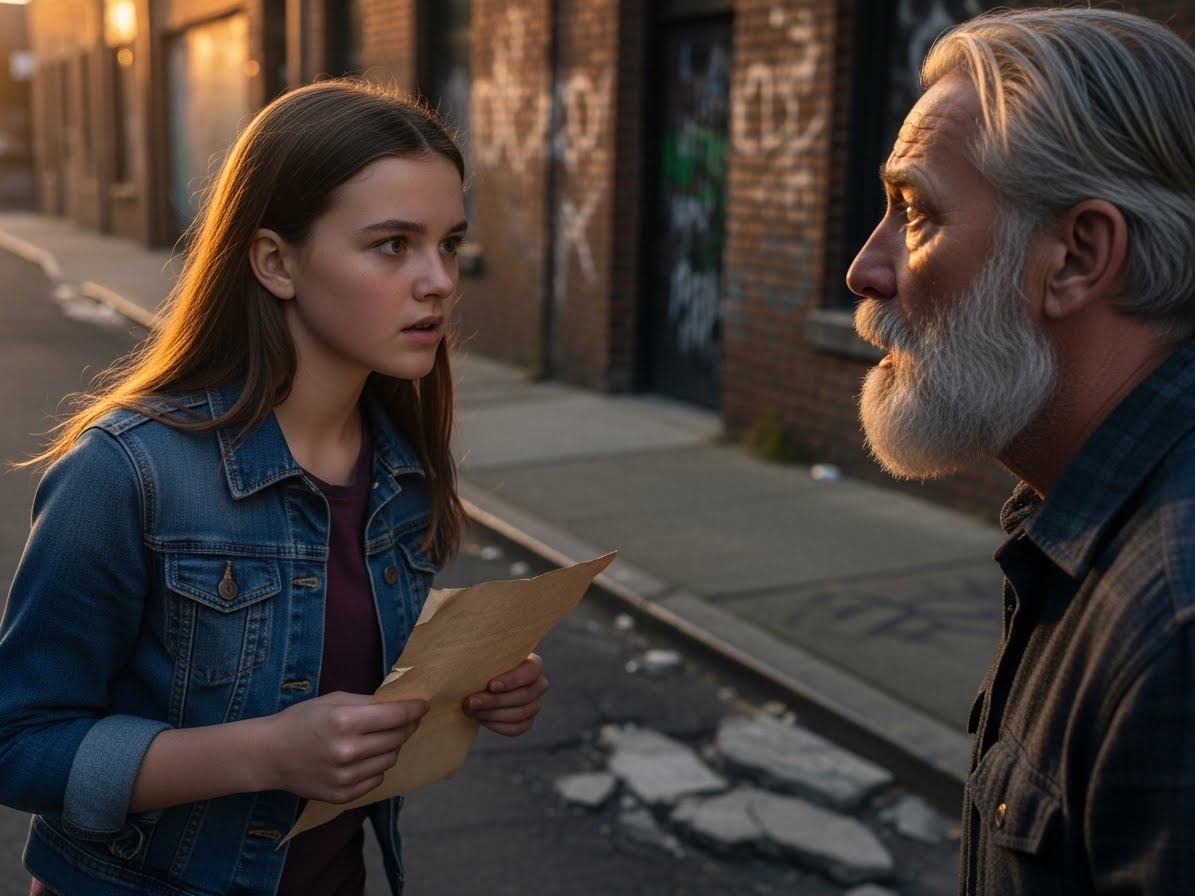
I Found A Stranger’s 40-Year-Old Letter Hidden In A Library Book. It Confessed To A Crime That Wasn’t Illegal, But Was Definitely Dangerous. When I Tracked Him Down, I Realized He Was Holding The Key To Saving My Entire Neighborhood.
PART 1
Chapter 1: The Paper Ghost
The Eastwood Public Library smells like wet wool, floor wax, and the slow decay of paper. To most people, it’s a depressing smell. To me, it’s the only perfume that matters. It smells like safety.
My name is Lily. I’m sixteen years old, and I am an expert at being invisible.
In Eastwood, invisibility is a superpower. If you’re invisible, the landlords don’t ask you where your mom is when the rent is late. If you’re invisible, the truant officers walk right past you on 5th Street. If you’re invisible, you don’t get hurt.
It was a Tuesday in November, the kind of day where the sky is the color of a bruised plum and the wind cuts through your jeans like a razor. I was hiding in the library. My mom was at work—her second shift at the diner—and the heat in our apartment had been turned off since Friday. The library was warm. The library didn’t ask questions.
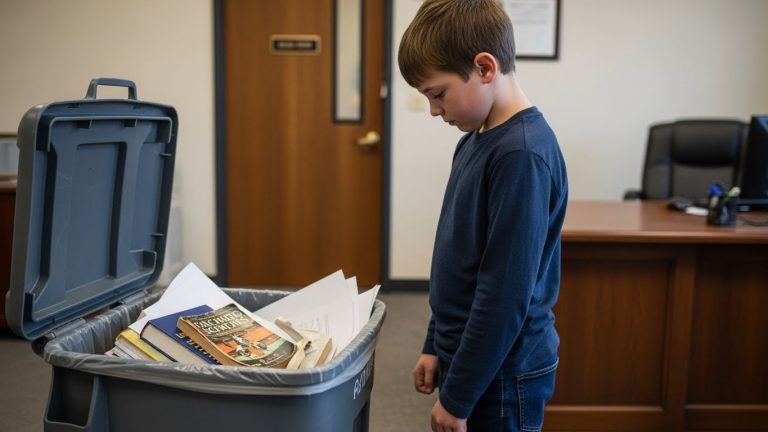
I walked to the fiction section, Aisle 4. I ran my fingers along the spines of the books. I wasn’t looking for anything new. I wanted comfort. I pulled out a hardcover copy of To Kill a Mockingbird. It was an ancient edition, the red fabric cover frayed at the corners, the gold lettering faded to brown.
I walked to my usual spot—a beanbag chair in the corner behind the microfiche machines—and cracked the book open.
Something fell out.
It wasn’t a checkout card. It wasn’t a bookmark.
It was a sealed envelope.
It hit the carpet with a soft thud. The paper was yellowed, brittle, and stained with something that looked like coffee rings from decades ago. There was no name on the front. Just a date written in jagged, angry blue ink: October 14, 1984.
I looked around. Mrs. Gable, the librarian, was busy scolding a group of middle schoolers near the computers. The library was quiet.
I picked up the envelope. It felt heavy. Not heavy like it held money, but heavy like it held a secret.
I shouldn’t have opened it. It wasn’t mine. But curiosity is a hunger, and I was starving.
I slid my fingernail under the flap. The glue had dried up years ago, and it popped open with a dry crackle.
I pulled out a single sheet of lined notebook paper. The handwriting was cramped, slanted, pressing hard into the paper as if the writer was furious.
To the Ghost who finds this,
If you are reading this, then I am gone. I didn’t have the guts to do it in person, so I’m doing it on paper. I tried. God knows I tried. I wanted to fix this town. I wanted to stop the factories from poisoning the water. I wanted to give the kids on 9th Avenue a chance to be something other than factory fodder.
I saved every dime. I starved myself. I stole. I begged. I have the money. It’s sitting in the lockbox. Fifty thousand dollars. It was supposed to be the seed money for the community center. It was supposed to be the ladder out of this hole.
But they broke me. The City Council. The zoning board. The men in the suits who told me I was nothing but a janitor with delusions of grandeur. They laughed at me today. They told me my money was dirty.
So I’m leaving. I’m leaving the money where nobody will look. If you find this, take it. Do something good. Or burn it. I don’t care anymore.
This town doesn’t want to be saved. It wants to drown.
– Elias.
I sat there, my breath caught in my throat. Fifty thousand dollars. In 1984. That was a fortune. That was a life.
I read the name again. Elias.
I looked up. My eyes drifted across the library to the large window overlooking Main Street.
Sitting at the long oak table near the radiator was a man. He was there every day. He wore a coat that was more patches than fabric. He had a white beard that was stained yellow around the mouth. He never read books. He just stared out the window, watching the rain, muttering to himself.
Everyone called him “Crazy Elias.”
He was the town spectre. The cautionary tale. Parents pointed at him and told their kids, “Stay in school, or you’ll end up like him.”
I looked at the letter. I looked at the man.
The handwriting on the paper was sharp, intelligent, furious. The man at the table looked broken, hollowed out by forty years of regret.
He hadn’t left. He hadn’t vanished. He had stayed in Eastwood and watched it drown, just like he predicted.
I stood up. My legs felt shaky. I shoved the letter into my pocket and walked toward him.
Chapter 2: The Man on 4th Street
Walking up to Elias was like walking up to a sleeping bear. You didn’t know if he would ignore you or swipe at you.
I stopped at the edge of his table. He smelled like old rain and menthol cigarettes. He didn’t look up. He was tracing a pattern on the wood table with a gnarled finger.
“Excuse me,” I whispered.
He stopped moving his finger. He didn’t turn his head. “Library’s closing in ten minutes, kid. Go home.”
His voice was gravel. Deep, rough, unused.
“I found something,” I said. I pulled the envelope out of my pocket and placed it on the table. Right on top of the invisible pattern he was tracing.
Elias looked at the envelope. For a long time, he didn’t move. Then, slowly, his eyes shifted from the window to the paper.
I saw the recognition hit him like a physical blow. His shoulders stiffened. His hand trembled as he reached out, hovering over the yellowed paper.
“Where?” he rasped.
“In a book,” I said. “To Kill a Mockingbird. Aisle 4.”
He let out a sound that was half-laugh, half-sob. “Atticus Finch,” he muttered. “I always thought he was the only honest man left.”
He picked up the letter. He didn’t open it. He just held it, feeling the weight of forty years.
“You read it?” he asked, looking up at me. His eyes were a startling, piercing blue, hidden under bushy white brows. They were eyes that had seen too much.
“Yes,” I said.
“Then you know I’m a coward,” he said bitterly. “You know I failed.”
“I know you had fifty thousand dollars,” I said. “And I know you wanted to build a ladder.”
Elias slammed his hand on the table. The noise echoed through the quiet library. Mrs. Gable looked up sharply from her desk.
“There is no ladder!” Elias hissed, leaning in close to me. “It’s a trap door. That money… it’s cursed. It’s blood money. It’s sweat money. And it’s gone.”
“Is it?” I challenged him. I don’t know where the bravery came from. Maybe it was the fact that my own electricity was getting cut off. Maybe I was tired of drowning, too. “The letter says you hid it. It says you were leaving. But you’re still here, Elias. You’ve been sitting in this library every day for as long as I can remember. I think you’re still guarding it.”
Elias stared at me. The anger in his eyes faded, replaced by a deep, terrifying sadness.
“I didn’t leave because I couldn’t,” he whispered. “I got as far as the bus station. I had the ticket in my hand. But I couldn’t step on the bus. I couldn’t take the money, and I couldn’t spend it here. So I hid it. And I sat down to wait for someone brave enough to find it.”
He looked me up and down. He saw my frayed gloves. He saw the hunger in my face.
“What’s your name, girl?”
“Lily.”
“Well, Lily,” Elias said, standing up. His joints popped. He was taller than I expected. “You found the ghost. Now, the question is… are you brave enough to find the treasure? Or are you going to let this town break you, too?”
“I’m already broken,” I said. “I have nothing to lose.”
Elias smiled. It was a grim, toothless smile, but it had a spark in it. A spark I hadn’t seen in Eastwood in a long time.
“Then come with me,” he said. “The library is closing. And we have a grave to dig up.”
I followed him out into the cold November rain. I wasn’t just walking home. I was walking into the past, to finish a fight that started before I was even born.
PART 2
Chapter 3: The Iron Skeleton
The rain in Eastwood isn’t clean. It collects the soot from the interstate and the grime from the abandoned smokestacks, turning into a cold, grey sludge that coats everything it touches. I pulled my denim jacket tighter around myself, shivering as I followed Elias down 4th Street.
He didn’t walk like an old man anymore. The shuffle was gone. He moved with a strange, frantic energy, his boots splashing through puddles, his head down against the wind. He looked like a man who had suddenly remembered he had a destination.
“Where are we going?” I shouted over the sound of a passing siren.
“The Foundry,” Elias grunted, not looking back. “The belly of the beast.”
The Foundry was a massive, rotting carcass of a building on the edge of the river. It used to be a steel mill, the heart of Eastwood’s economy. Now, it was a condemned shell fenced off with chain-link and razor wire. It was where the junkies went to shoot up and where the stray dogs went to fight.
“We can’t go in there,” I said, catching up to him. “It’s fenced off. Police patrol it.”
Elias stopped at a section of the fence that looked secure. He reached down, grabbed the bottom of the chain-link, and lifted. It swung up like a heavy curtain. The metal had been cut years ago, expertly hidden in the tall weeds.
“Police don’t come here, Lily,” Elias said, crawling under. “They don’t like the ghosts.”
I hesitated. This was trespassing. This was dangerous. But the weight of the letter in my pocket felt heavier than common sense. I crawled under the fence.
The Foundry loomed over us, a cathedral of rust. The windows were shattered, jagged teeth against the night sky. We walked through the main yard, navigating piles of scrap metal and overturned oil drums.
Elias led me to a small, nondescript door on the side of the main building. It was welded shut.
“It’s sealed,” I said.
“Look closer,” Elias whispered.
He pushed a loose brick in the wall beside the door. A mechanism clicked—a sound of heavy, oiled gears. The entire door frame shifted inward. It wasn’t welded; it was a false front.
“I was the maintenance foreman here for thirty years,” Elias said, his voice echoing as we stepped into the pitch-black darkness. “I built this room to hide my tools from the supervisors. Then, I used it to hide something more valuable.”
He clicked on a flashlight. The beam cut through the stagnant, dusty air. We were in a stairwell, spiraling down deep into the earth.
“Stay close,” Elias warned. “The stairs are rusted. One wrong step, and you fall into the river intake.”
We descended. The air grew colder, damp, smelling of ancient grease and the river. I counted the steps. Twenty. Thirty. Forty.
We reached the bottom. It was a small concrete room, lined with pipes that sweated condensation. In the center of the room, bolted to the floor, was a massive, rusted industrial boiler.
Elias walked up to it. He placed his hand on the cold iron. He looked like he was greeting an old friend. Or an old enemy.
“Forty years,” he whispered. “I haven’t been down here in forty years.”
Chapter 4: The Currency of Hope
Elias knelt at the base of the boiler. He pulled a heavy wrench from the deep pocket of his coat—I hadn’t even noticed he was carrying it. He fitted it onto a large bolt near the floor.
He grunted, straining against the rusted metal. His face turned red, the veins in his neck bulging. For a second, I thought he would have a heart attack right there.
“Let me help,” I said, grabbing the handle of the wrench.
“Together,” he gasped. “On three. One. Two. Three!”
We pulled.
SCREECH.
The bolt gave way with a sound like a dying animal. Elias spun it loose. He did the same to three other bolts. Then, he pulled a square metal plate off the side of the boiler.
It wasn’t a boiler access panel. It was a safe.
Inside the hollow cavity, wrapped in thick, oil-soaked rags and sealed in heavy plastic, was a metal box.
Elias pulled it out. His hands were shaking so hard he almost dropped it. He set it on the concrete floor.
“Is that it?” I whispered. The silence in the room was deafening.
“Open it,” Elias said, sliding it toward me. “I can’t do it. If it’s… if the rats got to it, or the damp… I can’t look.”
I knelt in the dust. The box was an old military ammo crate, green paint flaking off. I undid the latches. They snapped open loudly.
I lifted the lid.
I gasped.
It wasn’t paper money. Paper would have rotted.
It was gold.
Small, heavy bars. And silver coins. Stacks of them. And underneath the metal, wrapped in layers of Ziploc bags (which must have been new technology back then), were bundles of cash.
“I didn’t trust the banks,” Elias muttered, watching my face. “Banks fail. Gold doesn’t.”
“Elias,” I breathed, picking up a gold bar. It was heavy, cold, and undeniably real. “This isn’t fifty thousand dollars. With inflation… with the price of gold… this is…”
“It’s enough,” Elias cut me off. “It’s enough to buy the block. It’s enough to bribe the zoning board. It’s enough to build the center.”
He looked at the treasure, but there was no greed in his eyes. Only relief. And exhaustion.
“I stole it from the payroll,” he confessed quietly. “Over ten years. I skimmed the accounts. The owners were skimming millions from the workers, cutting safety corners, dumping sludge in the river. I figured I was just taking back what they owed this town.”
He looked at me.
“That’s the crime, Lily. Embezzlement. Grand larceny. If they catch me with this, I die in prison.”
“They won’t catch you,” I said, closing the lid. “We’re going to use it. We’re going to fix Eastwood.”
CLICK.
The sound came from the stairwell.
We both froze. It was the sound of a gun hammer being cocked.
“That’s a lot of pretty metal for two sewer rats,” a voice echoed from the darkness above.
I spun around, standing in front of the box. Elias scrambled to his feet, holding the wrench.
A light shined down the stairs, blinding us.
“Who’s there?” Elias roared.
“Just an interested investor,” the voice sneered.
A figure stepped into the light. It wasn’t the police. It was worse.
It was Kray. The local dealer who ran the corner of 5th and Main. He was young, vicious, and he had followed us through the fence. He was holding a pistol, and he was smiling.
Chapter 5: The Ledger of Sins
“Step away from the box, old man,” Kray said, walking down the last few steps. “I always knew you were hiding something. Crazy Elias, sitting in the library, watching the street. You weren’t watching the rain. You were watching your stash.”
“This isn’t for you,” Elias growled, stepping in front of me. “This belongs to the town.”
Kray laughed. It was a hollow, ugly sound in the concrete room. “The town? The town is dead, old man. I own the town. Now move, or I put a bullet in you and the girl.”
I looked at the box. I looked at Elias. He was seventy years old. He couldn’t fight Kray.
But Elias wasn’t looking at Kray’s gun. He was looking at the boiler behind Kray. Specifically, at a steam valve that was vibrating slightly.
“Lily,” Elias whispered without moving his lips. “When I move, you grab the box and you run. Do not look back.”
“I’m not leaving you,” I hissed.
“You have to,” he said. “You’re the future. I’m just the past.”
Elias raised his hands. “Okay, son. You win. Take it. Just let the girl go.”
“I don’t leave witnesses,” Kray smiled, leveling the gun at Elias’s chest.
“Neither do I,” Elias shouted.
He didn’t lunge at Kray. He swung the heavy wrench backward, slamming it into the pressure release valve of the boiler next to him.
PSSSHHHHHT!
A jet of superheated steam exploded from the pipe, screaming like a banshee. It didn’t hit Kray directly, but it created a wall of scalding white fog between us and the gunman.
“Agh!” Kray yelled, stumbling back, firing blindly. BANG. BANG.
Bullets sparked off the iron boiler.
“Run!” Elias shoved me toward the stairs.
I grabbed the ammo crate. It was heavy, maybe thirty pounds. Adrenaline surged through me, turning my muscles to steel. I sprinted up the stairs, the metal clanging under my boots.
“Get back here!” Kray screamed from the steam cloud.
I reached the top of the stairs and burst out into the night air. I waited.
“Elias!” I screamed down the hole.
A moment later, Elias emerged from the steam, coughing, his coat torn. He slammed the secret door shut and threw the locking bolt.
“Go!” he wheezed. “He’ll shoot the lock off in a minute!”
We ran. We scrambled over the scrap piles, slipping in the mud. I could hear Kray pounding on the metal door behind us, screaming curses.
We made it to the fence. I shoved the box under, then crawled after it. Elias followed, snagging his coat on the razor wire but ripping it free.
We didn’t stop running until we were six blocks away, huddled in the alley behind the library dumpsters.
My lungs were burning. My legs felt like jelly.
Elias slumped against the brick wall, sliding down until he hit the ground. He was clutching his side.
“Did we… did we lose him?” he gasped.
“I think so,” I panted. “Elias, are you okay?”
He moved his hand away from his side. His palm was dark and wet.
“He was a better shot… than I thought,” Elias whispered.
“Oh my god,” I dropped to my knees. “You’re shot. We need a hospital.”
“No!” Elias gripped my wrist. His grip was surprisingly strong. “No hospitals. They’ll call the police. They’ll take the box. The money becomes evidence. It disappears forever.”
“But you’re bleeding!”
“It’s a graze,” he lied. I knew it was a lie. “Listen to me, Lily. Open the box. Look under the gold. Look at the bottom.”
“Why?”
“Because the gold isn’t the weapon,” Elias wheezed, his eyes closing. “The gold is just the ammo. The weapon is underneath.”
I fumbled with the latches again. I lifted the gold bars, my hands slick with rain and sweat.
At the bottom of the crate, wrapped in oilskin, was a black leather notebook.
“The Ledger,” Elias whispered. “The names. The dates. The bribes. The men who destroyed this town in ’84… they’re the fathers of the men running it now. That book… that book burns them all down.”
He looked at me, his eyes fading.
“You have the money to build,” he said softly. “And you have the book to destroy. You’re the architect now, Lily.”
His head lolled back against the brick.
“Elias!” I screamed, shaking him.
“Just… rest,” he mumbled. “Just need to rest.”
I looked at the bleeding old man. I looked at the gold. I looked at the black book.
I wasn’t an invisible girl anymore. I was a girl with a war chest and a list of targets.
And the first thing I was going to do was save the man who saved me.
PART 3
Chapter 6: The Sanctuary of Silence
I dragged Elias through the mud of the alleyway. He was heavy, dead weight against my shoulder. The blood from his side was soaking into my denim jacket, warm and terrifying.
“Leave me, Lily,” he wheezed. “Hide the box. Save yourself.”
“Shut up,” I gritted out. “We’re almost there.”
I didn’t go to the hospital. Hospitals ask questions. Hospitals call the police. And in Eastwood, the police answered to the same men named in Elias’s ledger.
I dragged him to the back door of the library. It was locked, obviously. I pounded on the metal with my fist, screaming into the rain.
“Mrs. Gable! Open up! Please!”
I didn’t know if she was still there. It had been an hour since closing. But Mrs. Gable was a fixture, part of the building itself.
The door swung open. Mrs. Gable stood there, her glasses perched on her nose, a ring of keys in her hand. She looked annoyed, until she saw the blood. Until she saw Elias.
Her face went pale. She didn’t scream. She stepped back and held the door wide.
“Bring him in,” she ordered. Her voice was steel.
We collapsed onto the floor of the breakroom. Mrs. Gable locked the door and pulled the blinds. She knelt beside Elias, ripping open his shirt.
“It’s a through-and-through,” she muttered, inspecting the wound. “Missed the liver. He’s lucky.”
“Can you help him?” I asked, my hands shaking as I clutched the ammo crate.
Mrs. Gable looked at me, then at the box. She recognized it. Or at least, she recognized the history it carried.
“I was an Army nurse in Vietnam before I was a librarian, Lily,” she said, grabbing a first-aid kit from the wall. “Boil some water in the kettle. And get me the vodka from the bottom drawer of my desk.”
For the next hour, the library wasn’t a place of books. It was a field hospital. Mrs. Gable cleaned the wound, stitched it with efficient, steady hands, and bandaged him up. Elias passed out from the pain, his breathing ragged but steady.
When it was done, Mrs. Gable washed her hands and sat opposite me at the small table. The ammo crate sat between us.
“Elias Thorne,” she whispered, looking at the sleeping man. “We all thought he ran away with the money.”
“He didn’t run,” I said, placing my hand on the box. “He hid. He waited.”
“And the box?” she asked.
“It’s the future,” I said. “And inside is a book that’s going to burn down the past.”
I opened the ledger. I showed her the names.
Mrs. Gable read the first page. Her eyes widened.
“Mayor Higgins,” she read. “Councilman Drake. The Chief of Police.”
“Their fathers,” I corrected. “But the sins are the same. They’re still running the same rackets. Still poisoning the water. Still keeping us poor.”
Mrs. Gable looked up. A slow, dangerous smile spread across her face.
“My husband died of cancer from that water,” she said softly. “I’ve been waiting forty years for someone to load the gun. Looks like you brought the ammo.”
Chapter 7: The Auction of Truth
We waited three days. Elias recovered on a cot in the library basement, hidden among the archives. I went to school like nothing happened, but my backpack felt heavier. It carried the ledger.
The City Council meeting was on Tuesday night. The agenda was simple: “Zoning approval for new chemical storage facility on 9th Avenue.”
They were going to poison us again.
I walked into the Town Hall. It was packed with angry residents, but they looked defeated. They knew the vote was rigged. They knew the Council didn’t care.
I didn’t sit in the back. I walked straight to the front row.
Mayor Higgins Jr. was at the podium, a slick man with a smile that didn’t reach his eyes.
“We understand the concerns,” he droned. “But this facility brings jobs. It brings revenue.”
“It brings cancer!” a woman shouted from the back.
“Order!” Higgins banged his gavel. “One more outburst and I’ll clear the room.”
I stood up.
“I have a question, Mr. Mayor,” I said. My voice didn’t shake. I had Elias’s courage now.
Higgins squinted at me. “Public comment is over, young lady.”
“It’s not a comment,” I said, pulling the black leather notebook from my bag. “It’s a history lesson.”
I walked to the microphone. The police officer moved to stop me, but Mrs. Gable stepped into the aisle, blocking him. She was joined by the janitor. Then the high school principal. They formed a wall.
I opened the book.
“October 14, 1984,” I read. “Payment of ten thousand dollars to Alderman Higgins. Purpose: Silence regarding the toxic dumping in the East River.”
The room went dead silent. Mayor Higgins turned the color of ash.
“That’s… that’s a lie,” he stammered.
“November 1, 1984,” I continued, flipping the page. “Payment to Chief of Police regarding the disappearance of union organizer Mike Sallows.”
I looked up at the Council members. They were all there. The sons of the men in the book.
“This ledger details forty years of bribes, theft, and murder,” I said into the microphone. “It matches bank records. It matches death certificates. And I made copies. One is with the FBI. One is with the New York Times. And one is right here.”
“Seize that book!” Higgins screamed, pointing at me.
“No,” a voice boomed from the back of the room.
The doors swung open. Elias stood there. He was leaning on a cane, pale and bandaged, but he looked like a king returning from exile.
“Elias?” someone whispered. “Crazy Elias?”
“I’m not crazy,” Elias said, walking down the aisle. The crowd parted for him like the Red Sea. “I’m just the accountant.”
He stood next to me. He looked at Higgins.
“You have two choices,” Elias said. “Option A: The FBI raids this building in the morning. You all go to prison for racketeering.”
“And Option B?” Higgins choked out.
“Option B,” I said. “You resign. All of you. Tonight. And before you go, you sign the zoning permit for the Eastwood Community Center and Scholarship Fund.”
“We don’t have the budget for a center!” a councilman yelled.
I reached into my bag and pulled out a single gold bar. I slammed it onto the podium.
THUD.
“We have the budget,” I said. “We’re buying the town back.”
Chapter 8: The Architect
The resignation of the entire City Council made national news. The FBI investigation that followed took down Kray’s drug ring, too—turns out, he was paying the police to look the other way, just like the ledger said.
Eastwood didn’t change overnight. The factories were still rusted. The winter was still cold.
But the fear was gone.
Six months later, I stood on the corner of 9th Avenue. The razor wire was gone. The fence was down. Construction crews were pouring concrete for the foundation of a new building.
“It looks good,” a voice said behind me.
I turned. Elias was sitting on a bench, feeding pigeons. He looked different. Clean shaven. He wore a new coat—one without patches.
“It looks like a beginning,” I said, sitting next to him.
“We spent half the gold,” Elias grumbled good-naturedly. “Contractors are expensive.”
“We have enough left for the scholarships,” I reminded him. “The first ten kids go to college next fall. Including me.”
Elias smiled. He reached into his pocket and pulled out a new, leather-bound notebook. He handed it to me.
“What’s this?”
“A new ledger,” he said. “The old one was about debts. This one is about credits. You write the future in this one, Lily.”
I opened the book. The pages were blank, crisp, and white.
“Are you leaving?” I asked. “Now that it’s done?”
Elias looked at the library down the street. He looked at the construction site. He looked at the kids playing in the street without fear.
“No,” he said. “I think I’ll stay. I finally have a reason to watch the street.”
I took a pen and wrote the first entry in the new book.
May 15, 2024. Project: Hope. Status: Under Construction.
I closed the book. The invisible girl was gone. The crazy old man was gone.
We were just two architects, watching our city rise from the ashes.
THE END.