“Please… Just Make It Fast,” The Dying CEO Whispered. The Doctors Were Too Late—But The Single Dad In The Security Uniform Wasn’t.
Chapter 1: The Invisible Medic
The smell of Mercy General Hospital at 2:00 AM was a specific cocktail of industrial floor wax, stale coffee, and quiet desperation.
Marcus Johnson knew every tile of the third-floor hallway. He knew which wheel on the janitor’s cart squeaked. He knew that the vending machine in the east wing hummed in the key of B-flat. And he knew that if he walked softly enough, the nurses wouldn’t even look up from their stations.
That was how he liked it. Invisible.
Marcus adjusted the collar of his navy blue security uniform. It was polyester, itchy, and two years old. The fabric was shiny at the elbows. His name tag, M. Johnson, tilted slightly to the left. He didn’t bother fixing it.
He was 38, but the reflection in the dark window of the nursery ward showed a man who had lived a dozen lifetimes. There were gray hairs in his beard and deep grooves etched around his eyes—the kind of lines carved by desert sun and sleepless nights.
He reached into his breast pocket and pulled out a folded piece of construction paper. It was wrinkled, soft from being taken out and put back a hundred times.
He unfolded it. A crayon drawing. A stick figure of a man in blue, standing next to a smaller figure with two giant puffs of black hair. A yellow sun with a smiley face beat down on them.
“Daddy is my superhero,” it said in jagged, colorful letters.
Maya had shoved it into his hand that morning before the school bus came. She was eight going on thirty. Too smart for her own good, and definitely too smart to have a dad working night security for minimum wage. But she looked at him like he hung the moon.
“Superhero,” Marcus whispered to the empty hallway, a sad smile touching his lips. “If you only knew, baby girl.”
The radio on his belt crackled, shattering the silence.
“Code Trauma. ETA two minutes. Multiple injuries. Security to the bay for crowd control.”
Marcus folded the drawing, tucked it over his heart, and started walking. He didn’t run. Running made people nervous. You walked with purpose. That’s what the Sergeant used to say. Slow is smooth, smooth is fast.
When he pushed through the double doors of the Emergency Department, the controlled chaos hit him like a physical wave.
A gurney crashed through the ambulance bay doors.
“Female, mid-30s, unrestrained driver in a rollover!” a paramedic shouted, sweat dripping down his face. “BP is tanking! 80 over 40 and dropping!”
Marcus stood by the wall, arms crossed, watching. This was his job now. Watch. ensure no drunks stumbled in. Ensure the family members didn’t rush the doctors. Just watch.
But then he saw her.
The woman on the gurney was dressed in clothes that cost more than Marcus’s truck. A torn silk blouse, a blazer that looked tailored. But right now, the money didn’t matter. Her face was gray. Her dark hair was plastered to her forehead with sweat and blood.
“Get me a line!” a nurse screamed. “Where is the attending? Where is Dr. Evans?”
“He’s in surgery!” another nurse yelled, cracking a saline bag. “He said ten minutes!”
“We don’t have ten minutes!”
The woman on the gurney let out a low, guttural moan. Her hand, manicured and trembling, shot out and gripped the nearest nurse’s scrub top.
“Please…” she gasped, her eyes unfocused, rolling toward the harsh lights. “Please… just make it fast. I don’t… I don’t want to feel it.”
The fear in her voice was primal. It was the sound of someone who knew the end was coming and was terrified of the pain.
The nurse looked helpless. “Hang on, honey. We’re trying.”
Blood was pooling on the floor. Bright red. Arterial.
Marcus felt a twitch in his right hand. A phantom muscle memory. He looked at the nurses. They were good people, but they were overwhelmed. They were waiting for a leader. They were waiting for a doctor who wasn’t coming.
The woman’s monitor started to wail. Beep-beep-beep-beep. Fast. Thread. Irregular.
Marcus looked at the security camera in the corner. He thought about his job. He thought about the rent due on Tuesday. He thought about Maya’s braces. If he stepped in, he was breaking protocol. He could be fired. Liability issues. Lawsuits.
Then the woman looked blindly into the room and whispered, “Mom?”
That was it.
Marcus pushed off the wall.
He walked past the stunned triage nurse. He walked past the orderly holding the clipboard.
“Sir, you can’t be in here!” the paramedic barked, stepping in his path. “Security needs to stay back!”
Marcus didn’t stop. He didn’t even slow down. He locked eyes with the paramedic. Marcus’s eyes were dark, deep, and suddenly terrifyingly calm.
“I’m a medic,” Marcus said. His voice wasn’t loud, but it carried a weight that silenced the immediate area. “Step aside.”
“You’re a guard,” the paramedic snapped.
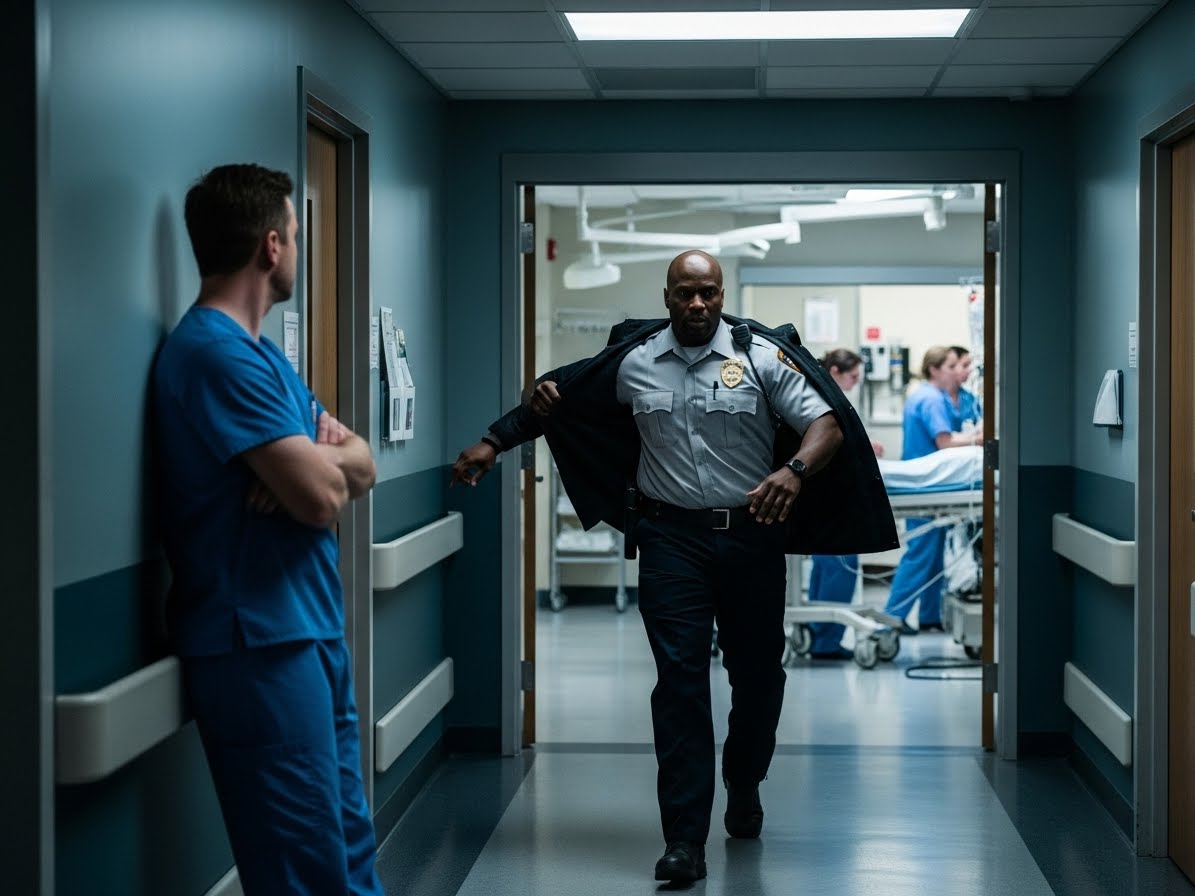
Marcus reached up and unzipped his cheap polyester jacket. He shrugged it off his shoulders and let it drop to the blood-slicked floor.
He wore a plain grey t-shirt underneath. As he moved, the muscles in his arms flexed, revealing the map of his past. Faded black numbers on his left forearm. A unit insignia on his right. The scars that ran like white lightning across his dark skin—shrapnel marks he never talked about.
The paramedic saw the ink. He knew what it meant. He stepped back.
Marcus stepped up to the gurney. The world narrowed down to a three-foot radius. The noise of the alarms faded into the background.
“Gauze,” Marcus commanded. He didn’t shout. He didn’t have to. “Trauma shears. Now.”
The nurse handed them over instinctively.
Marcus worked. His hands, usually seen holding a flashlight or a thermos, became instruments of precision. He located the bleeder in the woman’s chest cavity within seconds. He didn’t flinch at the blood coating his fingers. It was warm, sticky, and familiar.
He applied pressure—heavy, steady pressure.
“I need you to look at me,” Marcus said to the woman.
She blinked, her eyes struggling to focus on the man looming over her. She saw a blur of grey and dark skin.
“That’s it,” Marcus said, his voice dropping an octave, becoming a soothing rumble. “Focus on my voice. You’re not going anywhere. You hear me? Not today.”
“Hurts…” she whispered.
“I know,” Marcus said. “Pain means you’re alive. Hold onto it.”
He worked for six minutes. He packed the wound, stabilized her neck, and directed the nurses on fluid resuscitation. He was a conductor of a symphony of survival.
When the double doors finally banged open and Dr. Evans rushed in, breathless and angry, the bleeding had stopped. The vitals were stabilizing.
“What the hell is going on?” the doctor demanded.
Marcus stepped back immediately. The trance broke.
He looked down at his hands. Red.
He grabbed a towel from the tray and wiped them off. He didn’t look at the doctor. He didn’t look at the nurses staring at him with their mouths open.
He bent down, picked up his security jacket from the floor, and put it back on. He zipped it up to his chin.
“She’s stable,” Marcus said quietly to the air.
Then he turned and walked out of the trauma bay, back into the silent, empty hallway.
Chapter 2: The Transaction
The sun was coming up when Marcus clocked out.
The adrenaline had long since faded, replaced by the heavy, dull ache in his lower back that always came after a double shift. He walked to his truck—a ten-year-old Ford with a cracked windshield and a passenger door that only opened if you kicked it in the right spot.
He sat in the driver’s seat for a moment, gripping the steering wheel. He closed his eyes and tried to push the smell of copper out of his nose.
Don’t take it home, he told himself. Leave it here.
He drove through the waking city. By the time he unlocked the door to his small apartment, he was just “Dad” again.
Maya was already awake, sitting at the kitchen table in her pajamas, a bowl of cereal in front of her. The TV was playing cartoons at low volume.
“Daddy!” She beamed, milk dripping from her chin.
Marcus felt his chest loosen. This. This was the mission.
“Hey, Supergirl,” he said, hanging his jacket by the door. “You finish your math?”
“Yes,” she said, pointing to a workbook. “And I made you toast but it got cold.”
Marcus walked over and kissed the top of her head. Her hair smelled like coconut oil and innocence. He sat down and ate the cold toast. It was the best thing he’d tasted all night.
He took her to the bus stop. He held her hand, even though she was getting to that age where she wanted to be independent. She didn’t pull away. Not yet.
When the bus pulled away, Marcus went back inside and collapsed onto the couch. He didn’t dream. He never did. He just ceased to exist for six hours until the alarm woke him up to do it all over again.
Three days passed.
No one at the hospital said a word. The nurses gave him strange looks in the cafeteria—whispering behind their hands—but the administration said nothing. Marcus assumed he was in the clear. He assumed the woman had been transferred or discharged. He assumed he was still invisible.
He was wrong.
It was Tuesday night, just after his shift started. His supervisor, a sweaty man named Greg who spent most of his time watching football on his phone, radioed him.
“Johnson. Front desk. You got a visitor.”
Marcus frowned. “Who?”
“Some lady. Looks expensive. Better get up here.”
Marcus felt a cold knot in his stomach. Lawsuit, he thought. She died, and the family is suing because the security guard touched her.
He walked to the main lobby.
She was standing by the large glass windows, looking out at the parking lot. She wasn’t wearing the blood-soaked silk blouse anymore. She was wearing a charcoal power suit that fit her like armor. Her hair was sleek, pulled back in a severe bun. She was leaning on a cane, favoring her left side, but she stood tall.
It was her. The woman from the gurney.
Marcus slowed down. He wanted to turn around. He wanted to radio Greg and say he was sick. But he didn’t run.
He walked up to her.
She turned. Her eyes were sharp, calculating. Blue like ice. She scanned him, taking in the uniform, the scuffed boots, the weary posture.
“You’re him,” she said. It wasn’t a question.
“I’m Marcus,” he said, keeping his hands clasped behind his back. “Can I help you, Ma’am?”
“I’m Catherine Blake,” she said, extending a hand. “CEO of Blake Industries.”
Marcus looked at her hand. He didn’t take it.
“I know who you are,” he said.
Catherine paused, then lowered her hand slowly. She wasn’t used to being refused. “The doctors told me what happened. They said the attending was delayed. They said… a security guard stopped the bleeding.”
“I just did what needed doing,” Marcus said, his voice flat.
“You saved my life,” Catherine said. She took a step closer. “I looked you up, Mr. Johnson. Or should I say, Sergeant Johnson? Silver Star recipient. Two tours in Afghanistan. Honorable discharge.”
Marcus’s jaw tightened. “That was a long time ago.”
“And now you’re checking ID badges for twelve dollars an hour,” she said. It wasn’t an insult; it was an observation. A data point.
“I have a daughter,” Marcus said defensively. “I need steady hours. I need to be home in the mornings.”
Catherine reached into her purse. She pulled out a checkbook.
“I don’t like debts, Mr. Johnson. I don’t like owing people. It makes me uncomfortable.” She uncapped a gold pen. “I want to compensate you. For your services.”
She started writing. She tore the check out and held it toward him.
Marcus looked at the number. It was $10,000.
Ten thousand dollars. That was the rent for a year. That was Maya’s braces. That was a new transmission for the truck.
He looked at the check. Then he looked at Catherine’s face.
She wasn’t smiling. Her eyes were cold. This wasn’t gratitude. This was a transaction. She was buying her life back from him so she didn’t have to feel like she needed anyone. She was paying him to go away so she could go back to believing she was invincible.
Marcus felt a flare of anger in his chest. Not for himself, but for the principle of it.
He reached out and took the check.
Catherine exhaled, her shoulders relaxing slightly. “Good. I trust that settles—”
Marcus ripped the check in half.
The sound was loud in the quiet lobby. Riiip.
He put the pieces together and ripped them again. Then he dropped the confetti into the trash can next to him.
Catherine stared at him, her mouth slightly open. “Are you insane? Do you know how much money that is for someone like you?”
“Someone like me?” Marcus repeated, stepping into her space. He towered over her, but he wasn’t threatening. He was just… solid.
“Ms. Blake, when your hand was gripping that nurse’s arm, you weren’t a CEO. You weren’t rich. You were just scared. You asked for your mother.”
Catherine flinched as if he’d slapped her.
“I didn’t save you for money,” Marcus said, his voice low and intense. “I saved you because you were a human being who was dying. And where I come from, you don’t leave people behind.”
He leaned in closer.
“You don’t owe me a dime. But if you really want to pay me back? Go home. Hug your family. And try to live a life that’s worth saving.”
He turned on his heel.
“Johnson!” she called out, her voice cracking. “Wait!”
Marcus didn’t wait. He walked back toward the security office, back to the shadows.
He left Catherine Blake standing in the lobby, trembling, surrounded by the shreds of her money, feeling poorer than she had ever felt in her life.
But Marcus knew this wasn’t over. People like Catherine Blake didn’t like to lose. And he had just started a war he wasn’t sure he could win.
Chapter 3: The Ghost in the Glass Tower
Catherine Blake didn’t sleep well anymore.
She used to pride herself on it. Six hours sharp, no dreams, no interruptions. Just efficient, biological recharge time that kept her functional through 16-hour days and back-to-back board meetings. She was a machine, and machines didn’t toss and turn.
But now, every time she closed her eyes, she didn’t see the darkness behind her eyelids. She saw the ceiling of the emergency room. She smelled the antiseptic. She felt the cold, creeping sensation of her own blood leaving her body.
And she heard his voice.
“Pain means you’re alive. Hold onto it.”
Two weeks had passed since she had tried to hand Marcus Johnson a check for $10,000, and he had ripped it up like it was junk mail.
She was sitting in her corner office on the 43rd floor. The city of Chicago stretched out below her, a grid of glass and steel, glittering in the twilight. She had built an empire here. She knew how to win. She knew how to take control. She knew how to make people need her more than she needed them.
But Marcus Johnson hadn’t needed anything.
That fact unsettled her more than the accident itself.
Her assistant, a young man named David who was terrified of her, knocked on the glass door.
“Ms. Blake? The car is downstairs. The Mercy General Gala starts in forty minutes.”
Catherine turned her chair around. She looked at the reflection in the window. Perfect hair. Perfect makeup. Diamonds at her throat that cost more than Marcus’s entire yearly salary.
“I’m not going,” she said.
David blinked. “Ma’am? You’re the keynote speaker. The hospital is naming a wing after the company. You have to be there.”
Catherine gripped the armrests of her chair. The hospital. The place where she almost died. The place where he worked.
“They want you to talk about your recovery,” David pressed gently. “It’s good PR. The ‘Iron Lady’ who survived the crash. It tests well with the shareholders.”
The Iron Lady.
That was the narrative. She was strong. She was a survivor. She had pulled herself back from the brink through sheer force of will.
It was a lie.
She hadn’t pulled herself back. A security guard with sad eyes and scarred hands had dragged her back. And she had tried to pay him off to keep her narrative clean.
“Fine,” Catherine stood up, smoothing her dress. “Let’s go.”
The ride to the hospital was silent. Catherine watched the city blur past. She felt like an imposter in her own life.
When they arrived, the hospital looked different. The trauma bay entrance—where she had been wheeled in, broken and bleeding—was around the back. The front entrance was transformed. Red carpet. Valet parking. Banners draped across the stone pillars.
MERCY GENERAL ANNUAL CHARITY GALA.
Inside, the atrium was unrecognizable. The smell of disinfectant was replaced by expensive perfume and catering. A string quartet played softly near the silent auction tables. Donors in tuxedos and evening gowns mingled under chandeliers that had been dusted for the occasion.
Catherine moved through the crowd with practiced ease. She smiled. She shook hands. She thanked people for their generosity. She was the queen of this court.
But her eyes weren’t looking at the donors.
She was scanning the perimeter. She was looking at the corners of the room, the exits, the shadows.
She didn’t know why she was looking for him. This was a black-tie event. He was the night shift security guard. This wasn’t his world.
Then, she saw him.
He was standing near the kitchen service doors, his back against the wall. He wasn’t wearing a tuxedo. He was wearing the same navy uniform, the fabric worn thin at the shoulders. His hands were clasped behind his back in parade rest.
He wasn’t watching the party. He wasn’t looking at the jewelry or the food.
He was watching the crowd. His eyes moved methodically from face to face, checking for threats, checking for trouble.
He looked completely out of place, a smudge of reality in a room full of fantasy.
Catherine’s breath caught in her throat. She excused herself from a conversation with the Mayor and started walking toward him. She didn’t know what she was going to say. Maybe she would apologize. Maybe she would yell at him for ripping up the check.
She was ten feet away when the music stopped.
Not because the song ended, but because a glass shattered against the marble floor.
Chapter 4: The Second Save
The sound of breaking glass cut through the chatter like a gunshot.
“Help! Someone help him!”
The scream came from Table 4, right in the center of the room. A woman in a red dress was standing, shrieking, clutching her hands to her face.
Beside her, an elderly man—one of the hospital’s biggest donors—had collapsed. He was face down in his plate of untouched salmon.
Panic rippled through the room instantly. The wealthy elite, so composed a moment ago, scattered like frightened birds. Chairs scraped against the floor. People gasped.
“Is there a doctor?” someone shouted. “We’re in a hospital, for God’s sake!”
It was ironic. The room was full of hospital administrators, board members, and bureaucrats. But the actual doctors were working shifts upstairs or were at home sleeping.
Catherine froze. She watched the man’s wife shaking him. “Arthur! Arthur, wake up!”
Then, a blur of motion.
It was Marcus.
He moved through the crowd of tuxedos like a shark through water—efficient, silent, and fast. He didn’t run; he glided.
He reached the table before anyone else. He didn’t hesitate. He grabbed the heavy man by the shoulders and lowered him to the floor, careful not to let his head hit the marble.
“Give him space!” Marcus’s voice boomed. It wasn’t a shout; it was a command that brooked no argument.
The crowd parted.
Catherine watched, mesmerized. It was happening again.
Marcus knelt beside the man. He placed two fingers on the man’s carotid artery. He put his ear to the man’s mouth.
“No pulse. No breathing,” Marcus announced to the room.
He ripped the man’s expensive tuxedo shirt open, buttons popping and rolling across the floor. He placed the heel of his hand on the man’s sternum, interlaced his fingers, and locked his elbows.
One. Two. Three. Four.
He began chest compressions.
The rhythm was perfect. Steady. Hard. He was pumping the man’s heart for him.
“You!” Marcus pointed at a waiter standing nearby with a tray of champagne. “Run to the wall cabinet. Grab the AED. Now!”
The waiter dropped the tray and ran.
“You!” He pointed at the man’s wife. “Talk to him. Tell him to stay. He can hear you.”
The wife sobbed, holding her husband’s hand. “Arthur, please! Stay with me!”
Marcus kept pumping. Sweat beaded on his forehead. His face was a mask of absolute focus. He wasn’t a security guard anymore. He wasn’t a minimum-wage employee. He was a master of his craft, operating in a league that no amount of money in that room could buy.
The waiter returned with the Automated External Defibrillator.
Marcus didn’t stop compressions. He gestured with his head. “Open it. Attach the pads. Upper right, lower left.”
The waiter’s hands were shaking so bad he couldn’t peel the stickers.
“Move,” Marcus growled.
He stopped compressions for a split second, snatched the pads, slapped them onto the man’s bare chest, and resumed pumping instantly.
The machine whirred to life. A robotic voice spoke. “Analyzing heart rhythm. Do not touch patient.”
Marcus threw his hands up and scanned the crowd. “Clear!”
The machine charged. Zap.
The man’s body arched off the floor, then slumped back down.
Silence.
The machine analyzed again. “Shock advised.”
“Clear!” Marcus yelled.
Zap.
Nothing.
Marcus went back to compressions. One. Two. Three. Four.
“Come on,” Marcus whispered, his voice gritty. “Don’t you die on me in a tuxedo. Come on.”
Catherine held her breath. The entire room was silent, watching a man in a faded security uniform fight death on the ballroom floor.
Suddenly, the man on the floor gasped. It was a wet, ragged sound, but it was the best sound in the world. His eyes fluttered open. He coughed.
“Good,” Marcus said, wiping sweat from his eyes. “Good. Stay with us.”
Paramedics—the on-duty team from the ER—finally burst through the doors with a stretcher. They rushed over, but the work was already done.
“He’s back,” Marcus told the lead paramedic. “Sinus rhythm returned after two shocks. Keep him on oxygen.”
The paramedic nodded at Marcus with respect. ” nice work, Johnson.”
Marcus stood up. He wiped his hands on his pants. He looked at the crowd staring at him. He saw the awe in their faces. He saw the confusion.
He adjusted his crooked name tag.
Then, without saying a word, he turned and walked back toward the kitchen service doors. He disappeared before the applause could start.
Chapter 5: The Truth About Heroes
Catherine found him twenty minutes later.
He was outside, on the concrete loading dock behind the kitchen. It was raining lightly, a cold Chicago drizzle.
He was leaning against the brick wall, staring out at the dumpster and the wet pavement. He had a cigarette in his hand, unlit. He was just rolling it between his fingers.
Catherine stepped out of the heavy metal door. The click of her heels on the concrete made him look up.
“You did it again,” she said.
Marcus shrugged. “Guy had a heart attack. Standard procedure.”
“There was nothing standard about that,” Catherine said. She walked closer, ignoring the rain spotting her silk dress. “I watched you. You took command of a room full of the most powerful people in the city, and you saved a man’s life while they were still figuring out how to dial 911.”
Marcus put the unlit cigarette in his pocket. “Is there a point to this, Ms. Blake?”
“The point,” Catherine said, her voice rising, “is that you are wasting your life.”
Marcus stiffened. He pushed off the wall. “Excuse me?”
“You’re a combat medic,” she said. “You have skills that… that are incredible. You should be running a trauma unit. You should be teaching. You should be doing anything other than guarding a door for twelve dollars an hour.”
She gestured at his uniform. “Why? Why do you do this? Why do you hide?”
Marcus looked at her. Really looked at her. For the first time, Catherine didn’t see the employee; she saw the man. And he looked exhausted.
“You think I’m hiding?” Marcus asked quietly.
“I think you’re afraid,” Catherine challenged him. “I think you’re afraid of being great again.”
Marcus laughed. It was a dry, humorless sound.
“I’m not afraid of greatness, lady. I’m afraid of being absent.”
He took a step toward her. The rain was coming down harder now.
“I have a daughter,” Marcus said. “Maya. She’s eight years old. Her mom died three years ago. Ovarian cancer.”
Catherine went still.
“When my wife got sick,” Marcus continued, his voice steady but thick with emotion, “I was deployed. I was overseas, saving soldiers, being a ‘hero.’ Being great.”
He looked down at his hands—the hands that had saved Catherine, and Arthur, and countless others.
“I missed the diagnosis. I missed the first round of chemo. I missed the nights she was scared and crying.”
He looked back up at Catherine. His eyes were wet, and it wasn’t from the rain.
“I came home two weeks before she died. And after the funeral, I looked at my little girl, and I promised her something. I promised her I would never be away again. I promised her I would be there for breakfast every morning and tuck her in every night.”
He pointed a finger at his chest.
“This job? The night shift? It means I can take her to school. It means I can pick her up. It means when she has a nightmare, I’m the one who wakes up, not a babysitter.”
Catherine felt the air leave her lungs.
“You asked why I’m here,” Marcus said. “I’m here because my daughter needs me more than the world needs another hero. She needs a dad.”
He turned away from her, looking back at the dark parking lot.
“You can keep your money, Ms. Blake. You can keep your gala. I’m rich enough.”
Catherine stood there in the rain, frozen.
She thought about her penthouse apartment. Empty. She thought about her awards, her magazine covers, her bank account. She thought about the fact that if she died tomorrow, the only thing that would happen is her stock price would fluctuate.
Marcus Johnson had nothing, and yet he had everything.
He had someone who needed him.
The guilt hit her like a physical blow. She had tried to buy him off. She had tried to “fix” him. She had judged him for his uniform, thinking he was beneath her.
But standing there on the loading dock, Catherine realized the truth.
She wasn’t the powerful one. He was.
She had built a narrative that she was a survivor, a self-made woman. But she was a fraud. She was alive because of this man. And she was hiding the truth because it didn’t fit her image.
She wiped the rain from her face. Her makeup was ruined. Her hair was a mess. She didn’t care.
“I’m sorry,” she whispered.
Marcus didn’t hear her. He was already walking back inside to finish his shift.
Catherine stayed on the dock for a long time. She listened to the rain. And for the first time in years, she didn’t think about profit margins or public relations.
She thought about what Marcus had said in the lobby three weeks ago.
“Try to live a life that’s worth saving.”
She walked back inside. She walked past the ballroom where the party was restarting. She walked past her assistant, David.
“Ms. Blake! Where are you going? The speech is in five minutes!”
Catherine didn’t stop.
“Cancel it,” she said.
“What? We can’t cancel! The press is here!”
“I said cancel it, David.”
She walked out the front door, hailed a taxi, and went home. She sat in her living room in the dark, staring at the city lights.
She knew what she had to do. She had to stop lying. She had to destroy the narrative she had spent years building.
And she had to make sure the world knew the name Marcus Johnson. Not because he wanted it. But because he deserved it.
Chapter 6: The Confession
The next morning, the media landscape of Chicago shifted on its axis.
Catherine Blake called an emergency press conference at 9:00 AM. Usually, these events were scripted, rehearsed, and sanitized by a team of PR sharks. But today, there were no scripts. There were no teleprompters.
The room was packed. Flashes popped like strobe lights. Every major network was there, hungry for the “Iron Lady’s” statement on her recovery.
Catherine walked to the podium. She wore no jewelry. She wore a simple white blouse. She looked tired, but she looked real.
“Three weeks ago,” she began, her voice steady, “I told you that I survived a car accident because of my own resilience. I told you that I fought my way back.”
She paused, looking directly into the camera lens.
“I lied.”
A murmur rippled through the room. Reporters glanced at each other.
“I didn’t save myself,” Catherine continued. “I was dying. I was bleeding out on a gurney in the hallway of Mercy General while the doctors were delayed. I was terrified, and I was alone.”
She took a deep breath.
“The only reason I am standing here today is because of a man named Marcus Johnson.”
On the wall-mounted TV in the hospital cafeteria, Marcus froze. He was holding a sandwich halfway to his mouth. Maya was sitting across from him, coloring in her workbook. She had a half-day at school, and he had brought her in for lunch before his shift ended.
“Daddy?” Maya asked, looking at the screen. “Is that the lady?”
Marcus didn’t answer. He watched as his name—his invisible, ignored name—was spoken to millions of people.
“Marcus Johnson is a night security guard,” Catherine told the world. “He is also a decorated combat veteran. When the system failed me, he stepped in. He saved my life with his bare hands. And when I tried to thank him… when I tried to pay him… he refused.”
Catherine’s voice cracked slightly.
“He told me that he didn’t do it for money. He did it because it was right. I tried to bury his story because it didn’t fit my narrative. I wanted to be the hero. But I am not the hero. He is.”
The room erupted. Reporters were shouting questions. “Who is he?” “Where is he?” “Is he still a guard?”
Catherine stepped back from the podium. “I am sorry it took me this long to tell the truth. Thank you.”
She walked off stage.
In the cafeteria, the silence was deafening. Every nurse, every doctor, every orderly turned to look at Marcus.
Maya tugged on his sleeve. Her eyes were wide, shining with something that made Marcus’s throat go tight.
“Daddy,” she whispered loudly. “She told everyone.”
Marcus set his sandwich down. He felt exposed. Naked.
“She called you a hero,” Maya said, a grin spreading across her face. She held up her drawing—the one of the superhero in the blue uniform. “I told you. I told you so!”
Marcus pulled Maya into a hug, hiding his face in her hair so she wouldn’t see his eyes watering. “Yeah, baby. You told me.”
But the warmth of the moment didn’t last.
By the time they got to the parking lot, the news vans were already circling. Marcus had to shield Maya’s face as they pushed through a crowd of reporters shouting his name.
“Mr. Johnson! How does it feel to be a hero?” “Mr. Johnson! Why are you working security with a Silver Star?” “Mr. Johnson! Look over here!”
They barely made it to the truck. Marcus drove away with his hands shaking on the wheel.
The next morning, the fallout hit.
Marcus walked into the security office for his shift, but his keycard didn’t work. The light blinked angry red.
The door opened, and his supervisor, Greg, stepped out. He looked uncomfortable. He wouldn’t meet Marcus’s eyes.
“Greg?” Marcus asked. “My card is down.”
“It’s not down, Marcus,” Greg mumbled. “Look, administration… they’re freaking out. The media is swarming the lobby. Patients are complaining about the cameras. It’s a circus.”
Marcus felt a cold stone settle in his stomach. “So?”
“So, you’re a distraction,” Greg said. “They’re putting you on administrative leave. Indefinite. Until the heat dies down.”
“Leave?” Marcus stepped forward. “You’re suspending me? For saving a life?”
“I know, man. It sucks. But it comes from the top. Liability concerns. Unauthorized medical procedure. They’re looking for a reason to distance themselves.”
“I have a daughter,” Marcus said, his voice low and dangerous. “I have rent.”
“It’s unpaid leave, Marcus. I’m sorry.”
Greg went back inside and the door clicked shut.
Marcus stood in the hallway. He had survived war. He had survived the death of his wife. He had survived the loneliness of raising a child alone.
But now, because he had done the right thing, he had lost the one thing keeping them afloat.
He drove home in silence. When he walked through the door, Maya looked up from the TV.
“You’re home early!” she cheered.
“Yeah,” Marcus said, forcing a smile that felt like it might crack his face. “Just… decided to take a vacation, Supergirl.”
He went into his bedroom, sat on the edge of the bed, and put his head in his hands.
Chapter 7: The Visit
Two days passed.
Marcus didn’t answer his phone. It rang constantly. Unknown numbers. TV producers. Reporters offering money for an exclusive. He turned it off.
He spent the time building a Lego castle with Maya. He cooked pancakes. He tried to ignore the fact that the rent was due in four days and he had $300 in the bank.
On the third evening, there was a knock at the door.
Not the frantic pounding of a reporter. A steady, hesitant knock.
Marcus looked through the peephole. He sighed. He unlocked the deadbolt and opened the door.
Catherine Blake stood in the hallway of his run-down apartment complex.
She looked completely different. No power suit. No heels. She was wearing jeans and a grey sweater. Her hair was down, loose around her shoulders. She held a brown paper bag in one hand and a thick folder in the other.
“You found me,” Marcus said flatly.
“I have resources,” Catherine said. She looked past him. “Can I come in?”
Marcus hesitated, then stepped aside. “It’s not much.”
Catherine walked into the small living room. It was clean but cluttered with toys. The furniture was mismatched. It smelled like bleach and cinnamon toast.
Maya was at the kitchen table, doing homework. She looked up and gasped.
“You’re the lady!” Maya said.
Catherine smiled. It was a genuine smile, soft and a little sad. “Hi. I’m Catherine. You must be Maya.”
Maya nodded vigorously. “My daddy saved you.”
“Yes, he did,” Catherine said, looking at Marcus. “He saved me in more ways than one.”
Marcus crossed his arms. “If you’re here to offer me money again, Catherine, you can turn around.”
“I’m not,” she said. She walked over to the coffee table and set the folder down. “I heard about the suspension. I’m sorry. I didn’t think the hospital would be that stupid.”
“They’re scared of lawsuits,” Marcus said. “I’m a liability.”
“You’re a wasted asset,” Catherine corrected him.
She sat down on his worn-out sofa. She looked at him with an intensity that made him uncomfortable.
“I’ve been thinking about what you said. About why you work the night shift. About being there for Maya.”
She tapped the folder.
“I’m starting a foundation. The Heart Foundation. It’s fully funded as of this morning. My personal money. No board of directors to answer to.”
Marcus frowned. “Okay. Good for you.”
“The goal of the foundation is to provide emergency medical training to communities that are underserved,” Catherine continued. “We want to teach teachers, coaches, parents, and security guards how to do what you did. CPR. Stop the Bleed. Trauma response.”
She looked at Marcus.
“I need a Director of Operations. Someone to design the curriculum. Someone to train the trainers.”
Marcus shook his head. “I can’t work a 9-to-5 corporate job, Catherine. I told you. I have to drop her off, and I have to pick her up.”
“I know,” Catherine said. “That’s why the office is five minutes from her school. And the hours? You set them. You want to work 10 AM to 2 PM? Fine. You want to work from home? Fine. As long as the job gets done.”
Marcus stared at her.
“And the salary?” Catherine named a figure.
It was four times what he made at the hospital. It was enough to buy a house. Enough for college. Enough to breathe.
“Why?” Marcus asked. “Why are you doing this?”
“Because you were right,” Catherine whispered. “I was living a life that wasn’t worth saving. I was building an empire of nothing.”
She looked over at Maya, who was pretending to do math but was obviously listening.
“I don’t have anyone waiting for me at home, Marcus. I don’t have a legacy. But this… this could be it. Helping people. Like you helped me.”
She stood up and walked to the door.
“You don’t have to answer now. But please… don’t let your pride keep you from doing what you were born to do.”
She left the folder on the table and walked out.
Marcus looked at the folder. Then he looked at Maya.
Maya hopped off her chair and walked over. She picked up the folder and handed it to him.
“Daddy?”
“Yeah, baby?”
“Does this mean you can be a superhero for your job now?”
Marcus took the folder. He opened it. He saw the plans. He saw the vision. And for the first time in three years, he didn’t feel like a ghost. He felt like a soldier who had finally found his new mission.
“Yeah,” Marcus smiled, tears pricking his eyes. “I think it does.”
Chapter 8: The Legacy
One Year Later
The ribbon-cutting ceremony for the “Johnson Center for Community Healing” was packed.
It wasn’t a stuffy gala with tuxedos and champagne. It was a block party. There was a bouncy castle for the kids. There was a taco truck. There was music.
The building stood on the corner of a neighborhood that the city had forgotten years ago. But now, it was a beacon. Fresh paint. Glass windows. And inside, classrooms full of mannequins and medical supplies.
Marcus stood by the stage, adjusting his tie. He hated ties. But Maya had picked this one out—it had tiny ambulances on it—so he wore it.
He looked out at the crowd.
He saw the faces of the first graduating class. Thirty people. A high school football coach. A grandmother who raised three kids. A young man who worked at the grocery store.
They were all certified. They all knew how to stop a bleed. They all knew CPR.
Catherine walked up to him. She looked healthy. Vibrant. She wasn’t the ice queen anymore. She was laughing, holding a clipboard.
“You ready?” she asked.
“No,” Marcus groaned. “I hate speeches.”
“You’ll be fine. Just tell them the truth.”
Catherine walked to the microphone. The crowd cheered.
“Welcome,” she said. “A year ago, I was saved by a man who believed that action matters more than titles. Today, we are opening this center to ensure that everyone has the power to save a life.”
She gestured to Marcus. “Ladies and gentlemen, our Director, Marcus Johnson.”
The applause was thunderous. Maya was in the front row, clapping so hard her hands must have hurt. She was wearing a yellow dress and her hair was in braids with beads that clicked when she moved.
Marcus stepped up. He cleared his throat.
“I’m not a speaker,” he said, his deep voice echoing over the street. “I’m a medic.”
He looked at the graduates.
“People call me a hero. But the truth is, a hero isn’t someone who flies or has superpowers. A hero is just the person who decides not to look away.”
He paused, looking down at Maya.
“For a long time, I thought my life was over. I thought I had nothing left to give. But someone taught me that we all have a second act.”
He looked at Catherine. She smiled, tears in her eyes.
“This center isn’t about me,” Marcus said. “It’s about you. It’s about the neighbor next door. It’s about being ready when the moment comes. Because the only thing worse than dying… is watching someone die when you could have done something.”
He cut the ribbon. The crowd roared.
An hour later, the party was winding down.
Marcus stood on the sidewalk, loosening his tie. Maya ran up to him, her beads clacking musically.
“Daddy! Daddy! Catherine said we can get ice cream!”
Marcus looked up. Catherine was walking toward them, her heels clicking on the pavement. She looked happy. Truly happy.
“Did she now?” Marcus smiled.
“Yes! And she’s coming too!” Maya grabbed Marcus’s hand with her left hand and reached out for Catherine with her right.
Catherine hesitated for a split second, looking at the small hand reaching for hers. Then, she took it.
Maya swung their hands back and forth. “Come on! Double scoop!”
They walked down the street together as the sun set over Chicago. A Black single dad who used to be invisible. A CEO who used to be untouchable. And a little girl who had stitched them both together with crayon drawings and stubborn love.
Marcus looked at Catherine over Maya’s head.
“Thank you,” he mouthed silently.
Catherine squeezed Maya’s hand and looked back at him.
“No,” she whispered. “Thank you.”
They kept walking, no longer strangers, no longer alone. Just a family, of a sort, heading for ice cream in a city they had both helped to save.