RICH TEENS DESTROYED A GRIEVING BOY’S HANDMADE SHOES, NOT REALIZING HIS SISTER WAS THE OFFICER WATCHING THEM
Chapter 1: The Thread of Memory
The morning light in the quiet suburb of Maplewood, Ohio, was distinctively gray, the kind of heavy, slate-colored sky that promised rain but held onto it, creating a pressurized atmosphere that felt like the world was holding its breath. Inside the small, weathered bungalow at the end of Elm Street, ten-year-old Leo sat on the edge of his bed, his small feet dangling just inches above the hardwood floor. The room was silent, save for the rhythmic ticking of an old wall clock, but inside Leo’s chest, a storm was brewing.
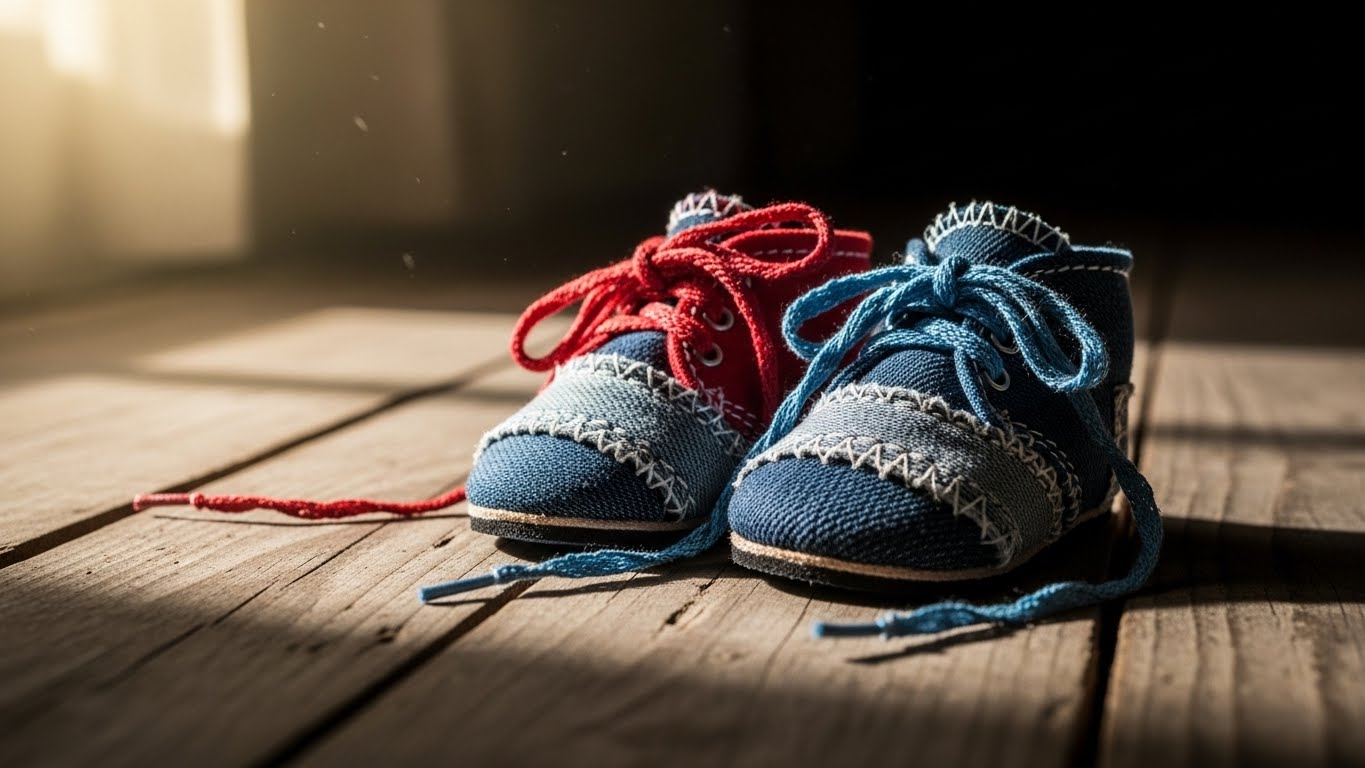
He stared down at the objects in his hands. They weren’t just shoes. To the uninitiated eye, perhaps to the kids at school or the people rushing by in the grocery store, they were an eyesore. They were a patchwork of denim scraps, old flannel, and thick, uneven white stitching that zigzagged like a chaotic heartbeat. The rubber soles had been salvaged from an old pair of worn-out sneakers, glued and sewn onto the new fabric body with a desperation that was palpable even in the craftsmanship.
But to Leo, they were the Crown Jewels. They were the Holy Grail. They were the very last thing his mother, Elena, had touched before the machines in the hospital room turned into a singular, flatlining tone.
Leo ran his thumb over the coarse denim of the left toe. He remembered the smell of the hospital room—antiseptic, stale coffee, and the faint, sweet scent of the vanilla lotion his mother tried to wear to mask the smell of illness. He remembered her hands. They had been so thin, the skin translucent like parchment paper, shaking with the tremors that the chemotherapy had gifted her. Yet, she had sewn. Stitch by agonizing stitch.
“Why don’t we just buy Nikes, Mom?” Leo had asked back then, sitting in the uncomfortable plastic chair next to her bed, trying to keep his voice from trembling. “You need to rest.”
Elena had smiled, a weak uplifting of the corners of her mouth that didn’t quite reach her tired eyes. “Because, my little Lion,” she had whispered, her voice raspy. “Store-bought shoes just cover your feet. These… these will hold you. Every stitch is a promise that I’m with you. Even when I’m not.”
She had finished the left shoe the night she died. The needle was still threaded, poked through the fabric, resting on the bedside table when the nurses came in to tell Leo and his sister, Sarah, that it was time to say goodbye.
Now, a week later, Leo slid his feet into them. They fit perfectly. Of course they did. She knew his measurements better than she knew her own. He tied the laces—mismatched, one white, one navy blue—with a precision that bordered on ritualistic.
“Leo! Breakfast!” The voice came from the kitchen, sharp but not unkind.
Leo jumped, the spell breaking. “Coming, Sarah!”
He walked out to the kitchen, careful not to scuff his feet on the floorboards. Sarah was standing by the stove, flipping a pancake. At twenty-six, she looked exhausted. Her blonde hair was pulled back into a severe, tight bun, compliant with department regulations. She was already in half of her uniform—the dark navy trousers with the crisp pleat, the heavy black boots polished to a mirror shine. Her utility belt, heavy with the tools of her trade—handcuffs, radio, baton, sidearm—sat on the kitchen table next to a carton of orange juice.
Sarah turned, flipping a pancake onto a plate. She looked at Leo, her eyes softening. She was trying so hard. Leo knew it. She had gone from being a big sister who visited on weekends to a legal guardian and a single parent overnight. The grief was etched into the dark circles under her eyes, but she masked it with the rigid discipline of a rookie police officer.
“Eat up,” she said, sliding the plate toward him. “I have a double shift today. Mrs. Higgins is going to watch you after school, okay?”
Leo nodded, poking at the pancake. “I’m going to the park first,” he said quietly. “Just for a bit. It’s Saturday.”
Sarah paused, the coffee mug halfway to her lips. She looked down at his feet. Her gaze lingered on the patchwork shoes. A flash of pain crossed her face—she missed their mother, too—but she forced a smile.
“Those look… sturdy,” she lied gently. She worried about him wearing them. She knew how cruel the world could be, how cruel middle schoolers were. But she couldn’t bring herself to tell him to take them off.
“Mom made them,” Leo said, his voice defensive, though Sarah hadn’t attacked him.
“I know, buddy. I know,” Sarah sighed, walking over and kissing the top of his head. She smelled like starch and metallic polish. “Just… be careful, okay? Stay near the gazebo if you go to the park. I’ll be on patrol in that sector around 4:00 PM, so I might swing by and wave.”
“Okay,” Leo mumbled.
Sarah finished her coffee in one gulp, the bitterness waking her up. She began the transformation that Leo found both cool and terrifying. She put on the heavy Kevlar vest, velcroing it tight across her chest. Then the uniform shirt, buttoning it up to the neck, pinning the silver badge—Officer S. Miller—over her heart. Finally, she strapped on the heavy duty belt.
She wasn’t just Sarah anymore. She was Officer Miller.
“I love you, Leo,” she said, grabbing her keys. “Lock the door if you leave.”
“Love you too,” Leo replied.
When the door clicked shut, the silence rushed back in. Leo finished his breakfast quickly, cleaned his plate, and looked down at his shoes again. They were his armor. Today, he felt brave. He wanted to take them out into the world. He wanted to walk where his mother couldn’t.
He grabbed his jacket and headed out. The air outside was crisp, carrying the scent of fallen leaves and damp earth. Leo walked slowly, his eyes glued to the pavement, watching the denim shoes step one after the other. Left, right, left, right.
“I’m taking you for a walk, Mom,” he whispered to the wind.
He headed toward Liberty Park, the large green space in the center of town. It was usually safe, filled with families and dog walkers. But the overcast sky had kept most people away today. The park was largely empty, save for a few joggers and a group of teenagers hanging out near the concrete benches by the fountain.
Leo felt a knot in his stomach but ignored it. He walked to a bench far away from the teenagers, near the old oak tree his mother used to love. He sat down, pulled his knees to his chest, and just watched the leaves fall. He felt close to her here.
He didn’t notice the group of teenagers shift their attention. He didn’t notice the taller boy in the varsity jacket point in his direction. He didn’t see the predator locking onto the prey. He was too busy wiping a tiny speck of dust off the toe of his left shoe, ensuring his mother’s work remained perfect.
Chapter 2: The Stained Canvas
The quiet of the park was broken by the crunching of gravel and the loud, boisterous laughter of adolescent invincibility. Leo stiffened. He kept his head down, hoping, as small animals do, that stillness would render him invisible.
It didn’t.
“Yo, check it out. I think the circus left a clown behind.”
The voice was deep, cracking with puberty, and dripping with entitlement. Leo looked up. Standing over him were three boys, older—maybe sixteen or seventeen. They loomed like skyscrapers against the gray sky.
The leader, a boy Leo recognized vaguely from the high school yearbook as Brad, stood in the center. Brad was the quintessential picture of suburban wealth. He wore a designer varsity jacket that probably cost more than Leo’s entire wardrobe, pristine designer jeans, and a pair of high-end, limited-edition combat boots that looked like they had never touched mud in their lives. He was holding a large cup of dark soda, the straw chewed mangled in his mouth.
Flanking him were two cronies, echoing his sneer like distorted reflections.
“Whatcha got on your feet, kid?” Brad asked, stepping closer. He invaded Leo’s personal space, the smell of sugary soda and expensive cologne washing over the boy.
Leo instinctively tucked his feet under the bench. “Nothing,” he stammered. “Just shoes.”
“Shoes?” Brad laughed, looking back at his friends. “You call those shoes? They look like my grandma’s quilting project threw up on a pair of Converse.”
The friends snickered. “Maybe he found them in the dumpster behind the Goodwill,” one suggested.
“Nah,” Brad said, crouching down slightly, his eyes gleaming with malice. “Even the Goodwill has standards. These are… what are these? Home ec projects?”
Leo’s face burned hot. His heart hammered against his ribs like a trapped bird. He wanted to run, but his legs felt heavy, anchored by the fear and the weight of the moment.
“My mom made them,” Leo said. His voice was small, trembling, but there was a steel thread of pride in it. “She made them for me.”
Brad’s eyebrows shot up. “Your mom made them? What is she, blind? Or just too broke to go to the mall like a normal person?”
The insult hit Leo like a physical slap. “She’s not blind!” Leo shouted, the sudden volume surprising even himself. “She… she was sick. She made them in the hospital.”
The information hung in the air for a second. A normal human being, possessing a shred of empathy, would have backed off. They would have mumbled an apology and walked away. But Brad was not operating on empathy; he was operating on the adrenaline of performance for his audience. He couldn’t let a ten-year-old yell at him.
“Sick?” Brad sneered, straightening up. He took a long, loud slurp from his soda. “Well, looks like the sickness went to her brain if she thought these looked good. She did a terrible job, kid. Honestly, it’s embarrassing. You walking around in those… it’s like pollution for my eyes.”
“Leave me alone,” Leo said, tears prickling the corners of his eyes. He started to stand up, intending to run home, to lock the door, to hide.
“Sit down,” Brad commanded, shoving Leo back onto the bench with one hand. The force was unnecessary and shocking. Leo gasped.
“I’m trying to help you,” Brad said, a cruel smile spreading across his face. “You can’t walk around town wearing trash. It reflects bad on the neighborhood. We have property values to think about.”
Brad looked at the cup in his hand. It was a 32-ounce cola, dark, sticky, and full of ice.
“You know what?” Brad mused. “These need a dye job. Maybe darker would look better. Hide those ugly stitches.”
Leo’s eyes widened in horror. “No! Don’t!”
Before Leo could move, Brad tipped the cup.
Time seemed to slow down. The dark, caramel-colored liquid cascaded out of the lid like a waterfall of sludge. It hit the left shoe—the one she had finished the night she died.
Leo screamed. It was a sound of pure, unadulterated heartbreak.
The soda soaked instantly into the porous denim. It stained the white flannel patches a sickly brown. The sticky syrup seeped into the white stitching, turning the bright thread into a muddy mess. Ice cubes bounced off the fabric and rattled onto the concrete.
“Oops,” Brad deadpanned, tossing the empty cup onto the grass. “My hand slipped.”
Leo dropped to his knees. He didn’t care about the bullies anymore. He didn’t care about his dignity. He pulled a tissue from his pocket and frantically dabbed at the shoe, his hands shaking violently. “No, no, no, please, Mom, no…” he sobbed. The tissue just spread the stain, grinding the sugar deeper into the fabric.
“Look at him,” one of the other boys laughed nervously. “He’s crying over garbage.”
Brad wasn’t done. The crying annoyed him. It made him feel something he didn’t want to feel, so he decided to crush it.
“Stop whining!” Brad snapped. “I did you a favor. Now you have an excuse to throw them away.”
Leo looked up, his face wet with tears, his eyes red and swollen. “She died last week! It’s all I have left of her! You ruined it!”
The raw grief in Leo’s voice silenced the park. Even the wind seemed to stop.
Brad looked down at the sobbing boy. For a fleeting second, he looked hesitant. But then he looked at his friends, waiting for his reaction. He couldn’t be the guy who got sad because of a kid. He had to be the alpha.
“Then she did you a favor leaving early,” Brad spat, his voice cold, “if this is the best she could do for a son.”
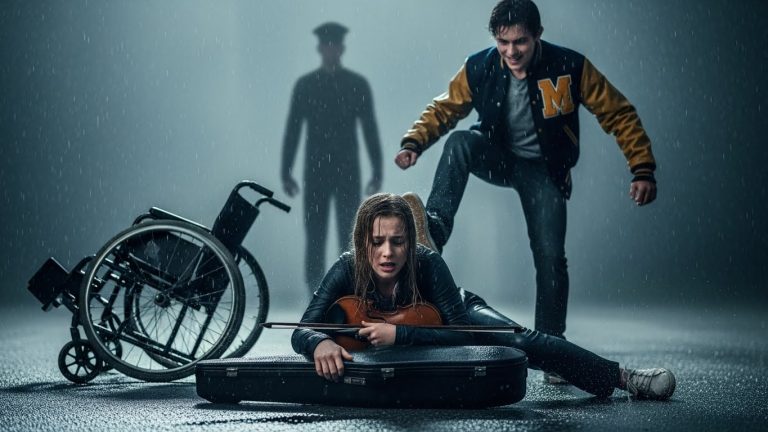
And then, to punctuate his cruelty, to prove his dominance, Brad lifted his heavy, mud-caked designer boot.
“Let me help you finish the job.”
He slammed his foot down.
He stepped directly onto Leo’s small, soda-soaked foot. He ground the heel of his boot into the delicate, hand-stitched fabric, twisting it back and forth, mashing the mud from the park into the denim, tearing one of the seams.
Leo cried out in pain and loss, trying to pull his foot away, but Brad put his weight into it, pinning the boy’s foot to the concrete.
“There,” Brad grunted. “Now they’re vintage.”
Chapter 3: The Badge and the Sister
The world was a blur of pain and humiliation for Leo. He was trapped under the weight of the boot, sobbing into his hands. But then, the pressure on his foot suddenly vanished. Brad had stepped back.
Leo expected another kick. He curled into a ball.
But the silence that followed wasn’t the silence of anticipation. It was the silence of terror.
The air around them shifted. The temperature seemed to drop ten degrees.
“Step away from him.”
The voice wasn’t loud. It wasn’t a scream. It was a low, vibrating command that resonated in the chest. It was the voice of authority, stripped of all patience.
Brad and his friends turned around.
Parked on the curb, just ten yards away, was a black-and-white Police Interceptor, its engine idling with a low growl. The lights weren’t on, but they didn’t need to be.
Standing on the grass, having approached silently from behind, was Officer Sarah Miller.
She was terrifying.
She wasn’t wearing her sunglasses. Her blue eyes were blazing with a cold, hard fire that made the gray sky look warm. Her hand was resting casually, yet dangerously, on her utility belt—not on her weapon, but near her radio. Her posture was rigid, a coil of kinetic energy waiting to snap.
She looked at the soda cup on the ground. She looked at the stain on Leo’s shoe. She looked at the mud on Brad’s boot. And then she looked at Leo’s tear-streaked face.
The “Police Officer” veneer cracked for a millisecond, revealing the devastated sister underneath, before hardening into something indestructible.
“I said,” Sarah repeated, taking a slow, deliberate step forward, her boots crunching on the gravel with a sound that sounded like judgment day, “step away from the boy.”
Brad, who had been a giant ten seconds ago, suddenly looked very small. He stumbled back, his hands coming up in a pathetic gesture of surrender.
“Whoa, Officer,” Brad stammered, his voice cracking. “We were just… we were just messing around. Just playing.”
“Playing?” Sarah echoed. She walked right up to Brad. She was inches from his face. She could smell the soda on his breath. “Is that what you call it?”
She pointed a gloved finger at Leo, who was now looking up, eyes wide, recognizing his sister but seeing a stranger.
“That boy,” Sarah said, her voice trembling with suppressed rage, “buried his mother seven days ago.”
The color drained from Brad’s face. His friends took a collective step back, looking like they wanted to dissolve into the bushes.
“He is wearing the last thing she ever made for him,” Sarah continued, her voice rising slightly, sharp as a whip. “She sewed those shoes in a hospice bed while her organs were shutting down. She put every ounce of strength she had left into that stitching so that he wouldn’t feel alone when she was gone.”
Sarah stepped closer to Brad, forcing him to look her in the eye. “And you… you decided to pour soda on them? You decided to grind your boot into them?”
“I… I didn’t know,” Brad whispered, sweat beading on his forehead. “I didn’t know about his mom.”
“You didn’t know?” Sarah scoffed. “You didn’t need to know his history to know that you were being cruel. You didn’t need to know she died to know that destroying someone’s property is wrong. You did it because you thought you could. You did it because you thought he was weak and you were strong.”
She looked down at Brad’s expensive boots. “Nice boots,” she noted coldly. “Who bought those for you? Daddy?”
Brad nodded dumbly.
“Lucky you,” Sarah said. “My brother’s shoes were paid for in blood and pain. And you just desecrated a memorial.”
Sarah grabbed her radio. The static crackle sounded like a thunderclap in the quiet park.
“Dispatch, this is Unit 4-Alpha. I have a 10-10 in progress at Liberty Park. Harassment, destruction of property, and disorderly conduct. I need a unit to assist.”
“Wait!” Brad panicked. “You’re arresting us? For shoes? My dad is a lawyer! You can’t arrest me for this!”
Sarah smiled, but it was a smile devoid of humor. “I’m not arresting you, Brad. Not yet. I’m detaining you. And I’m not calling a lawyer.”
She leaned in close. “I’m calling your mother.”
The blood left Brad’s face completely. “No, please. Don’t call my mom. Please, Officer. I’ll pay for the shoes. I’ll give him mine. Just don’t call my mom.”
“Too late,” Sarah said, pulling out her notepad. ” sit down. On the ground. Now.”
The three teenagers, stripped of their bravado, sat on the damp grass like toddlers in timeout.
Sarah stood over them, a sentinel of justice. She waited. She made them sit there for twenty minutes while neighbors gathered, watching. She made them sit there while the backup unit arrived. And she made them sit there until a luxury SUV screeched to a halt at the curb.
Brad’s mother, a woman in a sharp business suit, stormed out. She looked ready to argue, ready to defend her precious son.
Sarah intercepted her. She didn’t shout. She simply pointed to Leo, who was still sitting on the bench, trying to clean his shoe. Then she pointed to Brad. She explained, in calm, clinical detail, exactly what her son had said and done. She repeated the line: “She did you a favor leaving early.”
Brad’s mother stopped. Her face went pale. She looked at her son, sitting on the grass, avoiding her gaze. The shame radiating off the woman was palpable.
She walked over to Brad. The slap that echoed across the park wasn’t physical, but the disappointment in her voice was far heavier. “Get in the car,” she hissed. “You and I are going to have a very long talk about who you are becoming.”
She turned to Sarah and Leo. Tears were in her eyes. “Officer… I… I am so incredibly sorry. We will replace them. We will do whatever you need.”
“You can’t replace them,” Sarah said softly, looking at Leo. “But you can make sure he never does this to anyone else again.”
“I will,” the woman promised.
Chapter 4: Mending
The park cleared out. The police cruiser drove away. The SUV vanished.
It was just Sarah and Leo again.
The adrenaline faded, leaving Sarah feeling heavy and shaky. The cop facade crumbled. She walked over to the bench and sat down next to her little brother.
He wasn’t crying anymore. He was just staring at the brown stain on the denim, looking defeated.
“I’m sorry, Sarah,” Leo whispered. “I shouldn’t have worn them. I ruined them.”
Sarah’s heart broke all over again. She slid off the bench and knelt in the dirt, ignoring the grass stains on her pristine uniform trousers. She took Leo’s foot in her hands.
“You didn’t ruin anything, Leo,” she said, her voice thick with emotion. “And you didn’t do anything wrong.”
She unlaced the shoe gently. She pulled it off his foot. She reached into her utility pocket and pulled out a clean white handkerchief and a small bottle of water she kept for emergencies.
“Look,” she said. She poured a little water on the handkerchief. “It’s just sugar and dirt. We can fix this.”
With infinite patience, Sarah began to dab at the stain. She didn’t scrub hard; she treated the shoe like it was an artifact in a museum. She worked the water into the fabric, lifting the dark brown out of the white stitching.
“Mom used high-quality thread,” Sarah murmured, smiling through her own tears. “She knew you were messy. She knew you’d need something tough.”
Leo watched, mesmerizing, as the stain began to fade. It wasn’t perfect—there was still a faint shadow—but the angry darkness was gone. The shoe looked lived-in, not ruined.
“Is it okay?” Leo asked.
“It’s better than okay,” Sarah said. She looked up at him. “It has a story now. These shoes survived Mom’s illness. And now? They survived the bullies. They’re tough, Leo. Just like you.”
She slipped the shoe back onto his foot and tied the laces tight.
“You defended her memory,” Sarah said, gripping his shoulders. “I heard you. You stood up to them. Mom would have been so proud of you.”
Leo threw his arms around Sarah’s neck, burying his face in the rough Kevlar of her vest. He sobbed, letting go of the fear and the shame. Sarah held him tight, rocking him back and forth on the park bench.
“I miss her,” Leo cried.
“I know,” Sarah whispered, resting her cheek on his head. “I miss her too. Every single day. But look down.”
Leo pulled back and looked at his feet.
“She’s still protecting you,” Sarah said. “And I’m protecting you too. Between the two of us, nobody is ever going to hurt you, Leo. I promise.”
Sarah stood up and extended her hand. “Come on. Let’s go home. I think we both need some hot chocolate. And maybe… maybe we can find some fabric paint and touch up that spot. Make it look like a battle scar.”
Leo smiled for the first time that day. He took his sister’s hand.
They walked out of the park together, the tall police officer and the small boy with the patchwork shoes. The sky was still gray, but the world felt a little less heavy. The shoes weren’t pristine anymore, but they carried a new weight now—the weight of survival, and the weight of a love that was fierce enough to sew denim and strong enough to stop bullies in their tracks.